A systems administrator is a key technical professional responsible for keeping an organization’s IT environment stable, secure, and fully functional. In many companies, this role sits at the center of day-to-day digital operations. Whether it involves maintaining servers, managing internal networks, configuring software, or ensuring user access permissions are correctly assigned, the systems administrator acts as a technical backbone for the entire workplace.
Their responsibilities often extend across both hardware and software environments. On the hardware side, they may work with physical servers, desktop machines, networking equipment, and storage systems. On the software side, they handle operating systems, business applications, security tools, and cloud-based services. This combination of tasks makes the role highly versatile and technically demanding.
In many modern workplaces, systems administrators are also responsible for ensuring uptime and performance. If a network goes down or a server becomes unresponsive, they are typically the first responders. They diagnose the issue, restore functionality, and ensure that similar problems are prevented in the future. This requires both technical knowledge and strong problem-solving skills under pressure.
Depending on the organization, a systems administrator may work on-site, remotely, or in a hybrid setup. On-site administrators often handle physical installations, hardware replacements, and direct troubleshooting. Remote administrators, on the other hand, focus on virtual environments, cloud systems, and software-based infrastructure management. Both variations require a strong understanding of IT systems, though the tools and workflows may differ.
Beyond maintenance and troubleshooting, systems administrators sometimes contribute to planning and improving IT infrastructure. In more advanced roles, they may recommend upgrades, optimize network design, or implement automation strategies to improve efficiency. While entry-level professionals focus more on support and maintenance, experienced administrators often move into more strategic responsibilities over time.
This role is also widely regarded as a stepping stone within the IT industry. Many professionals begin their careers as systems administrators before advancing into specialized fields such as cybersecurity, cloud engineering, or network architecture. The hands-on experience gained in this position builds a strong technical foundation that supports long-term career growth.
Why Systems Administrators Are Essential in Modern Organizations
As businesses become increasingly dependent on digital systems, the importance of systems administrators continues to grow. Nearly every company, regardless of size or industry, relies on some form of internal network, data storage, and communication infrastructure. Without proper administration, these systems can become unstable, inefficient, or vulnerable to security threats.
Systems administrators ensure that employees can perform their work without disruption. They manage user accounts, control access permissions, and maintain secure authentication systems. They also ensure that software updates are applied correctly and that hardware continues to perform reliably over time.
Security is another major part of their responsibility. With cyber threats becoming more advanced, systems administrators help protect organizational data by configuring firewalls, monitoring network traffic, and implementing security policies. Even a small misconfiguration can expose a company to serious risks, making their role critical to business continuity.
In addition to security and stability, systems administrators help improve efficiency. By automating repetitive tasks, optimizing system performance, and streamlining workflows, they reduce downtime and improve productivity across the organization. Their work often goes unnoticed when everything is running smoothly, but it becomes extremely visible when systems fail.
The Value of Understanding Systems Administrator Salaries
For anyone working in or entering this field, understanding salary expectations is an important step in career planning. Compensation for systems administrators can vary significantly depending on several factors, including location, experience level, technical expertise, and industry demand.
Knowing the salary landscape helps professionals evaluate whether they are being fairly compensated. It also provides insight into how much growth potential exists within the role. Since systems administration often serves as a foundation for higher-paying IT careers, salary trends can also indicate long-term earning potential.
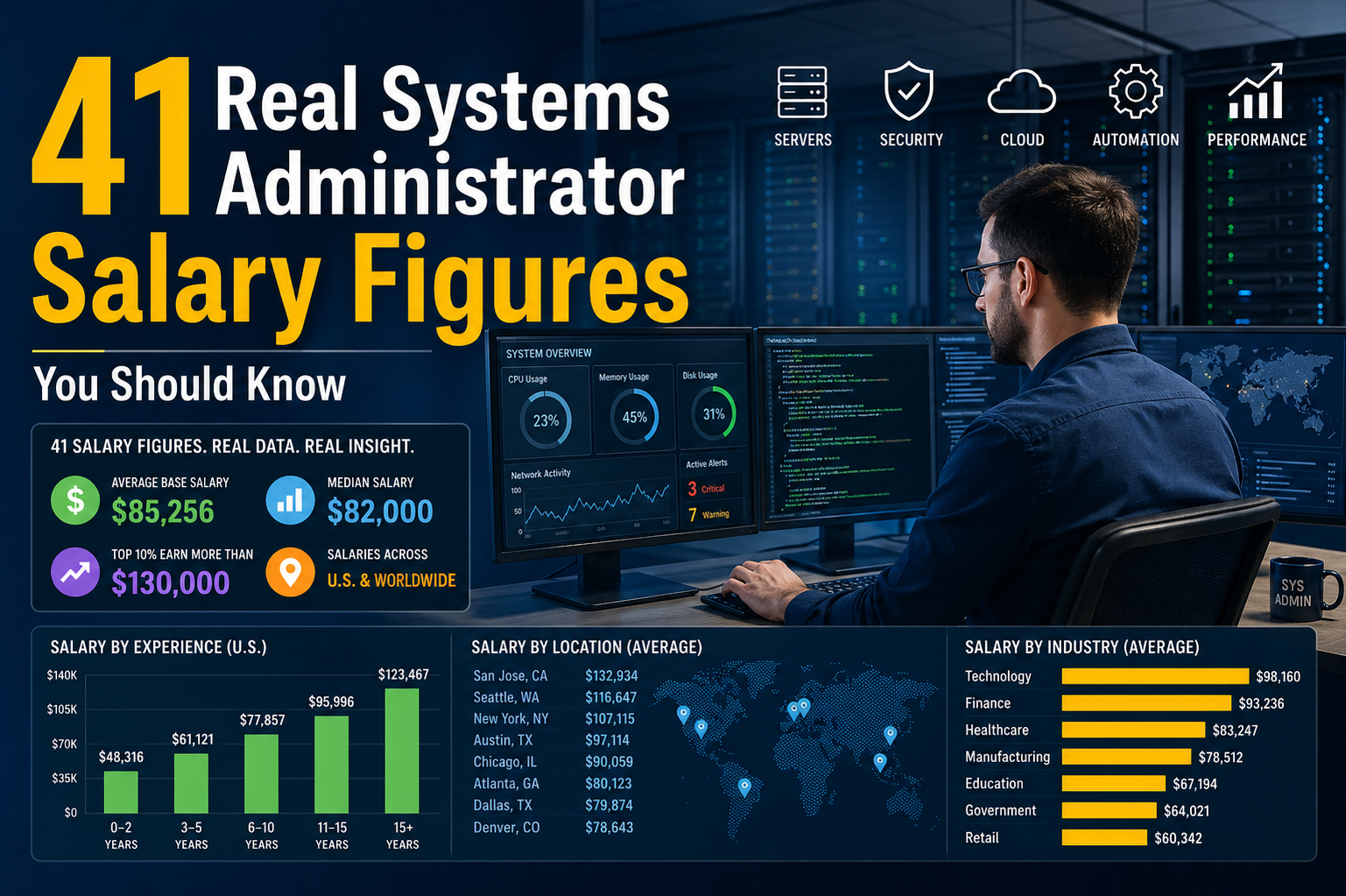
Across the United States, systems administrator salaries show noticeable variation. In general, professionals in this field earn a stable middle-to-upper income compared to many other technical roles. The national average salary is approximately $88,927, which reflects a balance between entry-level positions and more advanced roles.
At the lower end of the scale, entry-level systems administrators typically earn around $70,000 annually. These roles often involve basic maintenance tasks, user support, and limited infrastructure responsibility. While still technically demanding, they are designed to help professionals gain foundational experience.
On the higher end, experienced systems administrators can earn around $104,000 or more on average. These positions often involve advanced network management, automation scripting, security oversight, and responsibility for large-scale IT environments. In certain high-demand regions or specialized industries, salaries can exceed this range significantly.
National Salary Range Overview for Systems Administrators
The salary distribution for systems administrators is shaped by both experience and geography. In smaller cities or lower cost-of-living areas, salaries tend to start lower but still remain competitive within the local economy. In contrast, major metropolitan areas and technology hubs often offer higher compensation to attract skilled professionals.
The national low-end average sits at approximately $70,000, reflecting entry-level or less experienced professionals. The overall average is close to $88,927, which represents a mid-career systems administrator with several years of practical experience. Meanwhile, the national high-end average reaches around $104,000, representing senior-level professionals or those working in specialized environments.
These figures highlight an important pattern in the field: salary progression is strongly tied to skill development and responsibility. As systems administrators gain more experience and expand their technical capabilities, their earning potential increases substantially.
However, national averages do not fully represent the variation that exists between different cities. Location plays a major role in determining salary levels, often influenced by local demand for IT professionals, cost of living, and the concentration of technology-driven industries.
How Location Influences Systems Administrator Pay
Geography is one of the strongest factors affecting systems administrator salaries. In regions with a high concentration of technology companies, financial institutions, or government agencies, demand for skilled IT professionals tends to be higher. This increased demand often leads to higher salaries.
For example, cities on the West Coast such as Seattle and several locations in California tend to offer some of the highest compensation levels for systems administrators. In these areas, experienced professionals can earn well above the national average due to the competitive job market and high cost of living.
On the East Coast, cities like New York and Washington, D.C. also show elevated salary ranges. These regions are influenced by large corporate environments, government infrastructure, and regulated industries that require strong IT support systems.
In contrast, smaller cities or regions with lower living costs generally offer lower salary ranges. However, even in these locations, systems administrators still maintain a solid income compared to many other professions. The trade-off often comes down to lifestyle balance, job availability, and career growth opportunities rather than salary alone.
An important observation is that while entry-level salaries remain relatively consistent across different regions, high-end salaries vary significantly. This means that experienced systems administrators often see the greatest financial benefit when working in competitive or high-demand markets.
Early Insights into Salary Distribution Across Cities
When examining systems administrator salaries across multiple cities, a clear pattern emerges. Smaller metropolitan areas often show modest but stable salary ranges, while larger urban centers demonstrate wider and higher earning potential.
In many mid-sized cities, entry-level salaries commonly start in the low-to-mid $60,000 range. Average salaries typically fall between the mid $70,000s and mid $80,000s, while higher-end roles can reach into the low $100,000 range depending on expertise and demand.
In more competitive job markets, even entry-level positions may start closer to $70,000 or higher. These regions often require more specialized skills or prior experience, which naturally raises the baseline compensation level.
As experience increases, the salary gap between entry-level and senior-level positions becomes more noticeable. In some cities, this difference can exceed $30,000 to $40,000 annually, reflecting the value placed on advanced technical knowledge and leadership capabilities within IT environments.
The variation across cities highlights an important reality in systems administration careers: salary is not fixed or standardized. Instead, it is influenced by a combination of technical skill, experience level, and geographic demand.
Transition into Salary Factors and Career Growth Context
Understanding salary ranges is only one part of evaluating a systems administrator career. Equally important is recognizing the factors that influence how those salaries are determined. Experience, technical skills, certifications, and industry type all play a significant role in shaping earning potential.
While location sets a baseline expectation, individual capability often determines how far a professional can move beyond that baseline. Systems administrators who invest in continuous learning and hands-on experience tend to progress more quickly into higher-paying roles.
The next stage of understanding this career involves examining how skills, tools, certifications, and industry environments directly impact compensation levels and long-term career development.
How Experience Shapes Systems Administrator Salaries
Experience is one of the most influential factors in determining how much a systems administrator earns. While entry-level professionals can expect a solid starting salary, long-term earning potential increases significantly with hands-on exposure to real-world IT environments.
At the beginning of a career, systems administrators usually focus on basic operational tasks. These include setting up user accounts, performing routine system maintenance, assisting employees with technical issues, and supporting existing infrastructure. At this stage, the role is heavily guided by procedures and supervision. Because responsibilities are limited, salaries tend to stay closer to the lower national range.
As professionals gain experience, their responsibilities expand. Mid-level systems administrators are often trusted with more complex tasks such as managing server environments, troubleshooting network issues, implementing security updates, and working with cloud platforms. They begin to operate more independently and are expected to resolve problems without constant oversight.
This transition from basic support to independent problem-solving is where salary growth begins to accelerate. Employers place higher value on individuals who can manage critical systems without supervision, especially in environments where downtime can result in financial loss or operational disruption.
At the senior level, systems administrators take on even greater responsibility. They may oversee entire IT infrastructures, design system architectures, lead automation projects, and coordinate with cybersecurity teams. In some organizations, senior sysadmins also mentor junior staff and help define IT policies.
With this level of responsibility, compensation increases significantly. Senior professionals are often paid not only for technical skill but also for leadership, decision-making ability, and risk management. Their experience allows them to anticipate problems before they occur, which adds major value to any organization.
Experience also impacts job mobility. A highly experienced systems administrator can often move between industries more easily and negotiate higher salaries. Employers are willing to pay a premium for proven expertise, especially in environments where reliability and uptime are critical.
Education Pathways and Their Impact on Earnings
Education plays an important role in building a foundation for a systems administration career, but it is not the only route into the field. Many professionals enter IT through formal degrees, while others build their careers through certifications, self-learning, and practical experience.
A bachelor’s degree in information technology, computer science, or a related field is often preferred by employers. This type of education provides structured learning in networking, programming, systems design, and cybersecurity principles. Graduates with formal degrees may have an advantage when applying for entry-level roles, especially in larger organizations.
However, an associate degree or technical diploma can also be sufficient for starting a career. These programs typically focus on practical IT skills and provide faster entry into the workforce. Many systems administrators begin their careers with this level of education and build expertise over time through experience.
In the IT industry, practical knowledge often matters more than formal education alone. Employers place high value on candidates who can demonstrate real-world problem-solving abilities. This means that hands-on experience, internships, and lab-based learning can sometimes outweigh academic credentials.
For individuals without formal degrees, alternative learning paths are widely accepted. Self-study, online courses, and community-based training programs allow aspiring systems administrators to develop technical skills at their own pace. What matters most is the ability to apply knowledge effectively in real environments.
Education also influences long-term salary growth. While entry-level positions may not show large differences based on education alone, higher-level roles often favor candidates with stronger academic backgrounds combined with certifications and experience.
Core Technical Skills That Increase Salary Potential
Technical skills are one of the most direct ways to increase earning potential as a systems administrator. Employers consistently pay more for professionals who can handle complex systems efficiently and independently.
One of the most important foundational skills is understanding operating systems. Systems administrators must be comfortable working with Windows Server, Linux distributions, and sometimes macOS environments. Each system has its own architecture, tools, and administrative processes.
Networking knowledge is another critical area. Systems administrators must understand how data moves across networks, how devices communicate, and how to diagnose connectivity issues. Concepts such as IP addressing, DNS configuration, routing, and firewall rules are part of daily responsibilities in many roles.
Security awareness is also essential. Modern organizations face constant cybersecurity threats, so systems administrators must understand how to secure systems, apply patches, and monitor for suspicious activity. Even basic security knowledge can significantly increase a candidate’s value in the job market.
Cloud computing has become increasingly important in recent years. Many organizations now rely on platforms such as AWS, Azure, or Google Cloud for infrastructure management. Systems administrators who understand cloud environments often earn higher salaries because they can manage both traditional and modern IT systems.
Automation and scripting skills are another major salary driver. The ability to automate repetitive tasks using tools like PowerShell, Python, or Bash reduces workload and improves efficiency. Employers highly value professionals who can streamline operations and reduce manual effort.
Problem-solving ability is perhaps the most important skill of all. Systems administrators are constantly required to diagnose and resolve technical issues quickly. Those who can think logically and troubleshoot effectively are often promoted faster and compensated at higher levels.
The Role of Active Directory in Systems Administration Careers
Active Directory is one of the most widely used identity and access management systems in enterprise environments. It allows organizations to manage users, devices, and permissions in a centralized way.
For systems administrators, understanding Active Directory is considered a fundamental requirement in many workplaces. It is used to control who has access to specific resources, manage security policies, and organize network structures.
A systems administrator who is proficient in Active Directory can efficiently manage large groups of users, assign roles, and ensure that security rules are properly enforced. This reduces administrative workload and increases system reliability.
From a salary perspective, Active Directory expertise is highly valuable. Employers expect systems administrators to be comfortable working with it, and those who lack this skill may find it difficult to secure higher-paying roles.
In many job interviews, questions related to Active Directory are standard. Candidates who demonstrate strong knowledge of user management, group policies, and troubleshooting within Active Directory environments often stand out from others.
Scripting and Automation as Salary Boosting Skills
Scripting is one of the most powerful tools available to systems administrators. It allows repetitive tasks to be automated, reducing manual effort and increasing efficiency.
Common scripting languages include PowerShell, Python, and Bash. These tools are used to automate system updates, manage user accounts, deploy software, and monitor system performance.
A systems administrator who understands scripting can significantly reduce operational workload. Instead of performing the same task repeatedly, they can create scripts that execute those tasks automatically.
This ability is highly valued by employers because it directly improves productivity and reduces the chance of human error. Automation also allows IT teams to scale operations without increasing staff size.
From a salary perspective, scripting knowledge often separates entry-level administrators from mid-level professionals. Those who can write and maintain scripts are typically offered higher compensation and more advanced responsibilities.
Over time, scripting skills also open the door to more specialized roles such as DevOps engineering, cloud automation, and infrastructure development.
Network Monitoring Tools and Their Importance in IT Careers
Network monitoring tools are essential for maintaining system performance and stability. They allow systems administrators to observe network activity, identify issues, and resolve problems before they escalate.
Tools in this category help track bandwidth usage, detect unusual traffic patterns, and diagnose connectivity problems. Without these tools, administrators would have limited visibility into system performance.
One of the most important aspects of using monitoring tools is interpretation. It is not just about collecting data, but understanding what the data means and how it relates to system behavior.
Systems administrators who can effectively analyze network data are often more valuable to employers. They can quickly identify root causes of issues instead of relying on trial-and-error troubleshooting.
This skill directly impacts salary because it reduces downtime and improves system reliability. Organizations are willing to pay more for professionals who can ensure stable and secure network operations.
Search Skills and Problem-Solving in Modern IT Environments
In modern IT environments, the ability to research and find solutions quickly is a critical skill. Systems administrators frequently encounter unfamiliar issues that require fast and accurate solutions.
Search skills involve knowing how to use documentation, forums, technical articles, and knowledge bases effectively. It also involves understanding how to refine search queries to find relevant information quickly.
While it may seem simple, strong research ability can significantly improve job performance. Many technical problems have already been solved by others, and being able to find those solutions efficiently saves time and effort.
Systems administrators who excel at problem-solving and information retrieval often become more independent in their roles. This reduces reliance on external support and increases overall productivity.
Employers value this skill because it improves efficiency and reduces operational delays. As a result, professionals who are strong problem solvers often progress faster in their careers and earn higher salaries.
Certifications as a Key Driver of Salary Growth
Certifications are one of the most effective ways to increase earning potential in systems administration. They validate technical skills and demonstrate expertise in specific tools or technologies.
Many employers view certifications as proof of competency. When comparing candidates with similar experience, those with certifications often have an advantage in hiring and salary negotiations.
Certifications can cover a wide range of areas including networking, security, cloud computing, and system administration. Each certification helps build credibility and expand career opportunities.
They are especially useful for individuals who may not have formal degrees. In such cases, certifications help bridge the gap between education and practical skills.
Over time, accumulating relevant certifications can lead to higher-paying roles, promotions, and specialization opportunities within IT.
Industry Certifications That Influence Systems Administrator Salaries
Certifications are one of the strongest tools for increasing a systems administrator’s earning potential because they provide measurable proof of technical ability. In many hiring processes, certifications help employers quickly evaluate whether a candidate can handle the demands of a role without extensive onboarding.
One of the most widely recognized certification paths comes from CompTIA. These certifications are often considered entry points into the IT field. They focus on foundational knowledge such as hardware, operating systems, networking, and basic security concepts. For new systems administrators, these certifications help establish credibility and demonstrate readiness for real-world responsibilities.
As professionals progress in their careers, more advanced certifications become important. Network-focused certifications, for example, validate a deeper understanding of routing, switching, and infrastructure design. These skills are critical in environments where systems administrators are responsible for maintaining stable and secure networks.
Security certifications also play a major role in salary growth. With cyber threats becoming more common, organizations place high value on professionals who understand how to protect systems from vulnerabilities. Certifications in this area show that a systems administrator can manage risk, implement security controls, and respond to incidents effectively.
Cloud-related certifications have become increasingly important in modern IT environments. Many companies now operate partially or fully in cloud infrastructures. Systems administrators who understand cloud platforms are often better positioned for higher-paying roles because they can manage both traditional on-premises systems and modern cloud environments.
Vendor-specific certifications are also highly valuable. Companies that rely heavily on specific technologies often prefer candidates who are certified in those systems. These certifications demonstrate practical, job-ready skills that align directly with the organization’s infrastructure.
Overall, certifications do more than validate knowledge. They signal commitment, continuous learning, and professional growth. In competitive job markets, they often serve as deciding factors between candidates with similar experience levels.
Cisco Certification Value in Systems Administration Careers
Cisco certifications are widely respected in the networking and IT infrastructure world. Cisco is known for producing networking equipment used by organizations across the globe, making its certification programs highly relevant for systems administrators.
Entry-level Cisco certifications focus on foundational networking concepts. These include understanding how data moves through networks, how devices communicate, and how to troubleshoot basic connectivity issues. This knowledge is essential for any systems administrator working in a networked environment.
More advanced Cisco certifications go deeper into routing, switching, and network design. Systems administrators who achieve these certifications demonstrate the ability to manage complex enterprise networks. This skill set is particularly valuable in large organizations with extensive IT infrastructures.
Cisco-certified professionals are often seen as more technically capable because their training includes hands-on networking scenarios. This practical focus helps bridge the gap between theoretical knowledge and real-world application.
From a salary perspective, Cisco certifications can significantly increase earning potential. Employers often associate these certifications with advanced technical ability, which leads to higher trust and higher compensation offers.
These certifications also open doors to more specialized roles. Many systems administrators who earn Cisco credentials transition into network engineering or infrastructure architecture positions, which typically offer higher salaries and greater responsibility.
Microsoft Certifications and Their Impact on Salary Growth
Microsoft certifications are highly relevant for systems administrators because many organizations rely heavily on Microsoft technologies. These include Windows Server environments, Microsoft 365 platforms, and Azure cloud services.
Modern Microsoft certifications are role-based, meaning they focus on specific job functions rather than general knowledge. This makes them directly applicable to real-world responsibilities. For systems administrators, this often includes managing servers, configuring cloud resources, and maintaining enterprise productivity tools.
One major advantage of Microsoft certifications is their direct alignment with workplace systems. If a company uses Microsoft technologies extensively, certified professionals can immediately contribute without extensive training.
Azure certifications are especially valuable in today’s cloud-driven IT landscape. Systems administrators who understand cloud infrastructure can manage virtual machines, storage systems, and network configurations in scalable environments. This skill is increasingly in demand across industries.
Microsoft certifications also help systems administrators move into higher-level roles within their organizations. They can lead to promotions, expanded responsibilities, and increased trust from management.
From a salary standpoint, these certifications often result in noticeable pay increases. Employers value professionals who can reduce onboarding time and improve system efficiency through proven technical expertise.
How Industry Type Impacts Systems Administrator Salaries
The industry in which a systems administrator works has a strong influence on salary levels and career progression. Different industries have different levels of dependence on IT infrastructure, which directly affects demand for skilled professionals.
Technology-focused industries, such as software development and IT services, tend to offer some of the highest salaries. These companies rely heavily on internal systems and require highly skilled administrators to maintain uptime and performance.
Telecommunications is another industry with strong demand for systems administrators. These organizations manage large-scale communication networks that must operate continuously. As a result, they require skilled professionals who can ensure stability and manage complex systems.
Financial institutions also place high importance on systems administration. Banks, insurance companies, and investment firms rely on secure and reliable systems to handle sensitive data and financial transactions. Because of the critical nature of their operations, they often offer competitive salaries to attract experienced professionals.
Government-related roles also employ systems administrators, particularly in infrastructure, defense, and public services. These positions often require additional security clearance but can provide stable and well-compensated career paths.
Healthcare organizations depend heavily on IT systems for managing patient records, scheduling, and diagnostic systems. Systems administrators in this field are responsible for ensuring data security and system reliability, which makes their role highly important.
Each industry values different aspects of systems administration. Some prioritize security, others focus on uptime, while some emphasize scalability and performance. These differences influence salary levels and career growth opportunities.
Computer Design and Software Companies
Companies involved in computer design and software development are among the most technically advanced environments for systems administrators. These organizations build the systems that power modern computing, meaning their internal IT infrastructure is often highly complex.
In such environments, systems administrators are not only responsible for maintenance but also contribute to development and testing environments. They support engineers by ensuring that systems are stable and capable of handling large workloads.
These companies often provide structured career growth opportunities. Systems administrators can move into roles such as DevOps engineering, cloud architecture, or infrastructure management.
Because these organizations are highly competitive, salaries tend to be above average. They value technical expertise and often reward employees who demonstrate strong problem-solving and automation skills.
However, competition for these roles is also high. Candidates are expected to have strong technical backgrounds, certifications, and hands-on experience with modern systems.
Telecommunications Industry Demands
The telecommunications industry relies heavily on systems administrators to maintain large-scale communication networks. These networks support everything from mobile phone services to internet connectivity.
Systems administrators in this industry are responsible for ensuring continuous uptime. Even short disruptions can impact thousands of users, making reliability a top priority.
Because of this high-pressure environment, salaries in telecommunications are often competitive. Organizations are willing to pay more for professionals who can manage complex systems and respond quickly to technical issues.
These roles often involve shift-based work or on-call responsibilities. Systems administrators may need to address issues outside of regular working hours, especially during outages or maintenance periods.
Despite the challenges, telecommunications provides strong career stability. The demand for communication services continues to grow, ensuring ongoing need for skilled IT professionals.
Finance and Insurance Sector Opportunities
The finance and insurance industries are heavily dependent on secure and efficient IT systems. Systems administrators in this sector are responsible for protecting sensitive financial data and ensuring smooth transaction processing.
Security is one of the most important aspects of these roles. Even minor vulnerabilities can lead to significant financial risk. As a result, employers place high value on professionals with strong security knowledge and experience.
Systems administrators in finance often work with highly regulated systems. They must follow strict compliance standards and ensure that all systems meet industry regulations.
Because of the high level of responsibility, salaries in this industry are often above average. Employers are willing to pay more for professionals who can ensure reliability and security.
However, career progression may vary depending on the organization. Some companies offer structured advancement paths, while others focus more on specialization rather than hierarchy.
How Salary Growth Becomes More Competitive Over Time
As systems administrators gain experience, salary growth becomes increasingly tied to specialization and responsibility. Entry-level roles tend to have smaller salary differences, but senior-level positions show much wider variation.
Experienced professionals who develop advanced skills in automation, cloud computing, or cybersecurity often see the fastest salary growth. These skills are in high demand and directly impact organizational efficiency.
In addition, professionals who combine technical expertise with leadership abilities tend to move into higher-paying roles more quickly. Managing teams, designing systems, and making strategic IT decisions all contribute to increased compensation.
Over time, systems administrators who continuously improve their skills and adapt to new technologies are more likely to reach the upper salary ranges within the profession.
How Career Growth Shapes Long-Term Salary Potential
Career growth in systems administration is not linear, and salaries tend to rise in stages rather than gradually increasing year by year. Early in the career, growth is mostly driven by skill acquisition and exposure to real systems. As experience builds, the focus shifts toward specialization, leadership, and strategic responsibility.
At the entry level, systems administrators typically focus on routine tasks such as system monitoring, user support, and basic troubleshooting. Salaries at this stage remain relatively stable because responsibilities are limited and closely supervised. However, this stage is crucial because it builds the technical foundation required for future advancement.
As professionals transition into mid-level roles, their responsibilities expand significantly. They begin managing more complex systems, handling network configurations, and working with security protocols. At this point, salary increases become more noticeable because the role now requires independent decision-making and deeper technical expertise.
Senior-level systems administrators operate at a much higher level of responsibility. They may oversee entire IT infrastructures, design system architecture, and coordinate with cybersecurity or development teams. Salaries at this stage increase significantly because the role directly impacts business continuity and operational stability.
Career progression also depends heavily on adaptability. Technology evolves quickly, and systems administrators who keep up with new tools, platforms, and methodologies tend to progress faster. Those who resist change often find their salary growth slowing over time.
The Importance of Specialization in Increasing Salary Levels
Specialization is one of the most effective ways to increase earning potential in systems administration. While general knowledge is essential at the beginning of a career, advanced roles often require focused expertise in specific areas.
One major area of specialization is cloud computing. As more organizations migrate to cloud platforms, systems administrators who understand cloud architecture, deployment, and management are in high demand. This specialization often leads to higher-paying roles and expanded responsibilities.
Cybersecurity is another highly valuable specialization. With increasing cyber threats, companies prioritize professionals who can secure systems, detect vulnerabilities, and respond to incidents. Systems administrators with security expertise often move into well-compensated security-focused roles.
Automation and infrastructure management are also key areas of specialization. Professionals who can automate workflows and manage large-scale systems efficiently are highly valued because they reduce operational costs and improve productivity.
Database management and enterprise systems are additional specialization paths. These roles require deep technical understanding and are often associated with higher salaries due to their complexity and importance.
Specialization not only increases salary potential but also improves job stability. Professionals with niche skills are less likely to face competition and more likely to be retained during organizational changes.
Work Environment and Its Effect on Compensation
The work environment of a systems administrator can significantly influence salary levels and job satisfaction. Different environments come with different expectations, workloads, and pressures.
In smaller organizations, systems administrators often handle a wide range of tasks. They may be responsible for everything from basic troubleshooting to infrastructure management. While salaries in these environments may be lower, the variety of work provides broad experience.
In larger organizations, systems administrators tend to have more specialized roles. They may focus on specific systems or departments, such as network management, server maintenance, or security operations. These roles often come with higher salaries due to increased complexity and responsibility.
High-pressure environments, such as financial institutions or telecommunications companies, often offer higher compensation. This is because system downtime or failures can have significant consequences, requiring highly skilled professionals to maintain stability.
Remote work environments have also become more common. While remote positions may offer competitive salaries, they also require strong self-management skills and the ability to troubleshoot without direct physical access to systems.
Shift-based or on-call environments may also influence salary levels. Positions that require availability outside standard working hours often offer additional compensation due to increased responsibility and workload expectations.
The Role of Technology Trends in Salary Evolution
Technology trends have a direct impact on systems administrator salaries. As new technologies emerge, the demand for professionals who understand them increases, often leading to higher compensation.
One of the most significant trends in recent years is cloud computing. Organizations are moving away from traditional infrastructure and adopting cloud-based solutions. This shift has increased demand for systems administrators who can manage hybrid and cloud-native environments.
Another major trend is automation. Companies are increasingly relying on automated systems to reduce manual workload and improve efficiency. Systems administrators who can create and manage automation scripts are highly valued in this environment.
Cybersecurity continues to be a growing concern. As threats become more sophisticated, organizations are investing heavily in security infrastructure. Systems administrators with security expertise are seeing strong demand and higher salaries as a result.
Artificial intelligence and machine learning are also beginning to influence IT infrastructure. While still emerging in systems administration, these technologies are being integrated into monitoring, automation, and predictive maintenance systems.
Edge computing and distributed systems are additional trends shaping the future of IT. As data processing moves closer to users, systems administrators will need to manage more complex and distributed environments.
Staying updated with these trends is essential for long-term salary growth. Professionals who continuously learn and adapt are more likely to remain competitive in the job market.
Long-Term Salary Growth Strategy for Systems Administrators
Long-term salary growth in systems administration requires a combination of technical skill development, strategic career decisions, and continuous learning.
One of the most important strategies is consistent skill upgrading. Technology changes rapidly, and staying current ensures continued relevance in the job market. Learning new tools, platforms, and methodologies helps increase value to employers.
Another key strategy is gaining certifications over time. Certifications help validate expertise and demonstrate commitment to professional development. They can also open doors to higher-paying roles and specialized positions.
Experience diversification is also important. Working in different industries, environments, or system types helps build a broader skill set. This makes professionals more adaptable and increases their career mobility.
Networking and professional relationships can also influence salary growth. Many job opportunities come through referrals or industry connections rather than traditional job applications.
Finally, strategic job changes can significantly increase salary levels. Moving between companies or industries often results in higher compensation than staying in a single position for a long period.
Conclusion
Systems administration is a stable and rewarding career path with strong long-term earning potential. Salaries vary based on location, experience, education, certifications, industry, and technical specialization, but overall compensation remains competitive across the field.
Entry-level professionals can expect solid starting salaries, while experienced systems administrators can reach significantly higher income levels by developing advanced skills and taking on greater responsibilities. The gap between low-end and high-end salaries reflects the importance of expertise, adaptability, and continuous learning.
Career growth in this field depends heavily on proactive development. Professionals who invest in certifications, gain hands-on experience, and stay updated with emerging technologies consistently achieve higher salaries and better opportunities.
Ultimately, systems administration offers more than just a job—it provides a foundation for long-term IT career growth. With the right combination of skills, experience, and strategic decisions, systems administrators can build a strong and financially rewarding professional future.