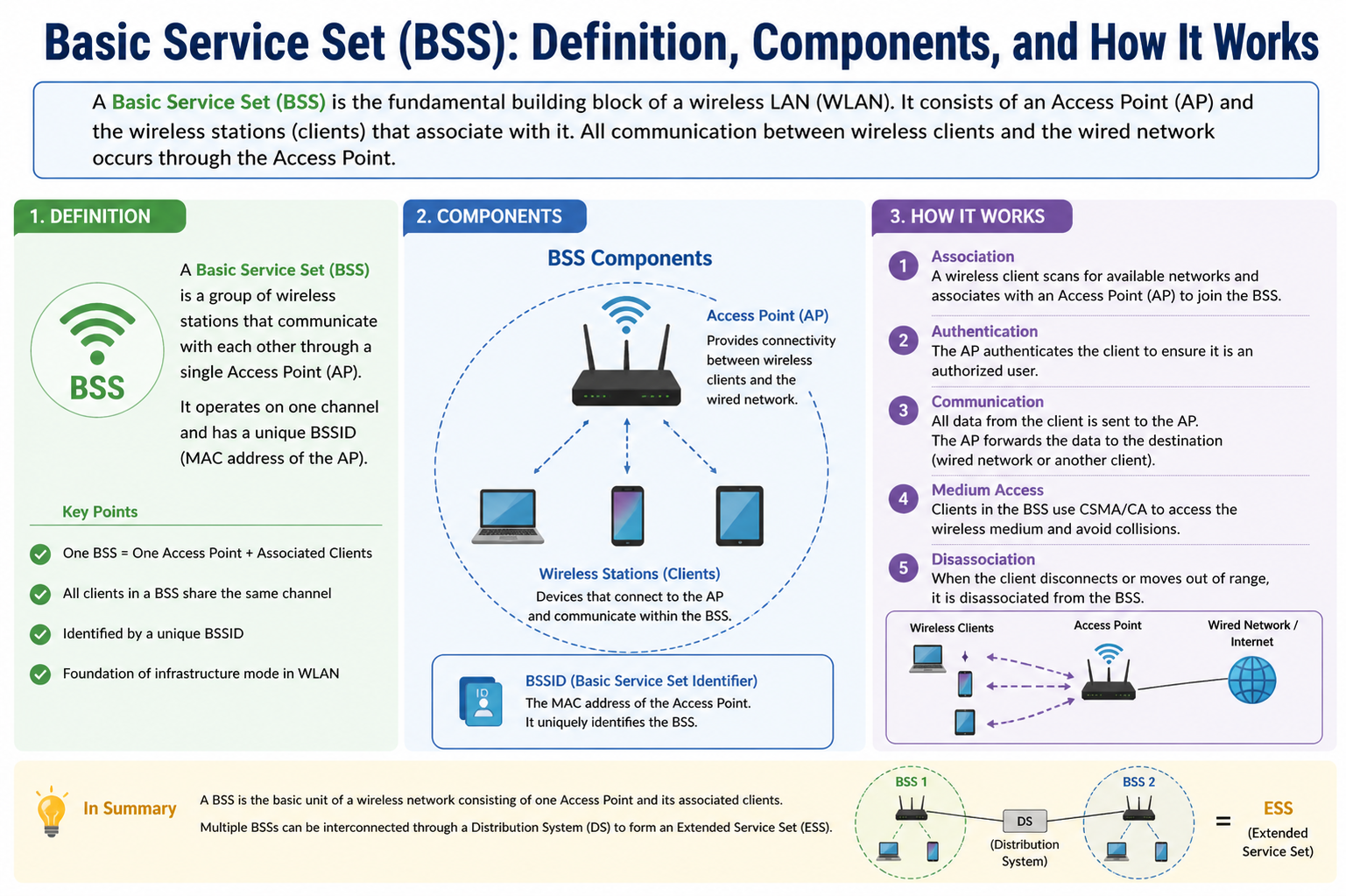
A Basic Service Set (BSS) is one of the fundamental building blocks in IEEE 802.11 wireless networking, commonly known as Wi-Fi. It represents a collection of wireless devices that communicate within a defined coverage area under a shared wireless network structure. In simple terms, a BSS is the smallest unit of a Wi-Fi network where devices such as laptops, smartphones, tablets, and other wireless clients connect and exchange data either through a central access point or directly with each other depending on the network mode. Understanding this concept is essential because it forms the foundation of how modern wireless communication systems are designed, deployed, and managed.
A BSS is not just a random group of devices; it is an organized structure defined by standards that ensure communication is efficient, controlled, and secure. Every device within a BSS follows specific rules for transmitting and receiving data so that interference is minimized and connectivity remains stable. This structure allows multiple users to share the same wireless medium without directly interfering with each other, which is crucial in environments where many devices operate simultaneously.
In wireless networking, the concept of a BSS becomes even more important when considering how large-scale Wi-Fi networks function. Whether in homes, offices, campuses, or public spaces, wireless communication relies on properly formed service sets to maintain connectivity. The BSS ensures that all connected devices are part of a single coordinated system rather than operating independently without structure.
Understanding the Role of IEEE 802.11 Standard in BSS
The Basic Service Set is defined under the IEEE 802.11 standard, which governs wireless local area networks. This standard establishes the technical rules for how devices communicate over radio frequencies, how connections are established, and how data is transmitted securely and efficiently. Within this framework, the BSS acts as the most basic operational unit of a Wi-Fi network.
The 802.11 standard was developed to ensure interoperability between different wireless devices and manufacturers. Without such a standard, devices from different brands would struggle to communicate reliably. The BSS concept ensures that regardless of the device type, all clients follow the same communication rules when connecting to a wireless network. This consistency is what makes Wi-Fi networks globally compatible and widely usable.
A key aspect of the BSS under this standard is that it defines how devices identify a network and how they maintain their association with it. Each BSS operates within a specific physical area and frequency range, allowing multiple BSS networks to exist in the same environment without causing significant interference, provided they are properly configured.
Basic Structure and Purpose of a BSS in Wireless Communication
The primary purpose of a Basic Service Set is to enable wireless devices to communicate efficiently within a limited area. It forms the foundation of all Wi-Fi communication by grouping devices under a single logical network structure. This structure allows data to flow between devices in an organized manner, preventing chaos in the shared wireless medium.
A BSS typically consists of an access point and multiple wireless client devices, although in some cases it can operate without a central access point. In infrastructure-based setups, the access point acts as the central controller, managing all communication between devices. In simpler or temporary setups, devices may communicate directly with each other without centralized coordination.
The purpose of organizing devices into a BSS is to improve network performance, reduce signal conflicts, and ensure fair access to the wireless medium. Since wireless communication relies on shared airwaves, there must be a system in place to prevent devices from transmitting at the same time in a way that causes data collisions. The BSS manages this coordination automatically.
In real-world environments, such as offices or public spaces, multiple BSS networks may exist side by side. Each one operates independently but follows the same underlying principles defined by the wireless standard. This allows for scalable network design where coverage can be expanded simply by adding more service sets.
Basic Service Set Identifier and Network Identification Concept
Every Basic Service Set is identified by a unique identifier known as the Basic Service Set Identifier. This identifier functions similarly to a digital fingerprint for the wireless network. It ensures that each BSS can be distinguished from others operating in the same physical area.
The identifier is derived from the hardware address of the access point in most infrastructure-based networks. This ensures that even if multiple networks share the same visible name, they can still be uniquely identified at the technical level. This distinction is important for network management, troubleshooting, and security analysis.
Devices use this identifier internally to maintain stable connections. When a device connects to a wireless network, it does not only rely on the visible network name but also associates itself with the unique identifier of the BSS. This prevents confusion when multiple networks have similar or identical names.
In environments with dense wireless traffic, such as offices or urban areas, many BSS networks may overlap. The unique identification system ensures that each network remains logically separate even when physical signal areas overlap. This separation is essential for maintaining reliable communication and avoiding connection errors.
Role of Wireless Clients in a Basic Service Set
Wireless clients are the end devices that connect to and operate within a Basic Service Set. These include everyday devices such as smartphones, laptops, tablets, printers, and IoT devices. In networking terminology, these devices are often referred to as stations.
The role of these clients is central to the purpose of the BSS because the entire network exists to facilitate communication for them. Without client devices, the BSS would serve no functional purpose. Each client communicates with the network to send and receive data, access the internet, or interact with other connected devices.
Clients in a BSS must follow specific rules when communicating over the wireless medium. Since multiple devices share the same frequency space, coordination is necessary to prevent data collisions. The BSS manages this by controlling when and how each device transmits data.
Different client devices may have different capabilities in terms of speed, signal strength, and power consumption. The BSS must accommodate all of these variations while maintaining overall network efficiency. This is why network design often considers the lowest-performing device when planning coverage and capacity.
Central Role of Access Point in Infrastructure-Based BSS
In most modern wireless networks, the access point plays a central role in the Basic Service Set. It acts as the main coordination device that manages communication between all connected clients. The access point also serves as a bridge between the wireless network and any external wired network.
When functioning as part of a BSS, the access point controls how data is transmitted, ensures that devices remain synchronized, and manages network access. It also broadcasts network information so that nearby devices can discover and join the network.
The access point helps maintain order within the wireless environment by regulating transmission timing and reducing interference. Without this central coordination, devices would attempt to communicate independently, leading to congestion and poor performance.
In addition to managing traffic, the access point also plays a key role in security. It verifies device identities and enforces encryption protocols to ensure that only authorized users can access the network. This makes it a critical component in maintaining both functionality and protection within a BSS.
Foundational Importance of BSS in Wireless Networking
The Basic Service Set is not just a technical concept but a foundational element that supports all Wi-Fi communication. Every wireless network, whether simple or complex, is built upon this structure. It defines how devices organize themselves, how they communicate, and how they maintain stable connections in a shared environment.
Without the BSS model, wireless networking would lack structure and consistency. Devices would struggle to coordinate communication, leading to interference and unreliable connections. The BSS provides the framework that makes modern wireless communication possible in homes, businesses, and public infrastructure.
Understanding this concept is essential for anyone studying wireless networking because it forms the basis for more advanced topics such as extended networks, roaming, and large-scale wireless deployments.
What is a Basic Service Set (BSS)? Advanced Structure and Functional Behavior
Building on the foundational understanding of a Basic Service Set, it becomes important to explore how this structure behaves in real wireless environments and how its internal components interact to maintain continuous communication. A BSS is not a static arrangement of devices; it is a dynamic system that constantly adapts to signal conditions, device movement, traffic load, and environmental interference. This adaptability is what makes Wi-Fi networks reliable in both small and large deployments.
At its core, the BSS operates through coordinated communication rules defined by the IEEE 802.11 standard. These rules ensure that every device connected to the network follows a structured method of transmitting and receiving data. Without such coordination, wireless communication would quickly become chaotic due to overlapping signals and simultaneous transmissions. The BSS prevents this by managing access to the shared wireless medium in an organized manner.
In practical scenarios, a BSS continuously monitors the state of connected devices and adjusts its behavior to maintain stability. When new devices join, the system integrates them into the existing communication structure. When devices leave or move out of range, the system reorganizes itself to ensure that remaining devices continue to operate efficiently. This constant adjustment is a key reason why Wi-Fi networks feel seamless to users despite underlying complexity.
How Communication Flow Works Inside a Basic Service Set
Communication within a Basic Service Set follows a structured process that ensures data is transmitted without conflict. When a device wants to send information, it must first gain permission to access the wireless medium. This controlled access mechanism is essential because all devices share the same radio frequency space.
Inside the BSS, devices do not transmit data randomly. Instead, they follow a coordinated system that determines when each device can send data packets. This prevents multiple devices from transmitting at the same time, which would otherwise result in signal collisions and data loss. The system ensures fairness so that no single device dominates the communication channel.
When a device successfully transmits data, the access point receives it and either processes it locally or forwards it to another device or external network. This flow of communication is continuous and happens within milliseconds, making it appear instantaneous to users. The efficiency of this process is one of the key strengths of a properly configured BSS.
In addition to device-to-access-point communication, the BSS also supports control messages that help maintain network stability. These include synchronization signals, acknowledgment messages, and management frames that ensure all devices remain connected and updated about network conditions.
Infrastructure Mode vs Ad-Hoc Mode in BSS Operation
A Basic Service Set can operate in two primary modes, each serving different networking needs. The most common mode is infrastructure mode, where all communication is managed through a central access point. In this setup, devices do not communicate directly with each other; instead, all data passes through the access point, which acts as a central hub.
Infrastructure mode is widely used in homes, offices, and public Wi-Fi networks because it provides better control, security, and scalability. It allows network administrators to manage traffic efficiently and implement security policies that protect all connected devices. This mode also supports seamless internet connectivity by linking the wireless network to a wired backbone.
The second mode is ad-hoc mode, also known as Independent Basic Service Set. In this configuration, devices communicate directly with each other without the need for a central access point. Each device acts as both a client and a transmitter, forming a peer-to-peer network.
Ad-hoc mode is typically used in temporary or small-scale scenarios where setting up an access point is not practical. For example, it can be used for quick file sharing between devices or temporary networking in remote locations. However, this mode has limitations in terms of range, scalability, and security compared to infrastructure mode.
Signal Coordination and Medium Access Control in BSS
One of the most important functions within a Basic Service Set is medium access control, which governs how devices share the wireless channel. Since wireless communication uses shared frequencies, there must be a system that ensures devices do not interfere with each other while transmitting data.
The BSS uses a method where devices listen before transmitting. This means a device first checks whether the channel is free before sending data. If the channel is busy, the device waits for a random period before trying again. This reduces the chances of multiple devices transmitting simultaneously.
This coordination is essential in environments with many connected devices. Without it, the wireless medium would become congested, leading to slow performance and frequent data loss. The BSS ensures that communication remains smooth even when multiple users are active at the same time.
Another important aspect of medium control is acknowledgment. When a device sends data, it waits for confirmation that the data has been received successfully. If no acknowledgment is received, the device retransmits the data. This ensures reliability even in environments with interference.
Understanding Network Association and Authentication Process
Before a device becomes part of a Basic Service Set, it must go through a process of association and authentication. This process ensures that only authorized devices are allowed to join the network and communicate with other devices.
Authentication is the first step, where the device proves its identity to the network. This may involve passwords, encryption keys, or other security mechanisms depending on the network configuration. Once authentication is successful, the device moves to the association stage.
During association, the device is officially registered as part of the BSS. The access point assigns resources and allows the device to begin communication. From this point onward, the device becomes an active participant in the network.
This process is crucial for maintaining network security and stability. It prevents unauthorized access and ensures that only trusted devices can consume network resources. It also allows the network to keep track of all connected devices, which is important for performance management.
Dynamic Behavior of Devices Within a BSS Environment
A Basic Service Set is highly dynamic, meaning devices can join, leave, or move within the network at any time. This flexibility is essential for modern wireless communication, where mobility is a key requirement.
As devices move within the coverage area, the signal strength may change. The BSS continuously monitors these changes and adjusts communication parameters accordingly. This ensures that devices maintain a stable connection even when moving between different locations within the coverage area.
When a device moves too far from the access point, the connection may weaken or drop. In larger networks, this issue is addressed by multiple interconnected BSS structures that allow seamless transition between coverage areas. This behavior supports mobility and ensures uninterrupted connectivity.
The dynamic nature of the BSS also allows it to adapt to changes in network load. When many devices connect simultaneously, the system distributes resources to maintain performance. When devices disconnect, resources are freed up for other users.
Role of Radio Frequencies and Channel Usage in BSS
The operation of a Basic Service Set depends heavily on radio frequency channels. These channels determine how data is transmitted over the air and help separate different networks operating in the same environment.
Each BSS operates on a specific channel to reduce interference with nearby networks. If multiple BSS networks use the same channel in close proximity, signal overlap can occur, leading to performance degradation. Proper channel selection is therefore critical for network efficiency.
Devices within a BSS automatically tune to the correct channel when connecting to the network. This ensures that communication remains synchronized and stable. In environments with high wireless density, careful channel planning is required to avoid congestion.
The use of different channels also allows multiple BSS networks to coexist in the same physical space. This is especially important in urban environments, offices, and public venues where many networks operate simultaneously.
Importance of Timing and Synchronization in BSS Operation
Timing plays a critical role in the operation of a Basic Service Set. All devices within the network must remain synchronized to ensure proper communication. This synchronization is achieved through periodic signals sent by the access point.
These signals help devices stay aligned with the network’s timing structure, ensuring that data transmission occurs in an organized manner. Without synchronization, devices could transmit data at conflicting times, leading to communication failures.
Synchronization also helps devices conserve power. By following a coordinated timing schedule, devices can enter low-power states when not actively transmitting or receiving data. This is especially important for mobile devices such as smartphones and tablets.
Overall, timing coordination ensures that the entire BSS operates as a unified system rather than a collection of independent devices.
What is a Basic Service Set (BSS)? Network Behavior, Scalability, and Real-World Deployment
A Basic Service Set continues to play a central role as wireless networks scale from small home setups to large enterprise environments. While earlier explanations focus on structure and communication flow, it is equally important to understand how a BSS behaves when it is deployed in real-world, high-density environments where multiple users, devices, and interference sources exist simultaneously. In such conditions, the BSS is not just a theoretical model but an active system that constantly adapts to ensure stable connectivity.
In practical deployment scenarios, a BSS must handle varying traffic loads throughout the day. For example, in an office environment, the number of active devices may increase significantly during working hours and decrease after office time. The system must adjust dynamically to these changes without disrupting connectivity. This adaptability is achieved through intelligent coordination between the access point and connected devices.
The performance of a BSS is heavily influenced by environmental conditions such as physical obstructions, electromagnetic interference, and distance between devices and the access point. Walls, furniture, and even human movement can affect signal quality. As a result, the BSS continuously manages signal strength and data transmission efficiency to maintain reliable communication despite these challenges.
Scalability of Basic Service Set in Wireless Networks
Scalability refers to the ability of a network to handle growth in the number of connected devices without significant degradation in performance. A single Basic Service Set has a natural limit in terms of how many devices it can support effectively. This limitation is primarily due to shared medium usage, where all devices compete for the same wireless channel.
As more devices join a BSS, network congestion can increase, leading to slower data rates and higher latency. To address this limitation, network designers often deploy multiple BSS units in the same environment. Each unit operates independently but contributes to a larger network structure. This allows the overall system to support a much higher number of devices.
In enterprise environments, scalability is achieved by carefully planning access point placement and channel distribution. Each BSS is designed to cover a specific area, ensuring that no single network becomes overloaded. This distributed approach helps maintain consistent performance even in high-density areas such as universities, airports, and large office buildings.
Scalability is also supported through intelligent load management. Some access points can monitor device distribution and adjust their behavior to balance traffic more evenly across multiple BSS zones. This ensures that no single point in the network becomes a bottleneck.
Interference Management and Signal Optimization in BSS
Wireless communication within a Basic Service Set is highly sensitive to interference. Since all devices share the same frequency space, external signals from other networks, electronic devices, or physical obstacles can impact performance. Effective interference management is therefore essential for maintaining network quality.
One of the primary methods of reducing interference is channel separation. Each BSS operates on a specific channel to minimize overlap with nearby networks. In environments where multiple networks exist, careful channel planning ensures that adjacent BSS units do not interfere with each other.
Signal optimization also involves adjusting transmission power. Access points can increase or decrease their signal strength depending on coverage requirements. Higher power levels extend coverage but may increase interference with neighboring networks, while lower power levels reduce interference but limit range.
Another important factor in interference management is adaptive rate control. Devices within a BSS automatically adjust their data transmission speed based on signal quality. When interference is low, higher data rates are used for faster communication. When interference increases, lower data rates are selected to maintain stability.
These mechanisms work together to ensure that the BSS remains functional even in challenging environments with multiple overlapping signals and competing wireless networks.
Mobility and Roaming Behavior within Basic Service Sets
Modern wireless environments require support for mobility, allowing users to move freely without losing connectivity. Within a single Basic Service Set, devices can move within the coverage area while maintaining their connection to the access point. However, when devices move beyond the range of one BSS, more complex mechanisms are required.
In extended networks, multiple BSS units are connected to form a larger system. This allows devices to move between different coverage areas without manually reconnecting. This process is known as roaming. While roaming typically involves multiple BSS units, the behavior begins at the individual BSS level, where signal strength and connection quality are continuously monitored.
When a device moves closer to the edge of a BSS coverage area, the signal begins to weaken. The system evaluates whether the device should remain connected or transition to another nearby access point. This decision is based on signal quality, network load, and availability of alternative connections.
This mobility support is essential for environments such as campuses, warehouses, and large public venues where users are constantly moving. Without proper BSS coordination, users would experience frequent disconnections and inconsistent performance.
Data Management and Traffic Prioritization in BSS
Within a Basic Service Set, not all data is treated equally. Different types of network traffic may have different levels of priority depending on their importance and sensitivity to delay. For example, video calls and voice communication require low latency, while file downloads can tolerate higher delays.
The BSS manages this by organizing traffic into priority levels. Time-sensitive data is transmitted first, while less critical data is queued for later transmission. This ensures that real-time applications function smoothly even when the network is heavily loaded.
Traffic prioritization is especially important in enterprise environments where multiple applications operate simultaneously. Without prioritization, important services could be delayed by less critical network activity, leading to poor user experience.
In addition to prioritization, the BSS also manages bandwidth allocation. Each device is assigned a fair share of available network resources to ensure balanced performance. This prevents any single device from consuming excessive bandwidth and degrading overall network quality.
Energy Efficiency and Power Management in BSS Devices
Energy efficiency is another important aspect of Basic Service Set operation, especially for mobile and battery-powered devices. Since wireless communication can consume significant power, the BSS includes mechanisms to reduce energy usage without affecting connectivity.
Devices within a BSS can enter low-power states when not actively transmitting or receiving data. The access point coordinates these states by sending periodic signals that allow devices to wake up at scheduled intervals. This reduces unnecessary energy consumption while maintaining network connectivity.
Power management is particularly important for devices such as smartphones, tablets, and IoT sensors. These devices often rely on battery power and must balance performance with energy efficiency.
The BSS also supports adaptive power control, where devices adjust their transmission power based on distance from the access point. Devices closer to the access point can use lower power levels, while those farther away may require higher power to maintain a stable connection.
Fault Tolerance and Network Stability in BSS Environments
A well-designed Basic Service Set includes mechanisms to handle faults and maintain stability even when certain components fail or experience issues. For example, if a device disconnects unexpectedly, the network quickly adjusts without disrupting other connected devices.
The access point plays a key role in maintaining stability by continuously monitoring device status and network conditions. If interference increases or performance drops, the system can adjust settings such as channel selection or transmission power to restore optimal operation.
In more advanced deployments, redundancy may be used where multiple access points support overlapping coverage areas. This ensures that if one BSS becomes unavailable, another can take over without affecting user connectivity.
Fault tolerance is essential for environments where continuous connectivity is critical, such as hospitals, financial institutions, and industrial systems. The ability of a BSS to maintain stability under changing conditions is one of its most important strengths.
What is a Basic Service Set (BSS)? Extended Service Sets, IBSS, Security, and Final Practical Understanding
As wireless networking expands beyond small areas, the Basic Service Set becomes part of larger and more complex architectures that allow seamless connectivity across wide environments. While a single BSS is responsible for managing communication within a limited coverage area, real-world networks often combine multiple BSS units to create broader and more flexible wireless systems. This final part explains how BSS integrates into larger structures, how peer-to-peer communication works, and how security and management complete the overall wireless framework.
A key concept related to BSS is that it does not exist in isolation in modern networking environments. Instead, it serves as a foundational element that can be extended, duplicated, or interconnected depending on the size and requirements of the network. This scalability allows organizations to build wireless infrastructures that support thousands of users while still maintaining structured communication rules.
Extended Service Set (ESS) and Multi-BSS Network Design
When multiple Basic Service Sets are connected together under a unified system, they form what is known as an Extended Service Set. This structure is widely used in large environments where a single access point is not sufficient to provide complete coverage. Instead, multiple access points are deployed, each creating its own BSS, and all are linked to form one larger network.
The main advantage of an Extended Service Set is seamless roaming. Users can move across different coverage areas without losing their connection or needing to reconnect manually. Although each access point maintains its own BSS, they all share a common network identity, allowing devices to transition smoothly between them.
In such a system, the user experience feels like a single continuous network, even though multiple BSS units are operating behind the scenes. This design is essential in environments like universities, airports, shopping malls, and large corporate offices where users frequently move between different physical locations.
The ESS concept demonstrates how the Basic Service Set acts as a building block for larger wireless infrastructures. Without the BSS, it would not be possible to scale wireless networks in such an organized and efficient manner.
Independent Basic Service Set (IBSS) and Peer-to-Peer Communication
While most modern networks rely on infrastructure mode, the Basic Service Set can also operate in a completely different configuration known as an Independent Basic Service Set. In this mode, devices communicate directly with each other without the need for an access point.
This peer-to-peer structure allows devices to form temporary networks quickly. For example, two laptops can share files directly, or a group of devices can connect in a meeting room without requiring external network infrastructure. Each device in this setup acts both as a transmitter and a receiver, handling communication responsibilities equally.
However, IBSS networks have limitations compared to infrastructure-based BSS setups. They typically support fewer devices, offer lower management control, and lack advanced security features. As a result, they are mainly used for temporary or emergency networking scenarios rather than permanent installations.
Despite these limitations, IBSS demonstrates the flexibility of the Basic Service Set concept. It shows that wireless communication can be structured in multiple ways depending on user needs and available resources.
Security Mechanisms in Basic Service Set Networks
Security is a critical aspect of any wireless network, and the Basic Service Set includes several mechanisms to protect communication and prevent unauthorized access. Since wireless signals travel through open air, they are inherently more vulnerable than wired connections, making strong security measures essential.
One of the primary security functions within a BSS is authentication. Before a device is allowed to join the network, it must prove its identity using credentials such as passwords, encryption keys, or digital certificates. This ensures that only trusted devices can access network resources.
Encryption is another key component of BSS security. Data transmitted between devices and the access point is encoded so that even if it is intercepted, it cannot be easily read or understood. Modern wireless networks use advanced encryption standards that provide strong protection against unauthorized access.
The access point plays a central role in enforcing these security measures. It verifies devices, manages encryption keys, and ensures that communication remains protected throughout the session. Without these mechanisms, wireless networks would be highly vulnerable to attacks and data breaches.
Security in BSS environments is not static; it requires continuous updates and monitoring. As new threats emerge, security protocols are updated to ensure ongoing protection. This makes the BSS not only a communication structure but also a secure environment for data exchange.
Network Management and Monitoring in BSS Systems
Effective management is essential for maintaining performance and reliability in a Basic Service Set. Network administrators use monitoring tools to observe traffic patterns, detect issues, and optimize performance. These tools provide insights into how devices are connected, how much data is being transmitted, and where potential bottlenecks may occur.
One of the key aspects of network management is identifying congestion points. If too many devices are connected to a single access point, performance may degrade. In such cases, administrators may adjust configurations, redistribute devices, or deploy additional access points to balance the load.
Monitoring also helps in detecting interference and connection issues. By analyzing signal strength and error rates, administrators can identify areas where network performance is weak and take corrective action.
Another important aspect of management is firmware updates. Access points and connected devices require regular updates to improve performance, fix bugs, and enhance security. Proper maintenance ensures that the BSS continues to operate efficiently over time.
Practical Importance of BSS in Everyday Life
The Basic Service Set is present in nearly every modern wireless environment, even though users rarely notice it directly. Every time a device connects to Wi-Fi at home, work, or a public location, it becomes part of a BSS.
In homes, a single access point typically creates one BSS that connects all household devices such as phones, laptops, and smart appliances. In offices, multiple BSS units may exist to support different departments or floors, ensuring smooth connectivity across the entire building.
Public spaces such as cafes, airports, and shopping centers rely heavily on BSS structures to provide internet access to large numbers of users simultaneously. Without this organized system, managing wireless communication in such environments would be extremely difficult.
The BSS also plays a critical role in emerging technologies such as smart homes, IoT devices, and industrial automation systems. These technologies rely on stable and efficient wireless communication, which is made possible through well-designed service sets.
Final Conclusion
The Basic Service Set is the fundamental building block of wireless networking. It defines how devices connect, communicate, and maintain coordination within a shared wireless environment. From small home networks to large enterprise systems, the BSS ensures that communication remains structured, efficient, and reliable.
It supports both simple and complex networking models, adapts to changing conditions, and forms the basis for larger systems like extended service sets. It also enables peer-to-peer communication in special cases and incorporates essential security and management functions.
Understanding the BSS provides a clear foundation for learning more advanced wireless networking concepts. It is not just a technical definition but a practical framework that powers everyday wireless communication across the world.