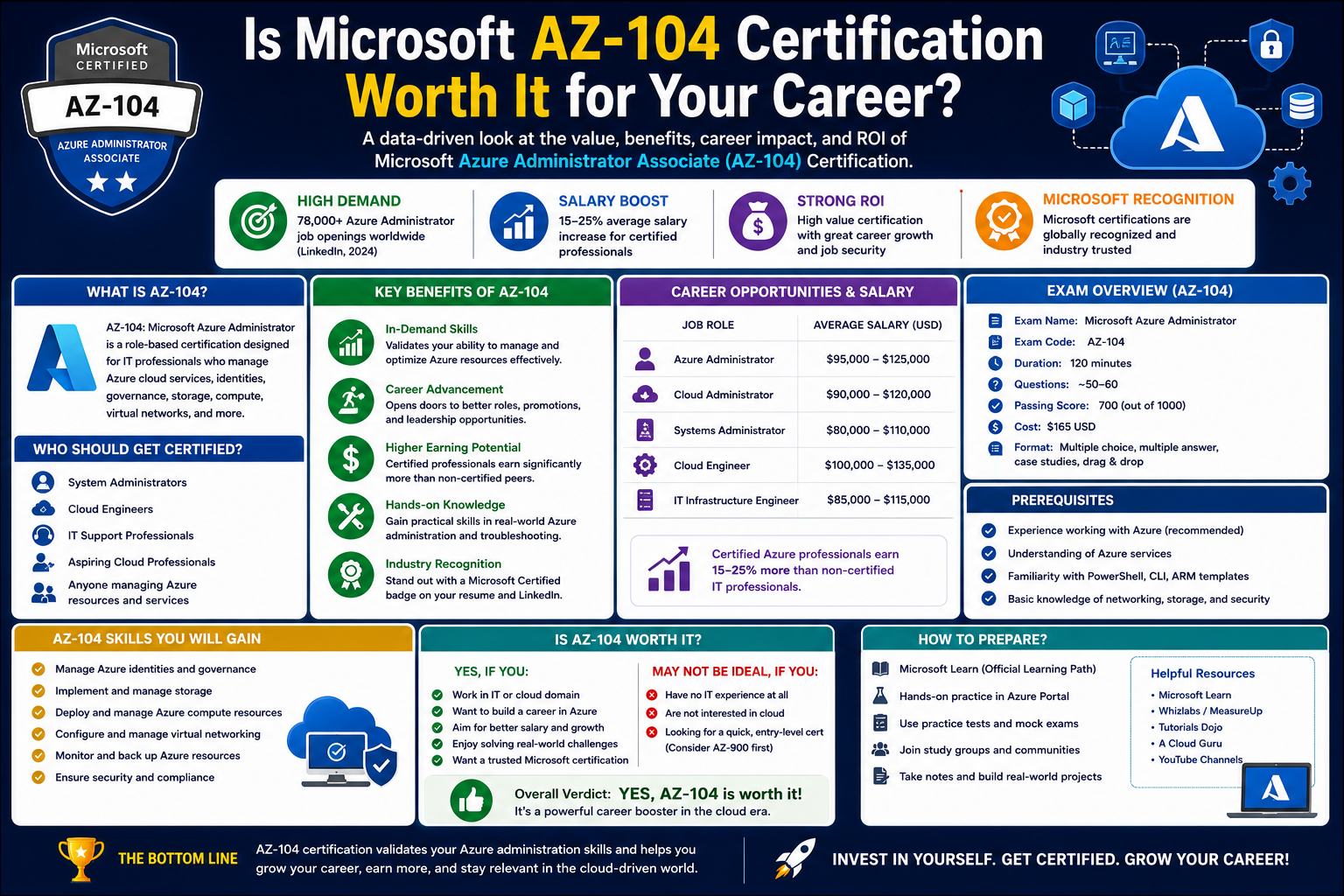
The AZ-104 certification is widely recognized as an important step for IT professionals who want to build a strong foundation in cloud administration, especially within Microsoft Azure environments. As more organizations shift their infrastructure toward cloud computing, the demand for skilled Azure administrators continues to grow. This certification is designed to validate whether an individual has the practical knowledge required to manage cloud services effectively. It is not just a theoretical qualification but a reflection of real-world administrative ability. Many professionals view it as a gateway into cloud-based careers because it demonstrates readiness to handle essential Azure tasks. For those aiming to establish themselves in IT infrastructure roles, this certification often becomes a strategic career investment rather than just an academic achievement.
Role of Azure Administrators in Modern Organizations
Azure administrators play a critical role in ensuring that cloud environments remain stable, secure, and efficient. Their responsibilities extend across multiple technical areas, including user management, resource allocation, system configuration, and performance monitoring. In modern organizations, Azure is often the backbone of digital operations, supporting everything from data storage to application hosting. Administrators are expected to maintain continuous availability of services while also ensuring compliance with security policies. This makes their role both operational and strategic. They often collaborate with developers, network engineers, and security teams to ensure that cloud systems are aligned with business goals. Because of this wide scope of responsibility, companies highly value professionals who have verified skills in managing Azure environments effectively.
What the AZ-104 Exam Actually Measures
The AZ-104 exam is structured to evaluate whether a candidate can perform the essential duties of an Azure administrator in real-world scenarios. It focuses on practical knowledge rather than memorization, ensuring that certified individuals are capable of handling live cloud environments. The exam assesses skills such as configuring virtual machines, managing storage solutions, implementing security controls, and monitoring system performance. It also examines how well a candidate understands identity management and governance within Azure. The goal is to ensure that those who pass are not just familiar with concepts but can actively apply them in operational settings. This makes the certification highly relevant for employers who need assurance that candidates can contribute immediately to their cloud infrastructure teams.
Breaking Down Azure Administrator Responsibilities
An Azure administrator is responsible for a wide range of technical operations that support cloud infrastructure. These responsibilities include managing user identities, configuring virtual networks, deploying computing resources, and maintaining storage systems. In addition, they are expected to monitor system health and ensure that cloud environments are optimized for performance and cost efficiency. Another key aspect of the role involves implementing backup and recovery strategies to protect critical business data. Administrators must also troubleshoot issues that arise within cloud systems and ensure minimal downtime. Because Azure environments are highly dynamic, administrators need to adapt quickly to changing requirements. This combination of responsibilities makes the role both challenging and essential for organizations relying on cloud-based solutions.
Core Domains Covered in the AZ-104 Exam
The AZ-104 certification covers several major domains that reflect the real responsibilities of an Azure administrator. These include managing identities and governance, implementing storage solutions, deploying and managing compute resources, configuring virtual networks, and monitoring Azure environments. Each of these areas plays a crucial role in maintaining a fully functional cloud system. Identity management ensures that users have appropriate access levels, while storage implementation focuses on data organization and security. Compute resources deal with virtual machines and applications, whereas networking ensures connectivity between services. Monitoring and backup functions help maintain system reliability and data protection. Together, these domains form a comprehensive skill set that prepares candidates for real-world Azure administration tasks.
Exam Cost and Financial Considerations
Pursuing the AZ-104 certification involves financial planning, as candidates must consider both the exam fee and any additional preparation resources. While the exam itself has a fixed cost, many individuals also invest in training materials, practice tests, and study guides to improve their chances of success. These additional resources can significantly enhance understanding of complex Azure concepts. However, the overall investment is often justified by the career opportunities that the certification can unlock. Many professionals view the cost as a long-term investment in their career growth rather than a short-term expense. Employers often value certified candidates more highly, which can lead to better job prospects and increased earning potential in the IT industry.
Importance of Hands-On Azure Experience
Practical experience is one of the most important factors in successfully passing the AZ-104 exam. While theoretical knowledge provides a foundation, hands-on exposure to Azure services helps candidates understand how systems behave in real environments. Working directly with virtual machines, storage accounts, and networking configurations allows learners to develop problem-solving skills that are essential for the exam. This experience also helps individuals become familiar with the Azure portal and command-line tools used in administration tasks. Without practical exposure, it can be difficult to fully grasp the complexity of cloud operations. Therefore, most successful candidates spend significant time practicing in live or simulated Azure environments before attempting the certification.
Recommended Skills Before Attempting the Exam
Before attempting the AZ-104 certification, it is important for candidates to develop a strong understanding of core IT and cloud concepts. Familiarity with operating systems, networking fundamentals, and basic security principles provides a solid foundation for learning Azure administration. Additionally, candidates should be comfortable working with command-line interfaces and automation tools, as these are commonly used in cloud environments. Understanding how virtual networks operate and how cloud resources are deployed is also essential. While there are no strict prerequisites, having practical exposure to Azure services significantly increases the likelihood of success. Many professionals recommend gaining at least several months of hands-on experience before sitting for the exam to ensure readiness.
Who Should Consider the AZ-104 Certification
The AZ-104 certification is suitable for a wide range of IT professionals who are interested in cloud computing and infrastructure management. Systems administrators, network engineers, and support technicians can all benefit from pursuing this certification. It is particularly valuable for individuals who are transitioning from traditional IT environments to cloud-based systems. Even those who are early in their careers can use this certification to demonstrate technical competence and commitment to professional growth. For individuals aiming to work in organizations that rely heavily on Azure services, this certification can serve as an important stepping stone toward more advanced roles in cloud architecture and administration.
Benefits for Systems Administrators
For systems administrators, the AZ-104 certification provides a direct pathway into cloud-based infrastructure management. Many of the skills required in traditional system administration are transferable to Azure environments, making the transition smoother. The certification helps administrators understand how cloud services differ from on-premises systems, particularly in terms of scalability, automation, and resource management. It also introduces them to modern tools used for monitoring and maintaining cloud infrastructure. By earning this certification, systems administrators can expand their expertise and increase their value within organizations that are adopting cloud technologies. It can also open opportunities for career advancement into more specialized cloud roles.
Benefits for Network Professionals
Network professionals can also gain significant advantages from pursuing the AZ-104 certification. While traditional networking focuses on physical infrastructure, Azure introduces virtual networking concepts that are essential in cloud environments. This certification helps network professionals understand how virtual networks are configured, secured, and managed within Azure. It also provides insights into integrating cloud networks with on-premises systems. As organizations increasingly adopt hybrid cloud models, this knowledge becomes highly valuable. Network professionals who earn the AZ-104 certification can position themselves as experts in both traditional and cloud networking, increasing their career flexibility and opportunities in the IT industry.
Value for Help Desk and Support Roles
For individuals working in help desk or technical support roles, the AZ-104 certification offers a clear pathway to career advancement. These professionals often interact with cloud-related issues on a daily basis, even if they are not directly responsible for system administration. By gaining AZ-104 certification, they can develop a deeper understanding of how Azure environments operate, which improves their troubleshooting capabilities. This knowledge allows them to move beyond basic support tasks and take on more advanced responsibilities. It also demonstrates initiative and technical growth, which can lead to promotions or transitions into system administration roles. In this way, the certification serves as a bridge between entry-level support and advanced IT careers.
Final Conclusion
The AZ-104 certification holds strong value for anyone looking to build or advance a career in cloud computing, especially within Microsoft Azure environments. It is not just another technical exam but a structured way to validate real-world skills required for managing modern cloud infrastructure. From handling identities and storage to managing virtual networks and compute resources, the certification covers the core responsibilities that define an Azure administrator’s role in today’s IT landscape. This makes it highly relevant in an industry where cloud adoption continues to expand rapidly.
For beginners in IT, the AZ-104 provides a clear learning path into cloud administration and helps build confidence in working with enterprise-level systems. For experienced professionals, it serves as a powerful validation of existing skills and can significantly improve career prospects. It can also act as a stepping stone toward more advanced Azure certifications and specialized cloud roles. Employers often see it as proof that a candidate is capable of handling real operational responsibilities in Azure environments.
The real value of AZ-104 lies in its balance between practical knowledge and industry recognition. While it requires time, effort, and hands-on practice, the return on investment is often reflected in better job opportunities, career growth, and stronger technical expertise. In a job market where cloud skills are increasingly in demand, this certification can help professionals stand out and stay competitive.
Overall, AZ-104 is worth it for those committed to building a serious career in cloud administration, particularly within the Microsoft ecosystem.