The CompTIA Network+ certification has long been a foundational credential for IT professionals who want to build expertise in networking concepts, infrastructure, troubleshooting, and security. Over the years, this certification has evolved to keep pace with rapid technological advancements in networking environments. Each new version of the exam reflects changes in industry practices, emerging technologies, and modern IT infrastructure demands.
The Network+ exam is not tied to any specific vendor, which makes it highly valuable for professionals working in diverse environments. Instead, it focuses on universal networking principles such as configuring, managing, and securing networks across different platforms. As technology has advanced, especially with the rise of cloud computing, virtualization, and software-defined networking, CompTIA has updated the exam to ensure that certified professionals remain relevant in the industry.
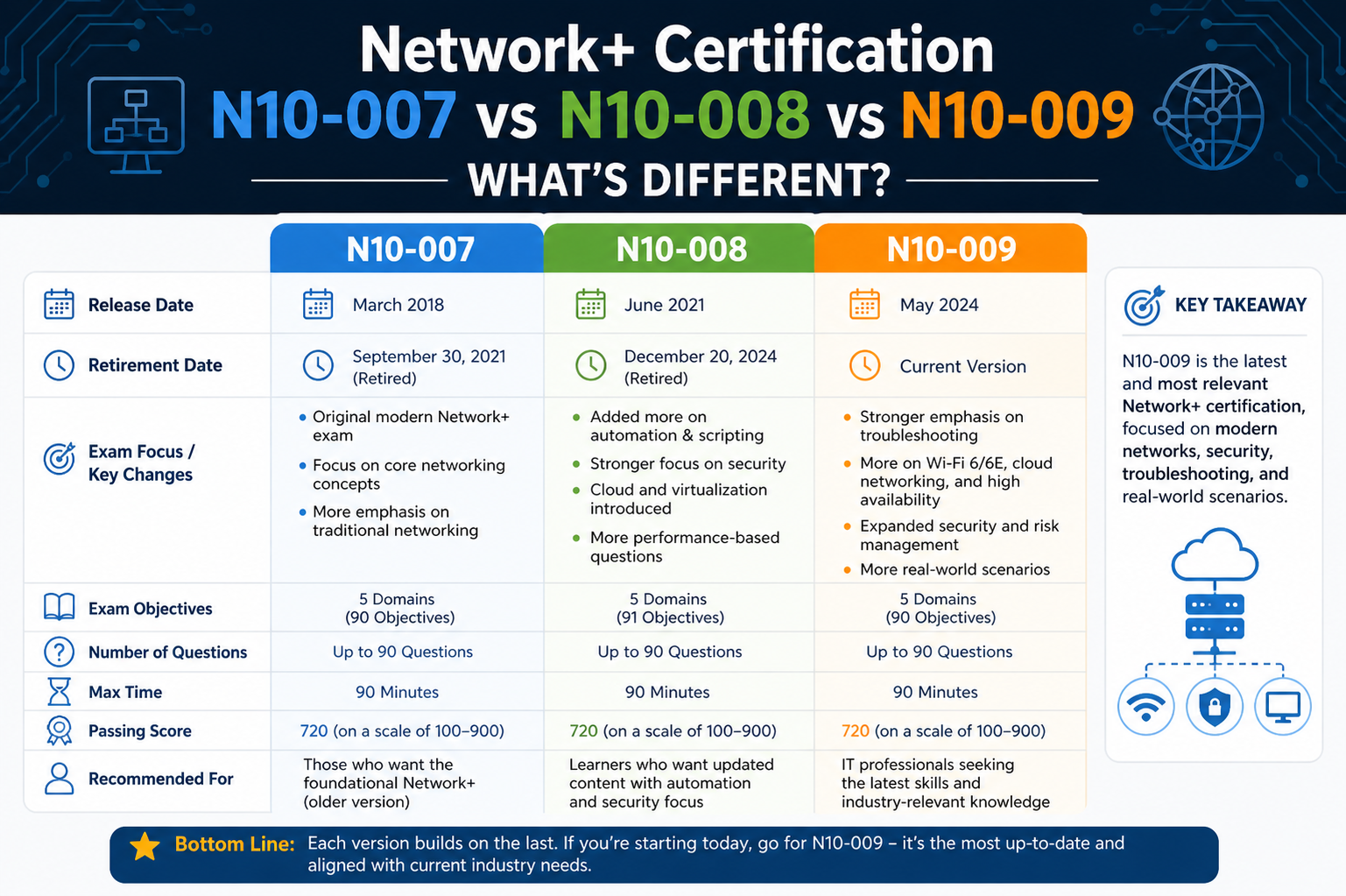
The three most recent versions—N10-007, N10-008, and N10-009—represent different stages in this evolution. While they all aim to validate the same core networking competencies, each version introduces new technologies, shifts in emphasis, and updated exam objectives that reflect current industry needs. Understanding these differences is essential for candidates planning their certification path, as well as for IT professionals who want to stay aligned with modern networking trends.
Overview of the CompTIA Network+ Exam Structure
The Network+ exam is designed to test both theoretical knowledge and practical skills in networking. It typically consists of a mix of multiple-choice questions and performance-based questions that simulate real-world networking scenarios. Candidates are required to demonstrate their ability to troubleshoot network issues, configure devices, implement secure network solutions, and understand key networking technologies.
Across all versions, the exam maintains a consistent focus on foundational networking concepts. However, the depth and emphasis of certain topics vary depending on the version. For example, earlier versions placed more focus on traditional networking hardware and protocols, while newer versions increasingly emphasize cloud networking, virtualization, and software-defined infrastructure.
The certification remains a key stepping stone for entry-level and intermediate IT professionals. It is often pursued by individuals aiming for roles such as network technician, network administrator, help desk support specialist, and junior cloud engineer. Its vendor-neutral nature ensures that the skills learned can be applied in a wide range of IT environments, making it one of the most versatile certifications in the industry.
Transition from N10-007 to N10-008: Key Industry Shift
The transition from the N10-007 exam to the N10-008 version marked a significant shift in CompTIA’s approach to networking education. While N10-007 focused heavily on traditional networking concepts, the N10-008 introduced a stronger emphasis on modern technologies that are now central to enterprise networks.
One of the most notable changes in this transition was the restructuring of exam domains. CompTIA streamlined certain sections to reduce redundancy and better reflect real-world job roles. For example, topics related to networking tools were integrated into broader troubleshooting concepts, encouraging candidates to develop a more holistic understanding of problem-solving rather than memorizing individual tools.
Another important shift was the introduction of network architecture concepts such as SD-WAN. This change reflected the growing importance of distributed networks and remote connectivity solutions in modern organizations. With more businesses adopting hybrid and remote work models, understanding how wide area networks operate in a software-defined environment became essential.
Additionally, the N10-008 version placed greater emphasis on cloud computing and virtualization. These technologies had already become widespread in enterprise environments, and CompTIA recognized the need for candidates to understand how virtual machines, cloud services, and remote infrastructure interact with traditional networks.
Major Technological Additions in N10-008 Exam
The N10-008 exam introduced several key technologies that were either minimally covered or not fully explored in the N10-007 version. These additions were designed to align the certification with modern IT infrastructure trends.
One of the most significant additions was virtualization. While virtualization existed in earlier versions, the N10-008 exam expanded its coverage significantly. Candidates were expected to understand how virtual machines operate, how cloud-based environments are managed, and how to troubleshoot issues within virtualized systems. This included knowledge of identity and access management, VM security configurations, and performance troubleshooting in cloud environments.
Another major addition was the Internet of Things (IoT). The rise of smart devices in homes, businesses, and industrial environments made IoT a critical networking topic. The exam required candidates to understand how IoT devices connect to networks, how they are managed remotely, and how to troubleshoot connectivity and performance issues. Devices such as smart thermostats, cameras, and sensors became part of networking scenarios.
The inclusion of 5G cellular technology also marked an important update. As mobile connectivity became faster and more widely adopted, understanding 5G networks became essential for troubleshooting wireless connections. Candidates needed to understand range limitations, signal strength issues, and how 5G integrates with existing network infrastructure.
Cloud computing also received expanded coverage. The N10-008 exam introduced deeper knowledge of cloud service models such as SaaS, IaaS, PaaS, and DaaS. Candidates were expected to understand how these services operate, how they are deployed, and how they interact with enterprise networks. Concepts like load balancing, redundancy, and disaster recovery (including hot, warm, and cold sites) became more prominent.
Structural Changes in Exam Domains
The structure of the exam domains also evolved significantly from N10-007 to N10-008. CompTIA refined the organization of topics to reflect real-world IT job functions more accurately. The earlier version included separate sections for networking tools and troubleshooting, but the newer version combined these into a more unified troubleshooting domain.
This change encouraged a shift from tool-based memorization to conceptual problem-solving. Instead of simply identifying tools, candidates were expected to understand how to diagnose and resolve network issues using a structured approach.
Another important structural change was the increased focus on network implementation and operations. Topics such as network architecture, wireless standards, and security configurations became more integrated into practical scenarios. This helped bridge the gap between theoretical knowledge and real-world application.
The shift also reflected the growing complexity of modern networks. As organizations moved toward hybrid infrastructures that combine on-premises systems with cloud services, networking professionals needed a broader skill set that covered multiple environments.
Why N10-008 Became a More Modern Certification
The N10-008 exam represented a modernization of the Network+ certification. It aligned the certification with current industry demands, particularly in areas such as cloud computing, virtualization, and mobile connectivity.
One of the key reasons for this modernization was the increasing adoption of remote work. As employees began working from different locations, traditional network setups became less relevant. Organizations needed professionals who could manage distributed networks, troubleshoot remote connectivity issues, and secure data across multiple environments.
The N10-008 exam addressed these needs by incorporating technologies like SD-WAN, cloud networking, and virtualization. These topics reflect how modern enterprises design and manage their networks today.
Additionally, cybersecurity considerations became more integrated into networking topics. While Network+ is not a security certification, understanding secure network configurations, access control, and threat mitigation became increasingly important. This reflects the reality that networking and security are now deeply interconnected fields.
Introduction of N10-009 and Its Direction
The introduction of the N10-009 exam marked another step forward in the evolution of Network+. This version builds on the foundation of N10-008 while introducing newer technologies and refining existing concepts to reflect the latest industry trends.
The N10-009 exam places a stronger emphasis on modern network environments and automation. It introduces concepts such as Infrastructure as Code (IaC), which allows network infrastructure to be managed through code rather than manual configuration. This reflects the growing trend toward automation in IT operations.
It also expands coverage of Software-Defined Networking (SDN) and SD-WAN, reinforcing the importance of flexible, programmable networks. These technologies allow organizations to manage network resources more efficiently and adapt quickly to changing demands.
Another key focus of the N10-009 exam is scalability and advanced network design. Technologies such as VxLAN are introduced to help manage large-scale network environments. This is particularly important for enterprise-level organizations that operate complex, distributed systems.
The inclusion of Zero Trust architecture, SASE (Secure Access Service Edge), and SSE (Security Service Edge) reflects the growing importance of security in network design. These concepts emphasize continuous verification and secure access across all network interactions.
Shift Toward Automation and Security in N10-009
One of the most significant changes in the N10-009 exam is the stronger focus on automation and security-driven networking. Traditional manual configuration methods are being replaced by automated, code-based infrastructure management. This shift reduces human error and improves scalability.
Zero Trust architecture is another major addition, representing a modern approach to cybersecurity. Instead of assuming trust within a network, Zero Trust requires continuous verification of every user and device. This approach is becoming standard in enterprise environments due to increasing cyber threats.
The integration of SASE and SSE further enhances network security by combining networking and security services into unified cloud-based solutions. This reflects the ongoing convergence of networking and cybersecurity disciplines.
Expanding Role of Virtualization in Modern Networking
Virtualization has become one of the most important concepts in modern IT infrastructure, and its role has significantly expanded across newer versions of the Network+ exam. While earlier versions like N10-007 introduced virtualization only at a conceptual level, later versions, especially N10-008, placed much greater emphasis on its practical applications within enterprise environments.
Virtualization allows multiple virtual systems to run on a single physical hardware system, improving efficiency, scalability, and resource utilization. In real-world networking environments, this technology is essential for creating flexible infrastructures that can adapt quickly to changing demands. It also plays a key role in cloud computing, where virtual machines form the backbone of most services.
In the context of N10-008, candidates are expected to understand not only what virtualization is but also how it is implemented and maintained. This includes knowledge of virtual machine creation, resource allocation, network segmentation within virtual environments, and performance optimization. The exam also introduces troubleshooting scenarios where virtual machines may experience connectivity or configuration issues.
Another important aspect is security in virtual environments. As organizations increasingly rely on virtual machines, securing these environments becomes critical. This includes managing access control, securing virtual networks, and ensuring proper isolation between systems. The exam reflects this by including scenarios where candidates must identify and resolve security-related issues within virtualized infrastructures.
Virtualization also plays a key role in cloud computing environments, which are heavily integrated into modern IT systems. Understanding how virtual machines operate in cloud platforms helps candidates better grasp how enterprise networks are structured today.
Cloud Computing as a Core Networking Component
Cloud computing has evolved from a secondary topic in early Network+ exams to a central component in newer versions. In the N10-007 exam, cloud concepts were introduced at a basic level, focusing mainly on definitions and general understanding. However, with the release of N10-008, cloud computing became a much deeper and more practical subject.
Cloud computing is essentially the delivery of computing services over the internet, including storage, servers, databases, networking, and software. It allows organizations to reduce infrastructure costs, improve scalability, and enhance accessibility. In modern networking environments, cloud services are no longer optional—they are a core part of infrastructure design.
The N10-008 exam requires candidates to understand different cloud service models such as Software as a Service, Infrastructure as a Service, Platform as a Service, and Desktop as a Service. Each of these models serves a different purpose within an IT ecosystem.
Software as a Service provides ready-to-use applications accessible through a web browser, eliminating the need for local installation. Infrastructure as a Service allows organizations to rent virtualized computing resources, including servers and networking components. Platform as a Service provides a development environment for building and deploying applications. Desktop as a Service delivers virtual desktops to end users, allowing remote access to fully functional work environments.
In addition to service models, the exam also covers deployment models such as public, private, hybrid, and community clouds. Understanding these models is essential for designing and managing scalable network environments.
Another important area is cloud troubleshooting. Candidates are expected to diagnose issues related to connectivity, performance, and configuration within cloud-based systems. This includes understanding latency issues, misconfigured services, and authentication problems.
Cloud redundancy and disaster recovery are also key topics. Concepts such as hot sites, warm sites, and cold sites are introduced to help candidates understand how organizations maintain business continuity in the event of system failures.
Internet of Things and Its Growing Network Impact
The Internet of Things represents one of the most rapidly expanding areas in modern networking. IoT refers to the network of physical devices that are connected to the internet and capable of collecting and exchanging data. These devices range from simple home appliances to complex industrial systems.
In earlier versions of the Network+ exam, IoT was mentioned briefly, but its coverage was limited. With the introduction of N10-008, IoT became a more significant topic, reflecting its increasing importance in both consumer and enterprise environments.
IoT devices include smart thermostats, security cameras, wearable technology, smart lighting systems, industrial sensors, and connected appliances. These devices rely on network connectivity to function effectively, making them an important consideration for network professionals.
One of the key challenges with IoT devices is managing their connectivity and security. Because these devices are often distributed across different locations and may have limited processing power, they can introduce vulnerabilities into a network if not properly configured.
The N10-008 exam emphasizes the importance of understanding how IoT devices connect to networks, how they are managed remotely, and how their activity is monitored. Candidates must also understand how to troubleshoot connectivity issues, such as weak signals, misconfigured settings, or network congestion.
Another important aspect is data logging and monitoring. IoT devices often generate large amounts of data, which must be collected, stored, and analyzed. Understanding how to access and interpret these logs is essential for diagnosing issues and ensuring proper device functionality.
Security is also a major concern in IoT environments. Since many IoT devices lack strong built-in security features, network professionals must implement additional safeguards such as segmentation, encryption, and access control to protect the network.
5G Technology and Wireless Network Advancements
The introduction of 5G technology represents a major advancement in wireless networking. 5G offers significantly faster speeds, lower latency, and greater capacity compared to previous generations of mobile networks. As a result, it has become an important topic in the N10-008 exam.
In practical terms, 5G enables faster communication between devices, improved performance for mobile applications, and better support for high-bandwidth activities such as video streaming and real-time collaboration. It also plays a key role in supporting IoT devices and smart city infrastructure.
The N10-008 exam requires candidates to understand how 5G networks operate, including their range limitations and signal characteristics. Unlike previous wireless technologies, 5G operates on higher frequency bands, which provide faster speeds but shorter range. This means that devices must be closer to cell towers to maintain a stable connection.
Candidates are also expected to understand how to troubleshoot 5G connectivity issues. This includes identifying coverage problems, interference, and configuration errors. Understanding the relationship between signal strength and distance from the tower is essential for resolving these issues.
Another important aspect is the integration of 5G with other networking technologies such as SD-WAN. This combination allows organizations to create highly flexible and efficient network architectures that support remote work and distributed environments.
The rise of 5G also reflects the broader trend toward mobile-first networking. As more users rely on mobile devices for work and communication, understanding wireless technologies becomes increasingly important for IT professionals.
Shift Toward Software-Defined Networking in Modern Exams
Software-Defined Networking represents a major shift in how networks are designed and managed. Instead of relying on traditional hardware-based configurations, SDN allows networks to be controlled through software, enabling greater flexibility and automation.
In the N10-008 exam, SDN concepts are introduced as part of the broader discussion on modern network architecture. Candidates are expected to understand how SDN separates the control plane from the data plane, allowing centralized management of network resources.
This approach simplifies network administration and allows for faster configuration changes. It also improves scalability, as networks can be adjusted dynamically based on demand.
SD-WAN extends these principles to wide area networks, enabling organizations to manage connections between multiple locations more efficiently. This is particularly important for businesses with remote offices or distributed teams.
The inclusion of SDN and SD-WAN in the exam reflects the growing importance of software-based networking solutions in modern IT environments. These technologies are increasingly replacing traditional hardware-centric approaches.
Networking Tools and Troubleshooting Evolution
Another important change in the newer exam versions is the evolution of troubleshooting methodologies. Earlier versions of the exam placed significant emphasis on memorizing specific networking tools. However, newer versions focus more on understanding the overall troubleshooting process.
This shift encourages candidates to develop critical thinking skills rather than relying solely on tool recognition. Instead of simply identifying a tool, candidates must understand how to diagnose and resolve network issues using a structured approach.
The troubleshooting process typically involves identifying the problem, establishing a theory of probable cause, testing the theory, implementing a solution, verifying functionality, and documenting findings. This systematic approach is essential for real-world IT environments.
By focusing on holistic troubleshooting rather than individual tools, the exam better prepares candidates for real job roles where problem-solving is more important than memorization.
Modern Network Environments and Architecture Evolution
Modern networking has shifted far beyond traditional on-premises systems, and this change is clearly reflected in the newer Network+ exam versions. Earlier exams like N10-007 focused mainly on conventional infrastructure such as routers, switches, cabling, and basic network layouts. While these fundamentals are still important, newer versions like N10-008 and N10-009 expand the scope to include hybrid, cloud-based, and software-defined environments.
In today’s IT world, most organizations do not rely on a single network type. Instead, they combine on-premises systems, cloud platforms, remote access solutions, and virtualized infrastructure. This hybrid model improves scalability and flexibility but also increases complexity. As a result, candidates are now expected to understand how these different environments interact and support each other.
Network architecture has also become more important than simple topology identification. Instead of just recognizing star, mesh, or hybrid designs, professionals must understand how modern architectures are built to support performance, security, and scalability across distributed systems. This includes understanding how data flows across multiple layers of infrastructure in real-world enterprise environments.
Another major shift is the rise of distributed networking. With remote work becoming common and applications hosted in different environments, networks are no longer confined to a single physical location. This requires professionals to design and manage systems that operate seamlessly across multiple geographic regions while maintaining stability and security.
Software Defined Networking and SD-WAN Expansion
Software Defined Networking represents a major transformation in how networks are managed. Unlike traditional networking, where each device is configured individually, SDN centralizes control through software. This allows administrators to manage the entire network from a single interface, improving efficiency and reducing complexity.
With SDN, the control layer is separated from the data layer. This separation allows centralized decision-making while traffic continues to flow through network devices. The result is a more flexible and programmable network that can adapt quickly to changing demands.
SD-WAN extends this concept to wide area networks, which are used to connect multiple locations such as branch offices and remote users. Instead of relying on traditional private connections, SD-WAN intelligently routes traffic based on performance, cost, and security conditions. This makes it especially useful for organizations with distributed operations.
In newer Network+ versions, candidates are expected to understand how SD-WAN improves connectivity between locations, how it enhances application performance, and how it integrates with cloud services. This includes understanding traffic prioritization, secure tunneling, and dynamic path selection.
The growing importance of SDN and SD-WAN reflects a broader shift toward automation and centralized control in networking. These technologies reduce manual configuration and allow networks to respond more dynamically to real-time conditions.
Infrastructure as Code and Network Automation
Infrastructure as Code is one of the most important additions in the N10-009 exam and represents a major shift in IT operations. Instead of manually configuring hardware and software systems, Infrastructure as Code allows administrators to define infrastructure using code-based templates.
This approach enables automation of network setup, configuration, and management. Once defined, infrastructure can be deployed consistently across different environments without manual intervention. This reduces errors, improves efficiency, and ensures consistency across systems.
In networking, Infrastructure as Code can be used to automate the configuration of routers, switches, firewalls, and virtual networks. It is especially valuable in cloud environments where infrastructure needs to scale quickly and reliably.
One of the key benefits of this approach is repeatability. Once a configuration is written in code, it can be reused multiple times, making deployment faster and more reliable. It also allows version control, meaning changes can be tracked and rolled back if needed.
The inclusion of Infrastructure as Code in the exam highlights the growing importance of automation in IT. Network professionals are now expected to understand not only how systems work but also how they can be automated and managed through programmable methods.
Scalability and Advanced Network Design Concepts
Scalability has become a major focus in modern network design due to the increasing size and complexity of enterprise environments. Networks must be able to handle growing traffic loads without performance degradation.
To address this, newer Network+ versions introduce concepts such as VxLAN, which stands for Virtual Extensible Local Area Network. This technology allows large-scale network segmentation and helps overcome limitations of traditional VLAN systems.
VxLAN enables the creation of virtual networks that can operate across physical infrastructure boundaries. This is especially useful in data centers and cloud environments where traditional networking methods are no longer sufficient for large-scale operations.
Candidates are expected to understand how VxLAN works, including how it encapsulates network traffic and extends Layer 2 networks over Layer 3 infrastructure. This allows organizations to scale their networks without being restricted by physical limitations.
Load balancing is another key scalability concept covered in newer exam versions. It ensures that network traffic is distributed evenly across multiple servers or resources to prevent overload and maintain performance. Understanding different load balancing methods is important for maintaining efficient network operations.
Structured Cabling and Physical Infrastructure Components
Even as networking becomes more software-driven, physical infrastructure remains a critical part of network design. The N10-009 exam introduces greater emphasis on structured cabling components such as Intermediate Distribution Frames and Main Distribution Frames.
A Main Distribution Frame serves as the central point where external network connections enter a building or data center. It acts as the primary hub for distributing network connections to internal systems.
Intermediate Distribution Frames act as secondary connection points that extend network connectivity from the main frame to different areas within a building. These components help organize and manage large-scale cabling systems efficiently.
Understanding these infrastructure elements is important for designing reliable and scalable physical networks. Proper cabling design ensures better organization, easier maintenance, and improved performance across enterprise environments.
These topics highlight that while modern networking is increasingly virtualized, physical infrastructure still plays a foundational role in supporting overall network performance.
Security Evolution and Zero Trust Architecture
Network security has undergone a major transformation in recent years, and this is clearly reflected in the newer Network+ exam versions. Traditional security models relied on perimeter-based protection, assuming that anything inside the network could be trusted. However, this approach is no longer sufficient in modern environments.
Zero Trust architecture introduces a completely different model. Instead of assuming trust, every user, device, and connection must be continuously verified before access is granted. This reduces the risk of unauthorized access and limits the impact of potential security breaches.
In the N10-009 exam, candidates are expected to understand how Zero Trust principles are implemented in real-world networks. This includes identity verification, access control policies, segmentation, and continuous monitoring of network activity.
In addition to Zero Trust, modern security frameworks such as SASE and SSE are also included. These frameworks combine networking and security into unified cloud-based solutions that provide secure access to applications from anywhere.
SASE integrates wide area networking with security functions such as secure web gateways and firewall services. SSE focuses more on delivering security services through the cloud without requiring traditional hardware-based solutions.
Together, these frameworks represent a shift toward cloud-based, identity-driven security models that are better suited for modern distributed networks.
Changing Expectations for Network Professionals
The evolution of Network+ exam versions also reflects changing expectations for IT professionals. Traditional network administrators primarily focused on hardware configuration and maintenance. However, modern roles require a much broader skill set.
Today’s network professionals must understand cloud computing, automation, virtualization, and cybersecurity in addition to traditional networking concepts. This reflects the increasing complexity of enterprise IT environments.
The inclusion of modern technologies in the exam ensures that certified professionals are prepared for real-world job roles. Whether working in cloud environments, hybrid infrastructures, or data centers, the skills tested in the exam are directly applicable to industry demands.
As networks continue to evolve, professionals must adapt to new tools and technologies. The Network+ certification evolves alongside the industry to ensure that candidates remain relevant in a rapidly changing IT landscape.
Modern Troubleshooting Approach and Operational Focus
One of the most important shifts across the Network+ exam versions is the way troubleshooting is handled. In earlier versions like N10-007, troubleshooting was more tool-focused, meaning candidates were often expected to recognize specific commands, utilities, and diagnostic tools. While those tools are still relevant, newer versions such as N10-008 and N10-009 place greater emphasis on understanding the troubleshooting process itself rather than memorizing individual tools.
This change reflects real-world IT environments where professionals are expected to analyze problems logically rather than rely on memorized commands. The structured troubleshooting methodology typically includes identifying the problem, establishing a theory of probable cause, testing the theory, implementing a solution, verifying system functionality, and documenting the outcome. This approach is now central to the exam.
In modern networking environments, issues are rarely isolated. A single problem can be caused by multiple overlapping factors such as misconfiguration, network congestion, authentication errors, or hardware failure. Because of this complexity, candidates must develop strong analytical thinking skills to diagnose and resolve issues efficiently.
The N10-009 version further strengthens this operational focus by integrating troubleshooting with modern technologies such as SDN, SD-WAN, and cloud-based environments. This ensures that candidates are not only familiar with traditional network issues but also capable of handling problems in virtualized and distributed systems.
Integration of Cloud and Hybrid Environments in Networking
Cloud computing is no longer an optional topic in the Network+ certification; it has become a core component of modern networking. Earlier versions introduced cloud concepts at a basic level, but newer versions require a much deeper understanding of how cloud and on-premises systems interact.
In hybrid environments, organizations combine traditional infrastructure with cloud platforms to improve flexibility, scalability, and cost efficiency. This creates complex networking scenarios where data and applications may reside in multiple locations simultaneously. Network professionals must understand how to manage and troubleshoot connectivity across these environments.
Candidates are expected to understand how cloud services integrate with enterprise networks, including authentication systems, data storage, and application delivery. This includes knowledge of how latency, bandwidth, and routing affect cloud performance.
Hybrid networking also introduces new security considerations. Data moving between cloud and on-premises systems must be protected through encryption, secure tunnels, and proper access control policies. Understanding these mechanisms is essential for maintaining secure and reliable network operations.
The increasing reliance on cloud services reflects a broader industry trend where organizations prioritize scalability and remote accessibility. As a result, the Network+ exam continues to expand its coverage of cloud-related networking concepts.
Advanced Wireless Technologies and Mobile Connectivity
Wireless networking has also evolved significantly across Network+ versions, with newer exams placing greater emphasis on modern wireless technologies such as Wi-Fi advancements and 5G connectivity.
Earlier versions focused mainly on basic wireless standards and configurations, but newer versions explore how wireless technologies integrate into enterprise environments. This includes understanding signal strength, interference issues, and coverage limitations in real-world scenarios.
5G technology is a major addition in newer versions, reflecting its growing importance in mobile and enterprise connectivity. It offers higher speeds, lower latency, and greater device capacity compared to previous generations. However, it also introduces new challenges, such as shorter range and the need for denser network infrastructure.
Candidates must understand how 5G networks operate, including how devices connect to cell towers and how environmental factors can affect signal quality. Troubleshooting wireless issues now includes analyzing physical distance, obstruction, and network congestion.
Wireless networking is also closely tied to IoT devices, which often rely on Wi-Fi or cellular connectivity. Understanding how these devices communicate and how to manage their connections is an important part of modern networking knowledge.
The growing importance of wireless technologies reflects the increasing mobility of users and devices in today’s IT environments. Networks are no longer confined to wired connections, making wireless expertise essential for IT professionals.
Security Advancements and Modern Threat Protection
Security has become a central focus in modern networking, and this is reflected in the evolution of Network+ exam content. While earlier versions included basic security concepts, newer versions integrate security deeply into networking topics.
One of the most significant advancements is the introduction of Zero Trust architecture. This model removes the assumption that any user or device inside the network is automatically trusted. Instead, every access request must be verified continuously based on identity, device health, and context.
This approach is particularly important in modern distributed environments where users access resources from multiple locations and devices. Zero Trust helps reduce the risk of unauthorized access and limits potential damage from security breaches.
In addition to Zero Trust, newer frameworks such as SASE and SSE are also included. These frameworks combine networking and security functions into unified cloud-based solutions. They enable secure access to applications regardless of user location, making them ideal for remote and hybrid work environments.
Security is no longer treated as a separate domain in networking; instead, it is integrated into every aspect of network design and operation. This includes access control, encryption, monitoring, and threat detection.
Candidates are expected to understand how to implement secure network configurations, identify vulnerabilities, and respond to security incidents. This reflects the increasing overlap between networking and cybersecurity roles in the IT industry.
Comparison of Exam Focus Across Versions
When comparing N10-007, N10-008, and N10-009, a clear pattern of evolution emerges. N10-007 focused primarily on traditional networking concepts such as hardware, protocols, and basic troubleshooting. It served as a strong foundation for entry-level networking knowledge.
N10-008 marked a transition toward modern networking environments. It introduced cloud computing, virtualization, IoT, and 5G technologies, reflecting the growing complexity of enterprise networks. It also shifted emphasis toward architectural understanding and practical troubleshooting skills.
N10-009 builds further on this foundation by introducing automation, Infrastructure as Code, advanced security frameworks, and scalable network design concepts. It reflects the industry’s move toward automation, cloud-first strategies, and zero-trust security models.
Across all versions, the core goal remains the same: to validate a candidate’s ability to troubleshoot, configure, operate, and secure network environments. However, the scope of knowledge required has expanded significantly to match modern IT demands.
Career Relevance and Industry Value of Network+ Certification
The Network+ certification continues to be highly valuable for individuals entering the IT field or advancing their networking careers. It provides a strong foundation in networking principles while also adapting to modern industry requirements.
Roles such as network administrator, IT support technician, and helpdesk specialist benefit directly from the skills covered in the exam. These professionals are often responsible for maintaining network performance, resolving connectivity issues, and ensuring system reliability.
Additionally, the certification is increasingly relevant for cloud-related roles such as junior cloud engineer or infrastructure support technician. As cloud technologies become more integrated with networking, professionals with Network+ knowledge are better prepared for hybrid environments.
The certification also serves as a stepping stone toward more advanced credentials in networking, cybersecurity, and cloud computing. It provides the foundational knowledge required to pursue specialized certifications and career paths in IT infrastructure.
The continued updates to the exam ensure that certified professionals remain aligned with current technologies and industry expectations. This makes Network+ a long-term valuable credential in the IT job market.
Final Conclusion
The evolution from N10-007 to N10-008 and finally to N10-009 demonstrates how rapidly networking technology has advanced. What began as a certification focused on traditional networking fundamentals has transformed into a comprehensive credential covering cloud computing, automation, virtualization, wireless technologies, and advanced security frameworks.
Each version builds upon the previous one, adding new layers of complexity while maintaining core networking principles. This ensures that candidates develop both foundational knowledge and modern technical skills required in today’s IT environments.
The Network+ certification continues to adapt to industry changes, making it a relevant and reliable benchmark for networking professionals worldwide.