Artificial intelligence is no longer a futuristic idea discussed only in research labs or science fiction movies. It has become part of everyday life. People interact with machine learning systems constantly, often without realizing it. Streaming services recommend movies, online stores suggest products, banks detect suspicious transactions, navigation apps optimize travel routes, and social media platforms personalize feeds using machine learning algorithms.
Behind these intelligent systems are machine learning engineers, professionals responsible for turning complex algorithms into practical applications that businesses and consumers can actually use. Over the last several years, the role of the machine learning engineer has evolved into one of the most valuable and fastest-growing careers in the technology industry.
The increasing importance of artificial intelligence has transformed how businesses operate. Organizations are now using data-driven systems to make decisions faster, automate processes, improve customer experiences, and gain competitive advantages. Because of this shift, companies are investing heavily in AI talent, especially professionals capable of deploying and maintaining production-ready machine learning systems.
Machine learning engineers occupy a unique position in this ecosystem. They are not only responsible for creating machine learning models but also for ensuring those models work efficiently in real-world environments. This requires a combination of software engineering, data science, cloud computing, infrastructure management, and analytical thinking.
As businesses continue racing to integrate AI into their products and operations, salaries for machine learning engineers have climbed dramatically. Companies are competing aggressively for skilled professionals who can build scalable systems, optimize infrastructure, and manage the lifecycle of machine learning applications.
The profession has also gained popularity because it combines strong earning potential with intellectually challenging work. Many engineers enjoy solving real-world problems using data, automation, and intelligent systems. Whether working on recommendation engines, fraud detection systems, autonomous technologies, or generative AI applications, machine learning engineers often contribute directly to products used by millions of people.
Despite the excitement surrounding the field, there is still confusion about what machine learning engineers actually do daily. Some people imagine the role involves only advanced mathematics or algorithm research, while others assume it is simply another branch of software development. In reality, the profession combines elements of multiple technical disciplines and requires both theoretical understanding and practical engineering expertise.
The rise of generative AI has further expanded interest in machine learning engineering. Businesses across industries are now exploring AI-powered chatbots, automated content generation, intelligent search systems, and advanced analytics tools. These technologies require sophisticated infrastructure and deployment pipelines, increasing the demand for engineers who can build reliable systems at scale.
As a result, machine learning engineering has become more than a niche specialization. It is now a central component of modern technology strategy for organizations of all sizes. Companies that once viewed AI as experimental are now embedding machine learning into core business operations, products, and services.
This growing reliance on intelligent systems explains why machine learning engineers are among the highest-paid professionals in tech today. Their skills directly influence a company’s ability to innovate, automate, and compete in increasingly data-driven markets.
What a Machine Learning Engineer Actually Does
Machine learning engineers are responsible for designing, building, deploying, and maintaining systems that allow computers to learn from data. Their work sits at the intersection of software engineering and data science, making the role highly technical and multidisciplinary.
One of the biggest misconceptions about machine learning engineering is that the job revolves entirely around building algorithms. While algorithm development is important, the reality is that machine learning engineers spend much of their time solving infrastructure, deployment, and operational challenges.
A machine learning project usually starts with data. Engineers often work with massive datasets collected from applications, customer interactions, sensors, transactions, or business systems. Before any model can be trained, the data must be cleaned, organized, and prepared for analysis. This process includes handling missing values, removing duplicates, transforming formats, and identifying inconsistencies.
Once the data is ready, machine learning engineers experiment with different algorithms and training techniques. Depending on the project, they may use traditional machine learning models, deep learning architectures, or modern transformer-based systems. Their goal is to create models capable of recognizing patterns, making predictions, or automating decisions accurately.
However, training a model is only one step in the process. A model that performs well in testing environments may fail in production if it cannot handle large volumes of users or real-time data. Machine learning engineers, therefore, focus heavily on scalability, reliability, and performance optimization.
Deployment is one of the most important parts of the role. Engineers package trained models into applications, APIs, or cloud-based services so businesses can integrate them into products and workflows. This often involves containerization tools, orchestration systems, and cloud infrastructure.
After deployment, machine learning engineers continue monitoring systems to ensure they perform correctly. Models can lose accuracy over time as user behavior changes or new data patterns emerge. Engineers must identify these issues quickly and retrain models when necessary.
Another critical responsibility is automation. Modern machine learning systems often rely on automated pipelines that handle data processing, model training, testing, deployment, and monitoring. Building these workflows efficiently requires strong engineering and DevOps skills.
Machine learning engineers also collaborate with multiple teams across an organization. They frequently work alongside data scientists, software developers, product managers, analysts, and business stakeholders. Communication is therefore just as important as technical ability because engineers must explain technical decisions and align projects with business goals.
In some organizations, machine learning engineers specialize in specific areas such as natural language processing, recommendation systems, computer vision, or generative AI. In others, they handle the entire machine learning lifecycle from start to finish.
The role continues evolving rapidly as AI technologies advance. Today’s engineers are expected to understand cloud computing, distributed systems, infrastructure optimization, and production monitoring in addition to machine learning concepts. This broad skill set is one reason the profession commands such high salaries.
Why Businesses Are Investing Heavily in AI Talent
The explosive demand for machine learning engineers is directly connected to the growing importance of artificial intelligence across industries. Businesses now view AI as a strategic advantage rather than a research experiment.
Companies generate enormous amounts of data every day. Customer purchases, mobile app usage, website traffic, financial transactions, and operational systems all produce valuable information. Organizations want to use this data to improve efficiency, predict trends, personalize experiences, and automate processes.
Machine learning systems make this possible by identifying patterns humans would struggle to detect manually. Businesses can use these systems to forecast demand, optimize supply chains, detect fraud, improve marketing campaigns, and automate customer support.
The rise of automation is another major factor driving demand for machine learning engineers. Companies are constantly searching for ways to reduce operational costs and increase productivity. AI-powered automation tools can handle repetitive tasks more efficiently than traditional software systems.
Retail companies use machine learning for personalized product recommendations. Financial institutions rely on AI for fraud detection and risk analysis. Healthcare providers use machine learning for diagnostics and predictive analytics. Logistics companies optimize delivery routes using AI-powered systems.
Even industries traditionally considered less technology-focused are adopting machine learning rapidly. Manufacturing companies use predictive maintenance systems to reduce downtime. Agricultural businesses use AI for crop monitoring and yield prediction. Energy companies analyze operational data to improve efficiency.
Cloud computing has also accelerated AI adoption significantly. In the past, only large corporations could afford the infrastructure needed for advanced machine learning systems. Today, cloud platforms provide scalable computing resources accessible to businesses of all sizes.
This accessibility has dramatically increased the number of organizations hiring machine learning engineers. Startups, mid-sized businesses, and enterprise corporations are all competing for talent capable of building intelligent systems.
Generative AI has intensified this demand even further. Businesses are now experimenting with AI-powered assistants, automated writing tools, image generation systems, and conversational interfaces. These applications require engineers who understand large-scale AI deployment and optimization.
Companies are especially interested in professionals who can operationalize AI systems effectively. Building experimental models is one thing, but deploying reliable production systems is far more challenging. Engineers capable of handling deployment, monitoring, scaling, and infrastructure management are therefore highly valuable.
Another reason businesses invest heavily in machine learning talent is competitive pressure. Organizations fear falling behind competitors that successfully integrate AI into products and operations. This urgency has created aggressive hiring environments and rising salary levels across the industry.
The shortage of experienced professionals also contributes to strong demand. Many candidates understand machine learning theory, but fewer possess hands-on experience with production systems. Employers, therefore, compete intensely for engineers who can manage real-world AI infrastructure effectively.
As artificial intelligence becomes increasingly integrated into daily business operations, demand for machine learning engineers is expected to remain extremely strong. Organizations across nearly every industry continue expanding their AI initiatives, creating long-term opportunities for skilled professionals.
The Difference Between Machine Learning Engineers and Data Scientists
Many people confuse machine learning engineers with data scientists because the two roles overlap in several areas. Both professions work with data, algorithms, and predictive systems, but their responsibilities and priorities are often very different.
Data scientists typically focus on extracting insights from data. Their work often involves statistical analysis, experimentation, visualization, and research. They explore datasets to identify trends, test hypotheses, and develop predictive models that help organizations make better decisions.
Machine learning engineers, on the other hand, focus more heavily on implementation and operationalization. Their primary goal is to turn machine learning models into scalable systems capable of functioning reliably in production environments.
A data scientist might build a recommendation model that performs well during experimentation. A machine learning engineer would then optimize, deploy, monitor, and maintain that model so it can serve millions of users efficiently.
The distinction becomes clearer when looking at daily workflows. Data scientists often spend significant time analyzing datasets, conducting experiments, and evaluating statistical performance. Machine learning engineers spend more time writing production-grade code, managing infrastructure, automating pipelines, and improving system scalability.
Software engineering skills are generally more important for machine learning engineers. They must understand APIs, cloud platforms, deployment strategies, version control, distributed systems, and infrastructure optimization. Data scientists may focus more deeply on statistical methods and analytical techniques.
The rise of MLOps has further expanded the engineering side of machine learning roles. Companies increasingly need professionals who can automate deployment workflows, monitor model performance, manage retraining pipelines, and ensure reliability under production conditions.
Despite these differences, collaboration between the two roles is extremely common. Data scientists and machine learning engineers often work together closely during AI projects. Data scientists may focus on experimentation and research, while engineers handle deployment and scalability.
In smaller companies, the distinction between the roles may blur significantly. One person might handle both research and deployment responsibilities. Larger organizations usually separate these functions more clearly to allow deeper specialization.
Understanding the difference between these careers is important because salary expectations, hiring requirements, and technical responsibilities can vary substantially. Machine learning engineers often command higher salaries when they possess strong infrastructure and deployment expertise because these skills are harder to find.
The growing complexity of production AI systems has made machine learning engineering increasingly specialized. Employers now prioritize candidates who can build reliable systems rather than simply develop models in isolated environments.
As AI adoption continues expanding, both professions will remain highly valuable. However, machine learning engineers are becoming especially critical because businesses increasingly depend on scalable, production-ready AI infrastructure rather than research prototypes alone.
Salary Structure of Machine Learning Engineers in Today’s Job Market
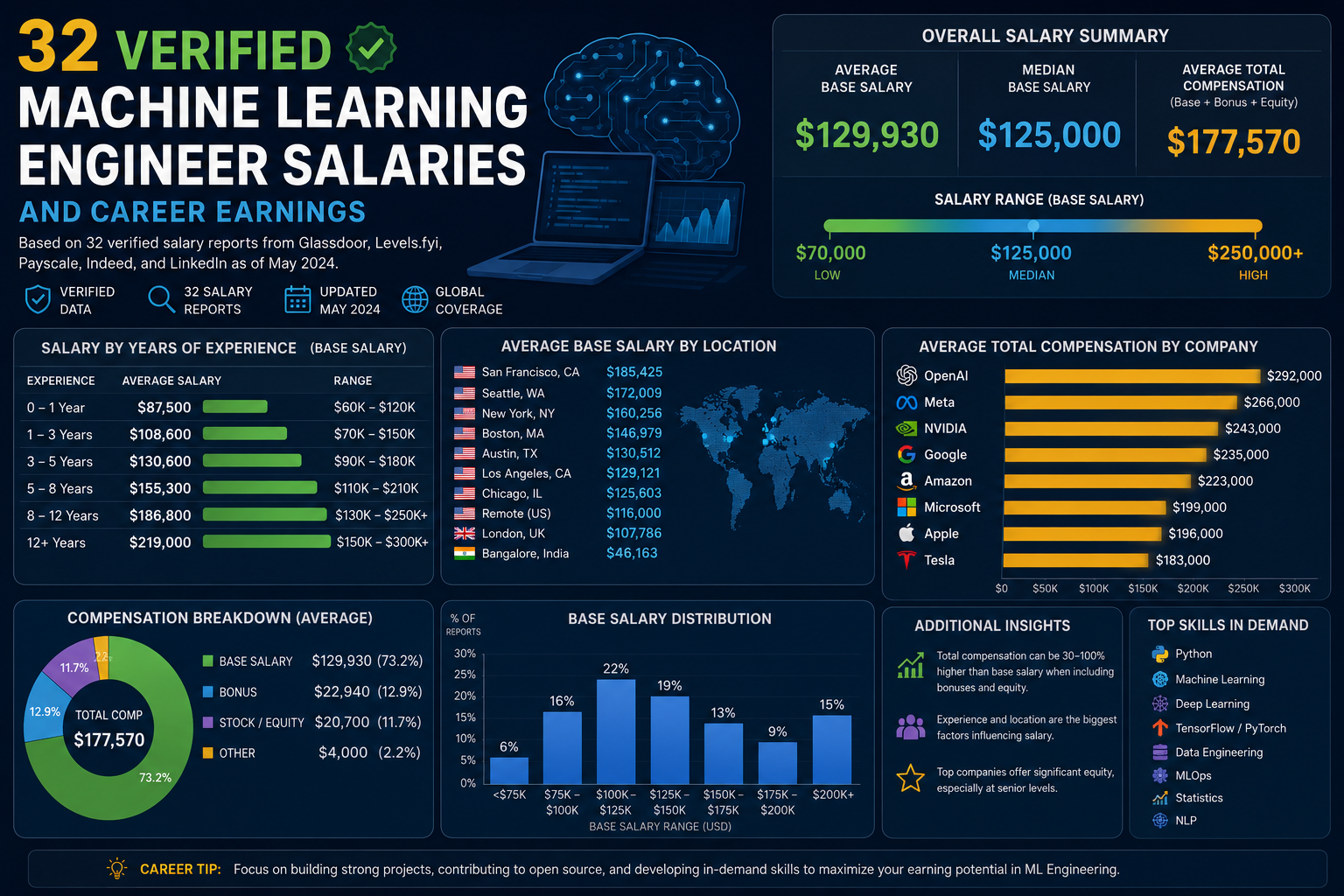
Machine learning engineering has become one of the most financially rewarding careers in the technology industry, but compensation in this field is far from uniform. Unlike traditional roles where salaries follow relatively predictable ranges, machine learning engineer pay varies widely depending on expertise, responsibilities, industry demand, and the complexity of systems being built.
At a basic level, most machine learning engineer compensation packages are structured around a combination of base salary, performance bonuses, and equity or stock options. However, the proportions of these components differ significantly from one organization to another. Large technology companies often offer substantial stock-based compensation, while startups may compensate with lower base salaries but higher equity potential.
What makes this field particularly interesting is that salary is not strictly tied to years of experience. Instead, compensation is heavily influenced by practical ability—especially the capacity to deploy and scale machine learning systems in production environments. Engineers who can demonstrate real-world impact often command significantly higher salaries, even if they are not the most senior in terms of years worked.
In recent years, demand for machine learning engineers has pushed salaries upward across nearly all experience levels. Entry-level professionals now often start at compensation levels that were once reserved for mid-level software engineers. Meanwhile, senior machine learning engineers working in high-demand industries frequently earn salaries that exceed traditional engineering roles by a substantial margin.
This upward pressure is driven by a shortage of qualified professionals who can handle both machine learning concepts and production engineering challenges. Organizations are no longer looking for individuals who can simply build models—they need engineers who can ensure those models perform reliably at scale under real-world conditions.
Understanding how salaries are structured in this field requires looking beyond headline figures and examining the specific factors that influence compensation. These include technical skill sets, industry specialization, geographic location, company type, and the ability to manage complex machine learning infrastructure.
Entry-Level Machine Learning Engineer Compensation and Expectations
Entry-level machine learning engineers typically enter the field with strong academic backgrounds in computer science, mathematics, data science, or related technical disciplines. However, academic knowledge alone is not enough to secure top-tier compensation in most cases. Employers expect early-career professionals to demonstrate hands-on experience with real machine learning projects.
At this stage, salaries are already relatively high compared to many other industries. Entry-level professionals are often tasked with supporting model development, cleaning datasets, assisting in pipeline construction, and contributing to basic deployment tasks. While they may not lead major projects, their role is still critical in supporting production systems.
One of the defining characteristics of entry-level compensation in machine learning engineering is rapid growth potential. Engineers who quickly gain experience in deployment, cloud systems, and model optimization often see significant salary increases within a short period. Unlike many traditional career paths, progression in this field can be accelerated through skill acquisition rather than time alone.
Employers place strong emphasis on practical ability at this stage. Candidates who can demonstrate familiarity with machine learning frameworks, programming languages, and data pipelines often have an advantage. More importantly, those who have built and deployed real projects—even small ones—tend to stand out significantly.
Entry-level engineers are also expected to learn quickly. The machine learning ecosystem evolves rapidly, and new tools, libraries, and techniques emerge constantly. Companies value adaptability and curiosity because these traits indicate long-term potential for growth.
Another important aspect of early-career compensation is exposure to production systems. Engineers who gain early experience working with deployment pipelines, cloud infrastructure, or monitoring systems often accelerate their salary progression. This is because production knowledge is one of the most valuable and scarce skills in the industry.
While base salaries for entry-level machine learning engineers are already competitive, total compensation can increase significantly when companies include bonuses or equity. Startups, in particular, may offer equity packages that provide long-term financial upside if the company succeeds.
Mid-Level Machine Learning Engineers and Rapid Salary Growth
Mid-level machine learning engineers typically have several years of experience working on real-world AI systems. At this stage, professionals are expected to take ownership of entire machine learning workflows, from data preparation and model development to deployment and monitoring.
This is often where salary growth becomes most noticeable. Engineers at the mid-level stage begin to transition from supporting roles into independent contributors who can manage complex systems with minimal supervision. As a result, companies are willing to offer significantly higher compensation to retain them.
Mid-level engineers often work on production systems that directly impact business outcomes. They may be responsible for recommendation systems, fraud detection models, search ranking algorithms, or predictive analytics tools. Because these systems are critical to business performance, engineers who maintain them become highly valuable.
One of the biggest salary drivers at this stage is specialization. Engineers who develop expertise in areas such as natural language processing, computer vision, or MLOps often earn more than generalist machine learning engineers. Specialized skills are harder to replace and therefore more highly rewarded.
Cloud expertise also becomes increasingly important at the mid-level stage. Companies expect engineers to understand how to deploy models using cloud platforms, manage scalable infrastructure, and optimize system performance. Engineers who can work effectively with cloud-based machine learning services often move into higher compensation brackets.
Another factor influencing mid-level salaries is ownership. Engineers who take responsibility for end-to-end machine learning systems tend to earn more than those who only contribute to specific parts of a pipeline. Ownership includes designing systems, making architectural decisions, and ensuring long-term reliability.
Mid-level professionals are also expected to collaborate more closely with cross-functional teams. Communication skills become increasingly important because engineers must explain technical concepts to non-technical stakeholders and align machine learning systems with business objectives.
At this stage, career progression is often closely tied to impact. Engineers who can demonstrate measurable improvements in system performance, efficiency, or business outcomes tend to advance more quickly. Companies are willing to invest in professionals who can clearly contribute to organizational success.
Senior Machine Learning Engineers and High-Value Expertise
Senior machine learning engineers represent the highest level of technical expertise in the field. These professionals typically have extensive experience designing, building, and scaling complex machine learning systems across multiple environments.
At this level, compensation can increase significantly due to the strategic importance of the role. Senior engineers are often responsible for guiding technical direction, making architectural decisions, and solving highly complex engineering challenges that impact entire organizations.
One of the key characteristics of senior machine learning engineers is system-level thinking. Rather than focusing on individual models or components, they design entire machine learning ecosystems. This includes data pipelines, training infrastructure, deployment systems, monitoring frameworks, and optimization strategies.
Senior engineers often lead machine learning initiatives that directly influence business outcomes. Their decisions can affect user experience, operational efficiency, revenue generation, and long-term product strategy. Because of this high level of responsibility, companies are willing to offer premium compensation packages.
In many organizations, senior machine learning engineers also take on leadership roles. They may mentor junior engineers, guide technical teams, and contribute to hiring decisions. This combination of technical and leadership responsibilities further increases their value within the company.
A major factor influencing senior-level compensation is specialization in high-demand areas. Engineers with expertise in generative AI systems, large-scale distributed computing, or real-time machine learning pipelines are especially valuable in today’s market.
Experience with production-scale systems is also essential. Senior engineers are expected to understand how to maintain system reliability under heavy load, manage infrastructure failures, and optimize performance in real-time environments.
At this level, engineers often work closely with executive leadership. They may contribute to strategic planning, technology roadmaps, and long-term AI initiatives. Their role becomes less about individual coding tasks and more about shaping the direction of machine learning within the organization.
Because of the combination of technical depth and strategic responsibility, senior machine learning engineers consistently rank among the highest-paid professionals in the technology industry.
Key Factors That Influence Machine Learning Engineer Salaries
While experience level plays an important role in determining compensation, it is not the only factor that influences salary in machine learning engineering. Several additional variables significantly impact earning potential.
One of the most important factors is the technical skill set. Engineers who specialize in high-demand tools and frameworks often earn more than those with general experience. Skills related to deep learning, distributed systems, and MLOps are especially valuable.
Another major factor is industry. Machine learning engineers working in finance, healthcare, autonomous systems, or large-scale technology companies tend to earn more than those in academic or non-profit environments. These industries often rely heavily on machine learning for core operations and are willing to invest more in talent.
Company size also plays a role. Large technology companies often provide higher total compensation through stock-based packages, while smaller startups may offer lower base salaries but greater equity potential. Each structure has different financial implications depending on the company’s performance.
Geographic location has historically been one of the strongest influences on salary. Technology hubs tend to offer higher compensation due to increased competition for talent and higher living costs. However, remote work trends are gradually reducing the impact of location in some cases.
Another important factor is production experience. Engineers who have successfully deployed machine learning systems into real-world environments are significantly more valuable than those with only theoretical or experimental experience. Production expertise demonstrates the ability to handle real operational challenges.
Cloud computing skills also strongly influence salary levels. Familiarity with platforms such as AWS, Google Cloud, or Azure is often required for modern machine learning roles. Engineers who can design scalable cloud-based systems tend to earn more.
Communication and collaboration skills can also affect compensation indirectly. Machine learning engineers who can clearly explain technical concepts and work effectively with cross-functional teams often progress more quickly into higher-paying roles.
Finally, the ability to adapt to new technologies is increasingly important. The machine learning field evolves rapidly, and engineers who continuously update their skills tend to remain more competitive in the job market.
Industry Demand and Its Direct Impact on Salaries
The demand for machine learning engineers continues to rise across nearly every major industry, and this demand has a direct impact on salary levels. As more organizations adopt AI-driven systems, competition for skilled engineers intensifies.
Technology companies remain the largest employers of machine learning engineers, but other industries are quickly catching up. Financial institutions use machine learning for fraud detection and algorithmic trading. Healthcare organizations rely on AI for diagnostics and patient care optimization. Retail companies use recommendation systems and demand forecasting models.
Manufacturing and logistics companies are also increasing their use of machine learning to improve efficiency and reduce operational costs. These industries often require engineers capable of working with large-scale data systems and real-time decision-making models.
The expansion of generative AI has further increased demand across industries. Businesses are now integrating AI-powered tools into customer service, content generation, marketing, and internal workflows. This shift has created additional demand for engineers who understand large-scale AI deployment.
As demand increases, salary competition intensifies. Companies must offer higher compensation to attract and retain qualified professionals. This has led to a steady rise in average salaries across all experience levels.
Another important factor is the global shortage of experienced machine learning engineers. While interest in the field is growing rapidly, the number of professionals with production-level experience remains relatively limited. This imbalance between supply and demand continues to push salaries upward.
Organizations are also willing to pay more for engineers who can reduce time-to-market for AI products. Faster deployment of machine learning systems often translates into significant business advantages, making experienced engineers highly valuable.
The increasing complexity of machine learning systems further contributes to rising salaries. Modern AI systems often involve distributed computing, real-time processing, and large-scale infrastructure management. Engineers capable of handling these challenges are in high demand.
As machine learning becomes more deeply integrated into business operations, its importance continues to grow. This ensures that demand for skilled engineers—and their corresponding salaries—will remain strong for the foreseeable future.
Geographic Differences in Machine Learning Engineer Salaries
Location has always played a major role in determining technology salaries, and machine learning engineering is no exception. Even in an increasingly remote-friendly world, geography still influences compensation because it affects the cost of living, access to top employers, industry concentration, and local demand for specialized talent.
In major technology hubs, machine learning engineers consistently earn some of the highest salaries in the world. Cities with dense concentrations of tech companies, venture capital funding, and AI-focused startups tend to offer premium compensation packages to attract skilled professionals. These regions often include well-established ecosystems where talent competition is intense, and companies must offer higher salaries to remain competitive.
However, salary differences between locations are not only about competition. They also reflect the complexity of work being done in different regions. In advanced tech hubs, machine learning engineers are more likely to work on large-scale systems, cutting-edge research applications, or high-impact production environments. These responsibilities naturally justify higher compensation levels.
At the same time, smaller cities and emerging tech regions have become increasingly attractive due to lower living costs and expanding remote opportunities. While base salaries in these locations may be lower, the difference is often balanced by reduced expenses and improved work-life stability. In some cases, remote roles even allow engineers to earn major-market salaries while living in lower-cost areas.
This geographical flexibility has reshaped how machine learning engineers evaluate career opportunities. Instead of focusing solely on salary numbers, many professionals now consider total compensation value, including lifestyle, cost of living, and long-term career growth potential.
Machine Learning Salaries in Major Technology Hubs
Large technology hubs remain the most lucrative markets for machine learning engineers. These cities host major technology corporations, AI startups, research labs, and cloud infrastructure providers. As a result, demand for skilled professionals is extremely high, and salaries reflect this competitive environment.
In these regions, machine learning engineers often work on highly complex systems involving large-scale data processing, advanced deep learning models, and real-time AI applications. The technical demands of these roles contribute directly to higher compensation levels.
Another reason salaries are elevated in these areas is the presence of global tech companies. Large organizations compete aggressively for top talent, often offering generous compensation packages that include base salary, performance bonuses, and stock-based incentives. These companies understand that machine learning engineers play a critical role in building scalable AI systems that support millions of users.
Startup ecosystems in these hubs also influence salary trends. Well-funded startups often offer competitive pay to attract engineers who can help build core AI infrastructure from the ground up. While these roles may carry higher risk, they often provide strong financial upside through equity participation.
Additionally, the cost of living in major tech cities contributes to higher salary expectations. Housing, transportation, and general expenses tend to be significantly higher in these areas, prompting employers to adjust compensation accordingly.
However, working in major hubs also provides non-financial advantages. Engineers gain exposure to advanced projects, cutting-edge technologies, and highly experienced teams. This environment can accelerate career growth and technical development, making these locations attractive beyond just salary considerations.
Salaries in Mid-Tier and Emerging Tech Cities
Outside major technology hubs, machine learning engineer salaries remain strong but generally fall within a more moderate range. Mid-tier cities often include growing tech ecosystems, regional headquarters of large companies, and expanding startup communities.
In these locations, machine learning engineers still earn competitive salaries, but compensation is typically adjusted to reflect the local cost of living. This creates a balance where professionals can enjoy strong earnings while benefiting from more affordable housing and lower overall expenses.
Many companies in these regions are in the process of scaling their AI capabilities. As a result, machine learning engineers often play a broader role, contributing to multiple aspects of machine learning systems. This can include data engineering, model development, deployment, and monitoring responsibilities.
One advantage of working in mid-tier cities is the opportunity for rapid skill development. Engineers often gain hands-on experience across the entire machine learning lifecycle, which can accelerate career progression. Because teams are smaller, individuals frequently take on more responsibility earlier in their careers.
Emerging tech cities are also increasingly attracting remote-friendly companies and distributed engineering teams. This trend has expanded opportunities for machine learning engineers outside traditional tech hubs, allowing them to access higher-paying roles without relocating.
While salaries in these regions may not match those in major tech hubs, the overall compensation package can still be very attractive when combined with lower living costs and improved lifestyle balance.
Remote Work and Its Impact on Salary Structures
The rise of remote work has significantly changed how machine learning engineer salaries are determined. In the past, compensation was heavily tied to geographic location. Today, many companies adopt hybrid or fully remote models that allow engineers to work from almost anywhere.
This shift has created both opportunities and challenges. On one hand, remote work allows engineers to access job opportunities previously limited to specific cities. On the other hand, some companies adjust salaries based on the employee’s location, creating variations in compensation for similar roles.
In fully remote organizations that adopt location-agnostic pay structures, machine learning engineers can earn top-tier salaries regardless of where they live. This approach is particularly common among large technology companies and globally distributed startups.
Remote work also expands the talent pool for employers, increasing competition for positions. As a result, companies often prioritize skill level and production experience over geographic proximity. Engineers with strong portfolios and real-world experience can therefore command high salaries even outside traditional tech hubs.
Another important factor in remote compensation is productivity expectations. Remote machine learning engineers are often expected to work independently, manage complex systems, and communicate effectively across distributed teams. Strong self-management skills can therefore indirectly influence career growth and salary progression.
However, remote work also introduces challenges related to collaboration and system complexity. Machine learning engineers must be comfortable working with distributed teams, managing asynchronous communication, and maintaining alignment across different time zones.
Overall, remote work has increased flexibility in the machine learning job market while also reshaping salary expectations across different regions.
Industry-Based Salary Differences in Machine Learning Engineering
Industry plays one of the most significant roles in determining machine learning engineer salaries. While the core technical skills remain similar across sectors, the value placed on machine learning varies widely depending on how critical AI is to a company’s operations.
Technology companies generally offer some of the highest compensation packages. These organizations rely heavily on machine learning for core products such as search engines, recommendation systems, advertising platforms, and cloud services. Because machine learning directly impacts revenue, these companies invest heavily in talent.
Financial services is another high-paying industry for machine learning engineers. Banks, hedge funds, and fintech companies use AI for fraud detection, algorithmic trading, credit scoring, and risk analysis. Since financial decisions often involve large sums of money, the stakes are high, and compensation reflects this importance.
The healthcare and life sciences industries also offer competitive salaries. Machine learning is increasingly used for medical imaging, patient diagnosis, drug discovery, and predictive healthcare analytics. Engineers working in these fields often deal with complex datasets and high-impact applications.
Autonomous systems and robotics represent another high-paying sector. Machine learning engineers in this field work on self-driving technology, industrial automation, drones, and advanced robotics systems. These applications require highly specialized knowledge and often involve real-time decision-making systems.
E-commerce and retail companies also hire machine learning engineers to build recommendation engines, pricing algorithms, and demand forecasting models. While salaries in this industry vary, top companies often offer strong compensation packages due to the scale of their data operations.
Manufacturing and logistics industries are increasingly adopting machine learning for predictive maintenance, supply chain optimization, and operational efficiency. While historically lower-paying, these sectors are becoming more competitive as AI adoption increases.
Government and academic research roles tend to offer lower salaries compared to private industry positions. However, they may provide other benefits such as research freedom, job stability, or opportunities to work on large-scale societal projects.
Skill-Based Salary Growth in Machine Learning Engineering
While location and industry influence salary levels, technical skills remain one of the most powerful factors in determining compensation for machine learning engineers. The field rewards individuals who continuously expand their expertise and adapt to evolving technologies.
Programming ability forms the foundation of machine learning engineering. Python is the dominant language, but familiarity with systems programming, distributed computing, and backend development can significantly increase earning potential.
Deep learning expertise is particularly valuable in today’s job market. Engineers who understand neural networks, transformer architectures, and large-scale model training often command higher salaries due to the demand for generative AI systems.
MLOps skills are also extremely important. These include model deployment, monitoring, versioning, automation, and pipeline orchestration. Engineers who can manage the full lifecycle of machine learning systems are especially valuable to organizations.
Cloud computing expertise significantly enhances salary potential. Knowledge of cloud platforms, scalable infrastructure, and serverless architecture is often required for modern machine learning roles.
Data engineering skills also play an important role. Machine learning systems rely heavily on high-quality data pipelines. Engineers who understand data transformation, storage systems, and distributed processing are in high demand.
System design ability is another critical factor. Machine learning engineers must often design architectures capable of handling large-scale data and real-time inference. Strong system design skills can lead to senior-level positions and higher compensation.
Soft skills such as communication and collaboration also influence career growth. Engineers who can clearly explain technical concepts and work effectively with cross-functional teams often advance more quickly into leadership roles.
Adaptability is perhaps one of the most important traits in this field. The machine learning ecosystem evolves rapidly, and engineers who continuously learn new tools and techniques tend to maintain higher long-term earning potential.
Experience Level and Its Long-Term Impact on Earnings
Experience remains a key driver of salary growth in machine learning engineering, but its impact is closely tied to skill development and real-world project exposure rather than time alone.
Early-career engineers typically focus on learning foundational concepts and supporting existing systems. As they gain experience, they begin contributing to more complex tasks such as model development and deployment.
Mid-career engineers often take ownership of full machine learning pipelines. They are responsible for designing systems, optimizing performance, and ensuring production stability. At this stage, salary increases become more substantial due to increased responsibility.
Senior engineers operate at a strategic level, designing large-scale machine learning systems and guiding technical direction. Their compensation reflects both their technical expertise and leadership responsibilities.
However, experience alone does not guarantee higher salary growth. Engineers who remain in limited roles without expanding their skill sets may see slower progression. In contrast, those who continuously develop expertise in new technologies often experience rapid career advancement.
The combination of experience, specialization, and production impact ultimately determines long-term earning potential in machine learning engineering.
Conclusion
Machine learning engineering has emerged as one of the most influential and financially rewarding career paths in the modern technology landscape. As artificial intelligence continues to move from experimental projects into core business infrastructure, the role of the machine learning engineer has shifted from a specialized niche to a central driver of innovation across industries.
The discussion of salaries, responsibilities, and industry demand makes one thing clear: compensation in this field is closely tied to real-world impact. Machine learning engineers are not only evaluated on their ability to build models but also on their ability to deploy, scale, and maintain systems that function reliably in production environments. This practical focus is what sets the profession apart from many other technical roles.
Across different experience levels, salary growth reflects increasing responsibility rather than just time spent in the industry. Entry-level engineers begin by supporting data preparation and model development, while mid-level professionals take ownership of full machine learning pipelines. Senior engineers, meanwhile, shape architecture decisions, lead teams, and influence long-term AI strategy. Each stage brings higher compensation as well as greater technical and organizational responsibility.
Geography, industry, and specialization further shape earning potential. Technology hubs, high-growth industries such as finance and healthcare, and advanced domains like generative AI and MLOps tend to offer significantly higher salaries due to increased demand and system complexity. At the same time, remote work has introduced greater flexibility, allowing skilled engineers to access competitive compensation without strict location constraints.
Ultimately, the machine learning engineering field rewards continuous learning and adaptability. The rapid evolution of tools, frameworks, and AI capabilities means that professionals who consistently upgrade their skills remain in high demand. Expertise in cloud computing, deployment systems, and large-scale machine learning infrastructure is especially valuable in today’s market.
As organizations continue to integrate artificial intelligence into every aspect of their operations, the importance of machine learning engineers will only increase. Their work sits at the intersection of data, software, and business strategy, making them essential contributors to the future of technology-driven innovation.