The AWS Cloud has become a foundational layer for how modern organizations build, deploy, and scale digital systems. It is not just a collection of hosting services but an entire ecosystem that allows companies to operate with flexibility, speed, and cost efficiency that traditional infrastructure struggles to match. Businesses rely on AWS to run applications, store massive datasets, support global users, and automate operations that once required large physical infrastructure and complex maintenance.
What makes AWS particularly impactful is how it enables transformation at every level of a company. Startups can launch products without investing heavily in hardware, while large enterprises can optimize global operations with high availability and redundancy. This shift has created a strong demand for professionals who understand how AWS works at a functional level and can guide decisions that affect performance, security, and cost. As organizations continue to migrate toward cloud-first strategies, the importance of foundational cloud knowledge has grown significantly.
Why Cloud Understanding Has Become a Core Professional Skill
Cloud computing is no longer limited to specialized IT departments. It has become a general business competency that influences decision-making across multiple roles. Whether it is finance teams analyzing cloud costs, project managers planning digital transformation initiatives, or technical teams building scalable applications, cloud awareness is now essential.
AWS plays a major role in this shift because it dominates a large portion of the cloud market and offers a wide range of services that support nearly every business function. Understanding how these services interact helps professionals contribute more effectively to strategic discussions. Even individuals who are not deeply technical benefit from knowing how cloud architecture supports business goals like scalability, reliability, and security.
This growing need for cloud literacy is one of the primary reasons certifications like the AWS Certified Cloud Practitioner have gained attention. They provide structured learning that helps individuals understand cloud concepts without requiring advanced engineering experience.
What the AWS Certified Cloud Practitioner Certification Represents
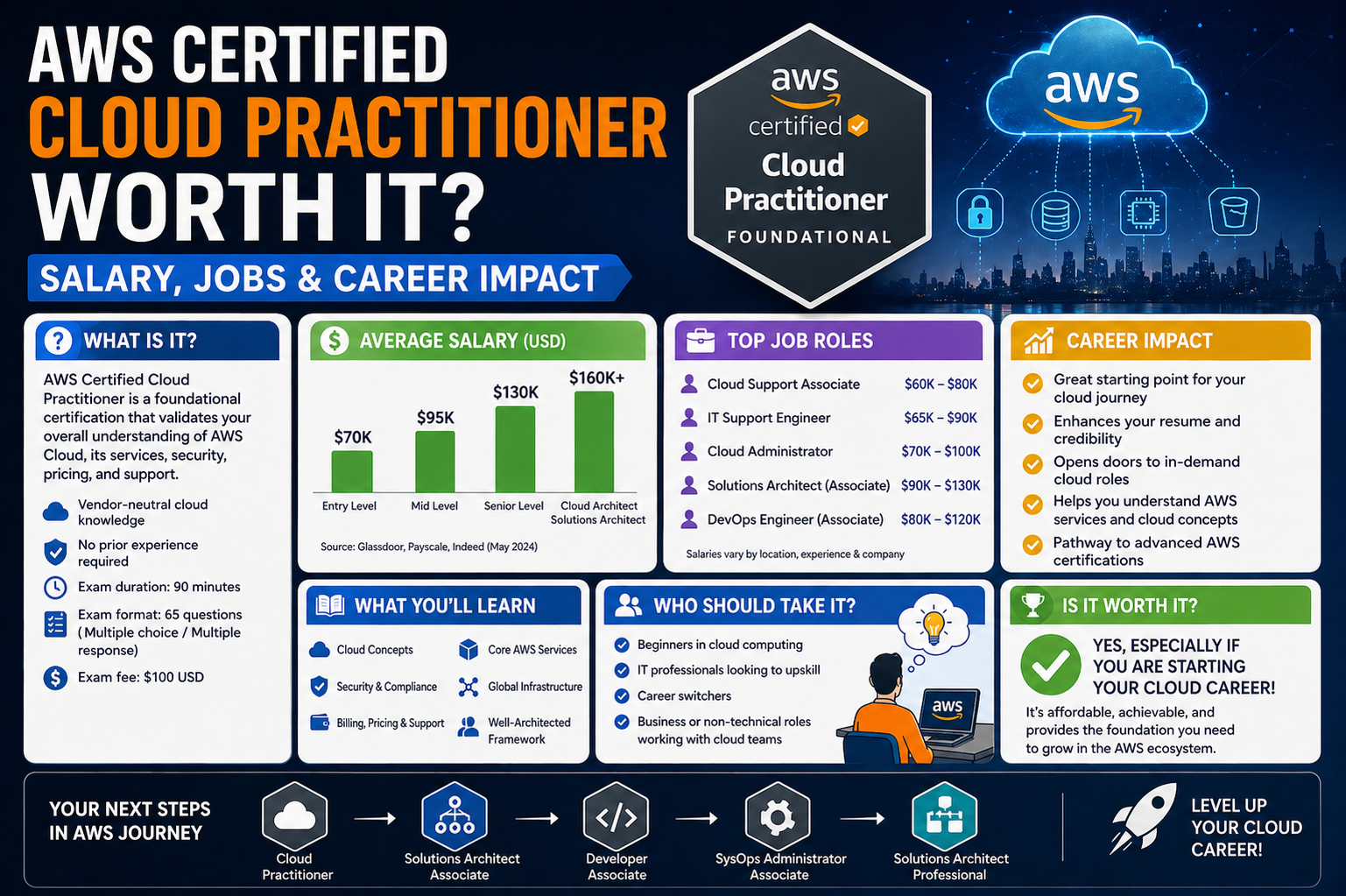
The AWS Certified Cloud Practitioner certification is designed to validate foundational knowledge of the AWS ecosystem. It does not focus on deep technical implementation but instead emphasizes understanding core concepts, services, and business-related cloud principles.
Earning this certification demonstrates that an individual understands how AWS operates at a high level, including its basic architecture, pricing models, and key service categories. It also shows awareness of security principles and how cloud services support business operations. This makes it especially valuable for individuals who interact with cloud environments but may not build or manage them directly.
Rather than preparing someone for a highly specialized technical role, the certification builds a broad understanding that can be applied across multiple job functions. It serves as an entry point into cloud learning and creates a foundation for more advanced AWS certifications in the future.
How Organizations Benefit from Cloud Practitioners
Companies increasingly depend on professionals who can bridge the gap between technical teams and business stakeholders. Cloud practitioners play a key role in this area by helping translate technical cloud capabilities into business value. They can explain how cloud adoption affects cost structures, operational efficiency, and system reliability.
For example, understanding how AWS pricing works allows professionals to contribute to budgeting discussions and identify opportunities for cost optimization. Similarly, knowledge of core services helps teams choose the right tools for specific business needs, whether it involves computing power, data storage, or application integration.
Organizations also benefit from having individuals who understand cloud security fundamentals. With cyber threats becoming more sophisticated, even non-technical stakeholders are expected to recognize basic security responsibilities and compliance considerations. This awareness reduces risk and improves decision-making across departments.
Breadth of Knowledge Covered in the Certification
One of the defining characteristics of the AWS Certified Cloud Practitioner certification is its broad scope. Instead of focusing deeply on one technical area, it introduces learners to a wide range of AWS services and concepts. These include computing, storage, networking, databases, security, and cost management.
This broad exposure helps individuals understand how different components of the AWS ecosystem work together. For instance, computing services handle processing tasks, storage services manage data retention, and networking services enable communication between systems. Understanding how these layers interact provides a clearer picture of cloud architecture as a whole.
The certification also introduces foundational knowledge of tools used for monitoring, automation, and cost optimization. While it does not require mastery of these tools, familiarity with them helps individuals make informed decisions when working in cloud-related environments.
Understanding the Business Value of Cloud Computing
Beyond technical awareness, the AWS Certified Cloud Practitioner emphasizes the business impact of cloud technology. This includes understanding how cloud adoption affects cost efficiency, scalability, and operational agility.
Cloud computing allows businesses to shift from capital-intensive infrastructure investments to flexible, usage-based pricing models. This change can significantly reduce upfront costs and improve financial predictability. It also enables organizations to scale resources up or down based on demand, which is especially valuable for businesses with fluctuating workloads.
The certification helps learners understand these concepts so they can participate in strategic discussions about technology investments. Instead of viewing cloud services purely from a technical perspective, individuals gain insight into how these services support broader organizational goals.
Entry-Level Accessibility and Learning Pathway
The AWS Certified Cloud Practitioner certification is often considered an entry point into the cloud computing field. It is designed to be accessible to individuals with limited or no prior AWS experience, making it suitable for beginners who want to build a career in cloud-related roles.
Despite being entry-level, it still requires structured preparation because it covers a wide range of topics. Learners must understand basic cloud principles, service categories, security concepts, and pricing models. This structured approach helps build a strong foundation that can support more advanced learning later.
Many professionals use this certification as a stepping stone toward more specialized AWS certifications. It provides the conceptual groundwork needed to move into roles such as cloud architecture, cloud engineering, or DevOps support. Even those who do not pursue advanced certifications often find value in the foundational knowledge it provides.
Common Misunderstandings About the Certification
One common misconception is that the AWS Certified Cloud Practitioner is too basic to provide real value. While it is true that it does not focus on deep technical skills, its purpose is not to replace advanced certifications. Instead, it is designed to build awareness and understanding of cloud fundamentals.
Another misunderstanding is that it is only useful for technical professionals. In reality, many non-technical roles benefit significantly from this certification. Professionals in finance, project management, sales, and operations often interact with cloud-based systems and benefit from understanding how AWS services function.
Some also assume that the certification guarantees job placement or advanced technical ability. While it enhances credibility and knowledge, it is best viewed as a foundational credential rather than a complete career qualification.
Importance of Cloud Awareness in Career Development
As industries continue to digitize, cloud awareness has become an important career asset. Employers increasingly expect professionals to understand how cloud systems impact business operations, even if they are not directly responsible for managing infrastructure.
The AWS Certified Cloud Practitioner helps bridge this gap by introducing essential cloud concepts in a structured way. This knowledge can improve communication between technical and non-technical teams, making collaboration more efficient and reducing misunderstandings in project execution.
For individuals early in their careers, this certification can also improve employability by demonstrating initiative and foundational knowledge of cloud computing. It signals that the candidate is aware of modern technology trends and is prepared to engage with cloud-based environments.
Relevance Across Different Professional Roles
The value of the AWS Certified Cloud Practitioner varies depending on the role of the individual. For technical professionals, it serves as a foundational stepping stone. For non-technical professionals, it provides essential awareness needed for decision-making. For managers and team leads, it enhances the ability to oversee cloud-related projects effectively.
In all cases, the certification helps build a shared understanding of cloud terminology and concepts. This shared understanding is critical in environments where multiple teams collaborate on cloud-based solutions.
Even professionals who do not work directly with AWS services benefit from knowing how cloud systems influence budgeting, security policies, and operational workflows. This makes the certification broadly applicable across industries.
Foundational Role in the AWS Certification Path
The AWS Certified Cloud Practitioner certification often serves as the first step in a larger certification journey. It prepares learners for more advanced AWS certifications by introducing core concepts that are expanded upon in specialized tracks.
While it does not dive deeply into technical implementation, it ensures that learners are familiar with essential terminology and cloud principles. This makes it easier to transition into more complex topics such as architecture design, security engineering, and advanced cloud operations.
The certification is also valuable for reinforcing structured learning habits. By covering a wide range of topics, it encourages learners to develop a holistic understanding of cloud environments rather than focusing narrowly on a single tool or service.
Growing Demand for Cloud Literacy in the Workforce
As cloud adoption continues to expand across industries, the demand for cloud-literate professionals is increasing. Organizations are not only looking for engineers who can build systems but also for individuals who can understand and communicate cloud strategies effectively.
The AWS Certified Cloud Practitioner helps meet this demand by providing a standardized introduction to cloud concepts. It ensures that professionals across different roles share a common baseline of knowledge, which improves collaboration and decision-making.
This growing emphasis on cloud literacy reflects a broader shift in how businesses operate. Cloud computing is no longer a niche skill but a core component of modern digital infrastructure, making foundational certifications increasingly relevant in today’s workforce.
Understanding the Exam Structure and Format
The AWS Certified Cloud Practitioner exam is designed to evaluate foundational cloud knowledge in a structured and standardized way. It consists of multiple-choice and multiple-response questions that test both conceptual understanding and practical awareness of AWS services. The exam is time-bound, requiring candidates to manage their pace effectively while ensuring accuracy across all questions. Instead of testing deep technical coding or architecture skills, it focuses on whether an individual understands how AWS functions at a broad level.
The structure of the exam is divided into four key knowledge domains, each representing a critical area of cloud understanding. These domains collectively assess how well a candidate can interpret cloud concepts, recognize AWS services, understand security principles, and evaluate pricing models. This balanced approach ensures that candidates are not overly specialized in one area but instead have a holistic understanding of the AWS ecosystem. The exam is intentionally designed to reflect real-world awareness rather than purely academic knowledge.
Core Domain of Cloud Concepts in Depth
The cloud concepts domain forms the foundation of the AWS Certified Cloud Practitioner exam. It focuses on the fundamental principles of cloud computing, including scalability, elasticity, and global infrastructure. Candidates are expected to understand how cloud environments differ from traditional on-premises systems and why organizations are increasingly adopting cloud-based solutions.
This domain also explores the value proposition of cloud computing from a business perspective. It highlights how cloud services enable organizations to innovate faster, reduce operational overhead, and scale resources based on demand. Understanding these concepts helps candidates grasp why cloud adoption has become a strategic priority for companies across industries. It also prepares individuals to explain cloud benefits in simple terms to non-technical stakeholders, which is an important professional skill in many roles.
Security and Compliance Knowledge Area
Security and compliance represent one of the most critical aspects of the AWS ecosystem, and the certification ensures candidates have a solid understanding of these principles. This domain introduces the shared responsibility model, which defines how security responsibilities are divided between AWS and the customer. Understanding this model is essential for recognizing what AWS manages and what the user must secure.
The domain also covers identity and access management concepts, encryption basics, and compliance frameworks used in cloud environments. Candidates learn how AWS provides tools to help organizations meet regulatory requirements and maintain secure systems. While the exam does not require deep technical configuration knowledge, it expects familiarity with how security principles are applied in cloud operations. This awareness is essential for anyone involved in decision-making or system planning.
Cloud Technology and Services Understanding
A significant portion of the certification focuses on AWS services and their practical use cases. This domain introduces a wide range of tools, including computing, storage, networking, database, and application integration services. Candidates are expected to recognize what each service does and when it should be used.
Rather than requiring deep technical expertise in each service, the exam emphasizes functional understanding. For example, candidates should know the difference between compute services like virtual servers and serverless functions, or understand how storage solutions vary based on performance and cost. This broad awareness allows individuals to participate in technical discussions and make informed recommendations even if they are not system builders.
The domain also highlights how AWS services work together to create scalable and reliable cloud architectures. This interconnected understanding is essential for building confidence in evaluating cloud-based solutions.
Billing, Pricing, and Cost Optimization Concepts
One of the most valuable aspects of the AWS Certified Cloud Practitioner certification is its focus on billing and pricing models. Cloud computing operates on a pay-as-you-go structure, which means organizations only pay for the resources they use. Understanding this model is essential for managing costs effectively and avoiding unnecessary expenses.
This domain introduces concepts such as pricing tiers, cost allocation tools, and budgeting strategies. Candidates learn how AWS provides visibility into usage and spending, allowing businesses to track and optimize their cloud costs. Knowledge of these principles is particularly useful for professionals involved in financial planning or resource management.
Cost optimization is a major advantage of cloud adoption, and this certification ensures that candidates understand how to identify opportunities for efficiency. This knowledge can directly influence decision-making in real-world business environments.
Real-World Skills Gained from Preparation
Preparing for the AWS Certified Cloud Practitioner exam provides more than just theoretical knowledge. It helps individuals develop practical awareness of how cloud systems operate in real-world environments. Even though the certification is entry-level, the learning process exposes candidates to a wide range of services and scenarios.
This exposure builds the ability to recognize appropriate cloud solutions for different business needs. It also helps individuals understand how cloud infrastructure supports applications, data storage, and global scalability. These skills are valuable in both technical and non-technical roles because they improve overall cloud literacy and communication.
In addition, preparation encourages structured thinking about technology decisions. Candidates begin to evaluate systems not just based on functionality but also on cost, security, and scalability considerations.
How the Certification Improves Decision-Making Ability
One of the key benefits of the AWS Certified Cloud Practitioner certification is its impact on decision-making skills. By understanding how cloud services function and how they are priced, professionals are better equipped to evaluate technology options in a business context.
This improved decision-making ability is especially important in organizations where cloud solutions are used across multiple departments. Even individuals who are not directly responsible for technical implementation can contribute meaningfully to discussions about resource allocation, system design, and vendor selection.
The certification helps build confidence in understanding trade-offs between different solutions. For example, choosing between performance and cost, or between managed and self-managed services, becomes easier when the underlying principles are well understood.
Impact on Entry-Level Cloud Careers
For individuals starting their careers in technology or IT-related fields, the AWS Certified Cloud Practitioner certification can serve as a strong foundation. It provides a recognized credential that demonstrates familiarity with cloud concepts, which is increasingly important in modern job markets.
Entry-level professionals often benefit from having a structured understanding of cloud environments before moving into more specialized roles. This certification helps build that foundation by introducing essential terminology and service categories. It also signals to employers that the candidate has taken initiative to learn industry-relevant skills.
While it does not guarantee advanced job roles, it can improve employability by strengthening a candidate’s profile. It also opens pathways to more advanced AWS certifications, which can lead to specialized technical positions.
AWS Cloud Practitioner vs Other Entry Certifications
When compared to other entry-level certifications in the cloud computing space, the AWS Certified Cloud Practitioner stands out due to its broad coverage and industry relevance. It does not focus on a single technical niche but instead provides an overview of the entire AWS ecosystem.
This makes it particularly suitable for individuals who are unsure about which specific cloud career path they want to pursue. It offers a general introduction that can later be expanded into more specialized certifications such as cloud architecture, security, or DevOps.
Other entry certifications may focus more heavily on technical implementation or specific vendor tools, but the AWS certification prioritizes conceptual understanding and business awareness. This difference makes it appealing to a wider audience, including non-technical professionals.
Common Challenges Candidates Face
Despite being an entry-level certification, candidates often face challenges when preparing for the AWS Certified Cloud Practitioner exam. One common difficulty is the wide range of services covered. Since the exam does not focus deeply on a single area, learners must become familiar with many different AWS tools and concepts.
Another challenge is understanding the differences between similar services. AWS offers multiple solutions for computing, storage, and networking, and distinguishing between them requires careful study. Candidates must also grasp pricing models and security principles, which can be complex for beginners.
Time management during the exam can also be a challenge, as candidates must quickly interpret questions and select the most appropriate answers without overthinking. This requires both knowledge and confidence built through preparation.
Effective Study Approach Without Overcomplication
Preparing for the AWS Certified Cloud Practitioner exam does not require overly complex study methods. A structured approach focused on understanding core concepts is usually sufficient. Candidates benefit from breaking down topics into categories such as cloud concepts, security, services, and pricing.
Consistent review and practical exposure to AWS terminology help reinforce understanding. Instead of memorizing isolated facts, learners should focus on how different services relate to each other and how they solve business problems.
Practice questions and scenario-based learning can also improve readiness by simulating exam conditions. This helps candidates become familiar with question patterns and improves their ability to apply knowledge effectively.
Practical Use of Knowledge in Workplace Scenarios
The knowledge gained from preparing for the AWS Certified Cloud Practitioner exam is directly applicable in many workplace scenarios. Professionals can use their understanding of cloud services to contribute to project planning, system evaluation, and cost discussions.
Even in non-technical roles, this knowledge improves communication with IT teams and helps align business goals with technical capabilities. For example, understanding cloud pricing models can help teams make more informed budgeting decisions, while knowledge of service categories can assist in selecting appropriate tools for specific tasks.
This practical application of knowledge is one of the key reasons why the certification holds value across different industries. It provides a shared language for discussing cloud technology, which enhances collaboration and decision-making within organizations.
Advanced Understanding of AWS Services in Context
The AWS Certified Cloud Practitioner certification, even though it is considered foundational, introduces learners to a surprisingly wide ecosystem of cloud services. In real-world usage, AWS is not just a single tool but a collection of interconnected services that work together to deliver complete digital solutions. Understanding how these services fit into broader workflows is one of the most valuable outcomes of preparing for this certification.
At a higher level, AWS services can be grouped into computing, storage, networking, databases, security, analytics, and application integration. The certification does not require deep configuration knowledge of each service, but it does expect recognition of their purpose. This distinction is important because in cloud environments, professionals are often required to make decisions about which service to use, even if they are not responsible for building it themselves.
For example, computing services are used to run applications and workloads, storage services manage data persistence, and networking services connect systems across regions. The ability to understand these categories allows professionals to evaluate solutions more effectively and communicate clearly with technical teams.
Computing Services and Their Practical Role
Computing services form the backbone of AWS operations, and the certification introduces candidates to how workloads are executed in the cloud. These services include traditional virtual machines as well as modern serverless computing models. Understanding the difference between these approaches is essential for grasping how AWS supports different types of applications.
Traditional computing models involve provisioning virtual servers where users manage operating systems and configurations. This approach provides flexibility but also requires more management responsibility. On the other hand, serverless computing allows applications to run without managing underlying infrastructure, automatically scaling based on demand.
The AWS Certified Cloud Practitioner exam emphasizes awareness of when each model is appropriate. This helps candidates understand how businesses choose between control, cost efficiency, and scalability. Even at a conceptual level, this knowledge is valuable because it reflects how modern cloud architecture decisions are made in real organizations.
Storage Systems and Data Management Concepts
Data storage is another core pillar of AWS, and the certification introduces different types of storage solutions designed for varying use cases. Some storage systems are optimized for frequent access and high performance, while others are designed for long-term archival and cost efficiency.
Understanding these differences helps professionals evaluate how organizations manage large volumes of data. In real-world scenarios, companies must decide how to balance speed, cost, and durability when storing information. AWS provides multiple storage tiers to support these needs, and the certification ensures candidates understand the purpose of each category.
Data management in the cloud is not just about storing files but also about organizing, securing, and retrieving information efficiently. This includes understanding how backup systems, redundancy, and replication contribute to data reliability. These concepts are essential for ensuring business continuity and minimizing the risk of data loss.
Networking Fundamentals in AWS Environments
Networking is a critical part of cloud infrastructure because it connects all services and enables communication between systems. The AWS Certified Cloud Practitioner certification introduces foundational networking concepts such as virtual networks, load balancing, and traffic distribution.
At a conceptual level, networking in AWS is about ensuring that applications can communicate securely and efficiently across different environments. This includes internal communication between services as well as external access for users around the world.
Load balancing is one of the key concepts introduced at this level. It ensures that incoming traffic is distributed evenly across multiple resources, improving performance and reliability. Understanding these principles helps candidates appreciate how large-scale applications maintain stability even under heavy usage.
Security Principles and Shared Responsibility Model
Security remains one of the most important themes in the AWS Certified Cloud Practitioner certification. The shared responsibility model is a central concept that defines how security responsibilities are divided between AWS and its customers.
In simple terms, AWS is responsible for securing the infrastructure that runs cloud services, while customers are responsible for securing their data, applications, and configurations. This distinction is critical because misunderstanding it can lead to security vulnerabilities.
The certification also introduces identity and access management concepts, which control who can access specific resources within an AWS environment. These principles help ensure that only authorized users can perform certain actions, reducing the risk of unauthorized access.
Encryption is another important topic, ensuring that data remains protected both in transit and at rest. Even though the certification does not require technical implementation skills, understanding these concepts is essential for evaluating secure cloud solutions.
Business Applications and Real-World Cloud Use Cases
One of the most valuable aspects of the AWS Certified Cloud Practitioner certification is its focus on real-world business applications. Cloud computing is not just a technical concept; it directly influences how businesses operate, scale, and innovate.
AWS services are used in industries ranging from healthcare and finance to entertainment and retail. Each industry uses cloud technology differently based on its needs. For example, healthcare organizations prioritize secure data storage and compliance, while entertainment companies focus on scalability and content delivery.
Understanding these use cases helps candidates see how cloud computing solves real business problems. It also allows them to connect technical concepts with practical outcomes, which is a valuable skill in both technical and non-technical roles.
Cost Management and Financial Awareness in Cloud Usage
Cloud computing introduces a unique financial model where businesses pay based on usage rather than fixed infrastructure costs. The AWS Certified Cloud Practitioner certification emphasizes understanding this pricing structure because it directly affects business decision-making.
Candidates learn how cloud costs can vary based on resource consumption, service selection, and geographic usage. This awareness helps professionals identify opportunities to optimize spending and avoid unnecessary expenses.
Cost management tools in AWS allow organizations to track usage patterns and forecast future spending. Understanding these tools, even at a conceptual level, enables professionals to participate in financial discussions related to cloud operations.
This financial awareness is particularly important because cloud costs can scale quickly if not managed properly. The certification helps build a mindset focused on efficiency and optimization.
Migration Concepts and Cloud Adoption Strategies
As organizations move from traditional infrastructure to cloud-based systems, migration becomes a critical topic. The AWS Certified Cloud Practitioner certification introduces basic concepts related to cloud migration and adoption strategies.
Cloud migration involves moving applications, data, and workloads from on-premises systems to cloud environments. This process can vary in complexity depending on the size and structure of the organization. Some migrations are simple and involve moving data storage, while others require complete system redesigns.
The certification helps candidates understand why organizations choose to migrate to the cloud. Common reasons include cost reduction, improved scalability, better performance, and increased reliability. Understanding these motivations helps professionals align technology decisions with business goals.
Importance of Serverless and Modern Architecture Awareness
Modern cloud architecture increasingly relies on serverless computing and managed services. The AWS Certified Cloud Practitioner certification introduces these concepts at a high level, helping candidates understand how cloud systems have evolved.
Serverless architecture allows developers to build applications without managing underlying servers. This reduces operational complexity and allows teams to focus on application logic rather than infrastructure management. It also improves scalability because resources are automatically adjusted based on demand.
Even though the certification does not require technical implementation of serverless systems, understanding the concept is important for recognizing modern cloud design trends. Many organizations are moving toward serverless and managed services to improve efficiency and reduce operational overhead.
Integration of AWS Services in Business Systems
One of the key strengths of AWS is the ability of its services to integrate seamlessly with each other. The AWS Certified Cloud Practitioner certification introduces the idea that cloud systems are not isolated tools but interconnected components of a larger ecosystem.
For example, computing services may work alongside storage systems and networking tools to deliver complete application solutions. This integration allows businesses to build complex systems without managing each component individually.
Understanding this interconnected nature of AWS services helps professionals see how cloud environments are structured. It also improves their ability to participate in discussions about system design and service selection.
Role of Monitoring and Optimization Tools
Monitoring and optimization are essential aspects of cloud management, and the certification introduces basic awareness of tools that help track system performance and resource usage.
These tools allow organizations to monitor application health, detect performance issues, and optimize resource allocation. Even at a foundational level, understanding their purpose helps professionals appreciate how cloud environments are maintained and improved over time.
Optimization is not just about performance but also about cost efficiency and resource utilization. AWS provides tools that help organizations identify unused or underutilized resources, allowing them to reduce unnecessary spending.
Building a Cloud Mindset Through Certification Preparation
One of the most significant outcomes of preparing for the AWS Certified Cloud Practitioner certification is the development of a cloud-focused mindset. Instead of thinking about technology in isolated terms, learners begin to see systems as interconnected services that support business objectives.
This mindset shift is valuable because it influences how professionals approach problem-solving. Instead of focusing solely on technical execution, they begin to consider scalability, cost, security, and reliability as part of every decision.
This broader perspective is what makes the certification valuable beyond its entry-level classification. It helps individuals think in terms of systems and outcomes rather than just tools and features.
Transitioning Toward Advanced Cloud Knowledge
The AWS Certified Cloud Practitioner certification is not an endpoint but a starting point for deeper cloud learning. It prepares individuals for more advanced certifications by building a strong conceptual foundation.
Once candidates understand the basics of AWS services, security, and pricing, they can move into specialized areas such as cloud architecture, DevOps practices, or security engineering. Each of these paths builds upon the foundational knowledge introduced in the Cloud Practitioner certification.
This progression ensures that learners develop both breadth and depth over time, starting with general awareness and gradually moving toward technical specialization.
Career Value and Industry Recognition of AWS Cloud Practitioner
The AWS Certified Cloud Practitioner holds meaningful value in today’s technology-driven job market because cloud computing has become a standard part of nearly every industry. Organizations across finance, healthcare, retail, education, logistics, and entertainment rely on cloud infrastructure to operate efficiently. As a result, professionals who understand cloud fundamentals are increasingly seen as valuable contributors, even if they are not deeply technical specialists.
One of the strongest advantages of this certification is its recognition by employers worldwide. AWS is one of the most widely adopted cloud platforms, and even entry-level certifications under its ecosystem carry weight in hiring decisions. Employers view the Cloud Practitioner certification as evidence that an individual understands essential cloud concepts, can communicate effectively with technical teams, and has a structured awareness of modern cloud environments.
This recognition is especially important in competitive job markets where candidates often need to demonstrate both technical awareness and business understanding. The certification helps bridge that gap by showing that a candidate is not completely new to cloud concepts and can participate in discussions involving cloud strategy and implementation.
Value for Career Beginners Entering the Tech Industry
For individuals entering the technology field for the first time, the AWS Certified Cloud Practitioner can serve as an important stepping stone. It provides structured exposure to cloud computing without requiring advanced programming or system administration skills. This makes it accessible for beginners who are still exploring which direction to take in their careers.
Many entry-level professionals struggle with the complexity of modern cloud ecosystems. AWS alone offers hundreds of services, which can feel overwhelming without guidance. The certification helps simplify this landscape by organizing knowledge into clear categories such as computing, storage, networking, security, and pricing.
By learning these fundamentals, beginners gain confidence in understanding how cloud systems operate. This confidence can improve interview performance, strengthen resumes, and provide clarity when pursuing more specialized roles later in their careers.
Relevance for Non-Technical and Business Professionals
The AWS Certified Cloud Practitioner is not limited to technical roles. In fact, its design makes it highly relevant for non-technical professionals who work alongside IT teams or make decisions influenced by cloud technology.
Professionals in finance, marketing, product management, operations, and sales often interact with cloud-based systems in some form. For these individuals, understanding AWS at a conceptual level improves communication with technical teams and supports better decision-making.
For example, a finance professional who understands cloud pricing models can contribute to cost optimization discussions. Similarly, a project manager with cloud awareness can plan timelines more realistically based on system capabilities and limitations. This shared understanding reduces miscommunication and improves collaboration across departments.
The certification therefore acts as a bridge between technical and non-technical roles, ensuring that business decisions are informed by a basic understanding of cloud infrastructure.
Value for IT Support and Infrastructure Roles
For IT support professionals and infrastructure administrators, the AWS Certified Cloud Practitioner provides a broader understanding of cloud ecosystems beyond traditional on-premises systems. Many IT roles are transitioning toward hybrid or fully cloud-based environments, making cloud literacy essential.
This certification helps IT professionals understand how AWS services replace or complement traditional infrastructure components. For instance, instead of managing physical servers, organizations may now use virtualized compute resources in the cloud. Instead of maintaining physical storage devices, they may rely on scalable cloud storage systems.
Understanding these shifts allows IT professionals to adapt to evolving job requirements and remain relevant in a rapidly changing industry. It also prepares them for more advanced certifications that focus on system administration, cloud architecture, or DevOps practices.
Limitations of the Certification and Realistic Expectations
While the AWS Certified Cloud Practitioner is valuable, it is important to understand its limitations. It is an entry-level certification designed for foundational knowledge, not advanced technical expertise. It does not prepare individuals to design complex cloud architectures or manage large-scale production environments independently.
One common misunderstanding is expecting the certification to lead directly to high-level technical roles. In reality, it serves as a starting point that must be followed by further learning and specialization. It builds awareness rather than deep technical mastery.
Another limitation is that it does not involve hands-on coding or system configuration in depth. While it introduces services and concepts, practical implementation skills must be developed through additional training or experience.
Despite these limitations, its value lies in providing clarity, structure, and direction for further learning. It helps individuals understand what areas of cloud computing they may want to specialize in later.
Long-Term Career Growth Potential
Although the AWS Certified Cloud Practitioner is an entry-level certification, it can play an important role in long-term career development. It acts as a foundation for more advanced AWS certifications, which are often required for specialized cloud roles.
Once individuals understand the basics, they can move toward certifications in cloud architecture, security engineering, DevOps, or machine learning. Each of these paths builds on the foundational knowledge gained from the Cloud Practitioner certification.
Over time, this progression can lead to high-level roles such as cloud engineer, solutions architect, cloud consultant, or DevOps engineer. These positions are in high demand and often offer strong career growth opportunities.
The certification also helps professionals stay adaptable in a rapidly changing technology landscape. As cloud computing continues to evolve, having a strong foundation makes it easier to learn new services and adapt to new industry trends.
Global Demand for Cloud Knowledge and Skills
The demand for cloud-related skills is not limited to a single region or industry. It is a global trend driven by digital transformation across organizations of all sizes. Companies are increasingly moving their operations to the cloud to improve efficiency, scalability, and innovation speed.
This global shift has created a strong demand for professionals who understand cloud fundamentals. Even if an individual is not working directly in a technical role, having cloud knowledge improves their employability and career flexibility.
The AWS Certified Cloud Practitioner helps meet this demand by providing a standardized introduction to cloud computing. It ensures that individuals across different regions and industries share a common understanding of cloud concepts.
This global recognition makes the certification a valuable credential for professionals seeking international career opportunities or remote roles in cloud-related fields.
Practical Impact on Workplace Communication
One of the often-overlooked benefits of the AWS Certified Cloud Practitioner is its impact on workplace communication. In many organizations, misunderstandings between technical and non-technical teams can slow down projects and lead to inefficiencies.
By providing a shared vocabulary for cloud concepts, the certification improves communication across departments. Professionals become more comfortable discussing topics such as cloud storage, computing resources, security policies, and cost management.
This improved communication leads to better collaboration and more efficient project execution. Teams can align more easily on goals, timelines, and resource requirements when everyone has a basic understanding of cloud terminology.
Return on Investment in Terms of Cost and Effort
The AWS Certified Cloud Practitioner is relatively affordable compared to many professional certifications. Its exam cost is low, and the preparation time is generally shorter than advanced certifications. This makes it an attractive option for individuals looking to gain a recognized credential without significant financial or time investment.
The return on investment comes from improved career opportunities, better job readiness, and increased confidence in cloud-related discussions. Even if it does not directly lead to a job promotion, it strengthens a professional profile and can improve chances of being selected for cloud-related roles or projects.
For many learners, the value lies not only in the certification itself but also in the structured learning process that leads to it. The knowledge gained during preparation often has long-term benefits in both technical and business environments.
Why Organizations Value Certified Cloud Practitioners
Organizations value employees who hold the AWS Certified Cloud Practitioner certification because it indicates a baseline understanding of cloud environments. This reduces training time and helps employees contribute more quickly to cloud-related projects.
Certified individuals are often better prepared to understand cloud strategies and participate in discussions about infrastructure planning and cost optimization. This makes them useful in cross-functional teams where cloud decisions impact multiple departments.
Organizations also benefit from having more employees who understand cloud security principles. Even basic awareness of security responsibilities can help reduce risks and improve compliance across systems.
Final Perspective
The AWS Certified Cloud Practitioner is best understood as a foundational credential that opens the door to cloud computing knowledge. Its true value lies not in technical depth but in accessibility, clarity, and broad applicability across roles.
It is particularly useful for beginners, non-technical professionals, and individuals transitioning into cloud-related careers. While it does not replace advanced certifications or hands-on experience, it provides the essential starting point needed to build a strong cloud career path.
In a world where cloud computing continues to shape how businesses operate, having even a foundational understanding of AWS is increasingly beneficial.