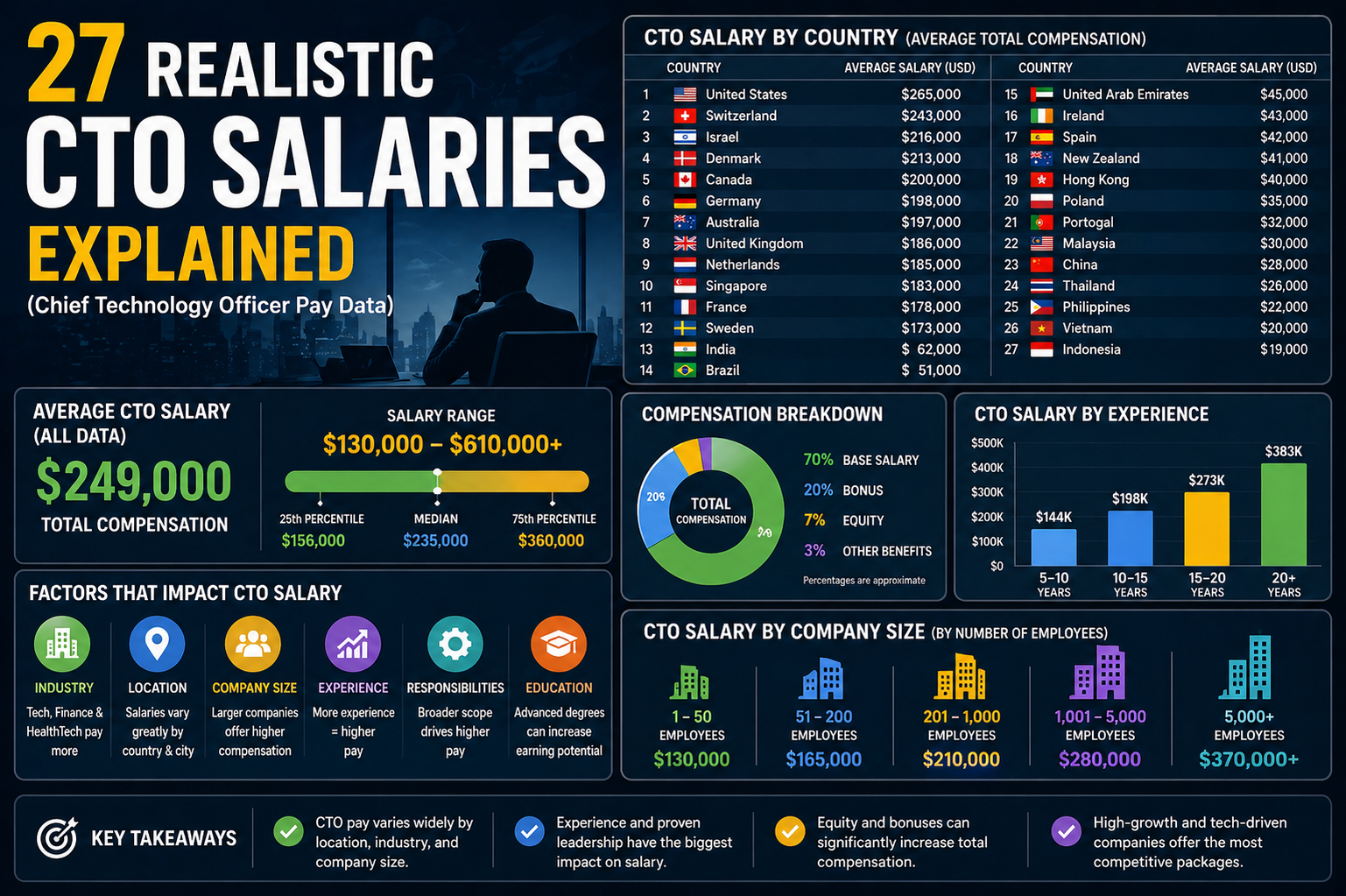
A Chief Technology Officer, often called a CTO, sits at the highest level of technical leadership within an organization. As businesses become increasingly dependent on technology for growth, efficiency, and innovation, the role of the CTO has shifted from being purely technical to deeply strategic. Today, CTOs are expected to shape the direction of entire companies through technology decisions that influence products, infrastructure, and long-term competitiveness. This evolution has also made the position one of the most financially rewarding roles in the tech and business world.
Understanding CTO compensation requires more than looking at a single average figure. Earnings differ significantly based on industry, company size, geographic location, leadership scope, and whether the CTO role is more technical or strategic. Because of this variation, salary transparency becomes essential. It helps professionals understand their market value and allows organizations to build competitive executive compensation packages that attract top-tier talent.
What a Chief Technology Officer Actually Is
A Chief Technology Officer is the executive responsible for guiding an organization’s technological direction. While the title might sound straightforward, the actual scope of the role is broad and often varies depending on the company’s structure, maturity, and goals. In smaller companies or startups, a CTO may be deeply involved in coding, product development, and system architecture. In larger enterprises, the role becomes more focused on leadership, strategy, and coordination across multiple departments.
At its core, the CTO ensures that all technological efforts align with business objectives. This means balancing innovation with practicality, cost efficiency with scalability, and short-term delivery with long-term vision. The CTO acts as the bridge between technical teams and executive leadership, ensuring that technology supports revenue growth, operational efficiency, and customer satisfaction.
Technology Strategy and Long-Term Vision
One of the most important responsibilities of a CTO is defining the technology strategy of the organization. This involves determining how technology will be used to achieve business goals over time. Rather than focusing on individual projects, the CTO develops a roadmap that guides infrastructure development, product engineering, system upgrades, and innovation initiatives.
This strategic planning often includes evaluating which technologies to adopt, which systems to scale, and which legacy systems need replacement. It also requires forecasting future trends in the industry, such as artificial intelligence, automation, cloud computing, and data analytics, and determining how those trends can be leveraged for competitive advantage. The CTO must ensure that technology investments deliver measurable business value rather than becoming unnecessary expenses.
Leadership of Engineering and Technical Teams
A major part of the CTO role involves managing and leading technical teams. This includes software engineers, DevOps specialists, IT professionals, architects, and sometimes data scientists or cybersecurity experts. In many organizations, team leads and engineering managers report directly or indirectly to the CTO.
Beyond simple management, the CTO is responsible for building a strong engineering culture. This includes hiring skilled professionals, defining performance standards, encouraging collaboration, and ensuring teams are aligned with organizational goals. In fast-growing companies, the CTO must also scale teams efficiently while maintaining productivity and technical quality.
Leadership in this context is not just about supervision but also about mentorship and direction. A strong CTO helps technical teams grow professionally while ensuring that the company’s engineering output remains consistent and reliable.
System Architecture and Technical Oversight
Another critical responsibility of a CTO is overseeing system architecture and ensuring that the organization’s technical infrastructure is stable, secure, and scalable. This includes making decisions about cloud infrastructure, databases, application frameworks, and integration systems.
The CTO must ensure that systems are designed to handle current demands while being flexible enough to support future growth. This involves careful planning around performance optimization, data security, disaster recovery, and system reliability. Poor architectural decisions can lead to long-term inefficiencies and high operational costs, making this responsibility one of the most technically demanding aspects of the role.
In addition, CTOs often work closely with cybersecurity teams to ensure that all systems are protected against threats. Security is no longer optional in modern businesses, and CTOs play a key role in enforcing best practices and compliance standards.
Collaboration With Executive Leadership
CTOs do not operate in isolation. They are part of the executive leadership team and regularly collaborate with roles such as the Chief Executive Officer, Chief Financial Officer, and Chief Operating Officer. This collaboration ensures that technology decisions align with financial planning, operational execution, and overall business strategy.
In executive meetings, the CTO is often responsible for explaining complex technical topics in simple terms so that non-technical leaders can make informed decisions. This requires strong communication skills and the ability to translate engineering concepts into business impact.
CTOs also participate in board-level discussions, especially in technology-driven companies. Their input can influence funding decisions, product direction, mergers, acquisitions, and long-term company strategy.
Evaluation of Emerging Technologies
Technology evolves rapidly, and one of the CTO’s ongoing responsibilities is to stay ahead of these changes. This includes monitoring advancements in artificial intelligence, cloud computing, machine learning, blockchain, and cybersecurity.
However, not every new technology is worth adopting. The CTO must evaluate whether emerging tools actually provide business value or simply add complexity. This requires a careful balance between innovation and practicality. For example, many organizations are currently exploring how artificial intelligence can be integrated into workflows, but the CTO must determine where it adds real efficiency and where it may introduce unnecessary risk or cost.
Technical Expertise and Strategic Thinking Balance
A successful CTO must combine deep technical knowledge with high-level strategic thinking. On the technical side, most CTOs have strong backgrounds in software engineering, cloud systems, DevOps practices, and cybersecurity. Many also have experience in building scalable systems and managing large-scale software projects.
However, technical ability alone is not enough. The CTO must also think strategically about how technology drives revenue, improves customer experience, and supports business expansion. This dual responsibility makes the role one of the most complex in any organization.
In addition to technical and strategic thinking, CTOs also rely heavily on leadership and communication skills. They must coordinate cross-functional teams, resolve conflicts, and ensure alignment across departments.
Tools and Platforms Used by CTOs
Although CTOs are not always hands-on developers, they must still be familiar with the tools used across engineering and IT teams. Cloud platforms such as AWS, Microsoft Azure, and Google Cloud are commonly used for infrastructure management. These platforms support everything from application hosting to data storage and machine learning services.
For development and deployment workflows, tools like Git-based version control systems, CI/CD pipelines, and containerization platforms are widely used. Project management and collaboration tools also play a significant role, helping CTOs track progress, assign tasks, and maintain visibility across teams.
In addition, analytics and business intelligence tools are used to measure system performance, user behavior, and operational efficiency. Communication platforms help maintain coordination between distributed teams, especially in global organizations where remote work is common.
Understanding CTO Compensation Landscape
While CTO responsibilities are extensive, their compensation reflects the importance of the role. Salaries vary widely depending on multiple factors such as company size, industry type, geographic region, and experience level. In general, CTO compensation can range from moderate executive-level salaries in smaller organizations to extremely high packages in large technology firms or fast-growing startups.
Location plays a particularly strong role in determining pay. Technology hubs typically offer higher salaries due to competition for talent and higher cost of living, while smaller cities may offer lower base salaries but better lifestyle balance. Industry also plays a major role, with sectors like fintech, artificial intelligence, and cybersecurity often offering higher compensation due to complexity and demand.
At this stage, it becomes clear that CTO salaries are not fixed or standardized. Instead, they are shaped by a combination of technical expertise, leadership responsibility, and business impact.
Early Understanding of Salary Variation Factors
Even before looking at exact salary figures, it is important to understand why CTO compensation varies so significantly. Companies in early growth stages often prioritize equity over base salary, offering ownership stakes in exchange for lower immediate pay. Larger enterprises, on the other hand, tend to offer structured compensation packages with higher salaries and performance-based bonuses.
The nature of the CTO role itself also influences pay. Some CTOs remain heavily involved in technical development, while others focus entirely on business strategy and leadership. Those with broader strategic responsibilities often command higher compensation due to their impact on overall company direction.
As the role becomes more senior and complex, compensation packages often expand to include bonuses, stock options, and long-term incentives. This makes total earnings significantly higher than base salary alone, especially in successful organizations.
Career Progression and Salary Growth for Chief Technology Officers
The career path of a Chief Technology Officer is rarely linear, and salary growth reflects that progression over time. Most CTOs do not start directly in executive roles. Instead, they move through a sequence of technical and leadership positions such as software engineer, senior developer, engineering manager, or head of engineering before reaching the CTO level. Each stage adds responsibility, decision-making authority, and exposure to business strategy, all of which gradually increase earning potential.
In the early stages of leadership, professionals are primarily focused on technical execution. Their responsibilities include writing code, reviewing systems, and contributing directly to product development. As they move into management roles, their focus shifts toward team coordination, project delivery, and mentoring junior engineers. These roles build the foundation for executive-level leadership by developing communication skills, strategic thinking, and operational oversight.
Once professionals transition into CTO positions, salary growth becomes more closely tied to organizational impact rather than technical output alone. The ability to scale teams, reduce operational inefficiencies, and align technology with business goals becomes more important than hands-on development work. As a result, compensation increases significantly with experience and proven leadership success.
Early Stage CTO Compensation and Responsibilities
First-time CTOs typically operate in startups, small businesses, or newly formed technology divisions within larger companies. At this stage, the role is often highly flexible and may combine responsibilities from multiple positions. A first-time CTO might oversee software development, infrastructure management, product planning, and even basic IT operations.
Because these roles are often in early-stage companies, base salaries tend to be lower compared to more established organizations. However, equity compensation is usually a major part of the package. This equity represents ownership in the company and can become highly valuable if the business grows successfully. In some cases, early CTOs accept lower salaries in exchange for a larger ownership stake, betting on future company valuation.
Despite lower base pay, early CTO roles provide critical experience. These positions allow professionals to develop leadership skills, learn how to scale technology systems, and understand how technical decisions impact business outcomes. This stage is often viewed as an investment in long-term career growth rather than immediate financial reward.
Mid-Level CTO Growth and Expanded Leadership Scope
As CTOs gain more experience, they typically move into mid-sized companies or rapidly scaling startups. At this stage, their responsibilities expand significantly. Instead of managing only technical execution, they begin overseeing entire engineering departments, coordinating cross-functional teams, and aligning technology strategy with business objectives.
Mid-level CTOs are often responsible for building scalable systems, improving development workflows, and ensuring product reliability. They also play a larger role in hiring senior engineering talent and establishing organizational structure within the technology department.
Salary levels at this stage increase considerably. Compensation is often structured as a combination of base salary, performance bonuses, and equity. While base pay is significantly higher than in early-stage roles, equity may still represent a meaningful portion of total compensation, especially in high-growth companies.
This stage also introduces more exposure to executive decision-making. Mid-level CTOs often collaborate closely with CEOs, product leaders, and financial executives to shape long-term company direction. This increased strategic involvement directly contributes to higher compensation levels, as the role becomes more central to business success.
Enterprise CTO Roles and High-Level Executive Compensation
Enterprise CTOs represent the highest tier of technical leadership within large organizations. These professionals are responsible for overseeing massive engineering teams, global infrastructure systems, and multimillion-dollar technology budgets. Their decisions impact not only product development but also business strategy, operational efficiency, and competitive positioning in the market.
At this level, the CTO role becomes almost entirely strategic. Enterprise CTOs focus on long-term planning, digital transformation initiatives, and organizational scalability. They are often involved in board-level discussions and may represent the company in investor meetings or public presentations.
Compensation for enterprise CTOs is significantly higher than earlier career stages. Base salaries are typically complemented by substantial bonuses and equity packages. In publicly traded companies, stock options and long-term incentive plans can make up a large portion of total earnings. These packages are designed to align executive performance with company success.
In addition to financial compensation, enterprise CTOs often receive executive benefits such as retirement contributions, private healthcare plans, relocation support, and performance-based incentives. The overall compensation structure reflects the high level of responsibility and organizational impact associated with the role.
Skill Expansion and Its Impact on CTO Earnings
As CTOs advance in their careers, continuous skill development becomes essential for increasing earning potential. While early technical expertise is important, long-term success in the role depends on expanding capabilities in areas such as business strategy, leadership, and operational management.
One of the most important skill areas for CTOs is strategic decision-making. This involves understanding market trends, identifying opportunities for innovation, and making technology investments that support long-term business goals. CTOs who demonstrate strong strategic thinking are often rewarded with higher compensation due to their broader organizational impact.
Leadership skills are equally important. CTOs must manage large and often geographically distributed teams, requiring strong communication, conflict resolution, and motivational abilities. The ability to build and maintain high-performing teams is directly linked to organizational success, which in turn influences executive compensation.
Another key skill area is financial literacy. CTOs are increasingly involved in budgeting, cost optimization, and return-on-investment analysis for technology projects. Understanding how technology decisions affect financial performance allows CTOs to contribute more effectively to executive discussions, increasing their value within the organization.
Specialization and Its Effect on CTO Salary Levels
Specialization within certain technology domains can significantly impact CTO compensation. CTOs who develop expertise in high-demand areas such as artificial intelligence, cybersecurity, cloud architecture, or data engineering often command higher salaries due to the complexity and importance of these fields.
Artificial intelligence specialization is particularly valuable in today’s market. CTOs with experience in machine learning systems, data infrastructure, and AI-driven product development are highly sought after by companies looking to integrate intelligent systems into their operations. This expertise often leads to premium compensation packages.
Cybersecurity specialization is another high-value area. As organizations face increasing digital threats, CTOs with deep knowledge of security architecture, risk management, and compliance frameworks are essential. Their role in protecting sensitive data and ensuring system integrity makes them highly valuable to employers.
Cloud architecture expertise is also critical in modern organizations. CTOs who understand how to design scalable cloud systems, optimize infrastructure costs, and manage distributed environments are in high demand, particularly in companies that rely heavily on digital platforms.
Remote Leadership and Changing Salary Structures
The rise of remote work has significantly changed how CTO compensation is structured. In the past, location played a major role in determining salary levels. Today, many organizations offer remote or hybrid CTO positions, allowing companies to hire talent regardless of geography.
This shift has created more standardized compensation structures in some cases, where salaries are based more on experience and skill level rather than location alone. However, some companies still adjust compensation based on regional cost of living differences.
Remote CTO roles also introduce new challenges. Managing distributed teams requires strong digital communication systems, clear workflows, and effective coordination across time zones. CTOs in these roles often rely heavily on collaboration platforms and cloud-based tools to maintain productivity and alignment.
Because of the added complexity of remote leadership, some organizations offer additional compensation or performance incentives for CTOs managing global teams. This reflects the increased responsibility associated with distributed operations.
Equity Growth and Long-Term Wealth Potential
One of the most important aspects of CTO compensation, especially in startups and high-growth companies, is equity. Unlike base salary, equity represents ownership in the company and has the potential to increase significantly in value over time.
In early-stage startups, CTOs often receive larger equity percentages in exchange for lower salaries. If the company grows successfully or undergoes acquisition or public listing, this equity can become extremely valuable. In some cases, equity earnings far exceed lifetime salary earnings.
In larger companies, equity is typically more structured and may come in the form of stock options, restricted stock units, or long-term incentive plans. While the percentage ownership is smaller, the overall value can still be substantial due to the scale of the organization.
Equity compensation introduces a long-term financial dimension to the CTO role. Unlike fixed salaries, equity rewards performance, company growth, and market success. This makes it one of the most powerful components of total CTO compensation.
Performance Metrics and Compensation Alignment
CTO compensation is often tied to performance metrics that reflect both technical and business outcomes. These may include system uptime, product delivery speed, engineering efficiency, revenue growth, or successful digital transformation initiatives.
In many organizations, bonuses and incentives are directly linked to achieving these performance targets. This ensures that CTOs are aligned with company objectives and are motivated to deliver measurable results.
Performance-based compensation structures also encourage innovation and efficiency. CTOs are incentivized to improve processes, reduce costs, and implement scalable solutions that support long-term business success.
As companies become more data-driven, the use of performance metrics in executive compensation continues to increase. This trend further strengthens the connection between CTO responsibilities and earning potential.
Advanced CTO Leadership and Executive Decision-Making Impact
At the highest level of a Chief Technology Officer’s career, the role becomes deeply intertwined with overall business leadership. Advanced CTOs are no longer evaluated solely on technical execution or team management. Instead, they are judged on how effectively they influence company direction, drive innovation, and contribute to long-term profitability. This shift in responsibility directly affects compensation, often placing senior CTOs among the highest-paid executives in an organization.
In mature companies, CTOs participate in shaping corporate strategy alongside other C-suite leaders. Their input influences product expansion, market entry decisions, mergers and acquisitions, and large-scale investment planning. This level of involvement requires a strong understanding of both technology and business economics. As a result, CTOs at this stage are expected to think like business leaders first and technologists second, even though their technical foundation remains essential.
Executive-level CTOs also act as representatives of the company’s technical vision to external stakeholders. This may include investors, board members, regulators, or strategic partners. Their ability to clearly communicate complex technical strategies in business terms becomes a critical asset. Companies value this skill highly, as it directly impacts funding decisions and market confidence, which in turn influences compensation levels.
Global Enterprise Complexity and Salary Expansion
In multinational organizations, CTO responsibilities expand significantly due to global operational complexity. These CTOs manage technology systems that span multiple countries, regulatory environments, and infrastructure ecosystems. They must ensure that all systems remain consistent, secure, and efficient while adapting to regional differences in compliance and market requirements.
Managing global engineering teams introduces additional challenges. CTOs must coordinate across time zones, cultural differences, and varying technical standards. This requires advanced leadership capabilities and strong organizational structure design. The complexity of these responsibilities is one of the key reasons why global CTO roles are among the most highly compensated positions in the technology sector.
In addition to technical oversight, global CTOs often participate in international expansion strategies. They evaluate new markets from a technological perspective, ensuring that infrastructure and product systems can support growth in different regions. This strategic influence further increases their value to the organization, resulting in higher compensation packages that often include significant bonuses and long-term equity incentives.
Strategic Influence on Business Growth and Revenue
One of the most important factors influencing high-level CTO compensation is their direct impact on business growth and revenue generation. Modern CTOs are expected to contribute not only to technical excellence but also to measurable business outcomes. This includes improving product performance, increasing system scalability, reducing operational costs, and enabling faster time-to-market for new features.
CTOs play a critical role in digital transformation initiatives, where companies transition from traditional systems to modern, cloud-based, and data-driven architectures. These transformations often have a direct impact on revenue growth and operational efficiency. CTOs who successfully lead such initiatives are highly valued, as their work can reshape entire business models.
In many organizations, CTOs also contribute to innovation strategies that lead to new product development or market opportunities. Whether it is integrating artificial intelligence into existing products or developing entirely new digital platforms, their decisions can significantly influence future revenue streams. This strategic importance is a key driver of executive-level compensation packages.
Long-Term Equity Value and Wealth Accumulation
At senior levels, equity becomes one of the most important components of CTO compensation. Unlike base salary, which is fixed, equity has the potential to grow exponentially based on company performance. This makes it a powerful wealth-building tool for experienced CTOs, especially those in high-growth or publicly traded companies.
In startup environments, senior CTOs who join early or stay through multiple funding rounds may accumulate substantial equity stakes. If the company achieves a successful exit through acquisition or IPO, the financial returns can be extremely significant. This potential for long-term wealth creation is one of the reasons many experienced professionals pursue CTO roles in startups despite lower initial salaries.
In large enterprises, equity is typically distributed through structured stock options or long-term incentive plans. While ownership percentages may be smaller, the overall value can still be substantial due to the scale of the organization. Over time, equity appreciation, dividend payouts, and stock performance can significantly increase total compensation beyond base salary and bonuses.
Risk, Responsibility, and Compensation Balance
CTO compensation is closely tied to the level of risk and responsibility associated with the role. Higher-paying CTO positions often involve greater accountability for organizational success or failure. This includes responsibility for system outages, security breaches, failed product launches, or missed strategic opportunities.
In fast-paced industries such as fintech or artificial intelligence, the consequences of technical decisions can be immediate and significant. CTOs in these environments must make high-stakes decisions under pressure, balancing innovation with stability. The complexity and risk involved in these roles justify higher compensation levels.
Similarly, CTOs responsible for large-scale infrastructure systems carry significant operational risk. Even small technical failures can lead to major financial losses or reputational damage. As a result, organizations compensate these executives at higher levels to reflect the importance and sensitivity of their responsibilities.
Evolving Expectations of Modern CTO Roles
The modern CTO role continues to evolve rapidly as technology becomes more embedded in every aspect of business operations. Today’s CTOs are expected to be both innovators and stabilizers, balancing the need for experimentation with the need for reliable system performance.
There is also increasing emphasis on data-driven decision-making. CTOs are expected to use analytics, performance metrics, and business intelligence tools to guide their strategies. This shift toward measurable outcomes has made the role more structured and performance-oriented than in the past.
Another evolving expectation is the integration of sustainability and ethical considerations into technology strategy. CTOs are increasingly responsible for ensuring that systems are energy-efficient, secure, and aligned with ethical standards in data usage and artificial intelligence. These additional responsibilities further expand the scope of the role.
Career Plateau and Executive Longevity
At senior levels, CTOs often reach a career plateau where salary growth becomes less about title progression and more about organizational impact and strategic contribution. At this stage, compensation increases are typically tied to performance, company success, or expanded responsibility rather than promotion.
Some CTOs choose to transition into broader executive roles such as Chief Information Officer, Chief Product Officer, or even CEO. These transitions often come with new compensation structures and expanded leadership responsibilities. Others remain in CTO roles for extended periods, focusing on long-term strategic influence within the same organization.
Executive longevity can also lead to increased compensation stability. CTOs who remain with a company through multiple growth phases often benefit from accumulated equity, long-term incentive plans, and leadership bonuses that reward sustained contribution.
Future Trends in CTO Compensation
The future of CTO compensation is expected to continue evolving alongside technological advancement and workforce changes. As artificial intelligence, automation, and cloud computing become more central to business operations, the demand for experienced CTOs is likely to remain strong.
One emerging trend is the increasing value placed on hybrid leadership skills. CTOs who can combine deep technical knowledge with strong business acumen and people management skills will likely command higher compensation than those focused solely on technical execution.
Another trend is the growing importance of remote and distributed leadership capabilities. As companies continue to operate globally, CTOs who can effectively manage virtual engineering teams across multiple regions will be highly sought after.
Additionally, equity-based compensation is expected to remain a major component of CTO pay structures, particularly in high-growth companies. This will continue to create opportunities for long-term wealth accumulation tied to company performance.
Final Understanding of CTO Salary Structure
Chief Technology Officer compensation is one of the most dynamic and variable in the executive landscape. It is shaped by a combination of experience, industry, company size, geographic location, leadership scope, and strategic impact. While base salary provides a foundation, total compensation often includes bonuses, equity, and long-term incentives that significantly increase overall earnings.
The role itself has evolved from a purely technical leadership position into a central executive function that directly influences business strategy and growth. As a result, CTOs are now among the most highly valued professionals in modern organizations.
Ultimately, CTO compensation reflects more than just technical expertise. It represents the ability to lead innovation, scale organizations, and shape the future direction of technology-driven businesses.
Career Mobility and Its Impact on CTO Earnings
One of the strongest drivers of long-term CTO income growth is strategic movement between companies. CTOs who shift roles at key growth stages often accelerate their compensation faster than those who remain in a single organization for too long. Each transition allows for renegotiation based on new responsibilities, expanded leadership scope, and proven achievements in previous roles.
However, movement alone is not enough to increase salary meaningfully. Organizations expect evidence of impact, such as scaling engineering teams, improving system performance, or leading successful product launches. CTOs who change companies without demonstrating measurable results may not see significant salary improvements. On the other hand, well-timed transitions into high-growth companies or more complex environments often result in substantial compensation jumps, especially when equity is part of the package.
Personal Branding and Industry Reputation
A CTO’s reputation in the broader technology ecosystem plays a significant role in determining earning potential. Professionals who are recognized for innovation, leadership, or technical excellence often attract higher-paying opportunities. This recognition may come from speaking at industry events, contributing to open-source projects, publishing technical insights, or leading high-impact engineering transformations.
Companies place strong value on credibility. A CTO with a respected industry reputation can increase investor confidence, attract stronger engineering talent, and enhance overall company positioning. Because of this indirect business value, organizations are often willing to offer premium compensation packages to CTOs with strong personal brands.
Venture-Backed Startups and Equity-Driven Compensation
In venture-backed startups, CTO compensation is structured differently from traditional corporate environments. Instead of relying heavily on high base salaries, these organizations often offer significant equity stakes. This approach aligns the CTO’s financial outcomes with the long-term success of the company.
In early-stage startups, CTOs may accept lower immediate compensation in exchange for ownership shares that could grow exponentially in value. If the company scales successfully or is acquired, the financial return from equity can far exceed traditional salary earnings. This high-risk, high-reward structure makes startup CTO roles especially attractive to experienced professionals seeking long-term wealth creation.
However, this model also carries uncertainty. Not all startups succeed, and equity can become worthless if the company fails. As a result, CTOs must carefully evaluate risk versus reward when joining early-stage ventures.
Expanding Skill Sets Beyond Core Technology
Modern CTOs are expected to operate beyond traditional engineering boundaries. Their role now intersects with business strategy, product design, customer experience, and even organizational behavior. This expansion of responsibility directly impacts compensation, as companies value leaders who can contribute across multiple domains.
For example, understanding revenue models helps CTOs make better technology investment decisions. Knowledge of customer experience design ensures that systems are built with usability in mind. Familiarity with financial planning allows CTOs to optimize infrastructure costs effectively. The broader the skill set, the more valuable the CTO becomes to the organization.
This interdisciplinary capability is one of the key reasons why experienced CTOs command significantly higher salaries than purely technical leaders.
Artificial Intelligence and Automation Reshaping the CTO Role
The rise of artificial intelligence and automation is transforming how CTOs operate. Routine engineering tasks are increasingly being automated, allowing CTOs to focus more on strategy, governance, and innovation. This shift is increasing the importance of high-level decision-making over hands-on technical work.
CTOs are now responsible for overseeing AI integration, ensuring ethical use of data, and managing large-scale digital transformation initiatives. These responsibilities require advanced judgment and strategic foresight, both of which significantly increase the value of the role.
As AI continues to evolve, CTOs who can effectively guide organizations through technological disruption are likely to see continued growth in compensation.
Fractional and Advisory CTO Roles
An emerging trend in the technology industry is the rise of fractional CTO positions. Instead of working full-time for a single organization, experienced CTOs may provide leadership services to multiple companies simultaneously on a part-time or advisory basis.
This model allows CTOs to diversify income streams while leveraging their expertise across different industries. In some cases, fractional CTOs can earn comparable or even higher total income than traditional full-time executives, depending on the number and scale of engagements.
Advisory roles also provide flexibility and reduce operational pressure while maintaining high earning potential. This makes them increasingly attractive to senior professionals later in their careers.
Economic Conditions and Market Demand Effects
Macroeconomic trends also influence CTO compensation levels. During periods of rapid technological investment, demand for experienced CTOs increases significantly, driving salaries upward. Industries such as artificial intelligence, cloud computing, and fintech often experience these growth cycles, leading to heightened competition for executive talent.
In contrast, during economic slowdowns, salary growth may stabilize or slow. However, CTOs remain in demand due to their ability to optimize costs, improve efficiency, and stabilize technical operations during uncertain times. This resilience helps maintain relatively strong compensation levels even in challenging economic environments.
Performance-Based Compensation Structures
Modern CTO compensation is increasingly tied to measurable performance outcomes. Companies now evaluate CTOs based on metrics such as system reliability, product delivery speed, revenue contribution, infrastructure efficiency, and scalability improvements.
Bonuses and incentives are often linked directly to these performance indicators. This structure ensures alignment between executive leadership and organizational goals. CTOs who consistently deliver strong results in these areas are more likely to progress into higher compensation tiers over time.
This performance-driven model reflects the growing emphasis on accountability in executive roles across the technology sector.
Internal Executive Compensation Balancing
CTO salaries are also influenced by internal executive compensation structures. Organizations typically maintain balance among C-suite roles such as CEO, CFO, COO, and CTO to ensure fairness and alignment within leadership teams.
This means that CTO compensation is not determined in isolation. Instead, it is often shaped by the overall executive pay framework of the company. In some cases, CTO salaries are adjusted to reflect their relative contribution to business outcomes compared to other executives.
This internal balancing helps maintain organizational stability while ensuring competitive compensation across leadership roles.
Negotiation Skills and Lifetime Earnings Impact
Even among CTOs with similar qualifications and experience, compensation can vary significantly based on negotiation ability. Effective negotiation involves understanding market benchmarks, demonstrating past achievements, and strategically positioning one’s value during hiring discussions.
Strong negotiators often secure higher base salaries, larger equity stakes, or better bonus structures. Over the course of a career, these differences can lead to substantial variations in total lifetime earnings.
Negotiation also plays a role during promotions and contract renewals, making it an essential skill for long-term financial success in executive roles.
Psychological and Operational Pressure in CTO Roles
The CTO position carries significant responsibility, particularly in organizations where technology is central to business operations. System failures, security breaches, or product downtime can have immediate financial and reputational consequences.
This high-pressure environment contributes to higher compensation levels, as organizations must ensure that they attract and retain leaders capable of managing complex, high-stakes systems. CTOs are expected to remain calm under pressure, make rapid decisions, and maintain operational stability across large technical environments.
The ability to perform effectively in such conditions is a key factor in determining executive compensation.
Evolving Strategic Importance of CTOs
The role of the CTO continues to evolve as businesses become increasingly dependent on technology. Many organizations are now structured as technology-first companies, where digital systems drive core operations and revenue generation.
In this environment, the CTO is no longer just a technical leader but a central figure in shaping business direction. Their influence extends into product strategy, customer experience, and long-term organizational growth.
As this trend continues, CTO compensation is expected to rise further, reflecting the growing importance of technology leadership in modern business ecosystems.
Conclusion
The role of a Chief Technology Officer has evolved into one of the most influential and high-value executive positions in modern organizations. As businesses become increasingly dependent on technology, the CTO is no longer limited to managing engineering teams or overseeing infrastructure. Instead, the role now sits at the center of business strategy, innovation, and long-term growth planning.
CTO compensation reflects this expanded responsibility. Earnings are shaped by a combination of factors including industry type, company size, geographic location, leadership scope, technical expertise, and the ability to drive measurable business outcomes. While base salaries provide a stable foundation, the true earning potential of a CTO is often realized through bonuses, equity, and long-term incentive structures that reward performance and company success.
Career progression also plays a major role in shaping income. As CTOs move from early-stage startups to mid-sized companies and eventually enterprise-level organizations, their responsibilities expand significantly, and so does their compensation. Those who successfully combine technical depth with strategic leadership tend to reach the highest earning tiers in the profession.
Beyond salary, the CTO role offers opportunities for long-term wealth creation, especially through equity in high-growth companies. At the same time, evolving trends such as artificial intelligence, remote leadership, and fractional executive roles are reshaping how CTOs work and how they are compensated.
Ultimately, Chief Technology Officers are not just technical leaders—they are business drivers whose decisions influence innovation, scalability, and competitive advantage. Their salaries reflect not only their expertise but also the critical impact they have on the success and future direction of the organizations they lead.