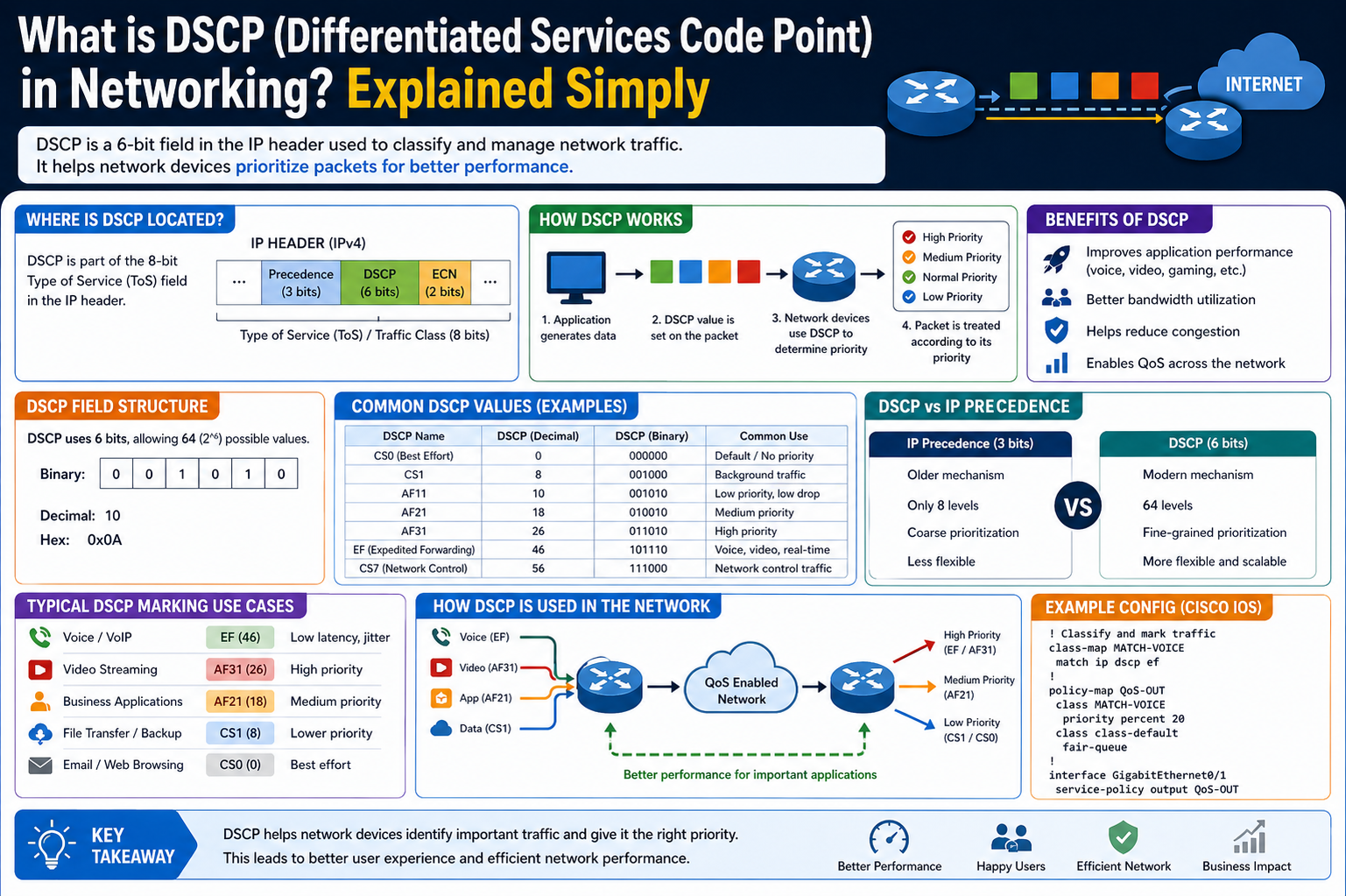
Differentiated Services Code Point (DSCP) is a mechanism used within modern IP networking to manage how different types of data traffic are treated as they move across a network. It is part of Quality of Service (QoS) strategies that aim to ensure that important or delay-sensitive traffic receives better handling compared to less critical data. DSCP works by placing a small classification value inside the IP packet header, which network devices then read to determine how the packet should be handled during forwarding, queuing, or possible dropping.
DSCP is embedded in the Internet Protocol header and uses a 6-bit field to represent traffic classification. This means that each packet can carry a value between 0 and 63, allowing networks to distinguish between multiple traffic types even within a limited space. Despite the simplicity of this field, it plays a powerful role in shaping how networks behave under congestion and load.
Purpose of Traffic Classification in Networks
The primary purpose of DSCP is to provide a structured way to classify and prioritize network traffic. In a shared network environment, not all data has equal importance. For example, real-time communication such as voice or video requires continuous, delay-free transmission, while email or file downloads can tolerate delays without significant impact.
DSCP allows network devices to identify these differences and apply appropriate handling rules. By doing so, it helps ensure that time-sensitive applications maintain performance even when the network is heavily utilized. This classification system is essential in enterprise environments, service provider networks, and any infrastructure where multiple types of applications compete for bandwidth.
Structure of the DSCP Field in IP Packets
The DSCP value is carried in the Type of Service (ToS) field of the IPv4 header and in the Traffic Class field in IPv6. This field has been redefined over time to support more advanced traffic handling capabilities. Within this field, 6 bits are dedicated specifically to DSCP, while the remaining bits are used for other functions such as Explicit Congestion Notification.
Because 6 bits are used, DSCP provides 64 possible combinations, each representing a different forwarding behavior. These combinations are grouped into standardized classes so that network administrators can apply consistent policies across different devices and vendors. This structure ensures interoperability and predictable behavior in complex network environments.
Historical Development of DSCP
DSCP was introduced as part of an evolution in IP networking standards designed to replace earlier and more limited traffic classification methods. Before DSCP, networks relied on a smaller number of bits to indicate priority, which restricted the ability to differentiate between multiple types of traffic.
As internet usage expanded and applications became more diverse, the need for a more scalable and flexible system became clear. DSCP was defined in response to this demand, providing a more granular and structured approach to traffic management. It allowed networks to move beyond simple priority marking and toward more sophisticated traffic engineering strategies.
Concept of Quality of Service in Relation to DSCP
Quality of Service is a broad framework used to manage network performance by controlling bandwidth allocation, delay, jitter, and packet loss. DSCP is one of the key tools used within QoS frameworks to implement these controls at the packet level.
By marking packets with DSCP values, networks can apply different forwarding rules depending on the type of traffic. This enables predictable performance for critical applications, even when network resources are limited. Without QoS and DSCP, all traffic would be treated equally, which could result in poor performance for sensitive applications during congestion.
How DSCP Influences Packet Handling
When a packet enters a network device such as a router or switch, the DSCP value is read and used to determine how the packet should be treated. This includes decisions such as which queue the packet should enter, how quickly it should be forwarded, and whether it should be dropped under congestion conditions.
Devices are configured with policies that map DSCP values to specific behaviors. These behaviors are designed to ensure that higher-priority traffic experiences minimal delay, while lower-priority traffic may be delayed or dropped if necessary. This mechanism helps maintain balance in network performance under varying loads.
Expedited Forwarding as High Priority Traffic
One of the most important DSCP classifications is Expedited Forwarding, which is designed for traffic that requires very low latency and high reliability. This type of traffic includes voice over IP communication, live video streaming, and interactive applications such as online gaming.
Expedited Forwarding is assigned a specific DSCP value that signals to network devices that this traffic should be treated with the highest priority. Packets marked in this way are typically placed in fast-forwarding queues, ensuring minimal delay. The goal is to simulate a dedicated, high-quality path through the network for real-time communication.
Assured Forwarding and Controlled Priority Levels
Assured Forwarding provides a more flexible classification system that allows multiple levels of priority within a structured framework. Instead of a single high-priority category, it defines several classes, each with different levels of importance and drop probability.
This system allows network administrators to fine-tune how traffic is handled based on both importance and network conditions. Packets within this category may still be dropped under congestion, but the likelihood of dropping depends on their assigned level. This makes Assured Forwarding useful for business applications that require reliability but are not as sensitive as real-time traffic.
Drop Precedence and Network Congestion Handling
Within Assured Forwarding, the concept of drop precedence is used to determine how likely a packet is to be discarded during congestion. Packets with lower drop precedence are more likely to be delivered successfully, while those with higher drop precedence are more likely to be dropped when network resources are limited.
This mechanism helps maintain overall network stability by ensuring that critical traffic continues to flow even during high congestion periods. It also provides a way to manage network load dynamically without completely shutting down lower-priority services.
Best Effort Traffic Classification
Best Effort traffic represents the default handling category in DSCP. Packets assigned this classification do not receive any special priority or guaranteed delivery behavior. Instead, they are treated on a first-come, first-served basis depending on available network resources.
This type of traffic includes general internet browsing, standard file transfers, and non-critical data communication. While it does not guarantee performance, it ensures that all traffic still has a chance to be delivered without requiring complex configuration or resource allocation.
Role of DSCP in Modern Network Design
In modern network environments, DSCP plays a crucial role in ensuring that diverse applications can coexist efficiently. With the increasing use of cloud services, video communication, and real-time collaboration tools, networks must be able to handle varying performance requirements simultaneously.
DSCP provides a standardized method for achieving this balance. By embedding classification directly into packets, it allows network infrastructure to make intelligent forwarding decisions at every hop. This reduces congestion impact and improves overall user experience across different types of applications.
Importance of Consistent DSCP Deployment
For DSCP to function effectively, it must be applied consistently across all network devices. If different devices interpret or apply DSCP values differently, traffic may not receive the intended priority treatment. This can lead to performance issues such as jitter in voice calls or delays in critical applications.
Consistency ensures that the classification assigned at the source is preserved throughout the network path. It also allows for predictable behavior, which is essential in large-scale environments where multiple routers, switches, and security devices are involved.
DSCP Marking and Packet Classification Process
Differentiated Services Code Point relies on a systematic process known as packet marking, where each IP packet is assigned a specific DSCP value before it enters or travels through a network. This marking process is typically performed at the edge of the network, where traffic first enters a controlled environment such as an enterprise network or service provider infrastructure.
Once a packet is marked, that DSCP value remains embedded in the packet header as it moves across different routers and switches. Each device along the path reads this value and applies preconfigured rules to determine how the packet should be handled. This ensures that traffic classification is preserved end-to-end, allowing consistent Quality of Service treatment throughout the network.
Packet classification is the foundation of DSCP operation. Without accurate classification, network devices would treat all traffic equally, leading to congestion issues and unpredictable performance for critical applications. DSCP solves this by enabling early identification of traffic type and importance.
Role of Edge Devices in DSCP Assignment
Edge devices play a crucial role in DSCP implementation because they are responsible for assigning initial priority values to outgoing packets. These devices include routers, firewalls, switches, and gateways that connect internal networks to external environments.
At the edge, traffic is inspected based on predefined rules such as application type, port number, protocol, or source and destination addresses. Once identified, the device assigns a DSCP value that reflects the required priority level. For example, voice traffic may be assigned a high-priority value, while bulk data transfers may receive a lower priority marking.
This early classification is important because it ensures that traffic is already prioritized before entering the wider network, reducing the likelihood of congestion-related performance degradation.
Traffic Identification Methods for DSCP Marking
To assign DSCP values accurately, network devices use multiple identification methods. One common approach is application-based classification, where traffic is recognized based on the type of application generating it. This allows voice, video, and data applications to be treated differently.
Another method is port-based classification, where specific network ports are associated with certain services. For example, voice communication protocols may use specific ports that are automatically mapped to higher priority DSCP values.
Additionally, deep packet inspection can be used in advanced networks to analyze packet content and identify application behavior more precisely. This allows for more granular classification and better traffic control in complex environments.
Mapping Traffic to DSCP Values
Once traffic is identified, it must be mapped to a corresponding DSCP value. This mapping is based on predefined QoS policies configured by network administrators. These policies define which traffic types receive which priority levels.
The mapping process ensures that similar types of traffic are consistently treated across the network. For example, all real-time communication traffic may be mapped to a high-priority DSCP value, while background system updates may be mapped to a lower priority.
This structured mapping system allows administrators to maintain predictable network behavior and optimize performance based on organizational requirements.
DSCP Behavior Across Network Devices
After a packet is marked, its DSCP value influences how it is treated at every network device it encounters. Routers and switches read the DSCP field and assign the packet to specific queues based on its priority level.
High-priority packets are placed in faster processing queues, allowing them to be forwarded with minimal delay. Lower-priority packets are placed in standard or delayed queues, where they may experience longer wait times during congestion.
This behavior ensures that critical traffic maintains consistent performance even when network resources are limited. It also allows networks to efficiently manage congestion without dropping all traffic indiscriminately.
Queuing Mechanisms in DSCP-Based Networks
Queuing is a fundamental concept in DSCP-enabled networks. When multiple packets compete for limited bandwidth, they are placed into queues based on their DSCP classification. Each queue represents a different priority level.
High-priority queues are serviced more frequently, ensuring that important traffic is transmitted first. Lower-priority queues are serviced when bandwidth is available. This system helps balance fairness with performance optimization.
Different queuing strategies can be implemented depending on network design, including priority queuing, weighted fair queuing, and class-based queuing. Each method provides different levels of control over traffic handling behavior.
Traffic Shaping and DSCP Integration
Traffic shaping is another important mechanism that works alongside DSCP to regulate network performance. It involves controlling the rate at which packets are sent into the network to prevent congestion.
When combined with DSCP, traffic shaping ensures that high-priority traffic is not only marked correctly but also transmitted in a controlled and efficient manner. This prevents sudden bursts of traffic from overwhelming network resources.
By shaping traffic based on DSCP values, networks can maintain smooth performance even during peak usage periods.
Congestion Management Using DSCP
Network congestion occurs when the demand for bandwidth exceeds available capacity. DSCP helps manage congestion by defining which packets should be prioritized and which can be delayed or dropped.
During congestion, high-priority packets are preserved as much as possible, while lower-priority packets may be discarded to free up resources. This selective dropping mechanism ensures that essential services remain operational even under heavy load.
Congestion management using DSCP allows networks to degrade gracefully rather than failing completely, which is critical for maintaining service reliability.
Interaction Between DSCP and Routing Decisions
While DSCP primarily influences packet handling within devices, it can also indirectly affect routing decisions in some advanced networks. In certain configurations, routing protocols may take DSCP values into account when selecting optimal paths.
This allows traffic to be routed through paths that best support its performance requirements. For example, latency-sensitive traffic may be directed through low-latency links, while bulk traffic may use less optimal paths.
Although not always used in standard deployments, this integration demonstrates the flexibility of DSCP in advanced network architectures.
Consistency Challenges in DSCP Deployment
One of the most significant challenges in DSCP deployment is maintaining consistent configuration across all network devices. If DSCP values are interpreted differently at various points in the network, traffic may not receive the intended priority treatment.
Inconsistent configurations can occur when different vendors or devices use different default settings or when policies are not uniformly applied. This can result in performance issues such as jitter, delays, or packet loss in critical applications.
Ensuring consistency requires careful planning, documentation, and centralized management of QoS policies.
Importance of Policy-Based Management in DSCP
Policy-based management is essential for effective DSCP implementation. Instead of manually configuring each device individually, administrators define centralized policies that are applied across the entire network.
These policies specify how different types of traffic should be classified, marked, and handled. They also define how DSCP values should be interpreted at each stage of the network.
This approach reduces configuration errors and ensures that QoS rules are consistently enforced, improving overall network reliability and performance.
DSCP in Multi-Vendor Network Environments
In real-world networks, equipment often comes from multiple vendors, each with its own implementation of QoS features. DSCP provides a standardized framework that allows these different systems to work together.
Because DSCP values are universally recognized in IP networking, they provide a common language for traffic classification across devices. This ensures interoperability and consistent behavior regardless of vendor differences.
However, careful configuration is still required to ensure that all devices interpret DSCP values correctly and apply appropriate handling rules.
Assured Forwarding Class Structure in DSCP
Assured Forwarding is one of the most flexible and widely used traffic handling models within DSCP. It is designed to provide multiple levels of delivery assurance without guaranteeing strict priority like Expedited Forwarding. Instead, it introduces a structured classification system that allows traffic to be divided into different classes based on importance and drop probability.
Each Assured Forwarding class is identified by a combination of class number and drop precedence. The class number represents the general priority group, while drop precedence defines how likely packets are to be dropped during congestion. This dual structure allows networks to fine-tune traffic handling behavior with much greater precision than simple high or low priority systems.
AF Class Hierarchy and Traffic Segmentation
Assured Forwarding is divided into four main classes, each representing a different level of service. Within each class, there are multiple drop precedence levels that further refine how packets are treated.
This hierarchical structure allows network administrators to segment traffic based on both importance and sensitivity to loss. For example, business-critical applications may be placed in a higher AF class, while less important services may be assigned to lower classes. Within each class, packets can still be prioritized further depending on how essential they are.
This segmentation is particularly useful in environments where many different applications operate simultaneously and require differentiated treatment without strict real-time guarantees.
Drop Precedence Behavior in Network Congestion
Drop precedence plays a key role in determining how packets behave during congestion. When network resources become limited, devices must decide which packets to forward and which to discard. Drop precedence provides a structured way to make these decisions.
Packets with lower drop precedence are more likely to be delivered successfully, even under heavy load. In contrast, packets with higher drop precedence are considered less critical and may be dropped first when congestion occurs.
This approach ensures that important traffic continues to flow while less critical traffic is sacrificed during periods of limited bandwidth. It helps maintain overall network stability without completely disrupting service.
Expedited Forwarding and Real-Time Traffic Handling
Expedited Forwarding is the highest priority classification within DSCP and is designed specifically for real-time and delay-sensitive traffic. This includes applications such as voice communication, video conferencing, and interactive services where delays or interruptions can significantly impact user experience.
Packets marked with Expedited Forwarding receive preferential treatment across the network. They are typically placed in high-priority queues and are forwarded with minimal delay. This ensures consistent performance even in congested network conditions.
The primary goal of Expedited Forwarding is to create a virtual low-latency path through the network, allowing time-sensitive applications to function as if they had dedicated bandwidth.
Comparison Between AF and EF Traffic Handling
Assured Forwarding and Expedited Forwarding serve different purposes within DSCP architecture. While EF focuses on strict low-latency delivery for critical real-time applications, AF provides flexible prioritization without strict guarantees.
EF traffic is given absolute priority and is rarely delayed, while AF traffic is managed based on class and drop precedence. This means AF traffic may experience some variability in delivery depending on network conditions.
Together, these two models allow networks to support a wide range of applications with different performance requirements, from highly sensitive voice calls to less critical data transfers.
Best Effort Traffic and Default Network Behavior
Best Effort represents the default traffic classification in DSCP. Any packet that is not explicitly marked with a higher priority value is treated as Best Effort traffic. This means it does not receive special handling or guaranteed delivery.
Best Effort traffic is forwarded based on available resources, without preferential treatment. During congestion, these packets are the first to experience delays or drops, as the network prioritizes higher-class traffic.
Despite its lack of priority, Best Effort remains an important part of network operation because it allows general data communication to continue without requiring complex configuration.
DSCP Value Distribution and Encoding System
The DSCP field uses a 6-bit binary structure, which allows for a total of 64 possible values. These values are grouped into predefined classes to simplify configuration and ensure interoperability across different systems.
Each DSCP value corresponds to a specific forwarding behavior. Some values are reserved for standard classifications like EF, AF, and Best Effort, while others may be used for experimental or custom configurations.
This encoding system provides flexibility while maintaining structure, allowing network engineers to design tailored QoS policies based on organizational needs.
Traffic Engineering and DSCP Optimization
Traffic engineering refers to the process of optimizing network performance by controlling how traffic flows through the infrastructure. DSCP plays a significant role in this process by enabling precise control over packet prioritization.
By assigning appropriate DSCP values, administrators can influence how traffic is distributed across network paths and how resources are allocated. This helps prevent congestion and ensures that critical applications receive sufficient bandwidth.
Effective traffic engineering using DSCP requires careful analysis of network usage patterns and application requirements to achieve optimal performance.
Impact of DSCP on Network Performance
DSCP directly influences key performance metrics such as latency, jitter, and packet loss. By prioritizing certain types of traffic, networks can reduce delays for real-time applications and improve overall responsiveness.
Latency-sensitive applications benefit the most from DSCP because high-priority packets are processed more quickly. Similarly, jitter is reduced because traffic flows are more predictable when properly classified.
Packet loss is also managed more effectively, as important traffic is protected during congestion while less critical traffic is dropped instead.
Role of DSCP in Service Provider Networks
Service providers use DSCP extensively to manage traffic across large-scale networks that serve multiple customers. In such environments, different customers may have different service level agreements that require specific QoS guarantees.
DSCP allows service providers to enforce these agreements by classifying and prioritizing traffic according to predefined policies. This ensures that premium services receive better performance compared to standard services.
It also enables efficient resource utilization by allowing providers to share infrastructure while still maintaining service differentiation.
Interaction Between DSCP and Security Policies
DSCP can also interact with security mechanisms in network environments. Firewalls and intrusion prevention systems may inspect DSCP values as part of their traffic analysis process.
In some cases, security policies may override or modify DSCP markings to ensure that malicious or unwanted traffic does not receive priority handling. This helps prevent abuse of QoS mechanisms.
Proper integration between QoS and security policies is essential to maintain both performance and protection within the network.
Challenges in Maintaining DSCP Integrity
Maintaining DSCP integrity across a network can be challenging, especially in complex environments with multiple devices and vendors. One common issue is DSCP remarking, where intermediate devices change or reset DSCP values.
This can occur due to misconfiguration or default device behavior, leading to inconsistent traffic handling. When DSCP values are altered unexpectedly, the intended QoS policy may not be enforced correctly.
To avoid these issues, careful planning and consistent policy enforcement are required throughout the network infrastructure.
Scalability of DSCP in Large Networks
DSCP is designed to scale effectively in large and complex networks. Its 6-bit structure allows for enough classification options to support a wide range of applications without becoming overly complicated.
In large-scale environments, DSCP provides a standardized method for managing traffic across multiple segments and devices. This ensures that QoS policies remain consistent even as the network grows.
Scalability is one of the key reasons DSCP remains widely used in enterprise and service provider networks.
End-to-End QoS Enforcement Using DSCP
For DSCP to be effective, QoS must be enforced end-to-end across the entire network path. This means that every device, from the source to the destination, must recognize and respect DSCP markings.
If any device fails to enforce DSCP policies correctly, the overall QoS strategy may be compromised. This makes coordination and configuration consistency critical in network design.
End-to-end enforcement ensures that traffic maintains its intended priority throughout its journey, resulting in predictable and reliable performance.
DSCP in Enterprise Network Environments
In enterprise networks, Differentiated Services Code Point plays a central role in maintaining performance consistency for a wide variety of business applications. Organizations typically run a mix of services such as voice communication systems, video conferencing tools, cloud-based applications, and routine data transfers. Each of these services has different performance requirements, and DSCP allows them to coexist efficiently on the same infrastructure.
Enterprise administrators define QoS policies that map business applications to appropriate DSCP values. This ensures that mission-critical systems receive higher priority during periods of congestion, while less important traffic is handled with standard or lower priority. The result is a more stable and predictable user experience across the organization, even when network demand is high.
DSCP in Voice and Video Communication Systems
Voice over IP and video conferencing are among the most sensitive applications when it comes to network performance. Even small delays or packet loss can significantly degrade call quality or cause interruptions in video streams. DSCP is widely used to address these challenges by prioritizing real-time media traffic.
Packets carrying voice or video data are typically marked with high-priority DSCP values so that they are processed quickly by network devices. This reduces latency and jitter, ensuring smooth and continuous communication. Without such prioritization, real-time applications would struggle to maintain acceptable performance during congestion.
Role of DSCP in Cloud-Based Applications
Modern organizations increasingly rely on cloud services for storage, collaboration, and application hosting. These services generate a wide range of traffic types, from interactive user sessions to large-scale data synchronization.
DSCP helps manage this diversity by assigning different priority levels based on application behavior. Interactive cloud applications that require immediate response may receive higher priority, while background synchronization tasks are assigned lower priority values. This ensures that user experience remains smooth even when large data transfers are occurring in the background.
DSCP and Bandwidth Optimization Strategies
Bandwidth is a limited resource in any network, and efficient utilization is essential for maintaining performance. DSCP contributes to bandwidth optimization by ensuring that available capacity is used in the most effective way possible.
By prioritizing critical traffic, DSCP prevents important applications from being delayed or dropped unnecessarily. At the same time, it allows lower-priority traffic to use remaining bandwidth without interfering with essential services. This balanced approach improves overall network efficiency and reduces waste of resources.
Congestion Avoidance and Traffic Prioritization
Congestion is one of the most common challenges in network environments, especially during peak usage periods. DSCP helps reduce the impact of congestion by enabling intelligent traffic prioritization.
When congestion occurs, network devices use DSCP values to determine which packets should be forwarded first and which can be delayed or dropped. This selective handling ensures that essential services continue to operate smoothly even under heavy load conditions.
Instead of treating all traffic equally, DSCP allows networks to degrade gracefully, maintaining service quality for important applications.
DSCP in Wireless Network Environments
Wireless networks present additional challenges for traffic management due to shared bandwidth and variable signal conditions. DSCP is used in wireless environments to prioritize traffic and improve user experience, particularly for mobile voice and video applications.
Access points and wireless controllers use DSCP values to manage how packets are transmitted over the air. High-priority traffic is given preference to reduce delays and improve reliability, while lower-priority traffic is transmitted when resources are available.
This helps ensure consistent performance even in environments with fluctuating connectivity conditions.
Interoperability of DSCP Across Network Devices
One of the key strengths of DSCP is its ability to work across different types of network equipment. Whether a network consists of routers, switches, firewalls, or load balancers, DSCP provides a common framework for traffic classification.
Because DSCP is based on standardized IP header values, it is recognized by virtually all modern networking devices. This ensures that QoS policies can be applied consistently across multi-vendor environments without compatibility issues.
However, proper configuration is essential to ensure that all devices interpret and apply DSCP values correctly.
DSCP Remarking and Policy Enforcement
In some network configurations, DSCP values may be changed or rewritten as packets pass through certain devices. This process is known as remarking and is often used to enforce organizational policies or align traffic with specific service requirements.
Remarking can be beneficial when integrating different network segments that use different QoS strategies. However, if not carefully managed, it can also lead to inconsistencies in traffic handling and reduced performance for critical applications.
Proper policy enforcement ensures that DSCP values remain consistent or are adjusted in a controlled manner throughout the network.
Security Considerations in DSCP Usage
While DSCP is primarily a performance management tool, it also has security implications. Malicious actors could potentially attempt to manipulate DSCP values to gain higher priority for unauthorized traffic.
To prevent this, many networks implement security policies that validate or reset DSCP markings at trusted boundaries. Firewalls and intrusion detection systems may also inspect DSCP values as part of their traffic analysis process.
These security measures ensure that QoS mechanisms cannot be exploited to bypass network controls.
Scalability Challenges in Large-Scale DSCP Deployment
Although DSCP is designed to scale effectively, large networks still face challenges in maintaining consistent QoS policies across thousands of devices and multiple geographic locations.
As networks grow, ensuring uniform DSCP configuration becomes more complex. Differences in device configuration, administrative policies, or vendor implementations can lead to inconsistencies.
To address these challenges, organizations often use centralized network management systems that automate QoS configuration and ensure consistent DSCP application across the entire infrastructure.
Monitoring and Troubleshooting DSCP Networks
Effective monitoring is essential for maintaining DSCP performance. Network administrators use monitoring tools to analyze traffic patterns, verify DSCP markings, and identify potential issues.
Troubleshooting DSCP-related problems often involves checking whether packets are being marked correctly, verifying that devices are applying QoS policies properly, and ensuring that traffic is following expected paths.
Without proper monitoring, misconfigurations can go unnoticed and lead to degraded application performance.
Performance Tuning Using DSCP Values
DSCP allows administrators to fine-tune network performance based on real-world usage patterns. By analyzing traffic behavior, they can adjust DSCP mappings to better align with application requirements.
For example, if a certain application experiences delays, its DSCP priority can be increased to improve responsiveness. Similarly, non-essential traffic can be downgraded to free up resources for critical services.
This flexibility makes DSCP a powerful tool for continuous network optimization.
Future Role of DSCP in Evolving Networks
As networks continue to evolve with increasing reliance on cloud computing, remote work, and real-time communication, DSCP remains highly relevant. Its ability to classify and prioritize traffic ensures that it can adapt to new application demands.
Emerging technologies such as edge computing and 5G networks also rely on QoS principles similar to DSCP for managing diverse traffic types. This demonstrates that DSCP will continue to play an important role in future network architectures.
Overall Significance of DSCP in Modern Networking
DSCP is a foundational element of modern Quality of Service frameworks, enabling networks to handle diverse traffic types efficiently and reliably. By providing structured classification, prioritization, and congestion management, it ensures that critical applications maintain performance even under challenging conditions.
Its combination of simplicity and flexibility makes it suitable for both small enterprise networks and large-scale global infrastructures. Through proper configuration and consistent application, DSCP contributes significantly to network stability, efficiency, and user satisfaction.
Conclusion
Differentiated Services Code Point is a core mechanism used in modern IP networks to control and optimize how traffic is handled. By embedding a small 6-bit value into the IP header, DSCP enables networks to classify packets and apply different levels of priority based on their importance and sensitivity. This allows critical applications such as voice calls, video conferencing, and real-time services to perform smoothly even when the network is under heavy load.
The strength of DSCP lies in its ability to create structured traffic management through classes like Expedited Forwarding, Assured Forwarding, and Best Effort. These classifications ensure that time-sensitive traffic receives priority handling, while less important data is processed in a fair and controlled manner. At the same time, drop precedence within Assured Forwarding adds another layer of control, helping networks manage congestion more intelligently.
In real-world environments, DSCP is essential for maintaining Quality of Service across enterprise systems, cloud platforms, service provider networks, and wireless infrastructures. It ensures that limited bandwidth is allocated efficiently and that performance remains predictable for key applications. However, its effectiveness depends heavily on consistent configuration, proper policy enforcement, and coordination across all network devices.
Despite challenges such as complexity, misconfiguration risks, and inconsistent implementation, DSCP remains one of the most widely used and reliable QoS mechanisms in networking. As modern networks continue to grow in scale and application diversity, DSCP continues to play a vital role in ensuring stable, efficient, and high-quality data delivery.