In today’s technology-driven world, product managers sit at the center of innovation and execution. They are responsible for ensuring that digital products are not only built correctly but also built for the right reasons. Instead of focusing on writing code or designing interfaces, product managers concentrate on aligning business objectives with user needs and technical feasibility. This balancing act makes the role both highly strategic and deeply collaborative.
A product manager often works as the connective tissue between multiple departments. Engineers, designers, marketers, data analysts, and business leaders all rely on product managers to provide direction and clarity. Without this role, teams may build features that are technically impressive but fail to solve real user problems. Because of this responsibility, product managers have become one of the most influential roles in modern software companies.
Despite the importance of the role, compensation for product managers is not straightforward. Salaries vary widely depending on experience, geography, industry, and company type. Two product managers with similar job titles may earn significantly different incomes simply because they work in different regions or industries. Understanding these differences is essential for anyone considering a career in product management or planning their next career move.
The growing demand for digital products has increased the importance of product managers across industries. From fintech platforms to healthcare applications and artificial intelligence tools, nearly every sector now depends on strong product leadership. As demand rises, so does the competition for skilled professionals, which directly influences salary trends.
Why Product Manager Salaries Vary So Widely
One of the most common questions about product management is why salaries differ so dramatically across companies and locations. Unlike some traditional roles with standardized pay scales, product management compensation is influenced by multiple dynamic factors.
First, product management is not a single, uniform job. The responsibilities of a product manager in a startup can be vastly different from those in a large enterprise organization. In smaller companies, a product manager may handle everything from research to delivery, often wearing multiple hats. In larger companies, the role may be more specialized, focusing on specific product areas or stages of the lifecycle.
Second, the level of ownership significantly impacts compensation. Product managers who are responsible for revenue-generating products or large-scale platforms typically earn more than those managing internal tools or experimental features. The business impact of the product directly correlates with the value assigned to the role.
Third, the level of technical complexity plays a major role. Product managers working on highly technical products such as cloud infrastructure, machine learning systems, or developer tools often receive higher compensation due to the specialized knowledge required. These roles demand a strong understanding of both engineering principles and business strategy.
Finally, external market forces such as talent shortages, regional cost of living, and industry competition also shape salary structures. In regions where tech talent is in high demand, companies often offer higher salaries to attract and retain skilled professionals.
Core Responsibilities That Influence Compensation
Product manager salaries are closely tied to the scope and depth of their responsibilities. The more strategic and impactful the role, the higher the compensation tends to be.
One of the primary responsibilities of a product manager is product planning. This involves defining what should be built, why it should be built, and how it aligns with broader company objectives. Product managers must evaluate competing priorities and make decisions that balance user needs with business goals.
Another critical responsibility is user research. Understanding customer behavior, pain points, and expectations is essential for building successful products. Product managers gather insights from interviews, analytics, surveys, and feedback channels. The ability to interpret this data and translate it into actionable decisions adds significant value to the role.
Feature prioritization is another major aspect of the job. Because resources are always limited, product managers must decide which features should be developed first. These decisions can directly influence product success, customer satisfaction, and revenue generation.
Roadmap development also plays a key role in shaping compensation. Product managers are responsible for planning product timelines and ensuring that teams stay aligned with long-term goals. This requires strong organizational skills and the ability to manage expectations across multiple stakeholders.
In addition to these responsibilities, product managers act as communication hubs within organizations. They ensure that engineering, design, marketing, and leadership teams remain aligned. This cross-functional leadership requires strong interpersonal skills and strategic thinking, both of which contribute to higher compensation levels.
Different Types of Product Managers and Career Paths
Product management is not a one-size-fits-all career. There are several variations of the role, each with its own focus and compensation structure.
An entry-level product manager, often called an associate product manager, is typically responsible for supporting senior team members. These individuals focus on learning the fundamentals of product development, user research, and execution processes. Their responsibilities are limited but foundational.
A standard product manager role represents the mid-level position in the career ladder. These professionals manage specific features or product areas independently. They are responsible for delivering measurable outcomes and often work closely with cross-functional teams.
Senior product managers operate at a higher strategic level. They may oversee entire product lines or manage multiple teams. Their focus shifts from execution to strategy, business impact, and long-term vision.
Technical product managers represent a specialized track within the field. These professionals work closely with engineering teams and often manage technically complex products such as APIs, infrastructure systems, or data platforms.
Group product managers and lead product managers take on leadership responsibilities. They oversee teams of product managers and ensure alignment across multiple products or business units. Their compensation reflects both their managerial responsibilities and strategic influence.
National Salary Overview and Market Expectations
Product manager salaries vary significantly across different markets, but there are general patterns that help define expectations.
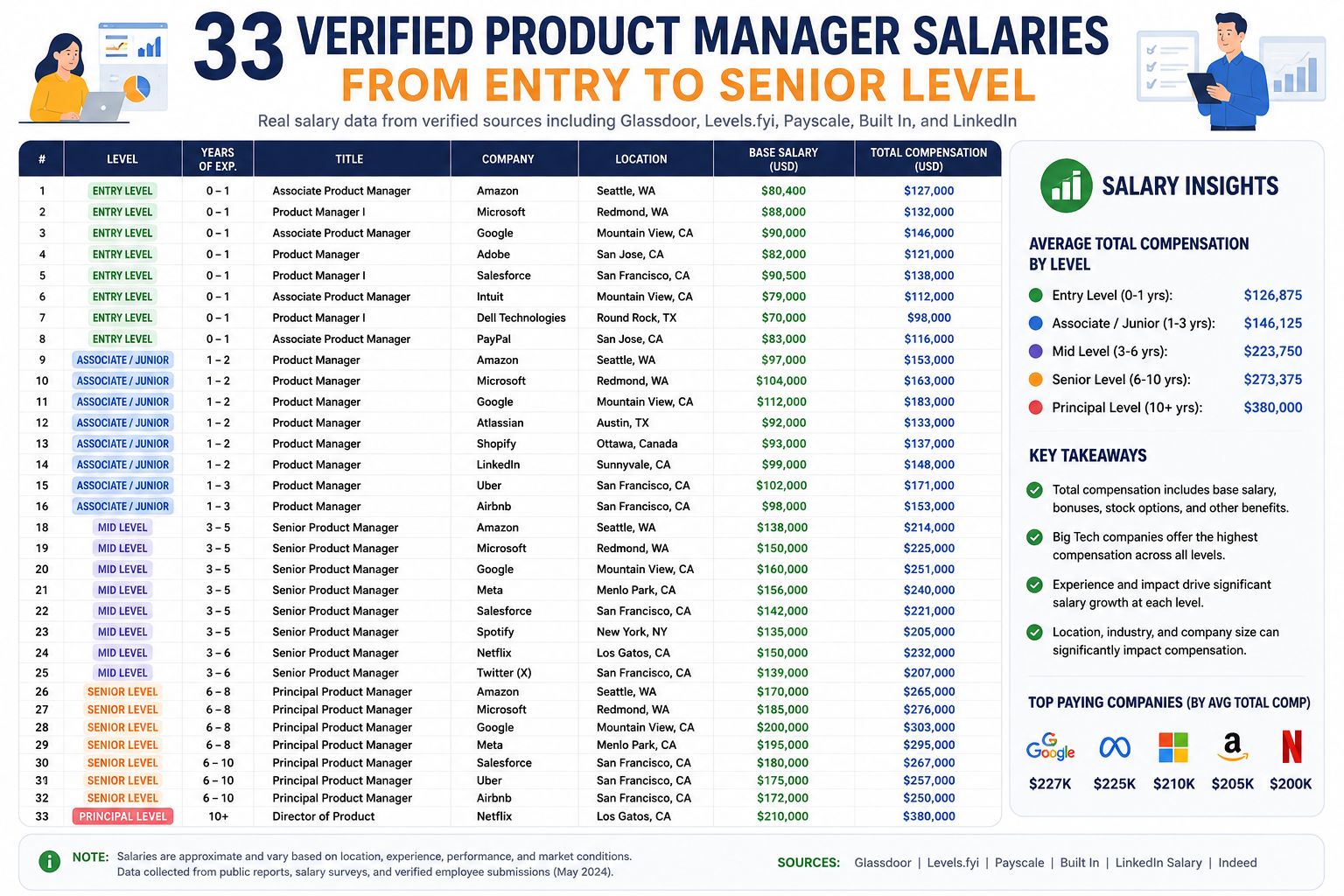
At a broad level, product managers in many developed markets tend to fall within a mid-to-high six-figure range depending on experience and specialization. Entry-level roles typically start at a lower range but remain competitive compared to many other professions. Mid-level product managers see a substantial increase in compensation as they take on more ownership and responsibility.
Senior product managers and those in leadership positions often reach significantly higher compensation levels. These roles may also include performance bonuses, stock options, and other incentives that contribute to total earnings.
It is important to understand that these ranges are not fixed. Market demand, company size, and industry specialization can all shift compensation upward or downward. For example, product managers in rapidly growing sectors such as artificial intelligence or financial technology often earn more than those in traditional industries.
Geographic Influence on Product Manager Pay
Location plays a major role in determining salary levels for product managers. In global technology hubs, compensation tends to be significantly higher due to increased competition for talent and higher living costs.
Cities with strong technology ecosystems often offer the highest salaries. These locations attract major technology companies, startups, and venture-backed firms, all competing for skilled professionals. As a result, product managers in these regions benefit from higher base salaries and stronger equity packages.
In contrast, regions with smaller technology markets or lower cost of living tend to offer lower base salaries. However, this is often balanced by reduced living expenses, making the overall quality of life comparable in some cases.
Mid-tier cities are becoming increasingly attractive for product managers. These locations offer a balance between competitive salaries and affordable living conditions. Many companies are also expanding remote work opportunities, allowing professionals to earn competitive salaries regardless of location.
Industry Differences and Their Impact on Earnings
The industry in which a product manager works can have a significant impact on compensation.
Technology-driven industries such as artificial intelligence, cloud computing, and fintech tend to offer the highest salaries. These sectors deal with complex systems and high-value products, requiring advanced expertise and strategic decision-making.
E-commerce and consumer technology companies also offer competitive compensation, particularly for product managers working on high-traffic platforms or revenue-generating features.
In contrast, industries such as education, nonprofit organizations, or internal enterprise tools may offer lower compensation. While these roles are often highly meaningful and impactful, they may not generate direct revenue, which influences salary structures.
Healthcare and regulated industries fall somewhere in between. These roles often require specialized knowledge and compliance understanding, which can increase compensation depending on complexity.
Company Stage and Equity Considerations
The stage of a company has a direct influence on product manager compensation. Early-stage startups often provide lower base salaries but compensate with equity. The potential long-term value of equity can be significant if the company grows successfully.
Mid-stage companies tend to offer a balance between salary and equity. These organizations are typically more stable and have established compensation structures.
Large enterprises and publicly traded companies often provide the highest base salaries along with structured bonuses and stock-based compensation. These roles offer stability and predictable income, though equity growth may be less dramatic compared to startups.
Product managers must evaluate total compensation rather than just base salary. Equity, bonuses, and long-term incentives all contribute to overall earnings.
Skills That Directly Impact Salary Growth
Several key skills influence how much a product manager can earn over time.
Technical literacy is one of the most important factors. Product managers who understand software architecture, APIs, and system design are often better equipped to work on complex products and command higher salaries.
Data analysis skills are equally important. The ability to interpret user behavior, run experiments, and evaluate product performance is essential in modern product management.
Strong communication and leadership abilities also play a major role. Product managers must influence stakeholders, align teams, and communicate complex ideas clearly. Those who excel in these areas often advance faster in their careers.
Strategic thinking is another critical skill. Product managers who can connect product decisions to business outcomes are highly valued, especially in senior roles.
Experience Progression and Career Growth
Experience is one of the most significant factors influencing product manager compensation.
Early-career professionals typically focus on learning and execution. Their responsibilities are limited, and their compensation reflects their developing expertise.
Mid-career product managers take on full ownership of product areas. They are responsible for outcomes, not just tasks, and their salaries increase accordingly.
Senior product managers focus on strategy, leadership, and business impact. Their compensation often includes additional incentives and reflects their broader influence within the organization.
As product managers gain experience, their ability to influence business decisions increases, which directly contributes to higher earnings potential.
Remote Work and Its Impact on Product Manager Salaries
The rise of remote work has significantly reshaped how product manager salaries are structured and negotiated. In the past, compensation was tightly tied to geographic location, meaning that where you lived heavily influenced how much you earned. Today, that model is increasingly blurred as companies adopt global hiring strategies and distributed teams become more common.
Remote product managers now operate in a hybrid compensation environment. Some companies still adjust salaries based on location, offering different pay bands depending on whether an employee is based in a high-cost or low-cost region. Others have adopted location-agnostic pay models, where product managers are paid based on role level rather than geography.
This shift has created both opportunities and challenges. On one hand, professionals living in lower-cost regions can now access salaries that were previously limited to major tech hubs. A product manager working from a smaller city can potentially earn a salary closer to that of someone based in a major metropolitan area.
On the other hand, some companies have introduced “geo-adjusted remote pay,” which reduces salaries for employees working outside major tech hubs. This means two product managers performing the same job may still earn different salaries depending on where they live.
Remote work has also increased competition. Companies are no longer hiring from a limited local talent pool but instead recruiting globally. This raises the bar for skills and experience, as candidates now compete with professionals from around the world.
At the same time, remote work has expanded opportunities for career mobility. Product managers can now work for high-paying international companies without relocating, which has opened new pathways for salary growth that did not previously exist.
The Role of Equity and Stock in Total Compensation
When evaluating product manager salaries, base pay is only part of the equation. In many technology companies, especially startups and large tech firms, equity and stock-based compensation play a major role in total earnings.
Equity represents ownership in a company. Instead of receiving all compensation in cash, product managers may receive stock options or restricted stock units that vest over time. If the company performs well, the value of this equity can significantly exceed base salary.
In early-stage startups, equity often makes up a large portion of compensation packages. While base salaries may be lower, the potential upside is high if the company grows or is acquired. This creates a risk-reward balance that appeals to many professionals seeking long-term financial growth.
In later-stage startups and publicly traded companies, equity becomes more structured and predictable. Employees receive stock units that vest over several years, often tied to performance or tenure. While the upside may be less dramatic than early-stage equity, the stability is higher.
Large technology companies also offer substantial equity packages. In these environments, product managers often receive a combination of salary, annual bonuses, and stock grants. The stock portion can sometimes equal or even exceed base salary, especially in senior roles.
Understanding equity is essential for accurately evaluating compensation. Two product managers with identical base salaries may have vastly different total earnings depending on the value of their stock grants.
How Company Size Shapes Product Manager Pay
Company size is another major factor influencing product manager salaries. The expectations, responsibilities, and compensation structures vary significantly between small startups, mid-sized companies, and large enterprises.
In early-stage startups, product managers often take on broad responsibilities. They may be involved in everything from user research to product delivery and even customer support. Because startups operate with limited budgets, salaries are often lower, but equity stakes can be substantial.
Mid-sized companies tend to offer more balanced compensation packages. These organizations usually have defined product teams, structured processes, and clearer career paths. Salaries are more stable, and equity is still meaningful but less risky compared to early-stage startups.
Large enterprises and global technology companies typically offer the highest base salaries. These organizations have well-defined compensation bands and structured promotion systems. Product managers in these environments often receive additional benefits such as bonuses, retirement plans, and stock awards.
However, larger companies may also have more specialized roles. Instead of managing an entire product, a product manager may focus on a specific feature or component. While this can limit scope, it often provides stability and higher financial compensation.
Product Complexity and Its Influence on Earnings
The complexity of a product is one of the most overlooked factors affecting product manager salaries. Not all products require the same level of technical knowledge, strategic thinking, or cross-functional coordination.
Simple consumer applications typically involve straightforward product decisions and shorter development cycles. While these roles are still important, they may not command the highest salaries.
In contrast, complex products such as enterprise software, cloud infrastructure, or artificial intelligence platforms require deep technical understanding and long-term strategic planning. Product managers in these roles must often understand system architecture, data flows, and integration challenges.
The more complex the product, the higher the responsibility placed on the product manager. Decisions in these environments can have large-scale implications for performance, security, and revenue. As a result, compensation tends to increase with product complexity.
Products that directly impact revenue streams or serve large enterprise clients also tend to offer higher salaries. The financial stakes are higher, and companies are willing to invest more in experienced professionals who can manage that complexity effectively.
Leadership Influence and Executive Responsibility
As product managers advance in their careers, their responsibilities begin to shift from execution to leadership. This transition has a direct impact on compensation.
Senior product managers and leadership-level roles are expected to influence company strategy rather than just manage individual features. They often work closely with executives, define long-term product vision, and oversee multiple teams or product lines.
In these roles, product managers are responsible not only for product success but also for business outcomes. Their decisions can affect revenue growth, customer retention, and market positioning. This level of responsibility naturally leads to higher compensation.
Leadership roles also involve people management. Product leaders may oversee teams of product managers, guide their development, and ensure alignment across multiple initiatives. Managing teams adds another layer of responsibility that is reflected in salary structures.
At the highest levels, such as director or head of product roles, compensation often includes significant bonuses and equity packages. These roles are less about day-to-day product work and more about shaping organizational direction and long-term strategy.
Negotiation Power and Salary Growth Strategy
One of the most important but often overlooked aspects of product manager compensation is negotiation. Even within the same company and role level, salaries can vary based on negotiation skills and timing.
Product managers who understand their market value are often able to secure higher compensation packages. This includes not only base salary but also equity, bonuses, and benefits. Employers frequently have flexible ranges, meaning there is room for negotiation even when salary bands are defined.
Timing also plays a critical role. Professionals who negotiate during job transitions often have more leverage than those seeking raises within the same company. External offers can be used as benchmarks to improve compensation discussions internally.
Another important factor is demonstrating impact. Product managers who can clearly show how their work has contributed to revenue growth, user engagement, or operational efficiency are in a stronger position to negotiate higher salaries.
Continuous skill development also enhances negotiation power. As product managers gain experience in technical systems, data analysis, and leadership, their perceived value in the market increases, giving them more leverage in compensation discussions.
Regional Market Dynamics Beyond Major Tech Hubs
While major cities often dominate discussions about product manager salaries, smaller and emerging tech markets are becoming increasingly important.
Many companies are expanding operations into secondary cities and regional hubs. These locations offer lower operational costs while still providing access to skilled talent. As a result, product manager salaries in these regions are gradually increasing.
In some cases, remote-first companies are deliberately hiring in smaller markets to optimize cost structures while maintaining competitive compensation relative to local standards. This creates a unique balance where salaries may be lower than major tech hubs but significantly higher than local averages.
Emerging tech regions also offer faster career progression opportunities. Because competition is less intense, product managers may advance more quickly into senior roles, which can offset differences in base salary.
Additionally, global hiring trends are reducing the importance of geography altogether. As more companies adopt distributed teams, regional salary differences may continue to narrow over time.
The Influence of Product Strategy on Compensation Levels
Product strategy plays a central role in determining the value of a product manager within an organization. Not all product managers operate at the same strategic level, and this difference is reflected in compensation.
Some product managers focus primarily on feature delivery. Their role is to ensure that specific functionalities are built efficiently and meet user expectations. While important, this level of work is typically associated with mid-level compensation.
Strategic product managers, on the other hand, are responsible for defining what should be built in the first place. They conduct market research, evaluate competitive landscapes, and identify long-term opportunities for growth. Their decisions shape the direction of entire product lines.
At the highest level, product managers contribute directly to business strategy. They work with executive leadership to align product direction with company goals. In these roles, compensation is significantly higher because the impact extends beyond individual products to overall company performance.
The ability to think strategically and connect product decisions to business outcomes is one of the strongest drivers of salary growth in product management.
Industry Disruption and Emerging Salary Trends
The product management field continues to evolve as new technologies and industries emerge. This evolution directly impacts salary trends and compensation expectations.
Artificial intelligence and machine learning have created a surge in demand for technically skilled product managers. These roles require an understanding of complex algorithms, data systems, and ethical considerations, making them some of the highest-paid positions in the field.
Fintech is another rapidly growing sector where product managers are in high demand. The intersection of finance and technology requires both regulatory awareness and technical expertise, contributing to higher compensation levels.
Cloud computing, cybersecurity, and developer tools are also driving salary growth. These industries require product managers who can work closely with engineering teams and understand deeply technical systems.
At the same time, traditional industries are beginning to adopt digital transformation strategies. This has increased demand for product managers in sectors such as healthcare, logistics, and education, although salaries in these areas vary depending on business model and revenue structure.
As industries continue to evolve, product management roles are becoming more specialized, which is likely to further widen salary ranges across different sectors.
Globalization of Product Management and Cross-Border Salary Differences
As product management becomes a globally distributed profession, salary structures are increasingly influenced by international hiring trends. Companies are no longer limited to hiring within national borders. Instead, they are building global product teams that span multiple continents, time zones, and economic regions.
This globalization has created a layered compensation landscape. Product managers working in North America, Western Europe, and parts of Asia-Pacific tend to earn significantly higher salaries compared to those in emerging markets. The difference is not only due to the cost of living but also the maturity of tech ecosystems and the concentration of high-growth companies.
In regions with established technology industries, product managers often benefit from structured career ladders, standardized salary bands, and strong equity programs. These markets tend to reward experience and specialization more aggressively.
In contrast, emerging markets are seeing rapid growth in product management roles but often at lower compensation levels. However, the gap is gradually narrowing as multinational companies expand operations and introduce global pay standards.
Remote-first companies are also challenging traditional salary geography models. Some organizations now use global compensation benchmarks, meaning a product manager in a lower-cost region may earn close to the same salary as someone in a high-cost region if their role is equivalent.
This shift is reshaping expectations and encouraging professionals worldwide to pursue product management as a high-value career path, regardless of location.
The Hidden Layers of Total Compensation
When discussing product manager salaries, base pay is only one part of the equation. Total compensation includes multiple layers that significantly affect overall earnings.
The first layer is base salary, which provides financial stability and is typically paid monthly or biweekly. This forms the foundation of compensation but does not represent the full earning potential of a product manager.
The second layer is performance-based bonuses. These bonuses are often tied to individual, team, or company performance metrics. In high-performing organizations, bonuses can represent a substantial percentage of total annual earnings.
The third layer is equity or stock compensation. This is especially important in startups and large technology companies. Equity can grow significantly in value over time, making it one of the most impactful components of long-term wealth creation for product managers.
The fourth layer includes benefits such as healthcare, retirement contributions, wellness programs, and professional development budgets. While these do not directly increase take-home pay, they contribute to overall financial well-being.
The final layer is intangible but important: career growth opportunities. Product managers who join fast-growing companies often experience rapid promotions and salary increases, which significantly impact lifetime earnings.
Understanding total compensation is essential for accurately evaluating job offers and career opportunities in product management.
How Salary Bands and Job Levels Work in Product Management
Most established companies use structured leveling systems to define product manager roles. These levels determine responsibilities, expectations, and compensation ranges.
Entry-level product managers are typically responsible for supporting existing products and learning core workflows. Their compensation is lower, but they gain exposure to product development processes and cross-functional collaboration.
Mid-level product managers operate independently and own specific product areas. They are responsible for delivering outcomes, managing stakeholders, and making data-driven decisions. Compensation increases significantly at this level due to increased ownership.
Senior product managers are expected to think strategically and manage complex product initiatives. They often influence product direction and collaborate with leadership teams. Their compensation reflects both experience and impact.
Lead or principal product managers operate at a highly strategic level, often focusing on multiple product lines or large-scale systems. These roles require deep expertise and strong leadership capabilities.
At the top of the hierarchy, directors and heads of product are responsible for entire product organizations. Their compensation includes substantial bonuses and equity packages, reflecting their influence on company-wide performance.
These leveling systems create clarity but also introduce variability, as different companies may define levels differently.
The Role of Performance in Salary Growth
Performance plays a critical role in determining how quickly a product manager’s salary grows over time. While entry-level compensation may be relatively standardized, long-term earnings depend heavily on individual contribution.
High-performing product managers are often recognized through faster promotions, larger salary increases, and access to more strategic projects. Their ability to consistently deliver successful products makes them valuable assets within organizations.
Performance is typically measured through product outcomes such as user engagement, revenue growth, retention rates, and customer satisfaction. Product managers who can directly influence these metrics are more likely to receive compensation increases.
In addition to quantitative results, qualitative performance also matters. Strong leadership, communication skills, and the ability to align stakeholders can significantly impact career progression.
Companies often reward consistent performers more than those who deliver isolated successes. This means long-term reliability and strategic thinking are just as important as short-term wins.
Performance-based compensation structures are especially common in large technology firms, where bonuses and stock grants are tied to measurable results.
The Growing Importance of Technical Product Management
Technical product management has become one of the fastest-growing segments within the field. As software systems become more complex, companies increasingly need product managers who understand technical architecture and engineering principles.
Technical product managers often work on APIs, cloud infrastructure, machine learning systems, and developer platforms. These roles require a deep understanding of how software systems are built and integrated.
Because of this specialized knowledge, technical product managers often earn higher salaries than generalist product managers. Their ability to communicate effectively with engineering teams and make informed technical decisions adds significant value.
These roles also involve more complexity and responsibility. Decisions made by technical product managers can affect system performance, scalability, and reliability, which directly impact business outcomes.
As a result, companies are willing to invest more in professionals who can bridge the gap between technical and business teams effectively.
How Economic Conditions Influence Product Manager Salaries
Macroeconomic conditions also play a role in shaping product manager salaries. During periods of economic growth, companies tend to expand hiring and offer higher compensation packages to attract talent.
In contrast, during economic downturns, hiring slows, and salary growth may stagnate. Companies may reduce bonus structures, limit equity grants, or delay promotions to manage costs.
Inflation also affects salary expectations. As the cost of living increases, employees often expect higher compensation to maintain purchasing power. Companies operating in competitive markets must adjust salary bands accordingly.
Technology sector performance is particularly influential. When tech markets are strong, demand for product managers increases, driving salaries upward. When markets contract, competition for roles becomes more intense, which can stabilize or reduce salary growth.
Despite economic fluctuations, product management remains a resilient career path due to its central role in digital product development.
The Impact of AI and Automation on Product Management Roles
Artificial intelligence is transforming many aspects of product management. While some tasks are becoming automated, the overall demand for skilled product managers remains strong.
AI tools can assist with data analysis, user behavior tracking, and even product ideation. This allows product managers to focus more on strategy, decision-making, and stakeholder management.
However, AI also increases the complexity of products, particularly in areas such as machine learning, predictive analytics, and automation systems. This complexity creates demand for more technically skilled product managers.
As AI continues to evolve, product managers who understand how to work with AI systems are likely to see increased compensation opportunities.
Rather than replacing product managers, AI is reshaping the role and increasing the importance of strategic thinking and technical literacy.
Career Transitions Into Product Management
Many professionals transition into product management from other fields such as engineering, design, marketing, or business analysis. These transitions can significantly influence starting salaries.
Individuals with technical backgrounds often enter product management at higher salary levels due to their ability to understand system architecture and collaborate with engineers.
Those coming from marketing or business roles may start at slightly lower levels but often excel in user research, communication, and strategy.
Career changers may initially experience a temporary salary adjustment, but long-term earnings often increase rapidly as they gain product experience.
Companies increasingly value diverse backgrounds in product management because they bring different perspectives to product development.
Successful transitions depend on building a combination of technical understanding, business acumen, and user-centric thinking.
Gender and Equity Considerations in Product Manager Compensation
Like many industries, product management has historically experienced compensation disparities across different demographic groups. While progress has been made in recent years, gaps still exist in some regions and organizations.
Companies are increasingly adopting transparent salary bands and structured leveling systems to reduce inconsistency in compensation decisions. These frameworks help ensure that pay is more closely aligned with role responsibilities rather than negotiation differences alone.
Equity distribution is another area where disparities can occur, particularly in startups where negotiation plays a larger role in determining stock allocations.
Awareness of these issues has led many organizations to implement more standardized compensation practices. However, ongoing attention is still required to ensure fairness and equity across the industry.
The Psychology of Salary Growth and Career Decision-Making
Salary growth in product management is not only influenced by external factors but also by individual career decisions.
Professionals who prioritize learning, skill development, and exposure to complex problems often experience faster salary growth. Taking on challenging roles early in a career can lead to higher long-term compensation.
Job switching is another significant factor. Product managers who move between companies every few years often see faster salary increases compared to those who remain in the same organization for extended periods.
However, stability also has value. Long-term employees may gain deeper institutional knowledge and access to leadership opportunities that contribute to higher compensation at senior levels.
Balancing stability and mobility is a key strategic decision for product managers aiming to maximize lifetime earnings.
Future Outlook of Product Manager Salaries
The future of product management compensation is expected to remain strong, driven by continued digital transformation across industries.
As more companies rely on software products to drive revenue, the demand for skilled product managers will continue to grow. This demand is likely to support sustained salary growth, particularly in specialized areas such as AI, cloud computing, and enterprise software.
Remote work and global hiring will continue to reshape salary structures, potentially reducing geographic disparities over time.
At the same time, increasing product complexity will require more advanced skills, leading to higher compensation for experienced professionals.
Overall, product management is expected to remain one of the most dynamic and financially rewarding roles in the technology industry, with salaries continuing to evolve alongside technological innovation and market demand.
Emerging Specializations Shaping the Future of Product Management Compensation
As product management evolves, one of the most important shifts influencing salaries is the rise of highly specialized roles. Product management is no longer a single generalized career path. Instead, it is branching into distinct domains that require deep expertise in specific technologies, industries, and user environments. These specializations are increasingly shaping compensation trends because companies are willing to pay a premium for focused knowledge that directly impacts business outcomes.
One of the fastest-growing specializations is artificial intelligence product management. These professionals work on products powered by machine learning models, predictive systems, and generative AI tools. The complexity of these systems requires a strong understanding of both data science principles and user experience design. AI product managers are responsible for ensuring that models are not only accurate but also useful, ethical, and aligned with real-world applications. Because of the technical depth involved, these roles often command higher-than-average salaries and are considered among the most competitive in the field.
Another emerging specialization is platform product management. Unlike traditional product managers who focus on end-user applications, platform product managers build systems that other developers and teams use to create products. This includes APIs, developer ecosystems, and internal infrastructure tools. The impact of platform products is often wide-reaching because they support multiple downstream applications. As a result, companies place a high value on professionals who can design scalable, reliable systems that enable broader innovation.
Security-focused product management is also gaining importance as cybersecurity concerns continue to grow across industries. These product managers work on systems that protect user data, prevent breaches, and ensure regulatory compliance. Their decisions have direct implications for risk management and legal accountability, making their role both sensitive and highly valuable. Compensation in this area tends to be elevated due to the critical nature of security infrastructure and the shortage of professionals with both technical and product expertise.
Healthcare and regulated industry product management is another specialized field shaping salary trends. Products in this category must comply with strict regulations, privacy laws, and safety standards. Product managers working in healthcare technology, for example, must understand both patient needs and regulatory frameworks. The complexity of balancing innovation with compliance often results in higher compensation, especially in organizations developing large-scale healthcare systems or digital health platforms.
The Increasing Value of Cross-Functional Leadership Skills
While technical expertise and industry specialization are important, cross-functional leadership has become one of the most powerful drivers of salary growth in product management. Modern product environments are highly collaborative, requiring constant coordination between engineering, design, marketing, sales, legal, and executive teams.
Product managers who excel at aligning these diverse stakeholders are often viewed as force multipliers within organizations. Their ability to translate technical constraints into business language—and vice versa—helps reduce friction and accelerate product development cycles. This capability is especially valuable in large organizations where misalignment between teams can lead to costly delays or failed product launches.
Strong cross-functional leaders are also skilled at conflict resolution. In many product environments, different teams may have competing priorities. Engineering teams may prioritize technical stability, while marketing teams may push for faster feature releases. Product managers who can balance these perspectives and guide teams toward a shared outcome are highly valued.
Communication clarity is another essential aspect of cross-functional leadership. Product managers who can articulate vision, priorities, and trade-offs simply and compellingly tend to earn more responsibility over time. This clarity helps reduce ambiguity and ensures that teams remain focused on the most impactful work.
Because of these leadership demands, companies often reward strong cross-functional product managers with faster promotions and higher compensation bands. Over time, these skills become just as important as technical knowledge in determining long-term salary growth.
Conclusion
Product management has become one of the most influential and financially rewarding roles in the technology industry, but its salary structure is far from uniform. Earnings are shaped by a combination of experience, industry specialization, technical depth, company size, and geographic location. This creates a wide compensation spectrum where entry-level professionals may start with modest salaries, while senior and specialized product managers can reach significantly higher income levels.
Beyond base pay, total compensation often includes bonuses, equity, and long-term incentives, which can dramatically increase overall earnings. These elements make product management not just a stable career choice but also a potentially high-growth financial path for those who continue to develop their skills.
As technology evolves, so does the role of the product manager. Emerging fields such as artificial intelligence, platform engineering, and security-focused product development are reshaping demand and driving new salary benchmarks. At the same time, remote work and global hiring trends are gradually changing how compensation is structured across regions.
Ultimately, success in product management depends on continuous learning, strategic thinking, and the ability to deliver measurable impact. Those who invest in both technical and leadership skills are best positioned to grow their careers and maximize their long-term earning potential in this dynamic field.