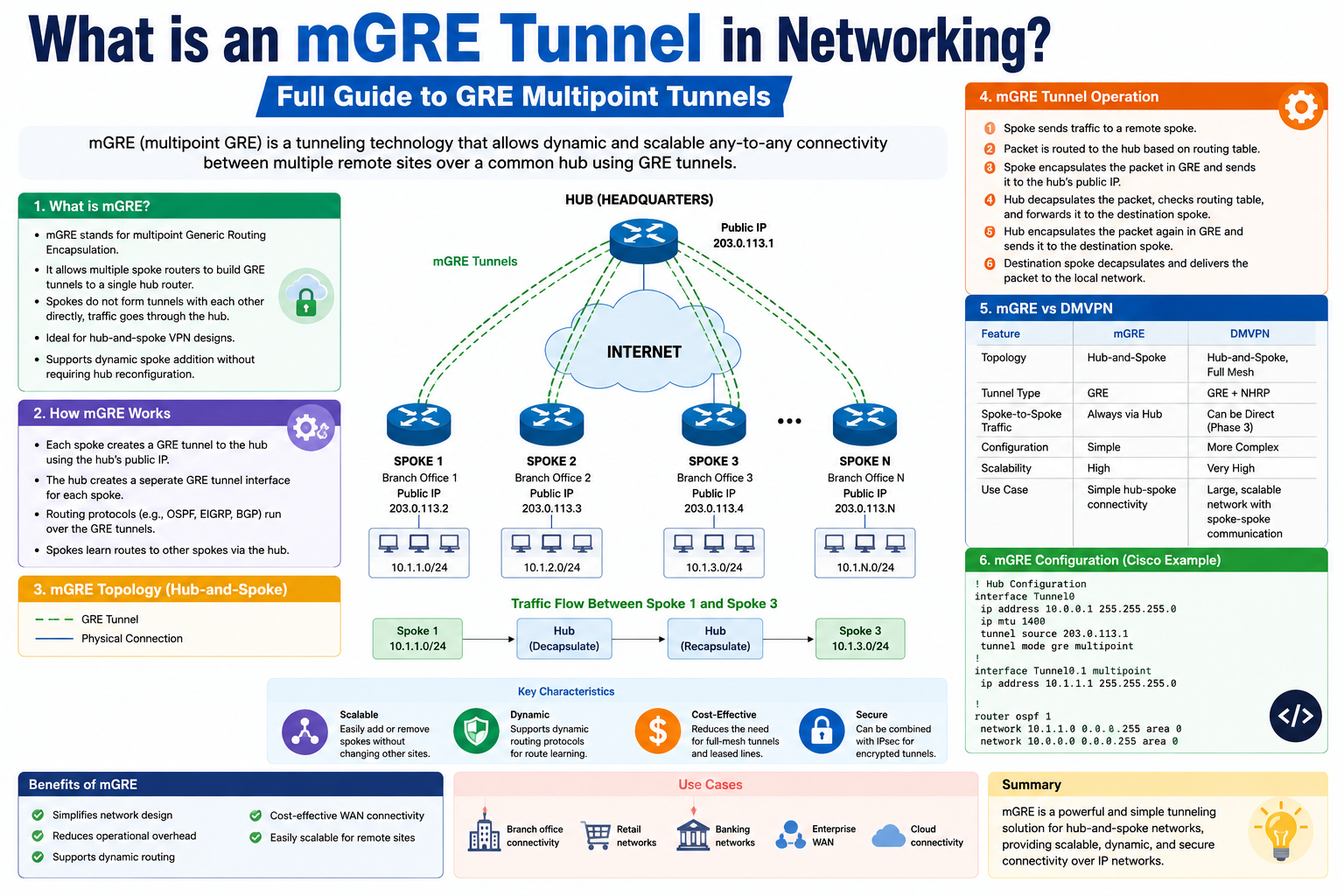
In modern computer networking, the need to connect multiple remote locations securely and efficiently has become a fundamental requirement for organizations of all sizes. As businesses expand across cities, countries, and even continents, traditional point-to-point communication models often become difficult to manage, expensive to scale, and complex to maintain. This is where the concept of a GRE multipoint tunnel, commonly referred to as mGRE, becomes highly relevant.
A GRE multipoint tunnel is a networking mechanism designed to allow multiple remote sites to communicate over a shared virtual tunnel infrastructure. Instead of creating separate individual tunnels between each location, mGRE enables a more centralized and scalable approach. This method significantly reduces configuration overhead while still maintaining secure and structured data transmission across the network.
To fully understand mGRE, it is important to first understand the foundational concept of tunneling in networking, which is the basis on which GRE and mGRE operate.
The Concept of Tunneling in Computer Networks
Tunneling in networking refers to the process of encapsulating one type of data packet inside another packet so that it can be transmitted across a network that may not normally support it. This encapsulation allows data to travel securely and efficiently through intermediate networks, including the public internet.
When a packet is encapsulated, it is wrapped with additional headers that contain routing and control information. These headers guide the packet through the network, ensuring it reaches the correct destination. Once the packet arrives at its destination, it is decapsulated, meaning the added headers are removed, and the original data is restored for processing.
Tunneling is essential in scenarios where private communication must occur over public infrastructure. Without tunneling, sensitive data would need to travel openly, making it vulnerable to interception or misuse.
GRE, or Generic Routing Encapsulation, is one of the most widely used tunneling protocols that enables this process. mGRE builds upon this concept by extending GRE into a multipoint architecture.
What is Generic Routing Encapsulation (GRE)?
Generic Routing Encapsulation is a tunneling protocol that allows a wide variety of network layer protocols to be encapsulated inside virtual point-to-point links. GRE creates a virtual tunnel between two endpoints, allowing data to pass through intermediate networks as if it were directly connected.
In a standard GRE setup, each tunnel connects exactly two endpoints. This is known as a point-to-point configuration. While this model is effective for small-scale connections, it becomes inefficient when there are multiple remote sites that all need to communicate with each other or with a central hub.
For example, if an organization has ten branch offices, a traditional GRE setup would require multiple individual tunnels between each location. This quickly becomes difficult to manage as the number of connections increases. The complexity grows exponentially with each new site added.
This limitation led to the development of multipoint GRE, which simplifies the architecture by allowing a single tunnel interface to handle multiple remote endpoints.
Introduction to Multipoint GRE (mGRE)
Multipoint Generic Routing Encapsulation, or mGRE, is an extension of the traditional GRE protocol that supports multiple remote endpoints over a single tunnel interface. Instead of creating separate tunnels for each connection, mGRE allows a single interface to manage multiple dynamic connections.
This design is especially useful in hub-and-spoke network topologies, where a central hub communicates with multiple remote sites (spokes). Each spoke establishes a connection with the hub, but the hub uses a single mGRE interface to manage all communication flows.
The primary advantage of mGRE lies in its ability to scale efficiently. As new remote sites are added, they can connect to the existing mGRE tunnel without requiring major reconfiguration of the entire network infrastructure.
This makes mGRE particularly valuable in enterprise networks, service provider environments, and large-scale virtual private networks where flexibility and scalability are essential.
How the MGRE Differs from the Traditional GRE
While GRE and mGRE share the same fundamental tunneling principles, they differ significantly in structure and scalability.
In traditional GRE, each tunnel is explicitly defined between two endpoints. This means that if there are multiple sites, multiple tunnels must be manually configured. Each tunnel maintains its own configuration, routing information, and management overhead.
In contrast, mGRE uses a single tunnel interface that can dynamically communicate with multiple endpoints. This eliminates the need for manually defining every possible connection between sites.
Another key difference lies in address resolution. In GRE, each tunnel endpoint is statically defined, while in mGRE, endpoints can be discovered dynamically using routing protocols or additional mechanisms such as Next Hop Resolution Protocol (NHRP) in certain implementations.
This dynamic behavior makes mGRE far more adaptable in environments where remote sites may frequently join or leave the network.
The Role of Encapsulation in mGRE
Encapsulation is the core mechanism that enables mGRE to function. It involves wrapping the original data packet inside a new packet structure so that it can traverse incompatible or unsecured networks.
When a device sends data through an mGRE tunnel, the original packet is encapsulated with a GRE header. This header contains essential information such as source and destination identifiers, protocol type, and routing instructions.
Once encapsulated, the packet is transmitted across the network to the destination tunnel endpoint. Upon arrival, the outer GRE header is removed, revealing the original data packet, which is then forwarded to its final destination.
This process ensures that data remains intact and properly routed across complex network environments. It also allows multiple types of traffic, including IP, multicast, and other protocols, to be carried over a single tunnel infrastructure.
Encapsulation is not only a technical requirement but also a structural necessity for virtual networking. Without it, communication between disparate networks would be inconsistent and unreliable.
Why the MGRE is Important in Scalable Network Design
Modern organizations require networks that can grow without requiring constant redesign or reconfiguration. mGRE plays a critical role in achieving this scalability.
One of the key challenges in traditional networking is managing multiple remote connections efficiently. As the number of sites increases, the number of required tunnels increases dramatically, leading to complexity and potential configuration errors.
mGRE solves this problem by allowing a single tunnel interface to support multiple remote endpoints. This reduces configuration overhead and simplifies network management.
Additionally, mGRE supports dynamic network environments where remote sites may frequently change. New locations can be added without disrupting existing connections, and outdated connections can be removed with minimal impact.
This flexibility makes mGRE highly suitable for organizations with distributed infrastructure, such as multinational corporations, cloud-based systems, and large educational or government networks.
Hub and Spoke Architecture in mGRE Networks
mGRE is most commonly implemented using a hub and spoke topology. In this design, a central hub acts as the main routing point for all communication, while remote sites function as spokes connected to the hub.
Each spoke establishes a tunnel connection with the central hub, but spokes do not directly connect. Instead, all communication between spokes is routed through the hub.
This structure simplifies network management because all control and routing decisions are centralized. The hub is responsible for managing traffic flow, encapsulation, and decapsulation of packets.
While this model enhances scalability and simplicity, it also introduces dependency on the central hub. If the hub experiences issues, communication across the entire network may be affected.
Despite this limitation, the hub and spoke design remains widely used due to its efficiency and ease of administration.
Data Flow Process in an mGRE Tunnel
Understanding how data flows through an mGRE tunnel helps clarify how the system operates in practice.
When a device at a remote site sends data, the packet is first forwarded to the local router. The router then encapsulates the packet using GRE headers and sends it through the mGRE tunnel toward the central hub.
At the hub, the packet is decapsulated and processed. If the destination is another remote site, the hub re-encapsulates the packet and forwards it through the appropriate tunnel interface.
The receiving remote site then decapsulates the packet and delivers it to the intended device.
This multi-step process allows seamless communication across distributed networks, even when devices are separated by large geographical distances or different network infrastructures.
Role of Routing in mGRE Environments
Routing plays a crucial role in determining how data moves through mGRE tunnels. Since multiple endpoints share a single tunnel interface, routing protocols are often used to manage traffic efficiently.
Dynamic routing protocols help the network automatically adjust to changes in topology. When new remote sites are added or removed, routing tables are updated accordingly, ensuring that data continues to flow correctly.
Without proper routing mechanisms, mGRE networks could become inefficient or unstable, especially as they scale.
Routing ensures that each packet reaches its intended destination through the most appropriate path while maintaining the integrity of the tunnel structure.
Security Considerations in mGRE Networks
While mGRE provides an efficient method for tunneling data, it does not inherently include encryption or security features. This means that data transmitted through mGRE tunnels is not automatically protected from interception.
To ensure secure communication, mGRE is often combined with additional security protocols that encrypt the data before it is encapsulated. This ensures that even if the data is intercepted during transmission, it cannot be easily read or modified.
Security is especially important in environments where sensitive information is transmitted across public or untrusted networks. Without proper protection, tunneling alone is not sufficient to guarantee confidentiality or integrity.
Operational Importance of mGRE in Enterprise Networks
In enterprise environments, mGRE is widely used to support large-scale communication between branch offices, data centers, and remote users. Its ability to simplify network architecture makes it a preferred choice for organizations that require efficient connectivity across multiple locations.
By reducing the number of required tunnels and centralizing control, mGRE helps network administrators manage complex infrastructures more effectively. It also allows for easier troubleshooting and monitoring since most traffic passes through a central hub.
As networks continue to grow in size and complexity, technologies like mGRE remain essential for maintaining performance, scalability, and operational efficiency.
Understanding Control Plane and Data Plane Behavior in mGRE
To truly understand how GRE multipoint environments function at a deeper level, it is essential to separate the concepts of the control plane and the data plane. These two logical components define how information is learned, processed, and forwarded within an mGRE-based network.
The data plane is responsible for the actual movement of packets. When a device sends information, the data plane handles encapsulation, forwarding, and delivery of those packets through the tunnel infrastructure. In an mGRE environment, this means wrapping user data inside GRE headers and transmitting it toward the appropriate endpoint.
The control plane, on the other hand, manages the intelligence behind routing decisions. It determines how devices learn about each other, how paths are selected, and how dynamic changes in the network are handled. Without a well-structured control plane, mGRE tunnels would lack the ability to adapt to changing network conditions.
In multipoint GRE deployments, the control plane becomes especially important because multiple remote endpoints may join or leave the network dynamically. The system must constantly update routing information, ensuring that traffic is always directed correctly without manual intervention.
This separation of responsibilities allows mGRE to remain both scalable and efficient, even in complex and evolving network environments.
Dynamic Endpoint Discovery in Multipoint GRE Environments
One of the most powerful aspects of mGRE is its ability to support dynamic endpoint discovery. In traditional point-to-point GRE tunnels, every remote connection must be manually defined. This approach does not scale well when dealing with large networks.
In contrast, mGRE allows the central hub to communicate with multiple remote sites without predefining each connection individually. Instead, remote devices can dynamically register themselves with the hub, enabling automatic communication setup.
This dynamic behavior is often supported by additional resolution mechanisms that help map remote network addresses to reachable tunnel endpoints. Once a remote site is recognized, the hub can encapsulate and forward traffic to it without requiring manual tunnel creation.
This capability significantly reduces administrative workload and makes network expansion much more efficient. New branches or remote offices can be integrated into the network with minimal configuration changes, allowing organizations to scale rapidly.
The Role of Mapping and Resolution Mechanisms
In multipoint tunnel environments, one of the key challenges is determining where to send encapsulated traffic when multiple destinations exist behind a single tunnel interface. This is where resolution mechanisms become critical.
These mechanisms maintain a mapping between logical network addresses and physical tunnel endpoints. When a packet arrives at the hub, the system consults its mapping database to determine the correct remote site for forwarding.
This mapping is not static in most modern implementations. Instead, it is dynamically updated as remote devices join, leave, or change their network status. This ensures that traffic is always directed accurately without requiring manual updates.
Without such resolution systems, mGRE networks would struggle to maintain accurate routing in environments where endpoints frequently change.
Spoke-to-Spoke Communication Behavior
Although mGRE is traditionally associated with hub-and-spoke topologies, modern implementations often support optimized communication between remote sites. Instead of routing all traffic through the central hub, some systems allow direct spoke-to-spoke communication once endpoints have been identified.
In such cases, the hub initially facilitates communication by acting as a discovery and coordination point. Once two remote sites have exchanged necessary information, they may establish a more direct communication path for future data exchange.
This optimization reduces latency and decreases the load on the central hub, improving overall network efficiency. However, the hub still plays a critical role in maintaining control and managing session information.
This hybrid approach allows organizations to balance centralized control with efficient data routing between endpoints.
Traffic Encapsulation and Nested Header Structure
In mGRE networks, encapsulation involves adding multiple layers of headers to a single packet. The original data, known as the inner packet, is wrapped inside one or more outer headers that guide it through the network.
The outer GRE header contains routing information required for tunnel traversal, while the inner packet remains unchanged until it reaches its final destination. This layered structure ensures that data can move across incompatible networks without modification.
In some advanced configurations, additional encapsulation layers may be applied depending on security or transport requirements. Each layer adds overhead but increases flexibility in how data is transmitted.
Understanding how these layers interact is essential for diagnosing performance issues and ensuring proper packet delivery in large-scale deployments.
MTU, Fragmentation, and Performance Considerations
One of the most common challenges in mGRE deployments is managing the Maximum Transmission Unit (MTU) size and packet fragmentation. Because GRE adds additional headers to each packet, the effective payload size is reduced.
If the resulting packet exceeds the MTU of an underlying network, fragmentation may occur. Fragmentation can significantly impact performance, increasing latency and reducing throughput efficiency.
To avoid these issues, network engineers often adjust MTU and Maximum Segment Size (MSS) values to ensure that encapsulated packets remain within acceptable limits.
Proper tuning of these parameters is critical in high-performance environments, especially where large volumes of data are transmitted across multiple tunnels simultaneously.
Failure to optimize MTU settings can result in packet loss, retransmissions, and degraded application performance.
Scalability Challenges in Large mGRE Deployments
Although mGRE is designed to improve scalability, extremely large deployments can still introduce challenges. As the number of remote sites increases, the central hub must handle a growing amount of encapsulation, decapsulation, and routing logic.
This increased workload can lead to performance bottlenecks if the central device is not adequately provisioned. CPU utilization, memory consumption, and interface load all become critical factors in maintaining network stability.
Additionally, as the number of endpoints grows, routing tables and mapping databases become more complex. Efficient data structures and optimized routing protocols are required to maintain responsiveness.
Organizations often address these challenges by distributing workloads across multiple hubs or by segmenting networks into smaller logical domains.
Handling Failures and Redundancy in mGRE Networks
Reliability is a key concern in any network architecture, and mGRE is no exception. Since many deployments rely on a central hub, redundancy mechanisms are essential to prevent single points of failure.
If the central hub becomes unavailable, communication between remote sites can be disrupted. To mitigate this risk, redundant hub configurations are often implemented.
These redundant systems can take over traffic processing in the event of a failure, ensuring continuity of service. In some cases, multiple hubs may operate simultaneously, sharing load and providing backup capabilities.
Failover mechanisms are typically designed to be transparent to end devices, meaning users experience minimal disruption during transitions.
Proper redundancy planning is essential for maintaining high availability in mission-critical environments.
Interaction with Multicast Traffic in mGRE Environments
Multipoint GRE is particularly well-suited for handling multicast traffic, which involves sending data from one source to multiple destinations simultaneously.
In traditional networks, multicast traffic can be difficult to manage due to routing complexities and bandwidth inefficiencies. mGRE simplifies this process by allowing multicast packets to be encapsulated and transmitted efficiently across the tunnel infrastructure.
Once the packet reaches the central hub, it can be replicated and forwarded to multiple remote sites as needed. This reduces the need for multiple individual transmissions and improves overall efficiency.
However, multicast behavior must be carefully managed to avoid unnecessary traffic duplication and bandwidth consumption.
Quality of Service and Traffic Prioritization
In enterprise networks using mGRE, different types of traffic often compete for limited bandwidth resources. To ensure optimal performance, Quality of Service (QoS) mechanisms are implemented.
QoS allows certain types of traffic, such as voice or video, to be prioritized over less time-sensitive data. This ensures that critical applications maintain performance even under heavy network load.
Within mGRE tunnels, QoS policies can be applied at multiple points, including at the hub and at remote endpoints. These policies help control congestion, reduce latency, and improve overall user experience.
Effective QoS configuration is especially important in environments where real-time communication is required.
Network Address Translation (NAT) Considerations
Network Address Translation can introduce complications in mGRE deployments, particularly when tunnels traverse public networks. Since NAT modifies IP address information, it can interfere with tunnel endpoint identification.
To address this, special configurations are often required to ensure that GRE traffic is properly translated and forwarded. Without correct handling, tunnels may fail to establish or experience intermittent connectivity issues.
In many cases, network engineers must carefully design NAT policies to accommodate tunnel traffic without disrupting encapsulation processes.
Cloud Integration and Virtualized Network Environments
As organizations increasingly move infrastructure to cloud platforms, mGRE has also found relevance in virtualized environments. Cloud-based networks often rely on virtual private clouds and segmented routing domains, making tunneling technologies highly valuable.
mGRE can be used to connect multiple virtual networks across different regions or availability zones. This enables centralized communication structures within distributed cloud environments.
However, cloud integration introduces additional complexity, particularly in terms of latency, security policies, and routing consistency.
Despite these challenges, mGRE remains a viable solution for extending traditional network architectures into cloud-based systems.
Real-World Enterprise Deployment Scenarios
In real-world applications, mGRE is commonly used by organizations with geographically distributed branches. These may include financial institutions, educational networks, healthcare systems, and multinational corporations.
In such environments, mGRE enables secure communication between headquarters and remote offices without requiring individual point-to-point tunnels for each location.
This simplifies network design and reduces operational overhead while maintaining consistent connectivity across all sites.
Additionally, service providers often use mGRE to deliver managed VPN services to clients, leveraging its scalability and centralized control capabilities.
Troubleshooting Complexity in Multipoint GRE Networks
As mGRE networks grow, troubleshooting can become increasingly complex. Issues may arise from routing misconfigurations, encapsulation errors, MTU mismatches, or endpoint resolution failures.
Diagnosing these problems requires a structured approach, beginning with verification of tunnel status and progressing through routing tables, encapsulation behavior, and interface statistics.
Because multiple endpoints share a single tunnel interface, isolating specific issues can sometimes be challenging. Careful monitoring and logging are essential for maintaining network health.
Effective troubleshooting practices help ensure that performance issues are identified and resolved quickly before they impact end users.
Optimization Strategies for High-Performance mGRE Networks
To maintain optimal performance in mGRE environments, several optimization strategies can be applied. These include tuning routing protocols, adjusting encapsulation parameters, and balancing traffic loads across available resources.
Efficient design also involves minimizing unnecessary encapsulation overhead and ensuring that traffic paths are as direct as possible within the constraints of the architecture.
Load distribution across multiple hubs or regions can further enhance performance in large-scale deployments.
Proper optimization ensures that mGRE networks remain responsive, stable, and capable of handling increasing traffic demands without degradation.
Evolving Role of mGRE in Modern Network Design
Multipoint Generic Routing Encapsulation has evolved far beyond its original purpose of simply extending point-to-point GRE tunneling into a multipoint structure. In modern network engineering, it is often viewed as a foundational technology that enables scalable virtual connectivity across distributed systems. As organizations shift toward hybrid infrastructures combining on-premises, cloud, and edge environments, mGRE plays a supporting role in maintaining consistent connectivity models across all these domains.
The real strength of mGRE is not just in encapsulation, but in how it abstracts physical topology into logical connectivity. This abstraction allows network engineers to design systems based on functional requirements rather than physical limitations. Instead of worrying about how many physical links are required between sites, engineers can focus on how data should flow logically between endpoints.
This shift in thinking is essential in large-scale enterprise environments where agility and adaptability are more important than rigid infrastructure design. mGRE provides the flexibility needed to support this modern approach.
Logical Topology Versus Physical Infrastructure
One of the most important conceptual shifts introduced by mGRE is the separation of logical topology from physical infrastructure. In traditional networking, physical connections often dictated how systems were designed. Each new site required additional physical or virtual links, which directly impacted scalability.
With mGRE, the physical infrastructure becomes less important than the logical structure of communication. A single hub can represent a centralized communication point, while multiple spokes represent distributed endpoints. The underlying physical paths used to carry this traffic are abstracted away by encapsulation.
This abstraction allows engineers to design networks based on business requirements rather than physical constraints. For example, a company might want all branch offices to communicate with headquarters but not directly with each other. This requirement can be implemented easily using a hub-and-spoke mGRE model without needing complex physical interconnections.
This separation of concerns simplifies both design and management, especially in environments where physical infrastructure is spread across multiple geographic regions.
The Importance of Scalability in mGRE Systems
Scalability is one of the primary reasons mGRE is widely used in enterprise environments. Traditional point-to-point GRE tunnels do not scale efficiently because each new connection requires a separate tunnel configuration. As the number of sites increases, the number of tunnels grows exponentially, creating a management burden.
mGRE solves this by allowing multiple remote endpoints to share a single tunnel interface. This means that adding a new site does not require restructuring the entire network. Instead, the new site simply registers itself with the central hub and begins communication through the existing multipoint structure.
This scalability is particularly valuable in organizations that frequently expand or restructure their network footprint. New branch offices, temporary sites, or cloud-based workloads can be integrated quickly without disrupting existing connections.
However, scalability in mGRE is not unlimited. As the number of endpoints increases, the central hub must handle more encapsulation, routing decisions, and control-plane processing. This introduces performance considerations that must be carefully managed.
Hub Load Distribution and Processing Bottlenecks
In any mGRE deployment, the hub plays a central role in managing traffic between all connected spokes. While this centralized design simplifies network architecture, it also introduces a potential performance bottleneck.
The hub must handle several critical functions simultaneously. These include packet encapsulation, decapsulation, routing decisions, and endpoint tracking. As the number of connected spokes increases, the processing load on the hub grows proportionally.
If the hub is not adequately provisioned, it may become overwhelmed, leading to increased latency, packet loss, or reduced throughput. This is especially true in high-traffic environments where multiple applications are transmitting large volumes of data simultaneously.
To mitigate this risk, network engineers often deploy more powerful hardware at the hub or distribute the load across multiple hub devices. In some cases, hierarchical hub structures are used, where secondary hubs handle subsets of spokes to reduce centralized load.
Hierarchical mGRE Architectures
In large-scale deployments, a single hub may not be sufficient to handle all traffic. This leads to the development of hierarchical mGRE architectures, where multiple layers of hubs are used to distribute processing and improve scalability.
In a hierarchical model, primary hubs manage high-level routing decisions, while secondary hubs handle localized traffic for specific regions or departments. This reduces the burden on any single device and improves overall network efficiency.
For example, a global organization might use regional hubs for different continents, with each regional hub managing local branch offices. These regional hubs then communicate with a central core hub for inter-region traffic.
This layered approach allows networks to scale horizontally without overwhelming a single central device. It also improves fault isolation, as issues in one region do not necessarily impact the entire network.
Dynamic Routing Behavior in mGRE Environments
Routing in mGRE networks is more complex than in traditional point-to-point systems because multiple endpoints share a single tunnel interface. Dynamic routing protocols are often used to manage this complexity.
These protocols allow routers to automatically learn about available paths and adjust routing tables in response to network changes. When a new spoke joins the network, it advertises its presence to the hub, which updates its routing information accordingly.
Similarly, if a spoke becomes unavailable, the routing system removes it from active tables to prevent traffic from being sent to an unreachable destination.
This dynamic behavior ensures that the network remains adaptive and resilient, even in environments where endpoints frequently change.
However, dynamic routing also introduces overhead, as routing updates must be continuously exchanged and processed. Efficient protocol selection and configuration are therefore critical for maintaining performance.
Encapsulation Overhead and Network Efficiency Tradeoffs
While encapsulation is essential for mGRE operation, it introduces additional overhead to every packet transmitted through the tunnel. This overhead includes extra headers that increase packet size and consume additional bandwidth.
In high-throughput environments, this overhead can become significant, especially when large volumes of small packets are transmitted. The cumulative effect can reduce overall network efficiency if not properly managed.
To address this, engineers often optimize packet sizes and adjust MTU settings to minimize fragmentation. Larger packets are generally more efficient because the overhead represents a smaller percentage of total data.
However, increasing packet size must be balanced against the limitations of underlying transport networks. If packets become too large, they may be fragmented or dropped, leading to performance degradation.
Fragmentation Handling in Multipoint GRE Networks
Fragmentation occurs when a packet exceeds the maximum transmission unit of a network segment. In mGRE environments, fragmentation can be particularly problematic because encapsulated packets are already larger than their original form.
When fragmentation occurs, a single packet is divided into multiple fragments that are transmitted separately and reassembled at the destination. This process introduces additional processing overhead and increases the likelihood of packet loss.
If even one fragment is lost, the entire packet must be retransmitted, which can significantly impact performance.
To avoid fragmentation issues, careful MTU planning is essential. Engineers often test different configurations to determine the optimal balance between packet size and network reliability.
Quality of Service Enforcement in Multipoint Environments
Quality of Service mechanisms play a critical role in ensuring that important traffic receives priority in mGRE networks. Since multiple types of traffic often share the same tunnel infrastructure, congestion can occur if resources are not properly managed.
QoS policies allow network administrators to classify traffic based on type, priority, or application. For example, voice traffic may be prioritized over file transfers to ensure clear communication in real-time applications.
In mGRE environments, QoS can be applied at both the hub and spoke levels. This allows for granular control over how traffic is handled throughout the network.
Proper QoS configuration ensures that critical applications maintain performance even during periods of high network utilization.
Security Architecture Considerations in mGRE Deployments
Although mGRE provides efficient tunneling capabilities, it does not inherently provide encryption or authentication. This means that data transmitted through mGRE tunnels is not protected by default.
To address this limitation, security protocols are often layered on top of mGRE. These protocols provide encryption, authentication, and integrity verification to ensure secure communication across untrusted networks.
Security architecture in mGRE environments typically includes multiple layers of protection. These may include encryption for data confidentiality, authentication mechanisms to verify endpoints, and integrity checks to detect tampering.
Without these additional security measures, mGRE should not be used for transmitting sensitive information over public networks.
Address Management and Overlapping Networks
One of the challenges in large-scale mGRE deployments is managing IP address allocation across multiple remote sites. In some cases, different branches may use overlapping IP address ranges, which can create routing conflicts.
To resolve this issue, network engineers often use network address translation or design unique addressing schemes for each site. Proper planning is essential to avoid conflicts that could disrupt communication.
Address management becomes even more complex in hybrid environments where on-premises networks connect to cloud-based systems. Consistent addressing strategies are required to maintain interoperability.
Integration with Modern Cloud and Hybrid Systems
As organizations increasingly adopt hybrid cloud architectures, mGRE continues to play a role in connecting distributed systems. Cloud environments often consist of multiple virtual networks that must communicate securely and efficiently.
mGRE can be used to extend traditional network architectures into cloud environments, allowing seamless communication between on-premises infrastructure and cloud-based resources.
However, cloud integration introduces additional challenges, including latency variability, security policy enforcement, and compatibility with cloud-native networking services.
Despite these challenges, mGRE remains a viable option for extending enterprise networks into virtualized environments.
Performance Monitoring and Network Visibility
Maintaining visibility into the mGRE network performance is essential for ensuring stability and efficiency. Monitoring tools are used to track traffic flow, detect anomalies, and identify performance bottlenecks.
Key performance indicators include latency, packet loss, throughput, and tunnel stability. By analyzing these metrics, engineers can identify potential issues before they impact users.
Because mGRE networks often involve multiple encapsulation layers and dynamic endpoints, monitoring becomes more complex than in traditional networks.
Effective visibility strategies are essential for maintaining long-term reliability.
Operational Best Practices in Large mGRE Deployments
In large-scale environments, operational best practices are critical for maintaining stability and performance. These practices include proper documentation, consistent configuration standards, and regular performance tuning.
Standardization helps reduce configuration errors and ensures that all network devices operate consistently. Regular audits help identify misconfigurations or inefficiencies that could impact performance.
Additionally, proactive capacity planning ensures that the network can handle future growth without degradation.
By following structured operational practices, organizations can maximize the effectiveness of their mGRE deployments while minimizing risk.
Shift Toward Software-Defined Networking Integration
One of the most important developments influencing the future of mGRE is its gradual alignment with software-defined networking (SDN) principles. Traditional mGRE deployments rely heavily on static or semi-dynamic configurations managed at the router level, but SDN introduces a centralized control mechanism that can programmatically manage tunnel behavior in real time.
In SDN-enabled environments, mGRE tunnels can be dynamically created, modified, or removed based on application demand rather than manual configuration. This allows networks to respond instantly to changes in traffic patterns, user demand, or security requirements. Instead of treating tunnels as fixed infrastructure components, they become flexible resources controlled by software logic.
This evolution improves efficiency by reducing human intervention and minimizing configuration errors. It also allows mGRE to function more effectively in highly automated environments such as cloud orchestration systems and large-scale enterprise data centers.
Increased Use in Hybrid Cloud Connectivity Models
As organizations continue adopting hybrid cloud strategies, mGRE is increasingly being used as a bridge between on-premises infrastructure and cloud platforms. Unlike traditional WAN connections, hybrid environments require flexible and secure pathways that can adapt to changing workloads.
mGRE supports this need by enabling scalable tunnel structures that can extend across multiple environments without requiring extensive reconfiguration. This is especially useful when workloads shift dynamically between private data centers and cloud regions.
In these scenarios, mGRE acts as a transport abstraction layer, allowing underlying infrastructure changes to occur without disrupting application connectivity. This decoupling of connectivity from physical infrastructure is becoming a core requirement in modern enterprise architecture.
Role in Edge Computing and Distributed Systems
Edge computing introduces another important use case for mGRE, where processing occurs closer to data sources rather than centralized data centers. In such architectures, thousands of distributed edge nodes may need to communicate with central systems or with each other.
mGRE provides a structured way to connect these distributed nodes through a simplified tunnel architecture. Instead of building complex mesh networks between every edge device, a centralized or regional hub can manage communication efficiently.
This reduces operational complexity and ensures that edge deployments remain manageable even as the number of nodes increases significantly. It also allows organizations to deploy edge infrastructure in remote or constrained environments without requiring extensive network redesign.
Automation and Policy-Driven Tunnel Management
Another emerging trend is the use of automation frameworks to manage mGRE configurations. Rather than manually configuring tunnels and routing policies, organizations are increasingly relying on policy-driven systems that define desired outcomes instead of individual commands.
In this model, administrators specify rules such as which sites should communicate, what level of priority traffic should receive, and how redundancy should be handled. The system then automatically configures mGRE tunnels to match these policies.
This approach reduces operational overhead and improves consistency across large networks. It also enables faster response to changing business requirements, as policies can be updated centrally and applied across all connected devices.
Automation also enhances reliability by eliminating many of the manual errors that traditionally occur in complex tunnel configurations.
Evolution Toward Hybrid Tunnel Architectures
Modern network environments are increasingly adopting hybrid tunnel architectures that combine mGRE with other tunneling technologies. These hybrid designs allow organizations to optimize performance based on specific use cases.
For example, mGRE may be used for general multipoint connectivity, while more specialized tunnels handle high-security or high-performance traffic. This layered approach allows networks to balance scalability, security, and efficiency.
Hybrid architectures also improve resilience by providing alternative communication paths in case one tunnel type experiences issues. This diversification strengthens overall network stability and reduces dependency on a single technology.
Conclusion
Multipoint Generic Routing Encapsulation (mGRE) represents a significant advancement in the way modern networks are designed, managed, and scaled. By extending traditional GRE tunneling into a multipoint architecture, it removes many of the limitations associated with point-to-point connections and introduces a far more flexible and efficient approach to building virtual private networks. Its ability to support multiple remote sites through a single tunnel interface makes it especially valuable in enterprise environments where scalability and centralized management are essential.
Throughout its design, mGRE emphasizes simplification of network operations while maintaining reliable communication between distributed locations. The hub-and-spoke model commonly supported by the hub-and-spoke model allows organizations to centralize control, reduce configuration complexity, and streamline routing decisions. At the same time, encapsulation ensures that data can traverse diverse and often insecure networks while maintaining logical separation between traffic flows.
However, mGRE is not without challenges. Its reliance on a central hub introduces potential performance bottlenecks and single points of failure if not properly designed with redundancy and capacity planning in mind. Additionally, the absence of built-in encryption requires careful integration with security protocols to ensure safe data transmission across untrusted networks.
Despite these considerations, mGRE remains a powerful and widely used technology in modern networking. Its adaptability to hybrid infrastructures, cloud environments, and large-scale enterprise systems ensures its continued relevance. As networks evolve toward more automated and software-driven models, mGRE continues to serve as a foundational tunneling mechanism that bridges simplicity with scalability in complex communication architectures.