In today’s connected world, almost every activity depends on digital systems, from communication and business operations to financial transactions and personal data storage. This heavy dependence on networks has also increased exposure to cyber risks. Threats such as unauthorized access, malware attacks, data theft, and system disruption are now common concerns for both individuals and organizations. Because of this, security mechanisms have become a fundamental part of modern IT infrastructure. Among these, firewalls play one of the most important roles as the first protective barrier between trusted internal systems and untrusted external networks. They help regulate what enters and leaves a network environment, reducing the chances of harmful traffic reaching sensitive systems. Understanding how firewalls function and how they differ in type is essential for building a secure digital environment.
Understanding the Basic Concept of a Firewall
A firewall can be understood as a security control system that monitors network traffic and decides whether to allow or block it based on predefined security rules. It works as a protective filter between a trusted internal network and external sources such as the internet. Every data packet that tries to enter or leave a system is inspected according to configured policies. If the traffic matches allowed conditions, it is permitted; otherwise, it is denied. This decision-making process helps prevent unauthorized access and reduces exposure to cyber threats. Firewalls are used in both personal computing environments and large enterprise networks. Their core purpose remains consistent: to enforce security policies and ensure that only legitimate communication is allowed while suspicious or unnecessary traffic is blocked before it can cause harm.
Early Firewall Systems and Rule-Based Filtering
In the early stages of network security, firewalls operated using relatively simple filtering methods. These systems mainly relied on basic rules involving IP addresses, ports, and protocols to determine whether traffic should be allowed or denied. For example, if a server needed to host a secure website, it would typically allow traffic on a specific port used for encrypted web communication while blocking all other unnecessary ports. This meant that users could access the website, but they could not reach administrative services or other sensitive access points that were not intended for public use. Such restrictions helped reduce the attack surface and made systems less vulnerable to unauthorized access attempts. Although these early firewalls were limited in functionality compared to modern systems, they formed the foundation for today’s more advanced security technologies.
Example of Basic Network Access Control in Early Firewalls
To better understand early firewall behavior, consider a scenario involving a web server. The server is designed to serve content over secure web traffic, which typically uses a standard communication channel. In this case, the firewall would be configured to allow incoming requests on that specific channel while blocking everything else. For instance, services used for remote system management or administrative access would be restricted from public reach. This prevents external users from attempting to exploit sensitive system functions. Even though these rules are simple, they are highly effective in limiting exposure to potential threats. By strictly controlling which communication pathways are open, early firewalls significantly reduced the risk of unauthorized intrusion and laid the groundwork for more complex security strategies that would emerge later.
Evolution of Firewalls into Advanced Security Systems
As cyber threats became more sophisticated, firewalls evolved beyond simple rule-based filtering. Modern systems now include advanced inspection techniques that allow them to analyze the content of data packets in greater detail. One such technique is deep inspection, where the firewall examines not just the source and destination of traffic but also the actual data being transmitted. This helps identify hidden malicious activity that may not be visible through basic filtering rules. Another important development is intrusion detection and prevention capability, which enables firewalls to recognize patterns associated with known attacks and actively block them. Additionally, specialized firewalls have been developed to protect web applications from targeted attacks. These advancements have transformed firewalls into intelligent security systems capable of defending against a wide range of modern cyber threats.
Transition from General Firewalls to Specialized Categories
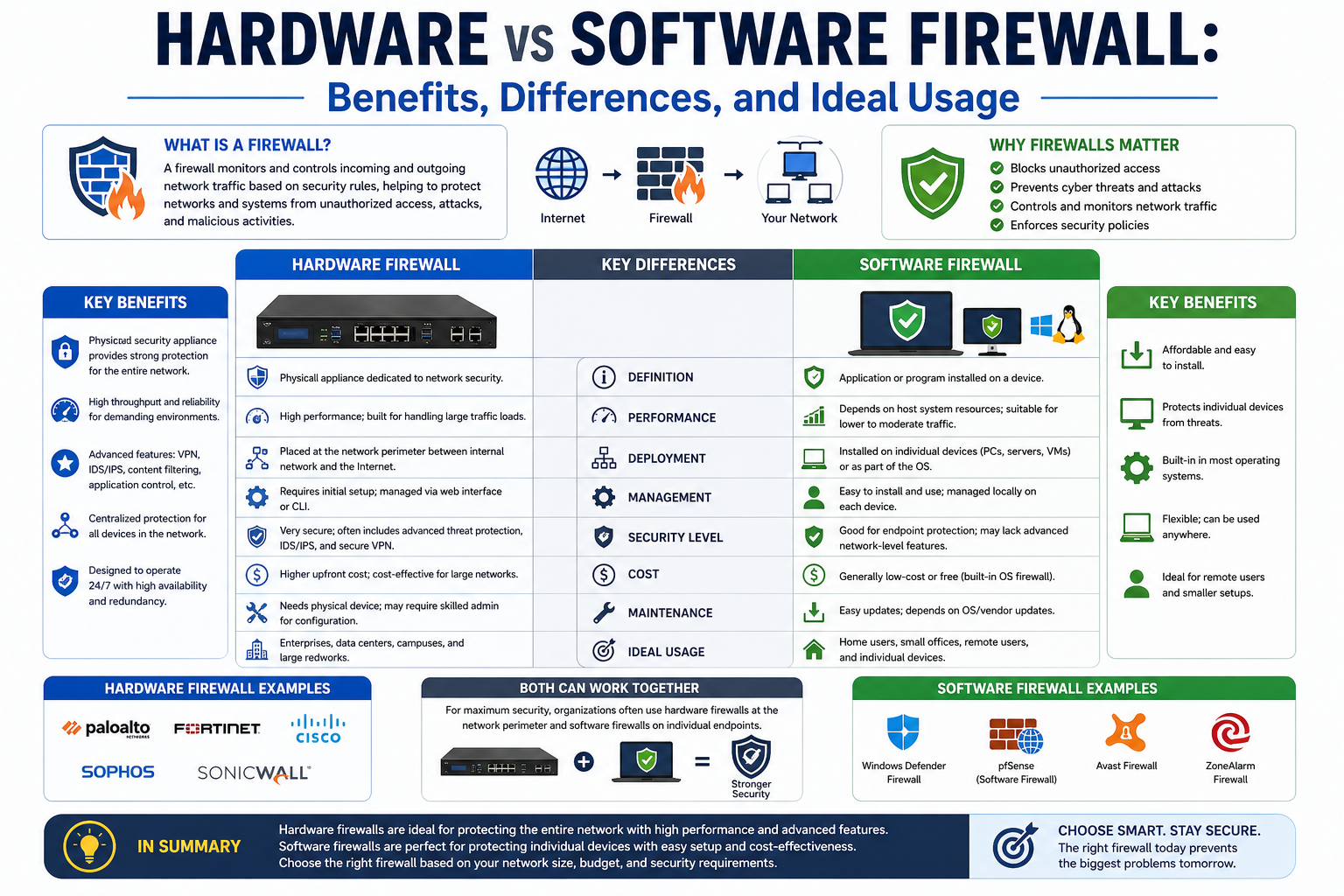
With the increasing complexity of network environments, firewalls began to be categorized based on how and where they are deployed. This led to the distinction between hardware-based and software-based firewalls. Each type serves the same fundamental purpose of controlling traffic but operates in different ways and at different levels within a network structure. Hardware firewalls are designed to protect entire networks, while software firewalls focus on individual devices. This separation allows organizations and users to choose solutions based on their specific needs. In many cases, both types are used together to create layered protection. Understanding this distinction is important because it directly influences how security is implemented in different environments, ranging from large corporate networks to personal devices used by remote workers.
Overview of Hardware Firewalls as Network Protection Devices
Hardware firewalls are physical security appliances that are installed between an external network connection and an internal network. They act as a central gateway through which all network traffic must pass before reaching connected devices. Because of this position, they can monitor and control traffic for an entire organization at once. These devices are purpose-built for handling large volumes of data and are optimized for performance and reliability. They often include dedicated processing components designed specifically for security tasks, which allows them to inspect traffic without slowing down the network significantly. Hardware firewalls are commonly used in businesses, data centers, and enterprise environments where multiple users and systems require consistent and centralized protection.
Placement and Role of Hardware Firewalls in a Network
A hardware firewall is typically placed at the edge of a network, directly between the internet connection provided by an external service and the internal local network. This means that all incoming and outgoing traffic must pass through it before reaching any internal system. Because of this position, it serves as the first major checkpoint for security enforcement. It can filter traffic, block suspicious requests, and allow only approved communication to proceed further into the network. This centralized control simplifies security management because administrators can define policies once and apply them across the entire network. It also ensures consistent protection for all connected devices, regardless of their individual configurations. This makes hardware firewalls particularly suitable for organizations that require strong, uniform security across multiple systems.
Performance and Scalability in Hardware-Based Protection
One of the key strengths of hardware firewalls is their ability to handle large amounts of network traffic efficiently. Since they are built with dedicated processing resources, they can manage high-speed data transfer without relying on the computing power of individual devices. This makes them ideal for environments where multiple users are accessing network services simultaneously. They are also highly scalable, meaning they can be upgraded or expanded to support growing network demands. In large organizations, this scalability is important because network usage tends to increase over time. Hardware firewalls are designed to maintain performance even under heavy traffic loads, ensuring that security measures do not interfere with overall network efficiency or user experience.
Common Features Found in Hardware Firewall Systems
Modern hardware firewalls include a wide range of security features beyond simple traffic filtering. Many systems are capable of inspecting encrypted traffic, identifying suspicious patterns, and blocking potential intrusion attempts in real time. Some also provide support for secure remote connections, allowing users to access internal networks safely from external locations. Additional features may include traffic balancing to distribute network load efficiently and monitoring tools that help administrators track network activity. These capabilities make hardware firewalls comprehensive security solutions for organizations that require strong protection at the network level. While feature sets vary depending on the system, advanced models are designed to offer multi-layered defense against both common and sophisticated cyber threats.
Examples of Hardware Firewall Solutions in Enterprise Use
Hardware firewalls are commonly used in enterprise environments and are produced by several well-known technology manufacturers. These systems are designed to serve organizations of different sizes, from small businesses to large multinational corporations. They are often chosen based on performance requirements, scalability needs, and available security features. Some models are built for high-capacity data centers, while others are intended for smaller office environments. Regardless of size, their primary role remains the same: to secure the network perimeter and control all traffic entering or leaving the organization. Their widespread use in professional environments highlights their importance in maintaining secure and stable network infrastructure.
Introduction to Software Firewalls as Device-Level Protection
Unlike hardware firewalls, software firewalls are installed directly on individual devices such as computers, laptops, or servers. They operate at the host level, meaning they are responsible for protecting only the device on which they are installed. These firewalls monitor incoming and outgoing traffic specific to that device and apply security rules accordingly. Because they are software-based, they do not require separate physical hardware and can be installed or configured directly within the operating system. This makes them widely accessible and easy to deploy across multiple devices. Software firewalls are commonly used in personal computing environments as well as in organizations that require device-level control in addition to network-wide protection.
How Software Firewalls Operate at the Host Level
Software firewalls function by analyzing network traffic that directly interacts with a specific device. They inspect applications, services, and processes attempting to send or receive data and determine whether such communication should be allowed. This level of control allows users or administrators to set detailed rules for individual programs, restricting or permitting access based on security needs. Since they operate within the operating system, they can also provide alerts when suspicious activity is detected. This makes them particularly useful for monitoring unauthorized access attempts targeting a single device. Unlike hardware firewalls, their scope is limited to one system, but within that scope, they offer precise and customizable control over network behavior.
Benefits and Flexibility of Software-Based Firewalls
One of the main advantages of software firewalls is their flexibility. They can be easily installed on most operating systems without requiring additional hardware investment. Many systems come with built-in firewall capabilities, making basic protection readily available. They are also highly customizable, allowing users to define specific rules based on applications or user preferences. This makes them suitable for environments where different devices require different security configurations. Additionally, they are cost-effective, which makes them accessible for individuals and small businesses. Their ability to provide protection at the device level ensures that even when a system is outside a secured network, it still maintains a layer of defense against external threats.
Importance of Software Firewalls for Remote and Mobile Users
Software firewalls are especially important in scenarios where users operate outside traditional office networks. With the rise of remote work and mobile computing, many devices frequently connect to public or untrusted networks such as home internet connections, cafes, or travel hubs. In such situations, hardware firewalls may not provide direct protection because the device is no longer within the secure network boundary. Software firewalls fill this gap by ensuring that each device remains protected regardless of its location. They help maintain consistent security policies even when users move between different environments, making them an essential component of modern endpoint security strategies.
Comparing Hardware Firewalls and Software Firewalls in Practical Use
When examining hardware and software firewalls in real-world environments, the differences become more meaningful than just technical definitions. Both serve the same core purpose of controlling network traffic and enforcing security policies, yet they operate at different layers and scales. Hardware firewalls are designed to protect entire networks from a centralized position, while software firewalls focus on securing individual endpoints. This difference in scope significantly affects how they are deployed, managed, and maintained in both enterprise and personal environments. In practice, organizations often use a combination of both to achieve layered security, ensuring that threats are filtered at multiple levels before they can cause damage. Understanding how each type performs in real scenarios helps in choosing the right strategy for different operational needs.
Performance Differences Between Hardware and Software Firewalls
Performance is one of the most noticeable distinctions between hardware and software firewalls. Hardware firewalls are built using dedicated processing units designed specifically for handling large volumes of network traffic. This allows them to inspect and filter data at high speeds without relying on general-purpose computing resources. Because they sit at the network gateway, they are optimized to manage simultaneous connections from many devices without significant performance degradation. This makes them highly suitable for organizations with heavy network usage, such as corporations, educational institutions, and data centers.
Software firewalls, on the other hand, depend on the computing resources of the device they are installed on. Their performance is limited by the host system’s processor, memory, and overall workload. Since they only manage traffic for a single device, this limitation is usually not a problem in everyday use. However, in environments where a device is running multiple resource-intensive applications, the firewall may contribute to a slight performance overhead. Despite this, modern systems are generally efficient enough that the impact remains minimal for typical users.
Scalability in Enterprise and Personal Environments
Scalability plays a major role when choosing between firewall types, especially in growing organizations. Hardware firewalls are highly scalable because they are designed to support expanding networks. As more users and devices are added, the firewall can often be upgraded or replaced with higher-capacity models without changing the overall architecture. This centralized scalability makes it easier for IT teams to manage security policies across large infrastructures. A single hardware firewall can protect hundreds or even thousands of connected devices, depending on its capacity.
Software firewalls scale differently because they operate individually on each device. Instead of upgrading one central system, each endpoint must be configured and maintained separately. While this might seem less efficient in large environments, it provides flexibility. Each device can have customized security settings tailored to its specific usage. In organizations with diverse roles and access requirements, this level of customization can be beneficial. However, managing a large number of software firewalls requires more administrative effort and consistent policy enforcement across all endpoints.
Security Depth and Protection Capabilities
Security capabilities differ significantly between hardware and software firewalls, especially in advanced threat environments. Hardware firewalls often include enterprise-grade features such as intrusion prevention systems, deep packet inspection, and application-level filtering. These features allow them to detect complex attack patterns and block malicious traffic before it reaches internal systems. Some advanced models can even analyze encrypted traffic to identify hidden threats, making them highly effective against modern cyberattacks. Their ability to act as a centralized security checkpoint gives them strong visibility over all network activity.
Software firewalls provide security at a more granular level. They focus on controlling which applications or processes on a device can access the network. This makes them effective for preventing unauthorized programs from sending or receiving data. While they may not offer the same level of network-wide intelligence as hardware firewalls, they provide strong endpoint protection. In combination with operating system security features, they help reduce the risk of malware spreading or unauthorized applications communicating externally without permission.
Deployment Complexity and Setup Requirements
Deployment is another area where hardware and software firewalls differ significantly. Hardware firewalls require physical installation within a network infrastructure. This involves connecting the device between the internet source and internal network systems. Proper configuration is necessary to ensure that traffic flows correctly and security policies are enforced as intended. In larger environments, deployment may also involve integration with existing networking equipment such as routers, switches, and servers. While this setup requires technical expertise, it results in a centralized and stable security structure once properly configured.
Software firewalls are much simpler to deploy because they are installed directly on operating systems. In many cases, they are already included as part of the system software, requiring only basic configuration to activate. This ease of deployment makes them suitable for individual users and small organizations. Updates and configuration changes can be applied remotely or through centralized management tools in enterprise environments. However, maintaining consistent configurations across many devices can become challenging without proper management systems in place.
Management and Administrative Control Differences
Managing hardware firewalls typically involves centralized administration. IT teams can configure security rules from a single interface, applying changes across the entire network. This simplifies policy enforcement and reduces the likelihood of inconsistent configurations. Monitoring tools included in hardware firewalls also provide a comprehensive view of network activity, allowing administrators to detect anomalies or potential threats more easily. Centralized management is one of the key reasons why hardware firewalls are preferred in large organizations.
Software firewalls require individual management for each device, although centralized endpoint management tools can help streamline the process in enterprise environments. Each installation may need specific rules depending on user requirements or system roles. While this allows for high customization, it also increases administrative workload. Ensuring that all devices maintain updated security policies is critical to avoid vulnerabilities. In environments where devices frequently move between networks, consistent management becomes even more important to maintain security standards.
Network Visibility and Traffic Control Capabilities
Hardware firewalls provide extensive visibility into network traffic because they monitor all data passing through the network gateway. This allows them to analyze patterns, detect unusual behavior, and enforce policies across multiple devices simultaneously. They can identify traffic sources, destination endpoints, and communication types across the entire network structure. This broad visibility is essential for detecting coordinated attacks or unusual traffic spikes that may indicate security incidents.
Software firewalls, while more limited in scope, provide detailed visibility into device-level activity. They can track which applications are communicating over the network and how frequently data is being transmitted. This level of detail is useful for identifying suspicious software behavior or unauthorized data transfers on a specific machine. Although they do not provide a full network overview, their strength lies in precise control and monitoring of individual system activity.
Cost Considerations and Investment Factors
Cost is a major factor when deciding between hardware and software firewalls. Hardware firewalls generally require a higher initial investment because they involve purchasing dedicated physical equipment. Additional costs may include installation, maintenance, and periodic upgrades. However, they provide long-term value for organizations that require centralized security and high performance across multiple systems. Their ability to protect entire networks makes them cost-effective in large-scale environments.
Software firewalls are generally more affordable because they are often included with operating systems or available at low cost. Even advanced third-party solutions are typically less expensive than hardware-based systems. This makes them an attractive option for individuals, small businesses, and remote workers. However, when deployed across many devices, management costs and administrative overhead may increase, partially offsetting their initial affordability.
Role in Modern Cybersecurity Strategies
Modern cybersecurity strategies rarely rely on a single type of firewall. Instead, they use a layered approach that combines multiple security technologies. Hardware firewalls serve as the first line of defense at the network perimeter, filtering large volumes of traffic and blocking obvious threats before they enter internal systems. Software firewalls add an additional layer of protection at the endpoint level, ensuring that individual devices remain secure even if external networks are compromised.
This layered defense model is important because cyber threats have become more complex and adaptive. Attackers often use multiple techniques to bypass security systems, making it necessary to implement protection at different points in the network. By combining hardware and software firewalls, organizations can create a more resilient security architecture that reduces the likelihood of successful attacks.
Adaptability in Changing Work Environments
The rise of remote work and cloud-based systems has changed how firewalls are used in modern IT environments. Hardware firewalls remain essential for securing office networks and data centers, but they are less effective for devices that frequently move outside controlled environments. Software firewalls address this limitation by providing protection regardless of location. This adaptability is crucial for employees who work from home, travel frequently, or use multiple devices across different networks.
Organizations now often implement hybrid security models where hardware firewalls protect internal infrastructure while software firewalls secure endpoints. This combination ensures continuous protection even when users are outside traditional network boundaries. As work environments continue to evolve, the integration of both firewall types becomes increasingly important for maintaining consistent security standards.
Interdependence of Hardware and Software Firewalls in Security Architecture
Rather than viewing hardware and software firewalls as competing solutions, it is more accurate to see them as complementary components of a unified security system. Each plays a distinct role in protecting digital environments at different levels. Hardware firewalls manage large-scale traffic flow and enforce centralized security policies, while software firewalls focus on individual device protection and application-level control.
This interdependence creates a multi-layered defense system that enhances overall security effectiveness. If one layer is bypassed, another layer still provides protection. This redundancy is critical in modern cybersecurity, where threats can originate from multiple sources and evolve rapidly. By integrating both firewall types, organizations and users can achieve stronger, more reliable protection across all levels of their digital infrastructure.
Advanced Security Capabilities in Modern Firewall Systems
As cyber threats have evolved, firewall technology has also advanced beyond simple traffic filtering into highly intelligent security systems. Modern firewalls, especially those used in enterprise environments, are no longer limited to basic rule enforcement. They now include sophisticated capabilities such as application awareness, behavioral analysis, and real-time threat intelligence integration. These enhancements allow firewalls to identify not only known threats but also emerging attack patterns that may not yet be formally documented. This shift has transformed firewalls from passive gatekeepers into active security systems capable of making context-aware decisions. Both hardware and software firewalls benefit from these advancements, although hardware systems typically implement them on a larger and more complex scale due to their role in protecting entire networks.
Deep Packet Inspection and Traffic Analysis
One of the most important advancements in firewall technology is deep packet inspection, which allows a firewall to examine the actual contents of data packets rather than just their headers. Traditional firewalls could only evaluate basic information such as source and destination addresses, ports, and protocols. Deep inspection goes further by analyzing the payload of the data itself, making it possible to detect hidden malware, suspicious scripts, or unauthorized data transfers embedded within seemingly normal traffic.
Hardware firewalls often use this capability at scale to monitor large volumes of network traffic in real time. This is especially useful in environments where multiple applications and users generate complex data flows. Software firewalls may also use deep inspection, but their scope is limited to the traffic of a single device. Even so, this feature significantly enhances endpoint protection by allowing detailed scrutiny of application-level communication.
Intrusion Detection and Prevention Mechanisms
Intrusion detection and prevention systems are another major component of modern firewalls. These systems are designed to identify malicious activity based on known attack signatures or unusual behavior patterns. When suspicious activity is detected, the firewall can either alert administrators or actively block the traffic depending on its configuration. This dual capability makes firewalls more proactive in defending against attacks rather than simply reacting to them after damage occurs.
Hardware firewalls typically integrate intrusion prevention at the network level, giving them visibility into all incoming and outgoing traffic. This allows them to detect coordinated attacks, such as distributed attempts to overwhelm a system or gain unauthorized access. Software firewalls implement similar logic but focus on activity originating from or targeting the specific device. This helps prevent malware infections, unauthorized application behavior, and suspicious outbound connections.
Application Awareness and Context-Based Filtering
Modern firewalls have become increasingly aware of the applications generating network traffic. Instead of treating all traffic equally based on ports and protocols, they can now identify specific applications and enforce rules accordingly. This means that a firewall can distinguish between legitimate business applications and unauthorized software attempting to use the same network channels.
In hardware firewalls, application awareness is used to enforce organizational policies across all users. For example, an organization may allow access to business communication tools while restricting entertainment or peer-to-peer applications. Software firewalls apply similar logic at the device level, allowing users or administrators to control which applications can access the internet. This level of granularity improves security while maintaining operational flexibility.
Encrypted Traffic Inspection Challenges and Solutions
A growing challenge in firewall security is the widespread use of encryption. While encryption is essential for protecting data privacy, it also creates blind spots for traditional inspection methods. Attackers can hide malicious payloads within encrypted traffic, making detection more difficult. To address this, modern firewalls have developed the ability to decrypt, inspect, and re-encrypt traffic in controlled environments.
Hardware firewalls often handle encrypted traffic inspection at scale, using specialized processing power to manage the computational load. This is critical in enterprise environments where large volumes of secure traffic flow continuously. Software firewalls may also inspect encrypted traffic, but they are generally limited to specific applications or connections due to resource constraints. Despite these challenges, encrypted traffic inspection remains a key feature in maintaining visibility over modern network communications.
Web Application Protection and Specialized Filtering
Web applications have become one of the most common targets for cyberattacks, making specialized protection essential. Firewalls designed to protect web applications focus on identifying threats such as injection attacks, cross-site scripting, and unauthorized data access attempts. These protections are often implemented in web application firewall modules that operate alongside traditional firewall functions.
Hardware firewalls may include dedicated web protection features to safeguard servers hosting websites, APIs, and online services. This is especially important for organizations that rely heavily on web-based infrastructure. Software firewalls, while not always equipped with full web application protection capabilities, still contribute by restricting unauthorized application communication and blocking suspicious outbound connections from compromised devices.
Load Balancing and Network Optimization Features
In addition to security functions, many modern hardware firewalls include network optimization features such as load balancing. Load balancing helps distribute network traffic evenly across multiple servers or systems to prevent overload and maintain performance stability. This ensures that no single server becomes a bottleneck, improving both reliability and user experience.
Software firewalls generally do not include load balancing features because they operate at the individual device level. However, they can still contribute indirectly to network performance by preventing unauthorized or unnecessary applications from consuming bandwidth. This helps maintain efficient resource usage on the device itself.
Virtual Private Network Integration and Secure Remote Access
Secure remote access has become a critical requirement in modern IT environments. Many hardware firewalls include built-in support for virtual private networks, allowing remote users to securely connect to internal systems over encrypted channels. This ensures that sensitive data remains protected even when accessed from external locations.
Software firewalls also play a role in remote connectivity by enforcing security rules on devices that connect from outside the corporate network. They help ensure that only authorized applications and services are allowed to communicate over secure connections. Together, these firewall types support secure remote work environments by maintaining consistent protection regardless of user location.
Deployment Differences in Physical and Virtual Environments
Firewall deployment has expanded beyond traditional physical infrastructure into virtual environments. Hardware firewalls are typically deployed as physical appliances within data centers or network boundaries. They require dedicated installation and integration with existing networking hardware. This physical placement gives them strong control over all traffic entering or leaving a network.
Software firewalls, however, are inherently flexible and can be deployed in both physical and virtual environments. They are commonly used on virtual machines, cloud instances, and remote endpoints. This flexibility makes them particularly useful in modern cloud-based infrastructures where workloads are distributed across multiple environments. Their ability to operate independently of physical hardware allows them to adapt to dynamic computing architectures.
Management Complexity and Administrative Overhead
Managing hardware firewalls involves centralized administration, which simplifies policy enforcement but requires skilled configuration and maintenance. Administrators must ensure that firewall rules are correctly aligned with organizational security policies and updated regularly to respond to emerging threats. While centralized management reduces duplication of effort, it also means that misconfigurations can have wide-reaching effects across the entire network.
Software firewalls require distributed management since they operate on individual devices. This increases administrative overhead but provides more granular control. In large organizations, centralized endpoint management systems are often used to streamline configuration and updates. Despite these tools, ensuring consistency across all devices remains a significant challenge, especially in environments with a high number of mobile or remote users.
Security Layering and Defense in Depth Strategy
Modern cybersecurity relies heavily on the concept of layered defense, often referred to as defense in depth. This approach involves using multiple security mechanisms at different levels of an infrastructure to create redundancy and reduce the likelihood of successful attacks. Firewalls are a core component of this strategy.
Hardware firewalls provide the first layer of defense by filtering traffic at the network boundary. Software firewalls add a second layer by securing individual devices and controlling application-level communication. When combined with other security technologies such as antivirus systems and intrusion detection tools, they create a comprehensive protection framework. This layered approach ensures that even if one security barrier is bypassed, additional barriers remain in place to prevent or limit damage.
Role in Cloud Computing and Modern Infrastructure
Cloud computing has significantly changed how firewalls are deployed and managed. Traditional hardware firewalls are still used to protect on-premises infrastructure, but cloud environments often rely on virtualized firewall solutions. These virtual firewalls function similarly to hardware firewalls but are implemented through software within cloud platforms.
Software firewalls also play an important role in cloud environments by protecting individual virtual machines and containers. As workloads become more distributed, the need for flexible and scalable firewall solutions increases. Both firewall types now extend beyond traditional network boundaries and operate within hybrid infrastructures that combine physical, virtual, and cloud-based systems.
Integration with Security Monitoring and Analytics Systems
Modern firewalls are increasingly integrated with security monitoring and analytics platforms. These systems collect data from firewall logs and analyze it to identify trends, detect anomalies, and generate alerts for potential threats. Hardware firewalls contribute large-scale network data, while software firewalls provide detailed endpoint-level insights.
This combination of data sources allows security teams to gain a comprehensive view of network activity. It also enables faster response to incidents by correlating information from multiple layers of the infrastructure. Integration with analytics systems has become a key component of proactive cybersecurity strategies, helping organizations detect and respond to threats more efficiently.
Growing Importance of Adaptive Firewall Technologies
As cyber threats continue to evolve, firewall systems are becoming more adaptive. Instead of relying solely on static rules, modern firewalls incorporate machine learning and behavioral analysis to identify unusual activity patterns. This allows them to respond dynamically to new types of attacks without requiring manual rule updates.
Both hardware and software firewalls are gradually incorporating these adaptive capabilities. Hardware systems apply them at scale across entire networks, while software systems focus on individual device behavior. This evolution represents a shift toward more intelligent and responsive security systems that can adapt to changing threat landscapes in real time.
Choosing Between Hardware and Software Firewalls in Real Environments
Deciding between hardware and software firewalls is not a matter of which one is universally better, but rather which one aligns with specific operational needs. In real-world environments, security requirements vary significantly depending on the size of the organization, the type of data being handled, and how users access systems. Hardware firewalls are generally chosen when there is a need to protect a centralized network infrastructure with many connected devices. They provide consistent policy enforcement and strong perimeter security, making them suitable for corporate offices, data centers, and institutions with stable network environments.
Software firewalls are typically selected when flexibility and device-level control are more important. They are ideal for environments where users frequently move between networks or operate outside centralized infrastructure. Remote employees, freelancers, and mobile users benefit greatly from software firewalls because protection remains active regardless of location. In many modern IT strategies, the decision is not exclusive. Instead, both firewall types are combined to create a layered security model that addresses both network-level and endpoint-level risks.
Enterprise Use of Hardware Firewalls in Centralized Security Models
In enterprise environments, hardware firewalls serve as the backbone of network security architecture. They are positioned at critical entry and exit points of organizational networks, ensuring that all traffic is filtered before reaching internal systems. This centralized approach allows security teams to enforce uniform policies across all departments and users. It also simplifies monitoring and incident response because all network activity passes through a single controlled point.
Large organizations often deal with complex infrastructures that include servers, databases, cloud connections, and multiple office locations. Hardware firewalls help unify security across these environments by acting as a central enforcement mechanism. They are especially valuable in industries where data sensitivity is high, such as finance, healthcare, and government sectors. Their ability to handle large-scale traffic while maintaining strict security controls makes them a foundational component of enterprise cybersecurity strategies.
Software Firewalls in Endpoint-Centric Security Approaches
Software firewalls play a crucial role in endpoint-centric security models, where each device is treated as an independent security boundary. This approach has become increasingly important due to the rise of remote work, mobile computing, and bring-your-own-device environments. In such scenarios, devices frequently connect to networks that are not controlled by an organization, increasing exposure to potential threats. Software firewalls ensure that security policies remain active regardless of network location.
By operating directly on the device, software firewalls can monitor application behavior, restrict unauthorized communication, and provide alerts when suspicious activity is detected. This level of control is particularly useful for preventing malware infections and blocking unauthorized data transmission. In environments where employees use personal or portable devices, software firewalls provide a consistent layer of protection that follows the user rather than the network.
Hybrid Firewall Strategies in Modern Cybersecurity Architectures
Modern cybersecurity rarely relies on a single firewall type. Instead, organizations adopt hybrid strategies that combine hardware and software firewalls to achieve comprehensive protection. In this model, hardware firewalls secure the network perimeter while software firewalls protect individual endpoints. This layered approach ensures that even if one security layer is bypassed, additional barriers remain in place to prevent or contain threats.
For example, if malicious traffic manages to pass through a network firewall, a software firewall on the target device can still block or restrict harmful activity. Similarly, if a device becomes compromised, the hardware firewall can prevent it from spreading threats across the network. This combination creates redundancy in security controls, which is essential in defending against increasingly sophisticated cyberattacks. Hybrid strategies are now considered standard practice in most mature IT environments.
Operational Challenges in Managing Firewall Systems
While firewalls are essential for security, they also introduce operational challenges that must be managed effectively. Hardware firewalls require careful configuration, regular updates, and ongoing monitoring to ensure optimal performance. Misconfigurations can lead to security gaps or network disruptions, making proper administration critical. Additionally, hardware maintenance may involve hardware upgrades or replacements over time, especially in high-demand environments.
Software firewalls present a different set of challenges. Since they are deployed across multiple devices, maintaining consistent configuration and policy enforcement can be complex. Devices may run different operating systems, receive updates at different times, or be used in varying network conditions. Ensuring that all endpoints remain compliant with security policies requires centralized management tools and disciplined administrative practices. Without proper coordination, inconsistencies can create vulnerabilities within the overall security framework.
Cost Efficiency and Long-Term Investment Considerations
Cost plays an important role in firewall selection, especially for organizations with limited budgets. Hardware firewalls typically involve a higher initial investment due to the cost of physical devices and associated infrastructure. However, they often provide long-term value by offering centralized protection for entire networks. Their ability to scale with organizational growth also makes them a cost-effective solution over time in large environments.
Software firewalls are generally more affordable and often included as part of operating systems or security suites. This makes them accessible for individuals and small organizations. However, when deployed across many devices, management and maintenance costs can increase. Despite this, their flexibility and low entry cost make them an attractive option for distributed or remote work environments. The overall cost-effectiveness of each firewall type depends heavily on the scale and structure of the environment in which it is used.
Adaptation to Remote Work and Mobile Computing Trends
The rise of remote work has significantly influenced how firewalls are deployed and used. Traditional hardware firewalls are effective within controlled office environments but are less relevant when users operate outside organizational networks. Software firewalls address this limitation by providing continuous protection regardless of location. This ensures that devices remain secure even when connected to public or untrusted networks.
Organizations now rely on a combination of secure network access solutions and endpoint protection to support remote workforces. Software firewalls play a key role in this structure by enforcing security rules directly on user devices. This allows employees to maintain secure connections whether they are working from home, traveling, or using shared networks. As remote and hybrid work models continue to expand, the importance of device-level security continues to grow.
Integration with Modern Security Ecosystems
Firewalls are no longer standalone security tools; they are now integrated into broader cybersecurity ecosystems. Hardware firewalls often connect with intrusion detection systems, security information platforms, and centralized monitoring tools. This integration allows organizations to analyze network traffic in real time and respond quickly to potential threats. It also provides valuable insights into traffic patterns and security incidents across the entire network.
Software firewalls are also increasingly integrated with endpoint security platforms. These systems combine firewall functions with antivirus protection, behavioral analysis, and device monitoring. This creates a unified security layer at the device level, improving visibility and control. Integration across both firewall types ensures that security data can be correlated and analyzed from multiple sources, improving overall threat detection and response capabilities.
Future Trends in Firewall Technology Development
Firewall technology continues to evolve in response to changing cybersecurity threats. One major trend is the increasing use of artificial intelligence and machine learning to detect and respond to threats automatically. These technologies allow firewalls to analyze behavior patterns and identify anomalies without relying solely on predefined rules. This improves their ability to detect new and unknown threats in real time.
Another emerging trend is the expansion of firewalls into cloud-native environments. As organizations move infrastructure to cloud platforms, firewalls are being adapted into virtual and distributed forms that can operate across multiple environments. This ensures consistent security policies regardless of where data or applications are hosted. Both hardware and software firewalls are evolving to support these modern architectures, becoming more flexible, intelligent, and scalable.
Strategic Role of Firewalls in Overall Cybersecurity Planning
Firewalls remain one of the most important components of any cybersecurity strategy. They form the first line of defense against unauthorized access and malicious traffic, helping to establish controlled communication between trusted and untrusted environments. However, they are most effective when used as part of a broader security framework that includes encryption, authentication, monitoring, and endpoint protection.
Hardware firewalls provide strong network-level defense, while software firewalls ensure continuous device-level protection. Together, they create a balanced security posture that addresses both centralized and distributed threats. As cyber risks continue to evolve, the strategic importance of firewalls remains constant, even as their technologies and deployment methods become more advanced and adaptive.
Final Perspective
Both hardware and software firewalls play essential roles in modern digital security, but they serve different purposes within the overall protection landscape. Hardware firewalls are best suited for centralized environments that require high performance, scalability, and unified control over large networks. Software firewalls are best suited for individual devices that operate across multiple and often untrusted networks, offering flexibility and portability.
The most effective security strategies do not rely on choosing one over the other but instead combine both to create layered defense systems. This integrated approach ensures that threats are addressed at multiple points, reducing the likelihood of successful attacks. In a world where digital risks continue to grow in complexity, understanding and properly implementing both firewall types is essential for maintaining strong and resilient cybersecurity.