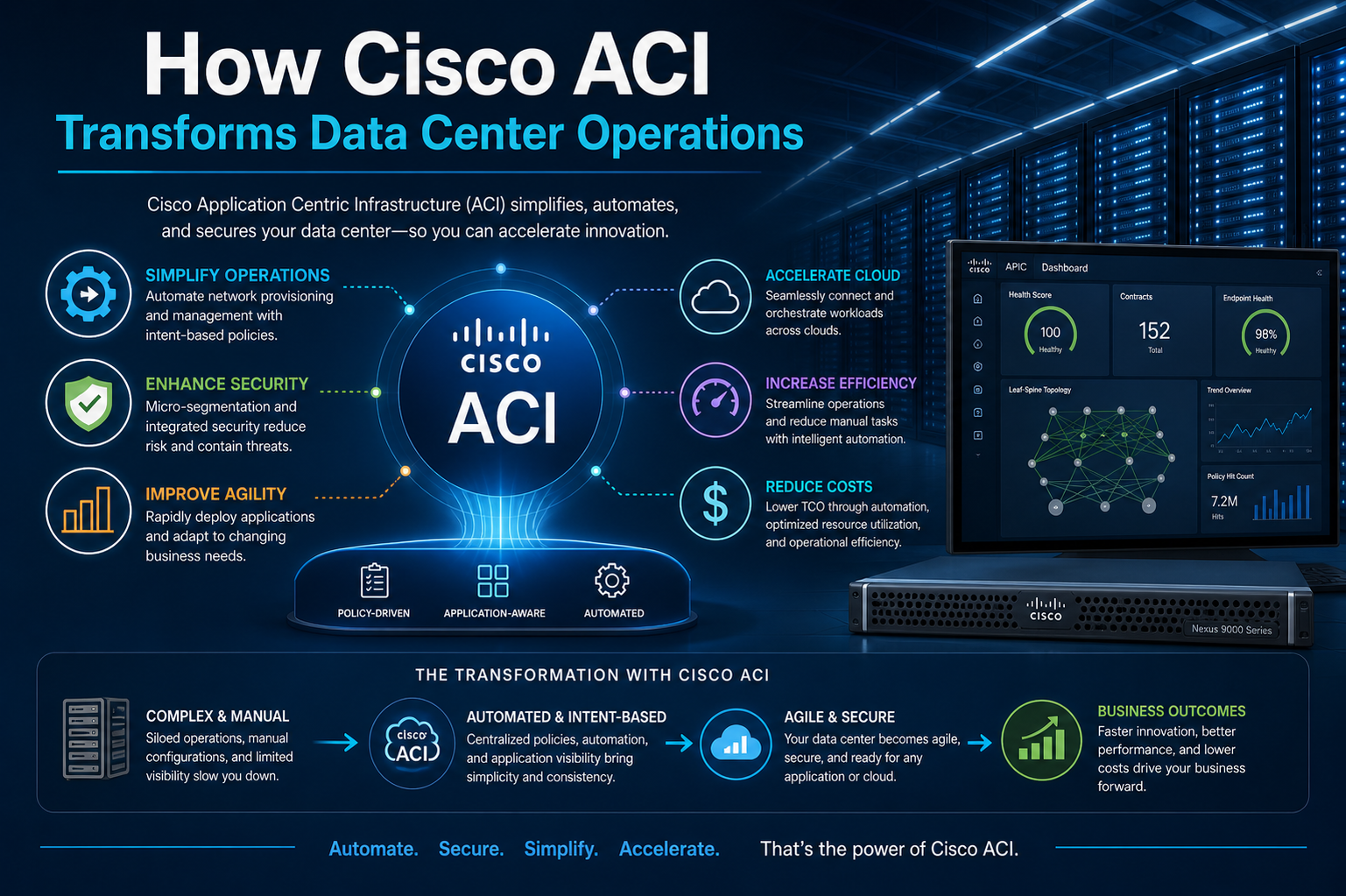
In today’s digital world, large-scale data centers power everything from cloud computing platforms to enterprise applications. Organizations such as Amazon and Microsoft rely on highly advanced systems to keep their infrastructure efficient, scalable, and secure. One of the key technologies enabling this level of performance is Cisco Application Centric Infrastructure, commonly known as Cisco ACI. This solution represents a significant shift in how networks are designed, managed, and optimized. Instead of relying on traditional, manual configurations, Cisco ACI introduces a centralized and automated approach that aligns network behavior with application requirements. This transformation has become essential as data centers continue to grow in size and complexity, requiring more intelligent and adaptive systems to handle increasing workloads and security demands.
The Evolution from Traditional Networking to Software-Defined Infrastructure
Before the introduction of software-defined networking, managing a data center required extensive manual effort. Network engineers had to configure each device individually using command-line interfaces, which was not only time-consuming but also prone to human error. As organizations expanded, their networks became more complex, making it increasingly difficult to maintain accurate documentation and ensure consistent configurations across all devices. This challenge led to the need for a more efficient and scalable approach. Cisco addressed this demand by introducing its Nexus product line in 2013, which laid the foundation for ACI. These systems were specifically designed to support modern architectures and incorporate automation capabilities directly into the network. By shifting control from individual devices to centralized software platforms, Cisco ACI enables administrators to manage entire infrastructures through intuitive interfaces, reducing operational overhead and improving consistency.
Defining Application Centric Infrastructure and Its Core Concept
Cisco ACI stands for Application Centric Infrastructure, a name that reflects its primary focus on applications rather than just hardware components. Traditional networks are typically configured based on device-level settings, but ACI changes this perspective by allowing administrators to define policies based on application needs. This means that instead of configuring switches and routers individually, engineers can specify how an application should behave, and the system automatically applies the necessary network configurations. This abstraction simplifies network management and ensures that applications receive the resources and connectivity they require without manual intervention. The ACI framework includes a centralized controller, policy-driven automation, and integration with various management tools, all working together to create a more responsive and adaptable network environment.
Centralized Management and the Shift Away from Manual Configuration
One of the most significant advantages of Cisco ACI is its centralized management model. In traditional environments, engineers needed to log into multiple devices to troubleshoot issues or implement changes. This process was not only inefficient but also increased the risk of inconsistencies. With ACI, all configurations and policies are managed through a unified interface, often referred to as the Application Policy Infrastructure Controller (APIC). This controller acts as the brain of the network, translating high-level policies into specific configurations for each device. As a result, network administrators can make changes quickly and ensure that those changes are applied consistently across the entire infrastructure. This centralized approach also improves visibility, allowing teams to monitor performance, detect anomalies, and respond to issues more effectively.
Automation as the Foundation of Efficient Data Center Management
Automation is at the heart of Cisco ACI and plays a crucial role in managing modern data centers. As networks grow larger, manual processes become increasingly impractical. ACI addresses this challenge by automating routine tasks such as provisioning, configuration, and troubleshooting. For example, when a new application is deployed, the system can automatically allocate the necessary network resources and apply the appropriate security policies. This not only speeds up deployment times but also reduces the likelihood of errors. Additionally, automation enables dynamic adjustments based on real-time conditions. If network congestion occurs, ACI can reroute traffic to maintain optimal performance. This self-adjusting capability ensures that the network remains resilient and efficient նույնիսկ under heavy workloads.
Spine-Leaf Architecture and Its Importance in ACI Environments
Modern data centers often use a spine-leaf architecture, which is a key component of Cisco ACI deployments. In this design, leaf switches connect to servers and endpoints, while spine switches provide high-speed connectivity between all leaf switches. Each leaf switch connects to every spine switch, creating multiple paths for data to travel. This structure ensures high availability and minimizes latency, as traffic can take the most efficient route through the network. Unlike traditional three-tier architectures, spine-leaf designs are optimized for east-west traffic, which is common in data centers where servers frequently communicate with each other. Cisco ACI enhances this architecture by automating its configuration and management, making it easier to scale and maintain.
Handling Complexity and Scale in Large Data Centers
As data centers expand, they must support a wide range of applications and services, often for multiple users or organizations. This multi-tenant environment requires strict segmentation to ensure security and performance. Cisco ACI simplifies this process by allowing administrators to create isolated network environments for different users or applications. These virtual networks can be deployed quickly and adjusted as needed, providing flexibility without compromising security. For instance, cloud providers can use ACI to create separate environments for each customer, ensuring that their data and resources remain isolated. This level of control is essential for maintaining trust and meeting regulatory requirements in modern IT environments.
Enhancing Security Through Policy-Driven Networking
Security is a major concern in any data center, and Cisco ACI addresses this challenge through its policy-driven approach. Instead of relying on traditional perimeter defenses, ACI enables micro-segmentation, which involves dividing the network into smaller, isolated segments. Each segment can have its own security policies, limiting the spread of potential threats. This approach reduces the attack surface and makes it easier to contain breaches if they occur. Additionally, ACI integrates with various security tools and platforms, allowing organizations to implement comprehensive protection strategies. By automating policy enforcement, ACI ensures that security measures are consistently applied across the network, reducing the risk of misconfigurations.
Real-Time Monitoring and Intelligent Network Optimization
Another key feature of Cisco ACI is its ability to monitor network performance in real time. The system collects data from various sources, providing insights into traffic patterns, resource utilization, and potential issues. This information allows administrators to make informed decisions and optimize network performance. In many cases, ACI can also take proactive measures, such as adjusting traffic flows or reallocating resources to prevent congestion. This level of intelligence is particularly valuable in dynamic environments where workloads can change rapidly. By continuously analyzing data and adapting to conditions, ACI helps ensure that applications run smoothly and efficiently.
Reducing Operational Costs and Improving Efficiency
Implementing Cisco ACI can lead to significant cost savings for organizations. By automating routine tasks and simplifying network management, ACI reduces the need for manual labor and minimizes the risk of errors. This allows IT teams to focus on more strategic initiatives rather than spending time on repetitive tasks. Additionally, the improved efficiency and scalability of ACI-enabled networks can reduce hardware requirements and energy consumption. These benefits make ACI an attractive solution for organizations looking to optimize their data center operations while maintaining high levels of performance and reliability.
Extending Cisco ACI into Multi-Cloud and Hybrid Environments
As organizations increasingly adopt hybrid and multi-cloud strategies, the need for consistent network management across different environments has become critical. Cisco ACI addresses this challenge by extending its policy-driven framework beyond the physical data center into public cloud platforms and remote infrastructures. Businesses often rely on services from providers such as Amazon Web Services and Microsoft Azure, and managing these environments separately can create operational silos. Cisco ACI eliminates this fragmentation by offering a unified approach, allowing administrators to define policies once and apply them consistently across on-premises and cloud environments. This capability ensures seamless connectivity, improved security, and simplified operations, making it easier for organizations to scale their infrastructure without losing control or visibility.
Policy-Based Automation and Application Profiles
A defining feature of Cisco ACI is its use of policy-based automation, which shifts the focus from device-level configuration to application-level intent. Administrators can create application profiles that define how different components of an application interact with each other and the network. These profiles include policies for connectivity, security, and quality of service, all of which are automatically enforced by the system. This approach reduces the complexity of managing large-scale environments, as engineers no longer need to configure each device individually. Instead, they can focus on defining high-level requirements, and ACI takes care of the underlying implementation. This not only speeds up deployment but also ensures consistency across the entire infrastructure, which is essential for maintaining performance and reliability in modern data centers.
Multi-Tenancy and Segmentation for Diverse Workloads
Data centers today must support a wide variety of workloads, often belonging to different departments, customers, or business units. Cisco ACI provides robust multi-tenancy capabilities that allow organizations to create isolated environments within a shared infrastructure. Each tenant can have its own policies, configurations, and security controls, ensuring that resources are used efficiently without compromising isolation. This is particularly important for service providers and large enterprises that need to support multiple clients or business functions simultaneously. By using logical segmentation, ACI ensures that traffic from one tenant does not interfere with another, enhancing both security and performance. This level of isolation is achieved without the need for additional hardware, making it a cost-effective solution for managing complex environments.
Integration with Virtualization and Container Platforms
Modern applications are increasingly built using virtualization and containerization technologies, which require dynamic and flexible networking solutions. Cisco ACI integrates seamlessly with platforms such as VMware vSphere and Kubernetes, enabling automated network provisioning for virtual machines and containers. This integration allows ACI to adapt to changes in the application environment, such as scaling up or down based on demand. For example, when new containers are deployed, ACI can automatically assign network policies and ensure that they are properly connected to other components. This level of automation is essential for supporting modern DevOps practices, where rapid deployment and continuous integration are key requirements. By bridging the gap between networking and application development, ACI helps organizations achieve greater agility and efficiency.
Enhancing Visibility with Telemetry and Analytics
Visibility is a crucial aspect of effective network management, and Cisco ACI provides advanced telemetry and analytics capabilities to help administrators understand what is happening within their infrastructure. The system collects detailed data on traffic flows, application performance, and network health, presenting it through intuitive dashboards and reports. This information allows teams to identify trends, detect anomalies, and troubleshoot issues more effectively. In addition, ACI leverages machine learning techniques to analyze this data and provide actionable insights. For instance, it can predict potential bottlenecks or recommend optimizations to improve performance. This proactive approach helps organizations maintain high levels of service availability and reduces the risk of unexpected disruptions.
Self-Healing Networks and Intelligent Traffic Management
One of the most powerful aspects of Cisco ACI is its ability to create self-healing networks. By continuously monitoring conditions and applying predefined policies, ACI can automatically respond to issues such as congestion, hardware failures, or security threats. For example, if a particular path in the network becomes congested, the system can reroute traffic through alternative paths to maintain performance. Similarly, if a device fails, ACI can quickly adjust configurations to minimize the impact on applications. This level of automation reduces the need for manual intervention and ensures that the network remains resilient նույնիսկ in the face of unexpected challenges. Intelligent traffic management also plays a key role in optimizing resource utilization, ensuring that critical applications receive the bandwidth and priority they need.
Simplifying Network Operations with Unified Interfaces
Managing a large-scale network can be a daunting task, especially when dealing with multiple tools and interfaces. Cisco ACI simplifies this process by providing a unified management platform that consolidates all network operations into a single interface. This platform allows administrators to configure policies, monitor performance, and troubleshoot issues without switching between different systems. The intuitive design of the interface makes it easier for teams to understand and manage complex environments, reducing the learning curve and improving productivity. Additionally, the centralized nature of ACI ensures that all changes are tracked and documented, providing a clear audit trail for compliance and governance purposes.
Supporting DevOps and Agile Development Practices
In today’s fast-paced IT landscape, organizations are increasingly adopting DevOps and agile methodologies to accelerate application development and deployment. Cisco ACI supports these practices by enabling programmable and automated networking. Through APIs and integration with automation tools, developers and operations teams can collaborate more effectively, ensuring that network configurations align with application requirements. This capability allows for faster deployment cycles and more efficient use of resources. For example, infrastructure can be provisioned on demand as part of an automated deployment pipeline, reducing the time it takes to bring new applications to market. By aligning networking with modern development practices, ACI helps organizations stay competitive and responsive to changing business needs.
Improving Reliability and Reducing Downtime
Reliability is a top priority for any data center, and Cisco ACI is designed to minimize downtime and ensure continuous operation. By combining automation, real-time monitoring, and intelligent decision-making, ACI creates a highly resilient network environment. The system can quickly detect and respond to issues, often resolving them before they impact users. This proactive approach reduces the likelihood of outages and improves overall service quality. Additionally, the use of redundant paths and dynamic traffic management ensures that applications remain accessible even in the event of hardware failures or network disruptions. These capabilities make ACI a valuable tool for organizations that depend on high availability and consistent performance.
Scalability and Future-Ready Network Design
As digital transformation accelerates, organizations must ensure their data centers can scale efficiently without constant redesign. Cisco ACI is built with scalability in mind, allowing networks to grow seamlessly as demand increases. Traditional network architectures often struggle to handle expansion because they require manual reconfiguration and hardware adjustments. In contrast, ACI uses a modular approach that enables administrators to add new devices or expand capacity without disrupting existing operations. This flexibility is particularly valuable for enterprises experiencing rapid growth or fluctuating workloads. By supporting large-scale deployments with minimal complexity, ACI ensures that infrastructure can evolve alongside business needs while maintaining consistent performance and reliability.
Consistent Policy Enforcement Across Distributed Environments
One of the biggest challenges in modern networking is maintaining consistent policies across geographically distributed environments. Organizations may operate multiple data centers, branch offices, and cloud platforms, each with its own unique requirements. Cisco ACI addresses this issue by providing a centralized policy model that can be applied uniformly across all locations. This ensures that security rules, access controls, and performance settings remain consistent, regardless of where applications are hosted. By eliminating discrepancies between environments, ACI reduces the risk of misconfigurations and enhances overall network stability. This unified approach also simplifies compliance with industry regulations, as administrators can easily enforce and audit policies from a single control point.
Advanced Security with Micro-Segmentation and Zero Trust Principles
Security threats continue to evolve, making it essential for data centers to adopt more sophisticated protection mechanisms. Cisco ACI incorporates advanced security features such as micro-segmentation, which divides the network into smaller, isolated segments. Each segment can have its own security policies, limiting the movement of potential threats within the network. This approach aligns with zero trust principles, where no user or device is automatically trusted, even if it is inside the network perimeter. By enforcing strict access controls and continuously verifying identities, ACI helps organizations protect sensitive data and critical applications. These capabilities are particularly important in environments that handle confidential information or support mission-critical operations.
Integration with Third-Party Tools and Ecosystems
Modern IT environments rely on a wide range of tools and platforms to manage operations, security, and performance. Cisco ACI is designed to integrate seamlessly with third-party solutions, creating a cohesive ecosystem that enhances functionality and efficiency. For example, it can work alongside monitoring tools, security platforms, and automation frameworks to provide a comprehensive view of the network. Integration with solutions from companies like VMware allows organizations to extend ACI’s capabilities into virtualized environments, while compatibility with open-source technologies ensures flexibility and adaptability. This interoperability makes ACI a versatile solution that can fit into diverse IT landscapes, supporting both legacy systems and modern applications.
Streamlining Troubleshooting and Root Cause Analysis
Identifying and resolving network issues can be a complex and time-consuming process, especially in large-scale environments. Cisco ACI simplifies troubleshooting by providing detailed insights into network behavior and performance. Through its centralized dashboard, administrators can quickly identify the root cause of issues, whether they are related to configuration errors, hardware failures, or traffic congestion. The system’s ability to correlate data from multiple sources allows for faster and more accurate diagnosis, reducing downtime and improving service quality. Additionally, automated alerts and notifications help teams respond to problems proactively, preventing minor issues from escalating into major disruptions.
Optimizing Resource Utilization and Performance
Efficient use of resources is critical for maintaining high-performance data centers. Cisco ACI optimizes resource utilization by dynamically allocating bandwidth and computing capacity based on application requirements. This ensures that critical workloads receive the resources they need while preventing less important tasks from consuming excessive capacity. By balancing workloads and prioritizing traffic, ACI helps maintain consistent performance even during peak usage periods. This optimization not only improves user experience but also reduces operational costs by minimizing the need for additional hardware. The ability to adapt to changing conditions in real time makes ACI a powerful tool for managing complex and dynamic environments.
Supporting Disaster Recovery and Business Continuity
Ensuring business continuity is a top priority for organizations that rely on data centers to support their operations. Cisco ACI plays a crucial role in disaster recovery by enabling rapid failover and seamless migration of workloads between different locations. In the event of a failure or outage, ACI can automatically redirect traffic and restore services with minimal disruption. This capability is essential for maintaining availability and protecting against data loss. By integrating with backup and recovery solutions, ACI helps organizations implement robust disaster recovery strategies that ensure resilience in the face of unexpected events.
Simplifying Network Provisioning and Deployment
Deploying new applications and services often requires significant network configuration, which can slow down innovation and increase operational overhead. Cisco ACI streamlines this process by automating network provisioning and deployment. Administrators can define templates and policies that are applied automatically when new resources are added, reducing the time and effort required to bring applications online. This approach not only accelerates deployment but also ensures consistency and accuracy, as configurations are applied in a standardized manner. By simplifying provisioning, ACI enables organizations to respond more quickly to changing business requirements and take advantage of new opportunities.
Adapting to Emerging Technologies and Industry Trends
The technology landscape is constantly evolving, with new trends such as edge computing, artificial intelligence, and the Internet of Things reshaping how data centers operate. Cisco ACI is designed to adapt to these changes, providing a flexible and future-ready platform that can support emerging technologies. Its programmable architecture and integration capabilities allow organizations to incorporate new tools and frameworks as they become available. This adaptability ensures that ACI remains relevant in a rapidly changing environment, helping businesses stay ahead of the curve and maintain a competitive edge. By embracing innovation and supporting modern workloads, ACI continues to play a vital role in the evolution of data center networking.
Operational Simplification Through Intent-Based Networking
Cisco ACI introduces the concept of intent-based networking, which fundamentally changes how administrators interact with infrastructure. Instead of focusing on low-level configurations, engineers define the desired outcome or intent, and the system translates that intent into the necessary technical actions. This approach reduces complexity and allows teams to focus on business objectives rather than device-specific commands. By aligning network behavior with application requirements, Cisco ACI ensures that infrastructure automatically adapts to changing conditions. This not only improves operational efficiency but also minimizes the chances of configuration errors, which are a common cause of network outages in traditional environments.
Lifecycle Management and Continuous Policy Validation
Managing a network is not a one-time task but an ongoing process that requires constant monitoring and adjustment. Cisco ACI supports full lifecycle management by continuously validating policies and configurations against the defined intent. This means that if any deviation occurs, whether due to manual changes or unexpected conditions, the system can detect and correct it automatically. Continuous validation ensures that the network remains compliant with organizational standards and security requirements. It also provides administrators with confidence that their infrastructure is operating as intended, even as workloads and demands evolve over time.
Role-Based Access Control and Administrative Flexibility
In large organizations, multiple teams often need access to network resources, but not everyone should have the same level of control. Cisco ACI addresses this challenge through role-based access control, which allows administrators to assign specific permissions based on user roles. For example, a network engineer may have full access to configuration settings, while a developer might only be able to manage application-level policies. This granular control enhances security and ensures that users can only perform actions relevant to their responsibilities. By providing flexibility in access management, ACI supports collaboration بین different teams while maintaining strict governance over critical infrastructure components.
Enhanced Application Performance and User Experience
At its core, Cisco ACI is designed to improve application performance and deliver a better user experience. By prioritizing traffic based on application requirements, the system ensures that critical services receive the necessary bandwidth and low-latency connectivity they need to function effectively. This is particularly important for applications that require real-time processing, such as financial systems or communication platforms. ACI’s ability to dynamically adjust network behavior in response to changing conditions helps maintain consistent performance, even تحت heavy workloads. As a result, users experience faster response times and fewer disruptions, which directly contributes to overall productivity and satisfaction.
Data-Driven Decision Making with Advanced Insights
Cisco ACI provides organizations with a wealth of data that can be used to make informed decisions about network management and optimization. Through advanced analytics and reporting tools, administrators can gain deep insights into traffic patterns, resource usage, and application performance. This data-driven approach enables teams to identify inefficiencies, plan capacity upgrades, and optimize configurations for better results. By leveraging these insights, organizations can move from reactive problem-solving to proactive management, addressing potential issues before they impact operations. This shift not only improves reliability but also supports long-term strategic planning.
Reducing Human Error Through Automation and Standardization
Human error is one of the leading causes of network disruptions, especially in complex environments যেখানে manual configurations are common. Cisco ACI mitigates this risk by automating repetitive tasks and enforcing standardized policies across the network. Automation ensures that configurations are applied consistently, reducing the likelihood of mistakes that can lead to downtime or security vulnerabilities. Standardization also simplifies training and onboarding, as teams can rely on predefined templates and best practices. By minimizing the need for manual intervention, ACI creates a more stable and predictable network environment.
Supporting Compliance and Regulatory Requirements
Many industries are subject to strict regulatory requirements المتعلقة data protection, privacy, and security. Cisco ACI helps organizations meet these requirements by providing robust policy enforcement and comprehensive auditing capabilities. Administrators can define policies that align with regulatory standards and ensure they are consistently applied across the network. Additionally, ACI maintains detailed logs of all activities, making it easier to demonstrate compliance during audits. This level of transparency and control is essential for organizations operating in highly regulated sectors such as finance, healthcare, and government.
Driving Innovation and Accelerating Digital Transformation
Digital transformation initiatives require flexible and scalable infrastructure that can support rapid innovation. Cisco ACI plays a key role in enabling this تحول by providing a programmable and automated network foundation. Organizations can quickly deploy new applications, experiment with emerging technologies, and scale their operations without being محدود by traditional networking constraints. This agility allows businesses to respond بسرعة to market changes and customer demands, giving them a competitive advantage. By simplifying network management and enhancing performance, ACI empowers organizations to focus on innovation rather than infrastructure تحديات.
Deep Dive into Cisco ACI Architecture and Core Components
To fully understand how Cisco ACI transforms data center management, it is important to explore its underlying architecture and the components that make it function effectively. At the heart of the system is the Application Policy Infrastructure Controller, commonly referred to as APIC. This centralized controller acts as the command center for the entire ACI fabric, translating high-level policies into specific configurations that are automatically applied across the network. Instead of configuring each device individually, administrators interact with APIC to define how applications should communicate, and the system ensures those requirements are enforced consistently. This abstraction layer is what makes ACI so powerful, as it removes the complexity of traditional device-level management while maintaining precise control over network behavior.
The Role of the ACI Fabric in Network Communication
The ACI fabric is the physical and logical backbone of the system, consisting of interconnected switches that form a high-performance network. These switches are typically part of the Nexus series developed by Cisco and are optimized for low latency and high throughput. The fabric operates using a spine-leaf topology, where every leaf switch connects to every spine switch, ensuring multiple paths for data transmission. This design eliminates bottlenecks and provides consistent performance regardless of traffic patterns. Within this fabric, policies defined in APIC are enforced at the hardware level, allowing for efficient packet forwarding and traffic management. The tight integration between software and hardware is a key factor in ACI’s ability to deliver both flexibility and performance.
Endpoint Groups and Policy-Based Communication
One of the core concepts in Cisco ACI is the use of endpoint groups, often abbreviated as EPGs. These groups represent collections of devices or workloads that share similar network requirements. Instead of managing individual endpoints, administrators define policies for entire groups, simplifying configuration and ensuring consistency. Communication between endpoint groups is controlled through contracts, which specify the rules governing traffic flow. For example, an application’s web servers may be placed in one group, while its database servers are placed in another. A contract would then define how these groups interact, including which protocols and ports are allowed. This model not only simplifies network design but also enhances security by enforcing strict communication boundaries between different parts of an application.
Contracts and Filters for Granular Traffic Control
Contracts in Cisco ACI serve as the mechanism for controlling communication between endpoint groups. These contracts use filters to define the specific types of traffic that are permitted or denied. Filters can include criteria such as IP addresses, protocols, and port numbers, allowing for highly granular control over network interactions. This level of precision is essential for maintaining security and ensuring that applications function correctly. By defining these rules at a policy level, ACI ensures that they are consistently applied across the entire network. This eliminates the need for manual configuration on individual devices and reduces the risk of misconfigurations that could lead to vulnerabilities or performance issues.
The Importance of Tenants and Logical Isolation
Cisco ACI introduces the concept of tenants to provide logical isolation within a shared infrastructure. A tenant represents a distinct network environment with its own policies, configurations, and resources. This is particularly useful in multi-tenant data centers, where multiple customers or departments share the same physical infrastructure. Each tenant operates independently, ensuring that its data and applications remain isolated from others. This isolation is achieved through virtualization techniques and policy enforcement, allowing organizations to maximize resource utilization without compromising security. By supporting multiple tenants within a single fabric, ACI enables efficient use of infrastructure while maintaining strict separation between different environments.
Integration of Layer 4 to Layer 7 Services
Modern applications often rely on advanced network services such as load balancing, firewalls, and intrusion detection systems. Cisco ACI integrates these Layer 4 to Layer 7 services directly into its architecture, allowing them to be managed as part of the overall policy framework. This integration simplifies deployment and ensures that these services are consistently applied across the network. For example, a load balancer can be automatically configured to distribute traffic بین application servers based on defined policies. Similarly, firewall rules can be enforced at multiple points within the network, providing comprehensive protection ضد potential threats. By incorporating these services into the ACI framework, organizations can achieve greater efficiency and security without the need for separate management systems.
Programmability and API-Driven Infrastructure
Cisco ACI is designed to be highly programmable, enabling organizations to integrate it with automation tools and custom applications. Through its robust API framework, administrators can interact with the system programmatically, allowing for advanced automation and orchestration. This capability is particularly valuable in environments that تعتمد on DevOps practices, where infrastructure needs to be dynamically provisioned and managed as part of automated workflows. By exposing its functionality through APIs, ACI allows developers and operations teams to build custom solutions that meet their specific requirements. This level of programmability ensures that the network can adapt to changing demands and integrate seamlessly with other systems.
Telemetry, Logging, and Real-Time Feedback Mechanisms
Effective network management requires continuous feedback and visibility into system performance. Cisco ACI provides comprehensive telemetry and logging capabilities that capture detailed information about network activity. This data is used to generate real-time insights, helping administrators understand how applications are performing and identify potential issues قبل they escalate. The system can track metrics such as latency, packet loss, and throughput, providing a clear picture of network health. بالإضافة إلى ذلك, detailed logs allow for thorough analysis of events, making it easier to troubleshoot problems and maintain compliance. By combining real-time monitoring with historical data analysis, ACI enables a proactive approach to network management.
Building a Resilient and Adaptive Infrastructure
Resilience is a critical requirement for modern data centers, and Cisco ACI is designed to deliver high levels of reliability. The architecture supports redundancy at multiple levels, including hardware, connectivity, and policy enforcement. This ensures that the network can continue operating even in the event of failures. Additionally, ACI’s ability to adapt to changing conditions allows it to maintain performance تحت varying workloads. Whether dealing with sudden spikes in traffic or unexpected disruptions, the system can adjust dynamically to ensure continuity. This combination of resilience and adaptability يجعل ACI a robust solution for organizations that depend on uninterrupted access to their applications and services.
Conclusion
Cisco ACI represents a significant advancement in data center networking, combining automation, policy-driven management, and intelligent analytics to create a highly efficient and resilient infrastructure. By shifting the focus from manual configuration to application-centric design, it simplifies operations and enhances scalability. Organizations benefit from improved security, better performance, and reduced operational costs, all while maintaining the flexibility needed to adapt to changing demands. As data centers continue to evolve, solutions like Cisco ACI will remain essential for managing complexity and supporting the growing نیاز for reliable, high-performance networks in an increasingly digital world.