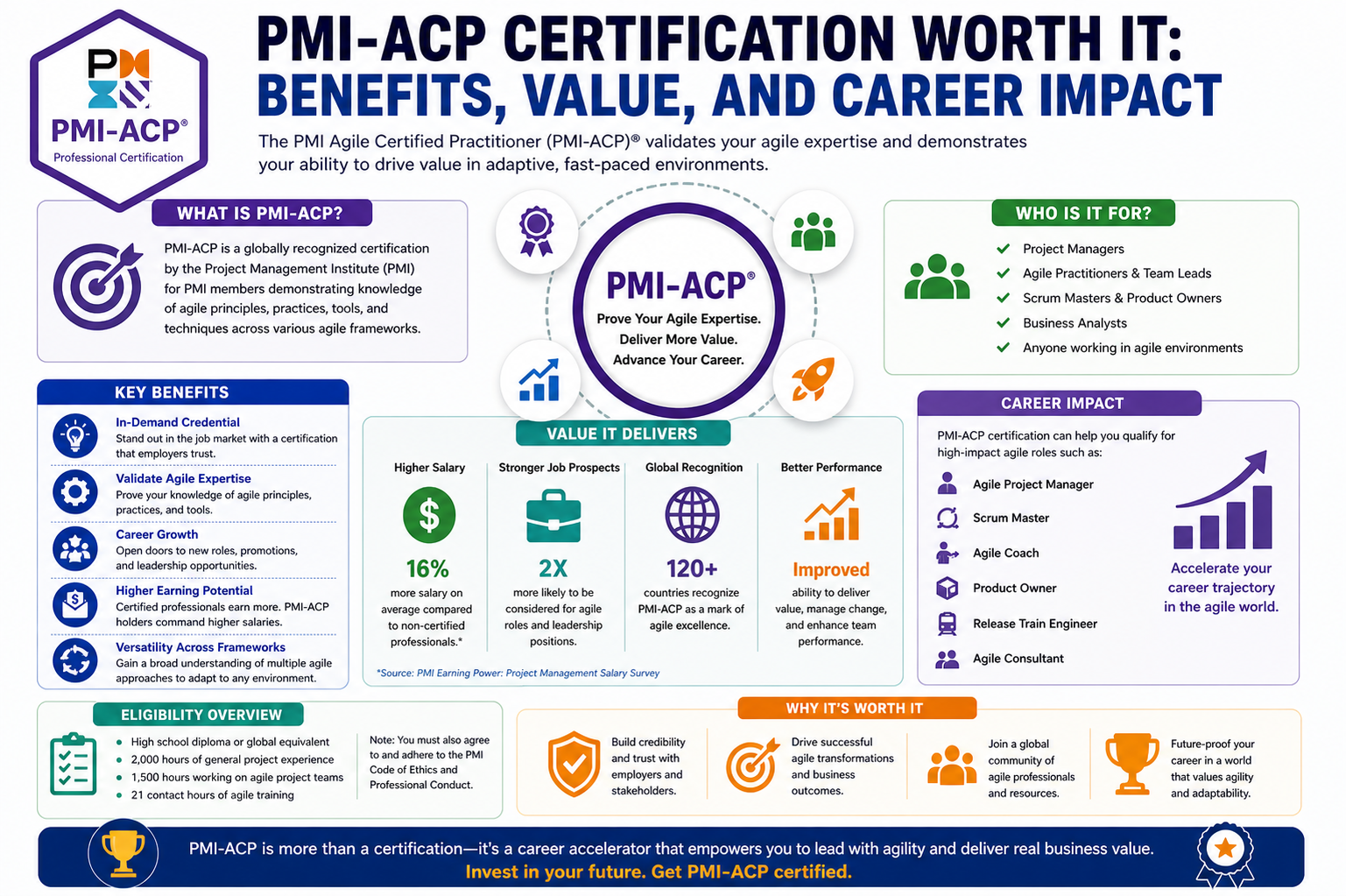
Modern organizations are increasingly shifting toward flexible and adaptive project delivery approaches as business environments become more dynamic and competitive. Traditional methods alone are no longer sufficient to handle rapid changes in customer expectations, technology evolution, and market pressure. This shift has significantly elevated the importance of agile practices across industries, making agile knowledge a critical skill set for professionals involved in project execution and delivery.
Rising Demand for Agile Project Professionals
As companies continue to adopt agile frameworks for improving efficiency and responsiveness, there is a noticeable rise in demand for professionals who can effectively manage agile projects. Businesses are not only looking for theoretical knowledge but also practical experience in agile environments where iterative development, collaboration, and continuous improvement are essential. This demand has created a strong need for certifications that validate real-world agile capabilities and understanding.
Understanding PMI Agile Certified Practitioner Certification in Professional Landscape
The PMI Agile Certified Practitioner certification has emerged as one of the key credentials that demonstrate a professional’s ability to work in agile project environments. It is designed for individuals who are already familiar with project management concepts and want to specialize further in agile methodologies. Unlike general certifications that focus broadly on project management, this credential emphasizes agile principles, frameworks, and hands-on application across different types of projects.
PMI-ACP vs Traditional Project Management Approaches
Traditional project management approaches are often structured and sequential, focusing heavily on planning and documentation before execution begins. In contrast, agile approaches prioritize flexibility, iterative development, and continuous feedback throughout the project lifecycle. The PMI Agile Certified Practitioner certification highlights this shift in mindset by focusing on adaptability and responsiveness rather than rigid planning. This makes it particularly valuable in industries where requirements frequently evolve and fast delivery is essential.
Career Value of Agile Certification in Current Market
Professionals who obtain agile certification often experience improved career opportunities due to the growing adoption of agile frameworks in organizations worldwide. Employers increasingly prefer candidates who can demonstrate both theoretical understanding and practical application of agile practices. This certification helps professionals position themselves for roles that require leadership in dynamic environments, where decision-making and adaptability play a critical role in project success.
Job Roles Commonly Associated with PMI Agile Certified Practitioner Certification
Individuals with this certification can pursue a wide range of roles across different industries. These roles often include responsibilities such as managing agile teams, facilitating sprint planning, ensuring continuous delivery, and coaching teams on agile practices. Common positions include agile project coordinator, scrum-focused roles, product ownership responsibilities, and delivery management positions where collaboration and iterative progress are essential components of success.
Salary Expectations for Agile Certified Professionals
The financial benefits associated with agile certification can be significant, especially for professionals who combine certification with practical experience. Organizations value professionals who can enhance productivity and streamline project delivery using agile techniques. As a result, certified individuals often have access to higher-paying roles compared to those without formal agile credentials. Salary levels can vary depending on experience, industry, and job responsibilities, but agile expertise consistently contributes to stronger earning potential in the job market.
Industry Adoption of Agile Methodologies
Agile practices are no longer limited to software development; they are now widely adopted across industries such as finance, healthcare, telecommunications, and manufacturing. This broad adoption has created a consistent need for professionals who understand agile frameworks and can implement them effectively in diverse environments. As organizations continue to prioritize flexibility and faster delivery cycles, agile-certified professionals become increasingly valuable assets in driving transformation initiatives.
Why Organizations Prefer PMI Agile Certified Practitioner Certified Candidates
Employers prefer candidates with agile certification because it provides assurance that the individual understands core agile principles and can apply them in real-world scenarios. Certification acts as a benchmark for evaluating knowledge, discipline, and commitment to professional development. It also reduces training time for organizations since certified professionals are already familiar with agile workflows, collaboration techniques, and iterative development processes.
Professional Recognition and Skill Validation
Beyond job opportunities and financial benefits, one of the key advantages of earning agile certification is professional recognition. It serves as validation of an individual’s ability to operate effectively in agile environments and contribute meaningfully to project success. This recognition enhances credibility within teams and organizations, making certified professionals more likely to be entrusted with leadership responsibilities and complex project challenges.
PMI-ACP Eligibility Requirements Explained in Detail
The PMI Agile Certified Practitioner certification has specific eligibility criteria designed to ensure that candidates already possess a foundational understanding of project environments and agile concepts. The requirements are structured in a way that balances formal education, practical agile experience, and structured training. Candidates are expected to demonstrate both theoretical awareness and real-world exposure to agile project environments before attempting the certification exam. This combination ensures that certified professionals are not only knowledgeable but also capable of applying agile principles in practical scenarios where adaptability and collaboration are essential.
Academic Background and Foundational Qualification Expectations
One of the key entry requirements for the PMI Agile Certified Practitioner certification is a basic academic qualification. Candidates are generally expected to hold at least a secondary school diploma or an equivalent level of education. This ensures that individuals attempting the certification have a minimum level of formal learning ability, which is necessary to understand structured project management concepts. While higher education is not mandatory, having a strong academic foundation can help candidates better grasp complex agile frameworks and methodologies.
Agile Experience Requirements and Practical Exposure
A significant part of eligibility for the PMI Agile Certified Practitioner certification revolves around hands-on agile experience. Candidates must demonstrate that they have actively participated in agile project environments, contributing to iterative development cycles, team collaboration, and adaptive planning processes. This experience requirement ensures that individuals are not approaching agile purely from a theoretical perspective but have been directly involved in real project scenarios where agile principles are applied. The emphasis on practical exposure helps maintain the credibility and value of the certification in professional environments.
Agile Training Requirement and Structured Learning
In addition to experience, candidates are also required to complete formal agile training hours. This structured learning component ensures that professionals are exposed to standardized agile concepts, methodologies, and best practices. The training typically covers key frameworks such as Scrum, Kanban, Lean, and hybrid agile approaches. It also focuses on developing an understanding of agile values, principles, and mindset shifts required to successfully implement agile practices in organizational settings. This requirement helps align candidates with globally recognized agile standards.
Different Eligibility Pathways for Professionals
The PMI Agile Certified Practitioner certification offers multiple pathways for eligibility, allowing professionals from different backgrounds to qualify. Individuals with extensive agile experience can qualify directly, while those with limited experience may combine training with additional certifications or academic qualifications. This flexible structure allows both experienced professionals and those transitioning from traditional project management roles to pursue the certification. It ensures inclusivity while maintaining the overall quality and relevance of certified practitioners.
Understanding the PMI-ACP Examination Structure
The PMI Agile Certified Practitioner exam is designed to evaluate a candidate’s understanding of agile principles across multiple dimensions. The exam consists of multiple-choice questions that test both conceptual knowledge and practical application. It is structured to assess how well candidates can apply agile thinking in real-world scenarios rather than simply recalling definitions. The exam duration is designed to challenge focus, time management, and decision-making abilities under pressure, reflecting real agile work environments.
Mindset Domain and Agile Thinking Approach
A major portion of the PMI Agile Certified Practitioner exam focuses on the agile mindset domain. This area evaluates a candidate’s understanding of agile values and principles and their ability to apply them in practical situations. It emphasizes flexibility, collaboration, continuous improvement, and customer-centric thinking. Candidates are expected to demonstrate how agile thinking influences decision-making, team interactions, and project outcomes. This domain is essential because mindset is the foundation of all agile practices and determines how effectively a professional can operate in dynamic environments.
Leadership Domain and Team Facilitation Skills
The leadership component of the PMI Agile Certified Practitioner exam focuses on a candidate’s ability to guide and support agile teams. Unlike traditional leadership styles that rely heavily on control and hierarchy, agile leadership emphasizes facilitation, empowerment, and servant leadership principles. Candidates are tested on their ability to foster collaboration, resolve conflicts, and create an environment where teams can self-organize and deliver value effectively. This domain highlights the importance of interpersonal skills in agile project success.
Product Domain and Framework Application Knowledge
The product domain evaluates a candidate’s understanding of how agile frameworks are applied in product development and delivery. It includes knowledge of Scrum, Kanban, and Lean methodologies, along with their practical implementation in managing workflows and delivering incremental value. Candidates are expected to understand how to prioritize work, manage backlogs, and ensure continuous delivery. This domain bridges the gap between theoretical knowledge and practical execution, making it a critical part of agile competency.
Delivery Domain and Execution Excellence
The delivery domain focuses on the actual execution of agile projects and the ability to deliver outcomes effectively. It assesses how well candidates can manage iterative development cycles, handle changing requirements, and ensure continuous value delivery to stakeholders. This includes understanding metrics, performance tracking, and adaptation strategies within agile environments. The delivery aspect of the certification ensures that professionals are not only planning agile projects but also successfully completing them in real-world conditions.
Core Agile Frameworks Covered in Certification Preparation
Candidates preparing for the PMI Agile Certified Practitioner certification are expected to understand multiple agile frameworks in depth. Scrum is widely used for iterative development and team-based delivery cycles, while Kanban focuses on visual workflow management and continuous improvement. Lean principles emphasize waste reduction and maximizing value delivery. Understanding how these frameworks interact and complement each other is essential for passing the exam and applying agile methodologies effectively in professional environments.
Key Skills Required for PMI-ACP Success
Success in the PMI Agile Certified Practitioner certification requires a combination of technical knowledge and soft skills. Candidates must develop strong analytical thinking, communication abilities, and problem-solving skills. Additionally, adaptability and collaboration are essential traits in agile environments. Professionals must also be comfortable working in fast-paced, changing conditions where priorities may shift frequently. These skills are not only important for passing the certification exam but also for performing effectively in agile-driven workplaces.
Differences Between PMI-ACP and Traditional Project Certifications
The PMI Agile Certified Practitioner certification differs significantly from traditional project management certifications in its focus and approach. While traditional certifications emphasize planning, documentation, and structured execution, agile certification focuses on adaptability, iterative progress, and continuous feedback. This difference reflects the evolving nature of modern project environments, where flexibility is often more important than rigid planning. Understanding this distinction helps professionals choose the right certification path based on their career goals and industry requirements.
Application Process and Validation of Experience
The application process for the PMI Agile Certified Practitioner certification requires candidates to document their education, training, and agile experience. This information is reviewed to ensure eligibility before allowing candidates to schedule the exam. The validation process is important because it maintains the credibility of the certification and ensures that only qualified individuals are assessed. Candidates must be honest and accurate when reporting their experience to avoid delays or rejection during the application review stage.
PMI-ACP Exam Structure and Difficulty Level Overview
The PMI Agile Certified Practitioner certification exam is designed to evaluate not just memorization of agile concepts but the ability to apply them in practical, real-world project situations. The exam is structured in a way that tests both conceptual clarity and decision-making skills under time constraints. Candidates are expected to demonstrate a strong understanding of agile principles and how they influence team behavior, project delivery, and stakeholder collaboration. The difficulty level is considered moderate to high because questions are scenario-based rather than purely theoretical.
Exam Format and Question Style Breakdown
The PMI Agile Certified Practitioner exam consists of multiple-choice questions that are scenario-driven. Instead of asking direct definitions, the exam often presents real-world project situations and asks candidates to choose the most appropriate agile response. This format is designed to reflect actual workplace challenges where professionals must make quick and effective decisions. The questions require analytical thinking, contextual understanding, and the ability to apply agile frameworks correctly depending on the situation.
Time Management and Exam Duration Challenges
Time management plays a critical role in successfully completing the PMI Agile Certified Practitioner exam. Candidates are required to answer a large number of questions within a limited timeframe, which tests both speed and accuracy. Many questions are lengthy and require careful reading to fully understand the scenario before selecting an answer. This makes it important for candidates to develop strong time allocation strategies during preparation so they can complete the exam without rushing or leaving questions unanswered.
Mindset Domain and Agile Thinking in Practice
The mindset domain focuses on evaluating how well a candidate understands and applies agile values in practical situations. This includes adaptability, collaboration, and continuous improvement. Candidates must demonstrate the ability to shift from traditional project thinking to an agile mindset where flexibility and responsiveness are prioritized. The exam assesses whether professionals can handle uncertainty and still maintain productivity while ensuring customer satisfaction and team alignment.
Leadership Domain and Servant Leadership Principles
Leadership in agile environments is fundamentally different from traditional management styles. The PMI Agile Certified Practitioner exam evaluates a candidate’s ability to act as a facilitator rather than a controller. This includes guiding teams, removing obstacles, and encouraging self-organization. Servant leadership principles are heavily emphasized, where the leader’s role is to support the team rather than direct every action. Candidates must show understanding of how leadership influences team morale and project success in agile environments.
Product Domain and Agile Framework Application Skills
The product domain tests a candidate’s knowledge of how agile frameworks are applied in managing product development. This includes understanding Scrum ceremonies, Kanban workflows, and Lean principles. Candidates are expected to know how to prioritize tasks, manage backlogs, and deliver incremental value to stakeholders. The exam focuses on how these frameworks are used in combination to achieve efficient and continuous delivery rather than isolated theoretical knowledge of each method.
Delivery Domain and Continuous Improvement Focus
The delivery domain evaluates how effectively candidates understand the process of delivering value in agile projects. It includes managing iterative cycles, handling feedback, and ensuring continuous improvement throughout the project lifecycle. Candidates are tested on their ability to adapt to changing requirements and maintain steady progress despite uncertainties. This domain emphasizes practical execution and the importance of delivering usable outcomes at the end of each iteration.
Agile Framework Integration in Real Projects
One of the key aspects tested in the PMI Agile Certified Practitioner exam is the ability to integrate multiple agile frameworks in real-world scenarios. Projects often require a combination of Scrum for structured iterations, Kanban for workflow visualization, and Lean principles for efficiency. Candidates must understand how these frameworks complement each other and when to apply each one depending on project needs. This integrated approach reflects real industry practices where hybrid agile models are common.
Common Challenges Faced by Candidates During Preparation
Many candidates find the PMI Agile Certified Practitioner exam challenging due to its scenario-based nature and emphasis on practical application. One common difficulty is shifting from memorization-based learning to situational analysis. Another challenge is understanding subtle differences between similar agile practices and choosing the most appropriate response. Time pressure during preparation and lack of hands-on agile experience can also make it harder to perform well in the exam.
Effective Study Approaches for Exam Success
Successful candidates often adopt a combination of theoretical study and practical exposure to agile environments. Reading agile principles alone is not enough; applying them in real or simulated projects greatly improves understanding. Practice questions and scenario-based exercises are especially useful for developing analytical thinking. Regular revision of frameworks and continuous exposure to agile terminology helps strengthen conceptual clarity and improves confidence during the exam.
Importance of Agile Mindset Transformation
A major requirement for passing the PMI Agile Certified Practitioner exam is adopting an agile mindset rather than relying on traditional project thinking. This transformation involves embracing change, encouraging collaboration, and focusing on delivering value continuously. Candidates who struggle with this mindset shift often find the exam more difficult because answers are not always straightforward and require flexible thinking based on context rather than rigid rules.
Role of Experience in Exam Performance
Practical experience plays a significant role in determining success in the PMI Agile Certified Practitioner exam. Candidates who have worked in agile environments tend to understand scenarios more naturally because they have encountered similar situations in real projects. Experience helps in recognizing patterns, making quicker decisions, and applying frameworks more effectively. Without hands-on exposure, candidates may find it harder to interpret complex questions accurately.
Comparison of PMI-ACP Exam with Other Agile Certifications
The PMI Agile Certified Practitioner exam is often compared with other agile certifications available in the market. While some certifications focus heavily on a single framework like Scrum, this certification provides a broader view of multiple agile methodologies. It evaluates overall agile competency rather than specialization in one framework. This makes it more comprehensive but also slightly more challenging for candidates who are new to agile concepts.
Preparation Strategy for Managing Exam Complexity
A well-structured preparation strategy is essential for handling the complexity of the PMI Agile Certified Practitioner exam. Candidates should focus on understanding concepts rather than memorizing them. Regular practice with scenario-based questions helps improve decision-making skills. Reviewing mistakes and analyzing why certain answers are correct or incorrect is also important for long-term retention. Consistent study habits and gradual improvement are more effective than last-minute preparation.
Overall Exam Experience and Skill Evaluation
The PMI Agile Certified Practitioner exam is designed to evaluate both knowledge and practical judgment. It challenges candidates to think like agile professionals who must make decisions in uncertain and fast-changing environments. The overall experience reflects real-world agile work conditions where flexibility, communication, and collaboration are essential. Successfully passing the exam indicates a strong understanding of agile principles and the ability to apply them effectively in professional settings.
PMI-ACP Certification Cost Breakdown and Financial Investment
The overall investment required for the PMI Agile Certified Practitioner certification is not limited to just the exam fee. Candidates should also consider training expenses, preparation materials, and potential retake costs if the exam is not cleared on the first attempt. The certification fee itself varies depending on membership status with the Project Management Institute. However, many professionals view this cost as a long-term investment in career growth rather than a short-term expense. The financial commitment is generally considered reasonable when compared to the potential salary growth and career opportunities that follow certification.
Training Costs and Preparation Resources Investment
Before attempting the PMI Agile Certified Practitioner exam, candidates are required to complete formal agile training hours. These training programs can vary significantly in cost depending on the provider, depth of content, and learning format. Some individuals choose self-paced online learning, while others prefer structured instructor-led programs. In addition to training, candidates often invest in practice exams, study guides, and simulation tests to improve readiness. These resources collectively contribute to the total preparation cost but also significantly increase the chances of passing the exam on the first attempt.
Exam Fee Structure and Membership Benefits
The exam fee for the PMI Agile Certified Practitioner certification is structured differently based on whether a candidate is a member of the Project Management Institute. Members benefit from a reduced exam fee, while non-members pay a higher amount. Many professionals choose to become members before applying for the exam because the membership benefits often outweigh the cost difference. These benefits may include access to study materials, professional resources, and networking opportunities that support long-term career development in project management.
Retake Costs and Financial Planning Considerations
In cases where candidates do not pass the PMI Agile Certified Practitioner exam on the first attempt, additional fees are required for retaking the exam. This makes proper preparation even more important from a financial perspective. Each attempt adds to the overall certification cost, which is why candidates are encouraged to invest time in thorough preparation before scheduling the exam. Effective planning, practice, and understanding of agile concepts can help minimize the risk of retakes and reduce unnecessary financial burden.
Long-Term Career Benefits of PMI-ACP Certification
One of the strongest arguments in favor of pursuing the PMI Agile Certified Practitioner certification is the long-term career benefit it offers. Professionals with this certification often gain access to higher-level roles that involve leadership in agile environments. Organizations value certified individuals for their ability to manage complex projects using adaptive methodologies. Over time, this can lead to increased responsibilities, better job stability, and improved professional recognition within the industry.
Impact on Salary Growth and Earning Potential
Certified agile professionals often experience a noticeable improvement in earning potential compared to non-certified peers. This is primarily due to the growing demand for agile expertise across industries. Organizations are willing to offer competitive compensation packages to individuals who can effectively lead agile teams and deliver results efficiently. While salary levels vary based on experience, industry, and role, the certification consistently contributes to stronger financial outcomes over time.
Career Opportunities Across Multiple Industries
The PMI Agile Certified Practitioner certification is not limited to a single industry or domain. Agile practices are widely used across technology, finance, healthcare, retail, and manufacturing sectors. This broad applicability allows certified professionals to explore diverse career paths. Roles involving project coordination, agile coaching, product management, and delivery leadership are commonly available to individuals with this certification. This versatility makes the certification valuable for professionals seeking flexibility in career direction.
Who Should Consider PMI-ACP Certification
This certification is particularly suitable for professionals who are already working in agile environments or transitioning from traditional project management roles. It is ideal for individuals who want to strengthen their understanding of agile methodologies and formalize their experience with a globally recognized credential. Those aiming for leadership positions in agile teams or organizations undergoing digital transformation can benefit significantly from this certification. It also serves as a stepping stone for professionals who plan to advance their careers in project management.
Limitations and Situations Where PMI-ACP May Not Be Suitable
While the PMI Agile Certified Practitioner certification offers many advantages, it may not be suitable for everyone. Professionals working in environments that rely heavily on traditional, structured project methodologies may find limited immediate value in agile certification. Similarly, individuals who do not plan to work in agile-driven roles may not fully benefit from the investment. It is important to evaluate career goals and industry requirements before committing to the certification path to ensure alignment with long-term objectives.
Comparison with Other Project Management Certifications
The PMI Agile Certified Practitioner certification differs from other project management credentials in its focus and approach. Unlike certifications that emphasize predictive or waterfall methodologies, this certification focuses on adaptive and iterative delivery models. It complements other certifications by adding agile expertise to a professional’s skill set. Many professionals choose to hold multiple certifications to enhance versatility and increase their competitiveness in the job market.
Professional Skill Enhancement Through Certification
Beyond career advancement and financial benefits, the PMI Agile Certified Practitioner certification also plays a significant role in enhancing professional skills. It improves decision-making abilities, strengthens leadership qualities, and develops a deeper understanding of team dynamics in agile environments. Certified professionals often become more confident in handling complex projects and adapting to changing requirements. These skills are valuable not only in professional settings but also in personal development.
Industry Recognition and Global Acceptance
The PMI Agile Certified Practitioner certification is widely recognized across global industries. This recognition ensures that certified professionals can pursue opportunities in different regions and organizations without restrictions related to geography. Employers around the world acknowledge the value of PMI certifications, which increases mobility and career flexibility for certified individuals. This global acceptance adds to the overall value of the certification.
Assessment of PMI-ACP Certification Value
When evaluating the overall worth of the PMI Agile Certified Practitioner certification, both tangible and intangible benefits must be considered. Financial investment, time commitment, and preparation effort are balanced by career advancement opportunities, salary growth potential, and professional recognition. For individuals committed to building a career in agile project environments, the certification offers strong long-term value. It not only validates existing knowledge but also enhances practical skills required in modern project management roles.
Final Evaluation of PMI Agile Certified Practitioner Certification Worth
The overall value of the PMI Agile Certified Practitioner certification becomes clearer when it is viewed through the lens of long-term career development, industry demand, and practical applicability. As organizations continue to evolve toward agile-driven project environments, professionals who understand adaptive frameworks and iterative delivery methods are becoming increasingly important. This certification serves as a structured validation of those capabilities and helps professionals position themselves more competitively in a rapidly changing job market.
Career Growth Potential After PMI-ACP Certification
One of the most significant advantages of earning this certification is the potential for career advancement. Professionals who demonstrate strong agile knowledge and certification-backed credibility are often considered for roles involving greater responsibility. These roles may include leading agile teams, managing product delivery cycles, or supporting organizational transformation initiatives. The certification acts as a signal to employers that the individual is capable of handling dynamic project environments with confidence and efficiency.
Enhanced Professional Credibility and Recognition
In addition to career progression, the PMI Agile Certified Practitioner certification enhances professional credibility. It reflects a verified level of understanding in agile principles, frameworks, and real-world application. This recognition is especially valuable in competitive industries where multiple candidates may have similar experience levels. Certification helps differentiate professionals by formally validating their skills and commitment to continuous learning in agile practices.
Practical Relevance in Real-World Agile Environments
The certification is not purely theoretical; it is closely aligned with real-world agile practices. Professionals who complete this certification are better prepared to handle situations involving changing requirements, cross-functional team collaboration, and iterative project delivery. The focus on practical application ensures that certified individuals can contribute effectively to project success rather than relying solely on theoretical knowledge. This makes the certification highly relevant in modern workplace environments.
Return on Investment and Long-Term Value
When analyzing the cost of certification against its benefits, many professionals find that the return on investment is strong over time. While there is an initial financial and time commitment, the potential for higher salaries, better job opportunities, and career advancement often outweighs these costs. The certification should be viewed as a long-term investment in professional development rather than a short-term expense. Its value increases as professionals gain more experience in agile environments.
Who Gains the Most from PMI-ACP Certification
The certification provides the greatest value to professionals actively working in or transitioning into agile roles. Individuals involved in project coordination, team leadership, product development, or delivery management benefit significantly from formal agile recognition. It is also beneficial for those moving from traditional project management into more flexible and adaptive environments. However, its impact may be limited for professionals who are not engaged in project-based or agile-driven work.
Industry Relevance and Future Demand Outlook
Agile methodologies continue to expand across industries, making agile expertise a long-term requirement rather than a temporary trend. Organizations increasingly prioritize speed, adaptability, and continuous improvement in their project execution strategies. This shift ensures that professionals with agile certification will remain in demand across various sectors. The PMI Agile Certified Practitioner certification aligns well with this ongoing transformation, making it a future-relevant credential.
Skill Development and Personal Growth Benefits
Beyond professional advantages, the certification also contributes to personal skill development. It enhances problem-solving abilities, communication skills, and leadership capabilities. Professionals learn how to operate effectively in collaborative environments where flexibility and responsiveness are essential. These skills not only improve workplace performance but also contribute to overall professional maturity and confidence in handling complex challenges.
Limitations to Consider Before Pursuing Certification
Despite its advantages, the certification may not be suitable for everyone. Professionals working exclusively in highly structured or traditional project environments may not fully utilize agile methodologies in their daily work. Additionally, those not planning to pursue project management or agile-related roles may find limited direct benefit. It is important to align certification goals with long-term career plans to ensure maximum value is achieved.
Comparison of Effort Versus Outcome
The effort required to earn the PMI Agile Certified Practitioner certification includes training, study time, and exam preparation. However, the outcomes often justify this effort through improved career opportunities and professional recognition. Compared to many other certifications in the project management domain, this certification provides a balanced combination of accessibility and value, making it a practical choice for many professionals.
PMI Agile Certified Practitioner Certification Worth
The PMI Agile Certified Practitioner certification is widely regarded as a valuable credential for professionals working in or transitioning into agile environments. It provides strong career benefits, enhances professional credibility, and supports long-term growth in industries where agile methodologies are becoming standard practice. While it requires dedication and preparation, the benefits often outweigh the costs for individuals committed to building a career in agile project management.
Overall Professional Impact and Long-Term Career Direction
Beyond immediate job opportunities and salary improvements, the PMI Agile Certified Practitioner certification plays a broader role in shaping long-term professional direction. It helps individuals transition from task-focused contributors into strategic contributors who understand how value is delivered across evolving project environments. Over time, this shift in thinking can open doors to leadership positions, cross-functional responsibilities, and involvement in larger transformation initiatives within organizations. For professionals serious about building a sustainable career in project delivery and agile leadership, this certification acts as a strong foundation that continues to deliver value well beyond the initial achievement.
Conclusion
In conclusion, the PMI Agile Certified Practitioner certification is worth pursuing for professionals who want to strengthen their agile expertise and advance their careers in modern project environments. It offers a combination of practical skill validation, industry recognition, and improved job prospects. As organizations continue to adopt agile approaches at scale, this certification remains a relevant and impactful investment for those aiming to grow in project management and agile leadership roles.