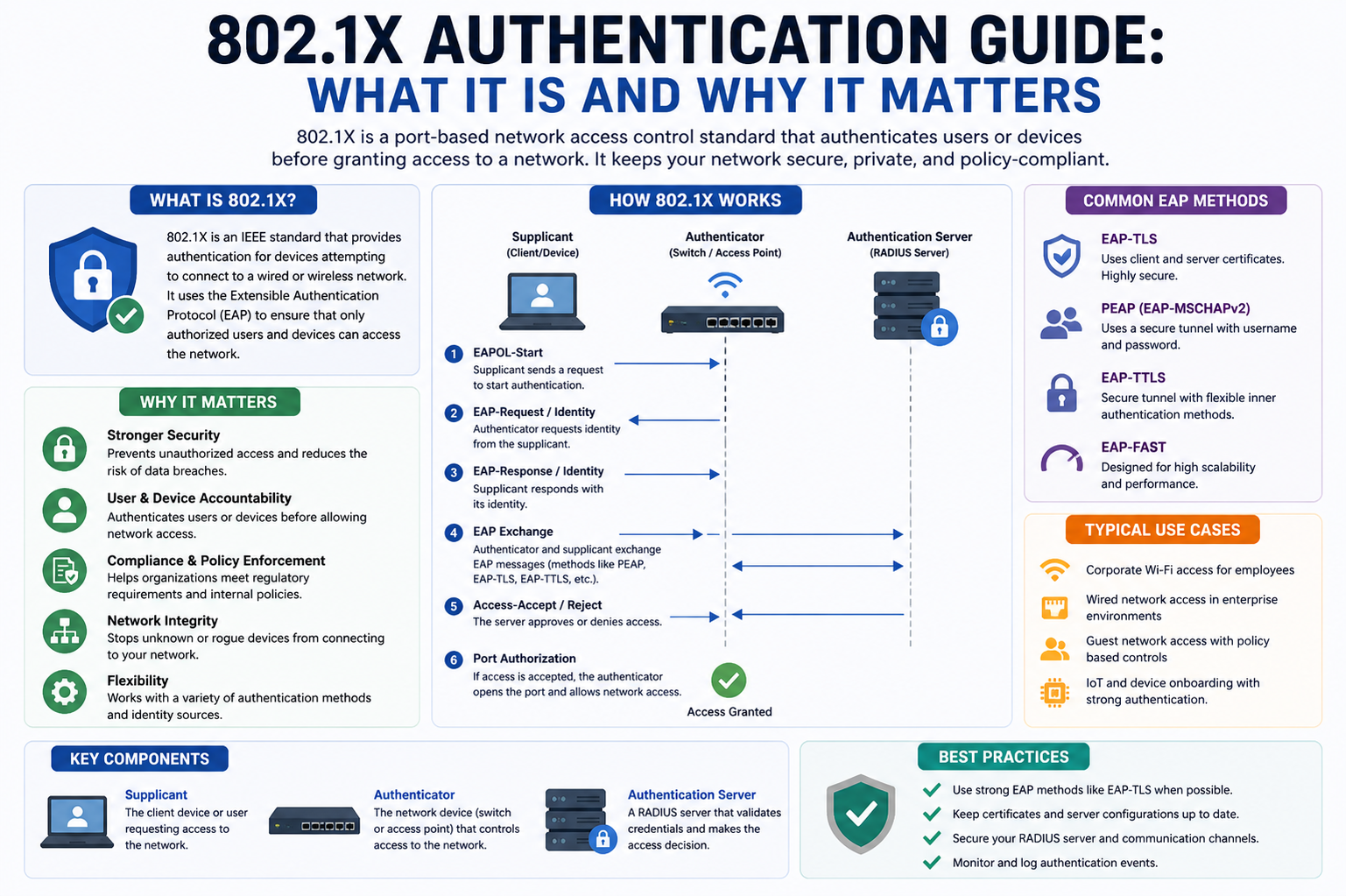
802.1X is a port-based network access control standard used to decide whether a device is allowed to connect to a network. It operates at the edge of a network connection and ensures that authentication happens before any meaningful data transfer is permitted. In enterprise environments, this mechanism is widely deployed to enforce strict identity verification for both wired and wireless connections.
Instead of allowing immediate access when a device plugs in or joins Wi-Fi, 802.1X places the connection in a restricted state. The device must first prove its identity using approved authentication methods. Only after successful verification does the network open full communication channels. This creates a secure gateway that protects internal systems from unauthorized access.
The importance of this approach increases in environments where multiple users, personal devices, and organizational systems share the same infrastructure. By requiring authentication at the entry point, 802.1X helps maintain control over who is connected and what resources they can access.
Why 802.1X Exists in Network Security
The primary purpose of 802.1X is to strengthen network security by preventing unauthorized devices from gaining access. In traditional network setups without port-based control, any device connected to a switch or wireless access point could potentially communicate on the network. This creates significant security risks, especially in business or institutional environments.
802.1X solves this issue by introducing an authentication step before network participation is allowed. Every device must identify itself and be validated before it can communicate beyond a limited initial state. This ensures that only trusted users and approved devices are granted access.
This mechanism is especially useful in organizations where sensitive data is handled, such as corporate networks, educational institutions, and managed service environments. It reduces the risk of intrusions, unauthorized data access, and malicious device connections.
Port-Based Network Access Control Concept
At the core of 802.1X is the idea of controlling access at the network port level. A port in networking represents the logical or physical entry point through which a device connects to a network. Instead of treating this port as fully open, 802.1X divides its behavior into controlled and restricted states.
When a device first connects, the port allows only limited communication required for authentication. This restricted mode prevents normal data traffic from flowing. The device is essentially isolated except for authentication exchanges.
Once identity verification is completed successfully, the port transitions into a fully open state. At this point, the device is granted access to network resources, applications, and services based on assigned permissions. This staged approach ensures that authentication always comes before authorization.
Controlled and Uncontrolled Access Ports
802.1X defines two logical components within a single network port: the controlled portion and the uncontrolled portion. These two components work together to enforce secure access.
The uncontrolled portion is always active and allows only authentication-related traffic. This is the communication channel used when a device first attempts to connect. It does not allow regular data traffic such as file sharing or application communication.
The controlled portion remains locked until authentication is complete. It is responsible for carrying normal network traffic once the device is verified. If authentication fails, this portion never opens, effectively blocking access.
This separation ensures that even if a device is physically connected to the network, it cannot interact with internal systems without passing authentication checks.
Role of Authentication in 802.1X
Authentication is the central function of 802.1X. It verifies the identity of a user or device before granting access to network resources. The system supports multiple authentication methods depending on security requirements and infrastructure design.
These methods may include username and password combinations, digital certificates, or other credential-based systems. The flexibility of authentication methods allows organizations to choose the level of security that matches their needs.
The key principle is that no device is trusted by default. Every connection must go through a verification process before access is permitted.
Connection With AAA Framework
802.1X operates closely with the AAA security model, which includes authentication, authorization, and accounting. Authentication confirms identity, authorization determines what resources can be accessed, and accounting tracks user activity on the network.
By integrating with AAA, 802.1X ensures that access control is not only secure but also manageable and traceable. This helps administrators enforce policies consistently across all connected devices.
The AAA model strengthens network governance by ensuring that every action is tied to an authenticated identity and recorded for monitoring or auditing purposes.
Relationship With EAP Protocol
802.1X relies heavily on Extensible Authentication Protocol, commonly known as EAP. EAP is not a single authentication method but a framework that supports multiple types of authentication mechanisms.
It acts as the communication layer that carries authentication messages between the device and the authentication system. This allows 802.1X to remain flexible and adaptable across different network environments.
EAP enables the use of various authentication techniques without changing the core structure of 802.1X, making it highly versatile in enterprise deployments.
802.1X in Wired and Wireless Networks
Although 802.1X is often associated with wireless networks, it is equally important in wired environments. In wired networks, it controls access through Ethernet ports, ensuring that only authorized devices can connect physically to the network.
In wireless networks, it is used to secure Wi-Fi connections by requiring authentication before allowing devices to join the wireless network. This prevents unauthorized users from accessing internal systems simply by connecting to a wireless access point.
In both cases, the underlying principle remains the same: authentication must occur before network access is granted.
Initial Connection and Authentication Trigger
When a device attempts to connect to a network using 802.1X, the process begins immediately at the port level. The connection is placed in a restricted state where only authentication communication is allowed.
The network system requests identity information from the device, which responds with its credentials. These credentials are not directly validated by the network switch or access point but are instead forwarded to a centralized authentication system.
This ensures that all authentication decisions are made consistently and securely through a dedicated verification process.
Supplicant Role in the Process
The supplicant is the component within the device that initiates and handles the authentication process. It is responsible for responding to identity requests and participating in the authentication exchange.
In most cases, the supplicant is built into the operating system or network driver. It operates in the background without requiring user interaction, although it may prompt the user for credentials when necessary.
Its main responsibility is to securely communicate authentication information to the network system.
Authenticator Role in Network Control
The authenticator is the network device that controls access to the network. It acts as an intermediary between the device requesting access and the authentication server that verifies identity.
It does not make final decisions about access. Instead, it forwards authentication requests and responses between the supplicant and the authentication server. Based on the server’s response, it either allows or blocks network access.
Common examples of authenticators include network switches and wireless access points in enterprise environments.
Authentication Server Function
The authentication server is the central authority responsible for verifying identity credentials. It maintains a database of authorized users and devices and determines whether a connection request should be approved.
When it receives authentication data, it compares it against stored records and applies security policies to decide the outcome. It then sends a response back to the authenticator indicating success or failure.
This centralized system ensures consistent security enforcement across the entire network infrastructure.
Communication Flow in Authentication Process
The authentication process in 802.1X involves a structured communication flow between three main components: the supplicant, the authenticator, and the authentication server.
First, the device initiates a connection and is placed in a restricted state. The authenticator requests identity information, which the supplicant provides. This information is forwarded to the authentication server for verification.
The server challenges the credentials and begins an exchange of authentication messages. This process continues until verification is complete. If successful, the server instructs the authenticator to open the controlled port and grant full access.
If authentication fails, the connection remains restricted, and no network access is granted.
Foundation of Secure Network Access Control
802.1X forms the foundation of modern network access control systems. It ensures that every device is verified before being allowed to communicate beyond limited authentication channels.
This approach significantly improves network security by reducing unauthorized access risks and enforcing strict identity validation. It is a critical component in environments where secure communication and controlled access are essential.
The structured authentication process, combined with centralized verification and port-based control, makes 802.1X a key standard in enterprise networking security systems.
Extensible Authentication Protocol in 802.1X Systems
Extensible Authentication Protocol plays a central role in how 802.1X performs authentication across network environments. It is not a single authentication method but a flexible framework designed to support multiple authentication techniques within a unified structure. This flexibility allows networks to adapt authentication requirements based on security policies, user types, and device capabilities.
Instead of enforcing one fixed method, the protocol allows different authentication styles to be negotiated between the connecting device and the authentication system. This makes it suitable for diverse environments ranging from simple password-based access to highly secure certificate-based systems. Its adaptability is one of the key reasons 802.1X is widely used in enterprise networks.
EAP operates by carrying authentication messages between the device attempting to connect and the backend authentication system. It ensures that identity verification is handled securely without exposing sensitive information directly across the network.
How EAP Works Within the Authentication Flow
EAP functions as a communication wrapper that facilitates the exchange of authentication data during the connection process. When a device tries to connect to a network, EAP messages are exchanged in a structured sequence between the supplicant, authenticator, and authentication server.
The process begins with identity requests and continues through multiple challenge-response exchanges. Each step is designed to verify credentials gradually rather than exposing them in a single transmission. This layered approach increases security and reduces the risk of credential interception.
EAP ensures that authentication remains modular, meaning different authentication methods can be used without changing the underlying network structure. This separation of method and transport is what makes it highly scalable and secure.
Types of Authentication Methods Supported by EAP
EAP supports a wide range of authentication methods, each designed for different security needs and network environments. Some methods rely on simple username and password verification, while others use encrypted communication or digital certificates for stronger security.
Certain methods prioritize simplicity and ease of deployment, making them suitable for environments where users frequently change devices. Other methods focus on strong cryptographic validation, which is often used in highly secure networks where data protection is critical.
The selection of an authentication method depends on organizational requirements, device compatibility, and security policies. This flexibility allows network administrators to balance usability and protection effectively.
Certificate-Based Authentication in Secure Networks
One of the strongest forms of authentication used within EAP-based systems involves digital certificates. These certificates act as digital identities issued by trusted authorities and are installed on devices or authentication servers.
When a device attempts to connect, the system verifies the certificate instead of relying solely on passwords. This reduces the risk of credential theft because certificates are significantly harder to replicate or intercept.
Certificate-based authentication is commonly used in environments that require high levels of trust and strict identity verification. It is especially effective in managed device ecosystems where control over endpoints is maintained.
Password-Based Authentication and Its Role
Password-based authentication remains one of the most commonly used methods within EAP frameworks. It allows users to authenticate using familiar credentials such as usernames and passwords.
While this method is easier to implement and manage, it is generally considered less secure compared to certificate-based systems. However, when combined with encryption and secure tunnels, it can still provide adequate protection for many environments.
This approach is often used in situations where convenience and accessibility are important, such as guest access networks or bring-your-own-device environments.
Tunneled Authentication and Secure Communication Layers
Some EAP methods use tunneling techniques to enhance security during authentication. In these systems, authentication data is transmitted through an encrypted tunnel, protecting it from interception or tampering.
This layered approach ensures that credentials remain secure even when transmitted over untrusted networks. The tunnel acts as a protective layer that shields sensitive information during the authentication process.
Tunneled authentication is particularly useful in wireless networks where communication channels are inherently more vulnerable compared to wired connections.
Role of Encryption in EAP-Based Authentication
Encryption is a fundamental component of secure authentication systems. Within EAP-based frameworks, encryption ensures that authentication data cannot be easily read or altered during transmission.
By encoding credentials and verification messages, encryption protects against unauthorized access and data interception. It also ensures the integrity of communication between the device and authentication server.
Strong encryption methods are essential for maintaining trust in network access systems, especially in environments where sensitive information is regularly transmitted.
Secure Handshake Mechanism in 802.1X
The authentication process in 802.1X relies on a structured handshake mechanism that ensures both the device and the network system validate each other. This handshake involves multiple steps of identity verification and response exchanges.
Each stage of the handshake builds trust incrementally, ensuring that only legitimate devices are granted access. If any step fails, the process is terminated, and access is denied.
This controlled negotiation prevents unauthorized devices from bypassing security checks and reinforces the integrity of the authentication system.
Role of Identity Verification in Network Access
Identity verification is a critical step in ensuring that only authorized users and devices are allowed to access the network. This process involves validating credentials against stored records in the authentication system.
Verification can include multiple factors such as passwords, certificates, or device-specific identifiers. The more verification layers involved, the stronger the overall security posture becomes.
This process ensures that network access is always tied to a verified identity rather than an untrusted connection request.
Dynamic Key Generation During Authentication
In many 802.1X implementations, dynamic keys are generated during the authentication process to secure ongoing communication. These keys are created after successful authentication and are used to encrypt data traffic between the device and the network.
Dynamic key generation ensures that even if authentication credentials are compromised, ongoing communication remains protected. Each session may use a unique encryption key, reducing the risk of long-term exposure.
This mechanism significantly enhances the confidentiality and integrity of network communication.
Session Establishment After Successful Authentication
Once authentication is successful, a secure session is established between the device and the network. During this stage, the controlled port transitions into an active state, allowing full communication.
The session defines how long the device remains connected and what level of access it has. It also determines how traffic is managed and monitored throughout the connection period.
This controlled session model ensures that access is continuously governed rather than granted indefinitely without oversight.
Access Control Policies in 802.1X Networks
Access control policies define what resources a device or user can access after authentication. These policies are enforced by the authentication server and communicated through the authenticator.
Policies can vary depending on user roles, device types, or security levels. For example, some users may only have access to basic network services, while others may be granted broader permissions.
This structured approach ensures that network access is aligned with organizational security requirements and operational needs.
Network Segmentation Through Authentication Systems
802.1X also supports network segmentation by controlling how authenticated devices interact with different parts of the network. Based on identity and policy, devices can be assigned to specific network segments.
This segmentation helps isolate sensitive systems and reduce the risk of unauthorized lateral movement within the network. It also improves performance by organizing traffic more efficiently.
By combining authentication with segmentation, networks achieve both security and operational efficiency.
Handling Authentication Failures in Network Access
When authentication fails, the 802.1X system ensures that the device remains restricted and cannot access network resources. Failed attempts are typically logged for monitoring and security analysis.
The system may allow limited retries or enforce temporary restrictions depending on configuration. This helps prevent repeated unauthorized attempts while still allowing legitimate users to correct errors.
Proper handling of authentication failures is essential for maintaining network integrity and detecting potential security threats.
Importance of Scalability in Authentication Systems
Modern networks often include thousands of devices, making scalability an important factor in authentication design. 802.1X systems are built to handle large numbers of simultaneous authentication requests efficiently.
The use of centralized authentication servers allows networks to manage identity verification at scale without overloading individual network devices. This centralized approach simplifies administration and improves consistency.
Scalability ensures that the authentication system remains effective even as network size and complexity grow.
Foundation of Secure Enterprise Connectivity
802.1X combined with EAP forms the foundation of secure enterprise connectivity. It ensures that every device must prove its identity before gaining access, creating a controlled and monitored network environment.
This structured authentication approach reduces risks, enforces security policies, and provides administrators with full control over network access. It remains a key component in modern network security architecture and continues to be widely adopted across various industries.
Authentication Server and Central Identity Control in 802.1X
The authentication server is the most critical decision-making component in an 802.1X environment. It acts as the central authority that verifies whether a device or user is permitted to access the network. This server maintains identity records, authentication policies, and security rules that govern access decisions across the entire infrastructure.
When authentication data is received, the server evaluates it against stored credentials and applies predefined security logic. Based on this evaluation, it determines whether access should be granted or denied. This centralized approach ensures consistent enforcement of security policies, regardless of where or how a connection attempt originates.
By separating authentication decisions from network devices like switches or access points, the system maintains stronger control and reduces the risk of unauthorized access due to misconfigured edge devices.
Role of RADIUS in Authentication Processing
RADIUS is commonly used as the communication protocol between the authenticator and the authentication server. It carries authentication requests, responses, and authorization information across the network in a structured format.
When a device attempts to connect, the authenticator forwards the credentials to the authentication server using RADIUS messages. The server then processes the request and sends back a response indicating whether the connection is approved or rejected.
This protocol ensures secure and standardized communication between network components, allowing authentication systems to scale efficiently while maintaining reliability and consistency.
Supplicant Behavior During Authentication Exchange
The supplicant plays an active role in responding to authentication challenges during the 802.1X process. It initiates the connection request and participates in the ongoing exchange of authentication messages until the process is completed.
During this exchange, the supplicant may be required to provide credentials multiple times depending on the authentication method in use. It handles encryption, credential formatting, and response generation based on system configuration.
Although this process happens automatically in most systems, it is essential for ensuring that only properly configured and authorized devices can successfully complete authentication.
Authenticator as the Network Gatekeeper
The authenticator serves as the enforcement point between the device requesting access and the authentication server. It controls whether traffic is allowed to pass beyond the initial connection stage.
Its main responsibility is to enforce the decisions made by the authentication server. It does not independently validate credentials but ensures that only approved sessions are granted access to network resources.
This role is typically performed by network switches or wireless access points, which act as entry points into the network infrastructure.
EAP Message Exchange Sequence in Detail
The authentication process involves a structured sequence of message exchanges that allow identity verification to take place securely. It begins with an identity request and continues with multiple challenge-response interactions.
Each message in the sequence serves a specific purpose, such as requesting credentials, verifying responses, or confirming authentication results. This step-by-step process ensures that sensitive information is never exposed in a single transmission.
The structured flow also allows the system to detect anomalies or mismatches early in the process, improving overall security and reliability.
Controlled Transition From Restricted to Full Access
One of the key features of 802.1X is the controlled transition from a restricted network state to full access. When a device first connects, it is placed in a limited-access mode where only authentication traffic is permitted.
Once authentication is successful, the system transitions the connection into a fully active state. This change is handled dynamically and is based entirely on the authentication server’s decision.
This controlled transition ensures that no unauthorized traffic can bypass the authentication process, even during initial connection attempts.
Session Authorization and Access Decision Process
After authentication is complete, the system moves into the authorization phase. This phase determines what level of access the device is allowed to have on the network.
Authorization rules are based on identity, role, device type, and security policies defined by administrators. These rules control which resources can be accessed and what actions are permitted during the session.
This separation of authentication and authorization ensures that identity verification and access control remain distinct processes, improving security flexibility.
Dynamic VLAN Assignment in Network Access Control
In many enterprise environments, authenticated devices are assigned to specific virtual network segments based on their identity. This process is known as dynamic VLAN assignment.
Depending on authentication results, a device may be placed into a restricted network, a guest network, or a full-access corporate network. This allows organizations to segment traffic without requiring manual configuration for each device.
Dynamic assignment improves both security and scalability by automatically organizing devices based on predefined policies.
Role of Accounting in Network Activity Tracking
Accounting is the third component of the AAA framework and works alongside authentication and authorization. It tracks user and device activity after access has been granted.
This includes recording session start and end times, data usage, and resource access patterns. These logs are useful for monitoring, auditing, and troubleshooting network behavior.
By maintaining detailed records, administrators can analyze usage patterns and identify potential security concerns or performance issues.
Security Benefits of Centralized Authentication Systems
Centralized authentication provides a significant security advantage by consolidating identity management into a single system. Instead of relying on individual network devices to make access decisions, all authentication requests are processed through a central authority.
This reduces configuration errors, improves policy enforcement, and ensures consistent decision-making across the entire network. It also simplifies user management, as credentials and permissions can be updated in one location.
Centralization strengthens overall network security by creating a unified control point for access management.
Common Challenges in 802.1X Deployment
Although 802.1X provides strong security benefits, its implementation can present challenges. These may include configuration complexity, certificate management, and device compatibility issues.
Some environments may also face difficulties when integrating legacy devices that do not support modern authentication methods. Proper planning and infrastructure design are required to ensure smooth deployment.
Despite these challenges, the long-term security benefits often outweigh the initial setup complexity.
Certificate Management and Infrastructure Requirements
When certificate-based authentication is used, proper certificate management becomes essential. This involves issuing, renewing, and revoking digital certificates for devices and users.
A secure infrastructure is required to manage these certificates effectively, often involving a dedicated system for identity and key management. Without proper handling, certificate-based systems can become difficult to maintain.
However, when implemented correctly, they provide one of the strongest forms of authentication available in network security.
Wireless Network Security Using 802.1X
In wireless environments, 802.1X plays a key role in securing access to Wi-Fi networks. Instead of relying on shared passwords, each device must authenticate individually before joining the network.
This prevents unauthorized users from gaining access simply by knowing a password. It also allows administrators to control access at a much more granular level.
Wireless authentication using 802.1X is widely adopted in corporate and educational environments where security is a priority.
Wired Network Authentication Applications
802.1X is not limited to wireless systems and is also widely used in wired network environments. In these setups, each physical port on a switch can require authentication before granting access.
This prevents unauthorized devices from gaining access by simply plugging into a network port. It adds an additional layer of protection to physical infrastructure.
Wired authentication is especially useful in public areas, office buildings, and shared network environments.
Security Enforcement Through Policy-Based Access
Policy-based access control allows administrators to define rules that determine how authenticated devices interact with the network. These policies can vary based on user roles, device types, or security requirements.
Once a device is authenticated, these policies are applied automatically to enforce restrictions or permissions. This ensures that access is not only granted but also controlled according to organizational rules.
Policy enforcement adds an additional layer of structure to network security management.
Importance of Mutual Authentication in Secure Systems
In advanced 802.1X implementations, mutual authentication ensures that both the client and the server verify each other’s identity. This prevents attackers from impersonating legitimate network systems.
Mutual authentication increases trust between communicating parties and reduces the risk of man-in-the-middle attacks. It is often implemented using certificates and encrypted validation processes.
This bidirectional verification strengthens overall network security significantly.
Foundation of Controlled Network Entry Systems
802.1X establishes a controlled entry system for modern networks where no device is trusted by default. Every connection must pass through a structured authentication process before gaining access.
This approach ensures that network resources are protected, access is regulated, and user activity is properly monitored. It remains a fundamental part of enterprise networking security architecture and continues to evolve with modern security needs.
Role of Network Policies After Authentication
After a device successfully completes authentication, network policies become the guiding rules that shape how it interacts with resources. These policies are defined by administrators and enforced automatically by the authentication system. They determine what level of access a user or device receives based on identity, role, or security classification.
Policies can be highly granular, allowing different permissions for different categories of users. For example, some devices may only access internet services, while others may be granted access to internal servers, databases, or restricted applications. This structured control ensures that access is not only granted securely but also aligned with organizational requirements.
These policies are applied dynamically at the moment authentication succeeds, which means access rights can change depending on the credentials presented during login.
Role-Based Access Control in 802.1X Environments
Role-based access control is a common strategy used alongside 802.1X to simplify and strengthen network security management. Instead of assigning permissions individually, users are grouped into roles such as employees, guests, or administrators.
Each role has a predefined set of permissions that dictate what network resources can be accessed. Once authentication is complete, the system automatically assigns the appropriate role to the device or user.
This approach reduces administrative complexity while ensuring consistent enforcement of security rules across the entire network infrastructure.
Device Profiling and Network Identification
Modern 802.1X systems often include device profiling, which identifies the type of device attempting to connect. This process analyzes network behavior, hardware characteristics, and communication patterns to determine whether the device is a laptop, mobile phone, printer, or IoT device.
Device profiling helps improve security by applying different access rules based on device type. For example, a personal device may receive limited access, while a managed corporate device may receive full network privileges.
This additional layer of intelligence enhances control and helps organizations manage diverse device ecosystems more effectively.
Guest Network Access Through Controlled Authentication
802.1X also supports guest access scenarios where temporary users are allowed to connect to the network under strict limitations. Guest authentication typically involves simplified credentials or temporary access permissions.
Once authenticated, guest users are placed into isolated network segments that restrict access to internal systems. This ensures that visitors can use network services like internet access without exposing sensitive organizational resources.
Guest access management is essential in environments such as offices, educational institutions, and public venues.
Security Isolation Through Network Segmentation
Network segmentation is a key security strategy supported by 802.1X authentication systems. By dividing a network into smaller isolated segments, organizations can control traffic flow and limit exposure between systems.
Each authenticated device is placed into a specific segment based on its identity or role. This prevents unauthorized lateral movement across the network and reduces the impact of potential security breaches.
Segmentation ensures that even if one part of the network is compromised, other areas remain protected.
Real-Time Access Revocation and Control
One of the powerful features of 802.1X systems is the ability to revoke access in real time. If a device becomes compromised or no longer meets security requirements, administrators can immediately terminate its session.
This instant control helps prevent unauthorized activity and reduces the risk of data exposure. Access can be removed without requiring physical intervention or device disconnection.
Real-time revocation is an important aspect of maintaining a secure and responsive network environment.
Logging and Monitoring of Authentication Events
Every authentication attempt in an 802.1X system is typically logged for monitoring and analysis purposes. These logs include successful logins, failed attempts, session durations, and policy assignments.
Monitoring authentication activity helps administrators detect unusual behavior, identify potential threats, and troubleshoot connectivity issues. It also provides valuable insight into network usage patterns over time.
This level of visibility strengthens security by enabling proactive detection of anomalies.
Troubleshooting Authentication Failures
Authentication failures can occur due to incorrect credentials, misconfigured devices, expired certificates, or policy mismatches. Diagnosing these issues requires analyzing logs and understanding the authentication flow.
Because 802.1X involves multiple components, troubleshooting often requires checking communication between the supplicant, authenticator, and authentication server.
Proper diagnostic tools and monitoring systems help identify where the failure occurs in the authentication chain, making resolution more efficient.
Importance of Time Synchronization in Authentication Systems
Accurate time synchronization plays a critical role in secure authentication systems. Many authentication methods rely on time-based validation, especially when using certificates or encrypted tokens.
If system clocks are not synchronized, authentication may fail due to mismatched timestamps or expired validation windows. This can cause legitimate devices to be denied access.
Maintaining consistent time across all network components ensures smooth authentication processes and prevents unnecessary access issues.
Scalability in Large Enterprise Networks
802.1X is designed to scale efficiently across large and complex network environments. Centralized authentication systems allow thousands of devices to be managed simultaneously without overwhelming individual network devices.
This scalability is essential in modern enterprises where users, devices, and applications are constantly growing. The architecture supports distributed authentication requests while maintaining centralized control.
Scalable design ensures consistent performance even as network demands increase.
Integration With Modern Security Frameworks
802.1X is often integrated into broader security frameworks that include identity management, endpoint security, and network monitoring systems. This integration allows organizations to create a unified security posture across all layers of infrastructure.
By combining authentication with other security technologies, networks become more resilient against attacks and unauthorized access attempts.
This layered approach strengthens overall defense mechanisms and improves visibility across the system.
Importance of Endpoint Compliance Checking
Before granting full access, some 802.1X systems perform endpoint compliance checks. These checks verify whether a device meets security requirements such as updated software, antivirus protection, or configuration standards.
If a device fails compliance checks, it may be placed in a restricted network or denied access entirely. This ensures that only secure and trusted devices can interact with critical systems.
Compliance checking adds an additional layer of protection beyond basic authentication.
Automation in Network Access Management
Automation plays a significant role in modern 802.1X deployments. Many processes such as authentication handling, policy assignment, and device segmentation are automated to reduce manual effort.
Automation improves efficiency, reduces human error, and ensures consistent enforcement of security policies. It also allows networks to respond quickly to changes in user behavior or device status.
This makes network access management more dynamic and responsive to real-time conditions.
Evolution of Network Access Control Systems
Network access control systems have evolved significantly over time, with 802.1X becoming a foundational standard in modern environments. Earlier systems relied on static configurations and manual access control methods, which were less secure and harder to manage.
The introduction of dynamic authentication systems allowed networks to become more intelligent and adaptable. Today, access control is integrated with identity management and security policies for more comprehensive protection.
This evolution reflects the growing importance of securing network entry points in complex digital environments.
Final Conclusion
802.1X provides a structured and secure method for controlling network access based on identity verification. It combines authentication, authorization, and policy enforcement into a unified framework that protects both wired and wireless environments.
By using components such as supplicants, authenticators, and authentication servers, it ensures that every connection is verified before access is granted. Its integration with EAP, RADIUS, and AAA frameworks allows it to remain flexible, scalable, and secure.
This system forms the backbone of modern enterprise network security by ensuring controlled access, continuous monitoring, and dynamic policy enforcement across all connected devices.