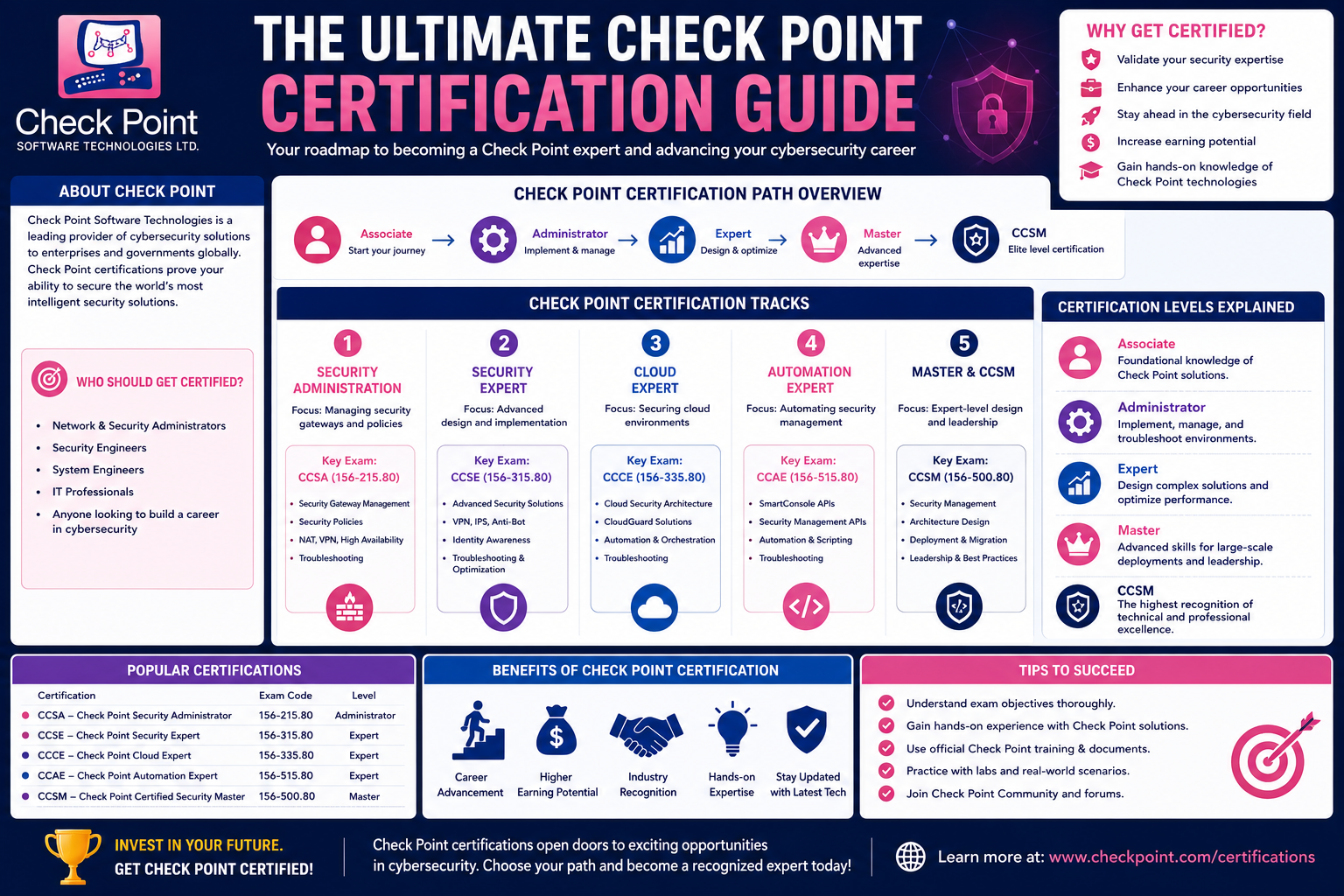
Check Point certification is widely recognized in the cybersecurity industry as a structured way to validate skills in network security, threat prevention, and security infrastructure management. It is designed for IT professionals who want to strengthen their expertise in securing enterprise environments using Check Point technologies. This certification path is valued because it demonstrates practical knowledge in real-world security scenarios, including firewall configuration, VPN management, and threat protection. Organizations often rely on certified professionals to ensure that their network environments are protected against evolving cyber threats. The certification framework is designed to support learners from foundational understanding to advanced expert-level capabilities, making it suitable for beginners as well as experienced security engineers. It also aligns with industry demands where cybersecurity skills are increasingly critical for maintaining secure digital operations across businesses of all sizes.
Understanding Check Point Certification and Its Purpose
Check Point certification is created to validate the ability of IT professionals to install, configure, manage, and troubleshoot Check Point security solutions. It focuses on practical knowledge rather than only theoretical understanding, ensuring that certified individuals can handle real operational challenges. The certification program is structured to reflect the complexity of modern cybersecurity environments, where organizations require professionals who can manage firewalls, monitor network traffic, and implement advanced threat prevention strategies. The certification is also designed to help professionals build credibility in the job market by demonstrating verified skills in one of the most widely used security platforms globally. This makes it an important credential for those aiming to work in cybersecurity roles such as security administrator, security engineer, and network security specialist.
Overview of the Certification Path Structure
The Check Point certification path is organized into multiple levels that progressively increase in complexity and technical depth. Each level is designed to build upon the previous one, allowing professionals to gradually develop advanced expertise. The pathway begins with foundational administration skills and moves toward expert-level security architecture and troubleshooting capabilities. This structured approach ensures that learners gain both conceptual understanding and hands-on technical proficiency. The certification journey typically includes core certifications such as administrator-level skills, advanced security engineering, and master-level expertise. Additional specialization options allow professionals to further enhance their knowledge in specific areas of security technology. This layered structure ensures that professionals can grow their careers systematically while staying aligned with industry requirements.
Core Certification Levels in Check Point Program
The Check Point certification program includes several core levels that define a professional’s expertise in the ecosystem. The foundational level focuses on basic security administration skills, including system configuration, user management, and network fundamentals. The intermediate level builds on this by introducing advanced topics such as security policy management, VPN configuration, and network optimization. The expert level is designed for professionals who manage complex security infrastructures and require deep technical knowledge in troubleshooting and system design. The highest level focuses on architectural mastery and large-scale security deployment across enterprise environments. Each level represents a step forward in technical responsibility, ensuring that professionals are prepared for increasingly complex roles in cybersecurity operations.
Exams, Training, and Certification Delivery System
Check Point certification exams are conducted through authorized testing centers and online proctoring systems managed by a global testing provider. These exams are designed to evaluate both theoretical knowledge and practical problem-solving ability. Training is highly recommended before attempting certification exams, as it helps candidates understand system architecture, configuration processes, and troubleshooting methods. Authorized training centers provide structured courses that include hands-on labs and real-world scenarios. These training programs are essential for building confidence and technical competence before taking certification exams. The certification system is continuously updated to reflect changes in cybersecurity threats and technology advancements, ensuring that certified professionals remain relevant in the industry.
Cost and Investment in Certification Journey
The cost of Check Point certification varies depending on the level of certification and geographic region. Entry-level certifications are generally more affordable, while advanced certifications require higher investment due to their complexity and depth. In most cases, the pricing reflects the value of the skills being validated and the global recognition of the certification. Additional costs may include training programs, study materials, and practice environments. Despite the investment required, many professionals consider it worthwhile due to the strong career opportunities associated with cybersecurity roles. The return on investment is often seen in higher salaries and better job prospects within IT security domains.
Preparation Strategy for Check Point Certification
Preparing for Check Point certification requires a combination of theoretical study and practical hands-on experience. Candidates are encouraged to build a strong foundation in networking concepts such as TCP/IP, routing, and network security principles. Hands-on practice with Check Point systems is essential for understanding real-world configurations and troubleshooting scenarios. Structured training courses provide guided learning paths that help candidates understand complex topics more effectively. Self-study using documentation and practice labs also plays an important role in reinforcing knowledge. A well-balanced preparation strategy ensures that candidates are fully equipped to handle both exam questions and real-world challenges in security environments.
Check Point Certified Security Administrator Overview
The Check Point Certified Security Administrator certification is the entry-level credential in the certification path. It focuses on foundational knowledge required to manage Check Point security systems effectively. This includes understanding basic firewall concepts, network security principles, user access control, and system administration tasks. Candidates are expected to be familiar with networking fundamentals and basic operating system environments. This certification is ideal for professionals who are new to cybersecurity or those transitioning into security-focused roles. It helps establish a strong base for advancing toward more complex certifications in the Check Point ecosystem. The knowledge gained at this level is essential for daily security operations in enterprise environments.
Check Point Certified Security Expert Overview
The Check Point Certified Security Expert certification represents a more advanced level of technical expertise. It is designed for professionals who already have experience working with Check Point systems and want to deepen their knowledge in security architecture and advanced configuration. This level focuses on topics such as firewall optimization, VPN management, network address translation, and system troubleshooting. It also emphasizes security policy implementation and advanced monitoring techniques. Professionals at this level are expected to manage complex network environments and ensure high levels of security performance. This certification is highly valued in organizations that require skilled security engineers to handle mission-critical infrastructure.
Check Point Certified Master Level Expertise
The Check Point Certified Master certification is intended for highly experienced professionals who manage advanced security infrastructures. This level focuses on complex deployment scenarios, deep troubleshooting, and large-scale network security design. Professionals at this level are expected to understand advanced routing, VPN architectures, and high availability configurations. The certification demonstrates the ability to manage enterprise-level security environments and resolve critical technical issues. It also reflects mastery in using advanced Check Point tools and command-line interfaces. Achieving this certification signifies a high level of expertise and is often associated with senior cybersecurity roles.
Check Point Certified Security Master Elite Overview
The Check Point Certified Security Master Elite certification represents the highest level of achievement in the certification hierarchy. It is designed for elite professionals who have extensive experience in security architecture and enterprise-level deployments. This certification focuses on advanced topics such as multi-domain management, global policy implementation, and high availability system design. It also includes advanced troubleshooting techniques for complex network environments. Professionals at this level are recognized as experts capable of designing and managing large-scale security infrastructures. This certification reflects deep technical mastery and strategic understanding of cybersecurity systems.
Comparison Between Check Point and Palo Alto Networks Certifications
Check Point and Palo Alto Networks certifications are both highly respected in the cybersecurity industry. Both focus on enterprise-level security solutions and provide structured certification paths from beginner to expert levels. The primary difference lies in the technology platforms they represent. Check Point focuses on its own security ecosystem, while Palo Alto Networks focuses on its firewall and security solutions. From a career perspective, both certifications offer similar salary potential and job opportunities. The choice between them often depends on the technology used by an organization. Many professionals select their certification path based on their workplace environment or career direction rather than perceived difficulty or advantage.
Career Opportunities and Salary Potential
Professionals with Check Point certification often find strong career opportunities in cybersecurity, network administration, and security engineering roles. Entry-level certified professionals typically begin in support or administration roles, while advanced certification holders move into engineering and architecture positions. Salaries vary depending on experience, certification level, and job responsibilities, but cybersecurity roles generally offer competitive compensation. Organizations value certified professionals because they bring verified skills in protecting digital infrastructure. As cyber threats continue to grow, demand for skilled security professionals remains strong, making this certification path a valuable career investment.
Certification Renewal and Continuous Learning
Check Point certifications are valid for a limited period, requiring professionals to stay updated with evolving technologies and security practices. Renewal ensures that certified individuals maintain current knowledge of updated systems and threat landscapes. Continuous learning is essential in cybersecurity because threats and technologies evolve rapidly. Professionals are encouraged to regularly upgrade their skills through advanced certifications and training programs. This ensures long-term career growth and sustained relevance in the cybersecurity industry.
Training and Skill Development Approach
Training plays a crucial role in achieving success in Check Point certification. Structured learning programs provide hands-on experience with real-world scenarios, helping candidates understand system behavior and configuration techniques. Practical labs allow learners to experiment with security settings, firewall rules, and network configurations in a controlled environment. Supplementary study materials and practice assessments help reinforce theoretical knowledge. A consistent training approach ensures that candidates develop both confidence and technical proficiency required to succeed in certification exams and professional roles.
Conclusion
Check Point certification offers a structured and valuable pathway for professionals aiming to build or advance a career in cybersecurity. It provides a clear progression from foundational knowledge to expert-level mastery, ensuring that learners develop both theoretical understanding and practical skills. With strong industry recognition, competitive salary potential, and growing demand for cybersecurity expertise, this certification path remains a powerful choice for IT professionals.