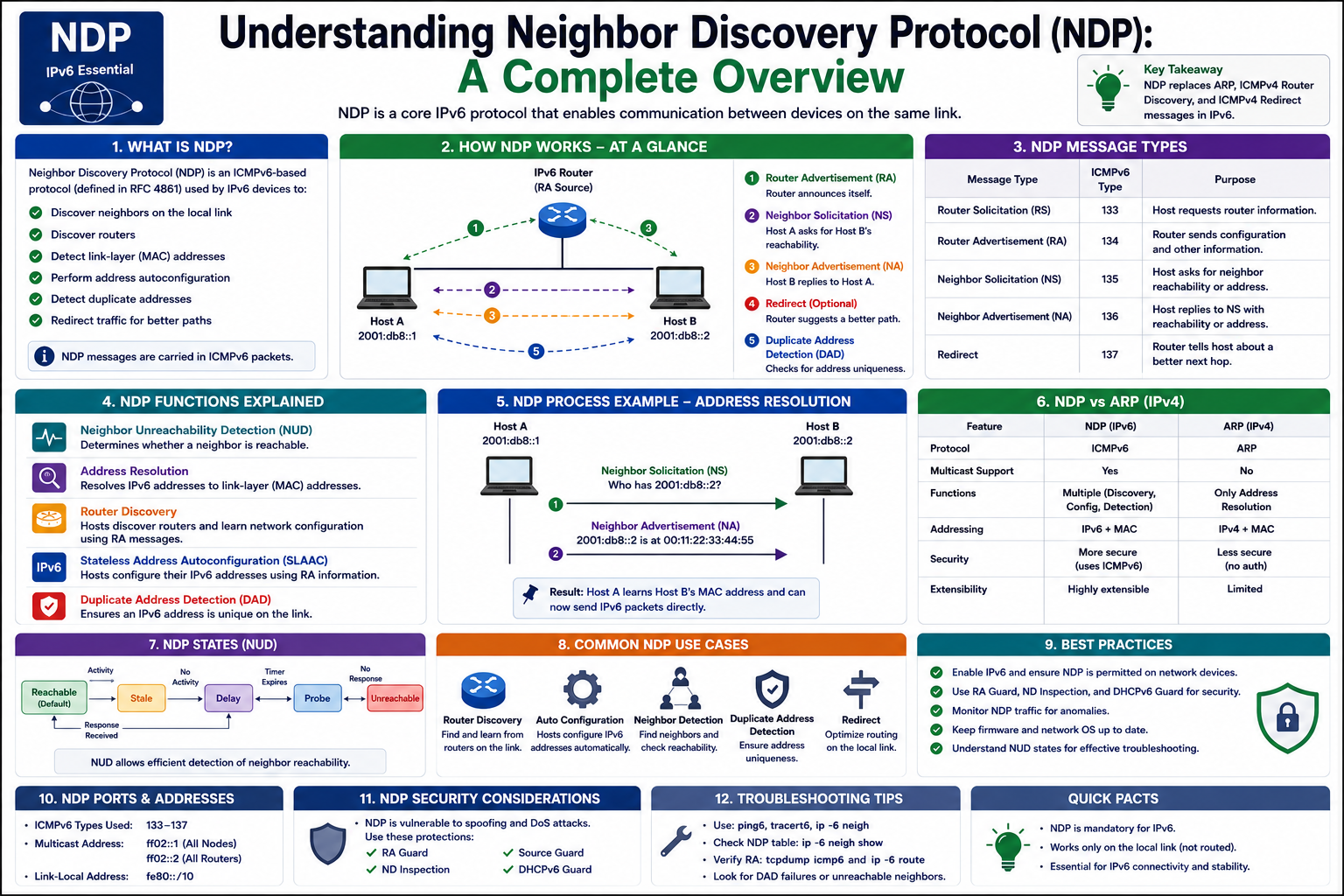
Neighbor Discovery Protocol (NDP) is a fundamental communication mechanism used in IPv6 networks to manage how devices identify, interact, and exchange information within a local network environment. It plays a central role in enabling smooth connectivity by handling essential network tasks such as locating nearby devices, discovering routers, and ensuring that data reaches the correct destination efficiently. NDP is designed to simplify and enhance the way devices communicate compared to earlier IPv4-based methods.
Evolution and Background of Neighbor Discovery Protocol
Neighbor Discovery Protocol was introduced as part of the transition from IPv4 to IPv6 to address limitations in older network communication methods. In IPv4 networks, multiple separate protocols were required to manage device communication, including address resolution and router discovery. NDP was created to unify these functions into a single, more efficient system. This evolution helped reduce complexity in network management and improved overall performance in modern digital infrastructures.
NDP builds upon earlier mechanisms but introduces more advanced capabilities tailored for IPv6 addressing, which is significantly larger and more complex than IPv4. As networks grew in scale and devices became more mobile and interconnected, a more intelligent protocol was needed to handle dynamic communication requirements. NDP fulfills this need by offering automated processes and improved network awareness.
Core Purpose of Neighbor Discovery Protocol in IPv6
Neighbor Discovery Protocol is primarily responsible for enabling devices within the same local network to discover each other and communicate effectively. It ensures that IPv6 devices can identify neighboring systems, determine available routers, and configure themselves without requiring heavy manual setup. This makes it a crucial component of modern network infrastructure.
One of its most important roles is replacing older IPv4-based mechanisms such as Address Resolution Protocol and router discovery functions. Instead of relying on separate protocols, NDP consolidates these responsibilities, improving efficiency and reducing network overhead. It also enhances communication reliability by continuously verifying device availability.
Key Components of Neighbor Discovery Protocol
Neighbor Discovery Protocol is built around several essential components that work together to manage network communication. One of the most important is router discovery, which allows devices to locate routers on the local network. This enables systems to determine where to send traffic that is intended for external networks.
Another major component is address resolution, which maps IPv6 addresses to physical hardware addresses. This ensures that data packets are delivered to the correct device on a network. Without this mapping, communication between devices would not function properly.
Neighbor unreachability detection is another critical element. It continuously checks whether a device on the network is still reachable. If a device becomes unavailable, NDP updates its records and helps reroute traffic accordingly.
Duplicate address detection is also included within NDP. This function ensures that no two devices are using the same IPv6 address on a local network. If a duplicate is detected, the protocol prevents conflicts by identifying and resolving the issue before communication begins.
Functional Capabilities of Neighbor Discovery Protocol
Neighbor Discovery Protocol provides several advanced features that improve network performance and automation. One of its most important capabilities is stateless address configuration, which allows devices to automatically generate their own IPv6 addresses without needing manual configuration or centralized servers.
It also supports router solicitation and router advertisement processes. Devices can request information from routers, and routers can respond with configuration details such as network prefixes and routing information. This interaction ensures that devices are properly configured when they join a network.
Neighbor solicitation and advertisement messages are used to determine device availability and resolve address information. These messages allow devices to confirm whether a neighbor is active and to obtain necessary communication details.
NDP also assists with next-hop determination, helping devices identify the best path for sending data outside the local network. This ensures efficient routing and reduces unnecessary delays in data transmission.
How Neighbor Discovery Protocol Works in IPv6 Networks
In IPv6 environments, Neighbor Discovery Protocol operates through a series of message exchanges between devices. When a device joins a network, it first attempts to discover available routers using solicitation messages. Routers respond with advertisements that contain essential network configuration details.
Once connected, the device begins identifying other systems on the same network segment. It sends solicitation requests to determine the hardware address associated with a specific IPv6 address. The target device responds with the necessary information, enabling direct communication.
Throughout this process, NDP continuously monitors device availability and updates network information dynamically. If a device becomes unreachable, the protocol detects the issue and adjusts communication paths accordingly. This ensures that data flows efficiently even when network conditions change.
Comparison Between IPv4 and IPv6 Neighbor Discovery Mechanisms
In IPv4 networks, multiple separate protocols are required to handle tasks that NDP manages in IPv6. Address resolution is handled by a dedicated mechanism that maps IP addresses to physical addresses. Router discovery is managed by another protocol, and path redirection is handled separately as well.
Neighbor Discovery Protocol consolidates all of these functions into a single integrated system in IPv6. This reduces network complexity and improves performance by minimizing the number of protocol exchanges required for basic communication tasks. It also enhances scalability, making it better suited for modern large-scale networks.
Another major difference is that IPv4 relies heavily on broadcast communication, which can generate unnecessary network traffic. NDP in IPv6 uses multicast communication instead, which is more efficient and reduces network congestion.
Advantages of Neighbor Discovery Protocol in IPv6 Environments
Neighbor Discovery Protocol offers several important advantages that make IPv6 networks more efficient and reliable. One of the most significant benefits is simplified network configuration. Devices can automatically configure themselves using built-in mechanisms without requiring manual setup, reducing administrative workload.
It also improves network efficiency by reducing unnecessary traffic. Since NDP uses targeted communication methods instead of broad network broadcasts, it minimizes congestion and improves overall performance.
Another advantage is enhanced reliability. NDP continuously verifies device availability and updates routing information in real time. This ensures that communication remains stable even when network conditions change dynamically.
The protocol also supports scalability, making it suitable for large and complex network environments. As more devices connect to modern networks, NDP ensures that communication remains organized and efficient.
Security Considerations in Neighbor Discovery Protocol
While Neighbor Discovery Protocol offers many advantages, it is also important to understand that it can be exposed to certain security risks. One potential issue involves unauthorized message interference, where malicious systems attempt to disrupt communication by sending false network information.
Another risk involves address spoofing, where incorrect identity information is introduced into the network. This can lead to communication errors or misdirected traffic if not properly controlled.
To address these concerns, modern networks often implement protective mechanisms that validate communication messages and ensure authenticity. These security measures help maintain the integrity of NDP operations and prevent unauthorized access or disruption.
Neighbor Discovery Protocol in Local Area Networks
In local area networks, Neighbor Discovery Protocol plays a vital role in ensuring smooth communication between devices. When a device joins a LAN, it automatically detects nearby routers and configures itself for communication without manual intervention.
It also enables efficient device-to-device communication within the same network segment. When one device needs to communicate with another, NDP quickly resolves address information and establishes a direct connection.
This automation reduces the need for manual configuration and makes network management significantly easier. It also improves user experience by ensuring that devices can connect and communicate immediately after joining the network.
Neighbor Discovery Protocol in Wide Area Network Communication
Although Neighbor Discovery Protocol primarily operates within local network segments, it also contributes indirectly to wide area network communication. It helps devices identify the first-hop router, which serves as the gateway for external communication beyond the local network.
When data needs to travel across multiple networks, NDP ensures that the correct initial routing path is selected. This allows communication to flow smoothly from the local device to external destinations.
In environments where devices move between networks, NDP supports mobility by enabling systems to quickly adapt to new routers and network configurations. This is especially important in modern mobile and distributed computing environments.
Role of Neighbor Discovery Protocol in Modern Networking
Neighbor Discovery Protocol is a core element of modern IPv6 networking because it provides automation, efficiency, and scalability. It reduces the need for manual configuration, improves communication accuracy, and enhances overall network performance.
As networks continue to expand and evolve, the importance of NDP becomes even more significant. It supports seamless communication between devices, ensures proper routing of data, and helps maintain stable network operations in dynamic environments.
Understanding how NDP functions provides a strong foundation for working with IPv6 networks, especially in environments where efficiency and automation are critical to performance.
Final Thoughts
Neighbor Discovery Protocol stands as one of the most important building blocks of IPv6 networking because it brings together multiple essential network functions into a single, efficient system. Instead of relying on separate protocols for tasks like address resolution, router discovery, and network configuration, NDP unifies everything into a streamlined process that improves both performance and manageability.
What makes NDP particularly significant is its ability to automate key networking operations. Devices can configure themselves, discover routers, identify neighbors, and maintain accurate communication paths without requiring constant manual intervention. This level of automation is one of the reasons IPv6 networks are considered more modern, scalable, and efficient compared to older IPv4-based systems.
At the same time, NDP is not just about convenience—it is also about reliability. By continuously monitoring device reachability and updating network information dynamically, it ensures that communication remains stable even in changing network conditions. This makes it especially valuable in large-scale environments where devices frequently join, leave, or move between networks.
However, like any core networking protocol, NDP must be properly secured and monitored. Without appropriate safeguards, it can be exposed to spoofing or misconfiguration risks. This is why modern networks often combine NDP with additional security mechanisms to maintain trust and integrity in communication.
Overall, Neighbor Discovery Protocol plays a foundational role in enabling the functionality of IPv6 networks. It simplifies network design, enhances efficiency, and supports the growing demand for scalable, automated, and reliable communication systems. As IPv6 adoption continues to expand, understanding NDP becomes increasingly important for anyone working with or managing modern network infrastructures.