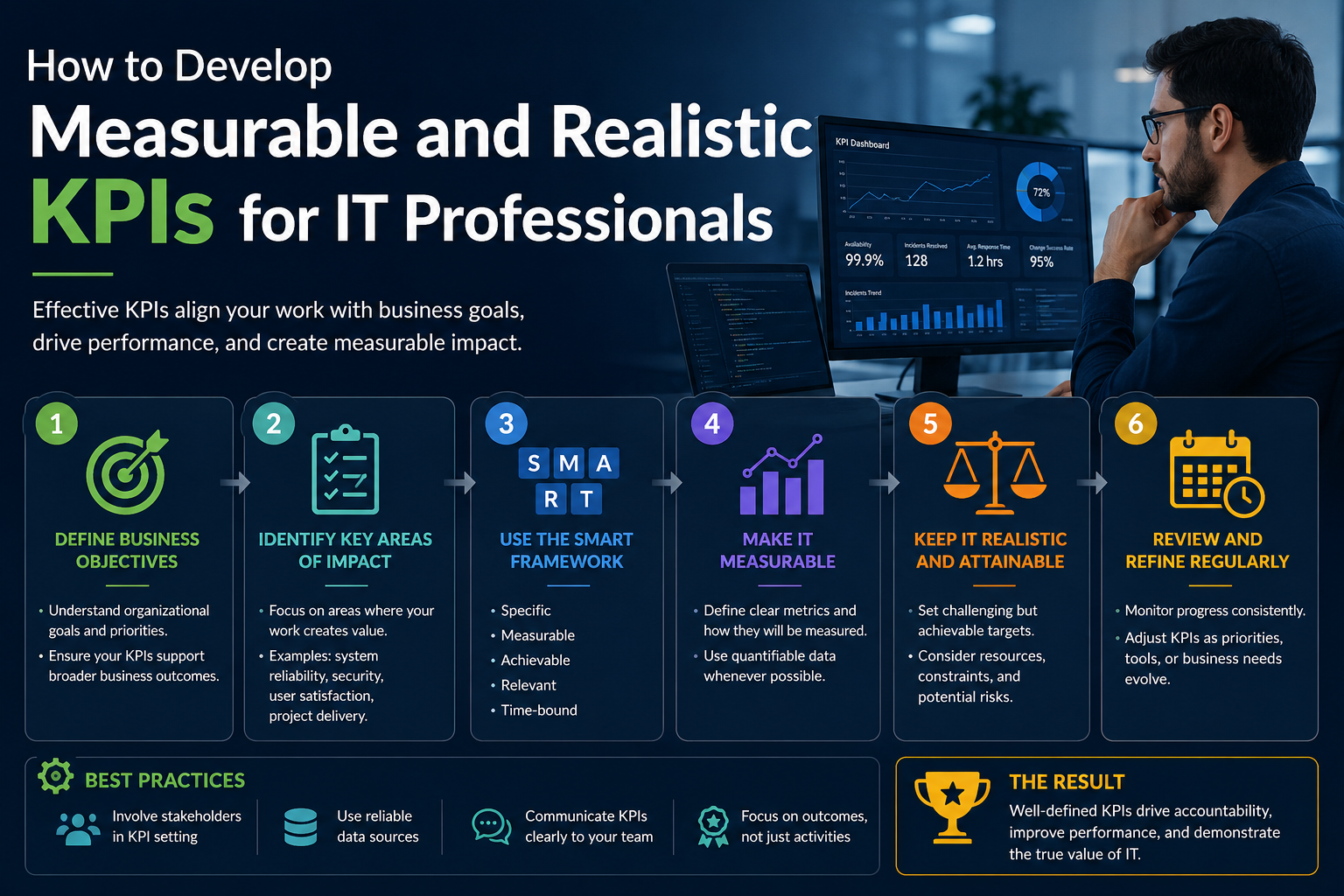
Technology teams are responsible for some of the most important operations inside any organization. They maintain systems, secure networks, solve technical problems, support employees, manage cloud platforms, and help businesses adapt to constant digital change. Despite the importance of this work, many organizations still struggle to measure how effectively their IT departments perform. Unlike sales teams that can point directly to revenue numbers or marketing departments that can show campaign statistics, IT success is often hidden behind smooth operations and the absence of problems.
This is where Key Performance Indicators, commonly called KPIs, become essential. KPIs give organizations a structured way to evaluate performance, track progress, and align technical work with business priorities. Instead of relying on vague impressions or assumptions, companies can use measurable goals to understand whether IT teams are delivering results that support organizational growth.
KPIs are not just management tools designed to monitor employees. When used correctly, they create clarity, direction, and accountability across teams. They help employees understand expectations while giving leadership valuable insight into operational efficiency, system reliability, and long-term improvement.
In many organizations, IT departments work behind the scenes. Employees only notice the IT team when something goes wrong, such as a network outage, software issue, or cybersecurity incident. Because of this, IT professionals often struggle to demonstrate the value of their work. Strong KPIs help translate technical achievements into measurable business outcomes that executives and stakeholders can easily understand.
For example, reducing average ticket resolution time shows improvements in efficiency and customer support. Increasing system uptime demonstrates stability and reliability. Faster deployment cycles reveal improved software development processes. These measurable outcomes help organizations recognize the contribution of IT teams beyond simply “keeping the computers running.”
At the same time, KPIs help IT departments focus on what matters most. Without clear priorities, technical teams can become overwhelmed by endless tasks, conflicting demands, and reactive work. KPIs establish direction by identifying the areas where effort should be concentrated. Instead of chasing every issue equally, teams can organize work around strategic goals that create the greatest impact.
Modern IT environments are also more complex than ever before. Organizations rely on cloud services, hybrid work environments, cybersecurity protections, automation platforms, and constantly evolving software systems. Managing all these moving parts requires careful planning and ongoing performance measurement. KPIs provide a framework for tracking whether systems remain stable, secure, scalable, and aligned with business expectations.
Another important reason KPIs matter is communication. Technical language can sometimes create a disconnect between IT professionals and business leadership. Executives may not fully understand infrastructure improvements, server optimizations, or network redesigns. KPIs bridge this gap by turning technical achievements into simple, measurable indicators. Instead of discussing technical configurations, leaders can focus on outcomes like reduced downtime, faster service delivery, and improved employee productivity.
Well-designed KPIs also encourage collaboration across departments. IT teams rarely work in isolation. They support human resources systems, financial platforms, communication tools, customer service software, and operational infrastructure. When KPIs align with organizational goals, technology departments become active partners in business growth instead of separate technical units.
However, not all KPIs are effective. Poorly designed metrics can create frustration, confusion, and even harmful behavior. Measuring the wrong things may encourage teams to prioritize numbers over meaningful outcomes. For example, focusing only on closing support tickets quickly may reduce service quality if technicians rush through problems without solving root causes.
This is why thoughtful KPI development is critical. Organizations must choose measurements that reflect real value rather than vanity metrics. Good KPIs should encourage long-term improvement, balanced performance, and collaboration rather than short-term shortcuts.
The process begins with understanding what the IT department actually does and how its responsibilities connect to broader business objectives. Every organization has unique technical needs. A software development company may focus heavily on deployment speed and application stability, while a healthcare organization may prioritize security compliance and uptime reliability. Effective KPIs must reflect these operational realities.
Clear communication is equally important during KPI development. Employees need to understand not only what is being measured but why those measurements matter. When teams understand the purpose behind KPIs, they are more likely to engage positively with the process rather than viewing metrics as surveillance tools.
Organizations should also recognize that KPIs are not permanent. Technology evolves rapidly, business priorities shift, and operational challenges change over time. Successful companies regularly review and adjust their KPIs to ensure continued relevance. Metrics that mattered two years ago may no longer reflect current objectives or challenges.
The best KPI systems are flexible, collaborative, and practical. They combine measurable performance goals with realistic expectations. They encourage continuous improvement without creating unnecessary pressure. Most importantly, they help IT teams focus on work that genuinely benefits the organization.
Why IT Teams Need Clear Performance Measurements
Many organizations assume that if systems are functioning properly, then the IT department must be doing a good job. While stable operations are certainly important, relying solely on assumptions creates major blind spots. Without structured performance measurements, organizations struggle to identify strengths, weaknesses, inefficiencies, and opportunities for improvement.
Clear performance measurements provide visibility into how technology teams operate on a daily basis. They allow organizations to move beyond guesswork and base decisions on actual data. This improves planning, budgeting, staffing, and overall operational management.
One of the biggest challenges in IT management is balancing reactive work with strategic priorities. Technology departments constantly receive requests ranging from password resets and software installations to security incidents and infrastructure upgrades. Without clear KPIs, teams can become trapped in reactive cycles where urgent problems consume all available time and resources.
Performance measurements help create balance by identifying what deserves attention and how success should be evaluated. They allow managers to distinguish between temporary activity and meaningful progress. Being busy does not necessarily mean being productive. KPIs help determine whether effort is producing valuable results.
Employee motivation also improves when expectations are clear. Ambiguity creates stress because employees are uncertain about what success looks like. Clear KPIs eliminate confusion by defining measurable objectives. Team members understand where to focus their efforts and how their contributions support organizational goals.
This clarity becomes especially important in larger organizations where multiple IT teams handle different responsibilities. Infrastructure engineers, cybersecurity specialists, software developers, support technicians, and cloud administrators all contribute in different ways. Tailored KPIs help each team focus on outcomes relevant to their specific roles while still supporting broader company objectives.
Another major benefit of clear measurements is accountability. Accountability should not be confused with blame or punishment. In healthy organizations, accountability means taking ownership of outcomes, learning from mistakes, and continuously improving processes. KPIs create accountability by establishing shared expectations and transparent evaluation criteria.
For leadership teams, performance measurements support better decision-making. Managers can identify trends, detect recurring problems, and allocate resources more effectively. For example, if ticket response times continue increasing, leadership may discover that the support team needs additional staffing or process improvements. If system downtime rises unexpectedly, it may indicate aging infrastructure or maintenance gaps.
KPIs also improve resource prioritization. IT departments often operate under tight budgets and limited staffing. Clear metrics help leaders decide where investments will have the greatest impact. Instead of relying on opinions or assumptions, decisions can be supported by operational data.
Security management is another area where performance measurements play a critical role. Cybersecurity threats continue growing in frequency and sophistication. Organizations must monitor response times, patch management, vulnerability detection, and incident resolution to maintain strong security postures. Without measurable indicators, security risks may go unnoticed until significant damage occurs.
Operational stability also depends heavily on consistent monitoring. Downtime, latency issues, and system failures can disrupt business operations and damage customer trust. KPIs related to uptime, incident management, and system performance help organizations maintain reliable services and identify emerging problems before they escalate.
In software development environments, KPIs help teams manage productivity and quality simultaneously. Measuring deployment frequency, defect rates, testing coverage, and sprint velocity provides insight into development efficiency without sacrificing stability. Balanced metrics encourage sustainable improvement rather than rushed releases.
Training and skill development are equally important areas for performance tracking. Technology changes rapidly, and outdated skills can quickly become organizational weaknesses. KPIs focused on certifications, training hours, or knowledge development encourage continuous learning and help teams stay prepared for evolving technical demands.
Communication between departments also improves when performance data is available. Non-technical stakeholders often struggle to understand IT workloads or priorities. KPIs create shared understanding by translating technical activities into business-friendly outcomes. This strengthens collaboration and helps leadership appreciate the strategic value of technology operations.
Clear measurements can even improve workplace culture when implemented thoughtfully. Employees are more likely to feel recognized when their contributions are visible and measurable. Teams gain confidence when they can demonstrate progress and achievements using objective data rather than subjective opinions.
At the same time, organizations must avoid creating unhealthy metric-driven environments. Excessive measurement can overwhelm employees and shift focus away from meaningful work. The goal is not to track every possible activity but to identify a manageable number of indicators that genuinely reflect success.
Balanced KPI systems consider both quantity and quality. For example, measuring the number of resolved support tickets alone may encourage rushed work. Combining resolution speed with customer satisfaction scores creates a more complete picture of performance. Similarly, measuring software deployment frequency without tracking stability could lead to unreliable releases.
Organizations should also recognize that different roles require different measurements. Support technicians, developers, security analysts, and infrastructure engineers contribute differently to organizational success. A one-size-fits-all approach rarely produces meaningful insights.
Transparency is another key factor in successful KPI implementation. Employees should understand how metrics are calculated, why they matter, and how results will be used. Hidden or confusing measurements create distrust and resistance. Open communication helps build confidence and cooperation.
The most effective KPI systems focus on improvement rather than punishment. Metrics should guide learning, process optimization, and better decision-making. When employees fear negative consequences for every missed target, they may manipulate numbers or avoid innovation. Healthy KPI cultures encourage honesty, experimentation, and continuous growth.
As organizations continue expanding their digital operations, the importance of performance measurements will only increase. Technology is no longer just a support function. IT departments play central roles in innovation, customer experience, operational continuity, and competitive advantage. Clear KPIs help ensure these responsibilities are managed effectively and aligned with long-term business success.
The Foundations of Strong and Achievable IT KPIs
Creating effective KPIs for IT teams requires far more than selecting random metrics or copying industry benchmarks. Strong KPIs are carefully designed measurements that reflect organizational priorities, support team performance, and encourage meaningful progress. The foundation of successful KPI development lies in understanding how technical operations connect to business outcomes.
Many organizations make the mistake of choosing metrics simply because they are easy to measure. While convenient data collection is important, not every measurable activity represents valuable performance. Effective KPIs focus on outcomes that genuinely matter to the organization and its employees.
One of the most widely used frameworks for creating effective KPIs is the SMART model. SMART stands for Specific, Measurable, Achievable, Relevant, and Time-Bound. This framework helps organizations create clear and practical goals instead of vague expectations.
Specific KPIs clearly define what success looks like. Ambiguous objectives create confusion because employees are unsure about priorities. For example, saying “improve security” is too broad to guide meaningful action. A more specific KPI might state, “Patch 95 percent of critical vulnerabilities within 14 days.” The second version provides a clear target and measurable expectation.
Measurable KPIs rely on objective data rather than opinions or assumptions. If progress cannot be tracked consistently, the KPI loses value. Measurable indicators allow teams to evaluate improvement over time and identify areas requiring attention. Reliable measurement also improves transparency and accountability.
Achievable KPIs are realistic within the organization’s available resources, staffing, and operational environment. Unrealistic goals can damage morale and create frustration. Employees who constantly face impossible expectations may stop engaging with the process altogether. Strong KPIs challenge teams without setting them up for failure.
Relevance is another essential factor. Every KPI should connect directly to organizational priorities or operational responsibilities. Measuring activities that do not support broader objectives wastes time and creates unnecessary complexity. Relevant KPIs help teams focus on work that delivers meaningful value.
Time-bound KPIs establish deadlines or reporting periods. Without timelines, goals can easily be delayed or deprioritized. Clear timeframes create urgency and help organizations evaluate progress consistently. Time-based measurements also support planning and resource management.
Beyond SMART principles, effective IT KPIs require operational context. Organizations must understand the daily realities of their technology teams before selecting measurements. Infrastructure teams, cybersecurity specialists, developers, and support technicians all face unique challenges and responsibilities. Metrics should reflect these differences rather than forcing every team into identical evaluation models.
Another important foundation is alignment with business strategy. IT departments exist to support organizational success, not operate independently from it. Strong KPIs connect technical work to broader business outcomes such as operational continuity, customer satisfaction, revenue protection, compliance, or innovation.
For example, a retail company that depends heavily on online sales may prioritize website uptime and transaction performance. A financial institution may focus more heavily on cybersecurity response times and compliance monitoring. A healthcare organization may emphasize system availability and patient data protection. Effective KPIs reflect these strategic priorities.
Collaboration plays a major role in KPI development as well. Metrics should not be created exclusively by executives or managers without input from technical teams. Employees performing the work often understand operational realities better than leadership alone. Including team members in KPI discussions improves accuracy, practicality, and employee engagement.
Communication during KPI implementation is equally important. Employees need to understand why certain metrics were chosen and how they contribute to organizational goals. Clear communication reduces resistance and helps teams view KPIs as useful tools rather than administrative burdens.
Simplicity is another essential principle. Organizations sometimes create overly complicated KPI systems filled with excessive measurements and detailed reporting requirements. Complex systems become difficult to maintain and often distract employees from meaningful work. Strong KPI frameworks focus on a manageable number of impactful indicators.
Balanced measurement is critical for avoiding unintended consequences. Focusing too heavily on one metric can distort behavior and reduce overall performance quality. For example, emphasizing rapid ticket closure rates may encourage technicians to prioritize speed over thorough problem-solving. Balanced KPIs combine efficiency, quality, reliability, and customer experience.
Organizations should also avoid relying solely on lagging indicators. Lagging metrics measure past performance, such as downtime incidents or completed projects. While valuable, they only reveal what has already happened. Leading indicators, such as training completion rates or proactive maintenance activities, help organizations anticipate future outcomes and prevent problems before they occur.
Flexibility is another important characteristic of effective KPI systems. Technology environments evolve quickly, and organizational priorities can shift unexpectedly. KPIs should be reviewed regularly to ensure continued relevance. Static metrics may eventually become outdated or disconnected from current business needs.
Data accuracy is equally important. Inconsistent or unreliable reporting undermines confidence in KPI systems. Organizations should establish clear methods for collecting, validating, and analyzing performance data. Employees must trust that measurements are fair and accurate.
Cultural factors also influence KPI success. Organizations with supportive, improvement-focused cultures tend to use metrics more effectively than environments driven primarily by fear or punishment. When KPIs are used solely for criticism, employees may hide problems or manipulate numbers instead of pursuing genuine improvement.
Recognition and feedback further strengthen KPI programs. Employees should receive acknowledgment for progress and achievements, not only criticism for missed targets. Positive reinforcement encourages engagement and motivates teams to maintain high performance standards.
Leadership involvement is essential throughout the process. Managers must actively support KPI initiatives, communicate priorities, and model accountability. When leadership ignores metrics or changes priorities constantly, employees lose confidence in the system.
Technology tools can also support KPI management. Dashboards, monitoring platforms, analytics systems, and reporting software help organizations track performance efficiently. However, tools alone do not guarantee success. The underlying measurements and organizational processes matter far more than the software being used.
Effective KPIs ultimately create shared understanding across the organization. They help leadership, employees, and stakeholders align around common goals and measurable outcomes. Instead of relying on assumptions, organizations gain visibility into operational performance and continuous improvement opportunities.
As IT environments become increasingly central to organizational success, the ability to create strong, achievable KPIs will remain one of the most important leadership skills in technology management.
Turning Business Objectives Into Meaningful IT Metrics
One of the biggest challenges organizations face when creating KPIs for IT teams is connecting technical work to larger business objectives. Technology departments often operate with highly specialized language, tools, and workflows that can seem disconnected from broader company goals. However, the most effective IT KPIs are the ones that directly support organizational success rather than simply measuring technical activity.
To build meaningful KPIs, organizations must first understand what the business is trying to accomplish overall. Every company has priorities such as improving customer experience, increasing operational efficiency, reducing costs, expanding services, improving security, or accelerating innovation. IT teams play a role in all these objectives, even if that role is not always obvious at first glance.
For example, consider a company focused on improving customer satisfaction. The IT department may support this goal by reducing website downtime, improving application speed, enhancing cybersecurity protections, or speeding up technical support response times. These technical improvements directly influence how customers experience the organization’s services.
Similarly, a business aiming to reduce operational costs may rely on IT teams to automate repetitive tasks, optimize infrastructure, improve cloud resource management, or reduce system failures that disrupt productivity. In this case, KPIs should measure efficiency improvements and operational stability rather than purely technical statistics.
The process of translating business goals into technical KPIs requires communication between leadership and IT departments. Executives may define the broader strategic direction, but IT professionals understand which technical processes influence those outcomes. Collaboration between both groups creates more realistic and valuable performance measurements.
A common mistake is focusing on technical metrics that sound impressive but have little impact on organizational priorities. For instance, measuring server processor utilization may provide useful technical information, but it may not directly help leadership understand whether the organization is operating more effectively. On the other hand, tracking application availability or incident response times provides clearer insight into business continuity and customer experience.
Good KPI development begins by asking a simple question: What business problem is the IT team helping solve? Once that question is answered, organizations can identify measurable indicators that reflect meaningful progress.
This approach also helps prevent unnecessary measurement overload. Many organizations collect enormous amounts of technical data without understanding which metrics actually matter. Monitoring everything equally creates confusion and distracts teams from critical priorities. Effective KPI systems focus on the indicators that have the strongest connection to organizational outcomes.
Alignment between IT metrics and business goals also improves executive support for technology initiatives. Leadership teams are more likely to invest in infrastructure upgrades, cybersecurity improvements, or employee training when they can clearly see how these efforts contribute to organizational success. KPIs help technology departments demonstrate value in terms that non-technical stakeholders understand.
Another advantage of business-aligned KPIs is improved prioritization. IT teams often juggle competing requests from multiple departments. Clear performance goals help determine which projects deserve immediate attention and which can be delayed. This reduces confusion and helps teams allocate time and resources more effectively.
Organizations should also recognize that different business goals require different types of metrics. A company focused on growth may prioritize scalability, innovation, and deployment speed. A company operating in a highly regulated industry may emphasize compliance, audit readiness, and security controls. KPI systems must reflect these strategic differences rather than relying on generic templates.
Operational maturity also affects KPI selection. Smaller organizations with limited technical infrastructure may initially focus on basic stability metrics such as uptime, ticket resolution, and backup reliability. Larger enterprises with advanced environments may track automation efficiency, predictive analytics, and complex service management indicators.
It is equally important to balance short-term operational metrics with long-term strategic measurements. Daily support performance matters, but organizations must also measure progress toward larger transformation goals such as cloud adoption, digital modernization, or cybersecurity resilience.
When organizations successfully align KPIs with business objectives, technology departments become more integrated into overall strategic planning. IT teams are no longer viewed simply as support functions. Instead, they become recognized as essential contributors to growth, stability, and innovation.
Choosing the Right Categories for IT KPIs
Not all IT work fits into a single category, which means effective KPI systems should reflect the diversity of responsibilities within modern technology departments. Choosing the right KPI categories helps organizations measure performance comprehensively without overwhelming teams with unnecessary complexity.
One of the most common categories involves infrastructure and operational stability. These KPIs focus on keeping systems, networks, and services running reliably. Organizations depend heavily on stable infrastructure to maintain productivity and customer trust, making operational metrics essential for most IT departments.
Common infrastructure KPIs include system uptime, network availability, incident frequency, mean time to repair, and service reliability. These measurements help organizations monitor operational health and identify recurring technical problems. Stable infrastructure often goes unnoticed when functioning properly, which makes measurable indicators especially important for demonstrating value.
Support and service desk performance represent another critical KPI category. Help desk teams serve as the front line of technical support for employees and customers. Their performance directly affects productivity, user satisfaction, and operational continuity.
Support-related KPIs often include ticket response times, resolution rates, escalation frequency, first-contact resolution percentages, and customer satisfaction scores. These indicators provide insight into how efficiently technical problems are being addressed and whether users feel supported effectively.
Cybersecurity has become one of the most important KPI categories in modern organizations. As digital threats continue growing, companies must carefully monitor security performance to reduce risks and maintain compliance. Security KPIs help organizations evaluate how effectively they detect, prevent, and respond to threats.
Examples of cybersecurity KPIs include vulnerability remediation timelines, incident response times, patch compliance rates, phishing test performance, unauthorized access attempts, and security training completion rates. These metrics help organizations strengthen their defensive posture while identifying areas requiring additional attention.
Software development teams require their own specialized performance measurements. Development environments operate differently from infrastructure or support teams, meaning their KPIs should reflect coding quality, release management, collaboration, and delivery efficiency.
Common development KPIs include deployment frequency, defect rates, sprint velocity, code review completion, testing coverage, and release stability. Balanced development metrics encourage both productivity and software quality rather than rewarding speed alone.
Cloud management has also emerged as a major KPI category as organizations continue migrating systems and services to cloud platforms. Cloud environments introduce unique operational challenges involving scalability, cost management, availability, and security.
Cloud-related KPIs may include resource utilization efficiency, cloud spending optimization, workload availability, automation coverage, and migration completion progress. These measurements help organizations ensure cloud investments deliver expected operational benefits.
Training and professional development form another important KPI category that organizations sometimes overlook. Technology evolves constantly, and outdated skills can quickly become operational weaknesses. Measuring training participation and certification progress helps organizations maintain a capable and adaptable workforce.
Learning-focused KPIs may include completed training hours, certification achievement rates, cross-training participation, skill assessment results, or knowledge-sharing activities. These indicators encourage continuous learning while helping leadership identify potential skill gaps.
Project management KPIs are equally valuable for organizations handling large technical initiatives. IT departments frequently manage upgrades, migrations, deployments, and system implementations that require careful coordination and scheduling.
Project-related metrics often include milestone completion rates, budget adherence, timeline accuracy, stakeholder satisfaction, and risk management effectiveness. These KPIs help organizations evaluate whether projects are being delivered successfully and efficiently.
Compliance and governance measurements are particularly important in regulated industries such as healthcare, finance, and government operations. These KPIs help organizations maintain audit readiness and meet legal or industry requirements.
Governance-related indicators may include policy compliance rates, audit findings, documentation completion, access review accuracy, and regulatory reporting timelines. These metrics support operational accountability and risk management.
Organizations should also consider innovation-focused KPIs. While operational stability is important, companies must also encourage improvement and modernization. Innovation metrics help teams balance maintenance responsibilities with strategic advancement.
Examples of innovation KPIs include automation implementation rates, process improvement adoption, experimental project success rates, and technology modernization progress. These measurements encourage forward-thinking initiatives instead of purely reactive operations.
The key to successful KPI categorization is balance. Organizations should avoid focusing exclusively on one area while ignoring others. Measuring only operational efficiency may neglect employee development. Measuring only project completion may overlook security risks. Comprehensive KPI systems provide visibility across multiple dimensions of IT performance.
However, balance does not mean measuring everything equally. Different organizations will prioritize categories differently depending on business objectives, industry requirements, operational maturity, and available resources. The goal is to create a practical system that reflects the organization’s most important priorities.
Leadership should also avoid creating excessive reporting burdens. Too many KPIs can overwhelm employees and reduce focus. A smaller set of meaningful, well-defined metrics is usually more effective than large collections of loosely connected measurements.
Successful KPI categories also evolve. As organizations grow and technology environments change, measurement priorities may shift. Regular review processes help ensure KPI systems remain aligned with current operational needs and strategic goals.
Measuring Productivity Without Creating Burnout
Productivity is one of the most misunderstood concepts in IT management. Many organizations assume productivity simply means completing more tasks in less time. While efficiency certainly matters, measuring productivity incorrectly can create unhealthy work environments, employee burnout, and declining service quality.
Technology work is often complex, unpredictable, and mentally demanding. IT professionals solve problems, manage risks, design systems, and support users in environments that change constantly. Measuring productivity purely through volume-based metrics can oversimplify this complexity and encourage counterproductive behavior.
For example, support technicians measured only by ticket closure rates may rush through issues without fully solving them. Developers pressured solely on deployment speed may release unstable software. Security analysts evaluated only on alert counts may prioritize quantity over meaningful threat analysis. Poorly designed productivity metrics often reward activity rather than outcomes.
Effective KPI systems recognize that sustainable productivity involves quality, collaboration, reliability, and long-term improvement in addition to speed or volume. Organizations must create balanced measurements that encourage healthy performance rather than constant pressure.
One important principle is recognizing the difference between output and value. High activity levels do not automatically create positive business outcomes. An IT team may complete hundreds of tasks while still failing to address major operational risks or strategic priorities. Strong productivity KPIs focus on meaningful contributions rather than simple workload counts.
Organizations should also account for the different types of work IT teams perform. Some tasks are repetitive and easy to measure, while others involve deep problem-solving, research, planning, or innovation. Complex technical projects may take significant time without producing immediate visible outputs. KPI systems must reflect these realities.
Context matters greatly when evaluating productivity. A support technician handling highly technical incidents may resolve fewer tickets than someone handling simple password resets, but their work may create greater organizational value. Similarly, a developer working on critical infrastructure improvements may appear slower than someone handling minor feature updates.
Balanced KPI systems combine quantitative and qualitative measurements. Quantitative metrics provide measurable data such as response times or project completion rates. Qualitative indicators evaluate factors such as customer satisfaction, teamwork, communication, and solution effectiveness. Together, these measurements provide a more complete view of performance.
Employee well-being should also be considered when designing productivity KPIs. Constant pressure to maximize output can lead to stress, fatigue, and reduced job satisfaction. Burnout not only harms employees personally but also increases turnover, mistakes, and operational instability.
Organizations can reduce burnout risks by setting realistic expectations and allowing flexibility in performance management. Achievable goals encourage motivation and engagement, while impossible targets create frustration and disengagement. KPI systems should challenge teams without demanding unsustainable workloads.
Another important strategy involves measuring process improvement rather than constant activity increases. Productivity should not always mean working faster. Sometimes the most valuable improvement comes from eliminating unnecessary work through automation, better documentation, or improved workflows.
Collaboration is another factor often overlooked in productivity measurement. IT teams rarely operate effectively through isolated individual performance alone. Successful operations depend heavily on communication, knowledge sharing, and teamwork. KPI systems should recognize collaborative contributions rather than rewarding only individual output.
Learning and professional development should also be protected. Employees need time to build new skills, research technologies, and improve processes. Organizations that focus exclusively on immediate productivity may unintentionally discourage growth and innovation.
Leadership behavior strongly influences how productivity metrics affect workplace culture. Managers who treat KPIs as tools for punishment create fear and defensiveness. In contrast, leaders who use metrics to support coaching, improvement, and realistic planning foster healthier environments.
Transparency helps as well. Employees should understand how productivity measurements are calculated and why they matter. Hidden or constantly changing expectations increase stress and reduce trust. Clear communication supports engagement and accountability.
Organizations should also regularly review KPI outcomes for unintended consequences. If metrics appear to encourage shortcuts, declining quality, or employee exhaustion, adjustments may be necessary. Effective KPI systems evolve based on feedback and operational experience.
Technology itself can support healthier productivity management. Monitoring platforms, automation tools, and analytics systems help reduce repetitive workloads while improving visibility into operational performance. However, automation should support employees rather than simply increasing expectations endlessly.
Workload balance is another critical consideration. Some IT roles involve unpredictable spikes in activity during outages, security incidents, or major deployments. KPI systems should account for these fluctuations rather than expecting identical performance under all conditions.
Remote and hybrid work environments have further changed how productivity should be measured. Visibility into employee activity is no longer a reliable indicator of effectiveness. Organizations increasingly need outcome-based metrics that focus on results rather than constant supervision.
Healthy productivity measurement ultimately supports both organizational success and employee sustainability. Strong KPI systems encourage efficiency, quality, innovation, and collaboration without creating toxic pressure or unrealistic demands.
As technology environments continue growing more complex, organizations that prioritize sustainable performance will likely outperform those focused solely on maximizing short-term output. Effective KPIs help create this balance by measuring meaningful progress while supporting long-term operational health.
Adapting KPIs as Technology and Business Needs Change
One of the biggest mistakes organizations make with IT KPIs is treating them as permanent measurements that never need revision. Technology evolves rapidly, business priorities shift, and operational risks change over time. A KPI that was highly valuable two years ago may no longer reflect the organization’s current goals or challenges. For this reason, successful IT departments regularly review and adjust their KPI strategies to stay aligned with both technical and business needs.
As companies adopt cloud services, automation platforms, artificial intelligence tools, and hybrid work environments, the responsibilities of IT teams continue expanding. Older metrics focused only on hardware uptime or ticket closure rates may no longer capture the full scope of modern IT operations. Organizations need KPIs that reflect innovation, adaptability, cybersecurity resilience, and user experience in addition to traditional operational stability.
Regular KPI reviews help leadership identify outdated measurements and replace them with more relevant indicators. These reviews also create opportunities to simplify overly complex reporting systems. In some cases, organizations accumulate too many KPIs over time, making it difficult for employees to focus on what truly matters. Removing unnecessary metrics can improve clarity and reduce reporting fatigue.
Employee feedback is especially valuable during KPI evaluations. Team members working directly with systems and processes often recognize problems with measurements before leadership notices them. They may identify metrics that unintentionally encourage poor behavior, create unrealistic expectations, or fail to reflect the actual complexity of their work. Including employees in KPI discussions improves fairness, practicality, and overall engagement.
Organizations should also pay attention to changes in business strategy. If a company shifts focus toward digital services, customer experience, or cybersecurity compliance, IT KPIs should evolve accordingly. Performance measurements must always support the organization’s most important priorities rather than remaining tied to outdated operational models.
Another important consideration is balancing operational maintenance with innovation. IT departments often spend significant time keeping existing systems stable, but organizations also rely on them to modernize infrastructure and support growth. Effective KPI systems measure both reliability and progress, ensuring teams are not trapped in purely reactive workflows.
Creating a Culture That Supports KPI Success
Even the best-designed KPIs will fail if the workplace culture surrounding them is unhealthy. Metrics alone do not improve performance. Success depends on how organizations communicate expectations, respond to results, and support employees throughout the process.
In positive environments, KPIs are used as tools for improvement, learning, and alignment. Employees understand how their work contributes to organizational goals and feel motivated to achieve measurable progress. Managers use data to guide decisions, remove obstacles, and support team development rather than simply criticizing missed targets.
In unhealthy environments, KPIs become sources of fear and pressure. Employees may focus only on protecting their numbers rather than solving real problems. Some may avoid difficult tasks that could negatively affect performance metrics, while others may manipulate reporting data to meet unrealistic expectations. This behavior weakens trust and reduces the value of the entire KPI system.
Transparency is one of the most important elements of a healthy KPI culture. Employees should clearly understand what is being measured, how results are calculated, and why the metrics matter. Hidden expectations or constantly changing standards create confusion and frustration. Open communication builds trust and encourages accountability.
Recognition also plays a major role in successful KPI management. Employees are more likely to stay engaged when leadership acknowledges progress and improvement rather than focusing only on mistakes. Celebrating achievements helps reinforce positive behavior and strengthens team morale.
Training and support are equally important. If organizations expect employees to meet higher performance standards, they must provide the tools, knowledge, and resources needed for success. Strong KPI systems are supported by clear processes, realistic workloads, modern technology, and opportunities for professional growth.
Ultimately, effective KPIs help IT departments become more organized, strategic, and aligned with business goals. They provide clarity in complex technical environments and create measurable ways to track improvement. When designed thoughtfully and managed fairly, KPIs help organizations build stronger IT teams that support long-term operational success and continuous innovation.
Conclusion
Creating clear and achievable KPIs for IT teams is one of the most effective ways organizations can improve performance, strengthen accountability, and align technology operations with business goals. In modern workplaces, IT departments are no longer limited to handling technical support or maintaining systems in the background. They play a major role in cybersecurity, cloud management, software development, communication infrastructure, and digital transformation. Because of this growing responsibility, organizations need reliable ways to measure progress and ensure teams are focusing on the right priorities.
Well-designed KPIs provide structure and direction in environments that are often fast-moving and highly complex. They help teams understand expectations, track measurable improvements, and identify areas that need attention before small issues become major problems. Metrics related to uptime, response times, project delivery, security compliance, and employee development all contribute to building stronger and more efficient IT operations.
However, successful KPI strategies require more than simply choosing numbers to track. Organizations must create measurements that are realistic, meaningful, and connected to actual business objectives. Poorly designed KPIs can create confusion, encourage unhealthy work habits, and shift attention away from important responsibilities that are harder to measure. Strong KPI systems balance productivity with quality, operational efficiency with innovation, and accountability with employee well-being.
Regular reviews and adjustments are also essential because technology and business priorities constantly evolve. The most effective organizations treat KPIs as flexible tools for continuous improvement rather than rigid rules that never change. By involving employees in the process and maintaining open communication, companies can create KPI systems that support both organizational growth and positive workplace culture.
Ultimately, KPIs help transform IT departments from reactive support teams into strategic business partners. When teams understand their goals and can clearly measure their impact, organizations gain stronger performance, better decision-making, improved collaboration, and greater long-term success in an increasingly technology-driven world.