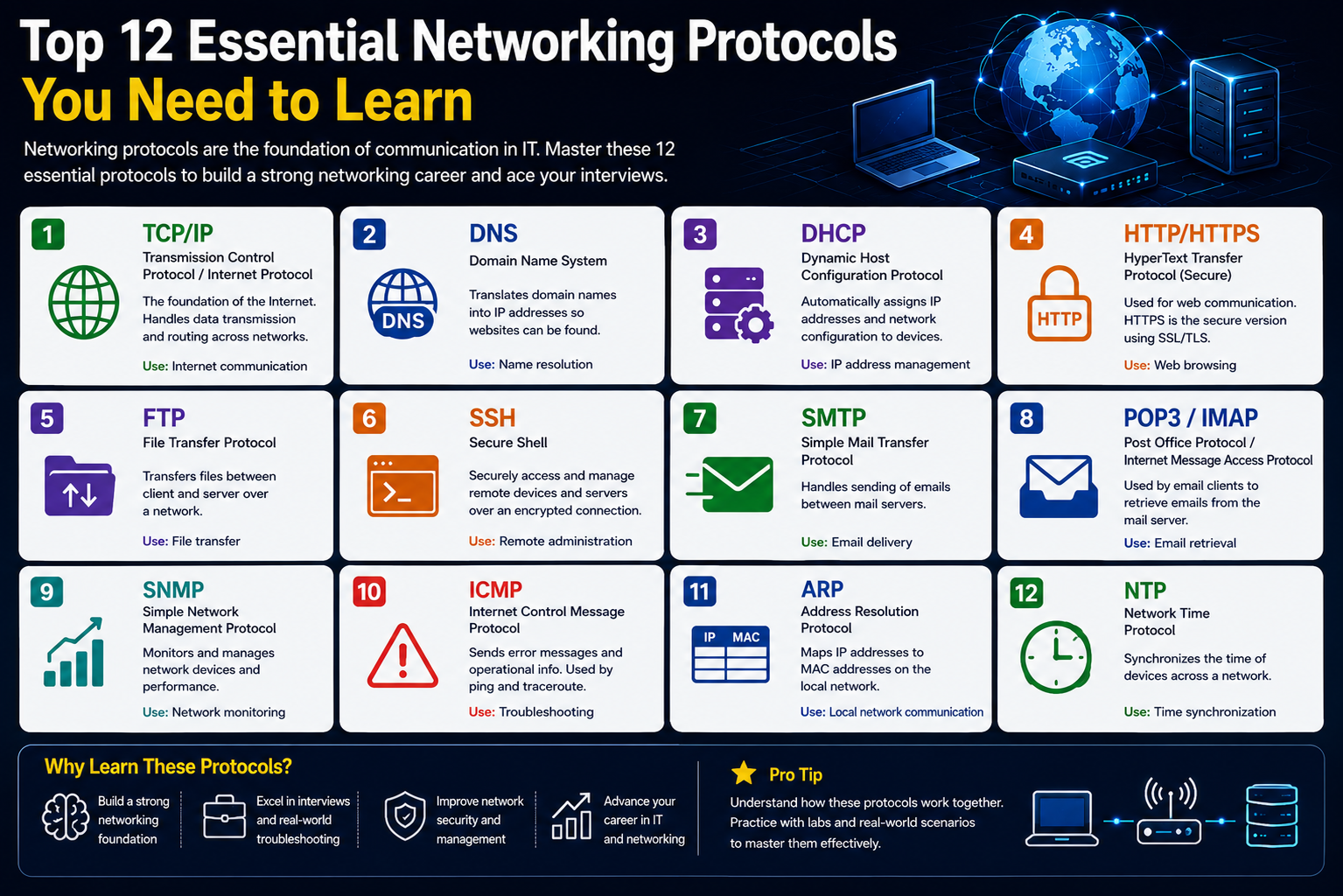
A strong networking foundation forms the backbone of any successful IT career. For beginners and experienced professionals alike, networking can feel overwhelming due to the sheer volume of concepts, technical terminology, and layered architecture involved. However, understanding key networking protocols simplifies how systems communicate, interact, and exchange data across networks. These protocols are not just theoretical concepts; they are practical tools that govern everyday operations within enterprise environments, data centers, and the internet itself. By mastering them, you gain the ability to diagnose issues, optimize performance, and design reliable infrastructures.
Address Resolution Protocol (ARP)
Address Resolution Protocol plays a fundamental role in bridging the gap between Layer 2 and Layer 3 of networking. It is responsible for mapping IP addresses to MAC addresses so devices within the same local network can communicate effectively. When a device wants to send data to another device on the same subnet, it must first discover the destination’s MAC address using ARP. This process involves broadcasting a request and receiving a reply containing the required hardware address.
One of the most important aspects of ARP is caching. Devices store ARP mappings temporarily to avoid repeated lookups, improving efficiency. However, this cache can become outdated or corrupted, leading to communication issues. In many troubleshooting scenarios, clearing the ARP cache resolves connectivity problems quickly. Understanding how ARP behaves in different environments is essential for diagnosing local network issues and identifying anomalies such as spoofing attacks or stale entries that disrupt communication.
Spanning Tree Protocol (STP)
Spanning Tree Protocol is critical for maintaining network stability in switched environments. It prevents loops that can occur when redundant connections exist between switches. Without STP, these loops can cause broadcast storms, overwhelming the network and leading to severe performance degradation or complete outages.
STP works by identifying and disabling redundant paths while keeping them available as backups. If a primary link fails, STP recalculates and activates an alternative path, ensuring continuous connectivity. While this protocol is typically enabled by default on enterprise switches, understanding its behavior is essential. Misconfigurations or delays in convergence can affect network performance, especially in environments with multiple interconnected switches.
Additionally, STP can sometimes interfere with other processes such as DHCP if ports remain in a listening or blocking state for too long. Knowing how to fine-tune STP settings allows administrators to balance loop prevention with efficient network access, especially in modern infrastructures where speed and reliability are equally important.
IEEE 802.1Q
IEEE 802.1Q is a standard that enables VLAN tagging, making it possible to carry multiple virtual LANs over a single physical connection. This innovation transformed network design by allowing segmentation without requiring separate physical links for each network.
By adding a VLAN tag to Ethernet frames, 802.1Q ensures that traffic is properly identified and routed to the correct VLAN. This approach improves scalability, reduces hardware requirements, and enhances network organization. It is especially useful in environments where multiple departments or services must share the same infrastructure while remaining logically separated.
Understanding this standard is crucial for configuring trunk links between switches and ensuring proper communication across VLANs. Without it, network segmentation would become inefficient and costly, requiring additional cables and interfaces for every isolated network.
TCP/IP
The TCP/IP suite is the foundation of modern networking and the internet. It consists of multiple protocols working together across different layers to enable communication between devices. At the network layer, IP handles addressing and routing, ensuring that packets reach their intended destinations. At the transport layer, TCP and UDP provide reliable and connectionless communication options, respectively.
TCP ensures data integrity by establishing connections, retransmitting lost packets, and maintaining order. UDP, on the other hand, prioritizes speed and efficiency, making it suitable for real-time applications such as streaming and voice communication. Alongside these, ICMP plays a diagnostic role, helping identify connectivity issues and measure latency.
A strong grasp of TCP/IP is essential for troubleshooting. Knowing when to use different tools and protocols can help isolate problems related to latency, packet loss, or routing. It also provides insight into how data flows across networks, from local environments to global infrastructures.
HTTP
Hypertext Transfer Protocol operates at the application layer and is widely used for web communication. It defines how clients and servers exchange data, making it the backbone of web browsing and many modern applications.
HTTP is not limited to websites; it is also used in APIs, web services, and various tunneling mechanisms. Understanding how HTTP requests and responses work is valuable when diagnosing performance issues or debugging application errors. Error codes, headers, and payload structures provide important clues about what might be going wrong.
In complex scenarios, issues may not be visible through a browser interface alone. Analyzing HTTP transactions in detail helps uncover hidden problems, such as misconfigured servers or inefficient data handling. This knowledge is especially important in environments where applications rely heavily on web-based communication.
File Transfer Protocol (FTP)
File Transfer Protocol is one of the oldest methods for transferring files across networks. Despite being considered legacy, it is still used in various environments due to its reliability and simplicity. FTP operates using separate control and data channels, which adds complexity to its configuration and troubleshooting.
There are different modes of operation, including active and passive, each affecting how connections are established. Additionally, secure variations using encryption provide safer alternatives for modern use cases. Understanding these differences is essential for ensuring compatibility and security in file transfer operations.
Because of its layered design and multiple connection types, FTP can present unique challenges. Administrators must be familiar with firewall configurations, port usage, and authentication mechanisms to ensure smooth operation.
Network Time Protocol (NTP)
Network Time Protocol ensures that devices across a network maintain accurate and synchronized time. This might seem like a minor detail, but it is crucial for security, logging, and system coordination.
Accurate timestamps are necessary for authentication mechanisms, event correlation, and auditing processes. In secure environments, even small discrepancies in time can cause authentication failures or make logs unreliable. NTP addresses this by synchronizing devices with trusted time sources in a hierarchical structure.
Organizations often implement internal time servers that synchronize with external references, creating a controlled and consistent environment. Understanding how NTP operates helps maintain reliability and ensures that all systems remain aligned in time-sensitive operations.
Internet Group Management Protocol (IGMP)
Internet Group Management Protocol is essential for managing multicast traffic. It allows devices to join or leave multicast groups, enabling efficient distribution of data to multiple recipients simultaneously.
Instead of sending separate streams to each device, multicast allows a single stream to be shared among all interested recipients. IGMP ensures that only devices that request the data receive it, reducing unnecessary traffic and conserving bandwidth.
This protocol is particularly useful for applications such as live video streaming within large organizations. Without IGMP, distributing real-time content to many users would place significant strain on network resources.
Simple Mail Transfer Protocol (SMTP)
Simple Mail Transfer Protocol governs the transmission of email between servers. It has been a standard method for decades and continues to play a vital role in modern communication systems.
SMTP handles the sending and relaying of messages, ensuring they reach their intended destinations. Understanding how it works is helpful for troubleshooting email delivery issues, analyzing message headers, and identifying delays or failures in transmission.
By examining SMTP interactions, administrators can pinpoint where messages are being held up and take corrective actions. This knowledge is especially important in environments where reliable email communication is critical.
Secure Shell (SSH)
Secure Shell provides a secure method for remote access and management of devices. It encrypts communication, protecting sensitive data from interception. Over time, SSH has replaced older, less secure protocols used for remote administration.
It is widely used by system and network administrators to access servers, configure devices, and transfer files securely. SSH sessions typically involve command-line interfaces, offering powerful control over remote systems.
Understanding SSH is essential for managing modern infrastructures. It not only enhances security but also provides flexibility in handling remote operations efficiently.
Border Gateway Protocol (BGP)
Border Gateway Protocol is responsible for routing data between different networks on a global scale. It is a key component of how the internet functions, enabling communication between independent networks.
BGP determines the best paths for data based on various factors, including policies and network conditions. It is commonly used by service providers and large organizations to manage external connectivity and ensure redundancy.
Learning BGP provides insight into how large-scale routing decisions are made. It also helps in designing resilient networks capable of handling multiple connections and optimizing traffic flow.
Open Shortest Path First (OSPF)
Open Shortest Path First is a widely used interior routing protocol designed for efficiency and scalability. It dynamically calculates the best paths within a network, adapting to changes in topology.
OSPF organizes networks into areas, reducing complexity and improving performance. It eliminates the need for manual route configuration, making it ideal for environments that frequently change or expand.
By understanding OSPF, administrators can build networks that automatically adjust to new conditions, ensuring consistent connectivity without extensive manual intervention.
Conclusion
Mastering networking protocols is a crucial step in building a strong IT career. Each protocol serves a specific purpose, contributing to the overall functionality, efficiency, and security of a network. From basic address resolution to complex routing decisions, these protocols work together to enable seamless communication across devices and systems.
As technology continues to evolve, the importance of understanding these foundational concepts only grows. Professionals who invest time in learning and applying these protocols gain the ability to troubleshoot effectively, design robust networks, and adapt to new challenges. Networking is not just a technical skill; it is a critical pillar of modern IT, and a deep understanding of its protocols ensures long-term success in the field.