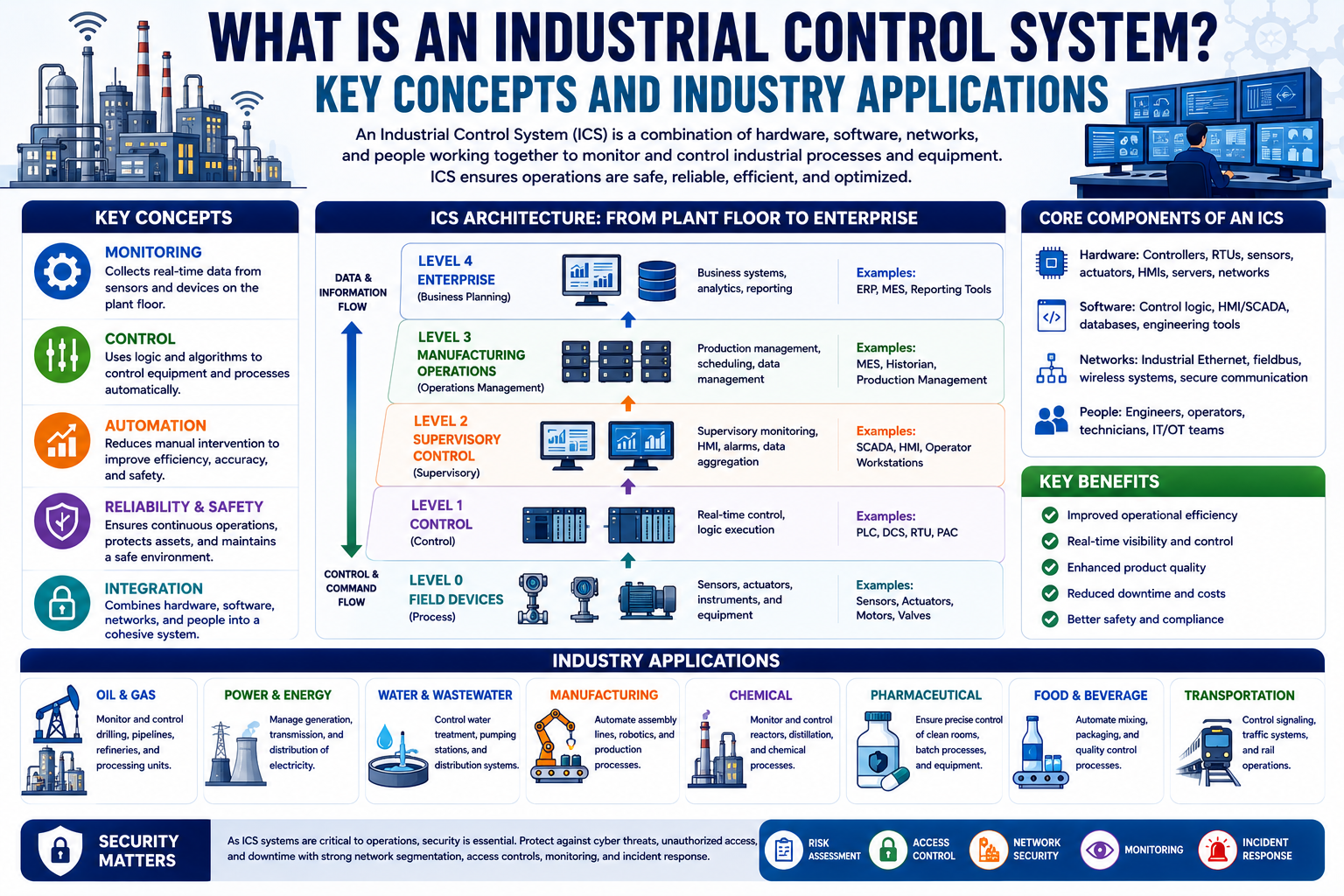
Industrial Control Systems (ICS) are specialized systems designed to monitor, manage, and automate industrial processes. These systems form the backbone of modern industrial operations, enabling machines, equipment, and entire facilities to function with precision, consistency, and minimal human intervention. At their core, ICS bring together hardware and software that work in coordination to control physical processes such as manufacturing, energy production, water treatment, transportation systems, and chemical processing.
In simple terms, an industrial control system acts like the “nervous system” of an industrial environment. It gathers information from sensors, processes that information, and then issues commands to machinery and equipment to maintain safe and efficient operations. For example, in a power plant, an ICS may monitor temperature, pressure, and voltage levels and automatically adjust systems to keep everything operating within safe limits.
Historically, these systems were isolated from business IT networks. They operated independently, using dedicated hardware and closed communication networks. This separation helped protect them from external threats. However, as industries adopted digital transformation and interconnected systems, ICS environments became increasingly integrated with corporate IT networks and even cloud-based platforms. While this integration has improved efficiency and real-time decision-making, it has also introduced new risks, particularly in cybersecurity.
Today, ICS is not limited to heavy industries alone. They are present in nearly every sector of modern infrastructure. From automated assembly lines in factories to traffic control systems in smart cities, ICS quietly operate behind the scenes, ensuring that complex processes run smoothly without constant human supervision.
The Role of Industrial Control Systems in Modern Industry
Industrial Control Systems play a critical role in maintaining continuous operations across a wide range of industries. Their primary purpose is to automate processes that were once manually controlled, reducing human effort while improving accuracy, speed, and reliability.
In manufacturing environments, ICS manages robotic arms, conveyor belts, and assembly lines. These systems ensure that products are assembled consistently and efficiently, reducing production errors and increasing output. In the energy sector, ICS regulates electricity generation and distribution, balancing load demands and preventing overloads in power grids. In water treatment facilities, they monitor chemical levels, filtration processes, and flow rates to ensure safe drinking water.
Transportation systems also rely heavily on ICS. Railways, airports, and traffic control systems use automation to manage schedules, signal systems, and safety operations. Even in sectors like agriculture, ICS are used in automated irrigation systems, climate-controlled greenhouses, and food processing facilities.
What makes ICS especially important is its ability to operate continuously and reliably. Many industrial environments run 24/7, and even a minor disruption can result in significant financial losses or safety risks. ICS helps reduce downtime by detecting issues early and responding automatically before problems escalate.
As industries continue to adopt smart technologies, ICS are becoming more intelligent. They are now capable of collecting vast amounts of operational data, which can be analyzed to improve efficiency, predict maintenance needs, and optimize performance over time.
Core Functions of Industrial Control Systems
The functionality of Industrial Control Systems revolves around three primary activities: monitoring, control, and automation. Each of these functions works together to ensure smooth industrial operations.
Monitoring involves collecting real-time data from sensors installed across industrial equipment. These sensors measure variables such as temperature, pressure, speed, humidity, and electrical output. The collected data is continuously sent to a central system for analysis.
Control refers to the system’s ability to adjust operations based on the data it receives. If a machine exceeds safe temperature levels, the ICS can automatically reduce its speed or shut it down entirely. This prevents damage to equipment and ensures worker safety.
Automation is the process of executing tasks without human intervention. Once configured, ICS can manage entire production processes automatically, from starting machines to adjusting production rates and handling shutdown procedures.
Together, these functions create a highly efficient environment where human operators focus more on supervision and decision-making rather than manual control of machinery. This shift has significantly improved productivity across industries while reducing operational errors.
Key Types of Industrial Control Systems
Industrial Control Systems are not a single unified technology but rather a collection of different systems designed for specific operational needs. The most common types include Supervisory Control and Data Acquisition systems, Distributed Control Systems, Programmable Logic Controllers, and Human-Machine Interfaces.
Each of these systems serves a unique role within industrial environments, and in many cases, they work together as part of a larger integrated control network.
Supervisory Control and Data Acquisition (SCADA) Systems
SCADA systems are used to monitor and control large-scale industrial operations spread across wide geographical areas. They are especially common in industries such as oil and gas pipelines, electric power grids, and water distribution networks.
A SCADA system collects data from remote locations using sensors and sends it to a central control system. Operators can then view this data in real time and make informed decisions. For example, if a pipeline pressure drops unexpectedly, the SCADA system can alert operators immediately so they can take corrective action.
One of the key advantages of SCADA systems is their ability to provide centralized control over distributed assets. This means operators do not need to be physically present at every site to manage operations. Instead, they can monitor and control everything from a central control room.
SCADA systems have evolved significantly over time. Early versions were standalone systems with limited connectivity. Modern SCADA systems are now networked and often integrated with corporate IT systems, enabling advanced analytics and remote access capabilities. However, this increased connectivity also introduces cybersecurity challenges that must be carefully managed.
Distributed Control Systems (DCS)
Distributed Control Systems are used primarily in large, complex industrial processes that require continuous and precise control. Unlike SCADA systems, which focus on wide-area monitoring, DCS are typically used within a single facility such as a chemical plant or refinery.
In a DCS, control functions are distributed across multiple controllers located throughout the facility. Each controller manages a specific part of the process, while a central system oversees overall coordination. This distributed approach improves reliability because even if one controller fails, other parts of the system can continue operating.
DCS is highly effective in environments where processes must remain stable over long periods. For example, in a petroleum refinery, maintaining consistent pressure and temperature is essential for safe and efficient production. DCS helps ensure these conditions are maintained automatically.
Another advantage of DCS is scalability. As industrial operations grow, additional controllers can be added without disrupting existing systems. This makes DCS ideal for large-scale industrial environments with complex workflows.
Programmable Logic Controllers (PLCs)
Programmable Logic Controllers are rugged industrial computers designed to control machinery and equipment. They are widely used in manufacturing, assembly lines, and automated production systems.
PLCs receive input from sensors and execute pre-programmed instructions to control machines. For example, in an automated packaging line, a PLC might detect when a product reaches a certain point on a conveyor belt and then trigger a robotic arm to package it.
One of the main strengths of PLCs is their reliability. They are built to withstand harsh industrial environments, including extreme temperatures, vibrations, and electrical noise. This makes them ideal for factory settings where standard computers would fail.
PLCs are also highly flexible. Engineers can program them to perform a wide variety of tasks, from simple on/off operations to complex sequential control processes. In many industrial systems, multiple PLCs work together to manage different sections of a production line.
Human-Machine Interfaces (HMI)
Human-Machine Interfaces provide the visual and interactive layer between operators and industrial systems. They allow humans to monitor and control industrial processes through graphical displays, dashboards, and control panels.
Through an HMI, operators can view real-time data, receive alerts, and issue commands to machinery. For example, an operator in a control room can use an HMI screen to monitor the status of multiple machines, adjust settings, or respond to system alarms.
HMIs simplify complex industrial data by presenting it in a clear and understandable format. Instead of interpreting raw sensor data, operators can view charts, graphs, and visual indicators that show system performance at a glance.
Modern HMIs are often touch-based and highly interactive, making them easier to use and more efficient for industrial operators. They also play a crucial role in improving response times during system failures or emergencies.
How Industrial Control Systems Work Together
In most industrial environments, ICS components do not operate in isolation. Instead, they work together as part of a unified system. PLCs handle local control tasks, DCS manage complex process coordination, SCADA provides centralized monitoring, and HMIs allow human interaction.
This layered architecture ensures that industrial processes remain efficient, reliable, and responsive. Data flows continuously between sensors, controllers, and operator interfaces, enabling real-time decision-making.
For example, in a manufacturing plant, sensors collect data from machines and send it to PLCs. The PLCs execute control commands and send updates to a SCADA system. Operators view this information through HMIs and can intervene if necessary. This interconnected structure allows for seamless automation and control across the entire facility.
As industries continue to modernize, ICS are becoming more integrated with advanced technologies such as cloud computing, artificial intelligence, and predictive analytics. This evolution is transforming industrial operations into highly intelligent and adaptive systems capable of self-optimization.
The Growing Importance of ICS in a Connected World
With the rise of digital transformation, Industrial Control Systems have become more connected than ever before. This connectivity has enabled greater efficiency, remote monitoring, and data-driven decision-making. However, it has also increased exposure to potential disruptions.
Modern industries rely heavily on ICS to maintain essential services. A failure in these systems can have widespread consequences, affecting energy supply, transportation, manufacturing, and public safety. As a result, ICS are now considered a critical part of the national infrastructure in many countries.
The growing importance of ICS means that organizations must carefully balance efficiency with security and reliability. While integration with modern IT systems brings significant benefits, it also requires careful design to ensure operational stability and resilience in complex industrial environments.
Industrial Control System Architecture in Depth
Industrial Control Systems are not built as single-layer systems. Instead, they are designed using a layered architecture that separates responsibilities across different levels of operation. This structured approach allows complex industrial environments to remain organized, scalable, and easier to manage.
At the most basic level, ICS architecture is often divided into field level, control level, supervisory level, and enterprise level. Each of these layers has a specific function and works in coordination with the others to ensure the smooth operation of industrial processes.
The field level is where physical processes actually occur. This includes sensors, actuators, motors, valves, and other equipment that directly interact with industrial machinery. These devices collect real-world data such as temperature, pressure, flow rate, and speed, and also execute physical actions based on control commands.
Above the field level is the control level. This is where Programmable Logic Controllers (PLCs) and Remote Terminal Units (RTUs) operate. These devices process data received from field devices and execute automated control actions. For example, if a sensor detects excessive pressure in a pipeline, a PLC may trigger a valve to release pressure automatically.
The supervisory level is where systems like SCADA and Human-Machine Interfaces (HMI) operate. This level provides monitoring, visualization, and centralized control. Operators can observe system performance, respond to alarms, and adjust system parameters when necessary.
At the top is the enterprise level, which connects industrial systems to business networks. This level integrates operational data with enterprise resource planning systems, analytics platforms, and decision-making tools. It allows organizations to analyze industrial performance in the context of business goals, such as cost efficiency, production targets, and resource optimization.
This layered structure ensures separation of responsibilities, but modern ICS environments often blur these boundaries due to increasing integration and connectivity.
Convergence of Operational Technology and Information Technology
One of the most significant transformations in industrial environments is the convergence of Operational Technology (OT) and Information Technology (IT). Traditionally, OT systems focused on controlling physical processes, while IT systems handled data processing, communication, and business applications.
In earlier industrial setups, these two domains were completely separate. OT systems were isolated to ensure stability and safety, while IT systems were connected to corporate networks and external communication channels. However, with the rise of digital transformation, industries began integrating these systems to improve efficiency and decision-making.
This convergence has enabled real-time data exchange between production environments and business systems. For example, production data collected by ICS can now be analyzed in enterprise systems to optimize supply chains, reduce waste, and improve forecasting accuracy.
However, this integration also introduces complexity. IT systems are typically designed for flexibility and data sharing, while OT systems prioritize stability and safety. Combining these two environments requires careful planning to ensure that industrial operations are not disrupted by external network issues or software changes.
One of the key challenges in OT-IT convergence is maintaining operational continuity while enabling secure communication between systems. Industrial environments often implement strict segmentation strategies to ensure that critical control systems remain protected even when connected to broader networks.
Industrial Communication Protocols and Their Role
Communication protocols are essential for enabling data exchange between devices in Industrial Control Systems. These protocols define how information is transmitted, interpreted, and acted upon across different components.
One of the most widely used protocols in industrial environments is Modbus. Originally developed for simple communication between controllers and devices, Modbus remains popular due to its simplicity and reliability. It allows devices to exchange data in a structured format, making it suitable for basic industrial control tasks.
Another important protocol is DNP3, which is commonly used in utility industries such as electricity and water distribution. DNP3 is designed for reliable communication over long distances and is capable of handling interruptions in network connectivity. It ensures that critical data is delivered even in unstable communication environments.
In more modern systems, OPC Unified Architecture (OPC UA) plays a key role in enabling interoperability between different devices and platforms. Unlike older protocols, OPC UA is designed with security and scalability in mind. It supports complex data structures and allows seamless integration between industrial and enterprise systems.
PROFINET is another widely used protocol, especially in manufacturing environments. It is based on Ethernet technology and provides high-speed communication between controllers, sensors, and actuators. This makes it suitable for time-sensitive industrial applications.
Each of these protocols serves a specific purpose, and in many industrial environments, multiple protocols operate simultaneously. This creates a diverse communication ecosystem that must be carefully managed to ensure compatibility and security.
Real-Time Data Processing in Industrial Systems
Industrial Control Systems rely heavily on real-time data processing to maintain operational efficiency. Unlike traditional IT systems that can tolerate delays, ICS environments require immediate responses to changing conditions.
Real-time processing begins with data acquisition from sensors distributed across industrial equipment. This data is continuously transmitted to controllers, where it is analyzed and processed within milliseconds. Based on this analysis, control decisions are made instantly to adjust system behavior.
For example, in a chemical processing plant, even a slight delay in temperature control can lead to unsafe conditions. Real-time processing ensures that corrective actions are taken immediately, preventing potential hazards.
To achieve this level of responsiveness, ICS systems use specialized hardware and optimized software designed for low-latency performance. These systems are engineered to prioritize critical control tasks over less important processes, ensuring that essential operations are never delayed.
Real-time data processing also enables predictive capabilities. By continuously analyzing trends and patterns, industrial systems can anticipate potential failures and take preventive actions before issues occur. This improves reliability and reduces downtime.
Industrial Network Topologies and Communication Design
The structure of industrial networks plays a crucial role in determining system reliability and performance. Unlike standard IT networks, industrial networks are designed with a strong emphasis on fault tolerance, redundancy, and deterministic communication.
Several network topologies are commonly used in ICS environments. The star topology connects all devices to a central hub, allowing centralized control but creating a single point of failure. The ring topology connects devices in a circular structure, providing redundancy by allowing data to flow in multiple directions.
Mesh topologies are often used in highly critical environments where multiple communication paths are required. This ensures that even if one connection fails, data can still reach its destination through alternative routes.
In addition to physical topology, network segmentation is an important design principle. Industrial networks are often divided into zones based on function and criticality. This segmentation helps isolate critical control systems from less secure or less important network areas.
Deterministic communication is another key requirement in industrial networks. Unlike traditional networks, where data transmission may vary in timing, ICS networks must ensure predictable communication to maintain synchronization between devices.
Edge Computing in Industrial Control Systems
Edge computing has become an important development in modern industrial environments. It involves processing data closer to the source of generation rather than sending it to centralized systems for analysis.
In traditional ICS architectures, data from sensors is transmitted to central control systems for processing. However, this can introduce delays and increase network load. Edge computing addresses this issue by enabling local processing at or near the device level.
For example, an intelligent sensor in a manufacturing plant can analyze data locally and make immediate decisions without waiting for instructions from a central system. This reduces latency and improves responsiveness.
Edge computing also enhances reliability. Even if communication with central systems is disrupted, local devices can continue operating independently. This is particularly important in environments where continuous operation is critical.
Another advantage of edge computing is reduced bandwidth usage. By processing data locally, only relevant or summarized information is sent to central systems, reducing network congestion.
As industrial environments continue to evolve, edge computing is becoming an essential part of ICS architecture, especially in combination with advanced analytics and artificial intelligence.
Industrial Internet of Things and Smart Systems Integration
The Industrial Internet of Things (IIoT) represents the expansion of connected devices within industrial environments. It involves embedding sensors, communication modules, and processing capabilities into industrial equipment to enable smarter operations.
IIoT devices collect vast amounts of data from machines and processes, enabling more detailed monitoring and analysis. This data can be used to improve efficiency, optimize maintenance schedules, and enhance production quality.
One of the key benefits of IIoT integration is improved visibility. Operators can gain real-time insights into every aspect of industrial operations, from machine performance to environmental conditions.
IIoT also enables predictive maintenance. By analyzing data trends, systems can predict when equipment is likely to fail and schedule maintenance before breakdowns occur. This reduces downtime and extends equipment lifespan.
However, increased connectivity also introduces additional complexity in managing and securing industrial systems. Each connected device becomes a potential entry point that must be protected.
Reliability Engineering and Redundancy in Industrial Systems
Reliability is one of the most critical requirements in Industrial Control Systems. Industrial environments often operate continuously, and even brief interruptions can lead to significant losses.
To ensure reliability, ICS are designed with redundancy at multiple levels. This includes redundant controllers, backup power supplies, duplicate communication paths, and failover systems.
If one component fails, another takes over immediately without interrupting operations. This ensures continuous system availability even in the event of hardware or software failures.
Reliability engineering also involves careful system design and testing. Engineers simulate failure scenarios to ensure that systems respond correctly under stress conditions. This helps identify weaknesses before systems are deployed in real-world environments.
Another important aspect of reliability is system monitoring. Continuous monitoring allows operators to detect early signs of failure and take corrective action before problems escalate.
Safety Instrumented Systems and Emergency Controls
In many industrial environments, safety is just as important as productivity. Safety Instrumented Systems (SIS) are designed specifically to prevent hazardous conditions and protect both equipment and personnel.
SIS operates independently from the main control systems and is activated when dangerous conditions are detected. For example, if pressure in a chemical reactor exceeds safe limits, the SIS can automatically shut down the system to prevent an explosion.
Emergency shutdown systems (ESD) are another critical component of industrial safety. These systems are designed to bring industrial processes to a safe state in case of emergencies such as equipment failure, fire, or operator error.
Safety systems are typically designed with strict reliability requirements and are tested regularly to ensure proper functioning. They operate independently to ensure that safety functions are not affected by failures in other parts of the system.
Lifecycle Management of Industrial Control Systems
Industrial Control Systems undergo a long lifecycle that includes design, installation, operation, maintenance, and eventual replacement. Proper lifecycle management is essential to ensure long-term reliability and efficiency.
During the design phase, engineers plan system architecture, select appropriate technologies, and define control strategies. Installation involves setting up hardware, configuring software, and integrating all system components.
The operational phase is the longest stage, during which the system performs its intended functions. During this phase, continuous monitoring and optimization are required to maintain performance.
Maintenance includes both preventive and corrective actions. Preventive maintenance focuses on regular inspections and updates to prevent failures, while corrective maintenance addresses issues after they occur.
Eventually, systems reach the end of their lifecycle and must be upgraded or replaced. This transition must be carefully managed to avoid disruptions in industrial operations.
Cybersecurity Threat Landscape in Industrial Control Systems
Industrial Control Systems operate at the heart of critical infrastructure, which makes them highly attractive targets for cyber threats. Unlike traditional IT systems, where the main concern is data theft, ICS environments face risks that can directly impact physical processes, safety, and national infrastructure stability. This shift from digital-only consequences to real-world physical effects is what makes ICS cybersecurity uniquely important.
Modern threat actors target ICS for a variety of reasons. Some are financially motivated, seeking ransom payments by disrupting industrial operations. Others may be politically motivated, aiming to destabilize essential services such as energy grids, water supply systems, or transportation networks. There are also state-sponsored groups that conduct long-term espionage or sabotage campaigns against critical infrastructure.
The threat landscape has evolved significantly as ICS environments have become more connected to corporate IT systems and external networks. Previously isolated systems are now exposed to the internet indirectly through remote access tools, vendor connections, and integrated data systems. This connectivity has increased efficiency but also expanded the attack surface.
One of the most dangerous aspects of ICS cybersecurity threats is that attackers often do not need to directly compromise industrial equipment. Instead, they exploit weaknesses in supporting systems such as engineering workstations, remote access gateways, or third-party software platforms. Once inside the network, they can move laterally toward critical control systems.
Common Attack Vectors Targeting Industrial Systems
Industrial environments are exposed to a variety of attack vectors, each exploiting different weaknesses in system design, configuration, or human behavior. Understanding these attack paths is essential for developing effective defense strategies.
One of the most common attack vectors is phishing. Industrial operators, engineers, and administrators may receive malicious emails designed to trick them into revealing credentials or downloading infected files. Once attackers gain access to a user account, they can move deeper into the network.
Another significant vector is remote access exploitation. Many industrial systems rely on remote connectivity for maintenance and monitoring. If these access points are not properly secured, attackers can exploit weak authentication mechanisms or outdated software to gain entry.
Supply chain attacks are also increasingly common. In these scenarios, attackers compromise third-party vendors or software providers to infiltrate industrial networks indirectly. Since industrial systems often rely on trusted vendor updates and services, this type of attack can be extremely difficult to detect.
USB and removable media infections remain a serious concern in isolated or semi-isolated environments. Malicious code introduced through physical devices can bypass network defenses entirely and spread within internal systems.
Misconfigured systems, weak passwords, and unpatched vulnerabilities also provide entry points for attackers. In many cases, industrial environments operate for long periods without updates due to operational constraints, increasing exposure to known vulnerabilities.
Advanced Persistent Threats in Industrial Environments
Advanced Persistent Threats (APTs) represent one of the most sophisticated and dangerous forms of cyberattacks targeting industrial systems. These threats are typically carried out by highly skilled attackers who maintain long-term access to networks while remaining undetected.
APTs are not focused on immediate disruption. Instead, they aim to infiltrate systems quietly, gather intelligence, and gradually move toward critical assets. In industrial environments, this can involve monitoring production processes, mapping network architecture, or identifying weaknesses in control systems.
Once inside, attackers may remain dormant for extended periods before launching a targeted attack. This delayed action makes detection extremely difficult because normal operations continue without visible disruption.
APTs often use multiple stages of compromise. They begin with initial access through phishing or supply chain vulnerabilities, followed by lateral movement across IT and OT networks. Eventually, they reach industrial control systems where they can manipulate processes or extract sensitive operational data.
The complexity of these attacks requires equally sophisticated defense mechanisms. Traditional security tools are often insufficient because APTs are designed to evade detection and blend into normal network activity.
Malware and Ransomware Targeting ICS
Malware specifically designed for industrial environments has become more advanced in recent years. Unlike traditional malware that focuses on data theft or system disruption, ICS-targeted malware is designed to manipulate physical processes.
One of the most well-known examples of industrial malware is Stuxnet, which demonstrated how malicious software could directly affect physical machinery. It targeted programmable logic controllers and altered their behavior while masking its activity from operators.
Since then, more advanced malware variants have emerged. Some are designed to sabotage industrial processes, while others focus on data manipulation or system disruption.
Ransomware has also become a major threat to industrial systems. In these attacks, malicious actors encrypt critical operational data or lock control systems, demanding payment for restoration. In industrial environments, even short periods of downtime can result in significant financial and operational losses, making these attacks particularly effective.
What makes ICS ransomware especially dangerous is its ability to spread into operational networks. Once inside, it can disrupt both IT systems and industrial processes, creating widespread impact across an organization.
Insider Threats in Industrial Control Environments
While external attackers receive most of the attention, insider threats represent a significant risk in industrial environments. These threats originate from individuals who already have authorized access to systems, such as employees, contractors, or vendors.
Insider threats can be intentional or accidental. In intentional cases, individuals may misuse their access for personal gain, sabotage operations, or assist external attackers. In accidental cases, employees may unknowingly introduce vulnerabilities through misconfigurations or unsafe practices.
One of the main challenges with insider threats is that insiders already have legitimate access credentials. This makes it difficult to distinguish malicious activity from normal operations.
Industrial environments often rely on role-based access controls to limit exposure. However, complex operational requirements sometimes lead to broader access privileges than necessary, increasing risk.
Monitoring and auditing user activity is essential for detecting unusual behavior. Sudden changes in system configuration, unauthorized access attempts, or unusual data transfers can indicate potential insider threats.
Network Segmentation and Defense Architecture
Network segmentation is one of the most important defensive strategies in industrial cybersecurity. It involves dividing a network into separate zones based on function and security requirements.
In industrial environments, segmentation typically separates corporate IT systems from operational technology systems. This separation helps prevent attackers from moving freely between business networks and critical control systems.
Within industrial networks, additional segmentation is often implemented to isolate different production areas or process control zones. This ensures that a compromise in one area does not automatically affect the entire system.
Defense-in-depth architecture is another key concept. Instead of relying on a single layer of security, multiple layers of protection are implemented across the network. These layers may include firewalls, intrusion detection systems, access controls, and monitoring tools.
The goal of segmentation and layered defense is to slow down attackers, limit their movement, and increase the chances of detection before critical systems are compromised.
Role of Monitoring and Intrusion Detection in ICS Security
Continuous monitoring plays a vital role in protecting industrial systems from cyber threats. Unlike traditional IT environments, where minor delays may be acceptable, industrial environments require immediate detection of anomalies to prevent physical damage.
Intrusion detection systems are used to monitor network traffic and identify suspicious behavior. These systems analyze communication patterns between devices and flag deviations from normal activity.
In industrial environments, behavioral analysis is particularly important. Instead of focusing solely on known attack signatures, modern detection systems monitor how devices typically behave and alert operators when unusual activity occurs.
For example, if a PLC suddenly receives commands outside its normal operational range, this may indicate a potential compromise. Similarly, unexpected data transfers between systems that normally do not communicate can signal lateral movement by an attacker.
Monitoring also extends to system logs, user activity, and device performance. By correlating information from multiple sources, security teams can identify subtle indicators of compromise.
Incident Response in Industrial Control Systems
Incident response in industrial environments is significantly more complex than in traditional IT systems. This is because any disruption can affect physical processes, safety, and production continuity.
An effective incident response strategy begins with the rapid detection and identification of the issue. Once a potential incident is detected, the priority is to assess its impact on industrial operations.
Containment is the next critical step. This may involve isolating affected systems, disconnecting network segments, or switching to manual control modes. The goal is to prevent the spread of the incident while maintaining safe operations.
After containment, recovery procedures are initiated. This includes restoring systems from backups, repairing compromised components, and verifying system integrity before returning to normal operations.
Post-incident analysis is also essential. Understanding how the incident occurred helps organizations strengthen defenses and prevent similar attacks in the future.
Industrial incident response must also consider safety implications. In some cases, maintaining physical safety may take priority over restoring system functionality.
Human Factors in ICS Security
Human factors play a crucial role in industrial cybersecurity. Even the most advanced technical defenses can be undermined by poor security practices, lack of awareness, or operational shortcuts.
Training and awareness are essential components of a strong security posture. Employees must understand the risks associated with industrial systems and follow proper procedures when handling sensitive operations.
One common issue in industrial environments is the use of shared credentials or weak password practices. This often occurs due to operational convenience but significantly increases security risk.
Another challenge is balancing security with operational efficiency. Industrial operators may prioritize speed and productivity over strict security protocols, leading to potential vulnerabilities.
Social engineering attacks also exploit human behavior. Attackers may impersonate trusted personnel or vendors to gain access to systems or sensitive information.
Building a strong security culture is essential for reducing human-related risks. This involves continuous training, clear policies, and consistent enforcement of security practices.
Emerging Technologies and the Future of ICS Security
Industrial Control Systems are evolving rapidly with the adoption of new technologies such as artificial intelligence, machine learning, and advanced analytics. These technologies are transforming how industrial environments operate and how security is managed.
Artificial intelligence is increasingly used for predictive maintenance, anomaly detection, and process optimization. By analyzing large volumes of data, AI systems can identify patterns that indicate potential failures or security threats.
Machine learning models can also improve cybersecurity by learning normal system behavior and detecting deviations in real time. This helps identify unknown or emerging threats that traditional systems might miss.
Cloud integration is another major trend. Many industrial systems now use cloud platforms for data storage, analytics, and remote monitoring. While this improves scalability and accessibility, it also introduces new security challenges.
Edge computing, combined with IoT expansion, is making industrial systems more decentralized. This distributed architecture improves efficiency but requires stronger coordination between devices and security systems.
As industrial systems become more intelligent and interconnected, the importance of robust security frameworks continues to grow.
Industrial Control System Hardening Techniques
Strengthening the security and reliability of Industrial Control Systems requires a set of focused hardening techniques that go beyond basic configuration practices. System hardening in industrial environments is about reducing vulnerabilities, limiting unnecessary functionality, and creating a stable operational baseline that is difficult for attackers to disrupt.
One of the most important hardening practices is disabling unused services and ports. Many industrial devices come with default features enabled that are not required for actual operations. These unnecessary services can become entry points for attackers if left active. By carefully auditing and disabling them, organizations significantly reduce exposure.
Another key technique involves enforcing strict configuration baselines. Once an ICS device or controller is configured and tested, its settings should be locked to prevent unauthorized changes. Any modifications must follow controlled change management procedures to ensure that operational integrity is maintained.
Firmware and software validation are also essential. Industrial systems often rely on embedded firmware that controls critical functions. Ensuring that only verified and digitally signed firmware updates are applied helps prevent malicious modifications from being introduced into control systems.
Access control hardening is equally important. Industrial environments should implement the principle of least privilege, ensuring that users only have access to the systems and functions necessary for their roles. This minimizes the risk of accidental misconfigurations and reduces the impact of compromised accounts.
Network-level hardening further strengthens ICS security. This includes implementing strict firewall rules between network zones, restricting communication paths, and monitoring all traffic entering and leaving critical control segments. Industrial networks should also avoid direct exposure to external networks unless necessary.
Another important aspect is device authentication. Every component within an industrial network should be uniquely identifiable and authenticated before communication is allowed. This prevents unauthorized devices from connecting to critical systems and helps maintain system integrity.
Finally, continuous validation and testing are essential. Industrial environments must regularly simulate failure scenarios, security breaches, and system overload conditions to ensure that hardened configurations remain effective under real-world stress.
Together, these hardening techniques create a more resilient industrial environment that can better withstand both operational failures and evolving cyber threats.
Conclusion
Industrial Control Systems have become the backbone of modern industrial operations, quietly managing the processes that power essential services such as energy production, water treatment, manufacturing, transportation, and critical infrastructure. As industries continue to evolve toward greater automation and digital integration, these systems have grown far more complex, interconnected, and intelligent than ever before.
What makes ICS especially important is its direct connection to the physical world. Unlike traditional information systems that primarily handle data, industrial control systems influence real-world processes. A small change in a control parameter can affect production output, equipment behavior, or even public safety. This close relationship between digital commands and physical outcomes makes reliability and precision essential at every level of design and operation.
At the same time, the increasing integration of ICS with corporate networks, cloud platforms, and remote access technologies has introduced new layers of exposure. While connectivity improves efficiency, monitoring, and decision-making, it also expands the potential attack surface. As a result, cybersecurity has become a central concern in industrial environments, requiring constant vigilance, layered defenses, and adaptive security strategies.
Another key takeaway is that ICS environments are not just technical systems—they are also human systems. Operators, engineers, administrators, and vendors all play a role in maintaining safe and efficient operations. This means that training, awareness, and disciplined operational practices are just as important as hardware and software protections.
Looking ahead, the future of Industrial Control Systems will likely be shaped by advanced technologies such as artificial intelligence, edge computing, and intelligent automation. These innovations will continue to improve efficiency and predictive capabilities, but they will also demand even stronger security frameworks and more sophisticated risk management approaches.
Ultimately, the strength of an industrial system lies in its ability to balance performance, safety, and security. Organizations that invest in resilient architectures, strong operational practices, and continuous monitoring will be better positioned to protect critical infrastructure and ensure uninterrupted services in an increasingly connected world.