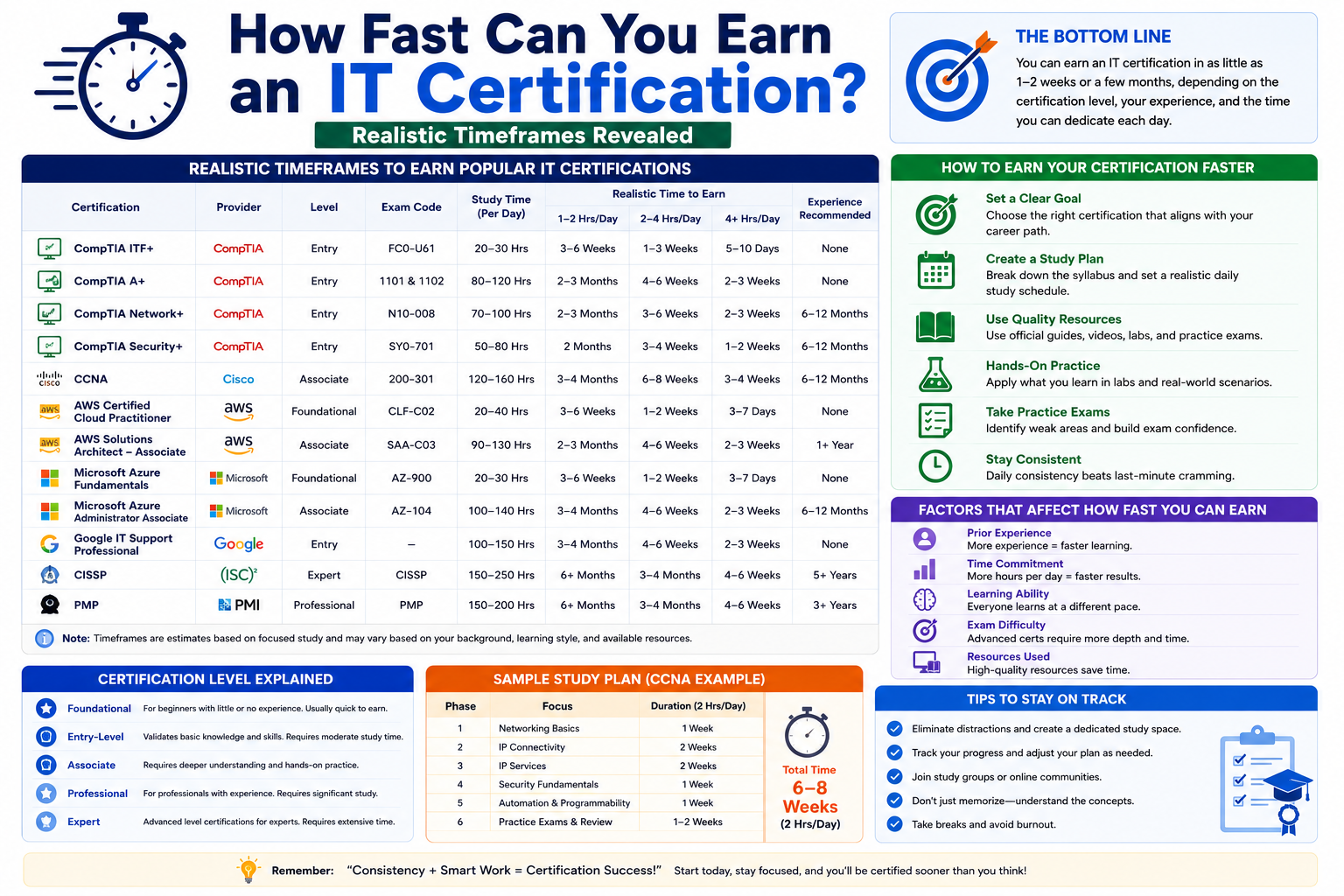
The time required to earn an IT certification is not a fixed number that applies equally to everyone. Instead, it is shaped by a combination of personal, professional, and situational factors that make each learner’s journey unique. Some individuals may complete preparation in a matter of weeks, while others may need several months to feel confident enough to take an exam. This variation is completely normal and reflects the nature of learning technical skills in a structured but flexible environment.
One of the most important reasons timelines vary is the depth of knowledge required for different certifications. Some exams focus on foundational concepts such as basic networking, cloud awareness, or general IT literacy. These tend to require less time because they introduce concepts at a beginner level. Other certifications, however, demand a deeper understanding of system architecture, security frameworks, or advanced troubleshooting. Naturally, these require longer preparation periods because learners must not only memorize concepts but also understand how they apply in real-world scenarios.
Another factor influencing study duration is the structure of the exam itself. Certifications that cover a wide range of topics often take longer to prepare for than those that focus on a narrow skill set. A broad exam might require candidates to understand multiple domains such as networking, security, storage, automation, and compliance, all within a single test. This breadth increases the time needed for revision and practice.
Psychological factors also play a role. Confidence, stress levels, and study consistency can all affect how quickly someone progresses. Some learners perform best under structured deadlines, while others benefit from a more flexible approach. The amount of time available each day or week for study also significantly shapes the overall timeline.
Ultimately, certification timelines are not just about difficulty. They are about alignment between knowledge, practice, and readiness. Understanding this variability helps learners set realistic expectations and avoid unnecessary pressure during their preparation journey.
The Role of Prior Experience in Study Duration
One of the strongest predictors of how long it takes to earn an IT certification is prior experience. Individuals who already work in IT or have hands-on exposure to relevant technologies often progress more quickly through exam preparation. This is because they are not starting from zero; instead, they are building on existing knowledge and practical understanding.
For example, someone working in a network support role may already be familiar with routing, switching, and troubleshooting concepts. When preparing for a networking certification, they can focus more on refining their understanding and filling knowledge gaps rather than learning everything from scratch. This can significantly reduce the overall study time required.
On the other hand, beginners entering the IT field without prior experience face a steeper learning curve. They must first understand basic terminology, system interactions, and foundational principles before even beginning exam-focused preparation. This naturally extends the timeline, as early study sessions are often spent building a conceptual base rather than memorizing exam objectives.
Experience also affects how quickly learners can interpret complex scenarios. Many IT exams are designed to test applied knowledge rather than simple recall. Candidates are often asked to solve problems, analyze system behavior, or choose the best solution among several correct answers. Those with real-world experience tend to recognize these patterns more easily because they have encountered similar situations in practice.
However, experience alone does not guarantee fast preparation. Even seasoned professionals may need additional time when entering a new domain. For instance, someone experienced in networking may still require several months to prepare for a cloud security certification because the concepts and tools differ significantly from their daily work.
Another important aspect of experience is familiarity with exam formats. Individuals who have taken multiple certifications in the past often develop efficient study habits. They understand how to interpret exam objectives, identify key topics, and manage revision time effectively. This familiarity reduces the learning curve for future certifications and shortens preparation cycles.
Ultimately, prior experience acts as an accelerator, but it does not eliminate the need for structured study. It simply shifts the focus from learning fundamentals to refining and applying knowledge.
Entry-Level Certifications and Short Preparation Cycles
Entry-level certifications are designed to provide foundational knowledge in information technology. These certifications typically target beginners or individuals with limited experience in the field. Because of this, they are structured to be more accessible and require shorter preparation periods compared to advanced certifications.
Most entry-level certifications focus on core concepts such as basic networking, operating systems, cloud fundamentals, and introductory cybersecurity principles. The goal is to build a strong foundation rather than test deep technical expertise. As a result, the study material is often more straightforward to digest.
For many learners, entry-level certifications can be completed within a relatively short timeframe, especially if they dedicate consistent study hours each week. The preparation process usually involves understanding key definitions, familiarizing oneself with basic tools and technologies, and practicing simple scenario-based questions.
One of the advantages of these certifications is that they help learners develop structured study habits early in their careers. Since the material is not overly complex, individuals can focus on building discipline, time management skills, and confidence in taking exams. These habits become valuable when progressing to more advanced certifications later on.
However, even though entry-level certifications are considered easier, they should not be underestimated. Many candidates make the mistake of assuming that minimal preparation is enough simply because the content appears basic. In reality, exams often include questions that test conceptual understanding rather than memorization.
Another important factor influencing preparation time at this level is familiarity with technology. Someone who already uses computers, understands basic networking concepts, or has experimented with cloud platforms may progress faster than someone encountering these topics for the first time. This difference can significantly affect study timelines.
Entry-level certifications also serve as a gateway to more specialized fields. They help learners identify areas of interest such as networking, cybersecurity, cloud computing, or system administration. As a result, the time invested in these certifications is not only about passing an exam but also about shaping future career direction.
Intermediate Certifications and Moderate Study Windows
Intermediate certifications represent a significant step up in complexity compared to entry-level exams. They are designed for individuals who already have some practical experience or foundational knowledge and are ready to deepen their expertise in specific IT domains.
These certifications often require a more structured and disciplined study approach. Unlike entry-level exams, which focus on basic concepts, intermediate certifications involve more detailed technical topics, practical scenarios, and problem-solving skills. This naturally increases the amount of time needed for preparation.
One of the key characteristics of intermediate certifications is their focus on application rather than theory alone. Candidates are expected to understand how systems interact, how to troubleshoot issues, and how to configure or manage technologies in real-world environments. This requires both conceptual understanding and hands-on practice.
The study timeline for intermediate certifications is typically longer because learners must spend time building practical familiarity with tools and systems. Reading theoretical material alone is not sufficient; practice labs, simulations, and scenario-based learning become essential components of preparation.
Another factor that extends preparation time is the breadth of topics covered. Intermediate certifications often span multiple domains within a single field. For example, a networking certification at this level may include routing protocols, security configurations, automation concepts, and performance optimization. Covering all these areas thoroughly requires sustained effort over several weeks or months.
Time management also becomes more critical at this stage. Many candidates preparing for intermediate certifications are already working professionals. Balancing job responsibilities with study schedules can stretch the preparation period, even if the individual is highly motivated.
Despite the increased difficulty, intermediate certifications are highly rewarding. They serve as a bridge between foundational knowledge and advanced expertise. Completing them often opens the door to more specialized roles and higher-level certifications.
The learning curve at this stage is steep but manageable with consistent effort. Most learners find that steady progress over time is more effective than intensive short-term study sessions. This gradual approach helps reinforce concepts and improve long-term retention.
Advanced Certifications and Long-Term Commitment
Advanced IT certifications require a significantly higher level of commitment compared to entry-level and intermediate certifications. These certifications are designed for experienced professionals who already possess strong technical knowledge and practical expertise in their chosen field.
The complexity of advanced certifications lies in their depth and breadth. Candidates are expected to demonstrate mastery over complex systems, architectural designs, security frameworks, and enterprise-level solutions. This level of understanding cannot be achieved through short-term study alone; it requires sustained learning and real-world exposure.
One of the defining characteristics of advanced certifications is their emphasis on problem-solving under complex conditions. Instead of straightforward questions, candidates are often presented with scenarios that involve multiple interconnected systems. They must analyze these situations carefully and select the most effective solution based on best practices.
Because of this complexity, preparation timelines for advanced certifications are typically much longer. Learners often spend several months revisiting concepts, practicing simulations, and refining their understanding of advanced topics. This extended preparation period is necessary to ensure both accuracy and confidence during the exam.
Another important factor is the depth of prerequisite knowledge. Advanced certifications often assume that candidates already have experience with related technologies or certifications. Without this background, preparation becomes significantly more time-consuming, as learners must first acquire foundational and intermediate knowledge before progressing to advanced topics.
Hands-on experience plays a crucial role at this level. Many advanced certifications are closely aligned with real-world job roles, meaning that practical exposure is just as important as theoretical study. Professionals who actively work with relevant technologies often find it easier to connect exam concepts with real scenarios.
Despite the long preparation time, advanced certifications offer substantial professional benefits. They are often associated with senior-level roles, specialized expertise, and leadership responsibilities within IT environments. As a result, the investment of time and effort is considered worthwhile by many professionals.
How Certification Complexity Shapes Study Timelines
As learners move deeper into the world of IT certifications, one of the most important factors influencing study duration becomes the complexity of the subject matter itself. Complexity is not just about how difficult the content appears at first glance, but also about how many layers of understanding are required to fully grasp and apply the concepts in real-world environments.
At a basic level, some certifications focus on recognition and recall of core ideas. These may include understanding definitions, identifying tools, or knowing general system behavior. However, as complexity increases, exams begin to require interpretation, analysis, and decision-making. Candidates are no longer just asked “what is this technology,” but instead “how does this technology behave under specific conditions,” or “what is the best solution in this scenario.”
This shift from knowledge-based learning to application-based thinking significantly increases the time needed for preparation. Learners must go beyond reading study materials and begin actively engaging with the subject matter. This often involves experimenting with systems, troubleshooting issues, and simulating real-world environments.
Another aspect of complexity is interconnectivity between topics. In more advanced certifications, concepts are rarely isolated. Instead, they are deeply interconnected. For example, a networking topic might overlap with security principles, cloud architecture, and automation tools. Understanding these relationships requires time and repeated exposure.
The cognitive load also increases with complexity. As learners progress, they must retain more information while also understanding how different concepts interact. This can slow down the learning process, especially when new ideas build upon previously mastered ones.
Ultimately, certification complexity directly influences study timelines by increasing both the depth and breadth of required knowledge. The more layered the content, the more time learners need to fully internalize and apply it effectively.
The Influence of Study Consistency and Learning Habits
While technical difficulty plays a major role in determining certification timelines, study consistency is equally important. Two individuals with the same background and goals may take very different amounts of time to prepare simply because of differences in study habits.
Consistency refers to how regularly a learner engages with study material over time. Those who study in small but frequent sessions tend to retain information more effectively than those who rely on occasional long study sessions. This is because consistent exposure helps reinforce memory and strengthens understanding through repetition.
Irregular study patterns, on the other hand, can slow progress significantly. When large gaps exist between study sessions, learners often need to spend additional time reviewing previously covered material before moving forward. This repetition increases the overall time required to complete preparation.
Another important aspect of study habits is focus quality. Effective learning requires more than just time spent studying; it requires active engagement with the material. Passive reading without practice or reflection often leads to slower progress and weaker retention.
Many successful certification candidates develop structured routines that balance learning, practice, and revision. These routines help maintain momentum and reduce the likelihood of burnout. Over time, consistent habits create a steady learning curve that shortens the perceived difficulty of the certification journey.
Motivation also plays a key role in consistency. Learners who have clear goals—such as career advancement, job transitions, or skill improvement—are more likely to maintain regular study schedules. Without clear motivation, it becomes easier to delay study sessions, which can extend preparation timelines.
Ultimately, consistency transforms certification preparation from a rushed effort into a gradual and sustainable process. This not only improves efficiency but also increases the likelihood of long-term retention and exam success.
Entry-Level Cloud Certifications and Accelerated Learning Paths
Cloud computing has become one of the most popular areas in IT certifications, especially for beginners entering the industry. Entry-level cloud certifications are designed to introduce fundamental concepts such as cloud infrastructure, service models, security basics, and deployment principles.
These certifications are often structured to be accessible to individuals with minimal technical background. Because of this, they can typically be completed within a shorter timeframe compared to more advanced cloud certifications. However, the exact duration still depends heavily on the learner’s familiarity with IT concepts.
One of the reasons cloud certifications can be completed relatively quickly is that they focus on conceptual understanding rather than deep technical implementation. Learners are expected to understand how cloud systems operate at a high level rather than configure complex architectures.
Despite their introductory nature, these certifications still require careful preparation. Cloud computing involves a wide range of topics, including storage, networking, virtualization, and security. Even at a basic level, understanding how these components interact is essential for success.
Hands-on experience with cloud platforms can significantly reduce preparation time. Learners who actively experiment with cloud services are often able to grasp concepts more quickly because they can connect theory with practice. This practical exposure reinforces learning and reduces the need for repeated revision.
Another factor influencing study duration is the rapid evolution of cloud technologies. As platforms evolve, certification content is frequently updated to reflect new services and features. This means learners must stay up to date while preparing, which can add complexity to the study process.
Entry-level cloud certifications also serve as a foundation for more advanced roles in cloud engineering, architecture, and security. As such, the time invested in these certifications often has long-term value beyond the initial exam.
Networking Certifications and Structured Learning Demands
Networking certifications are among the most structured and foundational qualifications in the IT industry. They cover essential concepts such as routing, switching, IP addressing, network protocols, and connectivity management. Because networking forms the backbone of most IT systems, these certifications are often considered essential for career growth in technical roles.
The study timeline for networking certifications varies depending on the depth of the certification level. Entry-level networking certifications may focus on basic connectivity and troubleshooting, while more advanced certifications require detailed knowledge of enterprise network design and optimization.
One of the key challenges in networking certifications is the abstract nature of many concepts. Unlike software-based topics, networking often involves invisible processes such as data transmission, packet routing, and protocol interactions. Understanding these abstract processes requires strong conceptual visualization skills.
Many learners find that networking certifications require repeated study cycles. Concepts such as subnetting, routing tables, and network protocols often need to be reviewed multiple times before they become fully clear. This repetition naturally extends preparation time.
Practical lab work plays a crucial role in networking education. Simulated environments allow learners to experiment with configurations and observe how changes affect network behavior. This hands-on practice is essential for reinforcing theoretical knowledge.
Networking certifications also require strong analytical skills. Candidates must be able to diagnose issues, interpret network behavior, and determine appropriate solutions. This level of problem-solving ability takes time to develop and refine.
Despite the challenges, networking certifications are highly valuable because they provide foundational knowledge applicable across many IT roles. The structured nature of networking also makes it easier to track progress over time, even if the overall preparation period is longer.
Cybersecurity Certifications and Depth of Preparation
Cybersecurity certifications are among the most intensive and demanding qualifications in the IT industry. They require not only technical knowledge but also a deep understanding of risk management, threat analysis, system vulnerabilities, and defense strategies.
The preparation time for cybersecurity certifications is often longer because the subject matter is both broad and highly detailed. Candidates must understand a wide range of topics, including encryption, identity management, network security, incident response, and compliance frameworks.
One of the key challenges in cybersecurity learning is the constantly evolving nature of threats. Security professionals must stay updated with the latest attack methods, tools, and defensive strategies. This dynamic environment makes continuous learning essential.
Cybersecurity certifications often require scenario-based thinking. Instead of straightforward technical questions, candidates are presented with real-world security situations that require careful analysis and decision-making. This adds complexity to the preparation process.
Another important factor is the need for critical thinking. Cybersecurity professionals must evaluate risks, anticipate potential vulnerabilities, and recommend appropriate security measures. Developing this mindset takes time and experience.
Hands-on practice is especially important in cybersecurity. Labs involving penetration testing, firewall configuration, and system monitoring help reinforce theoretical concepts. Without practical exposure, preparation can feel incomplete.
Many cybersecurity certifications are also designed for experienced professionals, which increases their difficulty level. Even entry-level security certifications require a solid understanding of general IT concepts before diving into specialized topics.
As a result, cybersecurity certifications often require a longer and more structured preparation timeline compared to other IT domains. However, the depth of knowledge gained makes them highly valuable in the job market.
Vendor Ecosystems and Their Impact on Learning Time
Different technology vendors structure their certification paths in unique ways, which directly impacts how long it takes to earn certifications. Major ecosystems such as cloud providers, networking companies, and software platforms each have their own progression models and learning expectations.
Some vendors design certifications in a linear progression, starting from foundational knowledge and gradually moving toward advanced expertise. This structure allows learners to build knowledge step by step, but it also means that higher-level certifications require completion of earlier stages or equivalent experience.
Other vendors offer more flexible certification paths where candidates can directly attempt intermediate or advanced exams if they already have sufficient experience. While this flexibility can reduce overall time, it also increases the importance of self-assessment before attempting exams.
The availability of learning resources also influences preparation time. Some ecosystems provide extensive documentation, labs, and training environments, making it easier for learners to practice and prepare effectively. Others require learners to rely more heavily on external practice and self-study.
Certification renewal policies also affect learning timelines. In some ecosystems, certifications must be renewed periodically, requiring professionals to stay continuously updated. This ongoing requirement shifts certification from a one-time goal to a continuous learning process.
Ultimately, vendor ecosystems shape not only what is learned but also how long it takes to achieve certification milestones. Understanding these structures helps learners plan more effectively and choose pathways aligned with their goals.
Impact of Exam Design and Question Formats
One of the most overlooked factors affecting how long it takes to earn an IT certification is the design of the exam itself. Not all certification tests are structured in the same way, and the format of questions can significantly influence preparation time. Some exams rely heavily on straightforward multiple-choice questions, while others include scenario-based problems, simulations, or performance-oriented tasks that require deeper understanding.
When exams are primarily multiple-choice, learners often progress more quickly through preparation. These types of questions usually test recognition of concepts rather than hands-on application. As a result, candidates can focus on memorization, revision, and understanding definitions or principles. This tends to shorten the study timeline, especially for those who already have some familiarity with the subject.
However, as exam design becomes more complex, preparation time naturally increases. Scenario-based questions require candidates to analyze situations and choose the best possible solution from multiple correct options. This means learners must not only understand concepts but also understand how to apply them in context. This added layer of interpretation increases the cognitive load and extends preparation duration.
Some certifications also include performance-based components, where candidates must complete tasks in a simulated environment. These tasks may involve configuring systems, troubleshooting issues, or analyzing configurations. Preparing for such exams requires hands-on practice, which takes significantly more time than theoretical study alone.
Another aspect of exam design is time pressure. Some exams are structured with tight time limits, requiring candidates to answer complex questions quickly. This forces learners to not only understand the material but also develop speed and efficiency in decision-making. Practicing under timed conditions becomes an essential part of preparation.
The number of topics covered in the exam also plays a role. Broad exams with many domains require longer preparation because learners must divide their attention across multiple areas. In contrast, narrowly focused exams allow for more concentrated study efforts.
Ultimately, the structure of the exam determines how deeply a candidate must engage with the material, which directly affects the time required to become fully prepared.
Role of Practice Labs and Simulation-Based Learning
Hands-on practice is one of the most critical components of IT certification preparation, especially for technical roles. While theoretical knowledge provides the foundation, practical experience reinforces understanding and builds confidence in applying concepts.
Practice labs allow learners to interact with real or simulated systems in a controlled environment. This helps bridge the gap between theory and real-world application. For example, configuring a network, deploying a virtual machine, or troubleshooting a security issue provides insight that reading alone cannot deliver.
The time required for lab-based learning can significantly extend overall preparation timelines. Unlike reading or watching instructional material, hands-on practice involves experimentation, trial and error, and repetition. Learners often need to revisit lab scenarios multiple times before achieving a full understanding.
Simulation-based learning is particularly important for certifications that include performance-based exam components. These simulations mimic real exam environments, allowing candidates to practice under similar conditions. This not only improves technical skills but also helps reduce anxiety during the actual exam.
Another important factor is the learning curve associated with lab environments. Beginners may need additional time to become familiar with tools, interfaces, and system behavior before they can even begin focused practice. This initial setup phase adds to the overall preparation timeline.
Despite the time investment required, practice labs often accelerate long-term understanding. Concepts learned through hands-on experience tend to stick better in memory and are easier to recall during exams. This makes lab work an essential, not optional, part of effective preparation.
Balancing Work, Study, and Personal Commitments
For most learners, IT certification preparation does not happen in isolation. It must be balanced with work responsibilities, family obligations, and personal commitments. This balance plays a major role in determining how long it takes to complete certification preparation.
Working professionals often face time constraints that limit how many hours they can dedicate to study each week. Even highly motivated individuals may only be able to study during evenings or weekends. This naturally extends the overall timeline compared to full-time learners.
The quality of study time is just as important as the quantity. Short, focused study sessions are often more effective than long, distracted ones. However, maintaining consistency under a busy schedule can be challenging, especially when unexpected responsibilities arise.
Personal commitments also influence learning pace. Family responsibilities, health considerations, and social obligations can all affect how much time is available for study. These factors vary widely between individuals, making certification timelines highly personal.
Stress management becomes an important part of balancing responsibilities. Attempting to study intensively while managing a full workload can lead to fatigue and reduced retention. Learners who pace themselves effectively often perform better over the long term.
Some individuals choose to extend their preparation timeline intentionally to maintain balance. This approach allows for steady progress without overwhelming pressure, resulting in more sustainable learning habits.
Ultimately, real-life commitments shape the rhythm of certification preparation as much as the study material itself. Understanding and respecting these constraints helps learners set realistic expectations.
Study Strategies That Influence Speed of Completion
The strategy used to prepare for an IT certification can dramatically affect how long the process takes. While some learners rely on passive reading and repetition, others adopt structured, goal-oriented approaches that accelerate progress.
One effective strategy involves breaking down exam objectives into smaller, manageable sections. This allows learners to focus on one topic at a time, reducing overwhelm and improving clarity. Structured progression helps maintain steady momentum.
Active learning techniques also play a major role. Instead of simply reading material, learners engage with it through note-taking, summarization, and self-testing. This approach improves retention and reduces the need for repeated revision.
Another common strategy is spaced repetition, where learners revisit topics at increasing intervals over time. This method strengthens long-term memory and reduces the likelihood of forgetting previously studied material.
Some learners also use scenario-based thinking to connect concepts. Instead of memorizing facts in isolation, they consider how different ideas interact in real-world situations. This improves understanding and reduces preparation time for application-based questions.
Group study or peer discussion can also influence the speed of learning. Explaining concepts to others reinforces understanding and helps identify gaps in knowledge. However, this method requires coordination and may not be suitable for everyone.
Ineffective strategies, such as last-minute cramming or unstructured study sessions, often increase preparation time in the long run. While they may seem productive in the short term, they typically result in poor retention and the need for repeated review.
Ultimately, the effectiveness of study strategies determines how efficiently learners move through certification material and how quickly they reach exam readiness.
Cognitive Retention and Memory Over Time
Memory plays a central role in certification preparation, especially for exams that cover a large amount of information. Understanding how memory works can help explain why some learners require more time than others.
Human memory is not static; it strengthens through repetition and weakens when information is not revisited. This means that consistent review is essential for long-term retention. Without reinforcement, even well-understood concepts can fade over time.
Different types of memory are involved in certification preparation. Short-term memory holds information temporarily, while long-term memory stores it for extended periods. The goal of effective study is to transfer knowledge from short-term to long-term memory.
Repetition is one of the most effective ways to achieve this transfer. Repeated exposure to concepts strengthens neural connections and improves recall speed during exams. However, repetition must be spaced appropriately to avoid diminishing returns.
Another important factor is cognitive overload. When learners attempt to absorb too much information at once, retention decreases. Breaking study sessions into smaller, focused segments helps improve understanding and memory retention.
Sleep and rest also play a crucial role in memory consolidation. During rest periods, the brain processes and organizes information, making it easier to recall later. Insufficient rest can slow down learning progress significantly.
Ultimately, cognitive retention determines how efficiently learners can move through study material and how much time they need to revisit concepts before achieving exam readiness.
The Effect of Burnout and Overstudying
While consistent study is important, excessive studying without breaks can lead to burnout. Burnout is a state of mental and physical exhaustion that negatively impacts learning efficiency and overall performance.
When learners push themselves too hard without adequate rest, their ability to retain information decreases. Study sessions become less productive, and the time required to understand concepts increases. This paradox means that studying more does not always lead to faster progress.
Burnout can also reduce motivation. Learners may begin to feel overwhelmed or disengaged from the material, leading to procrastination or avoidance. This further extends the overall preparation timeline.
Another consequence of overstudying is reduced cognitive clarity. When the brain is overloaded with information, it becomes harder to distinguish between important and less important concepts. This can lead to confusion and inefficient study habits.
Preventing burnout requires balance. Regular breaks, realistic study goals, and varied learning activities help maintain mental freshness. Short recovery periods are often more effective than long, uninterrupted study sessions.
Recognizing early signs of burnout is also important. Fatigue, difficulty concentrating, and lack of motivation are indicators that adjustments may be needed in the study schedule.
Ultimately, avoiding burnout is essential not only for well-being but also for maintaining steady and efficient progress toward certification goals.
Time Allocation Models Based on Weekly Study Hours
One of the most practical ways to estimate certification timelines is by considering weekly study hours. The total time required to prepare for an exam is heavily influenced by how many hours per week a learner can realistically dedicate to study.
Learners who study a few hours per week typically require a longer overall timeline. Progress is steady but gradual, and it may take several months to reach full readiness. This approach is common among working professionals with limited free time.
Those who can dedicate moderate daily study time often progress more quickly. Regular exposure to material helps reinforce learning and reduces the need for frequent revision. This leads to more efficient preparation cycles.
Intensive study schedules, where learners dedicate significant daily time, can shorten preparation timelines considerably. However, this approach is often difficult to sustain over long periods and may increase the risk of burnout if not managed carefully.
The effectiveness of time allocation also depends on focus quality. Two learners with the same study hours may achieve different results depending on how effectively they use that time. Focused, distraction-free study sessions tend to produce better outcomes.
Another important consideration is flexibility. Life events and unexpected responsibilities can disrupt even the best study plans. Building flexibility into study schedules helps maintain progress despite interruptions.
Ultimately, weekly study hours provide a useful framework for estimating timelines, but individual efficiency and consistency remain equally important factors.
Importance of Practice Exams and Readiness Checks
Practice exams are one of the most valuable tools in certification preparation. They provide learners with insight into exam structure, question types, and time management requirements. However, their impact on study timelines is often underestimated.
Taking practice exams helps identify knowledge gaps. By analyzing incorrect answers, learners can focus their study efforts on weaker areas, improving efficiency and reducing unnecessary repetition.
Practice exams also simulate real test conditions. This helps learners become familiar with time pressure and question formats, reducing anxiety during the actual exam. Repeated exposure to this environment improves confidence and performance.
Another benefit is progress tracking. Practice tests allow learners to measure improvement over time and determine when they are ready to attempt the actual certification exam.
However, over-reliance on practice exams without proper review can be ineffective. Simply taking multiple tests without analyzing results does not significantly improve understanding. Reflection and targeted study are essential components of this process.
In many cases, learners adjust their preparation timeline based on practice exam performance. If results are consistently strong, they may shorten their study period. If gaps are identified, additional time is required for revision.
Ultimately, practice exams serve as both a learning tool and a readiness indicator, helping learners make informed decisions about exam timing.
How Scheduling the Exam Shapes Preparation Time
The decision of when to schedule a certification exam has a significant impact on preparation duration. Setting a fixed exam date creates structure and urgency, which can influence study behavior.
Some learners prefer to schedule exams early in their preparation process. This creates a clear deadline, encouraging consistent study habits and reducing procrastination. The fixed timeline helps maintain focus and direction.
Others prefer to schedule exams only after feeling fully prepared. This flexible approach allows learners to study at their own pace without pressure. However, it can sometimes lead to extended preparation periods if deadlines are not self-imposed.
The timing of the exam also affects psychological readiness. Having a scheduled date can increase motivation, but may also introduce stress if preparation is not on track.
Adjusting exam dates is sometimes necessary when unforeseen circumstances arise or when additional preparation is needed. Flexibility in scheduling can help ensure better performance and reduce unnecessary pressure.
Ultimately, exam scheduling acts as a psychological and structural tool that influences how efficiently learners progress through their certification journey.
Realistic Timelines Across Different Candidate Profiles
Different types of learners experience different certification timelines based on their background, goals, and study environment. While there is no universal standard, general patterns can be observed across common candidate profiles.
Beginners entering IT for the first time often require the longest preparation periods. They must build foundational knowledge before focusing on exam-specific material, which naturally extends the timeline.
Working professionals with relevant experience tend to progress more quickly. Their familiarity with tools and concepts allows them to focus on refinement rather than basic learning.
Highly experienced professionals preparing for advanced certifications may still require extended timelines due to the depth and complexity of the content. However, their prior exposure often makes learning more efficient.
Full-time learners typically complete preparation faster due to increased study hours and consistency. However, maintaining focus over long periods without burnout becomes an important challenge.
Part-time learners balance study with other responsibilities, resulting in longer but more sustainable preparation timelines. Their progress is steady, even if slower.
Ultimately, certification timelines are shaped by a combination of experience, consistency, study strategy, and personal circumstances.
Conclusion
The time required to earn an IT certification is never a single fixed duration, and that is one of the most important realities for anyone entering or advancing in the field of information technology. While some learners may complete preparation in a matter of weeks, others may take several months or even longer, depending on their background, goals, and daily availability. This variation is not a disadvantage; instead, it reflects how learning in IT is deeply personal and shaped by many interconnected factors.
Experience plays a major role in shaping timelines. Individuals who already work with relevant technologies often progress faster because they can connect theory with real-world practice. Beginners, on the other hand, need more time to build foundational knowledge before they can fully understand exam concepts. This difference alone can significantly change preparation duration even for the same certification.
The complexity of the certification also has a strong influence. Entry-level exams typically require shorter preparation periods, while intermediate and advanced certifications demand a deeper understanding, hands-on practice, and scenario-based thinking. As complexity increases, so does the need for structured study, repetition, and practical application.
Study habits and consistency are equally important. Regular, focused study sessions are far more effective than irregular or last-minute preparation. Learners who maintain steady progress tend to retain information better and feel more confident when approaching exams. In contrast, inconsistent study patterns often lead to repeated revision and longer timelines.
Practical experience, practice labs, and mock exams further shape readiness. These tools help bridge the gap between theory and real-world application, but they also require time investment. Balancing study with work and personal responsibilities adds another layer that influences overall duration.
Ultimately, there is no universal answer to how long it takes to earn an IT certification. It depends on preparation quality, consistency, experience, and the nature of the exam itself. What remains consistent, however, is that thoughtful planning and steady effort lead to more effective and efficient certification success.