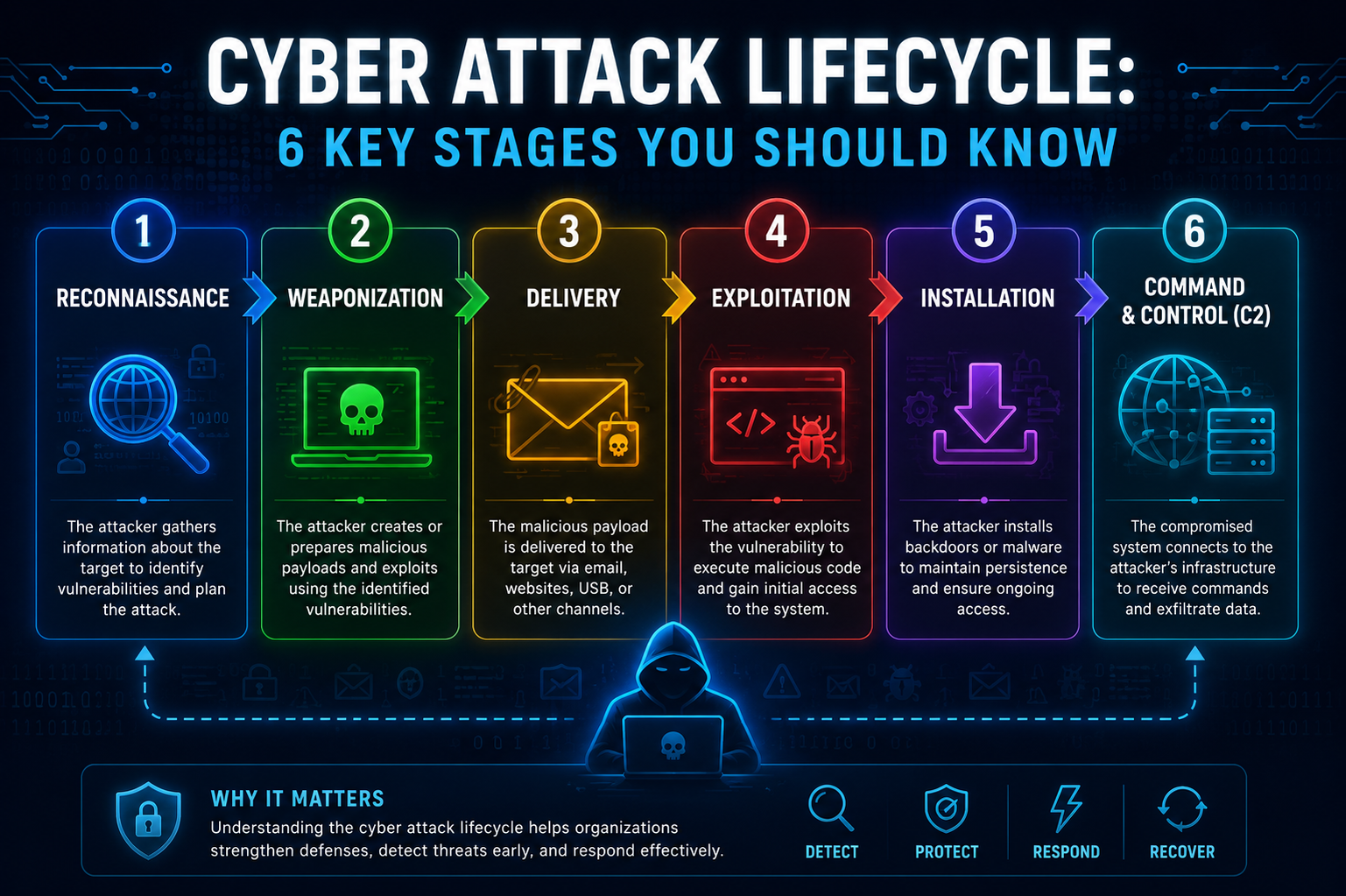
The cyber attack lifecycle represents the structured sequence that attackers follow when attempting to infiltrate, compromise, and exploit digital systems. Although cyber threats often appear sudden to victims, most successful attacks are carefully planned and executed through a series of predictable stages. Each stage has a distinct purpose, starting from information gathering and ending with the final objective of the attacker, such as data theft, system disruption, or unauthorized control. Understanding this lifecycle is essential because it reveals that cyber attacks are not random events but organized processes that can be disrupted at multiple points.
In today’s interconnected environment, every organization, system, and individual connected to digital networks becomes a potential target. Attackers rely on weaknesses in technology, human behavior, and system misconfigurations. However, the important aspect of the lifecycle is that it is not unstoppable. If defenders recognize and interrupt even one stage, the entire attack can fail. This makes awareness, prevention strategies, and layered defense mechanisms extremely important in reducing risk and strengthening digital protection.
Stage One – Reconnaissance and Information Gathering
The first stage of the cyber attack lifecycle involves reconnaissance, where attackers collect as much information as possible about their target. This stage is purely observational and does not involve direct intrusion. Instead, attackers gather intelligence that helps them understand the structure, behavior, and potential weaknesses of a system or organization.
During this phase, attackers may study publicly available sources such as social profiles, organizational websites, user discussions, and exposed technical information. They may also look for email patterns, employee roles, or technology systems being used. Even small details, such as job postings or online mentions of software tools, can help attackers build a detailed profile of their target.
The goal of reconnaissance is to reduce uncertainty. The more information attackers collect, the easier it becomes for them to design a successful attack strategy. However, this stage also presents an opportunity for defense, because limiting publicly exposed information and practicing digital awareness can significantly reduce the attack surface available to adversaries.
Stage Two – Weaponization and Delivery Preparation
After gathering enough intelligence, attackers move into the stage where they prepare their attack tools. This phase involves creating malicious content designed specifically to exploit the weaknesses identified during reconnaissance. The attack may be embedded in files, links, scripts, or software that appears harmless to the target.
Delivery is the method used to transfer these malicious tools to the victim. Common methods include deceptive messages, infected attachments, or compromised websites. The success of this stage depends heavily on human interaction, meaning that attackers often rely on users making small mistakes such as clicking a link or opening a file without verifying its authenticity.
This stage is critical because it transforms planning into action. However, defensive strategies such as filtering suspicious content, monitoring incoming traffic, and educating users can significantly reduce the chance of successful delivery. Preventing malicious content from reaching the system is one of the most effective ways to stop an attack before it begins.
Stage Three – Exploitation of System Weaknesses
The exploitation stage occurs when the delivered malicious content activates and takes advantage of a vulnerability in the target system. This is the moment when the attack transitions from preparation to actual intrusion. Vulnerabilities may exist in software, hardware, or even user behavior, allowing attackers to gain unauthorized access.
Once exploitation begins, attackers can bypass security controls and execute unauthorized actions within the system. This stage is often silent, meaning the victim may not immediately realize that their system has been compromised. Attackers use this advantage to establish a stronger presence inside the environment.
Exploitation is one of the most dangerous phases because it marks the beginning of internal access. However, systems that are regularly updated, patched, and monitored can significantly reduce exposure to exploitation attempts. Identifying vulnerabilities early is essential to preventing attackers from moving further in the lifecycle.
Stage Four – Installation and Persistence Establishment
After successfully exploiting a weakness, attackers move to the installation stage. Here, they deploy malicious components that allow them to maintain long-term access to the compromised system. These components may include hidden programs, backdoors, or unauthorized access tools designed to remain undetected.
The primary objective of this stage is persistence. Attackers do not want temporary access; they aim to ensure that even if the initial vulnerability is fixed, they can still re-enter the system. To achieve this, they embed mechanisms that automatically activate when the system restarts or when security measures attempt removal.
This stage significantly increases the severity of the attack because it allows attackers to maintain control over time. Effective monitoring systems, endpoint protection, and behavior-based detection can help identify unusual activity and prevent long-term compromise.
Stage Five – Command and Control Communication
Once attackers establish persistence, they set up a communication channel between the compromised system and their external control environment. This stage allows attackers to send instructions and receive information from the infected system remotely.
Through this connection, attackers can operate the system as if they have legitimate access. They may modify files, monitor user activity, or expand their reach within the network. This stage transforms the attack from a single compromise into a controlled operation.
The command and control stage is particularly dangerous because it enables continuous interaction with the compromised system. Detecting unusual communication patterns, blocking unauthorized connections, and using network segmentation are essential strategies for limiting this type of control.
Stage Six – Execution of Objectives and Final Actions
The final stage of the cyber attack lifecycle is where attackers achieve their primary objectives. This may include stealing sensitive information, disrupting services, demanding ransom, or altering system data. At this point, attackers have full control and can decide how to use the compromised environment.
Some attacks aim for financial gain, while others focus on disruption, espionage, or reputational damage. In many cases, victims only become aware of the attack after significant damage has already occurred. This makes early detection and prevention even more important.
The final stage represents the completion of the attacker’s plan, but it also highlights the importance of breaking the lifecycle earlier. If any previous stage is disrupted, this final outcome can be completely avoided.
Understanding Real-World Attack Behavior
Cyber attacks in real environments often combine multiple techniques from different stages of the lifecycle. Attackers continuously adapt their methods to avoid detection and increase success rates. In some cases, systems are compromised without any user interaction, making detection even more challenging.
Modern attacks may remain hidden for long periods, silently collecting data before taking any visible action. This delayed execution increases the difficulty of identifying the attack source and responding effectively. It also highlights why continuous monitoring and proactive defense strategies are necessary in today’s digital landscape.
Breaking the Cyber Attack Lifecycle Through Defense
The most important aspect of understanding the cyber attack lifecycle is recognizing that it can be interrupted. Attackers must successfully complete every stage to achieve their goal. This means defenders only need to stop the process at a single point to prevent full compromise.
Defensive strategies include strengthening user awareness, improving system security configurations, applying regular updates, and monitoring network behavior. Each layer of defense adds friction to the attacker’s progress, increasing the likelihood of detection or failure.
Organizations that adopt proactive security approaches are better positioned to handle evolving threats. Instead of reacting after an incident occurs, they focus on preventing attackers from advancing through the lifecycle in the first place.
Cyber Resilience and Long-Term Protection Strategy
Cyber resilience refers to the ability of a system or organization to withstand, respond to, and recover from cyber attacks. It involves combining technology, processes, and human awareness to build a strong defense structure. The goal is not only to prevent attacks but also to minimize damage if an attack occurs.
Training and awareness play a major role in resilience because human error is often a key factor in successful attacks. Regular education helps users recognize suspicious behavior and avoid common attack methods such as phishing or social engineering.
Strong system architecture, continuous monitoring, and layered security controls further enhance resilience. Together, these elements ensure that even if attackers attempt to move through the lifecycle, their progress is detected and disrupted early.
Final Conclusion
The cyber attack lifecycle demonstrates that every cyber threat follows a structured path from information gathering to final execution, and understanding this sequence is essential for building strong defense mechanisms. Since attackers must successfully pass through each stage to achieve their objective, organizations gain a powerful advantage by focusing on disruption rather than reaction. By limiting exposed information, strengthening system defenses, applying timely updates, monitoring network activity, and educating users, it becomes possible to break the attack chain at multiple points before real damage occurs. Ultimately, cybersecurity is most effective when it is proactive, layered, and continuously evolving, ensuring that attackers are consistently challenged and prevented from completing their intended goals.