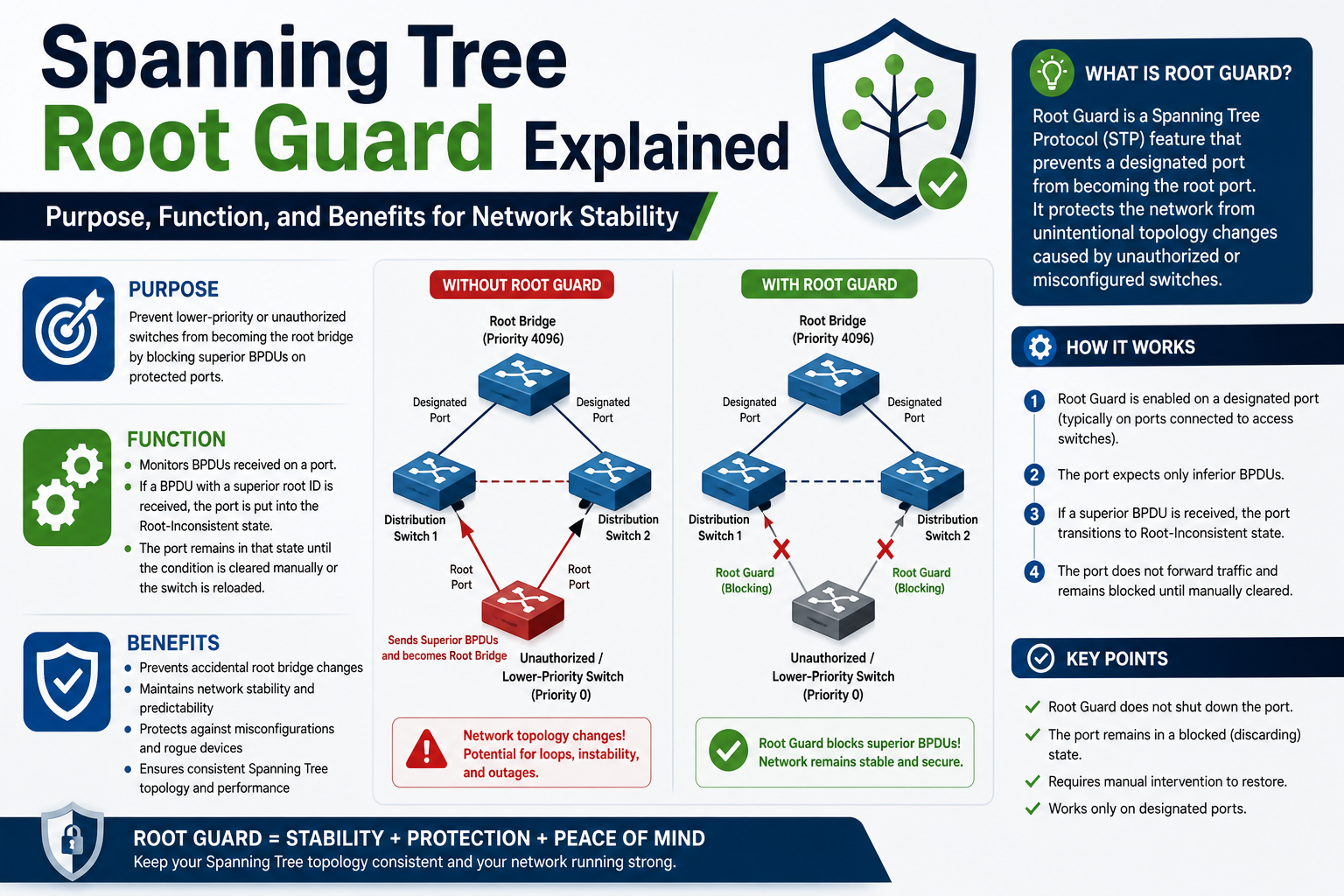
Spanning Tree Root Guard is a protective feature used in network switching environments to maintain control over which switch acts as the root bridge. In any network running the spanning tree protocol, the root bridge plays a critical role in determining the overall traffic flow and loop-free topology. Root Guard ensures that this central role is not accidentally or maliciously taken over by another switch. By enforcing strict control over root bridge election, it strengthens both the stability and security of the network.
The Role of Root Bridge Stability in Network Design
In a well-designed network, the root bridge is intentionally selected based on performance, reliability, and placement within the topology. This device becomes the reference point for all spanning tree calculations, meaning that every path decision ultimately traces back to it. If another switch suddenly claims to be a better root bridge, the topology can shift, causing recalculations, temporary outages, and inconsistent traffic flows. Root Guard prevents such disruptions by ensuring that only the intended switch maintains this authoritative role.
Why Spanning Tree Protocol Needs Additional Protection
The spanning tree protocol was originally designed to eliminate loops in a Layer 2 network by dynamically blocking redundant paths. While effective, it does not inherently prevent changes in root bridge selection if a device presents a superior configuration. This opens the door to instability, especially in environments where unauthorized or misconfigured devices might be introduced. Root Guard addresses this limitation by adding a layer of enforcement that preserves the intended hierarchy of the network.
How Bridge Protocol Data Units Influence Root Elections
Bridge Protocol Data Units, commonly known as BPDUs, are the messages exchanged between switches to share information about the network topology. These messages contain critical details such as bridge identifiers and path costs, which are used to determine the root bridge. When a switch receives a BPDU that indicates a better candidate for root bridge status, it may trigger a topology change. Root Guard intercepts these situations by blocking the acceptance of superior BPDUs on designated ports, effectively stopping unauthorized root changes.
Understanding the Concept of Superior BPDUs
A superior BPDU is one that advertises a lower bridge ID than the current root bridge, suggesting that the sending switch should take over as the new root. In normal operation, switches accept these messages and adjust their roles accordingly. However, not all superior BPDUs are desirable, especially when they originate from untrusted or less capable devices. Root Guard identifies these messages and prevents them from influencing the network, maintaining the integrity of the original design.
Port-Level Enforcement of Root Guard
Root Guard operates at the interface level, giving administrators precise control over where protection is applied. It is typically enabled on ports that should never lead to a root bridge, such as access ports or connections to external networks. When a port with Root Guard enabled receives a superior BPDU, it does not simply ignore the message. Instead, it transitions into a special state that effectively blocks traffic while the condition persists. This ensures that the network remains stable even in the presence of unexpected inputs.
The Root-Inconsistent State Explained
When Root Guard detects a violation, the affected port enters what is known as a root-inconsistent state. In this state, the port stops forwarding traffic to prevent any potential disruption caused by a change in root bridge status. This is not a permanent shutdown but rather a protective mechanism that remains active as long as the threat exists. Once the superior BPDUs stop arriving, the port automatically returns to normal operation without requiring manual intervention.
Preventing Rogue Switch Attacks in Layer 2 Networks
One of the most important benefits of Root Guard is its ability to defend against rogue switches. These unauthorized devices can be intentionally introduced by attackers or accidentally connected by users. If such a device advertises a lower bridge ID, it could become the root bridge and manipulate traffic flows for malicious purposes. Root Guard neutralizes this risk by ensuring that no external or untrusted switch can assume control of the network topology.
Maintaining Predictable Network Behavior
Consistency is essential in network operations, especially in environments that support critical applications. Frequent changes in the root bridge can lead to unpredictable latency, packet loss, and service interruptions. By locking down the root bridge position, Root Guard contributes to a more stable and predictable network. This stability is particularly valuable in large-scale deployments where even minor disruptions can have widespread consequences.
Comparing Root Guard with Other STP Security Features
While Root Guard focuses on preserving the root bridge, other spanning tree enhancements address different aspects of network protection. Some features prevent devices from sending BPDUs, while others block ports that receive unexpected BPDU traffic. Together, these mechanisms create a layered defense strategy that secures the spanning tree environment from multiple angles. Root Guard plays a unique role within this strategy by specifically targeting the integrity of root bridge selection.
Strategic Placement of Root Guard in Network Topologies
Deciding where to enable Root Guard requires careful planning. It is most effective on ports that connect to switches outside the administrative control of the network team. These may include connections to partner networks, unmanaged switches, or user-accessible ports. By applying Root Guard at these نقاط, administrators create a boundary that protects the core of the network from external influence. This strategic placement ensures maximum effectiveness without interfering with legitimate internal operations.
Balancing Security and Flexibility in Network Configuration
While Root Guard provides strong protection, it must be used thoughtfully to avoid unintended consequences. Enabling it on the wrong ports could block legitimate topology changes or hinder redundancy mechanisms. Network designers must strike a balance between enforcing stability and allowing necessary flexibility. This involves understanding the role of each connection and applying Root Guard only where it aligns with the overall design objectives.
Enhancing Network Reliability Through Controlled Topology Changes
In dynamic environments, topology changes are sometimes necessary, such as during maintenance or expansion. Root Guard does not prevent these changes entirely but ensures they occur in a controlled and predictable manner. By restricting unauthorized root bridge elections, it allows administrators to manage transitions deliberately rather than reacting to unexpected events. This controlled approach enhances overall network reliability and reduces the risk of downtime.
Operational Visibility and Monitoring of Root Guard Behavior
Effective use of Root Guard also involves monitoring its activity within the network. When a port enters the root-inconsistent state, it serves as an indicator that a potential issue has been detected. Administrators can use this information to investigate the source of the superior BPDUs and take appropriate action. This visibility turns Root Guard into not just a protective feature but also a diagnostic tool that helps maintain network health.
Reducing Network Convergence Issues with Root Guard
Network convergence refers to the time it takes for the spanning tree protocol to stabilize after a change. Frequent or unexpected root bridge changes can significantly increase convergence time, affecting performance. Root Guard minimizes these disruptions by preventing unnecessary recalculations. As a result, the network converges more quickly and maintains consistent performance even in complex topologies.
Supporting Scalable and Secure Network Architectures
As networks grow in size and complexity, maintaining control over topology becomes increasingly challenging. Root Guard supports scalability by enforcing clear boundaries and preserving hierarchical structure. It allows organizations to expand their networks without compromising stability or security. This makes it an essential component in modern network design, particularly in enterprise and data center environments.
Understanding Configuration Simplicity and Practical Deployment
Despite its powerful capabilities, Root Guard is relatively simple to implement. It typically involves enabling a single command on the desired interfaces, making it accessible even to those with limited configuration experience. This simplicity encourages widespread adoption and ensures that networks can benefit from enhanced protection without significant overhead.
Recognizing Common Operational Scenarios for Root Guard Use
There are several common scenarios where Root Guard proves especially valuable. These include environments with frequent user access, connections to third-party networks, and deployments with strict security requirements. In each case, the goal is to prevent unauthorized influence over the network’s core structure. By addressing these scenarios, Root Guard helps maintain both performance and trust within the infrastructure.
Integrating Root Guard into a Comprehensive Security Strategy
Root Guard should not be viewed in isolation but as part of a broader network security framework. When combined with other protective measures, it contributes to a robust defense against both accidental misconfigurations and deliberate attacks. This integrated approach ensures that multiple layers of protection work together to safeguard the network.
Adapting Root Guard to Different Network Environments
Different network environments may require different approaches to Root Guard implementation. For example, enterprise networks, campus environments, and data centers each have unique characteristics and challenges. Understanding these differences allows administrators to tailor Root Guard usage to meet specific needs, ensuring optimal performance and protection in every scenario.
Deep Dive into Root Guard Behavior and Network Control
Root Guard operates with a very specific objective: to enforce the intended hierarchy of a spanning tree environment by controlling how switches interact during root bridge elections. Unlike general spanning tree behavior, which dynamically adapts to topology changes, Root Guard introduces a layer of intentional rigidity. This rigidity is not a limitation but a safeguard, ensuring that the network does not deviate from its designed structure due to unexpected or unauthorized influences. By doing so, it gives network administrators confidence that their topology will behave as planned under normal and abnormal conditions.
How Root Guard Interacts with Spanning Tree Calculations
Spanning tree calculations rely on continuous communication between switches using BPDUs. Each switch evaluates incoming BPDUs to determine the best path to the root bridge. Root Guard modifies this behavior by preventing certain ports from participating fully in these calculations when a superior BPDU is detected. Instead of recalculating paths based on this new information, the switch effectively isolates the offending input. This ensures that the rest of the network continues to operate based on the original root bridge, maintaining consistency in path selection and traffic flow.
The Importance of Interface Roles in Root Guard Deployment
Every port in a spanning tree environment has a role, such as root port, designated port, or blocked port. Root Guard is most commonly applied to designated ports, particularly those that connect to downstream switches or external networks. These are the نقاط where an unexpected root bridge claim is most likely to originate. By enabling Root Guard on these interfaces, administrators ensure that only trusted paths influence the root bridge decision. This targeted approach maximizes protection while minimizing unnecessary restrictions on internal communication.
Behavioral Changes During Superior BPDU Detection
When a port with Root Guard enabled receives a superior BPDU, it does not follow the normal spanning tree process of updating its root information. Instead, it immediately transitions into a protective mode. This behavior is deliberate and ensures that the potential threat is contained at the نقطة of entry. The rest of the network remains unaffected, continuing to operate with the original root bridge. This localized response is one of the key strengths of Root Guard, as it prevents widespread disruption from a single مصدر.
Temporary Isolation Through Root-Inconsistent State
The root-inconsistent state is a defining characteristic of Root Guard operation. When a port enters this state, it effectively stops forwarding traffic, acting as a barrier between the network and the source of the superior BPDU. This isolation is temporary and automatically reversed once the offending condition is removed. The self-healing nature of this mechanism reduces the need for manual intervention and ensures that normal operations can resume quickly. It also provides a clear indication that a potential issue has occurred, allowing administrators to investigate further.
Impact on Traffic Flow and Network Performance
While Root Guard enhances security and stability, it can have a temporary impact on traffic flow when a port is placed in a root-inconsistent state. Traffic that would normally pass through the affected interface is blocked, which may require alternative paths to be used. In well-designed networks with redundancy, this impact is minimal, as traffic can be rerouted through other links. However, in less resilient topologies, it may result in temporary connectivity issues. This highlights the importance of designing networks with redundancy and proper failover mechanisms.
Differentiating Between Legitimate and Illegitimate Topology Changes
Not all topology changes are harmful. In some cases, a new switch with better capabilities may legitimately need to become the root bridge. Root Guard, however, does not distinguish between beneficial and harmful changes; it simply enforces the existing design. This means that administrators must carefully plan when and where to enable it. In environments where controlled changes are expected, Root Guard should be temporarily disabled or adjusted to allow the transition. This controlled flexibility ensures that the network can evolve without compromising security.
Operational Indicators of Root Guard Activation
When Root Guard is triggered, it provides clear operational indicators that can be observed through network monitoring tools and command-line outputs. These indicators help administrators quickly identify which ports are affected and why. The presence of a root-inconsistent state is a strong signal that a superior BPDU has been detected. By analyzing these signals, network teams can trace the source of the issue and determine whether it is a misconfiguration, a new device, or a potential security threat.
Integration with VLAN-Based Spanning Tree Instances
In modern networks, spanning tree is often implemented on a per-VLAN basis, allowing for more granular control of traffic and topology. Root Guard can be applied within these individual instances, providing protection tailored to each VLAN. This is particularly useful in environments with multiple logical networks sharing the same physical infrastructure. By controlling root bridge behavior at the VLAN level, administrators can maintain stability and security across diverse traffic segments.
Enhancing Layer 2 Security Posture
Layer 2 networks are often more vulnerable to certain types of attacks because they lack the inherent protections found at higher layers. Root Guard strengthens the security posture of Layer 2 by addressing one of its key vulnerabilities: the potential for unauthorized devices to influence topology. By preventing rogue switches from becoming the root bridge, it reduces the attack surface and helps protect sensitive data and services. This makes it an essential tool in environments where security is a top priority.
Common Misconfigurations and Their Effects
Improper configuration of Root Guard can lead to unintended consequences. For example, enabling it on ports that should legitimately receive superior BPDUs can block necessary topology changes. This may result in suboptimal routing or even connectivity issues. Another common mistake is failing to enable Root Guard where it is needed, leaving the network exposed to potential threats. Understanding the intended design and carefully applying Root Guard is crucial to avoiding these pitfalls.
The Relationship Between Root Guard and Network Redundancy
Redundancy is a fundamental principle of network design, ensuring that there are multiple paths for traffic in case of failure. Root Guard complements redundancy by ensuring that these paths are used in a controlled manner. While redundancy allows for flexibility, Root Guard ensures that this flexibility does not compromise the overall structure. Together, they create a balanced environment যেখানে resilience and stability coexist.
Monitoring and Logging for Proactive Management
Effective network management involves not only reacting to issues but also anticipating them. Root Guard contributes to proactive management by generating events and logs عندما it detects a violation. These logs can be integrated into monitoring systems, providing real-time alerts and historical data for analysis. By leveraging this information, administrators can identify patterns, detect anomalies, and improve the overall reliability of the network.
Adapting Root Guard in Dynamic Network Environments
Modern networks are increasingly dynamic, with frequent changes driven by virtualization, cloud integration, and evolving business needs. In such environments, the rigid enforcement of Root Guard must be balanced with the need for adaptability. This may involve selectively enabling it on critical نقاط while leaving other areas more flexible. By tailoring its deployment, organizations can benefit from its protective capabilities without hindering innovation and growth.
Understanding Vendor Variations in Root Guard Implementation
While the concept of Root Guard is consistent across networking platforms, the exact implementation details may vary بين different vendors. Command syntax, default behaviors, and monitoring capabilities can differ, requiring administrators to be familiar with the specific الأجهزة they are using. This knowledge ensures that Root Guard is configured correctly and operates as expected within the given environment.
Practical Considerations for Large-Scale Deployments
In large-scale networks, the deployment of Root Guard must be carefully planned and documented. This includes identifying all relevant interfaces, understanding traffic patterns, and ensuring compatibility with other features. Automation tools can کمک streamline this process, allowing for consistent configuration across multiple devices. Proper documentation also ensures that future changes can be made without disrupting the existing حفاظ structure.
Balancing Control and Operational Efficiency
Root Guard provides a high level of control over network behavior, but this control must be balanced with operational efficiency. Overuse or misplacement can lead to unnecessary restrictions and increased administrative overhead. By focusing on critical نقاط and aligning configuration with design goals, administrators can achieve the desired level of protection without compromising efficiency. This balance is key to maintaining a network that is both secure and easy to manage.
Practical Configuration Approach for Root Guard Deployment
Implementing Root Guard in a real-world network begins with a clear understanding of the topology and the role of each switch. Before applying any configuration, administrators must identify which device is intended to act as the root bridge and which interfaces connect to potentially untrusted or lower-tier switches. Root Guard is not applied randomly; it is strategically enabled on ports where the network design must be enforced. This careful planning ensures that the feature enhances stability rather than interfering with legitimate operations.
Command-Line Configuration Fundamentals
In most enterprise switching environments, Root Guard is configured through the command-line interface. After accessing the switch in configuration mode, the administrator selects the specific interface and enables the feature with a simple command. Although the syntax may vary slightly depending on the vendor, the logic remains consistent. The command activates monitoring on the selected port, instructing it to block any superior BPDU that attempts to influence root bridge election. This simplicity makes Root Guard one of the easiest yet most effective features to deploy in a network.
Selecting the Right Interfaces for Root Guard
Choosing where to enable Root Guard is critical to its success. It is typically applied to ports that connect to access-layer switches, unmanaged devices, or external networks. These connections represent potential entry points for rogue devices or misconfigured switches. By contrast, ports that connect to core or distribution switches, where legitimate root bridge changes might occur, are usually left without Root Guard. This selective application ensures that the network remains both protected and flexible where necessary.
Testing Configuration in Controlled Environments
Before deploying Root Guard across a production network, it is wise to test the configuration in a controlled lab environment. This allows administrators to simulate scenarios যেখানে a switch attempts to become the root bridge and observe how Root Guard responds. Testing helps confirm that ports enter the root-inconsistent state as expected and that normal operation resumes once the condition is removed. It also provides an opportunity to identify any unintended side effects, ensuring a smooth rollout in live environments.
Verification of Root Guard Status and Behavior
After configuration, verification is essential to confirm that Root Guard is functioning correctly. Network administrators use monitoring commands to inspect the spanning tree status of interfaces and identify any ports that are in a root-inconsistent state. These commands provide detailed insights into VLAN-specific behavior, port roles, and overall topology status. Regular verification ensures that the feature continues to operate as intended and provides early detection of any anomalies.
Recognizing Root Guard Trigger Conditions in Practice
In a live network, Root Guard is triggered عندما a port receives a superior BPDU from a connected device. This may occur due to a newly connected switch, a configuration change, or even a faulty device ارسال incorrect information. When this happens, the affected port transitions into a protective state, preventing the new device from influencing the network. Understanding these trigger conditions helps administrators بسرعة identify the cause and take corrective action if needed.
Troubleshooting Root-Inconsistent Ports Effectively
When a port enters the root-inconsistent state, it can disrupt traffic flow through that interface. Troubleshooting begins with identifying the source of the superior BPDU. Administrators may trace the connection to determine whether the device is authorized or if it represents a misconfiguration. In some cases, adjusting the priority of the intended root bridge or reconfiguring the connected switch may resolve the issue. The key is to address the root cause rather than simply disabling Root Guard.
Using Diagnostic Commands for Deeper Analysis
Advanced troubleshooting often involves using diagnostic commands that provide detailed information about spanning tree operations. These commands reveal the bridge ID, port roles, path costs, and BPDU activity across the network. By analyzing this data, administrators can understand why a port was blocked and how the topology is being interpreted by different switches. This level of visibility is essential for maintaining a stable and well-functioning network.
Handling False Positives and Misconfigurations
Not every Root Guard activation indicates a malicious event. Sometimes, legitimate devices may send superior BPDUs due to misconfigured priorities or incorrect settings. These situations can be considered false positives, where the feature correctly identifies a condition but the underlying cause is benign. Resolving these issues involves correcting the configuration of the involved devices so that they align with the intended network design.
Integrating Root Guard with Change Management Processes
In structured IT environments, changes to the network are carefully managed through formal processes. Root Guard should be considered during these changes to ensure that it does not interfere with planned updates. For example, when introducing a new core switch or redesigning the topology, administrators may need to temporarily adjust Root Guard settings. Integrating this feature into change management ensures smooth transitions and avoids unnecessary disruptions.
Automation and Consistency in Large Networks
As networks grow, manual configuration becomes less practical. Automation tools can be used to apply Root Guard settings consistently across multiple devices and interfaces. This reduces the risk of human error and ensures that all relevant ports are properly protected. Automation also simplifies updates and auditing, making it easier to maintain a secure and stable network over time.
Documentation as a Key to Long-Term Stability
Accurate documentation plays a crucial role in the effective use of Root Guard. Administrators should record which interfaces have the feature enabled, along with the reasoning behind each decision. This information يساعد future troubleshooting and ensures that new team members understand the network design. Good documentation also supports audits and compliance requirements, providing a clear record of security اقدامات.
Training and Awareness for Network Teams
Even with proper configuration, the effectiveness of Root Guard depends on the knowledge of the network team. Training ensures that administrators understand how the feature works, when it should be used, and how to respond to its activation. Awareness of Root Guard behavior helps prevent confusion عندما ports unexpectedly stop forwarding traffic, enabling faster resolution of issues.
Evaluating Network Topology Before Deployment
A thorough evaluation of the network topology is essential before enabling Root Guard. This includes understanding traffic patterns, identifying critical paths, and assessing redundancy. By analyzing these factors, administrators can determine the optimal placement of Root Guard and avoid unintended disruptions. This proactive approach ensures that the feature enhances rather than hinders network performance.
Coordinating Root Guard with Redundancy Protocols
Many networks rely on redundancy protocols to maintain availability in the event of failures. Root Guard must be coordinated with these protocols to ensure compatibility. For example, in environments with multiple uplinks, blocking one path due to Root Guard should not isolate the network. Proper design ensures that alternative paths remain available, maintaining connectivity even when protective measures are فعال.
Understanding Recovery and Self-Healing Mechanisms
One of the advantages of Root Guard is its ability to recover automatically from triggering conditions. When the superior BPDUs stop, the affected port exits the root-inconsistent state and resumes normal operation. This self-healing behavior reduces the need for manual intervention and ensures that temporary issues do not lead to prolonged downtime. Understanding this mechanism helps administrators trust the feature and rely on it for continuous protection.
Real-World Deployment Scenarios and Lessons Learned
In practical deployments, Root Guard has proven valuable in preventing unexpected topology changes caused by user-installed switches, vendor المعدات, or حتی testing devices connected without proper configuration. These real-world scenarios highlight the importance of proactive protection. Organizations that implement Root Guard often experience fewer network disruptions and improved overall stability. The lessons learned from these deployments emphasize careful planning, consistent configuration, and ongoing monitoring as the keys to success.
Best Practices for Effective Root Guard Implementation
Applying Root Guard effectively requires more than simply enabling it on a few interfaces. It involves aligning the feature with the overall network design and long-term operational goals. One of the most important best practices is to clearly define which switch should always remain the root bridge. Once this decision is made, Root Guard should be used to enforce that choice across the network. This approach ensures consistency and prevents unexpected topology changes that could disrupt performance.
Prioritizing the Right Root Bridge Selection Strategy
A strong Root Guard strategy begins with selecting the most suitable root bridge. This is typically a high-performance, centrally located switch with reliable hardware and sufficient capacity to handle network traffic. Administrators often adjust bridge priority values to ensure that this device consistently wins the root election process. By combining proper root bridge selection with Root Guard enforcement, networks achieve both stability and optimal traffic flow.
Protecting Network Edges from Unauthorized Influence
The edges of a network are the most vulnerable points when it comes to spanning tree manipulation. These are the locations where unauthorized devices, unmanaged switches, or حتی accidental connections are most likely to occur. Enabling Root Guard on edge-facing ports creates a protective boundary that prevents external devices from influencing the core topology. This defensive layer is essential for maintaining control over the network structure.
Combining Root Guard with Complementary Security Features
Root Guard becomes even more powerful when used alongside other spanning tree protection mechanisms. Features that control BPDU transmission or reception can complement Root Guard by addressing different aspects of Layer 2 security. While Root Guard ensures that the root bridge remains unchanged, other mechanisms help prevent unwanted BPDU activity altogether. Together, these features form a comprehensive security framework that strengthens the network ضد potential threats.
Avoiding Over-Deployment and Misuse
Although Root Guard is highly beneficial, applying it indiscriminately can create problems. Enabling it on ports that are part of the core or distribution layers may block legitimate topology changes and reduce network flexibility. Over-deployment can also complicate troubleshooting, as multiple ports may enter protective states simultaneously. The key is to apply Root Guard selectively, focusing on interfaces where control is ضروری and avoiding areas where dynamic behavior is required.
Maintaining Redundancy While Enforcing Control
Redundancy is essential for network availability, but it must be carefully balanced with control mechanisms like Root Guard. When a port is placed into a root-inconsistent state, traffic must be able to reroute through alternative paths. Designing the network with sufficient redundancy ensures that Root Guard does not inadvertently cause outages. This balance allows organizations to benefit from both resilience and stability without compromising either.
Monitoring and Continuous Improvement of Network Stability
Root Guard is not a one-time configuration but part of an ongoing process of network optimization. Regular monitoring helps identify patterns, such as repeated root-inconsistent events, which may تشير to deeper issues مثل misconfigured devices or unauthorized access attempts. By analyzing these patterns, administrators can refine their configurations and improve the overall reliability of the network. Continuous improvement ensures that the network remains efficient and secure over time.
Handling Network Expansion and Topology Changes
As networks grow, new switches and connections are added, which can introduce complexity and potential risks. Root Guard must be considered during these expansions to ensure that new devices do not disrupt the existing topology. This may involve enabling Root Guard on newly added interfaces or adjusting existing configurations to accommodate changes. Proper planning during expansion prevents instability and maintains the integrity of the network design.
Troubleshooting Persistent Root Guard Issues
In some cases, ports may repeatedly enter the root-inconsistent state, indicating an ongoing issue. Troubleshooting these حالات involves identifying the source of the superior BPDUs and determining whether it is a legitimate device or a misconfiguration. Administrators may need to adjust bridge priorities, reconfigure الأجهزة, or even replace faulty hardware. Persistent issues should not be ignored, as they can signal deeper problems within the network.
Understanding the Impact on Network Convergence Time
Root Guard can positively influence network convergence by preventing unnecessary topology changes. When the root bridge remains stable, the spanning tree protocol does not need to recalculate paths frequently. This leads to faster convergence and more predictable performance. However, if Root Guard is triggered frequently, it may indicate instability elsewhere, which could affect convergence. Monitoring and addressing these triggers is essential for maintaining optimal performance.
Documenting Configuration for Long-Term Management
Proper documentation is a critical aspect of managing Root Guard effectively. Each configured interface should be recorded along with the reason for its configuration. This documentation helps future administrators understand the network design and reduces the risk of accidental misconfiguration. It also supports troubleshooting by providing a clear reference for how the network is intended to operate.
Training Teams to Recognize Root Guard Behavior
Network teams must be familiar with how Root Guard behaves in مختلف scenarios. This includes understanding why a port might stop forwarding traffic and how to interpret diagnostic messages. Training ensures that administrators can بسرعة identify and resolve issues without unnecessary delays. A well-informed team is essential for maintaining a stable and secure network environment.
Adapting Root Guard to Different Network Architectures
Different types of networks require different approaches to Root Guard implementation. In campus networks, it is often used extensively at the access layer, while in data center environments, it may be applied more selectively. Understanding the unique requirements of each architecture allows administrators to tailor Root Guard usage for maximum effectiveness. This adaptability ensures that the feature remains relevant across a wide range of deployments.
Evaluating Performance and Resource Utilization
Although Root Guard does not significantly impact switch performance, it is still important to evaluate its behavior in large-scale environments. Monitoring resource utilization and ensuring that switches can handle the إضافي processing associated with spanning tree operations helps maintain efficiency. This evaluation is particularly important in high-density networks where multiple حفاظ features are فعال simultaneously.
Strengthening Overall Network Security Posture
Root Guard contributes significantly to the overall security of a network by preventing unauthorized control over its topology. By ensuring that only trusted devices can influence root bridge selection, it reduces the risk of attacks that هدف to manipulate traffic paths. This added layer of protection is especially valuable in environments where data integrity and availability are critical.
Ensuring Compatibility with Future Technologies
As networking technologies evolve, it is important to ensure that Root Guard remains compatible with new protocols and architectures. While its core function is tied to spanning tree, it can still play a role in hybrid environments where traditional and modern technologies coexist. Keeping configurations updated and aligned with current best practices ensures long-term compatibility and effectiveness.
Building a Stable and Predictable Network Environment
Ultimately, the goal of using Root Guard is to create a network that behaves in a stable and predictable manner. By preventing unexpected changes in the root bridge, it eliminates a major source of instability. Combined with thoughtful design, proper configuration, and ongoing monitoring, Root Guard helps build a network environment that supports both performance and security without compromise.
Conclusion
Spanning Tree Root Guard stands out as a simple yet highly effective mechanism for preserving control over network topology. By ensuring that the intended root bridge remains unchanged, it eliminates one of the most common causes of instability in Layer 2 environments. This consistency allows the network to operate predictably, reducing unexpected recalculations and minimizing the risk of downtime.
Beyond stability, Root Guard plays a crucial role in strengthening network security. It prevents unauthorized or misconfigured devices from influencing root bridge elections, effectively blocking a common attack vector in switching environments. This added layer of protection helps maintain trust in the network infrastructure while safeguarding data flow and connectivity.
When combined with thoughtful design, proper root bridge selection, and complementary protection features, Root Guard becomes an essential part of a resilient network strategy. Its ease of configuration and automatic recovery behavior make it both practical and reliable for long-term use. By integrating Root Guard into everyday network operations, organizations can achieve a balance of performance, security, and control that supports stable and scalable growth.