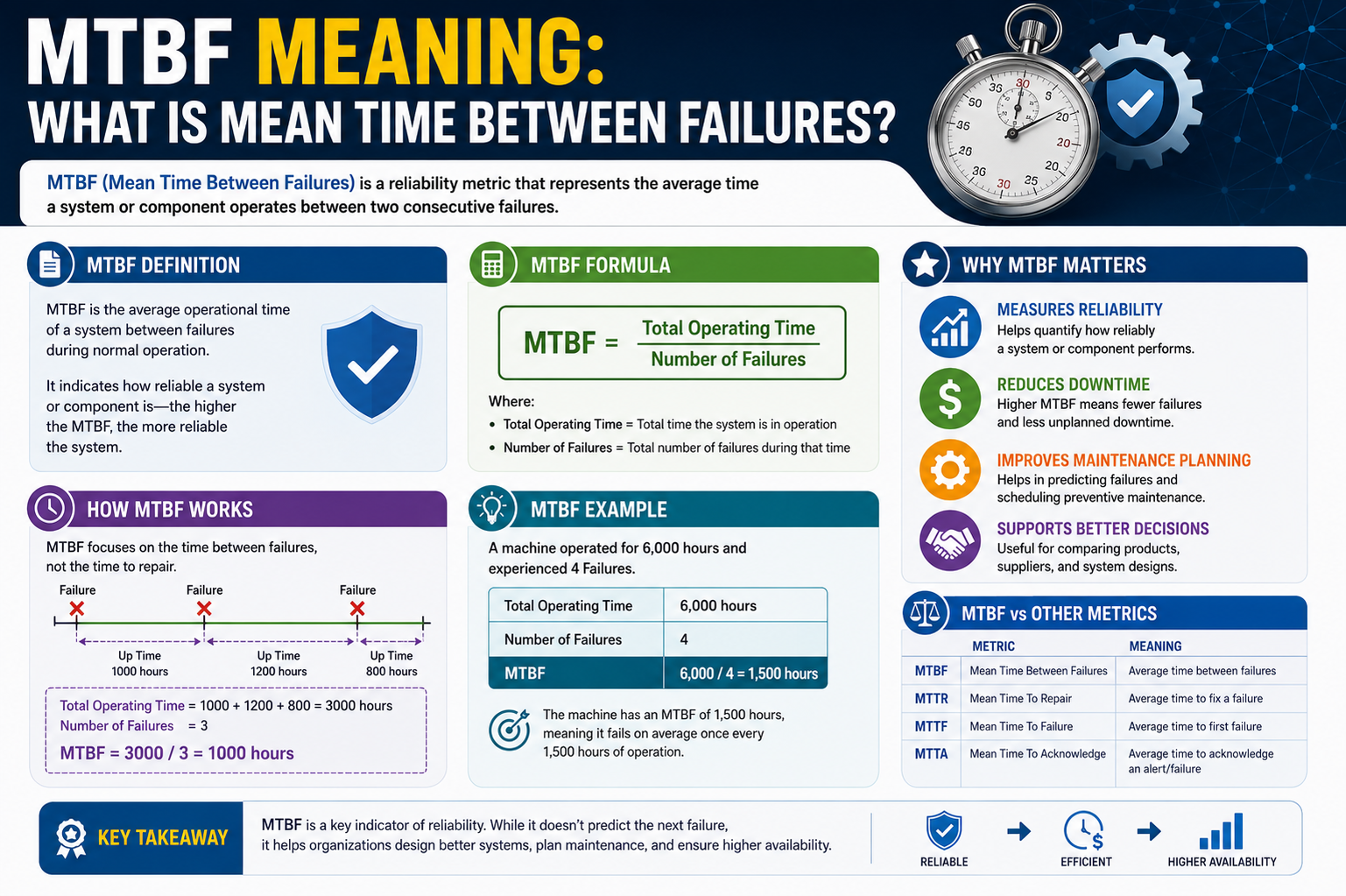
Mean Time Between Failure, commonly abbreviated as MTBF, is a fundamental reliability metric used to evaluate how long a system, device, or component can operate before it experiences a failure. In simple terms, it represents the average operational time between one failure and the next. This concept plays a critical role in modern technology environments where continuous operation is essential. Whether it is a server, a networking device, or a software application, understanding how frequently failures occur helps organizations prepare for interruptions and minimize their impact.
Failures are an inevitable part of any system. In everyday life, small disruptions such as missing deadlines or forgetting tasks are common. In technical environments, however, failures can lead to serious consequences such as service outages, financial loss, compromised data, or even safety risks depending on the system involved. These interruptions are commonly referred to as downtime. The primary objective for any organization is to maximize uptime, meaning systems should function smoothly for as long as possible. MTBF serves as a measurable way to track and improve this goal.
Why MTBF Matters in Modern Systems
The importance of MTBF extends beyond simple measurement. It provides valuable insights into the reliability and stability of systems over time. Organizations rely on this metric to make informed decisions about equipment purchases, maintenance schedules, and infrastructure design. A higher MTBF indicates a more reliable system that experiences fewer failures, while a lower MTBF suggests frequent issues that may require attention or replacement.
In environments where uptime is critical, such as data centers, healthcare systems, or financial platforms, even a small failure can have widespread consequences. By analyzing MTBF, organizations can anticipate potential problems and implement preventive measures before failures occur. This proactive approach reduces unexpected downtime and ensures smoother operations.
MTBF also plays a significant role in cost management. Frequent failures often lead to increased repair costs, replacement expenses, and operational disruptions. By improving MTBF, organizations can reduce these costs and achieve greater efficiency. It becomes easier to allocate resources effectively when the reliability of systems is well understood.
The Role of Downtime and Reliability
Downtime is one of the most critical challenges in any technical environment. It occurs when a system becomes unavailable or stops functioning as expected. The relationship between downtime and MTBF is direct and significant. Systems with a higher MTBF experience longer periods of uninterrupted operation, resulting in less downtime. Conversely, systems with a lower MTBF tend to fail more often, leading to frequent interruptions.
Reliability is the ability of a system to perform its intended function without failure over a specified period. MTBF is one of the primary metrics used to measure reliability. By analyzing historical failure data, organizations can estimate how reliable a system is and how it is likely to perform in the future. This information is essential for planning and decision-making.
Improving reliability is not just about fixing problems after they occur. It involves designing systems in a way that minimizes the likelihood of failure. This is where concepts like redundancy and high availability come into play. These strategies work alongside MTBF to enhance overall system performance and resilience.
Introduction to Redundancy and High Availability
Redundancy and high availability are closely related concepts that aim to reduce the impact of failures and maintain continuous operation. Redundancy involves duplicating critical components or systems so that if one fails, another can take over without interrupting operations. High availability refers to the design and implementation of systems that remain operational for the maximum possible time, even in the presence of failures.
These concepts are essential in environments where downtime is unacceptable. By combining redundancy with high availability strategies, organizations can ensure that their systems continue to function even when unexpected issues arise. This approach does not eliminate failures entirely, but it significantly reduces their impact.
Understanding Redundancy in Detail
Redundancy is a practical and widely used strategy to enhance system reliability. It involves having backup components or systems ready to take over in case of failure. This approach ensures that operations can continue without significant disruption.
In everyday life, redundancy can be seen in simple forms such as carrying a spare tire in a vehicle. If one tire fails, the spare can be used to continue the journey. Similarly, in technology environments, redundancy ensures that critical operations are not halted due to a single point of failure.
Redundancy can be implemented in various ways depending on the type of system and its requirements. The goal is to create multiple layers of protection so that even if one component fails, others can maintain functionality.
Types of Redundancy in Technology Environments
Redundancy in technical systems can be categorized into several types, each addressing different aspects of system reliability. These include hardware redundancy, software redundancy, and network redundancy. Each type plays a unique role in ensuring continuous operation and minimizing downtime.
Hardware redundancy involves the use of additional physical components such as servers, storage devices, power supplies, and networking equipment. By having multiple devices performing the same function, the system can continue to operate even if one component fails. This approach is commonly used in data centers and enterprise environments where reliability is critical.
Software redundancy focuses on maintaining backup copies of applications and systems. This includes techniques such as failover systems, virtual machines, and backup software that can restore operations quickly in case of failure. Software redundancy ensures that data and applications remain accessible even when issues occur.
Network redundancy ensures that data can still be transmitted even if part of the network fails. This is achieved through multiple network paths, redundant switches, and backup internet connections. By providing alternative routes for data, network redundancy minimizes the risk of communication breakdowns.
High Availability and Its Importance
High availability builds upon the concept of redundancy by ensuring that systems remain operational with minimal interruption. It involves designing systems in a way that reduces the likelihood of downtime and allows for quick recovery when failures occur.
The goal of high availability is to provide continuous service, even in the face of hardware or software failures. This is achieved through a combination of redundancy, monitoring, and automated recovery mechanisms. High availability systems are designed to detect failures quickly and switch to backup components without affecting users.
In modern environments, high availability is often a requirement rather than an option. Businesses rely on continuous access to their systems and services, making it essential to implement strategies that ensure consistent performance.
High Availability Architectures Explained
Different architectures are used to achieve high availability, each with its own advantages and use cases. These architectures determine how systems handle failures and maintain operations.
Active-passive architecture is one of the simplest forms of high availability. In this setup, one system actively handles operations while another remains on standby. If the primary system fails, the backup system takes over. This approach is straightforward and effective but may involve some delay during the transition.
Active-active architecture takes a more advanced approach by running multiple systems simultaneously. These systems share the workload and provide redundancy at the same time. If one system fails, the others continue to operate without interruption. This architecture offers better performance and reliability but may require more complex configuration and management.
N+1 and N+M models represent different levels of redundancy. The N+1 model includes one अतिरिक्त backup component, while the N+M model includes multiple backups. The choice between these models depends on the level of reliability required and the resources available.
How MTBF Connects with Reliability Strategies
MTBF is closely linked with redundancy and high availability strategies. While redundancy does not directly increase the MTBF of individual components, it improves the overall reliability of the system. By having backup components in place, the impact of failures is reduced, resulting in longer periods of uninterrupted operation.
High availability architectures further enhance this effect by ensuring that systems can recover quickly from failures. This combination of strategies helps organizations achieve higher reliability and better performance.
Understanding the relationship between MTBF, redundancy, and high availability is essential for designing effective systems. It allows organizations to balance cost, performance, and reliability to meet their specific needs.
Calculating MTBF and Its Practical Meaning
MTBF is calculated using a simple formula that divides the total operating time of a system by the number of failures it experiences. This calculation provides an average value that represents how long the system operates between failures.
MTBF=Total Operating TimeNumber of FailuresMTBF = \frac{\text{Total Operating Time}}{\text{Number of Failures}}MTBF=Number of FailuresTotal Operating Time
For example, if a system operates for a certain number of hours and experiences a specific number of failures during that time, the MTBF can be determined by dividing the total time by the number of failures. This value helps organizations understand the reliability of the system and plan accordingly.
It is important to note that MTBF is an average value and does not guarantee that failures will occur at exact intervals. Instead, it provides a general estimate based on historical data. This makes it a useful tool for planning and analysis, but it should be used alongside other metrics for a complete understanding of system performance.
Conclusion
Mean Time Between Failure is a critical metric that provides a clear understanding of how reliably systems and components perform over time. By measuring the average duration between failures, it allows organizations to anticipate disruptions, plan maintenance, and make informed decisions about infrastructure and resources. Rather than reacting to problems after they occur, MTBF supports a proactive approach that focuses on prevention, stability, and long-term efficiency.
When combined with strategies such as redundancy and high availability, MTBF becomes even more powerful. These approaches ensure that even when failures happen, their impact is minimized and operations can continue with little or no interruption. The result is a more resilient system capable of maintaining consistent performance in demanding environments.
Ultimately, improving MTBF is not just about increasing numbers but about enhancing overall reliability, reducing downtime, and ensuring a seamless user experience. Organizations that prioritize this metric and align it with strong design and maintenance practices are better equipped to handle challenges, optimize performance, and sustain continuous operations in an increasingly technology-driven world.