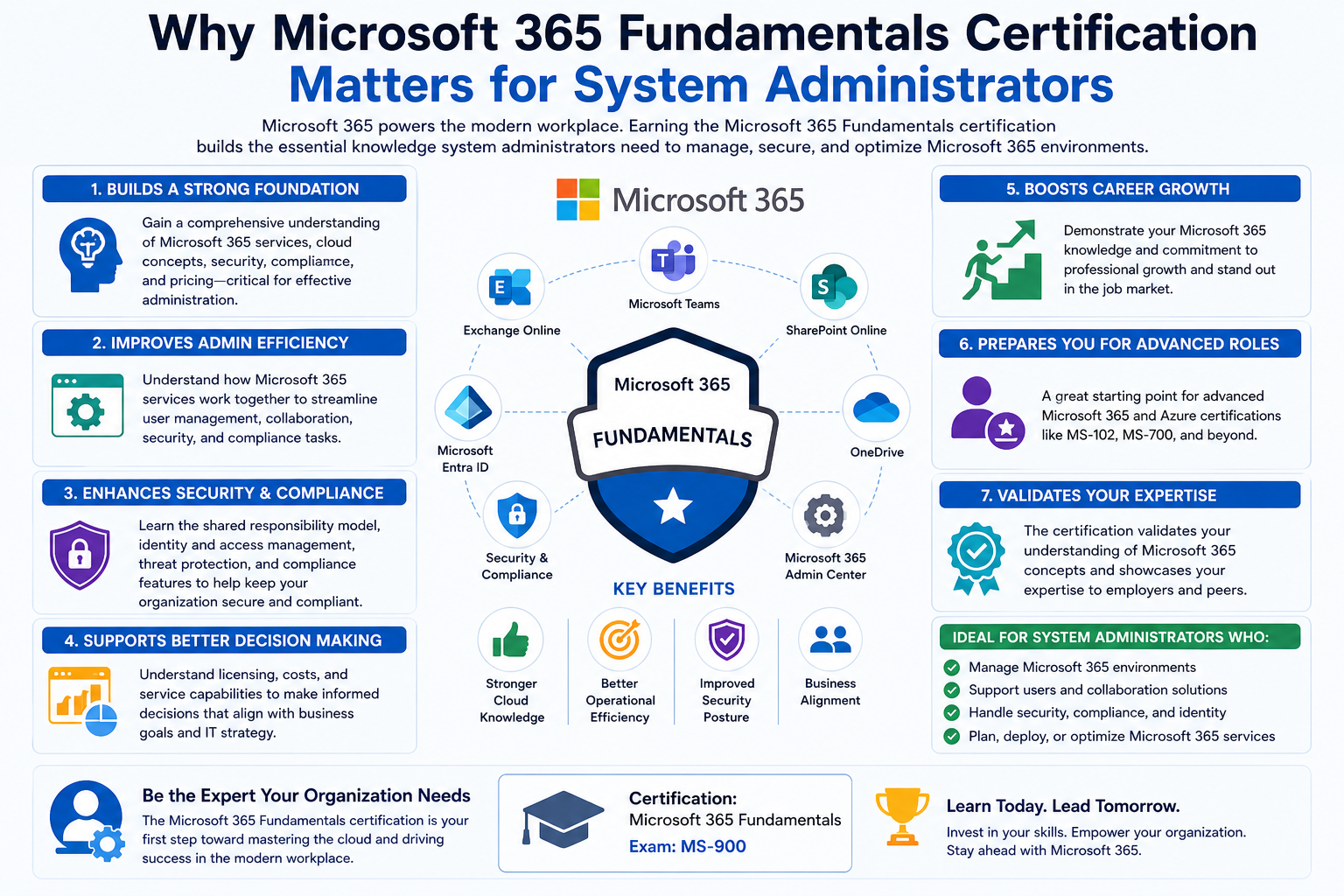
The idea of cloud computing has transformed how organizations operate, offering flexibility, scalability, and cost efficiency that traditional on-premises systems often struggle to match. At its core, cloud computing allows businesses to access computing resources such as storage, processing power, and applications on demand, paying only for what they use. This model reduces the need for heavy upfront investments in infrastructure and enables companies to adapt quickly to changing demands. However, while the concept itself is relatively simple, navigating the ecosystem of cloud providers and services can become complex, especially for those responsible for managing IT environments.
For systems administrators, this complexity raises an important question: how much foundational knowledge is necessary to effectively evaluate and support cloud solutions? Certifications like Microsoft 365 Certified: Fundamentals, commonly known as MS-900, aim to answer that question by validating a basic understanding of cloud services and Microsoft’s offerings. But determining whether this certification is truly valuable requires a deeper look at what it covers and how it aligns with the responsibilities of a systems administrator.
Breaking Down the Purpose of the MS-900 Certification
The Microsoft 365 Certified: Fundamentals certification is designed to provide a broad overview of cloud concepts and Microsoft 365 services. Rather than focusing on deep technical skills, it emphasizes conceptual understanding. This includes knowledge of Software as a Service (SaaS), the benefits of cloud computing, and how Microsoft 365 delivers productivity and collaboration tools through a subscription-based model.
This certification targets individuals who may not have a strong technical background but still need to understand cloud services. That includes business users, decision-makers, and entry-level IT professionals. For systems administrators, especially those early in their careers, the MS-900 can serve as a stepping stone into more advanced certifications by establishing a solid conceptual foundation.
Unlike more technical exams, the MS-900 does not require candidates to configure systems or troubleshoot complex issues. Instead, it focuses on ensuring that candidates can clearly explain what Microsoft 365 is, how it works, and why organizations might choose it over other solutions. This makes it more accessible but also raises questions about its depth and relevance for experienced professionals.
Exploring the Core Focus Areas of the MS-900 Exam
The MS-900 exam is structured around four main objectives, each addressing a key aspect of cloud computing and Microsoft 365. These objectives include understanding general cloud concepts, identifying core Microsoft 365 services, explaining security and compliance features, and describing pricing and support models.
The emphasis on terms like “describe” and “explain” highlights the exam’s focus on knowledge rather than application. Candidates are expected to understand concepts and communicate them effectively, rather than demonstrate hands-on technical expertise. This approach makes the certification suitable for those who need to participate in discussions about cloud adoption or support business decisions related to IT infrastructure.
For systems administrators, these objectives can still be relevant. Even though their roles often involve technical tasks, having a clear understanding of the broader context in which those tasks exist can improve communication with stakeholders and enhance decision-making. Knowing why a company chooses a particular service or how licensing impacts costs can be just as important as knowing how to configure a system.
Evaluating the Cost and Accessibility of the Certification
One of the most appealing aspects of the MS-900 certification is its affordability and accessibility. With a relatively low exam fee and no formal prerequisites, it is open to a wide range of candidates. This makes it an attractive option for individuals looking to enter the IT field or expand their knowledge without committing to a significant financial investment.
However, the low barrier to entry does not mean that preparation is unnecessary. Candidates who lack familiarity with Microsoft 365 or cloud computing concepts may still find the exam challenging. While it does not require hands-on experience, it does expect a solid understanding of how Microsoft’s services are structured and how they compare to other solutions in the market.
For systems administrators, the cost-benefit analysis is straightforward. The certification requires minimal investment in terms of both time and money, making it a low-risk way to add a recognized credential to a resume. The question then becomes whether the knowledge gained is sufficient to justify even that modest investment.
Assessing the Required Knowledge and Experience
Although there are no رسمی prerequisites for the MS-900 exam, having some prior exposure to cloud computing and Microsoft 365 can significantly improve the chances of success. Candidates are expected to understand why organizations move to the cloud, what services are available, and how those services are deployed and supported.
This includes familiarity with core Microsoft 365 applications and services, as well as a general understanding of security, compliance, and privacy considerations. While deep technical expertise is not required, candidates should be comfortable discussing these topics in a way that reflects Microsoft’s perspective and terminology.
For systems administrators, much of this knowledge may already be part of their daily work, especially if they are involved in managing or supporting cloud-based systems. In such cases, the certification can serve as a way to formalize and validate existing knowledge. For those who are newer to the field, it can provide a structured introduction to key concepts that will be built upon in more advanced roles.
Identifying the Ideal Candidates for the MS-900
The MS-900 certification is particularly well-suited for individuals who need to understand cloud services without necessarily working directly with their technical implementation. This includes business professionals, sales teams, and entry-level IT staff who participate in discussions about technology adoption.
For systems administrators, the value of the certification depends largely on their level of experience and career goals. Junior administrators may find it useful as a starting point, helping them build confidence and demonstrate a baseline level of knowledge. More experienced professionals, on the other hand, may find the content too basic to significantly enhance their skill set.
That said, even experienced administrators can benefit from the certification in certain contexts. For example, those who need to communicate with non-technical stakeholders or contribute to strategic planning may find that the MS-900 helps them articulate concepts more effectively. It can also be useful for professionals transitioning into cloud-focused roles who want to ensure they have a solid understanding of fundamental concepts.
Understanding the Role of MS-900 in Career Development
In the broader landscape of IT certifications, the MS-900 occupies a unique position. It is not designed to replace more advanced certifications or serve as proof of technical expertise. Instead, it acts as an entry point, providing foundational knowledge that can support further learning and specialization.
For systems administrators, this means that the MS-900 should be viewed as part of a larger learning path rather than a конечная цель. It can help bridge the gap between general IT knowledge and more specialized cloud skills, making it easier to pursue certifications focused on administration, security, or architecture.
By establishing a clear understanding of Microsoft 365 and cloud concepts, the MS-900 can also help administrators make more informed decisions about which areas to تخصص in. Whether they choose to focus on identity management, security, or infrastructure, the foundational knowledge gained from this certification can provide a useful context for more advanced studies.
Recognizing the Practical Benefits of Foundational Knowledge
Even though the MS-900 does not emphasize hands-on skills, the knowledge it provides can still have practical applications. Understanding how Microsoft 365 services are structured and how they interact with each other can improve troubleshooting, planning, and communication.
For example, knowing the الفرق between different subscription plans or understanding how compliance features are implemented can help administrators make better recommendations to their organizations. It can also reduce misunderstandings when working with vendors or stakeholders who may not have a technical background.
In many cases, the ability to clearly explain concepts is just as important as the ability to implement them. The MS-900 helps develop this skill by requiring candidates to think about cloud services from a conceptual perspective. This can be particularly valuable in environments where administrators are expected to take on advisory roles in addition to their technical responsibilities.
Balancing Simplicity and Relevance for Systems Administrators
One of the main criticisms of the MS-900 certification is that it may be too simplistic for experienced systems administrators. This is a valid concern, especially for those who are already comfortable working with cloud technologies and managing complex environments.
However, simplicity does not necessarily mean a lack of value. For some professionals, the certification can serve as a quick and easy way to validate knowledge that they already possess. It can also act as a refresher, helping them revisit fundamental concepts that may not be part of their daily tasks.
Ultimately, the relevance of the MS-900 depends on how it is used. For those who approach it as a learning opportunity and a stepping stone to more advanced certifications, it can be a worthwhile investment. For those seeking to demonstrate deep technical expertise, it may be less impactful on its own.
Examining the Broader Impact of Cloud Literacy
As cloud computing continues to evolve, the importance of cloud literacy is increasing across all roles within an organization. Systems administrators are no exception. Even if their primary responsibilities involve technical tasks, they are often required to understand and explain how cloud services fit into the overall IT strategy.
The MS-900 certification contributes to this broader goal by promoting a common understanding of cloud concepts and terminology. This can improve collaboration between technical and non-technical teams, reduce miscommunication, and support more effective decision-making.
For organizations, having employees who understand the fundamentals of cloud computing can lead to better outcomes when adopting new technologies. For individuals, it can open up new opportunities and make it easier to adapt to changes in the industry.
Continuing the Evaluation of MS-900 for Systems Administrators
As the role of systems administrators continues to evolve, certifications like the MS-900 play a role in shaping how professionals approach learning and development. While it may not be the most advanced or technically demanding certification, it provides a foundation that can support дальнейший рост and specialization.
The decision to pursue the MS-900 ultimately depends on individual goals, experience levels, and the specific demands of a given role. For some, it will be a valuable introduction to cloud computing and Microsoft 365. For others, it may serve as a quick validation of existing knowledge.
In either case, understanding what the certification offers and how it aligns with professional objectives is key to making an informed decision.
Evaluating the Practical Relevance of MS-900 for Daily Administrative Work
For systems administrators, the real value of any certification lies in how well it translates into everyday responsibilities. The Microsoft 365 Certified: Fundamentals certification does not directly train candidates to configure servers, manage identities in depth, or troubleshoot complex enterprise environments. Instead, it builds a conceptual framework that supports those activities indirectly. This distinction is important because many administrators initially expect certifications to focus heavily on technical execution, while the MS-900 takes a broader, knowledge-driven approach.
In practical terms, the MS-900 helps administrators understand the “why” behind the tools they use. For example, instead of just deploying services, it encourages an understanding of why organizations choose cloud-based solutions over traditional infrastructure. This includes considerations such as scalability, cost efficiency, accessibility, and business continuity. While these topics may not seem technical at first glance, they directly influence how systems are designed and maintained. Administrators who grasp these concepts are often better equipped to align their technical decisions with business goals.
Additionally, administrators frequently interact with non-technical stakeholders, including managers, finance teams, and end users. In such interactions, the ability to explain cloud services in simple terms becomes a valuable skill. The MS-900 supports this by focusing on clear explanations of Microsoft 365 offerings, enabling administrators to communicate effectively without relying on overly technical language. This can improve collaboration and reduce misunderstandings, particularly in organizations undergoing digital transformation.
Understanding Microsoft 365 Services from a Broader Perspective
A key component of the MS-900 certification is its coverage of Microsoft 365 services and applications. Rather than diving deep into configuration details, the exam emphasizes what each service does and how it contributes to productivity and collaboration. This includes tools for communication, document management, security, and employee engagement.
For systems administrators, this broader perspective can be surprisingly useful. In many environments, administrators are responsible not only for maintaining systems but also for recommending solutions. Understanding the full range of available services allows them to suggest tools that best meet organizational needs. For example, knowing how different collaboration platforms function can help administrators guide teams toward more efficient workflows.
Another advantage of this high-level understanding is the ability to identify overlaps and redundancies within an organization’s technology stack. Many companies adopt multiple tools with similar functionalities, often leading to inefficiencies and increased costs. By understanding what Microsoft 365 offers as a unified platform, administrators can help streamline operations and reduce unnecessary complexity.
This knowledge also supports better planning when implementing new services. Instead of approaching each tool in isolation, administrators can consider how different components of Microsoft 365 integrate with each other. This holistic view can lead to more cohesive and effective IT environments, even if the certification itself does not teach the technical steps required for implementation.
Exploring Security, Compliance, and Trust Concepts
Security and compliance are critical aspects of modern IT environments, and the MS-900 introduces these topics within the context of Microsoft 365. While it does not provide in-depth technical training, it explains the principles behind protecting data, managing access, and meeting regulatory requirements.
For systems administrators, this foundational knowledge is highly relevant. Even if they are not directly responsible for designing security architectures, they often play a role in implementing and maintaining them. Understanding the purpose of security features and compliance tools helps administrators use them more effectively and avoid common mistakes.
The certification also emphasizes the shared responsibility model, which is a fundamental concept in cloud computing. This modelوضح how responsibilities are تقسیم between the cloud provider and the customer. For administrators transitioning from on-premises environments, this can be an important shift in mindset. Recognizing which tasks are handled by the provider and which remain the organization’s responsibility is essential for maintaining secure and compliant systems.
Furthermore, the MS-900 highlights the importance of trust in cloud services. Organizations need assurance that their data is handled responsibly and that privacy is protected. Administrators who understand these concerns can better address questions from stakeholders and contribute to building confidence in cloud adoption.
Analyzing Pricing Models and Licensing Structures
One of the more practical areas covered by the MS-900 is pricing and licensing. Microsoft 365 offers a wide range of subscription plans, each with different features and costs. Understanding these options is essential for making informed decisions about which services to use.
For systems administrators, this knowledge can have a direct impact on budgeting and resource allocation. While they may not always be responsible for financial decisions, they often provide input on which tools are necessary and how they should be deployed. Being able to compare licensing options and سمجھ their implications can lead to more cost-effective solutions.
Licensing can also affect how services are implemented and managed. Different plans may include or exclude certain features, which can influence configuration choices and user access. Administrators who understand these differences can avoid مشکلات that arise from mismatched expectations or incorrect configurations.
Another benefit of understanding pricing models is the ability to scale services appropriately. Cloud computing allows organizations to adjust their usage based on demand, but this flexibility requires careful planning. Administrators who are familiar with pricing structures can help ensure that resources are used efficiently دون unnecessary expenses.
Comparing MS-900 with More Advanced Certifications
When evaluating the MS-900, it is important to consider how it compares to more advanced certifications. Microsoft offers a wide range of certifications focused on specific roles, such as administration, security, and architecture. These certifications typically require deeper technical knowledge and hands-on experience.
For systems administrators seeking to advance their careers, these role-based certifications may offer more immediate benefits. They demonstrate the ability to perform complex tasks and manage real-world environments, which are often key requirements for higher-level positions. In comparison, the MS-900 serves as an introductory certification that focuses on understanding rather than execution.
However, this does not mean that the MS-900 lacks value. In fact, it can complement more advanced certifications by providing context and clarity. Administrators who start with the fundamentals may find it easier to understand advanced topics later on. The certification can also fill gaps in knowledge, particularly for those who have learned through hands-on experience but lack formal training in cloud concepts.
Ultimately, the choice between the MS-900 and more advanced certifications depends on individual goals. For those looking to build a strong foundation, the MS-900 can be a logical starting point. For those aiming to تخصص in specific areas, it may be more efficient to focus on certifications that align directly with their career مسیر.
Recognizing the Role of MS-900 in Team Environments
In many organizations, systems administrators work as part of larger teams that include developers, security specialists, and business analysts. In such environments, having a shared understanding of cloud concepts can improve collaboration and reduce friction.
The MS-900 contributes to this shared understanding by providing a common language for discussing Microsoft 365 and cloud services. When team members have a similar مستوى of knowledge, it becomes easier to coordinate efforts and align objectives. This can be particularly important during projects that involve multiple departments or require cross-functional collaboration.
For administrators, this means that the certification can enhance their ability to work effectively within a team. Even if they already possess technical expertise, the ability to communicate concepts clearly and understand the perspectives of others can lead to better outcomes. This is especially true in organizations where cloud adoption is still evolving and roles are not strictly defined.
Examining Learning Outcomes Beyond the Certification
Preparing for the MS-900 involves studying a range of topics related to cloud computing and Microsoft 365. This learning process itself can be valuable, regardless of whether the certification is ultimately pursued.
For systems administrators, the preparation phase can reveal gaps in knowledge and provide opportunities to explore new areas. For example, learning about collaboration tools or employee experience platforms may highlight features that are not currently being used within their organization. This can lead to improvements in productivity and user satisfaction.
The certification also encourages a structured approach to learning. Instead of relying solely on تجربہ or informal training, candidates follow a defined set of objectives that cover key concepts. This can help ensure a more comprehensive understanding of the subject matter.
In addition, the knowledge gained أثناء preparation can be applied immediately in the workplace. Even without advanced technical skills, administrators can use their understanding of cloud concepts to make better decisions and provide more informed recommendations.
Balancing Time Investment with Career Benefits
One of the key considerations when pursuing any certification is the time required for preparation. The MS-900 is generally considered a low-effort certification compared to more advanced options. This makes it appealing for individuals with busy schedules or limited resources.
For systems administrators, this low time investment can be a significant advantage. It allows them to gain a recognized credential without disrupting their daily responsibilities. At the same time, it provides an opportunity to refresh their knowledge and stay current with industry trends.
However, it is important to consider whether this time could be better spent on more advanced training. For administrators who already have a strong understanding of cloud concepts, the MS-900 may offer limited additional value. In such cases, focusing on certifications that provide hands-on experience and technical depth may be more beneficial.
On the other hand, for those who are new to cloud computing or transitioning into cloud-focused roles, the MS-900 can provide a سریع and effective way to build confidence and establish a foundation for further learning.
Understanding the Limitations of a Fundamentals Certification
While the MS-900 offers several benefits, it is important to acknowledge its limitations. As a fundamentals certification, it does not cover advanced topics such as detailed configurations, automation, or complex troubleshooting. This means that it cannot replace practical experience or more تخصص training.
For systems administrators, this limitation is particularly relevant. Their roles often require hands-on skills and the ability to حل مشکلات in real-world environments. The MS-900 does not directly address these requirements, which can make it less impactful for those seeking to demonstrate technical expertise.
However, recognizing these limitations can help set realistic expectations. The MS-900 is not intended to be a comprehensive certification for administrators. Instead, it serves as a stepping stone that introduces key concepts and prepares candidates for more advanced learning.
By understanding what the certification can and cannot provide, administrators can make informed decisions about how it fits into their overall career strategy.
Exploring How MS-900 Supports Transition into Cloud-Focused Roles
As organizations continue shifting toward cloud-first strategies, systems administrators are increasingly expected to adapt their skill sets. Traditional responsibilities مثل managing on-premises servers and infrastructure are gradually being supplemented—or even replaced—by cloud-based administration tasks. In this evolving landscape, certifications like Microsoft 365 Certified: Fundamentals can play a role in helping administrators transition into cloud-focused roles.
The MS-900 provides a structured introduction to cloud التفكير, which can be particularly useful for administrators who have spent most of their careers working with local infrastructure. Understanding how cloud environments differ from on-premises setups is not just about learning new tools; it involves adopting a different mindset. Concepts such as scalability, shared responsibility, and subscription-based services fundamentally change how IT systems are designed and managed.
For administrators making this transition, the MS-900 can act as a bridge. It does not overwhelm candidates with technical complexity but instead focuses on helping them understand the bigger picture. This can make the shift to cloud technologies less intimidating and more approachable. Once this foundation is established, administrators can move on to more advanced certifications that focus on hands-on skills and تخصص.
Additionally, the certification introduces key terminology used in cloud environments. This is particularly important because effective communication often depends on using the correct language. Administrators who are familiar with cloud-related terms are better equipped to participate in discussions, collaborate with colleagues, and interpret documentation.
Understanding the Role of MS-900 in Organizational Decision-Making
Systems administrators are not always limited to technical التنفيذ; they often play a role in advising organizations on technology choices. Whether it is recommending a migration strategy or evaluating new tools, their input can influence important decisions. The MS-900 supports this aspect of the role by providing knowledge that extends beyond technical implementation.
For example, understanding the benefits and limitations of cloud services allows administrators to contribute to strategic planning. They can help organizations weigh factors such as cost, flexibility, security, and performance when deciding whether to adopt or expand cloud solutions. This broader perspective can make administrators more valuable to their organizations, as they are able to connect technical considerations with business outcomes.
The certification also highlights how Microsoft 365 fits into the competitive landscape of cloud providers. While it does not provide an exhaustive comparison, it helps candidates understand what differentiates Microsoft’s offerings. This knowledge can be useful when organizations are evaluating multiple vendors or considering hybrid solutions.
In many cases, decision-makers rely on administrators to explain the practical implications of adopting new technologies. The ability to clearly articulate these implications can strengthen trust and improve the quality of decisions. The MS-900 helps develop this ability by emphasizing explanation and understanding rather than technical execution.
Examining the Learning Curve and Study Approach
One of the appealing aspects of the MS-900 certification is its manageable learning curve. Unlike more advanced certifications that require extensive hands-on practice, the MS-900 can be prepared for through مطالعه of concepts, documentation, and training materials. This makes it accessible to a wide range of candidates, including those who may not have access to complex lab environments.
For systems administrators, the preparation process can be relatively straightforward. Many of the topics covered in the exam overlap with their existing knowledge, especially if they have experience with Microsoft products or cloud services. This can reduce the amount of time required to study and increase the likelihood of success.
However, it is still important to approach the exam with a clear strategy. Simply relying on general experience may not be sufficient, as the exam often expects answers that align with Microsoft’s رسمی perspective. This means that candidates should familiarize themselves with how Microsoft defines concepts, describes benefits, and positions its services.
Using official documentation and structured learning resources can help ensure that preparation is aligned with exam objectives. Practice exams and مراجعة materials can also be useful for identifying areas where additional study is needed. While the certification is considered entry-level, taking it seriously can improve both the learning experience and the outcome.
Analyzing the Impact on Resume and Professional Credibility
Certifications are often used as a way to demonstrate knowledge and commitment to professional development. The MS-900, while basic, can still contribute to a stronger resume, particularly for those at the beginning of their careers. It shows that the candidate has taken the initiative to learn about cloud services and understands the fundamentals of Microsoft 365.
For junior systems administrators, this can be especially valuable. When competing for entry-level or early-career positions, having a recognized certification can help differentiate them from other candidates. It provides tangible evidence of knowledge, even if practical experience is limited.
For more experienced administrators, the impact on credibility may be less significant. Employers and colleagues are more likely to focus on hands-on experience and advanced skills. However, the MS-900 can still serve as a supplementary credential that reinforces existing knowledge and demonstrates a well-rounded understanding of cloud concepts.
In some cases, organizations may also value certifications as part of their internal development programs. Employees who earn certifications may be seen as proactive and motivated, which can lead to new opportunities or responsibilities. While the MS-900 alone is unlikely to dramatically change a career trajectory, it can contribute to a positive professional image.
Exploring How MS-900 Enhances Communication Skills
Technical expertise is only one aspect of being an effective systems administrator. Communication skills are equally important, especially in environments where administrators تعامل with users, managers, and other stakeholders. The MS-900 indirectly supports the development of these skills by focusing on explanation and understanding.
By learning how to describe cloud concepts in simple terms, administrators become better communicators. They can explain the benefits of cloud services, clarify misconceptions, and guide users through changes. This is particularly important during transitions, such as migrating to Microsoft 365, where clear communication can reduce resistance and improve adoption.
The certification also encourages administrators to think about technology from the perspective of different audiences. Instead of focusing solely on technical details, they learn to consider how services impact productivity, collaboration, and business outcomes. This broader perspective can make their communication more relevant and effective.
In many organizations, administrators are expected to act as a bridge between technical and non-technical teams. The ability to translate complex concepts into understandable language is a valuable skill that can enhance their overall effectiveness. The MS-900 helps develop this skill by emphasizing clarity and comprehension.
Understanding the Relationship Between MS-900 and Real-World Experience
While the MS-900 provides valuable knowledge, it is important to recognize that it does not replace real-world experience. Systems administration is a practical field that requires hands-on skills and problem-solving abilities. Certifications can support this experience, but they cannot fully replicate it.
For administrators, the ideal approach is to combine theoretical knowledge with practical application. The MS-900 can serve as a starting point, helping them understand the concepts behind the tools they use. This understanding can then be reinforced through real-world tasks, such as managing users, configuring services, and troubleshooting issues.
In some cases, the knowledge gained from the MS-900 can even enhance practical experience. For example, understanding why certain features exist or how they are intended to be used can lead to more effective implementation. It can also help administrators avoid common pitfalls and make better decisions.
However, relying solely on a fundamentals certification without gaining hands-on experience is unlikely to be sufficient for career growth. Administrators should view the MS-900 as one component of a broader learning strategy that includes practical training and advanced certifications.
Evaluating the Usefulness for Different Career Stages
The value of the MS-900 varies depending on where an individual is in their career. For those just starting out, it can provide a clear introduction to cloud computing and Microsoft 365. This can make it easier to understand more advanced topics and build confidence in their abilities.
For mid-level administrators, the certification may serve as a refresher or a way to formalize existing knowledge. It can also be useful for those who are transitioning into roles that require more interaction with cloud services or business stakeholders.
For senior administrators and specialists, the MS-900 is less likely to provide significant new insights. At this stage, professionals typically require certifications that focus on advanced skills and تخصص. However, even at this level, the certification can still have value in specific contexts, such as training new team members or supporting organizational initiatives.
Understanding how the certification fits into different career stages can help administrators make informed decisions about whether to pursue it. It also highlights the importance of aligning certification choices with long-term goals.
Exploring the Broader Benefits of Cloud Awareness
Beyond its immediate impact on skills and knowledge, the MS-900 contributes to a broader awareness of cloud computing trends. As technology continues to evolve, staying informed about these trends is essential for maintaining relevance in the field.
For systems administrators, this awareness can influence career decisions and areas of specialization. Understanding the direction in which the industry is moving can help them identify opportunities and prepare for future challenges. The MS-900 provides a snapshot of current cloud practices and Microsoft’s approach to delivering services.
This awareness can also enhance adaptability. Administrators who understand fundamental concepts are better equipped to learn new tools and technologies as they emerge. Instead of starting from scratch, they can build on existing knowledge and quickly adjust to changes.
In a rapidly changing industry, the ability to adapt is a key عامل for long-term success. The MS-900 supports this by providing a foundation that can be expanded upon as new developments arise.
Continuing the In-Depth Assessment of MS-900
As the evaluation of the MS-900 continues, it becomes clear that its value is not defined solely by its technical depth. Instead, it lies in its ability to provide clarity, context, and foundational knowledge. For systems administrators, these qualities can complement technical skills and support overall professional growth.
The certification may not be the most challenging or prestigious option available, but it serves a specific purpose within the broader ecosystem of IT certifications. Understanding this purpose is key to determining whether it aligns with individual needs and objectives.
Weighing the Long-Term Career Impact of the MS-900 Certification
When considering any certification, systems administrators often look beyond immediate benefits and focus on long-term career impact. The Microsoft 365 Certified: Fundamentals credential is not designed to transform a career overnight, but it can contribute to steady professional growth when used strategically. Its role is subtle yet meaningful, particularly for those building a foundation in cloud technologies.
Over time, the IT industry continues to shift toward cloud-centric models, and professionals who understand these environments are better positioned for future opportunities. The MS-900 introduces concepts that remain relevant as organizations expand their reliance on cloud services. Even as technologies evolve, the fundamental ideas حول scalability, subscription models, and service-based architecture remain consistent.
For systems administrators, this means the certification can act as a stepping stone rather than a конечный achievement. It prepares individuals to engage with more advanced topics and certifications, which ultimately have a greater influence on career progression. By establishing a baseline understanding, the MS-900 reduces the learning curve associated with deeper technical training.
Additionally, the certification can signal adaptability. Employers often value candidates who demonstrate a willingness to learn and stay current with industry trends. Even a fundamentals certification can indicate that an administrator is aware of the importance of cloud computing and is taking steps to remain relevant in a changing field.
Understanding How MS-900 Fits into a Certification Pathway
A key strength of the MS-900 lies in how it fits into a broader certification pathway. Microsoft offers a structured ecosystem of certifications that progress from foundational knowledge to advanced تخصص. The MS-900 sits at the entry level, providing the groundwork for more specialized credentials in areas such as administration, security, and identity management.
For systems administrators, this progression is particularly important. While the MS-900 introduces essential concepts, it does not provide the technical depth required for managing complex environments. However, it creates a logical starting point for pursuing more advanced certifications that focus on hands-on skills.
Following the MS-900, administrators can explore role-based certifications that align with their career goals. These certifications build on the foundational knowledge and dive deeper into real-world scenarios, requiring candidates to demonstrate practical expertise. By starting with the fundamentals, administrators can approach these advanced topics with greater confidence and clarity.
This structured approach to learning can also improve retention. Instead of محاولة to absorb complex concepts all at once, candidates gradually build their knowledge. The MS-900 plays an important role in this process by introducing key ideas in a manageable and accessible way.
Analyzing the Return on Investment for Time and Effort
From a practical standpoint, systems administrators must consider whether the time and effort required for the MS-900 are justified. Compared to more advanced certifications, the investment is relatively low. Preparation can often be completed within a short timeframe, especially for those who already have some familiarity with Microsoft products or cloud services.
The financial cost is also minimal, making it accessible to a wide range of candidates. This combination of low cost and low time commitment results in a favorable return on investment for many individuals. Even if the certification does not significantly enhance technical skills, it can still provide value in terms of knowledge, confidence, and professional recognition.
However, the return on investment depends largely on individual circumstances. For administrators who already possess a strong understanding of cloud concepts, the incremental benefit may be limited. In such cases, the time spent preparing for the MS-900 might be better allocated to more advanced training.
On the other hand, for those who are new to cloud computing or looking to formalize their knowledge, the certification can offer a strong return. It provides a clear structure for learning and a recognized credential that can support career development.
Recognizing the Importance of Context in Certification Value
The value of the MS-900 cannot be assessed in isolation; it must be considered within the context of an individual’s role, organization, and career goals. In some environments, the certification may be highly relevant, while in others it may have little impact.
For example, in organizations that are actively adopting Microsoft 365, having a foundational understanding of the platform can be extremely beneficial. Administrators in these environments may find that the MS-900 helps them contribute more effectively to projects and discussions. It can also support smoother transitions during migrations or upgrades.
In contrast, administrators working in highly specialized or non-Microsoft environments may find the certification less applicable. While the general cloud concepts are still relevant, the specific focus on Microsoft 365 may limit its usefulness in certain contexts.
This highlights the importance of aligning certification choices with actual job requirements. Rather than pursuing certifications based solely on popularity or accessibility, administrators should consider how each option supports their текущ responsibilities and future aspirations.
Exploring the Psychological Benefits of Earning a Certification
Beyond tangible career benefits, certifications can also have psychological advantages. For many systems administrators, earning a certification provides a sense of accomplishment and мотивация. This can be particularly important for those who are early in their careers or transitioning into new areas.
The MS-900, with its accessible structure, offers an فرصة to achieve a recognized credential without overwhelming difficulty. Successfully passing the exam can boost confidence and encourage further learning. This positive reinforcement can play a significant role in maintaining momentum in professional development.
Confidence is not just a personal benefit; it can also influence workplace performance. Administrators who feel confident in their knowledge are more likely to participate in discussions, پیشنهاد ideas, and take initiative. The MS-900 can contribute to this confidence by validating foundational understanding.
Additionally, the process of studying for the certification can help develop disciplined learning habits. These habits are valuable for ongoing growth, as the IT field requires continuous learning and adaptation.
Understanding When MS-900 May Not Be the Right Choice
While the MS-900 has clear benefits, it is not the right choice for everyone. Systems administrators who already have extensive experience with cloud technologies may find the content too basic to be worthwhile. In such cases, the certification may not provide enough new knowledge to justify the effort.
Similarly, administrators who are focused on highly technical roles may benefit more from certifications that emphasize hands-on skills and advanced configurations. These certifications are often more aligned with the demands of complex IT environments and can have a greater impact on career advancement.
It is also important to consider personal learning preferences. Some individuals prefer practical, hands-on learning over theoretical study. Since the MS-900 is primarily conceptual, it may not be as engaging or effective for those who learn best through direct experience.
Recognizing these limitations is essential for making informed decisions. The goal is not to collect certifications but to pursue those that genuinely support growth and align with professional objectives.
Connecting MS-900 Knowledge to Real Business Outcomes
One of the often-overlooked aspects of the MS-900 is its connection to business outcomes. While it does not teach technical implementation, it provides insight into how cloud services impact productivity, collaboration, and cost management.
For systems administrators, this connection can enhance their ability to contribute to organizational success. By understanding how Microsoft 365 supports business اهداف, administrators can make more informed decisions and provide recommendations that align with those goals.
For example, knowledge of collaboration tools can help improve team efficiency, while understanding licensing models can lead to cost savings. These contributions may not always be visible, but they can have a significant impact on overall performance.
In many organizations, the role of the systems administrator is expanding to include strategic input. The MS-900 supports this shift by providing knowledge that goes beyond technical execution and addresses broader organizational needs.
Final Conclusion
The question of whether the Microsoft 365 Certified: Fundamentals certification is worth it for systems administrators does not have a simple yes or no answer. Its value depends on how it is used and what the individual hopes to achieve.
For junior administrators, career changers, or those new to cloud computing, the MS-900 can be a valuable starting point. It provides a clear introduction to essential concepts and helps build confidence in understanding Microsoft 365. The low cost and accessible nature of the certification make it an attractive option for those looking to enter the field or expand their knowledge.
For more experienced professionals, the certification may serve as a supplementary credential rather than a primary focus. While it may not significantly enhance technical expertise, it can still provide benefits in terms of communication, context, and foundational understanding.
Ultimately, the MS-900 is a lightweight certification with a specific purpose. It is not intended to replace advanced training or hands-on experience, but it can complement them. Systems administrators who approach it with realistic expectations and integrate it into a broader learning strategy are more likely to find it worthwhile.
The certification’s true value lies in its ability to clarify concepts, support communication, and provide a foundation for дальнейший growth. Whether it is worth pursuing depends on individual goals, experience levels, and the demands of the role.