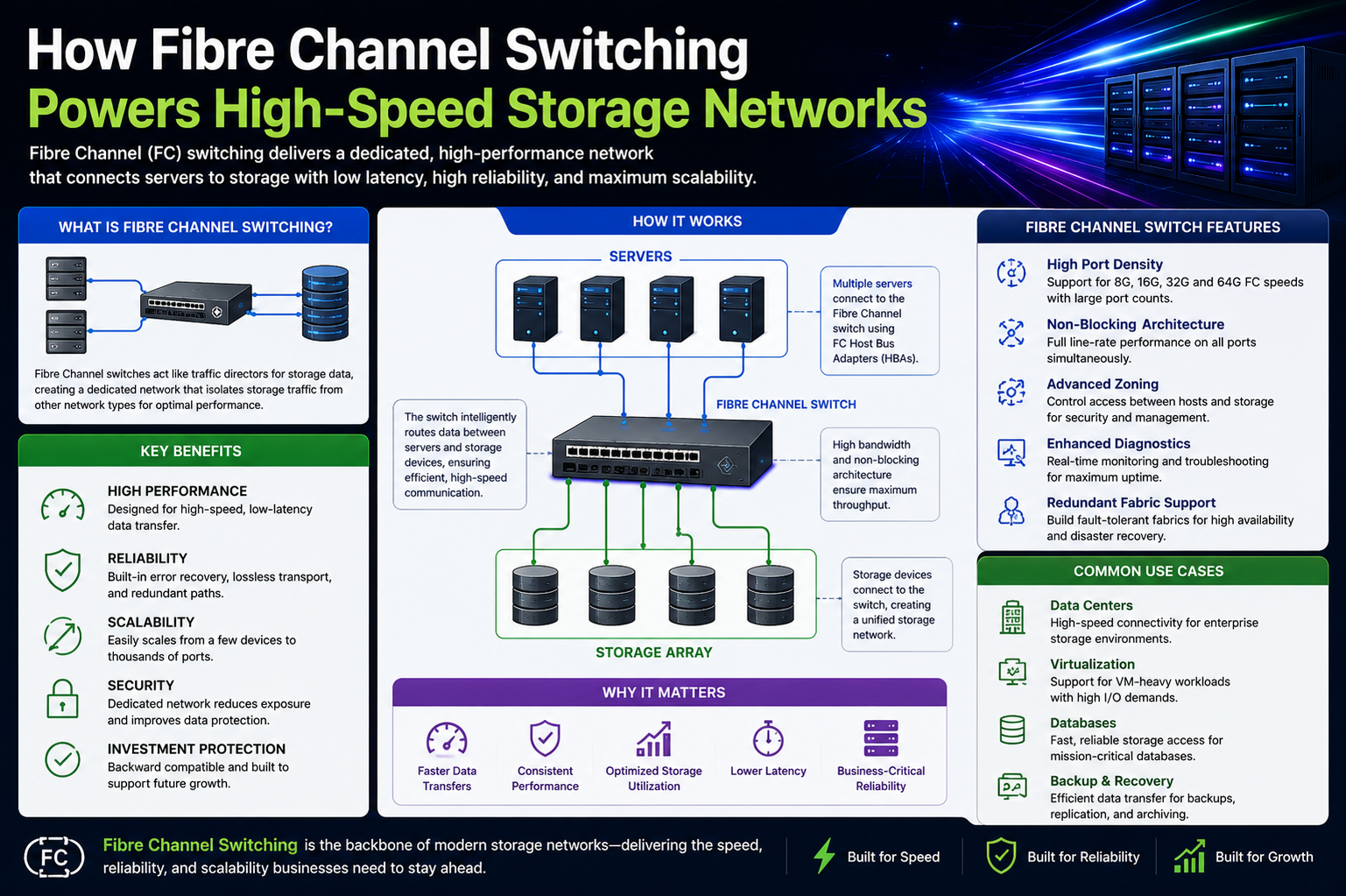
Fiber channel switching is the process of using intelligent switching devices to create a high-performance, structured network—often called a fabric—that connects servers and storage systems in a way that optimizes how data moves. Instead of sending data blindly across a shared medium, fiber channel switches analyze and direct traffic efficiently, ensuring that large volumes of information reach their destination quickly and reliably. This approach is especially valuable in environments where storage performance is critical, such as enterprise data centers and high-demand applications.
Understanding the Concept Through a Simple Analogy
To make sense of fiber channel switching, it helps to imagine a transportation system. Think of your local streets, highways, and logistics routes as a network. Everyday activities—like visiting nearby stores—use flexible and accessible roads. These roads support many types of vehicles and purposes, just like general-purpose networking technologies. However, when transporting heavy cargo over long distances, specialized routes like highways are preferred because they minimize delays and maximize efficiency.
Fiber channel switching works in a similar way. It is designed for moving large amounts of data quickly and consistently, much like a dedicated highway system built for heavy transport. Instead of competing with diverse types of network traffic, it operates within a focused environment where performance and reliability are prioritized above all else.
The Core Idea Behind Fiber Channel Technology
Fiber channel is a high-speed networking technology specifically built for storage communication. Unlike general networking systems that must handle a wide range of applications, fiber channel focuses on delivering data between servers and storage devices with minimal delay and maximum throughput. Its architecture is designed to reduce bottlenecks, maintain consistency, and ensure that critical data operations are completed without interruption.
This specialization makes fiber channel particularly effective in scenarios where large datasets must be accessed or transferred rapidly. Over time, the technology has matured and adapted to changing requirements, maintaining its relevance in modern infrastructures even as newer networking methods have emerged.
Key Terms That Define Fiber Channel Switching
Understanding fiber channel switching requires familiarity with a few essential concepts. Fiber channel itself refers to the underlying technology that enables high-speed communication between storage systems. Fiber channel switching, on the other hand, involves the use of switches to manage and direct that communication intelligently.
The term “Fibre Channel” is often used interchangeably, with the variation largely reflecting regional spelling differences rather than technical distinctions. The Fibre Channel Protocol (FCP) defines how data is formatted and transmitted within this environment, acting as the rulebook that ensures devices communicate effectively.
Another important concept is Fibre Channel over Ethernet (FCoE), which allows fiber channel traffic to travel across Ethernet networks, bridging the gap between traditional storage networking and more flexible infrastructure models. The idea of a network fabric is also central, describing the interconnected system of switches and devices that work together to route data efficiently.
The Role of Hardware in Fiber Channel Switching
While protocols and standards define how data is handled, hardware components make fiber channel switching possible in practice. One of the most critical elements is the Host Bus Adapter, which acts as the interface between a server and the fiber channel network. This specialized hardware ensures that data is transmitted correctly and efficiently between systems.
Fiber channel switches themselves form the backbone of the network. These devices are designed specifically for handling high-volume data transfers and are equipped with features that optimize performance, such as low latency and advanced traffic management capabilities. They differ from standard network switches by focusing entirely on storage communication rather than general data traffic.
Cabling and connectivity also play a crucial role. Fiber optic cables are commonly used because they support high speeds and long distances with minimal signal loss. In some cases, copper connections may be used for shorter distances, but fiber remains the preferred medium for most deployments.
Additional components, such as connectors, transceivers, and gateways, contribute to the overall functionality of the system. Together, these elements create a cohesive environment where data can flow smoothly and reliably between devices.
The Importance of Protocols and Standards
The reliability of fiber channel switching is largely due to its well-defined protocols and standards. These rules govern how data is packaged, transmitted, and received, ensuring consistency across different devices and vendors. The Fibre Channel Protocol is particularly significant, as it provides the structure needed for efficient communication within storage networks.
By adhering to these standards, organizations can build systems that are both scalable and interoperable. This consistency reduces the risk of compatibility issues and allows networks to expand without compromising performance. For network professionals, understanding these protocols is essential for designing and managing effective storage solutions.
How Fiber Channel Switching is Used in Practice
Fiber channel switching is primarily used in environments where performance and reliability are critical. Large organizations often rely on it to connect servers to storage arrays, creating dedicated pathways for data transfer. This setup ensures that applications requiring fast access to data—such as databases, virtualization platforms, and analytics tools—can operate without delays.
Unlike general networking technologies, which must accommodate a wide range of traffic types, fiber channel focuses exclusively on storage communication. This specialization allows it to deliver consistent performance even under heavy workloads. As a result, it is often the preferred choice for mission-critical systems where downtime or latency could have significant consequences.
Fiber Channel and Storage Area Networks
One of the most common applications of fiber channel switching is within Storage Area Networks. A SAN is a dedicated network that provides access to consolidated storage resources, allowing multiple servers to share and manage data efficiently. Fiber channel technology is well-suited for SANs because it offers the speed and reliability needed for high-performance storage operations.
In a SAN environment, fiber channel switches connect servers and storage devices into a unified fabric. This structure enables seamless communication and allows data to be accessed as if it were locally attached, even though it may be stored on remote systems. The result is a flexible and scalable solution that can adapt to growing data demands.
Comparing SAN and NAS Approaches
When discussing fiber channel switching, it is important to understand how it differs from other storage solutions. Storage Area Networks and Network-Attached Storage represent two distinct approaches to managing data.
SANs, which often use fiber channel, provide block-level access to storage. This means that data is delivered in raw form, allowing applications to manage it directly. This approach is ideal for performance-intensive workloads that require fast and efficient data handling.
NAS, on the other hand, typically relies on Ethernet-based protocols and provides file-level access. This makes it more suitable for general file sharing and collaborative environments, where ease of use and accessibility are more important than raw performance.
Both approaches have their advantages, but fiber channel-powered SANs stand out when speed, scalability, and reliability are the primary concerns.
The Evolution of Fiber Channel Switching
Over time, the boundaries between different types of networking technologies have begun to blur. Modern data centers often use converged infrastructures that combine storage and general networking into a single system. Despite this trend, fiber channel continues to play a significant role due to its proven performance and reliability.
Advancements in technology have introduced new ways to integrate fiber channel with other networking methods, such as running fiber channel traffic over Ethernet. These innovations allow organizations to benefit from the strengths of both approaches while simplifying their infrastructure.
Even as newer solutions emerge, fiber channel remains a trusted choice for environments where consistent performance is essential. Its ability to handle large volumes of data with minimal latency ensures that it continues to be relevant in an ever-evolving technological landscape.
Why Fiber Channel Switching Matters Today
The demand for efficient data storage and transfer has never been greater. Organizations are dealing with increasing amounts of information, and the need to access and process that data quickly is critical. Fiber channel switching addresses this challenge by providing a dedicated, high-performance solution for storage communication.
Its ability to deliver reliable and predictable performance makes it an essential component of many enterprise systems. By separating storage traffic from general network activity, it ensures that critical operations are not affected by congestion or interference.
Building Expertise in Fiber Channel Switching
For those interested in networking and data management, understanding fiber channel switching is a valuable skill. It provides insight into how high-performance storage systems operate and highlights the importance of specialized technologies in modern infrastructure.
Learning about fiber channel involves exploring both its technical and practical aspects, from hardware components to protocol configuration. This knowledge can open the door to advanced roles in network administration and data center management, where expertise in storage networking is highly sought after.
The Bigger Picture of Data Movement
At its core, fiber channel switching is about moving data efficiently. It represents a focused approach to networking, where every component is designed with performance in mind. By creating a structured and intelligent system for data transfer, it ensures that information flows smoothly between devices, supporting the applications and services that depend on it.
As data continues to grow in volume and importance, technologies like fiber channel switching will remain essential. They provide the foundation for reliable and efficient storage systems, enabling organizations to manage their information with confidence and precision.
Conclusion
Fiber channel switching stands as a purpose-built solution for environments where speed, reliability, and precision in data movement are non-negotiable. By leveraging intelligent switches within a dedicated fabric, it ensures that storage traffic flows efficiently without the congestion and unpredictability often associated with general-purpose networks. This focused design allows organizations to handle massive volumes of data while maintaining consistent performance, which is critical for modern applications that rely on real-time access and processing.
Beyond its technical strengths, fiber channel switching represents a strategic approach to infrastructure design. It separates storage communication from everyday network traffic, creating a controlled environment where data integrity and low latency are prioritized. This separation not only enhances performance but also simplifies management in complex systems, making it easier to scale operations as data demands grow.
As technology continues to evolve, fiber channel remains a dependable foundation within storage networking. Its integration with newer solutions and its adaptability to changing architectures demonstrate its lasting value. For organizations seeking efficiency and stability in their data ecosystems, fiber channel switching continues to deliver a balance of performance and reliability that few alternatives can match.