Computer programmers are the unseen builders behind almost everything digital you interact with daily. From mobile apps and websites to banking systems, online shopping platforms, and even smart home devices, their work forms the backbone of modern technology. As industries continue shifting toward automation and digital solutions, programming has become one of the most essential professions in the global workforce. What makes this role especially important is that it is not limited to one industry—programmers are needed in healthcare, finance, education, entertainment, transportation, and nearly every other field that relies on software systems. Their work ensures that digital products function smoothly, securely, and efficiently, often handling complex logic that most users never see but constantly depend on. As technology continues to evolve, the demand for skilled programmers continues to rise, making it a highly valuable and future-focused career path.
What a Computer Programmer Actually Does
A computer programmer is responsible for writing the instructions that make software and applications function correctly. These instructions, known as code, tell a computer exactly what to do, step by step. Programmers take ideas, business requirements, or technical designs and turn them into working programs that solve real-world problems. This could include creating a mobile app, developing a website feature, building internal company tools, or maintaining large-scale systems used by thousands or even millions of users. While the work may seem purely technical, it is also highly creative because programmers must constantly find efficient ways to solve problems. Every feature you see in an application—from logging in to making payments—exists because a programmer carefully designed and implemented the logic behind it. Their job is not only to build new systems but also to ensure that existing systems continue running smoothly as technology and user needs evolve over time.
Turning Ideas Into Functional Software
One of the most important aspects of programming is transforming abstract ideas into functional software. Businesses often start with a concept or a problem they want to solve, but it is the programmer who brings that idea to life in a digital form. This process involves understanding requirements, breaking them into smaller logical steps, and then translating those steps into code that a computer can execute. Programmers must think logically and systematically, ensuring that every possible scenario is accounted for so that the software behaves correctly under different conditions. They also need to consider performance, scalability, and user experience while building applications. A small mistake in logic can lead to major issues in how a program functions, so precision and attention to detail are critical. Over time, this ability to convert ideas into structured systems becomes one of the most valuable skills a programmer develops in their career.
Core Daily Responsibilities in Programming Work
The daily responsibilities of a computer programmer vary depending on the type of company and project they are working on, but there are several common tasks across most roles. Programmers spend a significant portion of their time writing new code to develop features or improve existing systems. They also review requirements provided by product managers or clients to understand what needs to be built. In many cases, they participate in planning sessions where they help design how a system should function before any code is written. Another key responsibility is maintaining existing software, which involves updating outdated features, fixing issues, and ensuring compatibility with new technologies. Programmers also spend time documenting their code so that other developers can understand and work with it in the future. This documentation is essential for teamwork and long-term maintenance of software systems, especially in large organizations where many developers collaborate on the same projects.
Writing and Maintaining Reliable Code
Writing code is only part of a programmer’s job; ensuring that the code is reliable and efficient is equally important. Reliable code means that the software performs consistently without unexpected errors or crashes. To achieve this, programmers follow structured coding practices and standards that help keep their work organized and readable. Clean code is easier to maintain, update, and debug, which becomes especially important in large systems with thousands of lines of code. Maintenance is an ongoing responsibility because software is never truly finished. As user needs change and technology evolves, programmers must revisit existing code to improve performance, fix bugs, or add new features. This continuous improvement cycle is what keeps software relevant and functional over time. In many cases, programmers also refactor code, which means restructuring it without changing its external behavior, simply to make it more efficient and easier to manage in the future.
Testing, Debugging, and System Improvement
Testing and debugging are critical parts of a programmer’s workflow. After writing code, programmers must test it to ensure that it behaves as expected in different scenarios. This includes checking how the software performs with valid inputs, invalid inputs, and unexpected user behavior. When issues are found, the debugging process begins, where programmers carefully analyze the code to identify and fix the root cause of the problem. Debugging requires patience and strong analytical thinking because errors are not always obvious and may be caused by small mistakes hidden deep within the system. In addition to fixing bugs, programmers also work on improving system performance. This might involve optimizing code so it runs faster, uses less memory, or handles more users at once. These improvements are essential in modern applications where performance and user experience play a major role in success. Without proper testing and debugging, even well-designed software can fail in real-world conditions.
Collaboration With Teams and Stakeholders
Programming is rarely a solo activity, especially in professional environments. Most programmers work as part of a larger team that includes other developers, designers, product managers, and sometimes clients or business stakeholders. Collaboration is essential because building software requires different types of expertise working together. Programmers often attend meetings where they discuss project goals, review progress, and plan upcoming features. They must also communicate technical concepts in a way that non-technical team members can understand, which is an important skill in itself. In team settings, programmers frequently review each other’s code to ensure quality and consistency. This process, known as code review, helps catch mistakes early and improves overall system design. Working effectively in a team environment also requires adaptability, as requirements can change during development, and programmers must be ready to adjust their work accordingly while maintaining progress on the project.
Programming Languages and Technical Skills
Computer programmers rely on a variety of programming languages and technical tools to complete their work. Each language has its own strengths and is used for specific types of tasks. For example, some languages are better suited for web development, while others are designed for building system-level software or mobile applications. Many programmers learn multiple languages over time to increase their flexibility and job opportunities. In addition to languages, programmers also use tools that help them manage code, track changes, and collaborate with others. Version control systems are especially important because they allow teams to work on the same project without overwriting each other’s work. Programmers also need to understand databases, operating systems, and software frameworks, depending on their area of specialization. Strong problem-solving skills are just as important as technical knowledge because programming often involves finding creative solutions to complex challenges rather than simply applying predefined instructions.
Common Job Titles in Programming Careers
The title “computer programmer” is often used broadly, but in the real world, there are many different job titles that fall under the same skill set. These include software developer, application developer, systems programmer, embedded systems developer, back-end developer, and full-stack developer. While the names differ, they all involve writing and maintaining code to build software systems. The differences usually come down to specialization. For example, front-end developers focus on the visual and interactive parts of applications, while back-end developers work on the server-side logic and databases. Systems programmers work closer to hardware and operating systems, while full-stack developers handle both front-end and back-end tasks. Despite these distinctions, all programming roles share a common foundation of logical thinking, coding ability, and problem-solving skills. Understanding these job titles helps clarify career paths and allows individuals to choose a direction that aligns with their interests and strengths.
Why Programming Skills Are in High Demand
Programming skills are in extremely high demand because nearly every industry now relies on software to operate efficiently. Businesses need applications to manage data, communicate with customers, automate tasks, and analyze performance. As digital transformation continues across the world, the need for skilled programmers grows even faster. Companies are constantly looking for professionals who can build secure, efficient, and scalable systems. Another reason for this high demand is the rapid pace of technological change. New tools, frameworks, and platforms are always emerging, and organizations need programmers who can adapt quickly. This demand is not limited to large tech companies; small businesses, startups, and government organizations also rely heavily on programming expertise. As a result, programming has become one of the most stable and future-proof career choices available today, offering opportunities across many different sectors and regions.
Flexibility of Modern Programming Careers
Modern programming careers offer a level of flexibility that is uncommon in many other professions. With the rise of remote work, many programmers now have the option to work from anywhere, as long as they can collaborate effectively with their teams. This flexibility allows individuals to access job opportunities beyond their local area, often leading to better career prospects and improved work-life balance. In addition to remote work, programming careers also offer flexibility in specialization. Programmers can move between different fields such as web development, mobile development, data engineering, or system architecture as their skills evolve. This adaptability makes programming a dynamic career where continuous learning is not just encouraged but required. As technology continues to advance, programmers who stay flexible and open to new tools and methods are more likely to grow and succeed in the long term.
Understanding Computer Programmer Salary Structures
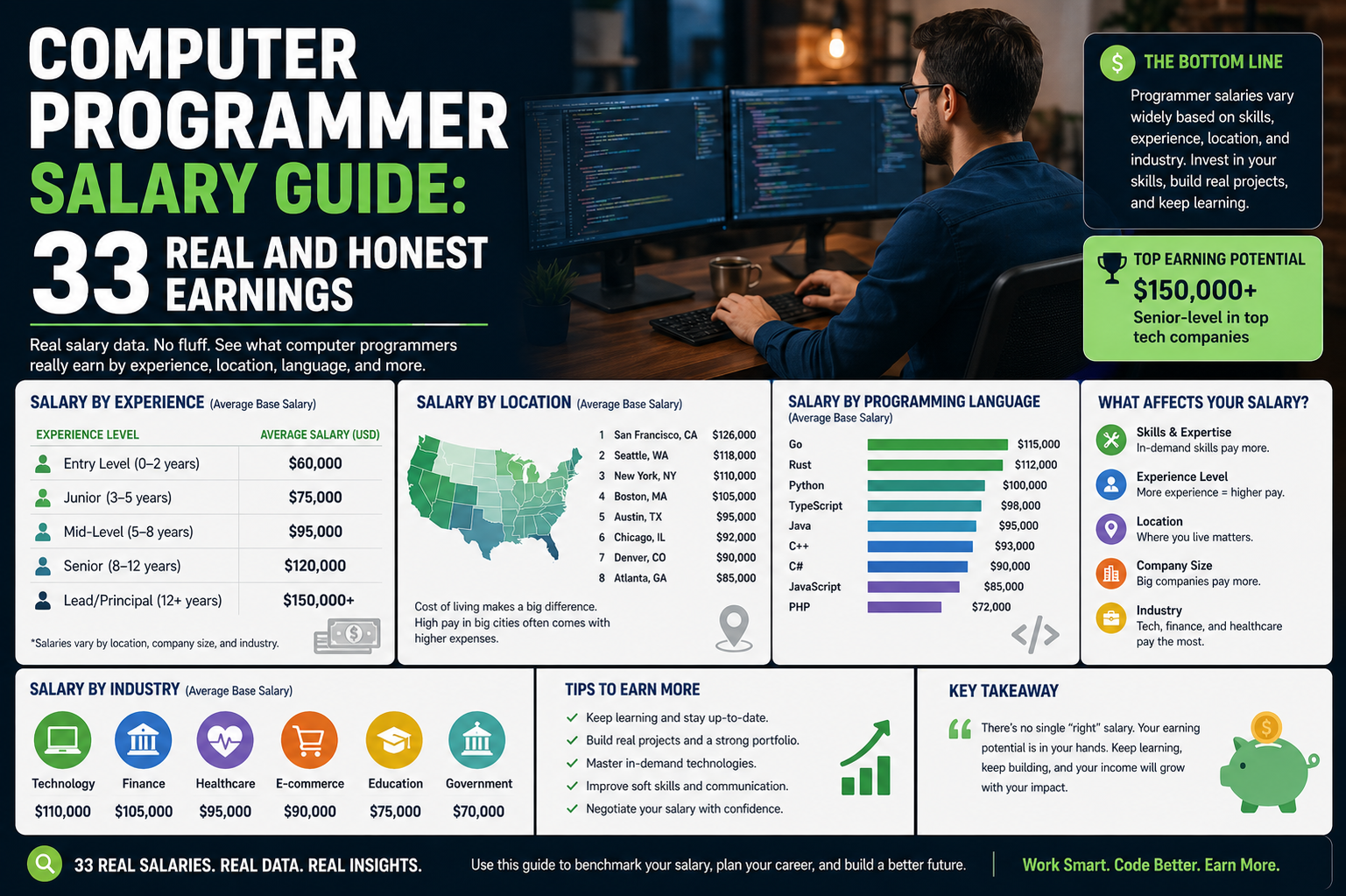
Computer programmer salaries are not fixed numbers that apply universally across the profession. Instead, they are built from a combination of base pay, experience level, industry demand, technical specialization, and geographic location. Even within the same company, two programmers may earn significantly different salaries depending on the complexity of their responsibilities and the value of their skill set. In many cases, salary structures are designed to reward both technical expertise and problem-solving ability, meaning that programmers who can handle complex systems or critical infrastructure often earn more than those working on simpler applications. Understanding how these structures work is essential for anyone trying to evaluate job offers or plan a long-term career in programming.
How Location Shapes Programmer Earnings
Location continues to play one of the strongest roles in determining how much a computer programmer earns. In high-cost regions with strong technology industries, salaries tend to be significantly higher due to competition among companies and the higher cost of living. Cities with established tech ecosystems often attract large corporations, startups, and global firms that are willing to pay premium salaries to secure skilled talent. On the other hand, smaller cities or regions with less developed tech industries usually offer lower salary ranges, although they often balance this with a lower cost of living. This means that while absolute income may be lower, purchasing power can sometimes feel more balanced depending on lifestyle and expenses. However, the rise of remote work has begun to blur these traditional location-based differences.
High Demand Tech Cities and Salary Expectations
In major technology hubs, programmer salaries tend to reach their highest levels due to intense competition for skilled professionals. These cities are often home to global tech companies, fast-growing startups, and innovation-driven industries that require advanced software systems. Programmers working in such environments are often involved in large-scale systems, artificial intelligence applications, cloud infrastructure, or high-performance software products. The complexity of work in these regions contributes directly to higher pay scales. In addition, companies in these areas often offer additional compensation benefits such as stock options, performance bonuses, and flexible work arrangements. While the cost of living in these cities is also higher, the salary growth potential is often much greater compared to smaller markets.
Mid-Level Cities With Balanced Opportunities
Mid-sized cities offer a balanced environment for computer programmers, combining reasonable salary levels with moderate living costs. These locations may not have the same level of global tech dominance as major hubs, but they still host strong regional companies, growing startups, and established enterprises that rely heavily on software development. Programmers in these areas often enjoy stable career opportunities without the extreme competition found in larger tech centers. Salaries in mid-sized cities tend to fall in a moderate range, reflecting both the demand for talent and the economic conditions of the region. Many professionals find these cities appealing because they offer a better work-life balance while still providing meaningful career growth opportunities.
Lower Salary Regions and Cost of Living Balance
In smaller cities or regions with limited tech infrastructure, programmer salaries are generally lower compared to major urban centers. However, this does not necessarily indicate weaker career opportunities. Instead, it often reflects differences in local economic conditions and cost of living. In such areas, programmers may work for local businesses, government organizations, or smaller tech firms that operate with more limited budgets. While the pay scale may be lower, daily expenses such as housing, transportation, and food are also significantly reduced. As a result, many programmers in these regions still maintain a comfortable standard of living. Additionally, remote work opportunities are increasingly allowing professionals in lower-paying regions to access higher-paying roles from companies based elsewhere.
The Impact of Remote Work on Salaries
Remote work has fundamentally changed how computer programmer salaries are structured. In the past, compensation was heavily tied to physical location, meaning that programmers had to live in high-paying cities to earn top-tier salaries. Today, many companies hire globally or nationally, allowing programmers to work from anywhere. This shift has created opportunities for individuals in lower-cost regions to earn salaries comparable to those in major tech hubs. However, not all companies follow this model. Some still adjust salaries based on the employee’s location, while others offer standardized pay regardless of geography. This variation makes remote work both an opportunity and a complex factor in salary negotiation.
Industry Differences in Programmer Pay
The industry in which a programmer works has a significant impact on earnings. Certain sectors consistently offer higher salaries due to the complexity, sensitivity, or scale of their software systems. For example, industries such as finance, cybersecurity, healthcare technology, and aerospace often require highly secure and reliable systems, which increases the value of skilled programmers. These roles may involve handling sensitive data, building real-time systems, or working with advanced algorithms, all of which contribute to higher compensation. In contrast, industries like education, non-profit organizations, or small-scale internal IT departments may offer lower salaries, although they often provide more stability or flexibility. Understanding industry differences helps programmers choose career paths that align with both their interests and financial goals.
Company Size and Its Influence on Salary
The size of a company also plays a major role in determining how much a programmer earns. Large technology companies typically have more resources and higher budgets, allowing them to offer competitive salaries, bonuses, and benefits packages. These companies often work on complex, large-scale systems that require advanced technical skills, which further increases compensation levels. Startups, on the other hand, may offer lower base salaries but compensate with equity or stock options, giving programmers a potential long-term financial upside. Smaller companies may have more limited budgets but often provide a more flexible or close-knit work environment. Each type of company offers different trade-offs between salary, growth potential, and job stability.
Experience-Based Salary Growth Patterns
Experience remains one of the most reliable predictors of salary growth in programming careers. Entry-level programmers typically start with foundational tasks such as debugging, maintaining code, and assisting in small development projects. As they gain experience, they gradually move into more complex responsibilities such as designing systems, optimizing performance, and making architectural decisions. Mid-level programmers often take ownership of significant portions of a project, while senior programmers are expected to lead development efforts, mentor junior staff, and contribute to strategic planning. This progression naturally leads to higher compensation, as increased experience brings greater responsibility and technical depth. However, it is not only time that matters—skill development and project impact play an equally important role in salary advancement.
Skill Specialization and Its Financial Impact
Specialization in certain programming skills can significantly increase earning potential. While general programming knowledge is valuable, employers often pay a premium for expertise in high-demand or complex technologies. Skills in cloud computing, machine learning, cybersecurity, and large-scale system architecture are particularly valuable in today’s market. Programmers who specialize in these areas often work on critical systems that require high reliability and advanced technical understanding. Additionally, familiarity with modern frameworks, scalable backend systems, and distributed computing can further enhance salary potential. Even within traditional programming languages, advanced knowledge and deep expertise can set candidates apart in competitive job markets.
Entry-Level Programming Salaries and Expectations
At the beginning of a programming career, salaries are typically more modest, reflecting the learning curve associated with the profession. Entry-level programmers are usually focused on gaining practical experience, understanding development workflows, and learning how large software systems are built and maintained. During this stage, most of their work involves smaller coding tasks, bug fixes, and support for senior developers. Although compensation is lower compared to experienced roles, this stage is critical for building the foundation of a successful career. Employers value candidates who show strong learning ability, problem-solving skills, and adaptability, as these traits often determine long-term growth potential in the field.
Mid-Level Programmer Salary Progression
Mid-level programmers experience a noticeable increase in salary as they take on more responsibility and begin working more independently. At this stage, they are expected to contribute to system design, develop key features, and ensure that their code integrates effectively with larger systems. They often participate in decision-making processes and may lead smaller project components. This level of experience typically comes with a deeper understanding of programming principles, better efficiency in coding, and improved problem-solving abilities. As a result, employers are willing to offer significantly higher compensation to retain skilled mid-level professionals who can deliver consistent and reliable results across projects.
Senior-Level Programmer Earnings and Responsibilities
Senior programmers are among the highest earners in the field because of their extensive experience and leadership responsibilities. At this level, individuals are not only expected to write high-quality code but also to guide development teams, review complex systems, and make architectural decisions that shape entire applications. They often act as mentors for junior and mid-level programmers, helping them improve their skills and maintain coding standards. Senior programmers may also collaborate closely with business leaders to align technical solutions with organizational goals. Their salary reflects both their technical expertise and their ability to influence project direction, improve efficiency, and reduce risks in software development.
Total Compensation Beyond Base Salary
A programmer’s total compensation often extends beyond base salary. Many companies offer additional financial benefits such as performance bonuses, stock options, retirement contributions, and healthcare packages. In larger technology firms, stock-based compensation can represent a significant portion of total earnings, especially if the company performs well over time. Bonuses may be tied to project success, individual performance, or company profitability. These additional components can substantially increase overall income, making total compensation more important than base salary alone when evaluating job offers. Understanding the full compensation structure is essential for accurately comparing different employment opportunities in the programming field.
Advanced Factors That Influence Programmer Salaries
Beyond location, experience, and industry, there are several advanced factors that play a major role in determining how much a computer programmer earns. These factors are often less obvious but can create significant differences in pay between two professionals with similar years of experience. Things like the complexity of the systems a programmer works on, their ability to handle large-scale architecture, and their contribution to critical business operations all influence compensation. Employers often assess not just what a programmer knows, but how effectively they apply that knowledge in real-world, high-pressure environments. This is why two programmers with similar resumes can still have very different salary outcomes depending on the impact of their work.
Programming Language Expertise and Salary Value
Programming languages are not all valued equally in the job market. While foundational languages such as Python, Java, and C++ remain widely used and respected, the demand for specific languages shifts depending on industry trends. Languages that support modern development practices, cloud computing, and scalable systems often command higher salaries. For example, languages used in distributed systems or high-performance computing are particularly valuable in companies dealing with large-scale data or real-time applications. On the other hand, legacy languages still hold strong value in industries that rely on older systems. Programmers who maintain or modernize these systems are often highly compensated due to the scarcity of professionals with that expertise.
High-Value Modern Programming Skills
Modern programming environments increasingly reward developers who understand advanced tools and frameworks beyond basic coding. Skills related to cloud platforms, containerization, microservices architecture, and distributed systems are especially valuable in today’s market. These skills allow programmers to build applications that are scalable, reliable, and efficient across global user bases. Additionally, familiarity with automation tools and continuous integration systems improves development speed and software quality, making programmers more attractive to employers. As companies continue migrating to cloud-based infrastructure, programmers who can design and manage cloud-native applications often see faster salary growth compared to those focused only on traditional development environments.
Legacy Systems and Specialized Programming Demand
While modern technologies receive a lot of attention, legacy systems still play a critical role in many industries. Large organizations, especially in banking, insurance, and government sectors, continue to rely on older software systems that were built decades ago. These systems are often written in older programming languages and require specialized knowledge to maintain and upgrade. Programmers who understand these legacy systems are in short supply, which makes their skills highly valuable. Because replacing or rewriting these systems can be extremely expensive and risky, companies often prefer to retain skilled programmers who can maintain them. This creates a niche but highly paid segment of the programming job market.
Industry-Specific Salary Differences in Depth
Different industries place different levels of importance on software systems, and this directly impacts programmer salaries. In industries such as finance, technology, and healthcare, software is mission-critical, meaning that even small errors can have major consequences. As a result, programmers working in these sectors are often paid more to reflect the responsibility and precision required. Financial institutions, for example, rely on real-time trading systems and secure transaction platforms, while healthcare organizations depend on accurate data processing systems that protect patient information. In contrast, industries with less technical complexity may offer lower salaries but often provide more predictable workloads and less pressure-driven environments.
The Role of System Complexity in Compensation
System complexity is one of the strongest hidden factors influencing programmer pay. Programmers who work on simple applications or internal tools typically earn less than those working on complex, distributed systems that handle large volumes of data or users. Complex systems require deeper understanding of architecture, performance optimization, security, and scalability. They also involve more risk, as failures can affect thousands or even millions of users. Because of this, companies are willing to pay higher salaries to programmers who can design, build, and maintain such systems reliably. The more critical and complex the system, the higher the expected level of expertise and compensation.
Freelance and Contract Programming Income
In addition to traditional employment, many programmers work as freelancers or contract developers. This career path offers a different salary structure, often based on hourly or project-based payments rather than fixed annual salaries. Freelance programmers can sometimes earn more than full-time employees, especially if they have specialized skills or work with international clients. However, income can also be less stable, as projects may vary in availability and duration. Freelancers must also handle their own taxes, benefits, and business expenses, which are typically covered by employers in traditional roles. Despite these challenges, freelance programming offers flexibility and the potential for high earnings based on demand and expertise.
Remote Contract Work and Global Pay Scales
Remote contract work has expanded opportunities for programmers worldwide. Instead of being limited to local job markets, programmers can now work for companies in different countries and regions. This global access can significantly increase earning potential, especially for those in regions with lower average salaries. Some companies pay based on location, while others offer standardized global rates. This variation creates opportunities for skilled programmers to earn significantly more than local averages. However, competition is also global, meaning programmers must continuously improve their skills to remain competitive in an international talent pool.
Performance-Based Salary Growth
Many companies now use performance-based systems to determine salary increases and bonuses. In these systems, programmers are evaluated not just on time served but on measurable contributions such as code quality, project delivery, problem-solving efficiency, and collaboration. High-performing programmers who consistently deliver strong results may receive faster promotions and higher salary increases. Performance reviews often consider both technical skills and soft skills such as communication, teamwork, and leadership. This approach encourages continuous improvement and rewards individuals who actively contribute to the success of their teams and projects.
The Importance of Problem-Solving Ability
Problem-solving is one of the most important skills in programming and has a direct impact on earning potential. Programmers are frequently faced with complex challenges that require logical thinking, creativity, and technical knowledge. The ability to quickly identify issues, analyze possible solutions, and implement effective fixes is highly valued by employers. Programmers who excel in problem-solving are often assigned to critical tasks and high-impact projects, which can lead to higher salaries and faster career advancement. This skill also becomes more important as programmers move into senior roles where they are expected to handle larger and more complex system challenges.
Career Mobility and Salary Growth Opportunities
Programming offers strong career mobility, meaning professionals can move between roles, industries, and even specializations with relative ease. This flexibility allows programmers to pursue higher-paying opportunities as they gain experience. For example, a web developer may transition into backend systems development, cloud engineering, or software architecture over time. Each transition often comes with increased responsibility and higher pay. Career mobility also allows programmers to switch companies strategically, which is one of the most common ways to achieve significant salary increases in the tech industry. Unlike many traditional careers, programming rewards continuous learning and adaptability.
Soft Skills and Their Hidden Impact on Salary
While technical skills are essential, soft skills also play a major role in salary growth. Communication, teamwork, leadership, and time management are increasingly important in modern software development environments. Programmers who can clearly explain technical concepts to non-technical stakeholders are especially valuable in collaborative settings. Leadership abilities become important as programmers move into senior or managerial roles, where they are responsible for guiding teams and making strategic decisions. Employers often consider these skills when making promotion and salary decisions, especially in roles that require cross-team collaboration or client interaction.
Certifications and Their Effect on Earnings
Certifications can also influence salary levels by validating a programmer’s knowledge in specific technologies or platforms. While not always required, certifications can help candidates stand out in competitive job markets. They demonstrate a structured understanding of tools, frameworks, or cloud environments and can be especially useful when transitioning into new areas of specialization. In some cases, certifications are directly tied to salary increases or eligibility for certain roles. However, practical experience and real-world project work often carry more weight than certifications alone. The most effective approach is a combination of both formal validation and hands-on experience.
The Influence of Economic Conditions on Salaries
Economic conditions can also affect programmer salaries on a broader scale. During periods of strong economic growth, companies tend to invest more in technology and software development, leading to higher demand for programmers and increased salaries. In contrast, during economic slowdowns, hiring may slow down, and salary growth may become more limited. However, programming remains one of the more resilient careers because technology is essential to most industries, even during challenging economic periods. This stability makes programming a relatively secure career path compared to many other professions that are more sensitive to economic fluctuations.
Negotiation Power in Programming Careers
Salary negotiation is an important but often overlooked factor in determining programmer income. Many programmers accept initial job offers without negotiation, potentially leaving money on the table. However, understanding market rates, skill value, and industry demand can significantly improve negotiation outcomes. Experienced programmers with strong portfolios and in-demand skills often have greater leverage when negotiating salaries. Companies are usually willing to pay more for candidates who demonstrate clear value and can contribute immediately to important projects. Effective negotiation can result in substantial long-term income differences over the course of a career.
Long-Term Salary Growth Trends in Programming
Over time, programming careers tend to show strong salary growth, especially for individuals who continuously develop their skills and adapt to new technologies. Early-career programmers may start with modest salaries, but consistent learning and career progression can lead to significantly higher earnings in later stages. Those who move into specialized technical roles, leadership positions, or high-demand industries often experience the highest long-term growth. Unlike many traditional careers, programming offers multiple pathways for advancement, allowing professionals to shape their careers based on their interests, strengths, and goals while steadily increasing their earning potential.
Future Outlook of Computer Programmer Salaries
The future of computer programmer salaries looks strongly tied to continued digital transformation across every major industry. As businesses expand their reliance on software, automation, and artificial intelligence, the demand for skilled programmers is expected to remain high. New technologies are constantly emerging, and each one creates additional need for professionals who can build, maintain, and improve complex systems. This ongoing demand suggests that programming will continue to be a high-value career path, especially for individuals who stay updated with modern tools and practices. While salary growth may vary by region and specialization, the overall trend points toward steady or increasing compensation for skilled developers over time.
Impact of Artificial Intelligence on Programmer Roles
Artificial intelligence is reshaping how programming work is done, but it is not eliminating the need for programmers. Instead, it is changing the nature of their responsibilities. AI tools can now assist with writing code, detecting errors, and automating repetitive tasks, which allows programmers to focus more on system design, problem-solving, and higher-level architecture. This shift increases the value of programmers who understand how to work alongside AI systems and integrate them into real-world applications. As AI becomes more advanced, programmers who can build, train, and manage these systems are likely to see higher salary growth due to their specialized expertise and the complexity of their work.
Cloud Computing and Salary Expansion Opportunities
Cloud computing continues to be one of the most influential factors in modern programming careers. Many companies have moved their infrastructure to cloud platforms, creating strong demand for programmers who understand cloud-based development and deployment. Working with cloud systems often involves managing scalable applications, distributed databases, and secure environments that support global users. Because of the technical complexity involved, programmers with cloud expertise are often compensated at higher levels than those working only with traditional on-premise systems. As cloud adoption continues to grow, this area is expected to remain a major driver of salary increases in the programming field.
Cybersecurity and High-Value Programming Skills
Cybersecurity has become an essential concern for almost every organization, and programmers play a key role in protecting digital systems. Secure coding practices, vulnerability testing, and system protection are now core responsibilities in many development roles. Programmers who understand how to prevent security breaches and design safe systems are highly valued, especially in industries handling sensitive data such as finance, healthcare, and government services. Because security threats are constantly evolving, companies are willing to invest heavily in professionals who can reduce risk and ensure system integrity. This makes cybersecurity-related programming skills one of the most financially rewarding areas in the field.
Specialization vs Generalization in Salary Growth
A major decision that affects long-term salary potential in programming is whether to specialize or remain a generalist. Generalist programmers can work across multiple technologies and roles, making them flexible and adaptable in different environments. However, specialists who focus deeply on a specific area, such as machine learning, cloud architecture, or embedded systems, often command higher salaries due to their rare and advanced expertise. Specialized knowledge becomes especially valuable in complex industries where deep technical understanding is required. In many cases, the highest-paying roles in programming belong to individuals who have developed strong expertise in a focused technical domain.
Freelancing and Independent Career Paths
Freelancing continues to be a growing career path for programmers seeking flexibility and income control. Independent programmers can choose their clients, set their rates, and work on diverse projects across different industries. This flexibility can lead to high earning potential, especially for those with strong reputations or niche expertise. However, freelance work also requires business management skills, including client communication, project management, and financial planning. Income can fluctuate depending on workload and market demand, but experienced freelancers often earn more per project than traditional salaried employees. This makes freelancing an attractive option for those willing to manage uncertainty in exchange for independence and potential financial gain.
Global Competition in the Programming Job Market
The programming job market has become increasingly global due to remote work and digital collaboration tools. Companies are no longer restricted to hiring locally and can now recruit talent from anywhere in the world. This creates both opportunities and challenges for programmers. On one hand, it allows access to higher-paying jobs across international markets. On the other hand, it increases competition, as programmers must now compete with global talent pools. This shift encourages continuous skill development and adaptability. Programmers who keep up with industry trends and maintain strong portfolios are better positioned to succeed in this competitive global environment.
Continuous Learning as a Salary Growth Driver
Continuous learning is one of the most important factors influencing long-term salary growth in programming. Technology evolves rapidly, and programming languages, frameworks, and tools can change significantly over time. Programmers who regularly update their skills are more likely to remain competitive in the job market and access higher-paying opportunities. Learning new technologies, improving problem-solving abilities, and exploring advanced system design concepts all contribute to career advancement. Employers value individuals who demonstrate curiosity and a commitment to growth, as these qualities often translate into better performance and innovation within teams.
Role of Leadership in Higher Programming Salaries
As programmers advance in their careers, leadership responsibilities often become a major factor in salary increases. Senior programmers and team leads are not only responsible for writing code but also for guiding development teams, making architectural decisions, and ensuring project success. Leadership roles require strong communication skills, decision-making ability, and technical expertise. These positions carry more responsibility, which is reflected in higher compensation. Programmers who develop leadership capabilities often transition into roles such as technical lead, engineering manager, or software architect, all of which offer significantly higher salary potential compared to individual contributor roles.
Work-Life Balance and Salary Trade-Offs
Work-life balance is another important consideration in programming careers, and it often influences salary decisions. High-paying roles may sometimes come with increased workload, tighter deadlines, or higher levels of responsibility. On the other hand, positions that offer better balance may come with slightly lower compensation. Programmers must often decide what matters more to them at different stages of their careers—maximizing income or maintaining flexibility and personal time. Remote work has improved balance for many professionals, but expectations can still vary depending on company culture and project demands.
Geographic Mobility and Career Advancement
Geographic mobility can significantly impact a programmer’s salary growth. Moving to regions with stronger technology industries or higher-paying companies can lead to immediate salary increases. Even within the same country, relocating to a major tech hub can open doors to better opportunities and more advanced roles. However, with the rise of remote work, physical relocation is becoming less necessary for salary advancement. Programmers can now access global opportunities without moving, although competition may also be higher. Flexibility in location continues to be a major advantage in maximizing career and income potential.
Emerging Technologies and Future Salary Trends
Emerging technologies such as artificial intelligence, blockchain, augmented reality, and quantum computing are expected to create new programming opportunities in the future. Each of these fields requires specialized knowledge and advanced technical skills, which often leads to higher compensation. As these technologies mature, companies will need programmers who can build and maintain complex systems that operate in new and evolving environments. Early adopters of these technologies may benefit from strong salary growth as demand for their expertise increases. Staying ahead of technological trends will be a key factor in long-term career success.
Economic Value of Programming in Modern Society
Programming has become one of the most economically valuable skills in the modern world. Almost every industry now depends on software systems to operate efficiently, manage data, and deliver services. This widespread reliance on technology means that programmers play a critical role in economic development and innovation. Their work supports everything from global communication systems to financial infrastructure and healthcare technology. Because of this importance, programming continues to be a highly respected and well-compensated profession. The value of software is expected to grow even further as digital transformation continues across industries.
Final Perspective
A career in computer programming offers a combination of financial opportunity, flexibility, and long-term stability. While salaries vary depending on experience, location, specialization, and industry, the overall earning potential remains strong across most regions. Programmers who invest in continuous learning, develop specialized skills, and adapt to new technologies are more likely to achieve higher income levels over time. The profession also offers multiple career paths, including technical, leadership, and freelance opportunities, allowing individuals to shape their careers based on personal goals. As technology continues to evolve, programming will remain a central and highly rewarding career field with strong future prospects.