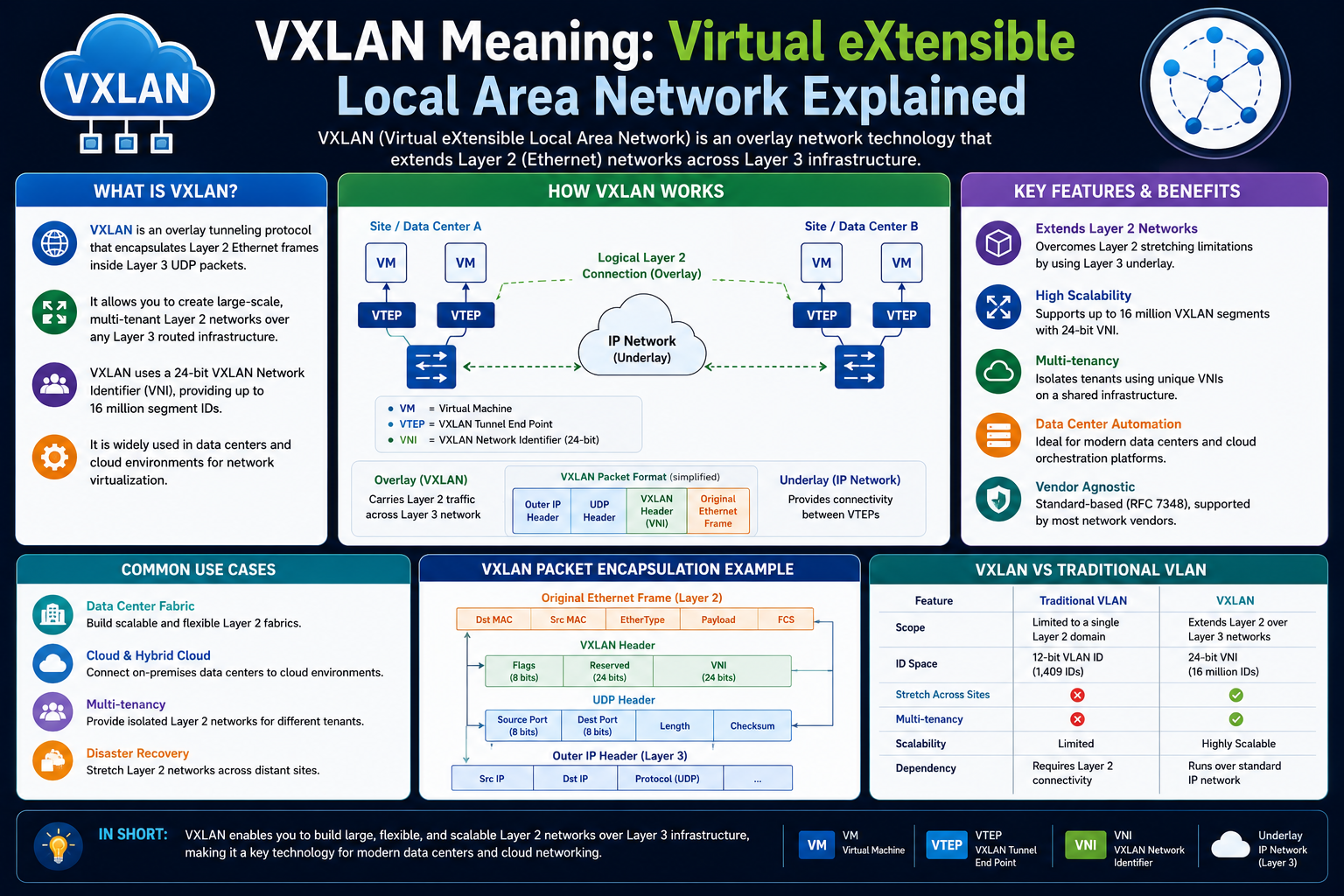
Virtual eXtensible Local-Area Network, commonly known as VXLAN, is an advanced network virtualization technology designed to overcome the limitations of traditional Layer 2 networking. It enables the creation of large-scale virtual networks that can operate across distributed physical infrastructures while maintaining isolation between different tenants, applications, or organizations. VXLAN is widely used in modern data centers and cloud environments where scalability, flexibility, and multi-tenancy are essential requirements.
At its core, VXLAN allows multiple logical networks to exist on top of a shared physical network infrastructure. This means different organizations or applications can operate as if they each have their own independent network, even though they are actually sharing the same underlying hardware. This capability makes VXLAN a foundational technology in cloud computing, virtualization platforms, and large enterprise networks.
Why VXLAN is Needed in Modern Networking
Traditional networking technologies like VLAN were originally designed for smaller, more static environments. As data centers expanded and virtualization became mainstream, the limitations of these older technologies became more apparent. VLAN, for example, supports a limited number of isolated networks, which is not sufficient for today’s large-scale cloud infrastructures that may host thousands of tenants and virtual machines.
VXLAN was introduced to solve these scalability challenges. It provides a much larger address space and allows networks to be logically segmented without being restricted by physical hardware boundaries. This is especially important in cloud environments where virtual machines need to be frequently created, moved, and deleted without disrupting services. VXLAN ensures that network segmentation remains consistent regardless of physical location.
Core Concept of VXLAN Technology
The core idea behind VXLAN is network overlay. Instead of relying solely on the physical network to manage segmentation, VXLAN creates a virtual network layer on top of an existing IP infrastructure. This overlay network behaves like a traditional Layer 2 network but is transported over Layer 3.
In simple terms, VXLAN takes Ethernet frames from virtual machines or devices and encapsulates them inside IP packets. These packets are then transmitted across the physical network and later decapsulated at the destination. This process allows Layer 2 communication to occur over Layer 3 networks, effectively extending network boundaries across different physical locations.
This abstraction allows organizations to build flexible and scalable network architectures without being constrained by physical topology. It also enables workload mobility, meaning virtual machines can move between servers or even data centers while maintaining the same network configuration.
VXLAN Encapsulation Process Explained
One of the most important aspects of VXLAN is its encapsulation mechanism. When a device inside a VXLAN-enabled network sends data, the original Ethernet frame is wrapped inside a UDP packet. This process is known as encapsulation.
The encapsulation begins when a virtual machine generates an Ethernet frame. This frame is then intercepted by a VXLAN tunnel endpoint. The endpoint adds a VXLAN header to the original frame, which includes important information such as the VXLAN Network Identifier. After this, the entire packet is encapsulated inside a UDP packet and transmitted over the IP network.
Once the packet reaches its destination, the reverse process occurs. The VXLAN header is removed, and the original Ethernet frame is delivered to the destination virtual machine. This process of encapsulation and decapsulation allows VXLAN to extend Layer 2 networks over Layer 3 infrastructure seamlessly.
VXLAN Network Identifier and Its Role
A key component of VXLAN is the VXLAN Network Identifier, commonly known as VNI. This identifier is used to distinguish between different virtual networks within the same physical infrastructure.
Each VXLAN segment is assigned a unique VNI, which acts like a virtual network label. When a packet is encapsulated, the VNI is included in the VXLAN header to ensure it is delivered to the correct virtual network at the destination. This mechanism ensures traffic isolation between different tenants or applications.
The VNI is a critical improvement over traditional VLAN identifiers because it allows a significantly larger number of isolated networks. This makes VXLAN suitable for large-scale cloud environments where network segmentation requirements are extremely high.
VXLAN Overlay Networking Concept
VXLAN operates using an overlay networking model. In this model, the physical network is referred to as the underlay network, while the virtual network created by VXLAN is known as the overlay network.
The underlay network is responsible for providing basic IP connectivity between different devices. It does not need to be aware of VXLAN-specific configurations. On top of this, VXLAN creates virtual networks that operate independently of the physical infrastructure.
This separation between overlay and underlay networks provides significant flexibility. Network administrators can modify or scale virtual networks without making changes to the physical infrastructure. It also allows different virtual networks to coexist on the same hardware without interference.
How VXLAN Enables Tunneling Across Networks
VXLAN uses tunneling to transmit data between different endpoints in the network. A tunnel is essentially a logical connection between two VXLAN tunnel endpoints. These tunnels carry encapsulated traffic across the underlying IP network.
When data is sent from one endpoint to another, it is first encapsulated and then routed through the tunnel using standard IP routing protocols. This allows VXLAN traffic to travel across multiple network hops without losing its virtual network identity.
The tunneling mechanism ensures that even if the underlying physical network is complex or geographically distributed, virtual machines can still communicate as if they are on the same local network. This is one of the key advantages that makes VXLAN suitable for modern distributed systems.
Role of IP Underlay in VXLAN Networks
The IP underlay network plays a crucial role in VXLAN architecture. It is responsible for transporting encapsulated VXLAN packets between tunnel endpoints. Unlike the overlay network, the underlay network does not need to maintain information about virtual networks or VLAN configurations.
Instead, it focuses on providing reliable IP connectivity and routing. The simplicity of the underlay network is one of the reasons VXLAN is highly scalable. Since the complexity is handled in the overlay layer, the physical infrastructure remains efficient and easier to manage.
This separation of responsibilities allows organizations to build large and flexible networks without redesigning their entire physical architecture.
Understanding VXLAN Tunnel Endpoints (VTEPs)
VXLAN Tunnel Endpoints, commonly referred to as VTEPs, are critical components in VXLAN architecture. A VTEP is responsible for both encapsulating outgoing traffic and decapsulating incoming VXLAN packets.
VTEPs can be implemented in physical network devices such as switches or in virtual software-based switches running on servers. Each VTEP is assigned an IP address that is used to communicate with other VTEPs across the network.
When a virtual machine sends traffic, the local VTEP encapsulates the packet and forwards it to the destination VTEP. Upon receiving the packet, the destination VTEP removes the VXLAN header and delivers the original frame to the target virtual machine.
This process ensures seamless communication between devices located in different physical locations while maintaining logical network separation.
Encapsulation and Decapsulation Process in Detail
Encapsulation and decapsulation are fundamental operations in VXLAN networking. Encapsulation occurs at the source VTEP, where the original Ethernet frame is wrapped with additional headers including VXLAN, UDP, and IP headers.
This process allows the packet to travel across Layer 3 networks without losing its Layer 2 properties. Once the packet reaches the destination VTEP, decapsulation takes place. The added headers are removed, and the original Ethernet frame is restored.
This mechanism ensures that virtual machines experience uninterrupted communication, even when they are located in different physical data centers. It also enables seamless workload migration, which is essential in cloud computing environments.
VXLAN in Data Center Virtualization
VXLAN plays a major role in modern data center virtualization. As organizations increasingly adopt cloud-based architectures, the need for scalable and flexible networking solutions has become critical. VXLAN addresses this need by enabling the creation of virtual networks that can span across multiple physical locations.
In virtualized environments, virtual machines frequently move between physical servers. VXLAN ensures that network configurations remain consistent during these movements. This allows applications to continue running without interruption, improving overall system reliability and efficiency.
VXLAN also supports multi-tenancy, which is essential for cloud service providers. Multiple customers can share the same physical infrastructure while maintaining complete isolation from each other.
Basic Comparison Between VLAN and VXLAN
Traditional VLAN technology operates at Layer 2 and is limited in scalability due to its restricted identifier space. It can only support a relatively small number of isolated networks, which is not sufficient for modern cloud environments.
VXLAN, on the other hand, extends Layer 2 capabilities over Layer 3 networks and provides a much larger addressing space. This allows for millions of virtual networks to coexist on the same physical infrastructure.
While VLAN relies on physical network segmentation, VXLAN uses encapsulation and tunneling to achieve logical segmentation. This makes VXLAN far more suitable for dynamic and large-scale environments where flexibility and scalability are essential.
Conclusion
VXLAN represents a major advancement in modern networking by overcoming the scalability and flexibility limitations of traditional Layer 2 technologies. It enables organizations to build large-scale virtual networks that can operate seamlessly over existing Layer 3 IP infrastructures, making it a core technology in cloud computing, virtualization, and data center design.
By using encapsulation techniques, VXLAN allows Ethernet frames to be transported across IP networks while maintaining logical isolation between different tenants and applications. This ensures that multiple virtual networks can coexist securely on the same physical infrastructure without interference or data leakage.
The introduction of VXLAN Tunnel Endpoints plays a crucial role in making this system functional, as they handle the encapsulation and decapsulation of traffic, ensuring smooth communication between distributed virtual machines. Combined with the VXLAN Network Identifier system, VXLAN provides an enormous scaling advantage compared to traditional VLAN-based networking.
Overall, VXLAN is not just a replacement for older networking models but a foundational technology that supports modern digital transformation. It enables workload mobility, improves resource utilization, enhances network isolation, and supports the dynamic nature of cloud environments. As enterprises continue to grow and adopt virtualization at a larger scale, VXLAN remains a key solution for building efficient, secure, and highly scalable network architectures.