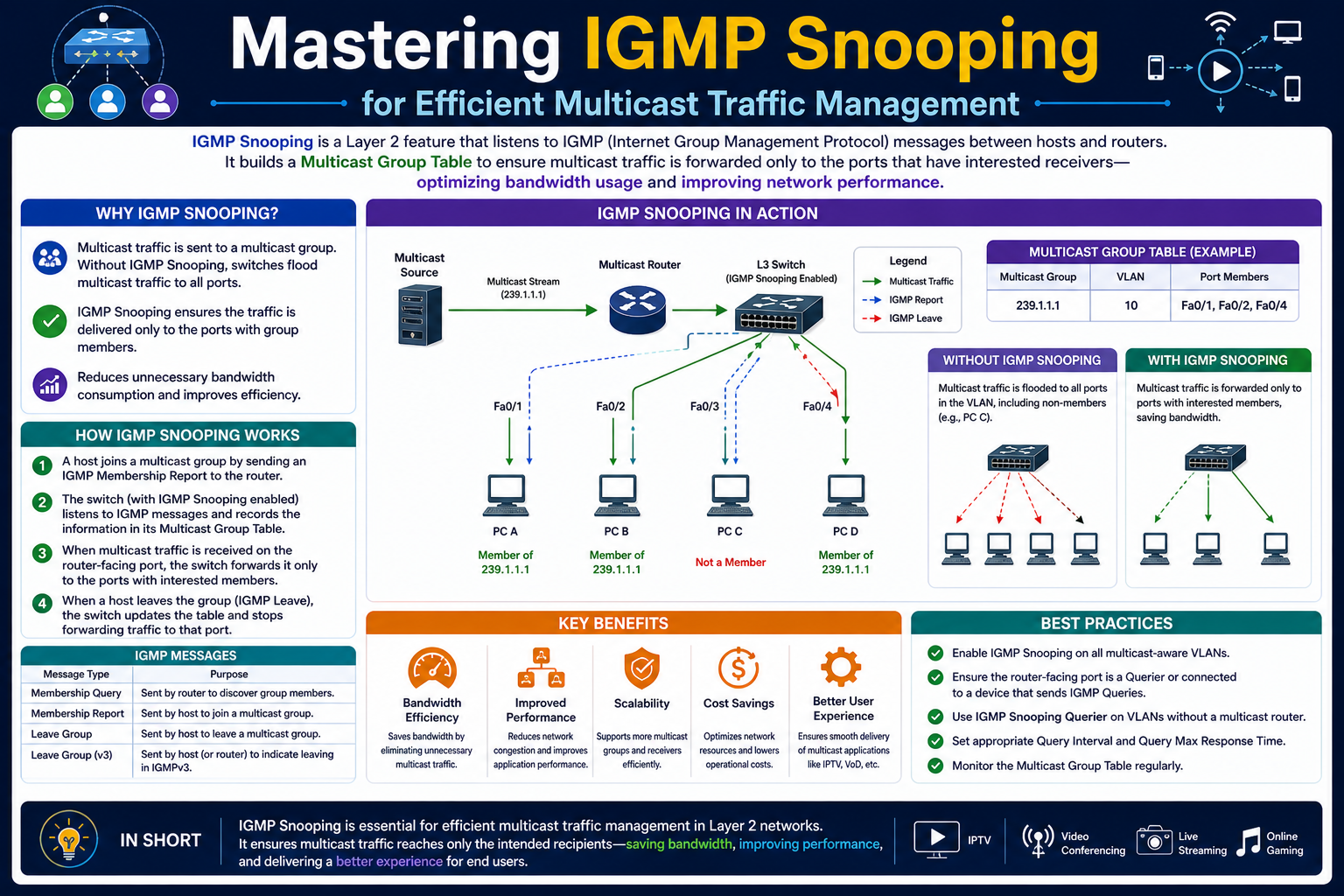
IGMP snooping is a switching feature designed to improve how multicast traffic is handled inside a network. In simple terms, it allows network switches to “listen in” on specific control messages that are exchanged between devices and routers. By doing this, the switch learns which devices actually want to receive multicast data and which do not. This prevents unnecessary forwarding of traffic and ensures that network resources are used more intelligently. Instead of flooding all devices with the same data, IGMP snooping makes delivery more selective and efficient, which is especially important in environments where multiple systems are connected and data usage needs to be optimized.
Understanding Multicast Communication in a Network Environment
To understand IGMP snooping properly, it is important to first understand multicast communication. Multicast is a method of sending data from one source to multiple selected recipients simultaneously. Unlike unicast, which sends data one-to-one, or broadcast, which sends data to everyone on a network, multicast targets only a specific group of devices that have expressed interest in receiving the same information. This approach is commonly used in applications like video streaming, online conferencing, and real-time data distribution systems. However, without proper control mechanisms, multicast traffic can become inefficient, especially in large networks where not all devices need the same data at the same time.
Basic Concept of IGMP Snooping in Switches
IGMP snooping works at the switch level, primarily within Layer 2 of the network architecture. The switch observes IGMP messages that are exchanged between hosts and multicast routers. These messages include signals such as join requests when a device wants to become part of a multicast group and leave requests when it no longer needs the data. By monitoring these communications, the switch builds a record of which ports are associated with which multicast groups. This allows it to forward traffic only to the relevant ports instead of sending it across the entire network. As a result, multicast traffic becomes more organized and controlled, improving overall efficiency.
How IGMP Snooping Improves Network Traffic Handling
In a typical network without IGMP snooping, multicast traffic is treated similarly to broadcast traffic. This means that every device connected to the switch receives the same data packets, regardless of whether they requested them or not. This behavior leads to unnecessary bandwidth consumption and can slow down network performance. IGMP snooping eliminates this issue by ensuring that multicast packets are forwarded only to devices that are part of the correct group. The switch effectively filters traffic based on learned group memberships, reducing congestion and improving the speed at which relevant data reaches its intended destination.
Role of IGMP Messages in Traffic Control
IGMP messages play a crucial role in how multicast traffic is managed. These messages are exchanged between hosts and routers to communicate group membership status. When a device wants to join a multicast group, it sends a join message, which is detected by the switch. Similarly, when a device no longer requires the data, it sends a leave message. IGMP snooping relies on these signals to maintain an updated forwarding table. This table is continuously adjusted as devices join or leave groups, ensuring that traffic distribution remains accurate and efficient at all times.
Why Traditional Switching Leads to Inefficiency Without Snooping
Without IGMP snooping, switches lack awareness of multicast group memberships. As a result, they rely on a basic forwarding method where multicast packets are sent out to all ports within a VLAN. This leads to unnecessary duplication of traffic and inefficient use of bandwidth. In addition, it increases processing overhead for devices that do not require the data. In large-scale environments, this inefficiency becomes more noticeable and can contribute to slower network performance, delays in data delivery, and overall resource wastage. The absence of traffic intelligence makes the network less optimized and more vulnerable to congestion issues.
Building Multicast Awareness Through Snooping Mechanism
IGMP snooping introduces intelligence into the switching process by creating awareness of multicast group activity. Instead of blindly forwarding traffic, the switch learns and adapts based on observed IGMP messages. This learning process allows it to map specific multicast groups to corresponding switch ports. Once this mapping is established, the switch can selectively forward traffic only where it is needed. This behavior significantly reduces unnecessary data transmission and ensures that network bandwidth is reserved for meaningful communication rather than redundant distribution.
Impact on Bandwidth Usage and Network Efficiency
One of the most important benefits of IGMP snooping is its ability to optimize bandwidth usage. In networks where multiple multicast streams are active, uncontrolled traffic distribution can quickly consume available resources. IGMP snooping prevents this by ensuring that only interested devices receive multicast packets. This targeted delivery reduces the overall load on network links and helps maintain stable performance even under heavy traffic conditions. By minimizing redundant transmissions, the network becomes more efficient, responsive, and capable of handling larger volumes of data without degradation in performance.
Improving Communication Precision in Multicast Environments
IGMP snooping also improves communication precision by ensuring that multicast data reaches only the intended recipients. In environments such as corporate networks, educational institutions, or streaming platforms, this precision is essential for maintaining quality of service. Devices that are not part of a multicast group are no longer burdened with irrelevant traffic. This not only improves their performance but also reduces unnecessary processing at the device level. The result is a more streamlined communication flow where data is delivered exactly where it is needed without interference or waste.
Network Visibility Through Switch-Level Monitoring
Another important aspect of IGMP snooping is the visibility it provides at the switch level. By monitoring IGMP messages, switches gain insight into how multicast groups are formed and how devices interact within the network. This visibility allows for better traffic management decisions and helps maintain an organized structure for data flow. Network administrators benefit from this behavior because it becomes easier to understand traffic patterns and optimize configurations accordingly. The switch effectively acts as an intelligent observer that continuously adapts to changes in group membership.
Foundational Role of IGMP Snooping in Scalable Networks
As networks grow in size and complexity, efficient traffic management becomes increasingly important. IGMP snooping plays a foundational role in supporting scalability by ensuring that multicast traffic does not overwhelm network infrastructure. Without it, larger networks would struggle with excessive broadcast-like behavior, leading to performance degradation. By maintaining controlled and selective traffic distribution, IGMP snooping allows networks to expand without sacrificing efficiency. This makes it an essential feature for modern infrastructures that rely heavily on multimedia, real-time communication, and distributed applications.
Multicast Traffic Behavior in Layer 2 Switching Environments
In a Layer 2 switching environment, multicast traffic behaves differently compared to unicast traffic. When a switch receives multicast data, it must decide how to forward it across available ports within a VLAN. Without any intelligence about group membership, the switch treats multicast frames similarly to broadcast frames and sends them to all connected devices. This approach creates unnecessary traffic replication and reduces overall efficiency. IGMP snooping changes this behavior by introducing awareness into the switching process, allowing the device to distinguish between ports that need multicast data and those that do not. This shift in behavior is essential for improving how Layer 2 networks handle group-based communication.
Interaction Between IGMP Snooping and Multicast Routers
Multicast routers play a key role in distributing multicast traffic across different network segments, while IGMP snooping operates within switches to manage traffic inside a local network. The interaction between the two ensures that multicast data is delivered accurately from source to destination. Routers rely on IGMP messages to understand group memberships, and switches with IGMP snooping observe the same messages to refine internal forwarding decisions. This coordination prevents unnecessary flooding within the LAN while still allowing proper distribution across routed networks. The result is a more structured and controlled multicast delivery system that operates efficiently across multiple layers of the network.
Forwarding Table Creation Through IGMP Snooping
One of the most important functions of IGMP snooping is the creation of a forwarding table. This table is built dynamically as the switch listens to IGMP join and leave messages. Each entry in the table maps a multicast group to specific switch ports where interested devices are connected. When multicast traffic arrives, the switch consults this table to determine the correct forwarding path. Instead of broadcasting packets to all ports, it forwards them only to the relevant ones. This targeted approach reduces unnecessary load on the network and ensures that devices receive only the data they have requested, improving both performance and efficiency.
Role of Join and Leave Messages in Group Management
IGMP join and leave messages are essential components of multicast group management. When a device wants to receive multicast traffic, it sends a join message indicating its interest in a specific group. The switch captures this message and updates its internal records accordingly. Similarly, when the device no longer needs the data, it sends a leave message to exit the group. The switch then removes the corresponding port from the forwarding list. This continuous exchange of messages ensures that group membership information remains up to date. IGMP snooping depends heavily on this dynamic communication to maintain accurate traffic distribution across the network.
Reduction of Unnecessary Flooding in Network Traffic
One of the major problems in traditional switching environments is traffic flooding. When multicast packets are treated as broadcast traffic, they are sent to every device in the network segment. This leads to unnecessary bandwidth usage and increases congestion, especially in larger networks. IGMP snooping addresses this issue by limiting the scope of multicast traffic. Instead of flooding all ports, the switch forwards packets only to those that have explicitly joined the multicast group. This selective forwarding significantly reduces network load and prevents devices from processing irrelevant traffic, leading to a more efficient and stable network environment.
Impact of IGMP Snooping on Network Performance Stability
Network performance stability is heavily influenced by how efficiently traffic is managed. IGMP snooping contributes to stability by reducing excessive data transmission and ensuring that network resources are used in a controlled manner. When multicast traffic is properly filtered and directed, switches and end devices experience less processing overhead. This leads to smoother data flow, fewer delays, and improved responsiveness. In environments where real-time communication is critical, such as video conferencing or live streaming, this stability becomes even more important. IGMP snooping ensures that performance remains consistent even under high traffic conditions.
Understanding Multicast Group Membership Dynamics
Multicast group membership is dynamic, meaning devices can join or leave groups at any time based on their data requirements. IGMP snooping adapts to these changes by continuously monitoring IGMP messages and updating forwarding decisions accordingly. This dynamic behavior ensures that the network always reflects the current state of group participation. As devices move between groups or disconnect entirely, the switch automatically adjusts its forwarding table. This flexibility allows the network to efficiently support changing workloads without manual intervention, making multicast communication more adaptable and responsive.
Switch Learning Process in IGMP Snooping Mechanism
The learning process in IGMP snooping is similar to how switches learn MAC addresses in traditional switching, but it focuses on multicast group information instead. Instead of just mapping devices to ports, the switch maps multicast groups to active participants. This learning process is passive, meaning the switch does not actively request information but instead listens to IGMP communication. Over time, this allows the switch to build a detailed understanding of multicast distribution within the network. This learned intelligence is then used to make real-time forwarding decisions that improve traffic efficiency.
Handling Multicast Traffic Across VLAN Segments
VLAN segmentation is commonly used to organize networks into smaller logical groups. IGMP snooping plays an important role in managing multicast traffic within these VLANs. Each VLAN operates independently, and IGMP snooping ensures that multicast traffic is restricted to relevant VLAN members. This prevents cross-VLAN flooding and maintains isolation between different network segments. By controlling multicast distribution within VLAN boundaries, IGMP snooping enhances both security and performance. It ensures that only devices within the same logical segment receive multicast data, reducing unnecessary exposure across the network.
Importance of Efficient Multicast Distribution in Modern Networks
Modern networks rely heavily on efficient data distribution methods due to the increasing use of multimedia and real-time applications. Multicast communication is a key part of this ecosystem, but without proper control, it can become inefficient. IGMP snooping ensures that multicast distribution remains optimized by forwarding traffic only where needed. This reduces network strain and allows infrastructure to support more simultaneous data streams. As network demands continue to grow, efficient multicast handling becomes essential for maintaining performance, scalability, and reliability across connected systems.
IGMP Snooping in High-Density Network Environments
In high-density network environments where a large number of devices are connected simultaneously, multicast traffic can quickly become overwhelming if not properly managed. IGMP snooping plays a crucial role in controlling this complexity by ensuring that multicast data is only delivered to devices that explicitly request it. In such environments, even a small amount of unnecessary traffic can scale into significant congestion issues. By filtering and forwarding multicast packets intelligently, IGMP snooping helps maintain smooth communication flow across all connected devices. This is especially important in enterprise networks, educational institutions, and large-scale streaming systems where multiple users may access the same content simultaneously without interfering with one another’s performance.
Reducing Network Load Through Selective Forwarding
Selective forwarding is one of the core strengths of IGMP snooping. Instead of distributing multicast traffic indiscriminately across all switch ports, the mechanism ensures that only relevant ports receive the data. This targeted approach significantly reduces overall network load. When unnecessary traffic is eliminated, switches and connected devices can focus their resources on meaningful data processing rather than filtering irrelevant packets. Over time, this reduction in load contributes to a more stable and predictable network environment. It also helps prevent bottlenecks that typically occur when too many devices are forced to process unwanted multicast streams.
Switch Intelligence Development Through Continuous Monitoring
IGMP snooping continuously monitors IGMP communication to develop an internal understanding of network behavior. This ongoing observation allows switches to refine their forwarding decisions dynamically. As devices join or leave multicast groups, the switch updates its internal mapping without requiring manual intervention. This adaptive intelligence ensures that traffic distribution remains accurate even as network conditions change. The more active the multicast environment, the more refined the switch’s understanding becomes. This continuous learning process enables efficient handling of complex traffic patterns that would otherwise overwhelm a traditional switching system.
Optimizing Bandwidth Utilization in Multicast Systems
Bandwidth optimization is one of the most significant advantages provided by IGMP snooping. In multicast systems without traffic control, bandwidth is wasted by sending identical data streams to devices that do not require them. IGMP snooping eliminates this inefficiency by ensuring that only interested devices receive multicast data. This results in a more balanced distribution of network resources. As a result, available bandwidth can be used for other critical applications, improving overall network productivity. This optimization becomes especially valuable in environments where bandwidth is limited or expensive, as it ensures maximum utilization without unnecessary consumption.
Impact on Real-Time Applications and Streaming Services
Real-time applications such as video conferencing, live broadcasting, and online collaboration tools rely heavily on stable and efficient data delivery. IGMP snooping directly contributes to the performance of these applications by reducing network congestion and ensuring timely delivery of multicast streams. When multicast traffic is properly managed, delays and jitter are minimized, leading to smoother communication experiences. This is particularly important in scenarios where even minor disruptions can affect user experience. By ensuring that only relevant devices receive the data, IGMP snooping helps maintain consistency and quality in real-time services.
Preventing Traffic Overload in Shared Network Segments
Shared network segments are particularly vulnerable to traffic overload because multiple devices compete for the same bandwidth resources. Without IGMP snooping, multicast traffic can easily flood these segments, leading to performance degradation for all connected devices. IGMP snooping prevents this by isolating multicast traffic to only those devices that have joined the appropriate groups. This isolation reduces unnecessary strain on shared infrastructure and ensures that bandwidth is allocated efficiently. As a result, even in heavily populated network segments, performance remains stable and predictable.
Enhancing Multicast Efficiency Through Group-Based Filtering
Group-based filtering is a fundamental principle behind IGMP snooping. Instead of treating all multicast traffic equally, the switch organizes traffic based on group membership. Each multicast group represents a set of devices interested in receiving the same data stream. IGMP snooping ensures that traffic is filtered according to these groups, allowing precise delivery of data. This structured approach eliminates randomness in traffic distribution and ensures that network behavior remains organized. Over time, this improves overall efficiency and reduces unnecessary processing overhead across the system.
Interaction Between End Devices and Switch Behavior
End devices play an important role in shaping how IGMP snooping functions within a network. Each device communicates its multicast preferences through IGMP messages, which are then interpreted by the switch. This interaction creates a feedback loop where device behavior directly influences traffic forwarding decisions. As more devices join or leave groups, the switch continuously adapts its forwarding strategy. This close relationship between end devices and switching behavior ensures that multicast traffic distribution always reflects real-time demand, rather than static configurations.
Scalability Improvements Enabled by IGMP Snooping
Scalability is a critical requirement in modern network design, and IGMP snooping significantly contributes to achieving it. As the number of connected devices increases, multicast traffic can become increasingly difficult to manage without proper controls. IGMP snooping ensures that growth does not lead to uncontrolled traffic flooding by maintaining precise group-based forwarding. This allows networks to expand without experiencing proportional increases in congestion or bandwidth usage. The ability to scale efficiently makes IGMP snooping an essential feature for growing infrastructures that support dynamic and high-demand applications.
Maintaining Network Order Through Structured Traffic Flow
Structured traffic flow is essential for maintaining order within a network, especially when multiple multicast streams are active simultaneously. IGMP snooping introduces structure by ensuring that each multicast group has a clearly defined set of recipients. This prevents chaotic traffic distribution and ensures that data flows in a controlled and predictable manner. By organizing traffic in this way, the network becomes easier to manage and troubleshoot. It also reduces the likelihood of unexpected performance issues caused by uncontrolled multicast flooding, ensuring a more stable and efficient communication environment.
Security Improvements Through Controlled Multicast Delivery
IGMP snooping contributes significantly to network security by limiting the exposure of multicast traffic. In a network without controlled multicast handling, data packets are often delivered to all connected devices, regardless of whether they requested them or not. This creates unnecessary risk, especially when sensitive information is being transmitted through multicast streams. IGMP snooping reduces this exposure by ensuring that only devices that have explicitly joined a multicast group receive the data. This selective delivery helps protect information from being accessed by unintended recipients. As a result, the network becomes more secure without requiring major changes to the underlying infrastructure.
Reducing Attack Surface in Multicast Networks
An uncontrolled multicast environment can unintentionally expand the attack surface of a network because unnecessary devices are exposed to traffic they do not need. IGMP snooping reduces this risk by restricting traffic flow to only those ports that are actively part of a multicast group. This means fewer devices are exposed to potentially exploitable data streams. By minimizing unnecessary traffic distribution, the switch effectively reduces opportunities for malicious interception or unauthorized monitoring. This controlled approach strengthens the overall resilience of the network and helps maintain a more secure communication environment.
Role of IGMP Snooping in Enterprise Network Design
In enterprise networks, efficiency and control are essential due to the large number of users and applications running simultaneously. IGMP snooping is often integrated into enterprise switch configurations to ensure that multicast traffic does not overwhelm network resources. Enterprises frequently rely on applications such as internal video broadcasts, collaborative tools, and real-time data sharing systems that use multicast communication. By implementing IGMP snooping, network administrators can ensure that these applications run smoothly without disrupting other services. This makes it a foundational feature in designing scalable and high-performance enterprise infrastructures.
Improving Quality of Service in Multicast Applications
Quality of Service is an important aspect of modern networking, especially when dealing with real-time applications. IGMP snooping supports improved Quality of Service by ensuring that multicast traffic is delivered efficiently and without unnecessary delays. When switches avoid flooding the network with irrelevant traffic, more bandwidth becomes available for priority applications. This leads to better performance for time-sensitive services such as video conferencing, online learning platforms, and live broadcasts. The result is a more consistent user experience with fewer interruptions and reduced latency.
Interaction Between IGMP Snooping and Network Congestion Control
Network congestion occurs when too much data competes for limited bandwidth resources. IGMP snooping helps prevent congestion by controlling how multicast traffic is distributed across the network. Instead of allowing large volumes of multicast data to be broadcast widely, the switch ensures that traffic is only sent where it is needed. This reduces unnecessary load on network links and prevents congestion from building up in busy segments. By managing traffic distribution efficiently, IGMP snooping plays a direct role in maintaining smooth and stable network performance even during peak usage periods.
Troubleshooting Challenges in Multicast Environments
Despite its advantages, multicast networking can still present challenges when issues arise. Misconfigurations, incorrect VLAN settings, or missing group memberships can lead to unexpected traffic behavior. IGMP snooping helps narrow down these issues by providing a clearer view of multicast group activity within the switch. However, administrators still need to verify that devices are properly joining and leaving groups and that multicast routers are functioning correctly. When troubleshooting, it is important to ensure that IGMP messages are being transmitted and received as expected, as any disruption in this communication can affect traffic distribution.
Importance of Proper VLAN Configuration for IGMP Snooping
VLAN configuration plays a critical role in the effectiveness of IGMP snooping. Since multicast traffic is often restricted within VLAN boundaries, incorrect VLAN setups can lead to improper traffic distribution. If devices are placed in the wrong VLAN or if multicast settings are inconsistent, IGMP snooping may not function as intended. Proper VLAN segmentation ensures that multicast groups remain organized and isolated according to network design. This separation helps maintain both performance and security by ensuring that only relevant devices participate in specific multicast streams.
Best Practices for Maintaining Efficient Multicast Operations
To maintain efficient multicast operations, it is important to follow structured best practices when implementing IGMP snooping. This includes ensuring that the feature is enabled consistently across all relevant switches and VLANs. Keeping network firmware updated also helps prevent issues related to bugs or outdated configurations. Additionally, designating a proper IGMP querier ensures that group membership information remains accurate even in the absence of a multicast router. Regular testing of multicast applications helps validate that traffic is being delivered correctly and that the system is functioning as intended.
Long-Term Benefits of IGMP Snooping in Network Evolution
Over time, networks tend to grow in complexity, supporting more devices, applications, and data streams. IGMP snooping provides long-term value by ensuring that multicast traffic remains manageable as the network evolves. Its ability to dynamically adapt to changing group memberships makes it suitable for environments with fluctuating demand. As more organizations rely on real-time communication and data streaming, the importance of efficient multicast handling continues to increase. IGMP snooping ensures that networks remain scalable, stable, and capable of supporting future technological requirements without major structural changes.
Advanced Role of IGMP Snooping in Modern Network Architectures
IGMP snooping has evolved from being a simple traffic filtering mechanism into a core component of modern network design. In complex infrastructures where virtualization, cloud services, and high-volume multimedia delivery coexist, multicast traffic must be carefully controlled to avoid performance degradation. IGMP snooping ensures that even in these advanced environments, multicast communication remains efficient and predictable. By continuously analyzing IGMP control messages, switches can dynamically adjust traffic forwarding decisions in real time. This adaptability makes it suitable for modern architectures where network conditions change frequently and demand precise traffic control.
Multicast Optimization in Virtualized and Cloud Environments
Virtualized environments introduce additional layers of complexity because multiple virtual machines may share the same physical network infrastructure. Without proper multicast control, traffic can quickly become inefficient and duplicated across virtual interfaces. IGMP snooping helps solve this problem by ensuring that multicast packets are delivered only to virtual machines that are part of the relevant group. In cloud-based systems, where resources are distributed across different physical and logical nodes, this behavior becomes even more important. It reduces unnecessary inter-node traffic and ensures that cloud applications receive only the data streams they are designed to process.
Role of IGMP Snooping in Reducing Latency Across Networks
Latency is a critical factor in network performance, especially for real-time applications. IGMP snooping helps reduce latency by minimizing unnecessary traffic on the network. When multicast packets are forwarded only to relevant ports, switches experience less congestion and processing delay. This leads to faster delivery of data to end devices. In environments where milliseconds matter, such as financial trading systems or live communication platforms, reducing latency can significantly improve overall system responsiveness. By streamlining traffic flow, IGMP snooping indirectly enhances the speed at which information travels across the network.
Efficient Handling of Multiple Multicast Streams
Modern networks often carry multiple multicast streams simultaneously, especially in environments like media distribution platforms or large organizations. Without proper management, these streams can interfere with each other and create unnecessary congestion. IGMP snooping helps organize these streams by maintaining separate forwarding entries for each multicast group. This separation ensures that each stream is delivered independently without overlapping traffic distribution. As a result, the network can handle multiple high-bandwidth applications at the same time without compromising performance or stability.
Adaptive Traffic Control in Dynamic Network Conditions
One of the most powerful aspects of IGMP snooping is its ability to adapt to dynamic network conditions. Devices frequently join and leave multicast groups based on changing requirements, and the network must respond accordingly. IGMP snooping continuously updates its forwarding table based on real-time IGMP messages, ensuring that traffic distribution always reflects current group membership. This adaptive behavior eliminates the need for manual reconfiguration and allows the network to respond instantly to changes in demand. It ensures that multicast traffic remains efficient even in highly dynamic environments.
Improving Resource Utilization in Large-Scale Networks
Large-scale networks often suffer from inefficient resource utilization when traffic is not properly managed. IGMP snooping improves this by ensuring that bandwidth, processing power, and switch resources are used only where necessary. Instead of distributing multicast traffic across all ports, the switch focuses resources on active group members. This targeted approach reduces waste and allows the network to support more users and applications without requiring additional infrastructure. Efficient resource utilization becomes especially important in environments where scaling hardware is expensive or limited.
Maintaining Consistency in Distributed Network Systems
In distributed systems where data is shared across multiple locations or segments, consistency is essential for reliable communication. IGMP snooping helps maintain this consistency by ensuring that multicast traffic is delivered uniformly to all intended recipients. By controlling how data is distributed, it prevents inconsistencies caused by partial or redundant delivery. This is particularly important in systems where synchronized data delivery is required, such as collaborative applications or distributed monitoring systems. IGMP snooping ensures that all participating devices receive the same information at the same time.
Reducing CPU and Processing Overhead on End Devices
When multicast traffic is broadcast unnecessarily, end devices are forced to process large volumes of irrelevant data. This increases CPU usage and can slow down overall device performance. IGMP snooping reduces this burden by ensuring that only relevant traffic reaches each device. As a result, devices spend less time filtering unwanted packets and more time processing useful data. This leads to improved performance at the endpoint level and contributes to a smoother user experience, especially in environments with limited device resources.
Enhancing Predictability in Network Traffic Behavior
Predictability is an important characteristic of well-designed networks. IGMP snooping enhances predictability by ensuring that multicast traffic follows defined paths based on group membership. Instead of unpredictable flooding behavior, traffic flows are controlled and consistent. This makes it easier for network administrators to understand and manage traffic patterns. Predictable behavior also simplifies troubleshooting and performance optimization, as administrators can clearly identify how multicast data is moving through the network at any given time.
Foundation for Scalable Multicast-Driven Applications
Many modern applications rely heavily on multicast communication for efficient data delivery. IGMP snooping provides the foundation for these applications by ensuring that multicast traffic remains scalable and manageable. As the number of users increases, the system does not suffer from exponential traffic growth because IGMP snooping restricts unnecessary distribution. This makes it possible to support large audiences, high-definition streaming, and real-time collaboration tools without overwhelming the underlying network infrastructure. It ensures that multicast-based applications remain viable even at large scales.
Final Conclusion
IGMP snooping plays a central role in optimizing multicast traffic across modern networks. It improves efficiency by ensuring that data is delivered only to interested devices, reduces congestion by preventing unnecessary flooding, and enhances scalability by supporting large and dynamic environments. It also strengthens security by limiting exposure of multicast streams and improves performance by reducing latency and device processing overhead. Through continuous monitoring of IGMP messages, switches gain the intelligence needed to manage traffic effectively. This makes IGMP snooping an essential feature for building stable, scalable, and high-performance network infrastructures.