In today’s digital world, almost every activity relies on network connectivity. Whether it is sending emails, browsing websites, accessing cloud services, or managing business systems, data is constantly moving between devices and networks. This constant exchange of information creates opportunities for both productivity and risk. While connectivity has made life easier, it has also opened the door to cyber threats such as hacking attempts, malware infections, unauthorized access, and data theft.
To control and secure this flow of information, one of the earliest and most fundamental security technologies was developed: the firewall. Firewalls remain a core component of cybersecurity because they act as a protective barrier between trusted internal systems and untrusted external networks. Their main job is to monitor, filter, and control network traffic based on predefined security rules.
Although modern cybersecurity includes advanced technologies such as artificial intelligence-based detection systems and cloud security platforms, firewalls are still widely used because of their simplicity, reliability, and effectiveness. They serve as the first line of defense in most network environments, from personal devices at home to complex enterprise infrastructures.
What a Firewall Actually Is in Simple Terms
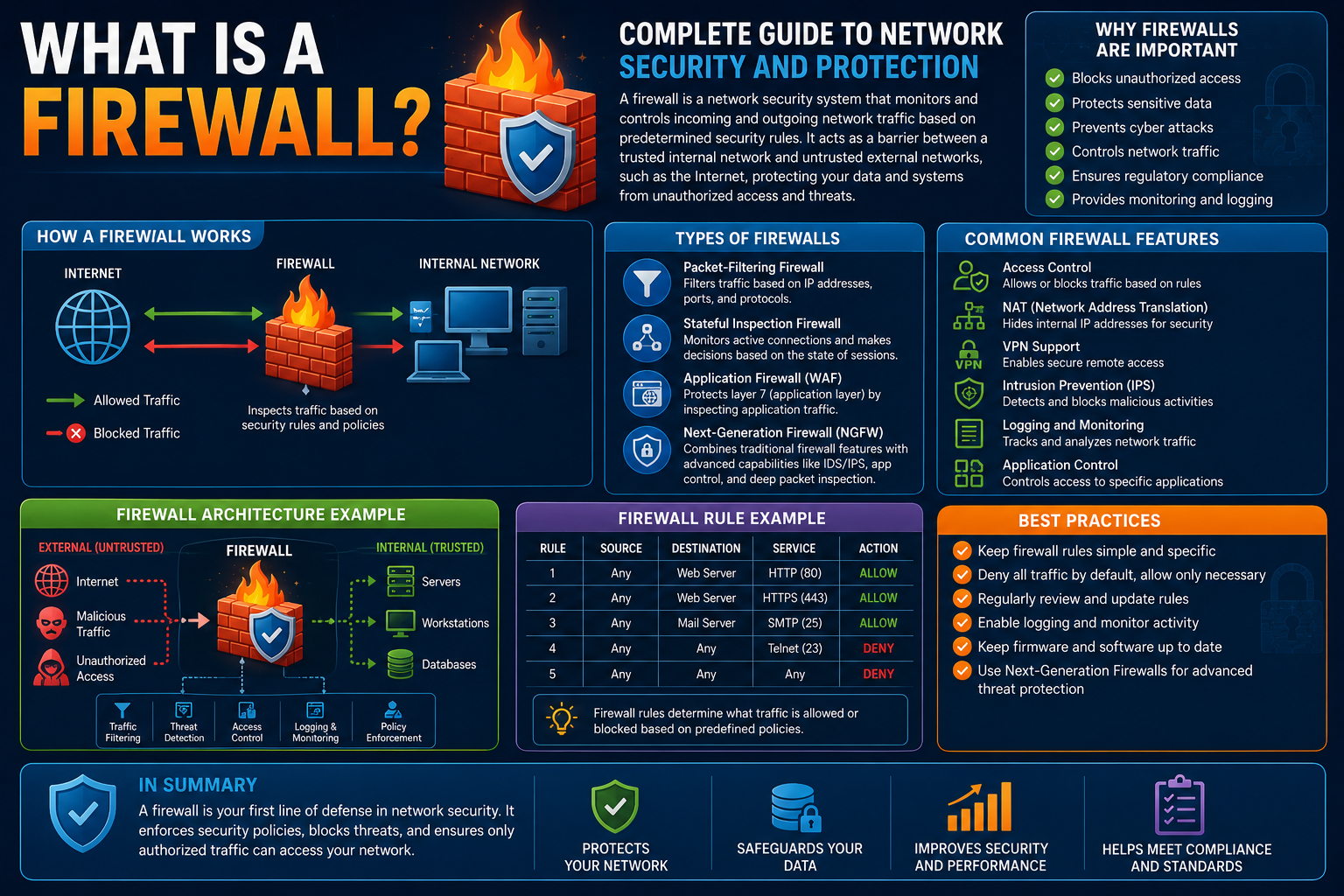
A firewall can be understood as a gatekeeper between two worlds: a trusted internal network and an untrusted external network, such as the internet. It decides what data is allowed to pass through and what must be blocked.
At its core, a firewall is either a software program, a physical device, or a combination of both. It continuously analyzes incoming and outgoing data and applies a set of rules created by users or system administrators. These rules define what kind of traffic is safe and what might be dangerous.
Every piece of data traveling across a network is broken into smaller units called packets. A firewall inspects these packets and checks details such as where the data is coming from, where it is going, and what type of communication it represents. If a packet meets the allowed criteria, it is passed through. If not, it is blocked or discarded.
This process happens in real time and is often invisible to users. When working properly, a firewall protects systems without interrupting normal operations or slowing down communication significantly.
The Basic Purpose of a Firewall in Network Security
The primary purpose of a firewall is to enforce security rules that protect devices and networks from unauthorized access. However, its role extends beyond simple blocking and allowing traffic. Firewalls also help in maintaining control, visibility, and structure within a network.
One of the most important functions is preventing unauthorized access. Hackers often attempt to gain entry into systems by scanning open ports or exploiting vulnerabilities in network services. A firewall reduces this risk by closing unnecessary entry points and restricting access to only approved services.
Another important function is traffic monitoring. Firewalls continuously observe network activity, which helps detect unusual behavior. For example, if a device suddenly begins sending large amounts of data to an unknown destination, the firewall may flag or block this activity.
Firewalls also support policy enforcement. In business environments, organizations often restrict access to certain websites or applications. Firewalls help implement these rules consistently across all users and devices connected to the network.
How Firewalls Work Behind the Scenes
To understand how firewalls function, it is important to look at how data travels across networks. When a user sends a request, such as opening a website, the request is broken into packets and sent across the Internet. These packets pass through multiple routers and networks before reaching their destination.
This decision-making process happens in milliseconds, allowing communication to continue smoothly while maintaining security. Firewalls can also log activity, which helps administrators analyze past traffic and identify suspicious behavior patterns.
Packet Filtering as the First Line of Defense
One of the simplest and earliest firewall methods is packet filtering. This technique examines individual packets of data and compares them against a set of predefined rules.
Each packet contains header information that describes its origin, destination, and type. Packet filtering firewalls focus primarily on this header information rather than the actual content of the data.
For example, a rule may state that traffic from a specific IP address should be blocked. If a packet comes from that address, it will be denied access immediately. Similarly, certain ports that are not needed for normal operations can be blocked entirely to reduce exposure to attacks.
Packet filtering is fast and efficient because it does not require deep inspection of data content. However, it is also limited because it cannot analyze the actual information inside the packet. This makes it less effective against complex or disguised threats.
Stateful Inspection and Smarter Traffic Analysis
As cyber threats became more advanced, basic packet filtering was no longer sufficient. This led to the development of stateful inspection, a more intelligent firewall method.
Unlike packet filtering, stateful inspection does not treat each packet as an isolated unit. Instead, it tracks active connections and understands the context of communication.
For example, when a user opens a website, the firewall recognizes that a session has been established. It then allows related packets to pass through as part of that ongoing session. If an unrelated or unexpected packet tries to enter the system pretending to be part of that session, it is blocked.
This approach provides a stronger level of security because it considers the behavior of traffic over time rather than just individual packets. It helps prevent spoofing attacks, where malicious data is disguised as legitimate communication.
Stateful inspection has become a standard feature in many modern firewalls because it balances performance with improved security awareness.
Proxy Firewalls and Application-Level Protection
Another important type of firewall is the proxy firewall, which operates at a deeper level of network communication. Instead of allowing a direct connection between a user and a server, a proxy firewall acts as an intermediary.
When a user sends a request, the firewall receives it first, evaluates it, and then forwards it to the destination on behalf of the user. The response from the server is also processed through the firewall before reaching the user.
This indirect communication provides an additional layer of protection because internal systems are never exposed directly to external networks. It also allows the firewall to inspect data at the application level, meaning it can analyze the actual content being transmitted.
Proxy firewalls are especially useful for filtering web traffic, blocking malicious websites, and enforcing strict usage policies. However, they can introduce slight delays in communication due to the extra processing involved.
The Evolution of Firewalls in Modern Networks
Firewalls have evolved significantly since their early development. Initially, they were simple tools designed to block or allow traffic based on basic rules. Over time, as cyber threats became more sophisticated, firewalls also became more advanced.
Modern firewalls often include multiple security functions combined into a single system. These may include intrusion detection, intrusion prevention, deep traffic inspection, and application-level filtering.
The evolution of firewalls reflects the changing nature of cybersecurity. Today’s networks are more complex, with cloud systems, remote access, mobile devices, and IoT technologies all connected simultaneously. This complexity requires firewalls to be more intelligent, adaptive, and capable of handling large volumes of diverse traffic.
Introduction to Advanced Firewall Capabilities
As firewall technology continues to evolve, newer systems are designed to provide broader protection beyond simple traffic filtering. These advanced systems often integrate multiple layers of security intelligence.
One of the key developments is the ability to inspect data more deeply, not just at the packet header level but also within the content itself. This allows firewalls to detect hidden malware, suspicious scripts, and abnormal communication patterns.
Modern firewalls can also identify applications rather than just ports and protocols. This means they can distinguish between different types of web traffic, such as video streaming, file sharing, or business applications, and apply specific rules to each category.
These improvements have made firewalls more adaptable to modern cybersecurity challenges, where threats are often hidden within legitimate-looking traffic.
The Role of Firewalls in Everyday Digital Life
Firewalls are not limited to large organizations or data centers. They are present in almost every connected device today. Home routers often include built-in firewalls that protect personal networks from external threats. Operating systems also include software-based firewalls that protect individual devices.
In business environments, firewalls play an even more critical role by protecting sensitive data, financial systems, customer information, and internal communication networks.
Even mobile devices and cloud platforms rely on firewall technologies to ensure secure communication between apps, servers, and users.
Without firewalls, digital systems would be far more vulnerable to attacks, making everyday online activities significantly riskier.
Expanding the Role of Firewalls in Modern Network Environments
As digital systems have grown more complex, firewalls have evolved from simple traffic filters into sophisticated security platforms capable of handling layered threats across distributed environments. In earlier stages of networking, a single firewall placed at the edge of a network was often sufficient. Today, however, organizations rely on multiple firewall systems working together across cloud platforms, remote endpoints, internal segments, and hybrid infrastructures.
This shift has changed the way firewalls are designed, deployed, and managed. Instead of acting as a single checkpoint, firewalls now function as part of a broader security ecosystem. They are integrated with monitoring systems, threat intelligence platforms, and access control frameworks to provide continuous protection.
Understanding the different types of firewalls and how they are deployed in real environments is essential for grasping how modern cybersecurity operates.
Network-Based Firewalls and Their Strategic Placement
Network-based firewalls are designed to protect entire networks rather than individual devices. These firewalls are typically installed at strategic points where network traffic enters or leaves an organization.
One of the most common placements is at the network perimeter, where internal systems connect to the internet. This positioning allows the firewall to inspect all incoming and outgoing traffic before it reaches internal devices. By doing so, it acts as a barrier that filters potentially harmful data before it can cause damage.
In larger infrastructures, network firewalls are not limited to a single perimeter. Instead, they are placed at multiple layers within the network. This layered approach ensures that even if one firewall is bypassed, additional barriers remain in place to limit movement within the system.
This concept of multiple defensive layers is often referred to as defense in depth. It significantly reduces the risk of widespread compromise by containing threats within isolated segments.
Host-Based Firewalls and Device-Level Protection
While network firewalls protect entire systems, host-based firewalls focus on individual devices. These firewalls are installed directly on endpoints such as laptops, servers, or workstations.
A host-based firewall monitors traffic specifically for the device it is installed on. This allows it to enforce personalized security rules tailored to the needs of that system. For example, a server hosting sensitive data may have stricter rules than a general user workstation.
One of the key advantages of host-based firewalls is their ability to provide protection even when a device is outside the corporate network. For instance, if an employee connects to public Wi-Fi, the firewall continues to monitor and filter traffic locally on the device.
This makes host-based firewalls particularly important in environments where remote work is common. They ensure that security is maintained regardless of the network a device is connected to.
Next-Generation Firewalls and Intelligent Traffic Control
Next-generation firewalls represent a major evolution in firewall technology. Unlike traditional firewalls that primarily rely on static rules, next-generation systems incorporate advanced intelligence to identify and respond to threats in real time.
One of the defining features of these firewalls is deep packet inspection. This capability allows them to examine not just the headers of data packets but also their full content. By analyzing payload data, these firewalls can detect hidden malware, suspicious scripts, and unauthorized communication patterns.
Another important feature is application awareness. Instead of simply recognizing ports and protocols, next-generation firewalls can identify specific applications generating traffic. This means they can differentiate between a video streaming service, a business communication tool, or a file-sharing platform, even if they use similar network ports.
This level of visibility allows organizations to create highly granular security policies. For example, they may allow access to a messaging application but restrict file transfers within it.
Additionally, these firewalls often integrate intrusion prevention systems. These systems actively block malicious activity rather than simply detecting it, providing real-time defense against attacks.
Unified Threat Management Systems and Centralized Security
Unified threat management systems combine multiple security functions into a single platform. Instead of using separate tools for antivirus protection, intrusion detection, content filtering, and firewall management, organizations can use a unified system that integrates all these features.
This consolidation simplifies security management and reduces complexity, especially for small and medium-sized organizations. With a single interface, administrators can monitor threats, configure rules, and analyze traffic across the entire network.
However, unified systems are not limited to smaller environments. Many large organizations also use them as part of distributed security architectures, where different branches or departments operate under centralized control.
Despite their convenience, unified systems must be carefully configured to avoid performance bottlenecks. Since they handle multiple security tasks simultaneously, they require sufficient processing power and proper optimization to maintain efficiency.
Hardware Firewalls in High-Traffic Environments
Hardware firewalls are physical devices designed specifically to handle network security tasks. Unlike software-based solutions, they operate independently of host systems and are dedicated solely to processing network traffic.
One of the main advantages of hardware firewalls is their ability to handle large volumes of traffic without affecting the performance of individual devices. Since they are placed at network entry points, they process data before it reaches internal systems.
These firewalls are commonly used in enterprise environments, data centers, and service provider networks. They are capable of handling complex routing decisions, high-speed connections, and large-scale security policies.
Because they operate at the infrastructure level, hardware firewalls are typically more reliable and stable than software alternatives. However, they require specialized configuration and maintenance, which makes them more suitable for environments with dedicated IT teams.
Software Firewalls and Flexible Endpoint Protection
Software firewalls operate directly on operating systems and provide flexible protection for individual devices. They are commonly used in personal computers, mobile devices, and small business systems.
One of the key advantages of software firewalls is their adaptability. Users can easily configure rules based on their specific needs, such as blocking certain applications or restricting internet access during specific times.
These firewalls also provide detailed visibility into device-level activity. Users can monitor which applications are accessing the internet and how much data they are transferring.
However, software firewalls depend on the resources of the host device. This means that heavy traffic or complex rule processing can impact system performance. Despite this limitation, they remain widely used due to their affordability and ease of deployment.
Firewall Architectures and Deployment Models
Firewalls can be deployed in various architectural models depending on the complexity and requirements of the network.
One common model is the single-layer firewall architecture, where one firewall protects the entire network perimeter. This approach is simple but may not provide sufficient protection for larger environments.
More advanced networks use multi-layer architectures, where multiple firewalls are placed at different points within the system. This creates segmented security zones that limit the spread of potential threats.
Another important model is the distributed firewall architecture. In this setup, firewall functions are spread across multiple devices and endpoints rather than centralized in one location. This approach is especially useful in cloud environments and large-scale distributed systems.
Cloud-based firewall models have also become increasingly popular. These firewalls operate within cloud infrastructure and provide scalable protection for virtual environments. They are particularly effective in environments where workloads are dynamic and constantly shifting.
Demilitarized Zones and Controlled Exposure
In complex network environments, exposing internal systems directly to the internet is highly risky. To reduce this risk, organizations use a network design concept known as a demilitarized zone.
A demilitarized zone is a separate network segment that sits between internal systems and external networks. It is used to host services that must be accessible from the internet, such as web servers, email servers, and DNS systems.
By isolating these services, organizations reduce the risk of internal network exposure. If a service in the demilitarized zone is compromised, attackers still face additional barriers before reaching internal systems.
Firewalls play a critical role in managing this architecture. One firewall typically protects the external boundary, while another controls access between the demilitarized zone and the internal network. This layered approach ensures that sensitive systems remain isolated even if perimeter defenses are breached.
Internal Segmentation and Lateral Movement Prevention
Modern cyberattacks often focus not just on breaking into a network but also on moving within it. Once attackers gain access to a single device, they attempt to expand their control by moving laterally across connected systems.
To prevent this, organizations use internal segmentation firewalls. These firewalls divide internal networks into smaller, isolated segments. Each segment has its own security rules and access controls.
For example, financial systems may be separated from employee workstations, while research systems may be isolated from public-facing applications. This segmentation ensures that even if one part of the network is compromised, the attacker cannot easily access other areas.
Internal segmentation is one of the most effective strategies for limiting the impact of security breaches.
Firewall Rule Management and Policy Design
Firewalls rely on rules to determine how traffic should be handled. These rules form the foundation of firewall behavior and must be carefully designed to balance security and usability.
Each rule typically defines conditions such as source, destination, protocol, and action. However, in complex environments, rule sets can become large and difficult to manage.
Poorly designed rules can lead to security gaps or performance issues. For example, overly permissive rules may allow unauthorized access, while overly restrictive rules may block legitimate traffic.
To maintain effectiveness, firewall rules must be regularly reviewed and updated. This ensures that they remain aligned with changing network conditions and emerging threats.
Firewall Logging, Monitoring, and Traffic Analysis
Firewalls do more than just block or allow traffic. They also generate detailed logs of all network activity. These logs provide valuable insights into how the network is being used and whether any suspicious behavior is occurring.
Security teams use firewall logs to identify patterns such as repeated access attempts, unusual traffic spikes, or connections to unknown destinations. These indicators can help detect early signs of cyberattacks.
In addition to logging, many firewalls integrate real-time monitoring tools that provide visual dashboards of network activity. This allows administrators to quickly assess the current security status of the system.
Continuous monitoring is essential in modern cybersecurity because threats often develop rapidly and require immediate response.
Firewall Performance and Network Efficiency Challenges
While firewalls are essential for security, they also introduce processing overhead. Every packet passing through a firewall must be inspected, evaluated, and either allowed or blocked.
In high-traffic environments, this can lead to performance challenges. If a firewall is not properly optimized or sized for the network it protects, it may become a bottleneck.
Advanced firewalls address this issue by using hardware acceleration, optimized algorithms, and distributed processing techniques. These improvements help maintain security without significantly impacting network speed.
Balancing security and performance is one of the key challenges in firewall deployment.
Cloud-Based Firewalls in Distributed Systems
As organizations increasingly move to cloud environments, traditional perimeter-based security models are no longer sufficient. Cloud-based firewalls provide a flexible alternative that can scale with dynamic workloads.
These firewalls operate within cloud infrastructure and protect virtual networks, applications, and services. They can be configured to adapt automatically to changing environments, making them ideal for modern cloud architectures.
Cloud firewalls also support global distribution, allowing organizations to enforce consistent security policies across multiple regions and data centers.
Their scalability and adaptability make them an essential component of modern cybersecurity strategies.
Why Firewalls Alone Are Not Enough in Modern Cybersecurity
Firewalls remain one of the most important components in network security, but relying on them alone is no longer sufficient in today’s threat landscape. Modern cyberattacks are more sophisticated, distributed, and adaptive than ever before. Attackers no longer depend on simple intrusion attempts or obvious malicious traffic. Instead, they use stealthy methods, encrypted channels, and legitimate-looking communication patterns to bypass traditional defenses.
A firewall is highly effective at controlling known types of traffic based on rules, but it does not inherently understand intent. It cannot always determine whether a legitimate-looking request is actually part of a malicious activity chain. This limitation becomes more visible as attacks evolve into multi-stage operations that blend in with normal network behavior.
For this reason, firewalls must be combined with other security mechanisms such as endpoint protection, behavioral analytics, identity management, and continuous monitoring systems. In modern cybersecurity, firewalls are no longer the sole defense layer but part of a larger security framework.
The Challenge of Encrypted Traffic in Firewall Inspection
One of the biggest challenges for firewalls today is encrypted traffic. A large portion of internet communication is now protected using encryption protocols such as HTTPS, which secure data between users and websites.
While encryption is essential for privacy and data protection, it also creates visibility limitations for firewalls. When traffic is encrypted, a firewall may only see metadata such as source, destination, and port, but not the actual content being transmitted.
This creates a blind spot where malicious activity can be hidden inside encrypted sessions. Attackers often exploit this by embedding malware, command-and-control signals, or data exfiltration activities inside encrypted traffic streams.
To address this issue, advanced firewalls use techniques such as encrypted traffic inspection. This involves temporarily decrypting traffic, analyzing it for threats, and then re-encrypting it before forwarding it to its destination. While effective, this approach introduces performance overhead and raises privacy considerations, especially in environments where sensitive data is handled.
Firewall Evasion Techniques Used by Cybercriminals
As firewalls become more advanced, attackers continuously develop methods to bypass them. These evasion techniques are designed to exploit weaknesses in rule configurations, protocol handling, or inspection limitations.
One common technique is the use of tunneling protocols. Attackers may encapsulate malicious traffic inside legitimate protocols such as DNS or HTTP, making it appear normal to firewall systems. Since these protocols are widely used, blocking them entirely is not practical.
Another technique involves port hopping, where attackers switch communication ports dynamically to avoid detection. Instead of using a fixed port that might be blocked, they distribute traffic across multiple ports to blend in with normal activity.
Attackers also use proxy servers and anonymization networks to hide their true origin. This makes it difficult for firewalls to distinguish between legitimate remote users and malicious actors.
Additionally, some attacks rely on fragmented packets, where malicious payloads are split into smaller pieces that individually appear harmless but form a complete attack when reassembled at the destination.
These techniques highlight the ongoing challenge of maintaining effective firewall defenses in a constantly evolving threat environment.
Misconfiguration as a Major Security Risk
While firewalls are powerful security tools, their effectiveness depends heavily on proper configuration. One of the most common causes of firewall failures is misconfiguration.
A firewall with overly permissive rules may unintentionally allow unauthorized access to sensitive systems. For example, opening unnecessary ports or allowing unrestricted traffic from external sources can expose internal networks to attack.
On the other hand, overly restrictive rules can disrupt legitimate business operations. Blocking essential services or misidentifying safe traffic as malicious can lead to system downtime and productivity loss.
Complex networks often require thousands of firewall rules, making management challenging. Over time, outdated rules may remain active, creating unnecessary vulnerabilities. In some cases, conflicting rules can create unpredictable behavior, where traffic is inconsistently allowed or blocked.
To reduce these risks, firewall configurations must be regularly audited, simplified where possible, and aligned with current network requirements.
The Rise of Zero Trust Security and Firewall Integration
Traditional network security models assume that anything inside the network is trustworthy. Firewalls were originally designed to protect the boundary between trusted internal networks and untrusted external networks.
However, this model is no longer sufficient in modern environments where users access systems from multiple locations, devices, and networks. The zero-trust security model addresses this challenge by assuming that no user or device is inherently trusted, regardless of location.
In a zero-trust architecture, firewalls still play an important role, but they are no longer the sole gatekeepers. Instead, they work alongside identity verification systems, access control policies, and continuous authentication mechanisms.
Every request is evaluated based on context, such as user identity, device health, and behavior patterns. Firewalls enforce segmentation and traffic control, but access decisions are also influenced by dynamic trust evaluation.
This integration significantly improves security by reducing reliance on static network boundaries.
Artificial Intelligence and Machine Learning in Firewalls
Modern firewalls are increasingly incorporating artificial intelligence and machine learning to enhance threat detection and response capabilities.
Traditional firewalls rely on predefined rules, which are effective against known threats but less effective against new or unknown attacks. AI-powered firewalls, however, analyze patterns of network behavior to identify anomalies.
For example, if a device suddenly begins communicating with unusual external servers or sending abnormal volumes of data, the system can flag this behavior as suspicious even if it does not match any known attack signature.
Machine learning models can also continuously improve by analyzing historical traffic data. Over time, they become better at distinguishing between normal and abnormal behavior, reducing false positives and improving detection accuracy.
These intelligent systems are particularly useful in detecting advanced persistent threats, which often remain hidden within normal network activity for extended periods.
Firewall Role in Internet of Things (IoT) Environments
The rapid growth of Internet of Things devices has introduced new security challenges. IoT devices such as smart cameras, sensors, and connected appliances often have limited processing power and weak built-in security features.
These devices are frequently targeted by attackers because they can be easily compromised and used as entry points into larger networks.
Firewalls play a critical role in protecting IoT environments by controlling device communication and isolating vulnerable systems. For example, a firewall can restrict IoT devices from communicating with external servers unless necessary, or segment them into isolated network zones.
However, managing firewalls in IoT environments is challenging due to the large number of devices and their diverse communication patterns. This requires adaptive and scalable firewall policies that can handle dynamic network conditions.
Cloud-Native Firewalls and Modern Infrastructure Security
As organizations increasingly adopt cloud computing, traditional firewall models must adapt to virtualized environments. Cloud-native firewalls are designed specifically for these environments, where resources are distributed, scalable, and dynamically managed.
Unlike traditional hardware-based systems, cloud-native firewalls operate as software-defined security layers integrated directly into cloud infrastructure. They can automatically scale based on traffic demand and adjust policies in real time.
These firewalls are particularly effective in protecting microservices architectures, where applications are broken into small, independent components that communicate frequently across networks.
By integrating directly into cloud platforms, cloud-native firewalls provide consistent protection across hybrid and multi-cloud environments.
Microsegmentation and Fine-Grained Network Control
Microsegmentation is a security strategy that divides networks into very small, isolated segments. Each segment is protected by its own set of security policies, often enforced by firewalls.
Unlike traditional segmentation, which divides networks into large zones, microsegmentation provides granular control over individual workloads and applications.
This approach significantly reduces the attack surface. Even if one segment is compromised, attackers are unable to move freely across the network.
Firewalls play a key role in enforcing microsegmentation policies by controlling traffic between these small segments. This ensures that only authorized communication paths are allowed.
Firewall Automation and Security Orchestration
As networks become more complex, manual firewall management becomes increasingly difficult. Automation is now an essential part of modern firewall systems.
Automated firewall management allows security policies to be updated dynamically based on changes in network conditions, user behavior, or threat intelligence feeds.
For example, if a new vulnerability is discovered, automated systems can quickly update firewall rules to block related traffic without requiring manual intervention.
Security orchestration platforms also integrate firewalls with other security tools such as intrusion detection systems, endpoint protection, and threat intelligence platforms. This creates a coordinated defense system that can respond to threats more efficiently.
Automation reduces response times and helps ensure consistent policy enforcement across large and distributed environments.
Firewall Integration in DevSecOps Environments
In modern software development practices, security is increasingly integrated into the development lifecycle through DevSecOps approaches.
Firewalls are becoming part of this process by being integrated into automated deployment pipelines. This ensures that security rules are applied consistently as applications are developed, tested, and deployed.
In cloud environments, infrastructure is often defined using code. Firewalls can also be configured using similar methods, allowing security policies to be version-controlled and automatically deployed alongside applications.
This approach reduces configuration errors and ensures that security is maintained throughout the entire lifecycle of an application.
Insider Threats and Firewall Limitations in Internal Networks
While firewalls are effective at blocking external threats, they are less effective against insider threats. An insider threat occurs when a trusted user or device within the network is misused or compromised.
Since firewalls often trust internal traffic by default, malicious activity originating from inside the network may go undetected.
For example, an employee with legitimate access may accidentally or intentionally transfer sensitive data outside the organization. Similarly, a compromised internal device may be used to move laterally across the network.
To address this limitation, organizations implement internal firewalls, behavioral monitoring, and strict access controls. However, firewalls alone cannot fully eliminate insider risks.
Threat Intelligence Integration with Firewalls
Modern firewalls are increasingly integrated with threat intelligence systems that provide real-time information about known threats.
These systems collect data from global sources about malicious IP addresses, domains, and attack patterns. Firewalls can use this information to automatically block or restrict suspicious traffic.
This dynamic approach allows firewalls to adapt quickly to emerging threats without requiring manual updates.
Threat intelligence integration enhances the ability of firewalls to detect and respond to attacks more effectively, especially in rapidly changing threat environments.
Future Directions of Firewall Technology
Firewall technology continues to evolve in response to changing cybersecurity challenges. Future firewalls are expected to become more autonomous, intelligent, and deeply integrated with broader security ecosystems.
One major direction is increased automation, where firewalls can independently adjust rules based on real-time analysis of network behavior.
Another direction is deeper integration with identity systems, where access decisions are based not only on network parameters but also on user identity and behavioral context.
Firewalls are also expected to become more distributed, operating seamlessly across cloud, edge, and on-premises environments. This will enable consistent security policies regardless of where data or applications reside.
As digital ecosystems continue to expand, firewalls will remain a critical component of cybersecurity, adapting continuously to new technologies and threat landscapes.
Advanced Firewall Analytics and Behavioral Pattern Detection
Modern firewall systems are increasingly moving beyond simple rule-based filtering toward advanced analytical models that interpret network behavior in real time. Instead of only checking whether traffic matches predefined conditions, these systems observe how devices normally behave and identify deviations from that baseline.
Behavioral pattern detection works by continuously learning the typical communication habits of users, applications, and devices. For example, a workstation in an accounting department may usually access financial databases during business hours and communicate with a limited set of internal servers. If that same device suddenly begins sending data to unfamiliar external destinations late at night, the firewall can flag this as abnormal activity.
This type of intelligence is particularly important in detecting slow and subtle attacks that do not trigger traditional security rules. Many modern threats are designed to operate quietly over long periods, gradually collecting data or escalating privileges without raising immediate alarms. Behavioral analysis helps uncover these hidden activities by focusing on patterns rather than isolated events.
By incorporating behavioral insights, firewalls become more adaptive and capable of identifying risks that static rule sets would miss. This marks a shift from reactive defense toward proactive security enforcement.
Role of Firewalls in Hybrid Workforce Security
The rise of remote and hybrid work environments has significantly changed how organizations secure their networks. Employees now connect from homes, public networks, mobile devices, and cloud platforms, making traditional perimeter-based security less effective.
Firewalls in hybrid environments must extend beyond physical network boundaries. They are now deployed as distributed security controls that follow users wherever they connect. This includes cloud-based firewall services and endpoint-integrated firewalls that enforce security policies directly on user devices.
One of the key challenges in this environment is maintaining consistent security enforcement. A user accessing corporate systems from an office network may face different risks compared to when they connect from a personal device on a public Wi-Fi network. Modern firewall systems must adapt dynamically to these conditions while still maintaining strong protection.
Identity-based policies are increasingly used in combination with firewall rules. Instead of relying solely on IP addresses or network locations, access decisions are tied to user identity, device health, and authentication status. This ensures that security remains consistent even when users move between different environments.
Firewall Resilience and High Availability Strategies
In critical environments, firewall failure is not an option. Even a short disruption in firewall services can expose networks to threats or interrupt essential operations. To prevent this, organizations implement high availability strategies for firewall systems.
High availability involves deploying multiple firewall instances in redundant configurations. If one firewall fails, another automatically takes over without interrupting network traffic. This ensures continuous protection even during hardware failures, software issues, or maintenance activities.
Load balancing is also used in some environments to distribute traffic across multiple firewall units. This improves performance while ensuring no single device becomes a bottleneck.
In addition, failover mechanisms are carefully tested to ensure smooth transitions between primary and backup systems. These strategies are essential in industries where downtime can lead to significant financial loss or operational disruption.
Conclusion
Firewalls have remained one of the most essential building blocks of cybersecurity since the early days of networked computing, and their importance has only grown as digital systems have become more complex. What began as simple traffic filtering tools has evolved into highly intelligent security systems capable of deep inspection, behavioral analysis, and integration with modern cloud and AI-driven infrastructures.
At their core, firewalls still serve the same fundamental purpose: controlling the flow of network traffic between trusted and untrusted environments. This basic function continues to be critical because every digital interaction depends on data moving across networks. Without proper control over this movement, systems would be exposed to constant threats, ranging from unauthorized access attempts to large-scale cyberattacks designed to steal or disrupt sensitive information.
However, the role of firewalls today extends far beyond simple filtering. Modern networks are no longer confined to physical boundaries, and users connect from multiple devices, locations, and platforms. This shift has transformed firewalls into distributed, adaptive systems that must operate across cloud environments, remote endpoints, and hybrid infrastructures. They now function as part of a broader security ecosystem that includes identity verification, intrusion detection, encryption management, and real-time monitoring.
Despite these advancements, firewalls are not a complete solution on their own. Their effectiveness depends heavily on proper configuration, continuous updates, and integration with other cybersecurity tools. Misconfigurations, evolving attack techniques, and encrypted traffic challenges all highlight the limitations of relying solely on firewall protection. This is why modern security strategies combine firewalls with layered defenses that address different aspects of risk.
Looking forward, firewall technology will continue to evolve in response to emerging threats and technological changes. Artificial intelligence, automation, and behavioral analytics are already shaping the next generation of firewall systems, making them more proactive and intelligent. At the same time, trends such as cloud computing, edge processing, and zero trust architecture are redefining how and where firewalls are deployed.
Even as cybersecurity becomes more advanced, the fundamental principle behind firewalls remains unchanged: protecting networks by controlling access and ensuring that only legitimate, authorized communication is allowed. This enduring relevance demonstrates why firewalls continue to be a cornerstone of digital security strategies across personal, enterprise, and global networks.
In a world where cyber threats are constantly evolving, firewalls provide stability, structure, and a critical first line of defense that supports the entire security ecosystem.