Microsoft has long been one of the most influential technology companies in the world, shaping how businesses operate and how IT professionals build their careers. From operating systems to enterprise-grade cloud platforms, Microsoft technologies are deeply embedded in nearly every organization. Windows continues to dominate the desktop environment, while Windows Server remains a backbone for enterprise infrastructure. In recent years, Microsoft Azure has further expanded the company’s influence by enabling organizations to move toward cloud-based operations. Because of this widespread adoption, professionals who understand Microsoft technologies are consistently in demand across industries.
The role of certifications in this ecosystem has always been crucial. Certifications serve as a structured way for individuals to learn technologies while also providing employers with a standardized method of evaluating skills. For many organizations, hiring certified professionals reduces risk because it ensures that candidates have at least a baseline understanding of essential systems and tools. This is especially important in environments where downtime, security risks, or misconfigurations can have serious consequences.
Microsoft certifications have historically been designed to align with real-world job roles, allowing individuals to gain both theoretical and practical knowledge. These certifications not only help beginners enter the IT field but also enable experienced professionals to validate and expand their expertise. Over time, Microsoft has refined its certification pathways to better reflect changes in technology and industry needs. One of the most notable certification tracks in Microsoft’s history was the Microsoft Certified Solutions Associate, commonly known as MCSA.
Understanding the Purpose of the MCSA Certification
The Microsoft Certified Solutions Associate (MCSA) certification was created to validate the foundational skills required to work with Microsoft technologies in a professional environment. It was primarily targeted at entry-level IT professionals who were beginning their careers and needed a way to demonstrate their competence. Unlike purely theoretical certifications, MCSA focused on practical, hands-on knowledge that could be directly applied in the workplace.
The certification was designed to represent the skills an individual would typically gain within their first year of working in an IT role. This included tasks such as installing operating systems, configuring servers, managing users, troubleshooting issues, and maintaining system performance. Because these responsibilities are common across many IT jobs, the MCSA became a widely recognized credential for those seeking roles such as system administrator, network technician, or desktop support specialist.
One of the key strengths of the MCSA certification was its ability to provide a consistent benchmark. Employers could trust that candidates who held the certification had been tested on relevant skills and had met Microsoft’s standards. At the same time, candidates benefited from having a credential that was recognized globally. This mutual trust between employers and professionals helped establish MCSA as a valuable stepping stone in the IT career path.
Another important aspect of the MCSA was its flexibility. Microsoft offered multiple MCSA tracks, each focused on a specific technology area. For example, there were MCSA certifications for Windows Server, SQL Server, and even Office-related technologies. This allowed candidates to choose a path that aligned with their interests and career goals while still maintaining a consistent level of quality and recognition.
The Structure of Microsoft’s Traditional Certification Path
Before the shift to modern certification models, Microsoft organized its certifications in a hierarchical structure that resembled a pyramid. At the base of this pyramid was the Microsoft Technology Associate (MTA), which provided introductory knowledge for individuals who were completely new to IT. The MTA focused on basic concepts and served as a starting point for those who wanted to explore technology careers.
Above the MTA was the MCSA certification, which represented the associate level. This level required a deeper understanding of Microsoft technologies and typically involved passing multiple exams. Each exam tested a different aspect of the technology, ensuring that candidates developed a well-rounded skill set. The MCSA was considered the point at which individuals transitioned from basic knowledge to practical, job-ready skills.
At the top of the pyramid was the Microsoft Certified Solutions Expert (MCSE). This certification was designed for experienced professionals who wanted to demonstrate advanced expertise in a specific area. While the MCSA focused on foundational skills, the MCSE emphasized specialization and strategic thinking. Candidates pursuing the MCSE were often preparing for senior roles, such as IT managers, architects, or consultants.
This structured approach allowed individuals to progress logically through their careers. They could start with basic knowledge, build practical skills with the MCSA, and then specialize with the MCSE. For many years, this pathway provided a clear roadmap for professional development in the Microsoft ecosystem.
Key Features and Requirements of the MCSA Certification
Earning the MCSA certification typically required passing two or three exams, depending on the specific track. Each exam focused on a particular area of expertise, such as networking, system administration, or database management. The exams were known for their difficulty, as they tested not only theoretical knowledge but also practical problem-solving skills.
Microsoft recommended that candidates have at least one year of experience working with the relevant technology before attempting the exams. While this experience was not strictly enforced, it was strongly advised because of the complexity of the material. Candidates who lacked hands-on experience often found the exams challenging, as they required an understanding of real-world scenarios rather than just memorized information.
The cost of the certification varied depending on location, but each exam generally required a separate fee. Because multiple exams were needed, the total cost could add up. However, many employers were willing to sponsor their employees’ certification efforts, recognizing the value of having skilled professionals on their teams. Additionally, Microsoft occasionally offered discounted retakes, making it more accessible for candidates who needed multiple attempts.
One of the most appealing aspects of the MCSA certification was its longevity. Once earned, the certification remained valid even after the exams were retired. While the status could change from “active” to “legacy,” it still served as proof of the holder’s skills and achievements. This made the MCSA a worthwhile investment for many professionals, as it continued to hold value over time.
The Role of MCSA in Career Development
The MCSA certification played a significant role in shaping IT careers. For many professionals, it served as the first major credential that helped them secure a job in the industry. Entry-level positions such as help desk technician, junior system administrator, and network support specialist often listed MCSA as a preferred or required qualification.
Beyond helping individuals get their first job, the MCSA also provided a foundation for career growth. The skills learned during the certification process were directly applicable to real-world tasks, allowing professionals to perform their roles more effectively. This not only improved job performance but also increased confidence, making it easier to take on new challenges and responsibilities.
Employers also benefited from hiring MCSA-certified professionals. These individuals required less training and were able to contribute more quickly to the organization. In environments where efficiency and reliability are critical, having certified staff can make a significant difference. This is one of the reasons why Microsoft certifications became so widely respected in the industry.
Another important advantage of the MCSA was its role as a prerequisite for higher-level certifications. Professionals who wanted to pursue the MCSE or other advanced credentials often needed to first complete the MCSA. This ensured that they had a solid foundation before moving on to more complex topics. As a result, the MCSA was not just an endpoint but a stepping stone to greater opportunities.
Differences Between MCSA and MCSE Certification Paths
The distinction between the Microsoft Certified Solutions Associate (MCSA) and the Microsoft Certified Solutions Expert (MCSE) certifications was a defining feature of Microsoft’s traditional certification framework. While both credentials were highly respected, they served very different purposes within an IT professional’s career journey. The MCSA was designed to validate foundational and intermediate skills, whereas the MCSE focused on advanced expertise and specialization. Understanding the differences between these two certifications helps clarify how Microsoft structured its learning pathways before transitioning to newer models.
The MCSA certification targeted individuals who were still building their technical foundation. It focused on essential skills such as configuring systems, managing servers, and troubleshooting common issues. These are the kinds of tasks that entry-level and mid-level professionals encounter daily. In contrast, the MCSE certification was aimed at experienced professionals who were ready to take on more complex responsibilities. It emphasized advanced problem-solving, system design, and strategic planning.
Another key difference was the number and type of exams required. The MCSA typically required candidates to pass multiple exams, each covering a specific topic within a broader technology area. This ensured that candidates developed a comprehensive understanding of the subject. On the other hand, the MCSE often required only one additional exam after completing the MCSA. However, this exam was significantly more challenging and required a deeper level of expertise.
The career outcomes associated with these certifications also differed. MCSA holders were generally prepared for roles such as system administrators, network technicians, and support specialists. These positions involve hands-on work with systems and infrastructure. MCSE holders, however, were often qualified for senior roles such as IT managers, system architects, and consultants. These roles require not only technical knowledge but also the ability to make strategic decisions and lead projects.
Despite these differences, the two certifications were closely connected. The MCSA served as a prerequisite for the MCSE, creating a clear progression path for professionals. This structure ensured that individuals developed a strong foundation before moving on to more advanced topics. It also helped maintain the credibility of the MCSE, as only those with proven skills could pursue it.
Exam Difficulty and Skill Expectations Across Certification Levels
One of the defining characteristics of Microsoft certifications was their level of difficulty. Both MCSA and MCSE exams were known for being challenging, but they tested different types of skills. The MCSA exams focused on practical knowledge and the ability to perform specific tasks. Candidates needed to demonstrate that they could configure systems, manage users, and troubleshoot issues effectively.
The MCSE exams, however, went beyond basic tasks. They required candidates to think critically and apply their knowledge to complex scenarios. Instead of simply configuring a system, candidates might be asked to design an entire infrastructure or solve a problem that involves multiple technologies. This shift in focus made the MCSE significantly more demanding.
Another factor that contributed to the difficulty of these exams was the emphasis on real-world scenarios. Microsoft designed its certification exams to reflect the challenges that professionals face in their jobs. This meant that candidates needed more than just theoretical knowledge; they needed practical experience. Those who had worked with Microsoft technologies in a professional setting were often better prepared to handle the exam questions.
Preparation for these exams typically involved a combination of study materials, practice tests, and hands-on experience. Many candidates used virtual labs or real-world projects to build their skills. This approach not only helped them pass the exams but also made them more effective in their roles. The rigorous nature of the certification process ensured that those who succeeded were truly qualified.
Recertification Policies and Certification Lifecycles
The lifecycle of Microsoft certifications has evolved over time, and the MCSA and MCSE were no exception. Initially, the MCSE certification required periodic recertification to ensure that professionals stayed up to date with the latest technologies. This process typically involved retaking exams every few years. The MCSA, on the other hand, did not always have strict recertification requirements, making it more accessible for entry-level professionals.
However, Microsoft later updated its policies to simplify the certification lifecycle. Both MCSA and MCSE certifications became valid until the associated exams were retired. Once an exam was retired, the certification would eventually transition from an “active” status to a “legacy” status. This change reflected the evolving nature of technology, as older certifications became less relevant over time.
The concept of a “legacy” certification is important to understand. It does not mean that the certification is invalid or worthless. Instead, it indicates that the certification is based on older technologies that may no longer be widely used. For example, a certification focused on an outdated version of Windows Server would still demonstrate the holder’s knowledge, but it might not reflect current industry standards.
This approach allowed professionals to retain their certifications while also encouraging them to pursue new ones. As technology continued to evolve, individuals were motivated to update their skills and stay competitive in the job market. This balance between recognition and relevance was a key aspect of Microsoft’s certification strategy.
Comparing MCSA with Other Certifications Like CCNA
When discussing the MCSA certification, it is often compared to other entry-level IT certifications, such as the Cisco Certified Network Associate (CCNA). While both certifications are highly regarded, they focus on different areas of expertise and prepare candidates for different roles. Understanding these differences can help professionals decide which certification aligns with their career goals.
Cisco Systems offers the CCNA certification as part of its networking-focused training program. Unlike Microsoft certifications, which are often product-based, Cisco certifications are more role-oriented within the networking domain. The CCNA focuses on topics such as routing, switching, network security, and wireless technologies. These skills are essential for professionals who work with network infrastructure.
The MCSA, in contrast, covers a broader range of Microsoft products and technologies. Depending on the specific track, it may include topics such as server administration, database management, and desktop support. This makes the MCSA more versatile, as it prepares candidates for a variety of roles within the Microsoft ecosystem. However, it does not go as deeply into networking concepts as the CCNA.
Despite these differences, there is some overlap between the two certifications. Both require an understanding of networking fundamentals, as these are essential for managing modern IT environments. As a result, many professionals choose to pursue both certifications. This combination provides a well-rounded skill set that is highly valued by employers.
Another similarity is that both certifications are considered entry-level. They are designed to help individuals establish a foundation in IT and begin their careers. However, the choice between them often depends on the individual’s interests and career goals. Those who prefer working with Microsoft technologies may choose the MCSA, while those interested in networking may opt for the CCNA.
The Value of Multi-Certification in IT Careers
In today’s competitive job market, having a single certification is often not enough to stand out. Many IT professionals choose to pursue multiple certifications to broaden their skill sets and increase their career opportunities. The combination of MCSA and other certifications, such as CCNA, is a common strategy for achieving this goal.
Holding multiple certifications demonstrates a commitment to learning and professional development. It shows employers that the candidate is willing to invest time and effort into improving their skills. This can be particularly important in roles that require knowledge of multiple technologies, such as system administration or network management.
For example, a system administrator may need to manage both Microsoft servers and network infrastructure. In such cases, having both MCSA and CCNA certifications can be a significant advantage. It allows the professional to handle a wider range of responsibilities and reduces the need for additional training.
Another benefit of multi-certification is increased flexibility. Professionals with diverse skills can adapt to different roles and industries more easily. This is especially valuable in a rapidly changing field like IT, where new technologies are constantly emerging. By staying versatile, individuals can remain relevant and competitive throughout their careers.
Ultimately, the value of certifications lies not just in the credentials themselves but in the knowledge and skills they represent. Whether pursuing MCSA, CCNA, or other certifications, the goal should always be to build practical expertise that can be applied in real-world situations.
The Retirement of MCSA and Microsoft’s Shift in Strategy
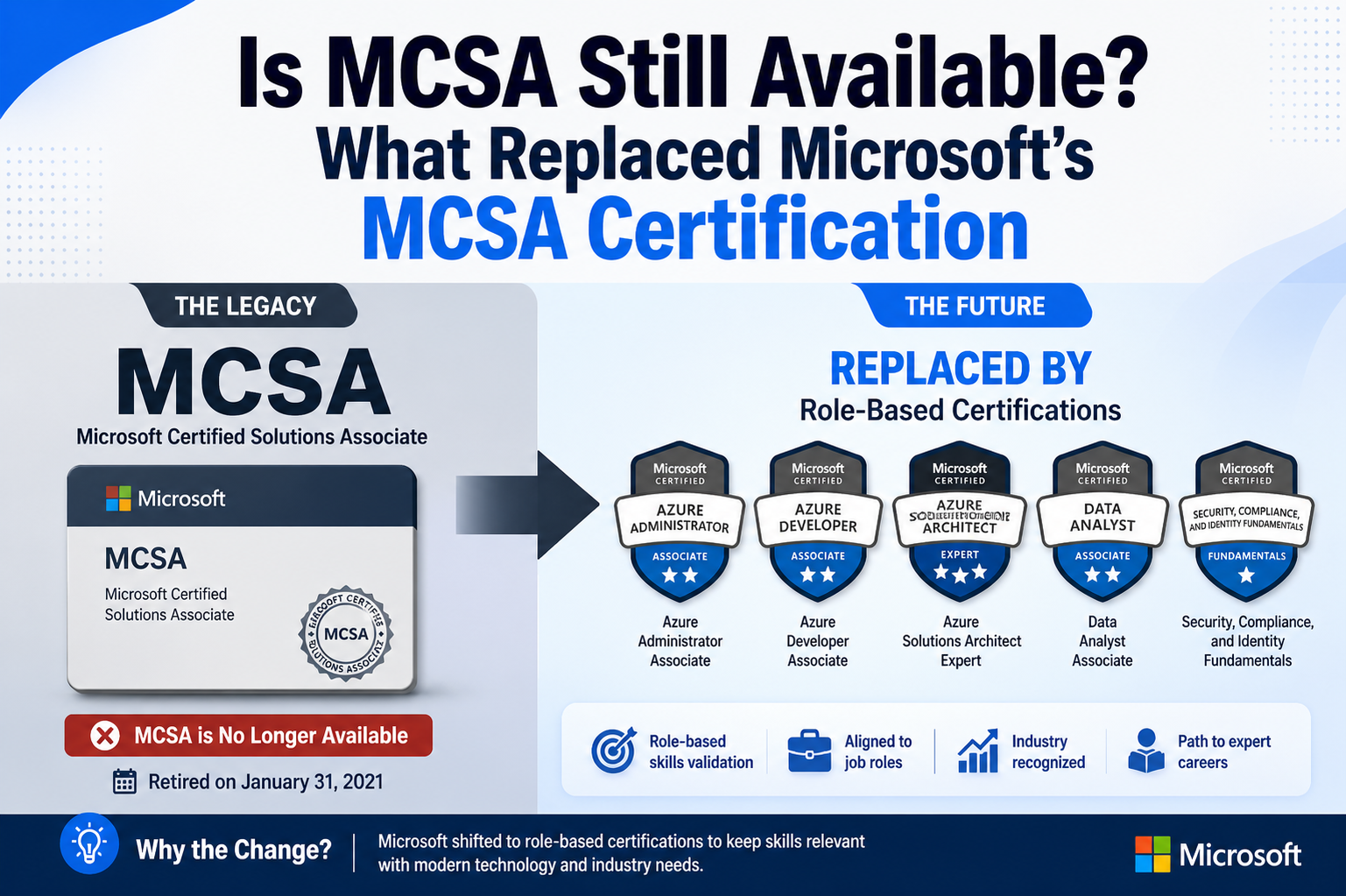
In 2021, Microsoft made a major decision that reshaped its certification landscape by officially retiring the Microsoft Certified Solutions Associate (MCSA), along with other long-standing certifications such as MCSE and MCSD. This move marked the end of an era for many IT professionals who had relied on these certifications as a structured pathway for career development. The decision was not sudden or arbitrary; rather, it reflected a broader shift in how technology roles were evolving in the modern workplace.
One of the primary reasons behind this transition was the rapid growth of cloud computing and hybrid environments. Traditional certifications like the MCSA were heavily focused on on-premises technologies, such as Windows Server installations and local infrastructure management. However, organizations were increasingly moving toward cloud-based solutions, where responsibilities are more dynamic and less confined to a single technology stack. This shift required a new approach to certification—one that could better align with real-world job roles rather than static product knowledge.
Microsoft recognized that the traditional certification pyramid, while effective in the past, was no longer sufficient for modern IT careers. Roles were becoming more specialized, and professionals were expected to have a mix of skills that spanned multiple technologies. For example, a system administrator might now need to manage both on-premises servers and cloud resources, while also understanding security and automation. The older certification model did not fully capture this complexity.
By retiring the MCSA, Microsoft aimed to simplify and modernize its certification offerings. Instead of requiring candidates to follow a rigid progression from one level to another, the new approach allows individuals to choose certifications based on their specific roles and career goals. This flexibility makes it easier for professionals to focus on the skills that are most relevant to their jobs.
The retirement of the MCSA also signaled a shift toward continuous learning. In a fast-changing industry, static certifications can quickly become outdated. Microsoft’s new model encourages professionals to regularly update their skills and stay current with the latest technologies. This ensures that certified individuals remain valuable in a constantly evolving job market.
Introduction to Role-Based Certifications
Following the retirement of the MCSA, Microsoft introduced a new framework known as role-based certifications. Unlike the previous model, which focused on products and hierarchical levels, role-based certifications are designed around specific job functions. This approach reflects the realities of modern IT roles, where responsibilities often span multiple technologies and require a combination of skills.
Role-based certifications are structured to match the tasks that professionals perform in their daily work. For example, instead of earning a general certification in server administration, a candidate might pursue a certification tailored to a “Windows Server Hybrid Administrator.” This certification would cover both on-premises and cloud-based tasks, providing a more comprehensive skill set.
Another advantage of role-based certifications is their clarity. Each certification clearly defines the skills and knowledge required for a particular role, making it easier for candidates to choose the right path. This is particularly helpful for individuals who are new to IT and may not be familiar with the various career options available. By selecting a role-based certification, they can focus on a specific area and build expertise more efficiently.
The new framework also includes different levels of certification, such as fundamentals, associate, and expert. These levels provide a sense of progression while still allowing flexibility. For instance, a beginner might start with a fundamentals certification to gain basic knowledge, then move on to an associate-level certification to develop practical skills. Experienced professionals can pursue expert-level certifications to demonstrate advanced expertise.
This shift to role-based certifications represents a more practical and adaptable approach to professional development. It aligns with the needs of both employers and employees, ensuring that certifications remain relevant and valuable in a rapidly changing industry.
Key Role-Based Certification Paths and Career Options
Microsoft’s role-based certification model offers a wide range of paths, each tailored to a specific career role. These roles cover various aspects of IT, from administration and development to data analysis and security. By aligning certifications with real-world job functions, Microsoft has made it easier for professionals to find a path that matches their interests and goals.
One of the most common roles is that of an administrator. Administrators are responsible for managing systems, networks, and resources, ensuring that everything runs smoothly. In the modern IT environment, this often includes managing both on-premises infrastructure and cloud services. Certifications in this area focus on tasks such as configuring systems, monitoring performance, and implementing security measures.
Another important role is that of a developer. Developers create applications and services that run on Microsoft platforms, including cloud-based solutions. Certifications for developers emphasize programming skills, application design, and integration with other services. These certifications are ideal for individuals who enjoy building software and solving complex problems.
Data-related roles are also becoming increasingly important. Data engineers and data scientists work with large datasets to extract insights and support decision-making. Certifications in this area cover topics such as data storage, processing, and analysis. They are particularly valuable in industries where data plays a critical role, such as finance, healthcare, and e-commerce.
Security is another key area of focus. As cyber threats continue to evolve, organizations need professionals who can protect their systems and data. Security certifications cover topics such as threat detection, incident response, and risk management. These certifications are essential for roles that involve safeguarding sensitive information and ensuring compliance with regulations.
Other roles include solution architects, DevOps engineers, and business analysts. Each of these roles requires a unique set of skills, and Microsoft’s certifications are designed to address those specific needs. By offering a diverse range of options, the role-based model allows professionals to specialize in areas that align with their career aspirations.
Examples of Modern Microsoft Certification Exams
To support its role-based certification framework, Microsoft has introduced a variety of exams that focus on specific skills and technologies. These exams are designed to test practical knowledge and ensure that candidates are prepared for real-world tasks. Some of the most notable examples highlight the diversity and depth of the new certification model.
One example is the AZ-204 exam, which focuses on developing solutions for Microsoft Azure. This exam is aimed at developers who want to build cloud-based applications. It covers topics such as designing and implementing solutions, integrating services, and monitoring performance. Candidates who pass this exam demonstrate their ability to create scalable and reliable applications in a cloud environment.
Another example is the AZ-800 exam, which focuses on administering Windows Server in a hybrid environment. This certification is particularly relevant for professionals who work with both on-premises and cloud-based systems. It covers tasks such as managing servers, implementing security, and ensuring high availability. This reflects the growing importance of hybrid infrastructures in modern IT environments.
The SC-200 exam is designed for security operations analysts. It focuses on detecting, investigating, and responding to security threats using Microsoft tools. This certification is ideal for individuals who want to specialize in cybersecurity and play a critical role in protecting organizational assets.
The DP-300 exam focuses on administering Microsoft Azure SQL solutions. It is aimed at database administrators who manage data in cloud environments. This exam covers topics such as performance optimization, data security, and high availability. It highlights the importance of data management in today’s digital landscape.
These examples demonstrate how Microsoft’s new certifications are tailored to specific roles and technologies. They provide a clear path for professionals to develop the skills needed for their chosen careers. By focusing on practical knowledge and real-world applications, these certifications ensure that candidates are well-prepared for the challenges of modern IT environments.
The Closest Modern Equivalent to MCSA
Although there is no direct replacement for the MCSA, some role-based certifications serve a similar purpose. One of the closest equivalents is the Windows Server Hybrid Administrator Associate certification. This certification combines elements of traditional server administration with modern cloud-based practices, making it a natural successor to the MCSA in many ways.
This certification focuses on managing Windows Server environments in both on-premises and cloud settings. It covers tasks such as configuring servers, managing storage, implementing security, and ensuring system reliability. These are many of the same skills that were emphasized in the MCSA, but with an added focus on hybrid environments.
The introduction of hybrid certifications reflects the reality that most organizations are not fully cloud-based or fully on-premises. Instead, they operate in a mixed environment where both types of infrastructure coexist. Professionals who can manage these environments are highly valuable, and certifications that focus on hybrid skills are in high demand.
Another similarity between this certification and the MCSA is its target audience. Both are aimed at individuals who are building their careers in IT and need a solid foundation of skills. However, the modern certification goes a step further by incorporating cloud technologies, making it more relevant to current industry trends.
In this way, while the MCSA itself has been retired, its legacy continues through newer certifications that build on its foundation. These certifications provide a pathway for professionals to develop the skills needed in today’s technology landscape while maintaining the practical focus that made the MCSA so valuable.
Cost of MCSA Certification and Financial Considerations
The Microsoft Certified Solutions Associate (MCSA) certification was widely regarded as one of the more affordable professional credentials in the IT industry, especially when compared to certifications offered by other major vendors. Microsoft structured its pricing in a way that made certification accessible to a broad audience, including students, entry-level professionals, and individuals transitioning into IT careers.
Typically, each MCSA exam required a separate fee, and candidates needed to pass two or three exams depending on the certification track they chose. In the United States, the cost per exam was generally around $165, while international pricing varied based on local currency and regional adjustments. As a result, the total cost of earning an MCSA certification ranged from moderate to reasonably affordable, making it an attractive option for individuals looking to build their credentials without a significant financial burden.
However, the exam fees were only one part of the overall investment. Many candidates also spent money on training materials, practice exams, online courses, and lab environments. These resources were often essential for success, as the exams required a deep understanding of practical concepts. While some individuals were able to prepare using free resources, others chose to invest in structured training programs to improve their chances of passing on the first attempt.
Another important factor to consider was the possibility of retakes. Microsoft exams were known for their difficulty, and it was not uncommon for candidates to need more than one attempt to pass. To address this, Microsoft occasionally offered discounted retake options, which helped reduce the financial risk for candidates. This approach encouraged more people to pursue certification while maintaining the high standards associated with Microsoft exams.
Overall, the cost of the MCSA certification represented a balance between accessibility and quality. It provided a valuable credential at a reasonable price, making it a popular choice for individuals looking to enter the IT field or advance their careers.
MCSA Certification Status After Retirement
Even though the MCSA certification was officially retired in 2021, it continues to hold value for those who earned it before its discontinuation. Microsoft ensured that previously awarded certifications would not simply disappear or become invalid. Instead, they remain part of an individual’s professional record and can still be used to demonstrate expertise and experience.
Certifications that were earned before retirement are typically listed on a professional transcript as either “active” or “legacy.” An active certification indicates that it was current at the time the associated exams were available, while a legacy certification reflects that the exams have been retired. Importantly, a legacy status does not mean that the certification has expired or lost its credibility. It simply indicates that it is based on older technology.
For many professionals, having an MCSA certification on their resume still carries weight. It demonstrates that they have undergone rigorous training and have met the standards set by Microsoft. In some cases, employers may even prefer candidates with legacy certifications if they are working with older systems that are still in use.
However, it is also important for professionals to stay up to date with current technologies. While the MCSA provides a strong foundation, the IT industry evolves rapidly, and new skills are constantly required. This is why many individuals who hold an MCSA choose to pursue newer certifications that align with modern technologies, such as cloud computing and cybersecurity.
In this way, the MCSA continues to serve as a valuable credential while also encouraging professionals to expand their knowledge and adapt to changing industry demands.
Salary Expectations and Career Impact of MCSA
The earning potential associated with the MCSA certification varies widely depending on factors such as job role, experience level, industry, and geographic location. However, one consistent trend is that certified professionals tend to earn higher salaries than their non-certified counterparts. This is because certifications demonstrate a level of expertise and commitment that is highly valued by employers.
Professionals who earned the MCSA certification often pursued roles such as system administrator, database administrator, or business intelligence analyst. Each of these roles comes with its own salary range and career progression opportunities. For example, system administrators are responsible for managing and maintaining IT infrastructure, while database administrators focus on organizing and securing data. Business intelligence analysts, on the other hand, use data to support decision-making processes.
In general, entry-level positions associated with the MCSA certification offer competitive starting salaries, with opportunities for growth as individuals gain experience. As professionals develop their skills and take on more responsibilities, they can move into higher-paying roles or specialize in specific areas. This upward mobility is one of the key benefits of earning a certification like the MCSA.
It is also worth noting that salaries can vary significantly based on location. In regions with a high demand for IT professionals, salaries may be higher due to increased competition for skilled workers. Similarly, industries such as finance, healthcare, and technology often offer higher compensation due to the critical nature of their IT systems.
While certification alone does not guarantee a high salary, it can significantly enhance a professional’s earning potential when combined with experience and additional skills. This makes the MCSA a valuable investment for those looking to build a successful career in IT.
The Long-Term Value of Microsoft Certifications in a Changing Industry
The retirement of the MCSA certification marked a significant shift in how Microsoft approaches professional development, but it did not diminish the importance of certifications as a whole. Instead, it highlighted the need for a more flexible and adaptive approach to learning in an industry that is constantly evolving.
Modern IT environments are characterized by rapid technological advancements, including the rise of cloud computing, artificial intelligence, and cybersecurity. These changes require professionals to continuously update their skills and stay informed about new developments. Microsoft’s role-based certifications are designed to address this need by focusing on practical, job-specific skills that can be applied immediately.
One of the key advantages of the new certification model is its emphasis on continuous learning. Rather than earning a certification and relying on it indefinitely, professionals are encouraged to regularly update their credentials. This ensures that their knowledge remains relevant and aligned with current industry standards. It also helps employers maintain a workforce that is capable of handling modern challenges.
Another important aspect of Microsoft certifications is their global recognition. Whether it is the legacy MCSA or a modern role-based certification, these credentials are respected by employers around the world. They provide a standardized way to measure skills and ensure consistency across different regions and industries.
For individuals, the long-term value of certifications lies in their ability to open doors to new opportunities. They can help professionals enter the IT field, advance in their careers, and transition into new roles. By continuously learning and adapting, individuals can build a sustainable and rewarding career in technology.
Final Thoughts
The Microsoft Certified Solutions Associate certification played a crucial role in shaping the careers of countless IT professionals. It provided a clear pathway for learning and validation, helping individuals build the skills needed to succeed in the industry. Although it has been retired, its impact continues to be felt through the professionals who earned it and the certification models that followed.
Today, Microsoft’s role-based certifications offer a more flexible and relevant approach to professional development. They reflect the realities of modern IT roles and provide targeted learning opportunities for individuals at all stages of their careers. While the MCSA may no longer be available, its legacy lives on in these new certifications, which continue to support the growth and success of IT professionals around the world.