In the modern corporate world, the role of a Chief Information Officer has evolved into one of the most influential executive positions within an organization. A CIO is no longer seen as a purely technical authority confined to managing IT systems. Instead, this position now sits at the intersection of technology, business strategy, and organizational leadership. As companies increasingly depend on digital infrastructure, data-driven decision-making, and advanced technologies such as cloud computing and artificial intelligence, the importance of the CIO has grown significantly.
This growing importance has also brought increased attention to CIO compensation. Salaries for chief information officers vary widely, reflecting differences in company size, industry demands, geographic location, and individual expertise. In high-growth technology hubs and large multinational corporations, CIO compensation packages can reach extremely high levels, often including base salary, bonuses, stock options, and long-term incentives. Meanwhile, in mid-sized companies or emerging markets, salaries may be more moderate but still highly competitive compared to other executive roles.
Understanding CIO salaries requires more than just looking at numbers. It involves examining what the role demands, how responsibilities have shifted over time, and why organizations are willing to invest heavily in these leaders. This overview provides a deep look into the CIO profession, starting with the role itself and gradually moving toward compensation structures and influencing factors.
The Role and Identity of a Chief Information Officer
The Chief Information Officer is the highest-ranking executive responsible for overseeing an organization’s information technology strategy and operations. At its core, the CIO ensures that all technological systems align with business goals, enabling efficiency, innovation, and long-term growth. However, the modern CIO role extends far beyond traditional IT management.
Historically, CIOs were primarily focused on maintaining internal systems, managing hardware and software infrastructure, and ensuring that employees had access to reliable technology. Their work was often operational, centered around uptime, maintenance, and support. Today, this definition has expanded dramatically. CIOs are now expected to actively contribute to business transformation, competitive strategy, and revenue generation.
In many organizations, the CIO participates directly in executive decision-making. They collaborate with CEOs, CFOs, and other senior leaders to determine how technology can drive business value. Whether it involves migrating systems to the cloud, implementing enterprise-wide cybersecurity frameworks, or integrating artificial intelligence into operations, the CIO plays a central role in shaping the future of the business.
A successful CIO must possess a unique blend of technical expertise and business intelligence. They are expected to understand complex systems such as enterprise resource planning platforms, cloud ecosystems, cybersecurity frameworks, and data analytics tools. At the same time, they must also be strong communicators, capable of translating technical concepts into business outcomes that stakeholders can understand.
In larger organizations, the CIO often leads entire departments that include IT operations, cybersecurity, software development, and data management teams. In smaller companies, however, the role may overlap with other executive positions, sometimes combining responsibilities of a Chief Technology Officer or Chief Information Security Officer.
Evolution of the CIO Role in Modern Enterprises
The evolution of the CIO role reflects broader changes in technology and business priorities. Decades ago, IT departments were considered support functions with limited strategic influence. Technology was seen as a cost center rather than a value driver. The CIO’s main responsibility was to ensure systems ran smoothly and efficiently without interruptions.
However, the digital transformation era has fundamentally changed this perception. As organizations began to rely heavily on digital platforms, data analytics, and automation, technology shifted from a support function to a strategic asset. This shift elevated the CIO into a leadership position that directly impacts organizational success.
Today’s CIO is deeply involved in innovation initiatives. They help organizations adopt emerging technologies, streamline operations, and improve customer experiences through digital solutions. In industries such as finance, healthcare, retail, and manufacturing, CIOs are often responsible for leading large-scale transformation projects that reshape entire business models.
The rise of cloud computing has further expanded the CIO’s responsibilities. Managing hybrid or fully cloud-based environments requires strategic planning, vendor management, cost optimization, and security oversight. Similarly, the growing importance of cybersecurity has made CIOs key players in risk management and regulatory compliance.
Artificial intelligence and data analytics have also added new layers of responsibility. CIOs are now expected to ensure that organizations can collect, process, and interpret vast amounts of data effectively. This requires not only technical infrastructure but also governance frameworks that ensure data accuracy, privacy, and ethical use.
As a result, the CIO has become a central figure in shaping digital strategy and ensuring that technology investments deliver measurable business outcomes.
Core Responsibilities of a Chief Information Officer
The responsibilities of a CIO are broad and multifaceted, reflecting the complexity of modern enterprises. At a high level, the CIO is responsible for developing and executing the organization’s technology strategy. This includes planning long-term IT roadmaps, overseeing system implementation, and ensuring that technology investments align with business objectives.
One of the primary responsibilities is infrastructure management. This involves overseeing servers, networks, databases, and cloud environments to ensure reliability, scalability, and performance. CIOs must also ensure that systems are secure and compliant with industry regulations.
Another critical responsibility is cybersecurity oversight. With increasing cyber threats, data breaches, and regulatory requirements, CIOs must implement robust security frameworks. This includes managing risk assessments, incident response strategies, and compliance with standards such as NIST or ISO frameworks.
CIOs also play a major role in digital transformation initiatives. This includes migrating legacy systems to modern platforms, adopting cloud technologies, and implementing automation solutions. These projects often require coordination across multiple departments and significant change management efforts.
In addition, CIOs are responsible for data governance and analytics. They ensure that organizations can effectively collect, store, and analyze data to support decision-making. This includes implementing business intelligence tools, managing data warehouses, and ensuring data integrity across systems.
Vendor and stakeholder management is another important aspect of the role. CIOs frequently work with external technology providers, consultants, and service vendors. They negotiate contracts, evaluate solutions, and ensure that third-party services align with organizational needs.
Finally, CIOs are increasingly involved in leadership and organizational development. They are responsible for building and leading IT teams, fostering innovation, and developing talent within the organization. Strong leadership skills are essential, as CIOs must inspire teams while also communicating effectively with executive stakeholders.
Skills and Technologies That Define a Modern CIO
To succeed in today’s environment, CIOs must possess a diverse skill set that combines technical knowledge with strategic leadership abilities. On the technical side, familiarity with enterprise platforms such as SAP, Oracle, Salesforce, and Microsoft Azure is essential. These systems form the backbone of many organizations and require strong oversight.
Cloud computing expertise is particularly important. CIOs must understand how to design, manage, and optimize cloud environments across providers such as AWS, Azure, and Google Cloud. This includes cost management, scalability planning, and security configuration.
Data analytics is another critical area. CIOs must be able to leverage tools such as Power BI, Tableau, and other business intelligence platforms to transform raw data into actionable insights. This supports better decision-making across the organization.
Cybersecurity knowledge is equally important. CIOs must understand threat landscapes, encryption methods, identity management systems, and compliance requirements. While they may not handle technical security tasks directly, they must oversee overall strategy and governance.
On the leadership side, CIOs need strong communication, negotiation, and strategic planning skills. They must be able to bridge the gap between technical teams and executive leadership, ensuring alignment across all levels of the organization.
Frameworks such as ITIL, COBIT, and TOGAF are also commonly used by CIOs to standardize processes, improve service delivery, and ensure governance compliance. These frameworks help CIOs maintain structure and consistency across complex IT environments.
Early Overview of Chief Information Officer Compensation Trends
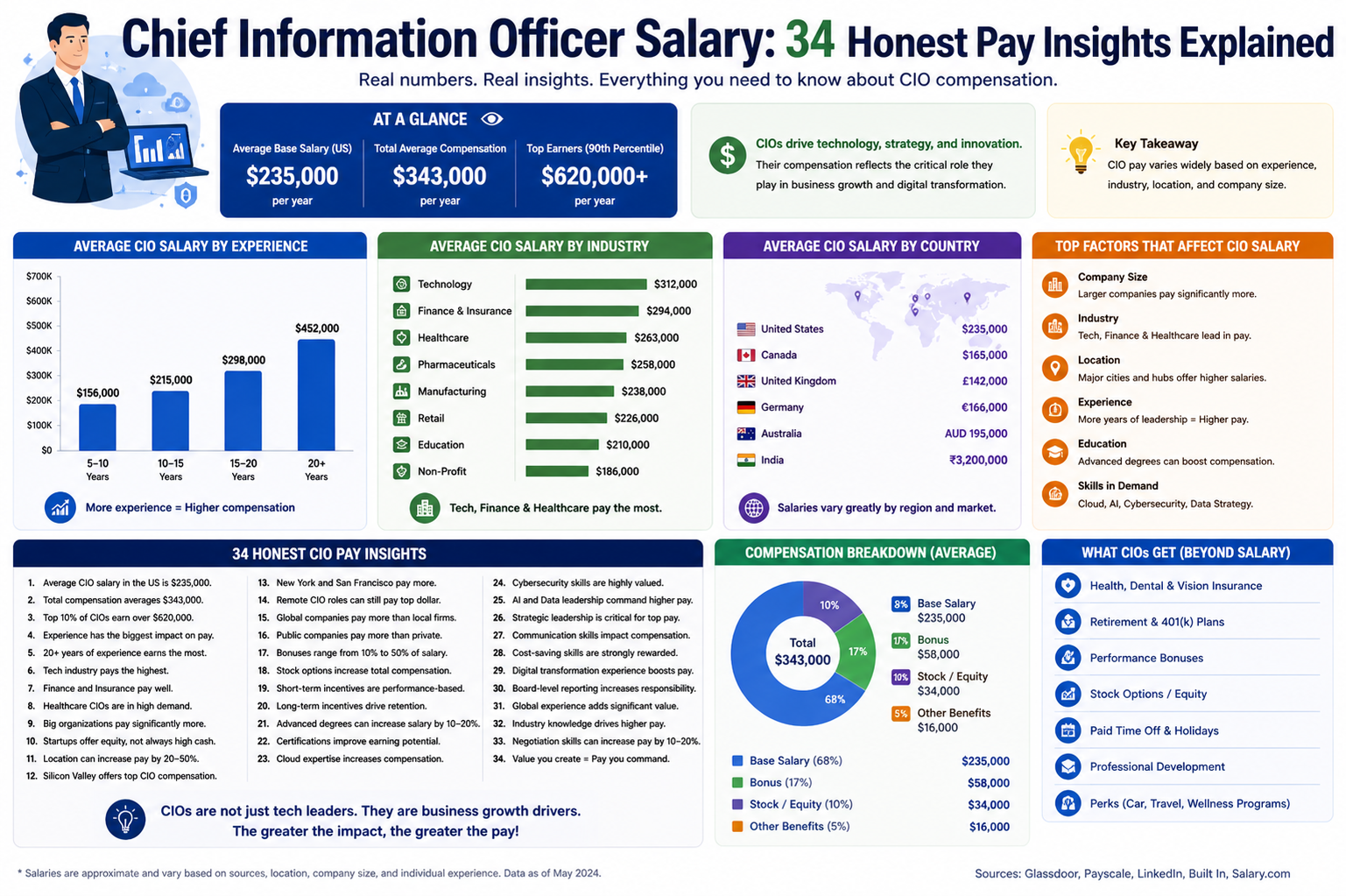
CIO compensation reflects the high level of responsibility associated with the role. On average, CIOs in the United States earn well into six-figure salaries, with total compensation often increasing significantly when bonuses, stock options, and performance incentives are included.
However, salaries vary widely depending on several factors. Larger companies tend to offer higher compensation due to the scale and complexity of their operations. Similarly, industries such as technology, finance, and healthcare typically offer more competitive pay due to their reliance on advanced digital systems and strict regulatory requirements.
Geographic location also plays a significant role. CIOs working in major metropolitan areas or technology hubs generally earn more than those in smaller cities or rural regions. This is due to higher demand, increased cost of living, and concentration of large enterprises.
Experience and track record further influence compensation. CIOs with a history of successful digital transformation, cost optimization, or enterprise-wide system implementation often command higher salaries. In many cases, compensation packages also include performance-based bonuses and long-term incentives tied to company growth.
The variability in CIO salaries reflects the diversity of the role itself. No two CIO positions are identical, and compensation is often tailored to the specific responsibilities, expectations, and strategic importance of the role within each organization.
Chief Information Officer Salary Breakdown by Industry and Market Demand
The salary of a Chief Information Officer is strongly influenced by the industry in which they operate. Different sectors place different levels of importance on technology, compliance, and digital transformation, which directly impacts compensation levels. Industries that are highly dependent on secure, scalable, and innovative IT systems tend to offer significantly higher pay compared to traditional sectors.
In the technology industry, CIOs often receive the highest compensation packages. This is because tech companies rely entirely on digital infrastructure, rapid innovation cycles, and large-scale data operations. CIOs in this sector are expected to drive product development support systems, manage global cloud infrastructure, and ensure continuous innovation. As a result, salaries in tech firms often include substantial performance bonuses and equity options.
The financial services sector is another high-paying industry for CIOs. Banks, investment firms, and insurance companies depend heavily on secure and compliant IT systems. CIOs in this field must ensure strict regulatory compliance, prevent cyber threats, and manage massive transaction systems. Due to the high stakes involved, compensation packages are typically very competitive and often include long-term incentive plans.
Healthcare is also a rapidly growing sector for CIO roles. Hospitals and healthcare networks increasingly rely on digital patient records, telemedicine platforms, and data analytics for treatment optimization. CIOs in healthcare must also ensure compliance with privacy laws and data protection standards. Because of these responsibilities, compensation has been steadily increasing in this industry.
Manufacturing and logistics companies also employ CIOs, but salaries tend to be slightly lower compared to tech or finance. However, this gap is narrowing as these industries adopt automation, robotics, and smart supply chain systems. CIOs in these sectors are increasingly responsible for digital transformation initiatives that improve efficiency and reduce operational costs.
Government and public sector CIO roles generally offer more stable but lower compensation compared to private industries. However, these positions often provide strong job security, pension benefits, and structured career growth paths.
Geographic Influence on Chief Information Officer Compensation
Location plays a significant role in determining CIO salaries due to differences in cost of living, market demand, and concentration of large enterprises. Cities with strong technology ecosystems and multinational corporations tend to offer significantly higher compensation packages.
Major metropolitan areas such as San Francisco, New York, and Seattle consistently rank at the top for CIO salaries. These cities host some of the world’s largest technology firms and financial institutions, creating strong demand for experienced IT executives. In these markets, CIOs often earn compensation packages that include high base salaries, stock options, and performance bonuses.
Mid-tier cities such as Austin, Denver, and Atlanta also offer competitive salaries, especially as more companies relocate their headquarters or establish regional offices in these areas. These cities often provide a balance between strong earning potential and lower living costs, making them attractive for senior IT executives.
Smaller cities and emerging markets typically offer lower base salaries for CIOs. However, the cost of living in these regions is also significantly lower, and senior executives may still enjoy comfortable compensation relative to local standards. Additionally, remote leadership roles have started to reduce the importance of physical location, allowing CIOs to work for high-paying organizations while residing in more affordable regions.
Internationally, CIO salaries vary widely. In regions such as Western Europe and parts of Asia, compensation is often competitive but structured differently, with more emphasis on fixed salary rather than equity-based incentives. In contrast, North American CIO compensation packages tend to be more heavily weighted toward performance bonuses and stock options.
Structure of CIO Compensation Packages
Chief Information Officer compensation is rarely limited to a base salary. Instead, it typically consists of multiple components designed to reward both performance and long-term contribution to the organization.
The base salary forms the foundation of compensation and is influenced by experience, company size, and industry. However, it is only one part of the total package. In many cases, base salary represents less than half of total compensation for senior CIOs.
Annual bonuses are a major component of CIO pay. These bonuses are usually tied to performance metrics such as system uptime, successful project delivery, cost savings, or digital transformation milestones. In some organizations, bonuses can significantly increase total annual earnings.
Long-term incentives, such as stock options or restricted stock units, are common in publicly traded companies. These incentives align the CIO’s performance with the long-term success of the organization. In high-growth companies, equity-based compensation can sometimes exceed base salary over time.
Some CIO roles also include profit-sharing arrangements, especially in privately held companies or partnerships. This allows executives to benefit directly from the financial success of the organization.
Additional compensation may include relocation packages, executive perks, retirement contributions, and deferred compensation plans. These benefits are designed to attract and retain top-tier executive talent in highly competitive markets.
Impact of Company Size on CIO Salary Levels
The size of the organization is one of the most important factors influencing CIO compensation. Larger organizations typically require more complex IT infrastructures, larger teams, and more strategic oversight, all of which justify higher salaries.
In small to mid-sized companies, CIOs often wear multiple hats. They may oversee not only IT strategy but also cybersecurity, infrastructure, and sometimes even operational technology. While responsibilities are broad, budgets are more limited, resulting in moderate compensation compared to enterprise-level roles.
Mid-sized companies offer a step up in complexity and pay. CIOs in these organizations often manage larger teams and more sophisticated systems. They are typically involved in scaling operations, improving efficiency, and implementing enterprise-level solutions. Compensation reflects this increased responsibility.
Large enterprises and multinational corporations offer the highest CIO salaries. These organizations operate across multiple regions, manage complex global IT systems, and require extensive governance structures. CIOs in these environments are often part of the executive leadership team and play a key role in shaping corporate strategy.
In Fortune 500 companies, CIOs may oversee thousands of employees and manage billion-dollar technology budgets. These roles often come with substantial bonuses, equity packages, and long-term incentive plans that significantly increase total compensation.
Experience-Based Salary Progression for CIOs
Experience is a major determinant of CIO earnings, but it is not simply measured in years. It also reflects the scope of leadership roles, complexity of responsibilities, and proven ability to deliver results.
Early-stage CIOs typically transition from roles such as IT director or VP of technology. At this stage, they may lead smaller IT teams and manage limited budgets. Their compensation reflects their entry into executive leadership, with moderate but competitive salaries.
Mid-career CIOs usually have extensive leadership experience and manage larger organizations or divisions. They are often responsible for multiple IT domains, including infrastructure, security, and digital transformation. Their compensation increases significantly as they take on broader responsibilities.
Senior or enterprise-level CIOs operate at the highest level of organizational leadership. They report directly to CEOs or boards of directors and are involved in strategic decision-making across the entire company. Their compensation packages often include substantial bonuses and equity, reflecting their impact on organizational success.
At the highest level, experienced CIOs may transition into broader executive roles such as Chief Digital Officer or even CEO, further increasing their earning potential.
Performance Factors That Increase CIO Compensation
Beyond experience and location, individual performance plays a critical role in determining CIO compensation. Organizations reward CIOs who deliver measurable business outcomes through technology initiatives.
One of the most important performance indicators is successful digital transformation. CIOs who modernize legacy systems, implement cloud infrastructure, or streamline operations often receive significant compensation increases.
Cybersecurity leadership is another key factor. CIOs who effectively protect organizations from data breaches and regulatory risks are highly valued. Strong performance in this area often leads to bonuses and long-term incentives.
Cost optimization is also a major performance metric. CIOs who reduce IT spending while improving system efficiency demonstrate clear value to the organization. This ability to balance cost and performance is highly rewarded.
Innovation leadership is increasingly important as organizations adopt emerging technologies such as artificial intelligence, machine learning, and automation. CIOs who successfully integrate these technologies into business operations often see accelerated career growth and compensation increases.
Finally, leadership effectiveness plays a crucial role. CIOs who build strong teams, improve organizational culture, and align IT strategy with business goals are more likely to advance into higher-paying executive roles.
Market Demand and Future Outlook for CIO Salaries
The demand for Chief Information Officers continues to grow as organizations become more dependent on digital systems. Nearly every industry now relies on technology to operate efficiently, compete effectively, and innovate continuously.
This rising demand has created a competitive market for experienced CIOs. Organizations are willing to offer higher salaries and more attractive compensation packages to secure top talent. As a result, CIO compensation is expected to continue increasing in the coming years.
Emerging technologies such as artificial intelligence, cybersecurity advancements, and cloud computing will further expand the responsibilities of CIOs. As these responsibilities grow, so too will the value placed on experienced IT executives.
In addition, the increasing importance of data-driven decision-making ensures that CIOs will remain central to organizational strategy. This continued relevance supports long-term salary growth and career stability for professionals in this role.
Career Path Progression Toward Becoming a Chief Information Officer
The journey to becoming a Chief Information Officer is rarely linear. It is typically built through years of progressive responsibility in technology leadership roles, combined with exposure to business strategy and organizational decision-making. Most CIOs begin their careers in technical or operational IT positions and gradually move into leadership roles that expand both scope and influence.
Early career professionals often start as systems administrators, network engineers, software developers, or IT support specialists. These roles build foundational technical knowledge, including infrastructure management, application development, cybersecurity basics, and system architecture. While these positions are not executive in nature, they are essential for understanding how technology functions at a practical level.
As professionals gain experience, they typically move into mid-level management roles such as IT manager, systems manager, or project manager. At this stage, responsibilities shift from hands-on technical work to team leadership, project coordination, and resource management. Individuals begin to oversee small teams, manage budgets, and interact with business stakeholders.
The next step is often director-level positions, such as IT director or director of technology. These roles involve managing entire IT departments, setting technology standards, and aligning IT initiatives with business objectives. Directors are frequently responsible for strategic planning, vendor negotiations, and large-scale system implementations.
From there, professionals may advance to vice president of IT or similar senior leadership roles. These positions are closely aligned with executive decision-making and often serve as the final stepping stone before becoming a CIO. VPs of IT are typically responsible for enterprise-wide technology strategy and may already participate in board-level discussions.
Finally, the Chief Information Officer role represents the culmination of this progression. At this level, professionals are no longer focused solely on IT operations but are instead responsible for shaping the organization’s digital future and ensuring technology drives business success.
How Leadership Scope Impacts CIO Salary Growth
One of the most significant factors influencing CIO compensation is leadership scope. The broader and more complex the leadership responsibility, the higher the salary potential. Scope is not defined only by team size, but also by the level of strategic influence and operational complexity.
CIOs who manage small IT departments within mid-sized companies typically have limited scope. Their responsibilities may include overseeing infrastructure, supporting internal systems, and managing a small group of IT professionals. While these roles are important, compensation is generally moderate compared to enterprise-level positions.
As leadership scope expands, CIOs begin managing larger teams, multiple departments, and more complex systems. They may oversee global IT operations, manage cross-functional initiatives, and coordinate with other executive leaders. This expansion in responsibility directly correlates with increased compensation.
At the enterprise level, CIOs often lead entire global technology ecosystems. This includes managing thousands of employees, coordinating across international offices, and overseeing massive IT budgets. In these environments, the CIO’s decisions have a direct impact on revenue, customer experience, and long-term business strategy.
The greater the strategic influence of the CIO, the higher the compensation tends to be. CIOs who are actively involved in shaping corporate direction, mergers and acquisitions, and digital transformation initiatives are often among the highest-paid executives in an organization.
Strategic Decision-Making and Its Effect on CIO Earnings
Modern CIOs are deeply involved in strategic decision-making processes, and this involvement significantly influences their earning potential. Organizations increasingly view technology as a core driver of business strategy rather than just an operational necessity.
CIOs who participate in board meetings and executive planning sessions are often compensated at higher levels. Their input directly affects business direction, investment decisions, and long-term organizational goals. This level of influence positions them as key decision-makers rather than support executives.
Strategic involvement in digital transformation is one of the most valuable contributions a CIO can make. Companies undergoing major technological shifts rely heavily on CIO leadership to guide cloud migration, system modernization, and automation initiatives. Successful execution of these strategies often leads to performance-based bonuses and salary increases.
CIOs who contribute to revenue growth strategies also tend to earn higher compensation. This includes leveraging data analytics to improve customer experience, implementing technology that enables new business models, or optimizing systems to increase operational efficiency.
Risk management is another area where strategic decision-making plays a role in compensation. CIOs who successfully protect organizations from cybersecurity threats, data breaches, and compliance violations are highly valued. Their ability to mitigate risk directly impacts organizational stability and financial performance.
Organizational Transformation and CIO Value Creation
One of the most important responsibilities of a modern CIO is leading organizational transformation. This involves reshaping how a company uses technology to improve efficiency, innovation, and competitiveness. CIOs who excel in transformation roles often experience significant salary growth.
Digital transformation initiatives typically include upgrading legacy systems, implementing cloud infrastructure, and adopting automation technologies. These projects require long-term planning, cross-departmental collaboration, and strong leadership skills.
CIOs who successfully lead transformation projects are able to demonstrate measurable business value. This may include cost reductions, improved operational efficiency, faster product delivery, or enhanced customer experiences. Organizations reward these outcomes through higher compensation and performance incentives.
In addition to technical transformation, CIOs often lead cultural transformation within organizations. This involves promoting digital adoption, encouraging innovation, and fostering collaboration between IT and business units. Strong leadership in this area can significantly increase a CIO’s influence and earning potential.
The ability to align technology initiatives with business strategy is one of the most valuable skills a CIO can possess. Organizations are willing to pay a premium for leaders who can translate complex technological investments into tangible business results.
Industry-Specific Demand and Compensation Variations
Different industries place varying levels of demand on CIOs, which directly affects salary structures. Industries with high reliance on data, security, and digital systems tend to offer higher compensation due to the critical nature of IT operations.
In the financial sector, CIOs manage highly sensitive systems that handle transactions, customer data, and regulatory compliance. The high-risk environment and strict regulatory requirements make these roles extremely demanding, leading to higher compensation packages.
The healthcare industry also places strong demand on CIOs. Healthcare systems rely on secure patient data management, electronic health records, and telemedicine platforms. CIOs in this field must ensure compliance with privacy regulations while also enabling efficient healthcare delivery systems.
Technology companies represent another high-demand sector. CIOs in tech firms are often at the forefront of innovation, managing large-scale infrastructure and supporting rapid product development cycles. Compensation in this industry is typically among the highest due to the competitive talent market.
Retail and e-commerce industries have also increased demand for CIOs as digital commerce continues to expand. CIOs in these sectors are responsible for managing customer-facing platforms, supply chain systems, and data analytics tools that drive sales and customer engagement.
Manufacturing, energy, and logistics industries are increasingly adopting digital technologies, leading to rising demand for CIO leadership. While historically these sectors offered lower compensation, modernization efforts are closing the gap.
Impact of Organizational Digital Maturity on CIO Salary
The digital maturity of an organization plays a significant role in determining CIO compensation. Companies at different stages of digital development require different levels of CIO expertise and leadership.
Organizations in early stages of digital maturity typically rely on CIOs to establish foundational systems. This includes implementing basic IT infrastructure, introducing cloud services, and standardizing operational processes. Compensation in these environments is generally moderate.
Companies in mid-level digital maturity require CIOs to optimize and expand existing systems. This includes improving data integration, enhancing cybersecurity frameworks, and implementing advanced analytics tools. CIOs in these environments often see higher compensation due to increased complexity.
Highly mature digital organizations require CIOs to focus on innovation, scalability, and continuous improvement. These companies often operate in highly competitive markets and depend heavily on advanced technologies such as artificial intelligence, machine learning, and automation. CIOs in these environments are typically among the highest-paid executives.
Digital maturity directly influences how strategic a CIO’s role becomes. The more integrated technology is within the business model, the greater the CIO’s influence and compensation potential.
Talent Competition and Market Pressure on CIO Salaries
The demand for experienced CIOs continues to grow, creating strong competition in the talent market. Organizations are increasingly willing to offer higher salaries, bonuses, and benefits to attract and retain top-tier IT leadership.
One of the key drivers of this competition is the shortage of highly experienced CIO-level professionals. As technology becomes more complex, organizations require leaders who not only understand IT systems but also possess strong business acumen and strategic vision.
This talent shortage has led to upward pressure on salaries, particularly in industries undergoing rapid digital transformation. Companies are competing not only on base salary but also on equity, bonuses, and long-term incentives.
Executive recruitment firms often play a significant role in CIO hiring, further driving competition. Organizations seeking top talent must offer attractive compensation packages to secure experienced candidates.
Remote leadership opportunities have also expanded the talent pool, allowing organizations to recruit CIOs from different geographic regions. This has increased competition globally and influenced salary benchmarks across markets.
Salary Negotiation Strategies for Chief Information Officers
Negotiating a Chief Information Officer salary is significantly different from negotiating mid-level or technical roles. At the executive level, compensation discussions are less about hourly rates or standard pay bands and more about total value contribution, strategic impact, and long-term business outcomes.
One of the most important aspects of CIO salary negotiation is understanding the full compensation structure. Base salary is only one component, while bonuses, equity, long-term incentives, and performance-based rewards often represent a substantial portion of total earnings. Experienced CIOs focus on negotiating the entire package rather than just the fixed salary.
Successful negotiation often begins with demonstrating measurable impact. CIOs who can show clear results from past roles such as cost reduction, system modernization, revenue growth enablement, or cybersecurity improvements have significantly stronger leverage. Organizations are more willing to offer premium compensation when they can see a direct connection between leadership performance and business success.
Another key negotiation strategy involves benchmarking against industry standards. CIOs who understand compensation trends across industries, company sizes, and geographic regions are better positioned to negotiate effectively. Knowledge of market ranges helps ensure that offers are competitive and aligned with industry expectations.
Equity negotiation is also a critical component at the executive level. In many organizations, especially technology-driven or high-growth companies, stock options or restricted stock units can significantly increase total compensation. CIOs who negotiate strong equity packages often see long-term financial gains that far exceed base salary.
Timing also plays an important role in negotiation. CIOs are in a stronger position when negotiating during hiring phases, major organizational transitions, or after successfully leading high-impact projects. Performance review cycles and company expansion periods are also favorable times for compensation discussions.
How CIO Performance Metrics Influence Salary Increases
Performance metrics are central to determining CIO compensation growth. Unlike traditional roles, CIO success is measured through a combination of technical, operational, and business outcomes. Organizations rely on these metrics to evaluate bonuses, salary increases, and long-term incentives.
One of the primary performance indicators is system reliability and uptime. CIOs are responsible for ensuring that critical systems remain operational with minimal downtime. High system availability directly supports business continuity and customer satisfaction, making it a key compensation factor.
Cost efficiency is another important metric. CIOs who successfully optimize IT budgets, reduce operational costs, and improve resource allocation often receive higher compensation. This demonstrates the ability to manage large-scale budgets effectively while still delivering business value.
Project delivery success is also heavily weighted in performance evaluations. CIOs who consistently deliver large-scale initiatives on time and within budget such as cloud migrations, enterprise software implementations, or infrastructure upgrades are viewed as high-value leaders.
Cybersecurity performance is increasingly important in compensation decisions. CIOs who successfully prevent data breaches, maintain compliance, and implement strong security frameworks are highly rewarded due to the financial and reputational risks associated with security failures.
Innovation contribution is another growing metric. CIOs who introduce new technologies, improve digital capabilities, or enable new revenue streams through technology are often recognized with bonuses and salary increases.
Role of Executive Presence in CIO Compensation Growth
Executive presence plays a significant role in determining a CIO’s long-term compensation trajectory. Beyond technical expertise, organizations value CIOs who can communicate effectively, influence stakeholders, and represent the IT function at the highest levels of leadership.
CIOs with strong executive presence are often invited to participate in board meetings, strategic planning sessions, and investor discussions. This level of visibility increases their influence within the organization and often leads to higher compensation.
Communication skills are a critical part of executive presence. CIOs must be able to translate complex technical concepts into business language that non-technical stakeholders can understand. This ability strengthens trust and enhances their role as strategic advisors.
Decision-making confidence is another key factor. CIOs are expected to make high-stakes decisions involving multimillion-dollar technology investments, cybersecurity risks, and enterprise system changes. Strong, confident leadership in these areas often leads to higher executive compensation.
Relationship-building across departments also contributes to executive presence. CIOs who collaborate effectively with CEOs, CFOs, and operational leaders are more likely to be seen as essential contributors to business success.
Impact of Emerging Technologies on CIO Salary Growth
Emerging technologies are reshaping the CIO role and significantly influencing salary trends. As organizations adopt new digital tools and platforms, CIO responsibilities continue to expand, increasing demand for highly skilled leaders.
Artificial intelligence is one of the most influential technologies affecting CIO compensation. CIOs responsible for AI integration must oversee data infrastructure, algorithm deployment, and ethical considerations. This specialized expertise often leads to higher pay.
Cloud computing continues to drive salary growth as organizations shift from traditional infrastructure to scalable cloud environments. CIOs who manage hybrid or multi-cloud systems are in high demand and often receive premium compensation.
Cybersecurity advancements also play a major role. With increasing cyber threats, CIOs who can implement advanced security frameworks and respond to evolving risks are highly valued. Security expertise is often directly tied to salary increases.
Automation and digital process optimization are also impacting CIO responsibilities. CIOs who implement automation strategies that improve efficiency and reduce operational costs are often rewarded with bonuses and salary enhancements.
Data analytics and business intelligence technologies are another key factor. CIOs who enable organizations to leverage data for decision-making are increasingly seen as strategic assets, leading to higher compensation packages.
Long-Term Career Value of a Chief Information Officer Role
The CIO role offers significant long-term career value beyond immediate salary considerations. It is one of the few executive positions that combines technical expertise with strategic business leadership, creating opportunities for continued advancement.
Many CIOs eventually transition into broader executive roles such as Chief Operating Officer, Chief Digital Officer, or even Chief Executive Officer. This progression reflects the increasing importance of technology in overall business strategy.
The skills developed as a CIO are highly transferable across industries. Leadership, strategic planning, risk management, and digital transformation expertise are valuable in virtually every sector, providing strong career flexibility.
CIO experience also positions professionals for advisory and board-level roles. Many former CIOs serve on corporate boards, technology advisory committees, or as consultants for large organizations. These roles often provide additional income streams and influence.
The long-term financial benefits of a CIO career are also significant. Even beyond base salary, equity compensation, bonuses, and long-term incentives can accumulate substantial wealth over time, especially in high-growth organizations.
Future Outlook for Chief Information Officer Salaries
The future of CIO compensation is closely tied to the continued evolution of digital transformation and enterprise technology dependency. As organizations become more digital-first, the strategic importance of the CIO will continue to increase.
Demand for CIOs is expected to grow across all major industries, including healthcare, finance, manufacturing, retail, and technology. This broad demand will continue to support competitive salary growth.
One of the most important trends shaping future compensation is the increasing integration of technology into business strategy. CIOs are no longer just IT leaders; they are business transformation leaders. This shift is expected to elevate compensation levels further.
The growing importance of cybersecurity will also continue to drive salary increases. As cyber threats become more sophisticated, CIOs with strong security leadership capabilities will remain in high demand.
Remote and global leadership trends are also expected to influence CIO salaries. Organizations are increasingly hiring CIOs across geographic boundaries, creating a more competitive global talent market.
Additionally, the rise of data-driven decision-making will continue to enhance the strategic value of CIOs. As companies rely more heavily on analytics, AI, and automation, CIO leadership will become even more critical.
Final Conclusion
The Chief Information Officer has evolved into one of the most influential and strategically important roles in modern organizations. No longer limited to managing technology infrastructure, CIOs now play a central role in shaping business direction, driving innovation, and ensuring organizational competitiveness.
This evolution is directly reflected in compensation trends. CIO salaries continue to rise as organizations recognize the critical value of technology leadership. From mid-six-figure salaries to executive packages exceeding several hundred thousand dollars, CIO compensation reflects both responsibility and impact.
Ultimately, the earning potential of a CIO is shaped by a combination of experience, industry, leadership ability, technical expertise, and strategic influence. Those who continue to adapt to emerging technologies, lead transformation initiatives, and contribute to business growth are positioned to achieve the highest levels of compensation and career success.