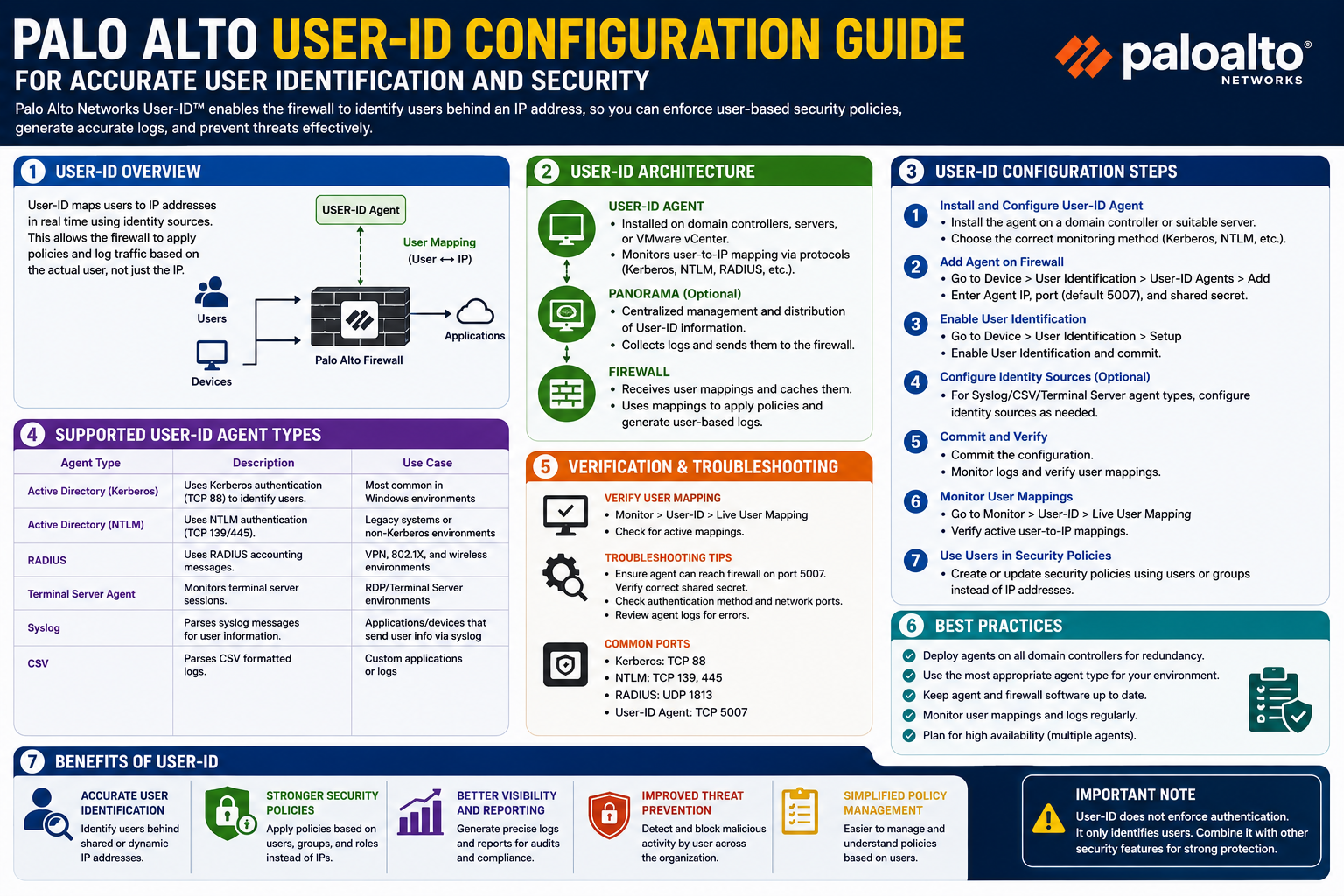
User-ID is a critical feature in Palo Alto firewalls that transforms how network security policies are applied. Instead of relying only on IP addresses, it allows administrators to enforce rules based on user identity. This shift is essential in modern environments where users frequently move across devices, locations, and network zones. By associating network activity with specific users and groups, User-ID provides deeper visibility, stronger control, and more accurate policy enforcement across the infrastructure.
In traditional networks, IP addresses were used as the primary method for identifying devices and controlling access. However, this approach has become increasingly ineffective due to dynamic addressing, mobile workforces, and shared devices. User-ID addresses these challenges by mapping users to their IP addresses in real time, ensuring that security policies remain consistent regardless of where or how users connect. This capability significantly improves both security and operational efficiency.
User-ID is part of a broader security framework that focuses on three essential elements: users, applications, and content. By combining identity awareness with application visibility and content inspection, organizations can create more intelligent and adaptive security policies. This approach allows administrators to permit, restrict, or monitor activity based on who the user is, what application they are using, and the type of content being accessed.
Modern enterprise environments often include a mix of employees, contractors, partners, and guests. Each of these user types requires different levels of access and security controls. User-ID enables organizations to define policies based on group membership, ensuring that each user category receives appropriate permissions. This granular control reduces the risk of unauthorized access while maintaining flexibility for legitimate users.
Wireless networks introduce additional complexity due to constant movement and IP reassignment. As users move between access points or network segments, their IP addresses can change frequently. This makes it difficult to track activity using traditional methods. User-ID solves this problem by maintaining a consistent identity mapping, allowing administrators to monitor user behavior accurately even in highly dynamic environments.
User-ID integrates with various identity repositories to collect user information. These repositories store authentication data, group memberships, and other relevant details. By connecting to these systems, the firewall can continuously update its understanding of user identities and their associated IP addresses. This integration ensures that policies are always based on the most current and accurate information available.
Another important capability of User-ID is its support for multiple identification methods. Different environments require different approaches to user mapping, and User-ID provides the flexibility to accommodate these needs. By using a combination of techniques, organizations can ensure reliable identification across all types of devices and network conditions.
How User-ID Works
User-ID operates by mapping user identities to IP addresses through several mechanisms. One of the most common methods involves monitoring authentication events. When a user logs into a system, an authentication record is generated. The firewall can observe these records and associate the user with the IP address of the device used during login. This mapping allows the firewall to apply policies based on user identity.
Another method involves direct user authentication. In this approach, users may be prompted to provide credentials when accessing certain resources. This ensures that the firewall can accurately identify the user, even in situations where automatic mapping is not available. While this method may introduce some user interaction, it provides a reliable way to maintain accurate identity information.
Captive portal authentication is also widely used, particularly in environments where users must authenticate before accessing network resources. The captive portal can present a login interface or use transparent techniques to identify users. This method is especially useful for guest networks or unmanaged devices where traditional directory integration may not be feasible.
Remote access scenarios require special consideration, as users connect from outside the corporate network. User-ID supports these scenarios by integrating with remote access solutions, allowing the firewall to receive user and device information during the connection process. This ensures that policies are applied consistently, regardless of the user’s location.
The firewall continuously updates user mappings as network activity changes. This dynamic process ensures that identity information remains accurate and up to date. As a result, administrators can rely on User-ID to enforce policies with confidence, knowing that decisions are based on current data.
Setting Up User-ID in the Firewall
The configuration process begins with enabling User-ID on the relevant network zones. This step allows the firewall to apply identity-based policies to traffic flowing through those zones. Administrators can choose to enable User-ID for specific subnets or entire zones, depending on their network design.
Once User-ID is enabled, the firewall must be configured to communicate with identity sources. This involves providing connection details and credentials so that the firewall can access authentication logs and user information. Proper configuration is essential to ensure accurate and reliable user mapping.
Server monitoring plays a key role in this process. The firewall needs to know which servers to query for authentication data. By specifying these servers, administrators enable the firewall to collect login events and build user-to-IP mappings. This step forms the foundation of the User-ID functionality.
After establishing communication with identity sources, the next step is configuring group mapping. Group mapping allows the firewall to understand which users belong to which groups. This information is crucial for creating policies that apply to specific roles or departments. By selecting relevant groups, administrators can simplify policy management and improve efficiency.
Once the configuration is complete, it is important to commit the changes and verify that the system is functioning correctly. Verification ensures that user mappings are being created as expected and that the firewall can successfully retrieve information from identity sources.
Applying Security Policies with User-ID
With User-ID in place, administrators can create security policies based on user identity. This approach allows for more precise control compared to traditional IP-based rules. Policies can specify which users or groups are allowed to access certain applications, services, or network segments.
When creating policies, administrators can include user or group information in the source criteria. This enables the firewall to enforce rules based on identity rather than just network location. For example, administrative users may be granted broader access, while regular users are restricted to specific applications.
Policy order is an important consideration. More specific rules should be placed higher in the policy list to ensure they are evaluated first. This helps prevent conflicts and ensures that the intended policies are applied correctly.
In addition to access control, User-ID enhances visibility into network activity. Administrators can monitor which users are accessing specific applications, how frequently they are used, and whether any unusual behavior is occurring. This insight is valuable for both security and operational purposes.
Benefits of Using User-ID
User-ID provides several advantages that make it an essential component of modern network security. One of the most significant benefits is improved visibility. By associating activity with specific users, administrators gain a clearer understanding of how the network is being used.
Another key benefit is granular control. Policies can be tailored to individual users or groups, allowing for more precise enforcement. This reduces the risk of over-permissioning and helps ensure that users only have access to what they need.
User-ID also enhances security by enabling faster detection and response to threats. When suspicious activity is identified, administrators can quickly determine which user is responsible and take appropriate action. This capability is critical for minimizing the impact of security incidents.
Operational efficiency is another important advantage. By automating user identification and policy enforcement, User-ID reduces the need for manual intervention. This allows administrators to focus on higher-level tasks while maintaining a strong security posture.
Additional Insights on User-ID Deployment
A well-planned User-ID deployment also requires careful consideration of network segmentation and traffic flow. Administrators should evaluate which zones truly need identity-based enforcement and ensure that User-ID is enabled only where it adds value. Over-enabling the feature across unnecessary zones can increase processing overhead without delivering meaningful benefits. By aligning User-ID deployment with actual user traffic patterns, organizations can maintain optimal performance while still gaining the visibility and control they need.
Another important factor is accuracy of user mapping. Inconsistent or outdated mappings can lead to incorrect policy enforcement, which may either block legitimate access or allow unintended activity. Regular monitoring of mapping tables and authentication sources helps ensure reliability. It is also beneficial to combine multiple identification methods, such as authentication monitoring and direct user authentication, to improve overall accuracy and reduce dependency on a single source of truth.
Ongoing maintenance plays a crucial role in sustaining the effectiveness of User-ID. As organizations evolve, changes in user roles, group memberships, and infrastructure must be reflected in the firewall configuration. Periodic reviews of group mappings, policy rules, and authentication settings help keep the system aligned with current requirements. By maintaining a proactive approach, administrators can ensure that User-ID continues to deliver strong security, accurate visibility, and efficient policy enforcement over time.
Conclusion
User-ID in Palo Alto firewalls represents a modern approach to network security that prioritizes user identity over traditional IP-based methods. It enables organizations to implement more accurate, flexible, and effective security policies by associating network activity with specific users and groups. Through integration with identity sources, support for multiple identification methods, and the ability to enforce granular policies, User-ID significantly enhances both visibility and control. When properly configured and maintained, it becomes a powerful tool for securing dynamic and complex network environments while supporting the needs of modern users.