Modern computer networks are built to move enormous amounts of data between devices, systems, and users in real time. As networks grow in size and complexity, understanding what is actually happening inside them becomes increasingly difficult without specialized observation techniques. This need for visibility has led to the development of various monitoring methods that allow engineers to inspect traffic flows without interrupting normal operations.
One of the most widely used techniques for gaining insight into network behavior is the ability to observe traffic as it passes through switching devices. In a typical network, switches forward data based on destination addresses and do not normally duplicate or expose that data elsewhere. While this design ensures efficiency, it also limits visibility into what is happening at a deeper level. Administrators often need to see more than just traffic movement; they need to analyze packet content, detect anomalies, and understand communication patterns between devices.
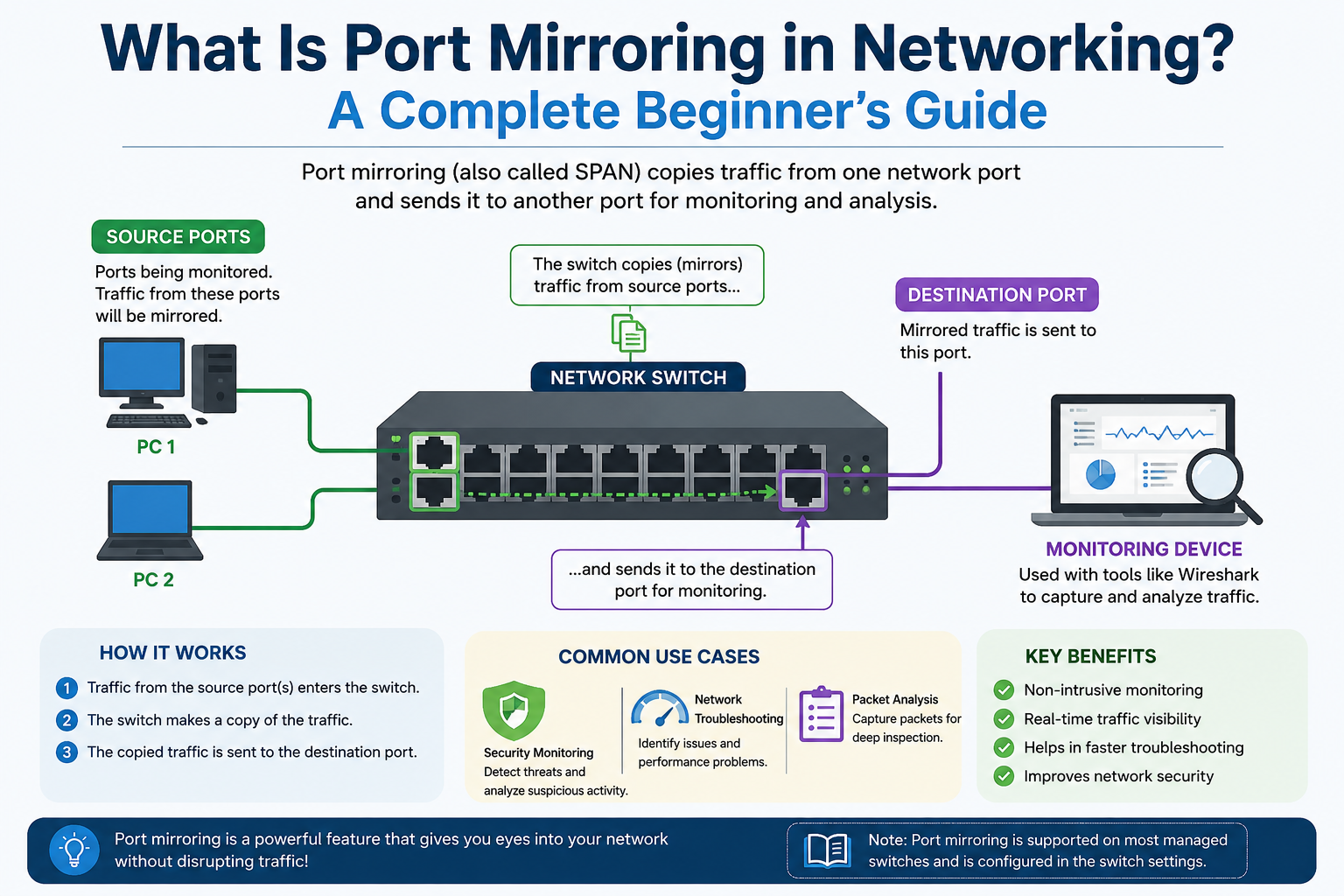
Port mirroring is one of the foundational mechanisms that makes this level of visibility possible. It provides a structured way to copy live network traffic and send it to a separate location for inspection. This capability allows administrators to analyze data flows without interfering with the actual communication taking place between devices.
Core Concept Behind Port Mirroring
At its simplest level, port mirroring is a process in which a networking device, such as a switch, creates a duplicate of data packets traveling through selected ports or VLANs and forwards those duplicates to another designated port. This destination port is typically connected to a monitoring system that is capable of analyzing the copied traffic.
The original data flow remains unaffected. Devices communicating across the network continue to send and receive information as usual. Meanwhile, a parallel stream of identical packets is created and delivered to a separate observation point. This dual-path behavior is what makes port mirroring especially useful in environments where uninterrupted service is critical.
The key idea is the separation of purpose. One path is responsible for actual communication between devices, while the mirrored path is used purely for analysis. This separation allows engineers to inspect real-time network activity without introducing delays or modifying the original traffic.
Unlike some filtering-based monitoring techniques, port mirroring does not selectively choose which packets to copy based on content. Instead, it typically duplicates everything that matches the defined source criteria, whether that is a specific port, a group of ports, or an entire VLAN. This makes it highly effective for capturing a complete picture of network behavior.
How Packet Duplication Works Inside Network Devices
To understand port mirroring more deeply, it is useful to consider what happens inside a switching device when traffic is duplicated. When a packet arrives at a switch port, the device first determines where that packet should be forwarded based on its internal forwarding logic. This decision is made using address tables and network rules that map destinations to specific ports.
In a standard forwarding scenario, the packet is sent only to the intended destination port. However, when port mirroring is enabled, an additional step is introduced. Before or during forwarding, the switch creates a copy of the packet. One copy continues along the normal forwarding path, while the duplicate is sent to the designated monitoring port.
This duplication process happens at high speed and is generally handled by hardware-level components within the switch. Because it is implemented close to the data plane, it can operate with minimal delay, even in high-throughput environments. However, the efficiency of this process depends heavily on the capabilities of the hardware and the volume of traffic being mirrored.
The mirrored copy is typically identical in structure to the original packet. It contains the same headers, payload, and metadata, allowing monitoring tools to reconstruct the communication exactly as it occurred on the network. This fidelity is essential for accurate analysis, especially in security and performance investigations.
Types of Port Mirroring in Network Environments
Although the general concept of port mirroring is consistent, its implementation can vary depending on network architecture and design requirements. Over time, different forms of mirroring have emerged to address specific operational needs.
The most common categories include local port mirroring, remote port mirroring, and encapsulated port mirroring. Each type has distinct characteristics that influence how and where mirrored traffic is delivered.
Local Port Mirroring and Its Operational Simplicity
Local port mirroring is the most straightforward and widely used form of traffic duplication. In this configuration, both the source ports and the destination monitoring port exist on the same switching device. This means that all mirrored traffic remains within a single hardware unit.
Because everything happens inside one switch, local port mirroring tends to introduce minimal latency. There are no additional network hops involved, and the duplicated traffic does not need to travel across other devices. This makes it particularly efficient for environments where immediate visibility is required.
Local mirroring is commonly used in smaller networks or in specific segments of larger infrastructures where targeted monitoring is sufficient. For example, a network administrator may choose to mirror traffic from a server-facing port to a monitoring system connected directly to the same switch. This setup allows for quick diagnostics without affecting other parts of the network.
Despite its simplicity, local port mirroring has limitations. One of the most significant is physical dependency. Since both source and destination must reside on the same device, monitoring capabilities are restricted to the reach of that single switch. In large or distributed networks, this can limit visibility and require additional configurations elsewhere.
Another consideration is resource usage. Even though modern switches handle mirroring efficiently, duplicating traffic still consumes internal processing capacity. When multiple high-traffic ports are mirrored simultaneously, the switch must handle a significant increase in workload.
Remote Port Mirroring and Distributed Network Visibility
Remote port mirroring extends the concept of traffic duplication beyond a single device. In this model, mirrored traffic is sent from one switch to a monitoring port located on a different switch. This allows organizations to centralize their monitoring infrastructure or analyze traffic from multiple network segments in one location.
To achieve this, the mirrored packets are forwarded across the network just like normal traffic. They travel through intermediate devices until they reach the destination switch, where they are delivered to the monitoring system. This introduces additional network hops compared to local mirroring.
Remote port mirroring is particularly useful in large-scale environments where network devices are distributed across different floors, buildings, or geographic locations. Instead of deploying monitoring tools everywhere, administrators can consolidate traffic analysis in a centralized monitoring station.
However, this added flexibility comes with trade-offs. The additional network traversal can introduce slight delays and increase the dependency on network stability. If intermediate links experience congestion or failures, mirrored traffic may be delayed or lost, potentially affecting analysis accuracy.
Another important factor is bandwidth consumption. Since mirrored traffic is duplicated and transmitted across the network, it adds extra load to existing links. In heavily utilized environments, this must be carefully managed to avoid impacting normal operations.
Encapsulated Port Mirroring and Advanced Traffic Transport
Encapsulated port mirroring represents a more advanced form of traffic duplication designed for complex and large-scale networks. In this approach, mirrored packets are not simply forwarded in their raw form. Instead, they are wrapped inside additional data structures that allow them to be transported across routed networks more efficiently.
This encapsulation process enables mirrored traffic to traverse Layer 3 networks, making it possible to send data across different subnets or even across wide geographic distances. Once the encapsulated packets reach their destination, they are decapsulated and forwarded to the monitoring system for analysis.
One of the main advantages of this method is scalability. Encapsulated mirroring allows organizations to monitor traffic from multiple sources distributed across different parts of the network without requiring direct Layer 2 connectivity between all devices.
It also provides greater flexibility in designing monitoring architectures. Instead of relying on physical proximity, administrators can centralize monitoring in a dedicated location, such as a network operations center, regardless of where the traffic originates.
However, encapsulation introduces additional processing overhead. Each packet must be wrapped and unwrapped, which requires computational resources. It also increases packet size, which can contribute to higher bandwidth usage.
Internal Behavior of Switching Devices During Mirroring
Inside a network switch, port mirroring is handled through specialized forwarding logic that operates alongside normal packet switching functions. When mirroring is enabled, the switch maintains additional configuration rules that determine which traffic should be duplicated and where it should be sent.
This process typically integrates with the device’s forwarding engine. As packets arrive, they are evaluated not only for their destination but also for mirroring rules. If a packet matches a configured source, it is duplicated and sent to the monitoring path.
The switch must ensure that mirroring does not interfere with primary forwarding operations. This requires careful balancing of processing resources. In high-performance environments, hardware acceleration is often used to handle mirroring efficiently, reducing the load on the main CPU.
Buffer management is another important aspect. If the monitoring port becomes congested or the monitoring system cannot process traffic quickly enough, buffers within the switch may fill up. This can result in dropped mirrored packets, which affects the completeness of analysis data.
Interaction Between Mirrored Traffic and Monitoring Systems
Once traffic is duplicated and sent to a monitoring port, it is typically processed by specialized tools designed to inspect packet-level information. These systems reconstruct conversations, analyze protocols, and identify patterns within the data stream.
Because mirrored traffic is an exact copy of live network communication, it provides a highly accurate representation of real-world conditions. This makes it especially valuable for troubleshooting performance issues, identifying unusual behavior, and understanding how applications interact across the network.
Monitoring systems rely on the completeness of mirrored data. Any loss or delay in packet duplication can reduce the accuracy of the analysis. For this reason, proper configuration and capacity planning are essential when deploying port mirroring in production environments.
Early Design Considerations in Port Mirroring Deployment
Before enabling port mirroring in any network environment, several design factors must be considered to ensure stable and effective operation. One of the most important considerations is bandwidth availability. Since mirrored traffic effectively doubles data flow for selected sources, it can significantly increase load on network links.
Another factor is device processing capacity. Even though modern switches are optimized for high-speed operations, extensive mirroring can still consume internal resources. This is especially relevant in environments where multiple high-traffic ports are being monitored simultaneously.
Network topology also plays a role. In simple designs, local mirroring may be sufficient. In more complex or distributed networks, remote or encapsulated approaches may be required to achieve complete visibility.
Traffic volume is another critical element. High-throughput environments can generate large amounts of mirrored data, which must be handled efficiently to avoid packet loss. Proper planning ensures that monitoring systems can keep up with incoming traffic without becoming overwhelmed.
Finally, careful selection of source and destination points is essential. Incorrect configuration can lead to incomplete data capture or unnecessary duplication of traffic, both of which reduce the effectiveness of monitoring efforts.
Expanding the Role of Port Mirroring in Modern Network Operations
As networks continue to scale in size and complexity, the role of visibility tools becomes more critical than ever. Port mirroring is no longer just a simple troubleshooting feature used occasionally by administrators; it has evolved into a foundational component of modern network monitoring strategies. In large enterprise environments, continuous observation of traffic behavior is often necessary to maintain performance, ensure security, and support compliance requirements.
What makes port mirroring particularly valuable is its ability to provide raw, unfiltered insight into network communication. Unlike summary-based monitoring systems that only report statistics, mirrored traffic contains complete packet-level detail. This allows engineers and analysts to reconstruct entire conversations, understand application behavior, and identify subtle anomalies that might otherwise go unnoticed.
In advanced deployments, port mirroring is integrated into broader monitoring architectures that include centralized analysis platforms, security operations centers, and performance optimization systems. Its role becomes less about occasional troubleshooting and more about continuous intelligence gathering across the entire network ecosystem.
Port Mirroring in Security Monitoring and Threat Detection
One of the most significant applications of port mirroring lies in network security. Cybersecurity teams rely heavily on visibility into live traffic to detect, analyze, and respond to potential threats. Because port mirroring provides an exact copy of network packets, it becomes an essential data source for identifying malicious activity.
Security analysts often use mirrored traffic to examine patterns that indicate unauthorized access attempts, lateral movement within a network, or data exfiltration efforts. Since attackers frequently attempt to disguise their actions within normal traffic flows, having access to full packet-level data is crucial for detecting subtle indicators of compromise.
For example, unusual communication between internal devices that normally do not interact may signal suspicious behavior. Similarly, repeated connection attempts to unfamiliar external destinations can indicate command-and-control activity. Without mirrored traffic, such patterns may be difficult to identify using only high-level logs.
Port mirroring also plays an important role in identifying encrypted traffic misuse. While encryption is essential for protecting data privacy, it can also be used to conceal malicious payloads. By analyzing metadata, packet timing, and traffic volume patterns, security teams can infer suspicious behavior even when content is not directly visible.
In some environments, mirrored traffic is fed into automated analysis systems that perform real-time inspection. These systems can correlate packet data with known threat signatures, behavioral models, and anomaly detection algorithms to generate alerts. However, even in automated setups, human analysts often review mirrored data for deeper investigation.
Role in Digital Forensics and Incident Investigation
When a security incident occurs, understanding exactly what happened is essential for containment and recovery. Port mirroring supports digital forensics by providing historical or real-time traffic data that can be analyzed in detail.
During an investigation, analysts may examine mirrored traffic to reconstruct the sequence of events leading up to an incident. This includes identifying the initial entry point, tracking movement across the network, and determining what data may have been accessed or transferred.
Because mirrored packets include full payload information, they allow investigators to see exactly what was transmitted between systems. This level of detail is invaluable when determining the scope of an incident or identifying compromised systems.
In forensic scenarios, timing is also critical. Mirrored traffic helps establish precise timelines, showing when specific communications occurred and how long certain connections remained active. This can be used to correlate network activity with system logs, application behavior, or external events.
Another important aspect of forensic analysis is persistence. In some environments, mirrored traffic is captured and stored for later review. While this requires significant storage resources, it enables retrospective investigations even after an incident has occurred.
Network Performance Analysis and Optimization
Beyond security, port mirroring plays a major role in optimizing network performance. Modern applications depend heavily on consistent connectivity, low latency, and reliable data delivery. Even small performance issues can significantly impact user experience.
By analyzing mirrored traffic, engineers can gain a detailed understanding of how data flows through the network. This includes identifying delays, congestion points, and inefficient routing paths. Unlike abstract performance metrics, mirrored packets reveal actual communication behavior at the protocol level.
One common use case is identifying latency sources. If users report slow application performance, mirrored traffic can help determine whether delays are occurring at the network layer, application layer, or due to external communication paths.
Port mirroring also helps detect congestion patterns. For example, if multiple high-volume flows are competing for the same network resources, mirrored data can reveal bottlenecks that may not be visible through standard monitoring tools.
In some cases, performance issues are caused by inefficient application design rather than network infrastructure. Mirrored traffic allows engineers to observe how applications interact with the network, helping them identify unnecessary retransmissions, chatty protocols, or excessive connection setups.
Understanding Traffic Behavior in Complex Network Topologies
Modern enterprise networks are rarely simple. They often consist of multiple layers, including core switches, distribution layers, access networks, and cloud-integrated components. In such environments, understanding how traffic moves across the entire system can be challenging.
Port mirroring helps bridge this visibility gap by providing insight into traffic at specific points in the network. By strategically placing mirroring configurations across different segments, administrators can build a more complete picture of end-to-end communication.
This approach is particularly useful in identifying asymmetric routing issues. In some cases, traffic may take one path when leaving a system and a different path when returning. Without detailed observation, these inconsistencies can be difficult to detect.
Mirrored traffic also helps in understanding inter-segment communication. In segmented networks where different departments or services are isolated, administrators can verify whether traffic is flowing only where it is intended or whether unintended cross-segment communication is occurring.
Port Mirroring in High-Density and Enterprise Environments
In large-scale environments, port mirroring must be carefully managed to avoid performance degradation. High-density switches may handle thousands of simultaneous connections, and duplicating traffic from multiple sources can create significant overhead.
One of the challenges in such environments is balancing visibility with efficiency. While it is desirable to monitor as much traffic as possible, doing so indiscriminately can overload both network devices and monitoring systems.
To address this, administrators often adopt selective mirroring strategies. Instead of duplicating all traffic, only critical ports or specific VLANs are monitored. This reduces load while still providing meaningful insight into network behavior.
Another consideration is aggregation. In some designs, multiple mirrored sources are combined into a single monitoring stream. While this simplifies analysis, it also increases the risk of congestion at the destination point.
High-density environments also require careful attention to buffer management. If mirrored traffic exceeds the capacity of the monitoring system, packets may be dropped, leading to incomplete analysis data. This can compromise both security monitoring and performance evaluation efforts.
Interaction with Virtualized and Cloud-Based Networks
As organizations increasingly adopt virtualization and cloud computing, traditional network monitoring approaches must adapt. Port mirroring is still relevant in these environments, but its implementation differs from physical network setups.
In virtualized environments, traffic flows between virtual machines often remain within the same physical host. To monitor this traffic, mirroring must be implemented at the virtual switch level rather than the physical switch. This allows visibility into east-west traffic that never leaves the host system.
Cloud environments introduce additional complexity. Network infrastructure is abstracted, and users often do not have direct access to physical switching devices. As a result, cloud providers typically offer virtual mirroring capabilities that replicate the functionality of traditional port mirroring.
These virtual implementations allow users to capture traffic from virtual interfaces and forward it to monitoring tools within the cloud ecosystem or external analysis systems. While the underlying mechanics differ, the core concept of traffic duplication remains the same.
One challenge in cloud environments is scalability. Since resources are shared across multiple tenants, mirroring must be carefully controlled to avoid excessive overhead. Cloud-based mirroring solutions often include filtering and sampling mechanisms to manage resource usage efficiently.
Differences Between Mirroring and Traffic Sampling Approaches
While port mirroring provides complete packet duplication, some environments use alternative methods such as traffic sampling. Sampling involves selecting only a subset of packets for analysis rather than copying all traffic.
The main advantage of sampling is reduced overhead. By analyzing only a fraction of traffic, systems can conserve bandwidth and processing resources. However, this comes at the cost of reduced visibility.
Port mirroring, on the other hand, provides full fidelity. Every selected packet is duplicated exactly, allowing for precise analysis. This makes it more suitable for detailed troubleshooting and security investigations.
In practice, both approaches may be used together. Sampling can provide a broad overview of network behavior, while mirroring is used for deep inspection when issues are detected.
Challenges in High-Speed Network Environments
As network speeds continue to increase, maintaining accurate traffic mirroring becomes more challenging. High-speed links generate large volumes of packets in extremely short timeframes, placing pressure on both network devices and monitoring systems.
One of the primary challenges is packet loss. If the monitoring system cannot process mirrored traffic quickly enough, buffers may overflow, resulting in dropped packets. This can lead to incomplete or misleading analysis results.
Another challenge is synchronization. In high-speed environments, ensuring that mirrored packets accurately reflect the timing of original traffic is essential for the proper reconstruction of communication flows.
Additionally, hardware limitations can become a bottleneck. Even advanced switching devices have finite processing capabilities, and excessive mirroring can impact overall performance.
To address these issues, network engineers often implement optimization techniques such as selective mirroring, traffic filtering, and distributed monitoring architectures.
Privacy and Data Sensitivity Considerations
Because port mirroring involves duplicating complete network traffic, it also raises important considerations around data privacy and security. Mirrored packets may contain sensitive information, including personal data, credentials, or confidential business communications.
As a result, access to mirrored traffic is typically restricted to authorized personnel. Monitoring systems are often placed in secure environments where access is controlled and logged.
In some cases, organizations may apply filtering mechanisms to exclude sensitive data from mirrored traffic. However, this must be carefully balanced with the need for accurate analysis.
Compliance requirements also influence how mirrored data is handled. Depending on regulatory frameworks, organizations may need to ensure that mirrored traffic is stored securely, retained for specific periods, or anonymized before analysis.
Integration with Broader Network Monitoring Systems
Port mirroring does not operate in isolation. In modern networks, it is typically integrated into a broader ecosystem of monitoring tools and platforms. These systems combine mirrored traffic with logs, performance metrics, and application data to provide a comprehensive view of network health.
In such environments, mirrored traffic serves as one of many data sources. It complements other monitoring techniques by providing deep packet-level insight that cannot be obtained through summaries alone.
This integration allows for more advanced analysis, including correlation between network events and application behavior. For example, performance issues detected in logs can be validated by examining corresponding mirrored traffic.
As networks become more dynamic and distributed, the importance of such integrated monitoring approaches continues to grow.
Designing Scalable Port Mirroring Architectures in Large Networks
As networks evolve into highly distributed, multi-layered infrastructures, the way port mirroring is designed becomes just as important as the feature itself. In small environments, enabling mirroring on a single switch might be sufficient. However, in enterprise-scale systems, traffic flows across hundreds or even thousands of devices, requiring a structured approach to monitoring design.
A scalable port mirroring architecture is not created by simply enabling duplication on multiple devices. Instead, it requires careful planning of where observation points should exist, how traffic should be aggregated, and how monitoring systems will consume the data. The goal is to ensure visibility without overwhelming network resources.
One of the key design principles is strategic placement. Instead of mirroring traffic everywhere, engineers identify critical observation points where traffic is most meaningful. These points often include core switches, distribution layers, data center edges, and security boundary devices. By focusing on these locations, organizations can achieve broad visibility without excessive duplication.
Another important aspect is hierarchy. In large environments, mirrored traffic is often collected from multiple access points and forwarded to aggregation nodes. These nodes consolidate traffic before sending it to centralized monitoring systems. This reduces complexity at the analysis layer and ensures that monitoring tools receive structured data streams rather than fragmented inputs.
Load distribution is also critical. If all mirrored traffic is sent to a single monitoring destination, that system can quickly become a bottleneck. To avoid this, traffic is often distributed across multiple collectors. This allows for parallel processing and improves overall analysis performance.
Scalability also depends on careful capacity planning. Engineers must estimate how much traffic will be mirrored under peak conditions and ensure that both network links and monitoring systems can handle the load. Without proper planning, even a well-designed mirroring strategy can fail under real-world traffic conditions.
Traffic Overhead Management and Performance Optimization
One of the most significant challenges in port mirroring is managing the additional load it introduces to the network. Since mirrored traffic is essentially a duplicate of real traffic, it can significantly increase bandwidth usage and processing requirements.
To mitigate this, organizations often implement selective mirroring strategies. Instead of duplicating all traffic from a given source, only specific types of traffic are mirrored based on operational needs. This reduces unnecessary load while still providing meaningful visibility.
Another optimization technique involves time-based mirroring. In some cases, traffic is mirrored only during specific time windows, such as peak usage periods or scheduled maintenance windows. This approach helps balance the need for visibility with the need to preserve system performance.
Traffic prioritization is another important factor. Not all mirrored packets are equally important. In some monitoring systems, critical traffic types such as authentication flows or application transactions may be prioritized over less important background communication. This ensures that essential data is always available for analysis, even under heavy load conditions.
Buffer management within switching devices also plays a crucial role. When mirrored traffic exceeds the processing capacity of a monitoring system, buffers may fill up and begin dropping packets. Proper tuning of buffer sizes and thresholds can help reduce the risk of data loss.
In high-performance environments, hardware acceleration is often used to handle mirroring tasks more efficiently. Dedicated switching ASICs can duplicate packets at line speed, minimizing the impact on overall device performance.
Common Failure Modes in Port Mirroring Deployments
Despite its usefulness, port mirroring is not immune to operational issues. Understanding common failure modes is essential for maintaining reliable monitoring systems.
One frequent issue is misconfiguration. Because port mirroring relies on a precise definition of source and destination ports, even small configuration errors can result in missing or incomplete data. For example, selecting the wrong interface or VLAN can lead to monitoring unrelated traffic while ignoring the intended target.
Another common problem is asymmetric visibility. In some network designs, traffic flows in different directions may pass through different paths. If only one direction is mirrored, the resulting analysis may be incomplete or misleading. This can make troubleshooting significantly more difficult.
Packet loss is another major concern. When monitoring systems cannot keep up with incoming mirrored traffic, packets may be dropped either at the switch or at the collection point. This leads to gaps in analysis and can obscure important events.
Overutilization of resources is also a frequent challenge. Mirroring too many ports or VLANs can overwhelm both network devices and monitoring infrastructure. This can lead to degraded performance not only in monitoring but also in the underlying network itself.
Finally, timing inconsistencies can affect analysis accuracy. In high-speed networks, even slight delays in mirrored traffic delivery can distort the perceived sequence of events, making it harder to reconstruct accurate communication flows.
Troubleshooting Strategies for Mirrored Traffic Issues
When issues arise in port mirroring deployments, systematic troubleshooting is required to identify and resolve the root cause. The first step is typically verifying configuration accuracy. Ensuring that the correct source and destination interfaces are defined is essential before investigating deeper issues.
Once the configuration is confirmed, attention shifts to traffic verification. Engineers often compare expected traffic patterns with observed mirrored data to determine whether packets are missing or incomplete. This helps identify whether the issue lies in the mirroring setup or elsewhere in the network.
Monitoring system performance is another critical area of investigation. If the analysis platform is overloaded, it may not be able to process incoming traffic efficiently. In such cases, upgrading hardware or redistributing load may be necessary.
Network congestion can also impact mirrored traffic delivery. If intermediate links are saturated, mirrored packets may be delayed or dropped before reaching their destination. Analyzing link utilization helps determine whether bandwidth constraints are contributing to the issue.
In some cases, the problem may originate within the switching hardware itself. CPU or ASIC limitations can prevent accurate duplication of traffic under heavy load conditions. Reviewing device performance metrics can help identify such bottlenecks.
Time synchronization between devices is another important factor. If monitoring systems and network devices are not properly synchronized, it can create inconsistencies in traffic analysis. Ensuring consistent time settings across the infrastructure helps improve accuracy.
Comparison of Port Mirroring with Traffic Interception Techniques
While port mirroring is one of the most common methods for traffic observation, it is not the only approach available. Other techniques exist that serve similar purposes but operate differently in terms of implementation and impact.
One alternative approach is traffic interception using network taps. Unlike port mirroring, which relies on switch-level duplication, taps physically copy traffic at the hardware level. This results in extremely accurate duplication with minimal packet loss.
However, taps require additional hardware installation and may not be as flexible as software-based mirroring. They are often used in environments where absolute accuracy is critical, such as financial systems or high-security networks.
Another approach involves inline inspection devices that sit directly in the traffic path. These devices can analyze, modify, or block traffic in real time. While powerful, they introduce potential points of failure and may impact network performance if not properly designed.
Compared to these methods, port mirroring offers a balance between flexibility and ease of deployment. It does not require physical infrastructure changes and can be configured quickly on existing devices. However, it may not provide the same level of precision as hardware-based alternatives.
Role of Port Mirroring in Distributed Monitoring Ecosystems
In modern network environments, monitoring is no longer centralized in a single location. Instead, it is distributed across multiple systems that work together to provide a comprehensive view of infrastructure behavior.
Port mirroring plays a key role in feeding data into these distributed ecosystems. Mirrored traffic is often collected from multiple network segments and aggregated into centralized analytics platforms. These platforms then process and correlate data from different sources.
This distributed approach allows organizations to monitor large-scale environments more effectively. Instead of relying on a single observation point, visibility is achieved through a network of coordinated monitoring nodes.
In such systems, data normalization becomes important. Since mirrored traffic may originate from different types of devices and network segments, it must be standardized before analysis. This ensures consistency in how information is interpreted.
Another important aspect is data correlation. Mirrored traffic is often combined with logs, system metrics, and application data to build a complete picture of network behavior. This multi-source approach improves accuracy and reduces blind spots.
Evolving Role of Port Mirroring in Virtualized Infrastructure
Virtualization has fundamentally changed how networks operate. In virtual environments, traditional concepts of physical ports are replaced by virtual interfaces. As a result, port mirroring must also adapt to this new model.
In virtual switches, mirroring is implemented at the software level. Traffic between virtual machines can be duplicated without ever leaving the host system. This enables deep visibility into internal communication that would otherwise be invisible in physical networks.
One challenge in virtual environments is resource contention. Since multiple virtual machines share the same physical hardware, excessive mirroring can impact overall system performance. Careful configuration is required to avoid overloading host resources.
Another challenge is isolation. In multi-tenant environments, it is essential to ensure that mirrored traffic does not cross security boundaries. Virtualization platforms typically enforce strict policies to prevent unauthorized access to mirrored data.
Despite these challenges, virtual port mirroring provides significant advantages in cloud-native environments. It enables detailed monitoring of application behavior, microservice communication, and containerized workloads.
Future Directions in Traffic Mirroring and Network Observability
As networks continue to evolve, the future of traffic mirroring is likely to shift toward more intelligent and adaptive systems. Instead of simply duplicating all selected traffic, future systems may incorporate context-aware filtering and dynamic adjustment based on network conditions.
Machine learning is expected to play a growing role in this evolution. By analyzing traffic patterns, systems may be able to determine which data is most valuable for mirroring at any given time. This could reduce overhead while improving analytical precision.
Another emerging trend is integration with automated response systems. Instead of simply observing traffic, mirrored data may be used to trigger automated mitigation actions when anomalies are detected.
In addition, increasing network speeds and distributed architectures will require more efficient mirroring techniques. Hardware advancements and software optimization will continue to shape how traffic duplication is implemented in future systems.
As observability becomes a core requirement in modern infrastructure, port mirroring will remain an important building block, even as its implementation evolves to meet new demands.
Port Mirroring in High-Availability Network Environments
In high-availability network environments, maintaining continuous service uptime is a top priority, and monitoring plays a central role in achieving that goal. Port mirroring becomes especially valuable in these settings because it allows administrators to observe live traffic without introducing any disruption to production systems. Unlike intrusive diagnostic methods, mirrored traffic provides a passive view of network behavior, ensuring that monitoring activities do not interfere with service continuity.
High-availability architectures often include redundant switches, load balancers, and failover mechanisms designed to ensure that services remain operational even during hardware or link failures. In such complex setups, port mirroring helps validate whether redundancy mechanisms are functioning correctly. For example, administrators can verify if traffic is properly rerouted during failover events or if certain paths become overloaded under stress conditions.
Another important use in high-availability environments is continuous health verification. By analyzing mirrored traffic, engineers can detect early signs of degradation, such as increasing retransmissions, abnormal connection resets, or irregular latency patterns. These indicators often appear before full system failures occur, allowing proactive intervention.
Port mirroring also supports synchronization validation in clustered systems. When multiple nodes work together to provide a single service, consistency in communication is essential. Mirrored traffic helps ensure that data replication between nodes is functioning correctly and that no discrepancies exist between distributed systems.
In disaster recovery scenarios, mirrored traffic can be used to validate backup network paths and confirm that failover configurations are properly aligned with operational requirements. This ensures that, in the event of a failure, traffic can be redirected without data loss or service interruption.
Overall, in high-availability environments, port mirroring acts as a silent observer that continuously verifies system stability, supports early detection of issues, and reinforces the resilience of critical network infrastructures.
Conclusion
Port mirroring remains one of the most practical and widely used techniques for achieving deep visibility into network traffic without disrupting normal communication. Its ability to duplicate packets and forward them to a dedicated monitoring point makes it an essential tool for network administrators, security analysts, and infrastructure engineers who need to understand what is happening inside complex digital environments.
Across modern networks, where data flows continuously between users, applications, and distributed systems, visibility is no longer optional. Port mirroring bridges the gap between raw traffic movement and meaningful insight by allowing complete inspection of real-time communication. Whether used for troubleshooting performance issues, detecting security threats, or validating network configurations, it provides a direct window into the behavior of connected systems.
One of its greatest strengths is versatility. It can be implemented in small local environments as well as large-scale enterprise or cloud-based infrastructures. From simple local mirroring on a single switch to advanced encapsulated methods spanning multiple network segments, it adapts to different operational requirements while maintaining its core purpose of traffic duplication for analysis.
At the same time, effective use of port mirroring requires careful planning. Factors such as bandwidth consumption, device processing capacity, and monitoring system limitations must always be considered. Without proper configuration, mirrored traffic can introduce overhead or lead to incomplete data capture, reducing its effectiveness. This is why thoughtful deployment and ongoing management are essential for maintaining reliable observability.
Despite these challenges, port mirroring continues to play a critical role in modern network operations. As networks grow more dynamic, virtualized, and distributed, the need for accurate and real-time traffic analysis becomes even more important. Port mirroring provides the foundation for this analysis, supporting not only day-to-day troubleshooting but also long-term optimization and security assurance.
In essence, it serves as a silent observer within the network—continuously enabling deeper understanding, stronger security posture, and improved performance across increasingly complex digital infrastructures.