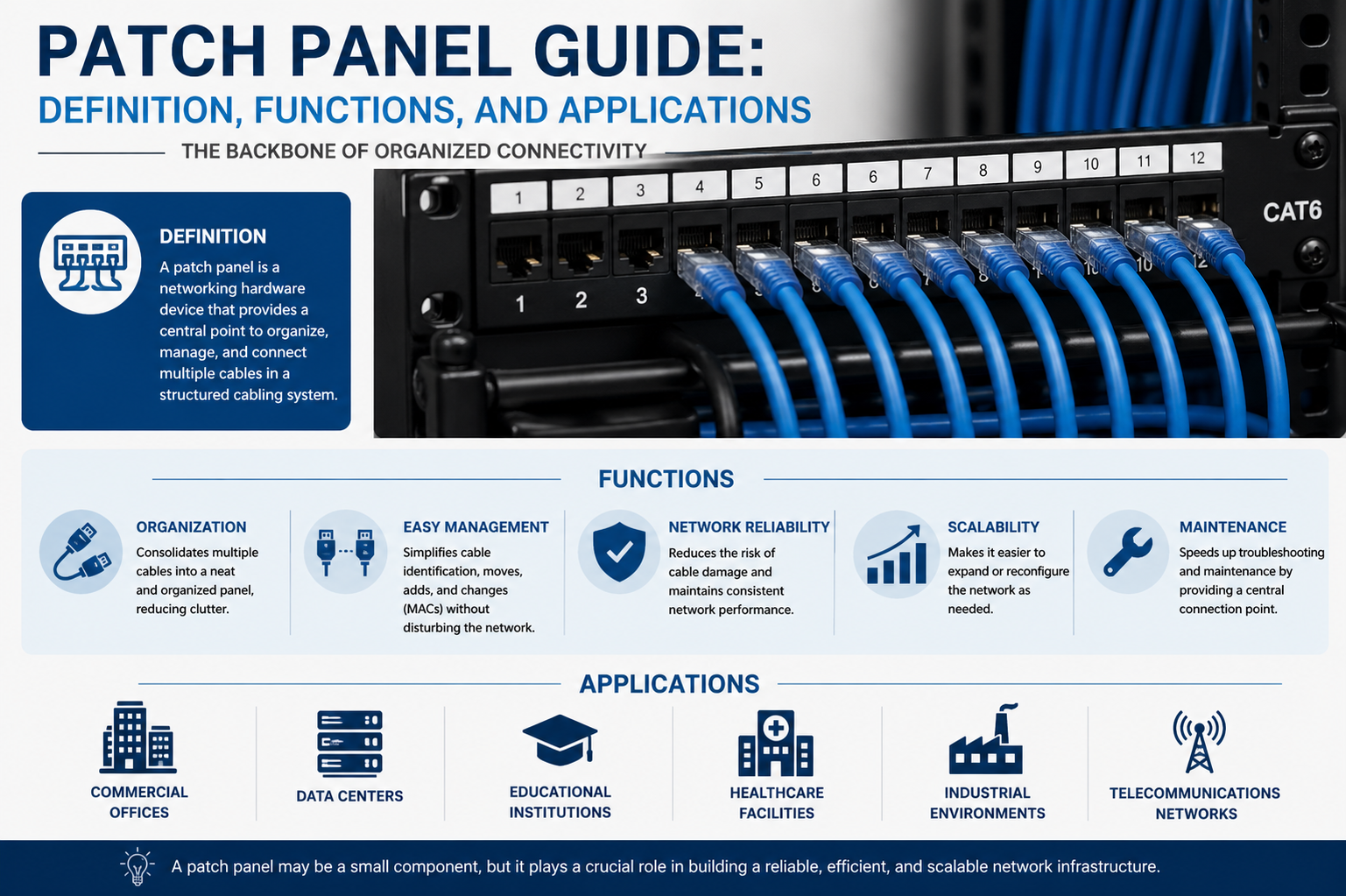
A patch panel is a foundational component in structured networking systems, designed to bring order and clarity to cable management. It acts as a centralized hub where all network cables are terminated, labeled, and organized in a systematic way. Instead of connecting devices directly to networking hardware such as switches, cables are first routed into the patch panel, which then connects to the switch using short, manageable patch cords. This design creates a clean separation between permanent infrastructure cabling and the active devices that handle network traffic.
The Role of Patch Panels in Cable Organization
In any network with multiple devices, cable organization quickly becomes a critical concern. Without a structured system, cables can become tangled, difficult to trace, and prone to accidental disconnection. A patch panel addresses these issues by providing a dedicated space where each cable is neatly terminated and clearly labeled. This organization not only improves the physical appearance of the network setup but also enhances efficiency when managing or troubleshooting connections.
How Patch Panels Fit into a Network Setup
Patch panels are typically installed in network racks alongside switches, routers, and other hardware. They are positioned in close proximity to switches so that short patch cables can be used to create connections between the two devices. The permanent cables coming from workstations, offices, or other endpoints are connected to the back of the patch panel, while the front ports are used for flexible connections to networking equipment. This arrangement ensures that any changes can be made quickly without disturbing the underlying cabling structure.
Types of Cables Supported by Patch Panels
Modern patch panels are designed to support a wide range of cable types, making them highly versatile. Commonly used cables include Cat5e, Cat6, and Cat6a for Ethernet networks, as well as fiber optic cables for high-speed data transmission. This flexibility allows patch panels to be used in various environments, from small office networks to large enterprise data centers. The ability to accommodate different cable standards ensures that the network can evolve without requiring a complete overhaul of the infrastructure.
Port Density and Size Variations
Patch panels are available in different sizes, typically defined by the number of ports they offer. Common configurations include 12, 24, 48, and 96 ports. The choice of size depends on the scale of the network and future expansion plans. Smaller panels are suitable for compact setups, while larger panels are ideal for environments with a high number of connections. Selecting the right size is important to ensure that the network can grow without requiring frequent replacements.
Purpose and Practical Benefits of Using a Patch Panel
The primary purpose of a patch panel is to simplify cable management and improve network organization. By centralizing all connections, it becomes easier to monitor, maintain, and modify the network. This structure allows administrators to quickly identify which cable corresponds to a specific device, reducing the time required for troubleshooting. Additionally, it provides a clear and documented layout of the network, which is essential for long-term maintenance and scalability.
Improving Network Flexibility Through Patch Panels
One of the key advantages of using a patch panel is the flexibility it offers. Changes in network configuration can be made by simply adjusting the short patch cables on the front of the panel. This eliminates the need to handle long cables that run through walls or ceilings. As a result, adding new devices, relocating workstations, or reconfiguring connections becomes a straightforward process that can be completed with minimal effort.
Separation of Physical Connections and Active Devices
Patch panels create a clear distinction between physical cable connections and active networking devices such as switches. This separation is important because it reduces wear and tear on the ports of expensive equipment. Instead of repeatedly plugging and unplugging cables directly into a switch, only the patch cords connected to the panel are handled frequently. This approach helps extend the lifespan of networking hardware and reduces the risk of damage.
Enhancing Troubleshooting and Maintenance Efficiency
In a well-organized network, troubleshooting becomes significantly easier. When an issue arises, administrators can quickly locate the relevant cable on the patch panel using labels and documentation. This eliminates the need to trace cables manually, which can be time-consuming and error-prone. The structured layout provided by a patch panel allows for faster diagnosis and resolution of problems, minimizing network downtime.
Labeling and Documentation Advantages
Each port on a patch panel can be labeled to indicate its corresponding endpoint, such as a specific workstation, room, or device. This labeling system provides a clear map of the network, making it easier to understand and manage. Proper documentation ensures that even new administrators can quickly become familiar with the network layout, reducing dependency on individual knowledge and improving overall efficiency.
When a Patch Panel Becomes Necessary
The need for a patch panel typically arises when a network reaches a certain level of complexity. In small setups with only a few devices, direct connections to a switch may be sufficient. However, as the number of connections increases, managing cables without a structured system becomes impractical. When a network includes more than a dozen connections or is expected to grow, implementing a patch panel becomes a logical and beneficial decision.
Scalability and Future Expansion Considerations
Patch panels play a crucial role in supporting network scalability. As organizations expand, their networking requirements evolve. A well-designed patch panel system allows for easy addition of new connections without disrupting existing ones. This scalability ensures that the network can adapt to changing needs without requiring significant modifications to the infrastructure.
How Patch Panels Work in Practice
The operation of a patch panel is straightforward. Cables from various endpoints are connected to the back of the panel, where they are securely terminated. The front of the panel features ports that can be connected to switches using short patch cords. When a connection needs to be changed, administrators simply move the patch cord to a different port. This simplicity makes patch panels an efficient tool for managing physical connections.
Managing Physical Connections Effectively
The primary function of a patch panel is to manage physical connections within the network. By providing a centralized location for cable termination, it eliminates the clutter and confusion associated with direct connections. This centralized approach ensures that all cables are organized in a consistent manner, making it easier to maintain and modify the network over time.
Avoiding Cable Clutter and Confusion
Without a patch panel, cables must run directly from devices to switches, often resulting in long, messy connections. This setup can quickly become unmanageable, especially in larger networks. A patch panel eliminates this problem by allowing cables to be routed neatly into a single location. The use of short patch cords further reduces clutter, creating a clean and professional appearance.
Signal Integrity and Performance Considerations
Patch panels do not actively process or alter network signals, which means they do not inherently degrade performance. Signal quality is primarily determined by the type, length, and quality of the cables used. Proper installation and termination are essential to maintaining optimal performance. When these factors are handled correctly, a patch panel has no negative impact on signal integrity.
Understanding Cable Categories and Their Impact
Different cable categories, such as Cat5e and Cat6, offer varying levels of performance. While patch panels can support multiple cable types, the overall network speed is determined by the lowest-performing component. For example, if a network uses both Cat5e and Cat6 cables, the performance will be limited to the capabilities of Cat5e. Consistency in cable selection is important لتحقيق the best results.
Wiring Standards and Consistency
Patch panels support standard wiring configurations that define how cables are terminated. The most common standards are T568A and T568B. Both are widely accepted, but it is important to use the same standard throughout the network to ensure compatibility. Consistent wiring prevents connectivity issues and simplifies maintenance.
Compatibility Between Different Cable Types
Patch panels are generally compatible with different cable categories, allowing for flexibility in network design. However, mixing cable types can lead to performance limitations. While it is possible to use both Cat5e and Cat6 cables within the same network, it is often الأفضل to standardize on a single type to achieve consistent performance and simplify management.
Comparing Patch Panels with Network Switches
A patch panel and a network switch serve very different purposes. A switch is an active device that directs data traffic between devices, requiring power and processing capabilities. In contrast, a patch panel is a passive component that simply organizes and connects cables. Understanding this distinction is essential for designing an efficient network.
The Passive Nature of Patch Panels
Patch panels do not require electricity and do not perform any data processing. Their role is purely physical, focusing on cable management and organization. This simplicity makes them reliable and cost-effective, as there are no electronic components that يمكن أن تتعطل or require maintenance.
Cost-Effectiveness and Practical Value
One of the appealing aspects of patch panels is their affordability. Compared to other networking equipment, they are relatively inexpensive while providing significant benefits in terms of organization and efficiency. The initial investment is minimal, especially when considering the long-term advantages they offer in maintaining a structured network.
Introducing Keystone Modules and Their Role
Keystone modules are small connectors that can be used with patch panels to support different types of connections. They allow for the integration of various interfaces, such as telephone lines or multimedia connections, into the network. This adaptability makes patch panels even more versatile, as they can accommodate a wide range of devices and technologies.
Flexibility Through Modular Design
The use of keystone modules adds a layer of flexibility to patch panels. Instead of being limited to a single type of connection, administrators can customize the panel to meet specific requirements. This modular approach ensures that the network can adapt to changing needs without requiring significant modifications.
Centralized Connectivity and Network Efficiency
By bringing all connections into a single location, patch panels create a centralized point of control for the network. This centralization improves efficiency by making it easier to manage, monitor, and modify connections. It also reduces the likelihood of errors, as all changes are made in a controlled and organized environment.
Long-Term Benefits of Structured Cable Management
Investing in a patch panel system provides long-term benefits that extend beyond immediate organization. It supports scalability, simplifies maintenance, and enhances overall network reliability. As networks continue to grow and evolve, the importance of structured cable management becomes increasingly evident.
Building a Reliable and Organized Network Infrastructure
A well-implemented patch panel system forms the backbone of a reliable network infrastructure. It ensures that cables are properly organized, connections are clearly documented, and changes can be made efficiently. This level of organization is essential for maintaining high performance and minimizing downtime.
Deeper Insight into the Purpose of a Patch Panel
A patch panel serves as the backbone of structured cable management by providing a centralized point where all network connections are organized and controlled. Its purpose goes far beyond simply holding cables in place. It creates a logical and physical structure that allows network administrators to manage connections efficiently without interfering with critical networking devices. By acting as an intermediary layer, it separates permanent cabling from active equipment, making the entire system easier to maintain and adapt over time. This separation is especially important in environments where frequent changes occur, as it prevents unnecessary disruption to the network.
Centralization as the Core Strength of Patch Panels
One of the most important aspects of a patch panel is its ability to centralize all network connections. Instead of having cables scattered across different devices, everything is brought into a single location. This centralization simplifies network management by giving administrators a clear and unified view of all connections. It also reduces the chances of errors, as all modifications are performed in one controlled area. When cables are centralized, it becomes much easier to maintain consistency and ensure that the network remains organized as it grows.
Reducing Complexity in Network Infrastructure
As networks expand, their complexity increases significantly. Without a proper system in place, managing dozens or even hundreds of cables can become overwhelming. A patch panel reduces this complexity by introducing a structured layout that organizes cables in a predictable manner. Each cable has a designated port, and each port can be clearly labeled. This structured approach eliminates confusion and allows administrators to focus on optimizing network performance rather than dealing with disorganized cabling.
Supporting Efficient Network Reconfiguration
Modern networks are dynamic, with devices frequently being added, removed, or relocated. A patch panel makes these changes much easier to handle. Instead of rerouting long cables or accessing hard-to-reach areas, administrators can simply adjust short patch cords on the front of the panel. This level of convenience significantly reduces the time and effort required to reconfigure the network. It also minimizes the risk of accidental disconnections, which can occur when handling longer cables directly connected to switches.
Improving Workflow for Network Administrators
The presence of a patch panel greatly improves the workflow of network administrators. Tasks such as adding new connections, troubleshooting issues, or performing maintenance become more straightforward and less time-consuming. With all cables neatly arranged and labeled, administrators can quickly identify the connections they need to work on. This efficiency not only saves time but also reduces stress, especially in high-pressure situations where quick problem resolution is essential.
Enhancing Physical Cable Protection
Another significant benefit of using a patch panel is the protection it provides to network cables and equipment. Permanent cables are securely terminated at the back of the panel and are rarely disturbed. This reduces the likelihood of wear and tear caused by frequent handling. Meanwhile, the short patch cords used on the front can be easily replaced if they become damaged. This approach protects the more critical and difficult-to-replace infrastructure cabling, ensuring long-term reliability.
Maintaining Clean and Professional Installations
A well-organized patch panel contributes to a clean and professional network installation. In environments such as offices, data centers, and server rooms, appearance matters as much as functionality. Neatly arranged cables not only look better but also reflect a high level of professionalism and attention to detail. This organized setup makes it easier for anyone working on the network to understand its layout and perform tasks efficiently.
Facilitating Better Airflow and Equipment Cooling
Proper cable management has a direct impact on airflow within network racks. When cables are disorganized and tangled, they can obstruct airflow and cause equipment to overheat. A patch panel helps prevent this issue by keeping cables neatly arranged and out of the way. Improved airflow ensures that networking devices operate within safe temperature ranges, which is essential for maintaining performance and extending the lifespan of the equipment.
Simplifying Large-Scale Network Deployments
In large-scale deployments, such as corporate offices or data centers, the number of cables can be overwhelming. A patch panel provides the structure needed to handle this scale effectively. By grouping connections into organized panels, administrators can manage large volumes of cables without losing control over the network layout. This scalability is crucial for organizations that rely on complex and expansive networking systems.
The Practical Logic Behind Using Patch Panels
The logic of using a patch panel lies in its ability to simplify tasks that would otherwise be complicated and time-consuming. Without a patch panel, every change in the network would require direct interaction with long cables and active devices. This approach is not only inefficient but also increases the risk of errors and equipment damage. By introducing a structured intermediary, patch panels make network management more logical, efficient, and reliable.
When Patch Panels Become Essential Rather Than Optional
While small networks may function without a patch panel, it quickly becomes essential as the network grows. Once the number of connections increases beyond a manageable level, the benefits of a patch panel become undeniable. It transitions from being a convenience to a necessity, ensuring that the network remains organized and functional. In professional environments, patch panels are considered a standard component rather than an optional addition.
Adapting to Future Network Requirements
Networks are constantly evolving, with new technologies and devices being introduced regularly. A patch panel provides the flexibility needed to adapt to these changes. Whether upgrading cables, adding new devices, or reconfiguring connections, the structured layout of a patch panel makes it easier to implement changes without disrupting the existing setup. This adaptability is a key factor in maintaining a future-ready network.
Understanding the Workflow of Cable Termination
Cable termination is a critical process in networking, and patch panels play a central role in it. Each cable is carefully terminated at the back of the panel using standardized methods. This ensures a secure and reliable connection that can support consistent performance. Proper termination is essential for maintaining signal quality and preventing issues such as data loss or interference.
Front-End Accessibility and Ease of Use
The front side of a patch panel is designed for easy access and quick adjustments. This is where patch cords are connected to switches or other devices. The layout is typically straightforward, with ports arranged in rows and clearly labeled. This accessibility allows administrators to make changes بسرعة and efficiently, without needing to التعامل مع the more complex and permanent cabling at the back.
Minimizing Downtime During Network Changes
Downtime can have serious consequences in any organization, making it important to minimize disruptions أثناء network changes. A patch panel يساعد in achieving this by allowing modifications to be made quickly and safely. Since changes are limited to the front panel, the risk of affecting other connections is greatly reduced. This ensures that the network remains operational even أثناء maintenance or upgrades.
Organized Labeling Systems for Better Traceability
Labeling is a critical feature of patch panels that enhances traceability. Each port can be marked with information about its corresponding endpoint, making it easy to identify connections. This labeling system is invaluable أثناء troubleshooting, as it allows administrators to quickly locate the مصدر of a problem. Clear and consistent labeling also ensures that the network can be understood by anyone who works on it.
Supporting Structured Cabling Standards
Patch panels are an integral part of structured cabling systems, which are designed to provide a standardized approach to network infrastructure. These systems ensure that cables are installed and managed in a consistent manner, improving reliability and performance. By integrating with structured cabling standards, patch panels contribute to the overall efficiency and scalability of the network.
Reducing Human Error in Network Management
Human error is one of the most common causes of network issues. Disorganized cables and unclear connections can lead to mistakes that disrupt the network. A patch panel reduces this risk by providing a clear and structured layout. With everything labeled and organized, administrators are less likely to make errors أثناء making changes or performing maintenance.
Improving Communication Within IT Teams
In environments where multiple افراد are responsible for managing the network, clear communication is essential. A patch panel helps facilitate this by providing a shared reference point for all connections. With proper labeling and documentation, team members can بسهولة understand the network layout and collaborate effectively. This reduces confusion and ensures that everyone is working with the same information.
Balancing Cost and Long-Term Benefits
Although installing a patch panel requires an initial investment of time and resources, the long-term benefits far outweigh the costs. The improved organization, reduced downtime, and easier maintenance all contribute to greater efficiency and reliability. Over time, these advantages translate into cost savings and a more stable network environment.
Ensuring Consistent Network Performance
While a patch panel does not directly influence network speed, it plays an indirect role in maintaining consistent performance. Proper cable management reduces the likelihood of physical issues such as loose connections or damaged cables. By ensuring that all connections are secure and well-organized, a patch panel يساعد in maintaining a stable and reliable network.
The Relationship Between Patch Panels and Network Growth
As networks continue to grow, the importance of maintaining an organized infrastructure becomes increasingly evident. A patch panel provides the framework needed to support this growth without compromising efficiency. By keeping cables व्यवस्थित and accessible, it ensures that the network can expand smoothly and continue to meet the demands of its users.
How Patch Panels Function in Real Network Environments
A patch panel operates in a very practical and straightforward way, yet its impact on network efficiency is significant. In a typical setup, cables from various endpoints such as offices, workstations, or devices are routed through walls or ceilings and terminated at the back of the patch panel. These cables are considered permanent infrastructure and are rarely moved once installed. On the front side of the panel, short patch cords are used to connect specific ports to a network switch. This simple mechanism allows administrators to control how devices are connected without ever touching the long, fixed cables behind the panel.
The Flow of Connections Through a Patch Panel
Understanding how connections flow through a patch panel helps clarify its role in networking. When a device sends data, the signal travels through its cable to the back of the patch panel. From there, a patch cord on the front connects that port to a switch, which then routes the data to its destination. The patch panel does not alter or process the data in any way; it simply acts as a bridge between the device and the switch. This design ensures that all physical connections are centralized while leaving data handling to active networking equipment.
Physical Layout and Rack Integration
Patch panels are typically installed in standard network racks, often positioned directly above or below switches. This placement is intentional, as it allows for the use of very short patch cords between the panel and the switch. The front-facing design ensures easy access for administrators, while the rear connections remain stable and undisturbed. Proper rack integration not only improves organization but also ensures that all components are aligned in a logical and accessible manner.
Back-End Termination and Stability
The rear side of a patch panel is where all permanent cables are terminated. This process involves carefully connecting each wire to the appropriate terminals using standardized wiring methods. Once installed, these connections are meant to remain untouched, providing a stable foundation for the network. By keeping these cables fixed in place, the risk of accidental disconnection or damage is greatly reduced. This stability is essential for maintaining consistent network performance over time.
Front-End Flexibility and Quick Adjustments
The front side of the patch panel is designed for flexibility and ease of use. Patch cords can be quickly connected, disconnected, or rearranged to change network configurations. This allows administrators to make adjustments without interfering with the permanent cabling. For example, if a device needs to be moved to a different network segment, the change can be made by simply repositioning a patch cord. This level of flexibility is one of the key reasons patch panels are widely used in professional environments.
Managing High Volumes of Connections Efficiently
In larger networks, the number of connections can be substantial. Patch panels make it possible to manage these connections efficiently by grouping them into organized sections. Each port corresponds to a specific cable, and each cable is clearly labeled. This structure ensures that even in complex setups, administrators can quickly identify and access the connections they need. Without a patch panel, managing such a high volume of cables would be extremely challenging.
Avoiding Direct Connections to Switches
Connecting all cables directly to a switch may seem simpler at first, but it quickly becomes impractical as the network grows. Long cables running directly into a switch can create clutter and make it difficult to identify individual connections. Additionally, frequent changes can lead to wear and tear on switch ports. A patch panel eliminates these issues by acting as an intermediary, allowing switches to remain protected while maintaining a clean and organized setup.
Cable Length Optimization and Efficiency
One of the often-overlooked advantages of using a patch panel is the optimization of cable lengths. Permanent cables are cut to the exact length needed to reach the patch panel, while short patch cords are used for connections to switches. This reduces excess cable length and minimizes clutter. Efficient cable management not only improves the appearance of the setup but also reduces the likelihood of tangling and interference.
The Importance of Proper Cable Termination
Proper termination is critical for ensuring reliable network connections. Each cable must be carefully connected to the patch panel using the correct wiring standard. Poor termination can lead to issues such as signal loss, interference, or intermittent connectivity. By providing a structured environment for termination, patch panels help ensure that connections are made correctly and consistently.
Signal Integrity and Patch Panel Performance
Patch panels are passive devices, meaning they do not amplify or modify signals. As a result, they do not inherently degrade network performance. Signal quality is determined by factors such as cable type, length, and installation quality. When cables are properly installed and terminated, a patch panel has no negative impact on performance. Instead, it helps maintain consistency by keeping connections secure and organized.
Understanding Differences Between Cable Categories
Different cable categories offer varying levels of performance, and patch panels are designed to support these differences. For example, Cat5e cables are commonly used for standard networking, while Cat6 cables provide higher performance and support faster speeds over shorter distances. Although patch panels can accommodate multiple cable types, it is important to maintain consistency within the network to achieve optimal results.
Performance Limitations in Mixed Cable Environments
When different cable categories are used together, the overall performance of the network is limited by the lowest-performing component. For instance, if a network includes both Cat5e and Cat6 cables, the maximum achievable speed will align with the capabilities of Cat5e. This highlights the importance of planning and standardizing cable types when designing a network.
Wiring Standards and Their Role in Connectivity
Patch panels support standard wiring configurations that define how cables are terminated. The two most common standards are T568A and T568B. While both are widely accepted, consistency is essential. Mixing standards within the same network can lead to connectivity issues. Patch panels are typically labeled to guide proper termination, ensuring that all connections follow the same standard.
Comparing Patch Panels with Active Networking Devices
It is important to distinguish between patch panels and active networking devices such as switches. A switch is responsible for directing data between devices, using power and processing capabilities to manage traffic. In contrast, a patch panel simply organizes physical connections. This distinction highlights the complementary roles of these components within a network.
Why Patch Panels Are Considered Passive Devices
Patch panels are classified as passive devices because they do not require power and do not perform any data processing. Their function is purely physical, focusing on cable management and organization. This simplicity makes them highly reliable, as there are no electronic components that can fail. It also contributes to their affordability and ease of maintenance.
Cost Considerations and Practical Implementation
The cost of a patch panel is relatively low compared to other networking equipment. However, the installation process requires careful planning and skilled labor. Tasks such as mounting the panel, terminating cables, and labeling ports must be performed accurately to ensure optimal performance. Despite the initial effort, the long-term benefits of improved organization and efficiency make patch panels a worthwhile investment.
Customizing Patch Panels with Modular Components
Patch panels can be customized using modular components known as keystone modules. These modules allow different types of connections to be integrated into the panel, such as telephone lines or multimedia interfaces. This customization provides flexibility, enabling the network to support a variety of devices and technologies without requiring separate infrastructure.
Adapting to Mixed Technology Environments
In many organizations, networks must support a combination of technologies, including data, voice, and multimedia. Patch panels make it easier to manage these diverse connections by bringing them into a single, organized system. With the use of modular components, administrators can adapt the panel to meet specific requirements, ensuring compatibility across different devices.
Maintaining Accessibility for Ongoing Management
Accessibility is a key factor in effective network management. Patch panels are designed to be easily accessible from both the front and back, allowing administrators to perform maintenance and make changes without difficulty. Ensuring that the panel is installed in a convenient location is essential for maximizing its effectiveness.
Reducing Downtime Through Organized Infrastructure
A well-organized patch panel setup helps reduce network downtime by making it easier to identify and resolve issues. When connections are clearly labeled and व्यवस्थित, administrators can quickly locate the source of a problem and take corrective action. This efficiency is particularly important in environments where network reliability is critical.
Supporting Long-Term Network Stability
By providing a structured approach to cable management, patch panels contribute to long-term network stability. They ensure that connections remain secure, organized, and easy to manage, even as the network evolves. This stability is essential for maintaining consistent performance and minimizing disruptions over time.
Advantages of Using Patch Panels in Network Infrastructure
Patch panels offer a wide range of advantages that make them an essential component in structured networking. One of the most significant benefits is their ability to keep cables organized in a clean and logical manner. In environments where dozens or even hundreds of cables are present, maintaining order is critical. A patch panel ensures that every cable has a designated place, reducing clutter and making the network easier to manage. This organized structure not only improves efficiency but also creates a professional and visually clean installation that reflects good network design practices.
Improved Cable Management and Reduced Clutter
Cable clutter is one of the biggest challenges in any growing network. Without a proper system, cables can quickly become tangled and difficult to trace. A patch panel eliminates this issue by providing a structured layout where cables are neatly terminated and arranged. Each connection is clearly visible and accessible, allowing administrators to work more effectively. This level of organization also reduces the chances of accidental disconnections, which can occur when cables are loosely arranged or overlapping.
Enhanced Flexibility for Network Changes
Flexibility is a key requirement in modern networking environments, where changes are frequent and often unpredictable. Patch panels make it easy to adapt to these changes by allowing quick reconfiguration of connections. Instead of dealing with long and complex cables, administrators can simply adjust short patch cords on the front of the panel. This makes tasks such as adding new devices, relocating workstations, or changing network layouts much more efficient and less time-consuming.
Simplified Troubleshooting and Faster Issue Resolution
Troubleshooting network issues can be a complex process, especially in disorganized setups. Patch panels simplify this process by providing a clear and labeled structure for all connections. When a problem occurs, administrators can quickly identify the relevant cable and test or replace it as needed. This reduces downtime and ensures that issues are resolved as quickly as possible. The ability to isolate problems efficiently is one of the most valuable advantages of using a patch panel.
Protection of Networking Equipment
Patch panels play an important role in protecting expensive networking equipment such as switches. By acting as an intermediary between permanent cabling and active devices, they reduce the need to frequently plug and unplug cables directly into switches. This minimizes wear and tear on switch ports, extending the lifespan of the equipment. Over time, this protection can lead to significant cost savings by reducing the need for repairs or replacements.
Support for Network Scalability and Growth
As organizations grow, their networking needs expand accordingly. Patch panels provide the scalability required to accommodate this growth. Additional connections can be easily integrated into the existing setup without disrupting the network. This scalability ensures that the infrastructure remains adaptable and capable of supporting future requirements. A well-planned patch panel system allows networks to grow smoothly without the need for major restructuring.
Better Documentation and Traceability
Documentation is a crucial aspect of network management, and patch panels make it easier to maintain accurate records. Each port can be labeled to indicate its corresponding endpoint, creating a clear map of the network. This traceability is invaluable when performing maintenance or troubleshooting issues. It ensures that administrators always know where each cable leads, reducing confusion and improving overall efficiency.
Cost Efficiency and Long-Term Value
Patch panels are relatively inexpensive compared to other networking components, yet they provide significant long-term value. The initial cost of purchasing and installing a patch panel is outweighed by the benefits of improved organization, reduced downtime, and easier maintenance. By preventing issues and streamlining operations, patch panelsساهم في lowering overall network management costs.
Disadvantages and Challenges of Patch Panels
Despite their many advantages, patch panels are not without challenges. One of the primary drawbacks is the initial setup process, which can be time-consuming and requires careful planning. Installing a patch panel involves mounting it in a rack, terminating cables, and labeling each connection. This process requires attention to detail and a certain level of expertise to ensure that everything is done correctly.
Space Requirements and Installation Considerations
Patch panels require adequate space within a network rack, which may not always be available in smaller setups. Proper placement is essential to ensure easy access to both the front and back of the panel. If space is limited, installing a patch panel can become challenging. Planning the layout of the network infrastructure in advance is important to ensure that there is enough room for all components.
Complexity for Beginners and Small Networks
For individuals who are new to networking, patch panels may seem complex at first. The process of terminating cables and understanding wiring standards can be intimidating. In very small networks with only a few devices, the benefits of a patch panel may not be immediately apparent. However, as the network grows, the advantages quickly become clear, making the initial learning curve worthwhile.
Labor and Installation Costs
While the hardware itself is affordable, the cost of installation can be higher due to the labor involved. Properly setting up a patch panel requires time, skill, and precision. Tasks such as cable crimping, routing, and labeling must be performed accurately to avoid issues لاحقًا. Despite these costs, the long-term benefits of a well-organized network often justify the investment.
Potential for Signal Issues Due to Poor Installation
Although patch panels do not inherently degrade signals, improper installation can lead to performance issues. Loose connections, खराब cable termination, or the use of low-quality cables can result in signal loss or interference. Ensuring that all connections are properly installed and tested is essential for maintaining optimal network performance. Regular inspections can help identify and resolve any issues before they affect the network.
Understanding the Difference Between Patch Panels and Switches
A common point of confusion is the difference between patch panels and switches. While both are essential components of a network, they serve entirely different purposes. A switch is an active device that directs data traffic between devices, while a patch panel is a passive component used for organizing cables. Recognizing this distinction is important for understanding how networks function and how different components العمل together.
The Passive Nature of Patch Panels in Detail
Patch panels do not require power and do not process data in any way. Their role is purely physical, focusing on the organization and management of cables. This passive nature makes them highly reliable, as there are no electronic أجزاء that can fail. It also means that they do not contribute to network latency or performance issues, provided that they are installed correctly.
Keystone Modules and Their Practical Applications
Keystone modules add another layer of functionality to patch panels by allowing different types of connections to be integrated. These modules can support various interfaces, including telephone lines, multimedia connections, and other specialized المعدات. By using keystone modules, administrators can create a versatile and adaptable network infrastructure that meets a wide range of requirements.
Flexibility Through Modular Network Design
The modular design of patch panels allows for easy customization and expansion. As new technologies emerge or requirements change, modules can be added or replaced without overhauling the entire system. This flexibility ensures that the network remains adaptable and capable of supporting future developments. It also reduces the need for costly upgrades by allowing incremental improvements.
Maintaining Network Performance and Reliability
A well-organized patch panel system contributes to overall network performance by ensuring that connections are secure and व्यवस्थित. Proper cable management reduces the risk of physical issues such as loose connections or damaged cables. By maintaining a stable and organized infrastructure, patch panels help ensure consistent and reliable network operation.
Routine Maintenance and Best Practices
Maintaining a patch panel is relatively straightforward, but it requires adherence to best practices. Regularly checking connections, ensuring that cables are properly secured, and updating labels as needed are all important tasks. Keeping the panel clean and व्यवस्थित also helps prevent issues and ensures that it remains easy to use. Consistent maintenance practices contribute to the long-term reliability of the network.
Preparing for Future Network Upgrades
Patch panels make it easier to implement network upgrades by providing a structured and accessible system for managing connections. Whether upgrading to higher-performance cables or replacing networking equipment, the presence of a patch panel simplifies the process. Changes can be made quickly and efficiently without disrupting the entire network, making upgrades less stressful and more manageable.
Creating a Strong Foundation for Network Infrastructure
A patch panel is more than just a tool for organizing cables; it is a critical component that supports the overall stability and efficiency of a network. By providing a centralized and structured approach to cable management, it ensures that the network remains व्यवस्थित, flexible, and easy to maintain. This strong foundation is essential for supporting the demands of modern networking environments and ensuring long-term success.
Conclusion
A patch panel stands as a simple yet highly impactful component in any structured network, bringing order, clarity, and control to what could otherwise become a chaotic system of cables. By acting as a centralized point for terminating and managing connections, it transforms complex cabling into an organized and easily manageable infrastructure. This organization directly supports smoother operations, quicker troubleshooting, and more efficient handling of network changes.
The real strength of a patch panel lies in its ability to separate permanent cabling from active networking devices. This separation not only protects valuable equipment but also allows administrators to make adjustments without disrupting the entire system. With clearly labeled ports and structured layouts, networks become easier to understand, maintain, and expand over time. This is especially important in environments where reliability and uptime are critical.
Beyond organization, patch panels contribute to flexibility and scalability. As networks grow and evolve, the ability to quickly reconfigure connections becomes essential. Patch panels make this possible through simple front-end adjustments, eliminating the need to handle long and پیچیدہ cabling. This adaptability ensures that the network can meet future demands without requiring major changes to its core structure.
While the initial setup may require time, planning, and careful installation, the long-term benefits far outweigh the effort. Reduced downtime, improved efficiency, and better cable management all contribute to a more stable and professional network environment. Even though patch panels do not process data or enhance speed directly, they create the conditions necessary for optimal performance by ensuring that every connection is secure and व्यवस्थित.
In modern networking, where complexity continues to increase, the importance of structured cable management cannot be overlooked. A patch panel provides the foundation for this structure, enabling networks to operate smoothly and efficiently. Its role may be passive, but its impact is essential, making it a key element in building reliable, scalable, and well-organized network systems.