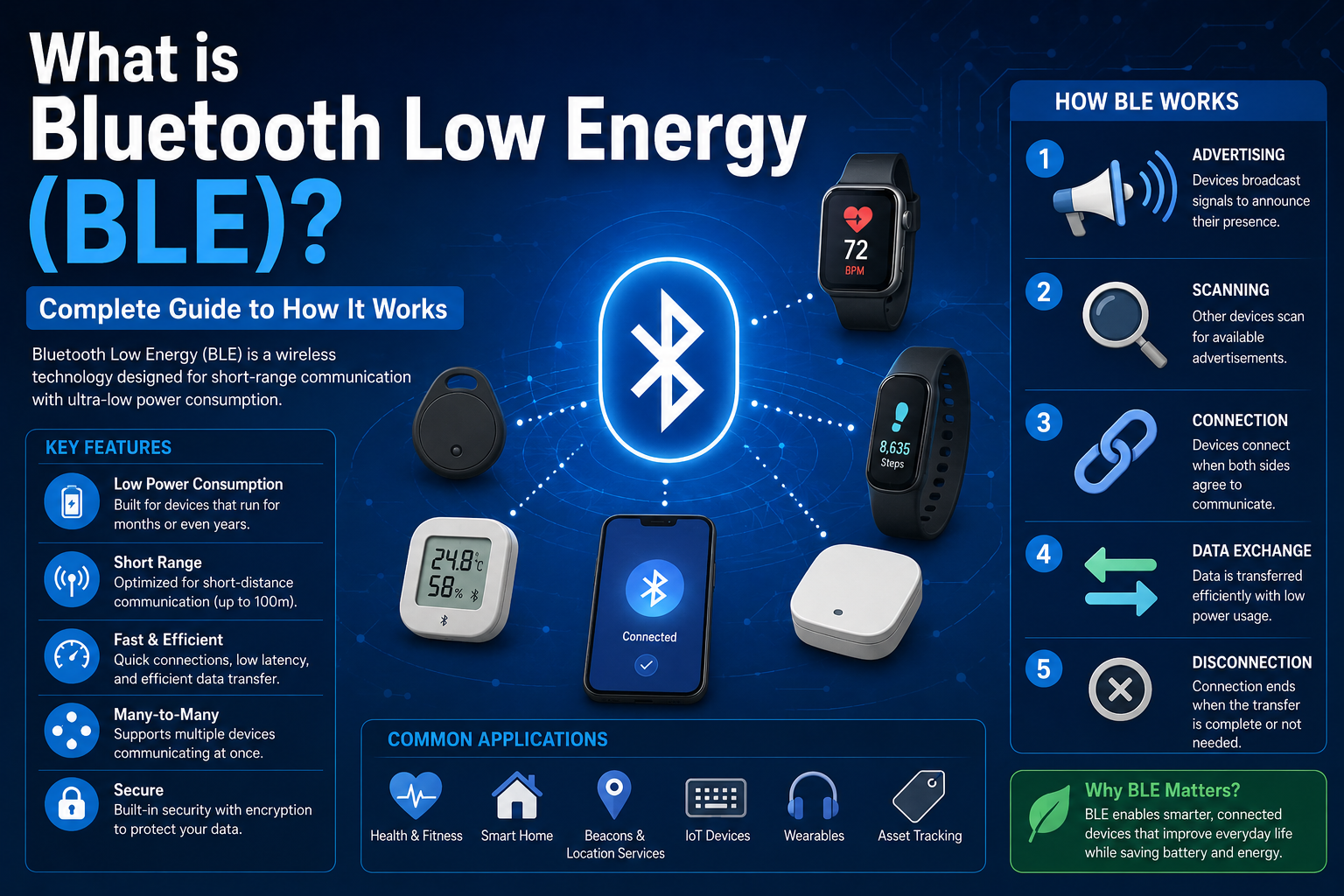
Bluetooth Low Energy, often abbreviated as BLE, is a specialized version of wireless Bluetooth technology designed to reduce power consumption while maintaining effective short-range communication. In today’s digital environment, where smart devices and connected systems dominate everyday life, BLE has become one of the most important communication protocols powering everything from wearable health trackers to industrial sensors. Its design philosophy is centered on efficiency, making it fundamentally different from traditional Bluetooth systems that prioritize continuous data transmission.
Unlike older wireless technologies that constantly maintain active connections, BLE operates in short bursts. This means it only transmits data when necessary, allowing devices to remain in a low-energy sleep state for most of their operation. This design is particularly valuable for small, battery-powered devices that need to run for months or even years without replacement or recharging.
At its core, BLE is not just an upgrade of classic Bluetooth but a rethinking of how wireless communication should function for modern low-power devices. While traditional Bluetooth was originally designed for continuous streaming, such as audio playback or file transfers, BLE was created with a different goal: efficient, intermittent communication with minimal energy usage.
The Evolution of Wireless Bluetooth Technology
To understand BLE, it is important to look at how Bluetooth technology evolved. Early Bluetooth systems were introduced to replace wired connections between devices like keyboards, headsets, and printers. These early versions focused heavily on maintaining stable, continuous connections, which required relatively high power consumption.
As mobile technology advanced and the Internet of Things began to emerge, developers recognized a need for a more energy-efficient communication method. Many new devices, especially wearable gadgets and environmental sensors, do not require constant data streaming. Instead, they only needed to send small packets of information at intervals.
This realization led to the development of BLE as part of Bluetooth 4.0. The introduction of BLE marked a significant shift in wireless design philosophy. Rather than optimizing for speed or constant connectivity, BLE prioritized energy conservation and long-term device usability.
Over time, BLE has been refined through multiple Bluetooth standards, improving its range, speed, and reliability. However, its core principle has remained unchanged: transmit small amounts of data efficiently while consuming as little power as possible.
Why Bluetooth Low Energy Was Needed
The rise of smart devices created a major challenge for wireless communication systems. Devices such as fitness trackers, smart watches, medical sensors, and home automation systems need to communicate wirelessly without draining their batteries quickly. Traditional Bluetooth, while effective for audio and data-heavy tasks, was not suitable for these lightweight communication needs.
One of the primary issues with classic Bluetooth was its constant connection requirement. Even when no data was being transmitted, the connection remained active, consuming energy. This was acceptable for devices plugged into power sources or those with large batteries, but not for small wearable or embedded systems.
BLE addressed this limitation by introducing an event-driven communication model. Instead of maintaining continuous connectivity, BLE devices “wake up” only when they need to send or receive data. After completing the transmission, they return to a low-power sleep state. This simple yet powerful change drastically reduced energy consumption.
Another reason BLE became necessary was the rapid growth of connected ecosystems. As the number of smart devices increased, there was a need for a communication protocol that could support large-scale deployments without overwhelming power requirements. BLE’s lightweight architecture made it ideal for such environments.
Core Principles Behind BLE Operation
BLE operates based on a few key principles that distinguish it from traditional wireless communication systems. The first is low-duty-cycle communication. Instead of maintaining a constant data flow, BLE transmits data in short bursts at scheduled intervals.
The second principle is minimal data transfer. BLE is not designed for large file transfers or high-bandwidth applications. Instead, it focuses on transmitting small packets of information such as sensor readings, status updates, or control signals.
The third principle is energy-efficient connectivity. BLE devices spend most of their time in sleep mode, waking only when required. This allows them to conserve battery life significantly compared to always-active wireless systems.
Another important principle is adaptive communication timing. BLE devices can adjust how frequently they communicate based on application requirements. For example, a heart rate monitor may send data every second, while a temperature sensor in a storage facility might send data every few minutes.
These principles collectively allow BLE to support a wide range of devices while maintaining extremely low power consumption.
How BLE Establishes Communication Between Devices
BLE communication begins with a process called advertising. In this stage, a BLE device broadcasts small packets of data at regular intervals. These packets contain basic information such as device identity and available services.
Nearby devices that are scanning for BLE signals can detect these advertisements. Once a compatible device identifies an advertisement it wants to interact with, it initiates a connection request. This marks the beginning of a temporary communication session.
Unlike traditional Bluetooth connections that remain active continuously, BLE connections are often short-lived and task-specific. Once the required data exchange is complete, the connection can be terminated or placed back into a low-energy state.
This connection model is highly efficient because it avoids unnecessary energy usage. Devices only communicate when needed, and idle time is minimized.
The Role of GATT in BLE Communication
Once a connection is established, BLE devices typically communicate using a structured framework known as the Generic Attribute Profile. This system organizes data into characteristics and services, allowing devices to understand what type of information is being shared.
Services represent broad categories of functionality, while characteristics represent specific data points within those services. For example, a fitness tracker might have a heart rate service, and within that service, a heart rate measurement characteristic.
This structured approach makes BLE highly flexible. It allows developers to define custom communication profiles for different applications while maintaining compatibility across devices.
GATT also supports efficient data exchange by allowing devices to read, write, or subscribe to specific data points. This means a device can receive updates automatically without constantly requesting information.
Energy Efficiency and Sleep Cycles in BLE Devices
One of the most defining features of BLE is its ability to conserve energy through intelligent sleep cycles. After completing a communication task, BLE devices enter a low-power state where most internal functions are temporarily paused.
During this sleep state, the device consumes minimal energy, often only enough to maintain memory and basic timing functions. When the next communication interval arrives, the device wakes up, performs its task, and returns to sleep.
This cycle repeats continuously, allowing devices to operate for extended periods on small batteries. In many cases, BLE devices can run for months or even years, depending on usage patterns.
The efficiency of this system is one of the main reasons BLE has become the dominant technology in wearable electronics and sensor networks.
Frequency Bands and Wireless Environment
BLE operates within the 2.4 GHz industrial, scientific, and medical radio band. This is the same general frequency range used by many other wireless technologies, including Wi-Fi and classic Bluetooth.
To avoid interference, BLE uses a technique known as frequency hopping. Instead of transmitting on a single frequency, it rapidly switches between multiple channels. This reduces the likelihood of interference and improves overall communication reliability.
BLE uses fewer channels compared to traditional Bluetooth, but it optimizes them for short, efficient transmissions. Each transmission is designed to be fast and precise, minimizing the time spent occupying the wireless spectrum.
This approach allows BLE devices to coexist with other wireless systems without significant performance degradation.
Real-World Behavior of BLE Connections
In practical use, BLE connections behave very differently from traditional wireless links. Instead of maintaining constant data flow, BLE devices often operate in a background state where they only communicate periodically.
For example, a wearable fitness device may only transmit data when it detects changes in heart rate, movement, or activity level. Similarly, smart home sensors may only send updates when environmental conditions change.
This event-driven behavior makes BLE ideal for systems where continuous communication is unnecessary. It also reduces network congestion, allowing many devices to operate simultaneously in the same environment.
BLE’s real-world performance is therefore highly dependent on usage patterns rather than constant transmission capacity.
Limitations and Practical Constraints of BLE
Although BLE is highly efficient, it does have limitations. One of the most important is data throughput. BLE is not designed for large-scale data transfers such as video streaming or file sharing.
Instead, it is optimized for small, frequent data packets. This means it performs exceptionally well for sensor data, control signals, and status updates, but is unsuitable for high-bandwidth applications.
Another limitation is range. While the BLE range has improved significantly in newer versions, it is still primarily designed for short to medium-distance communication.
Despite these limitations, BLE remains extremely effective within its intended use cases. Its strengths lie in efficiency and scalability rather than raw performance.
Advanced Working Mechanism of Bluetooth Low Energy (BLE) in Real Systems
Bluetooth Low Energy is often described as simple because it is designed for small, efficient communication, but its internal working structure is actually quite layered and carefully engineered. Beyond basic device-to-device communication, BLE relies on a combination of timing control, packet structure, adaptive power usage, and connection management strategies that allow it to function reliably in complex environments filled with multiple wireless signals.
At a deeper level, BLE is not just about sending data. It is about controlling when data is sent, how often it is sent, how much energy is used during transmission, and how devices coordinate without wasting resources. This makes BLE a highly optimized system rather than a simple wireless link.
To understand how BLE functions in modern environments such as smart homes, wearable ecosystems, and industrial sensor networks, it is necessary to examine how its internal mechanisms work together.
BLE Packet Structure and Communication Behavior
All communication in BLE is broken down into small data packets. These packets are intentionally lightweight so that they can be transmitted quickly and with minimal energy usage. Each packet contains structured information that allows devices to identify each other, understand the purpose of the message, and decide how to respond.
A BLE packet generally includes addressing information, payload data, and error-checking components. The addressing information ensures that only intended devices process the message, while the payload contains the actual data being transmitted. Error-checking mechanisms help ensure that corrupted data is discarded or retransmitted.
The size of these packets is intentionally limited. This restriction is not a drawback but a design choice that supports BLE’s low-energy philosophy. Smaller packets mean faster transmission times, which directly reduces the time a device’s radio must remain active.
Because radio activity is one of the most energy-intensive operations in wireless devices, minimizing transmission duration plays a major role in extending battery life.
Advertising and Discovery Process in BLE Networks
One of the most important processes in BLE communication is advertising. This is the mechanism through which devices announce their presence to nearby systems. Unlike traditional networks, where devices remain continuously connected, BLE devices often operate without permanent links.
During advertising, a BLE device periodically broadcasts short packets of information. These packets may include device identity, available services, or simple status updates. The purpose is not to transfer large amounts of data but to make the device discoverable.
Other devices operating in scanning mode listen for these advertisements. When a scanner detects a relevant advertisement, it can initiate a connection or simply record the information, depending on its purpose.
This discovery system is highly efficient because devices do not need to maintain constant communication. Instead, they rely on brief signals exchanged at intervals.
The timing of advertising events is carefully controlled. Devices can adjust how frequently they broadcast based on application needs. A device that requires frequent interaction may advertise more often, while a low-power sensor may reduce its advertising frequency to conserve energy.
Connection Establishment and Role Switching
Once a device discovers another BLE device, it can initiate a connection. This process is lightweight compared to traditional Bluetooth pairing and is designed to happen quickly.
During connection setup, one device typically assumes the role of a central controller, while the other becomes a peripheral. The central device manages communication timing and data requests, while the peripheral responds with data when requested.
This role separation helps maintain order in communication and reduces unnecessary complexity. However, BLE is flexible, and devices can switch roles depending on context or application design.
Once connected, devices agree on communication intervals known as connection events. These events define when devices will wake up and exchange data. Between these events, both devices can enter low-power states.
This structured timing system is one of the main reasons BLE is so energy efficient. Devices are not constantly active; instead, they synchronize only when needed.
Connection Interval and Power Optimization Strategy
The connection interval is one of the most important parameters in BLE communication. It defines the time gap between two successive communication events.
Shorter intervals allow more frequent data updates but consume more power. Longer intervals reduce power consumption but increase latency. This creates a balance between responsiveness and energy efficiency.
Different applications require different configurations. For example, a medical monitoring device may require short intervals to ensure real-time accuracy, while a temperature sensor in a warehouse may use long intervals since its readings change slowly.
BLE’s ability to adjust connection intervals dynamically makes it highly adaptable. Devices can even modify these intervals after connection establishment based on changing conditions.
This flexibility ensures that BLE can support both high-precision applications and long-term monitoring systems.
Data Exchange Through Attribute Protocol
Once a BLE connection is active, data is exchanged using a structured system known as the Attribute Protocol. This protocol organizes data into a hierarchy of services and characteristics.
Services represent functional categories, while characteristics represent specific data points within those categories. Each characteristic can be read, written, or subscribed to depending on device capabilities.
This structure allows BLE devices to communicate in a highly organized manner. Instead of sending unstructured data streams, devices interact with clearly defined data points.
For example, a smart watch may expose a heart rate service, and within that service, a heart rate value characteristic. A connected smartphone can then read or subscribe to that characteristic to receive updates.
This model makes BLE extremely scalable because new functionalities can be added simply by defining new services and characteristics.
Event-Driven Communication Model in BLE
Unlike traditional wireless systems that rely on continuous communication, BLE uses an event-driven model. This means communication only occurs when specific events trigger it.
These events may include sensor changes, scheduled intervals, user interactions, or external requests. Once an event occurs, the device wakes up, processes the event, transmits data if necessary, and returns to a low-power state.
This model significantly reduces unnecessary energy consumption. Instead of constantly transmitting or listening, devices only activate when meaningful activity occurs.
This approach is particularly useful in environments where data changes infrequently. For instance, environmental sensors may only need to transmit updates when temperature or humidity changes beyond a threshold.
BLE in Multi-Device Environments
In real-world applications, BLE devices rarely operate in isolation. Instead, they exist within dense networks of other BLE devices, Wi-Fi systems, and electronic equipment.
To handle this complexity, BLE uses frequency hopping and adaptive channel selection. This ensures that devices avoid interference and maintain stable communication even in crowded wireless environments.
When multiple BLE devices operate simultaneously, each device follows its own communication schedule. Because transmissions are short and infrequent, the probability of collision is reduced.
This makes BLE highly suitable for large-scale deployments such as smart buildings, industrial monitoring systems, and healthcare environments.
Introduction to BLE Mesh Networking
One of the most significant advancements in BLE technology is mesh networking. In a mesh network, devices can communicate not only directly but also through intermediate devices that relay messages.
This allows BLE networks to cover much larger areas than traditional point-to-point connections. Instead of relying on a single central device, messages can travel through multiple nodes until they reach their destination.
Mesh networking is particularly useful in environments such as large buildings, factories, and urban infrastructure systems.
Each device in a mesh network can act as both a receiver and a transmitter. This distributed communication model increases reliability because there is no single point of failure.
If one device becomes unavailable, messages can still travel through alternate routes.
BLE Mesh Communication Structure and Routing Logic
In a BLE mesh network, communication is structured around relay nodes. These nodes receive messages and forward them to other nodes until the message reaches its target.
Routing in BLE mesh networks is not fixed. Instead, it is dynamic and adaptive. Devices determine the best path based on availability and network conditions.
Messages are often broadcast rather than sent directly to a single device. This allows multiple devices to receive and evaluate whether they should process the message.
This approach increases redundancy and ensures that messages are more likely to reach their destination even in complex environments.
However, mesh communication must be carefully managed to avoid excessive network traffic. To prevent overload, BLE mesh systems use controlled message propagation rules.
BLE Security and Data Protection Mechanisms
Security is an important aspect of BLE communication, especially since it is widely used in personal and sensitive applications. BLE incorporates multiple layers of security to protect data from unauthorized access.
One of the primary security mechanisms is pairing, where devices establish trust before exchanging sensitive information. During pairing, devices may use encryption keys to secure communication.
BLE also supports data encryption during transmission, ensuring that intercepted packets cannot be easily interpreted.
In addition, devices can implement authentication mechanisms to verify the identity of connected devices before allowing data exchange.
These security features are especially important in applications such as healthcare monitoring and financial transactions.
Power Management and Energy Adaptation in BLE Devices
BLE devices continuously manage power consumption by adjusting internal processes based on workload. When no communication is required, devices enter deep sleep states where most hardware components are turned off.
Only essential timers and memory systems remain active during these periods. When a communication event occurs, the device wakes up, processes the event, and returns to sleep.
This cycle is repeated continuously throughout the device’s operation.
Advanced BLE implementations also adjust transmission power dynamically. Devices can increase power when signal strength is weak and reduce power when devices are close together.
This adaptive behavior ensures optimal energy usage without sacrificing communication quality.
BLE in Complex IoT Ecosystems
BLE plays a critical role in modern Internet of Things systems. In such environments, thousands of devices may operate simultaneously, collecting and transmitting data.
BLE’s low-power design makes it ideal for these ecosystems because devices can operate for long periods without maintenance.
In smart homes, BLE enables communication between lighting systems, thermostats, security devices, and personal gadgets. In industrial settings, it supports the monitoring of machinery, environmental conditions, and operational efficiency.
Because BLE devices can be easily integrated and configured, they provide a flexible foundation for scalable IoT architectures.
Real-World Applications of Bluetooth Low Energy (BLE) in Everyday Life
Bluetooth Low Energy has moved far beyond being a simple wireless communication tool. It now plays a central role in how modern digital systems interact with humans and environments. Its influence is especially visible in everyday consumer technology, where convenience, automation, and continuous monitoring are becoming standard expectations.
One of the most recognizable applications of BLE is in wearable technology. Devices such as fitness trackers, smart watches, and health monitoring bands rely heavily on BLE to function efficiently. These devices continuously collect data such as heart rate, sleep patterns, movement activity, and sometimes even blood oxygen levels. Instead of constantly transmitting data in real time, they store it internally and send it periodically to a connected smartphone. This reduces energy consumption significantly while still providing users with meaningful insights.
Another widespread use of BLE is in smart home ecosystems. Devices such as smart bulbs, thermostats, locks, and motion sensors often depend on BLE for communication. The advantage here is that BLE allows these devices to remain in a low-power state until they are needed. For example, a motion sensor can remain dormant for most of the day and only activate when movement is detected. This makes smart homes more energy-efficient and easier to maintain.
BLE is also commonly used in personal device connectivity. Wireless keyboards, mice, headphones, and printers often use BLE to maintain stable connections without draining batteries quickly. Unlike older wireless technologies that required frequent charging, BLE-based accessories can operate for months or even years on small batteries.
Beyond personal use, BLE has become a foundational technology in mobile device ecosystems. Smartphones use BLE for a wide range of background functions, including device discovery, proximity detection, and seamless pairing with nearby accessories. This enables features like automatic headphone connection or quick file sharing without complex setup processes.
BLE in Healthcare and Medical Monitoring Systems
One of the most impactful areas where BLE has transformed technology is healthcare. Modern medical devices increasingly rely on BLE for patient monitoring and data collection. This is especially important in remote healthcare, where continuous observation is needed without requiring hospital stays.
Devices such as glucose monitors, heart rate trackers, blood pressure cuffs, and pulse oximeters often use BLE to transmit patient data to mobile applications or healthcare systems. This allows doctors and caregivers to monitor patient health in real time or review historical trends without requiring physical visits.
The low-power nature of BLE is particularly important in medical devices because many of them are designed to be worn continuously. Patients cannot be expected to recharge or replace batteries frequently, so energy efficiency becomes critical.
BLE also enables emergency alerts in healthcare systems. If a device detects abnormal readings, it can immediately send a signal to a connected system or caregiver. This capability has improved response times in critical situations and made remote healthcare more reliable.
In hospital environments, BLE is also used for asset tracking. Medical equipment such as wheelchairs, infusion pumps, and monitoring devices can be tagged with BLE sensors, allowing staff to locate them quickly when needed. This improves operational efficiency and reduces delays in patient care.
Industrial Applications and Smart Manufacturing
BLE has also found significant adoption in industrial environments, especially in smart manufacturing and automation systems. In factories, BLE sensors are used to monitor equipment performance, temperature, vibration, humidity, and other environmental conditions.
Because BLE devices are low-power and easy to deploy, they can be installed in large numbers without requiring complex wiring or infrastructure changes. This makes them ideal for retrofitting older industrial systems with modern monitoring capabilities.
In predictive maintenance systems, BLE sensors continuously collect data from machinery. This data is then analyzed to detect early signs of wear or failure. By identifying problems before they occur, companies can reduce downtime and maintenance costs.
BLE is also used for worker safety monitoring in industrial environments. Wearable BLE devices can track worker location, detect hazardous conditions, and send alerts if unsafe situations arise. This improves safety in high-risk industries such as construction, mining, and manufacturing.
Another important use case is inventory and asset tracking. BLE tags can be attached to tools, parts, and equipment, allowing real-time tracking of their location within large facilities. This reduces loss, improves organization, and increases operational efficiency.
BLE in Smart Cities and Urban Infrastructure
As cities become more connected, BLE is increasingly being used in urban infrastructure systems. One of its primary applications is in location-based services. BLE beacons installed in public spaces can transmit signals that allow smartphones to determine their proximity to specific locations.
This enables services such as indoor navigation in malls, airports, and museums. Unlike GPS, which is less effective indoors, BLE provides accurate short-range positioning.
In transportation systems, BLE is used for vehicle tracking, passenger information systems, and smart ticketing solutions. Public transport systems can use BLE to improve efficiency and provide real-time updates to passengers.
Smart parking systems also use BLE to detect available parking spaces and guide drivers to them. This reduces congestion and improves urban mobility.
BLE is also used in public safety systems, where sensors can monitor environmental conditions such as air quality, noise levels, and temperature. This data helps city planners make informed decisions about infrastructure and public health.
Performance Characteristics and Real-World Behavior of BLE
While BLE is highly efficient, its real-world performance depends on multiple factors such as environmental conditions, device configuration, and network density. One of the key performance characteristics of BLE is its low latency in connection setup. Devices can establish communication quickly, making BLE ideal for short interactions.
However, BLE is not designed for high-speed data transfer. Its throughput is intentionally limited to prioritize energy efficiency. In real-world conditions, actual data rates are often lower than theoretical maximums due to interference and protocol overhead.
Signal range is another important factor. Although BLE can operate over relatively long distances under ideal conditions, obstacles such as walls, metal structures, and electromagnetic interference can reduce effective range significantly.
Despite these limitations, BLE performs exceptionally well in environments where small amounts of data need to be transmitted reliably and efficiently.
Interference and Coexistence with Other Wireless Technologies
BLE operates in the crowded 2.4 GHz frequency band, which is shared with many other wireless technologies. This includes Wi-Fi networks, traditional Bluetooth, and various industrial communication systems.
To handle this crowded environment, BLE uses frequency hopping techniques. Instead of staying on a single channel, it rapidly switches between multiple channels to avoid interference. This improves reliability and reduces the likelihood of data collisions.
BLE also uses adaptive frequency selection, where devices avoid channels that are experiencing high interference. This allows BLE to coexist with other wireless systems without significant performance degradation.
In environments with heavy wireless traffic, BLE devices may experience reduced performance, but they are generally able to maintain stable communication due to their robust design.
Security Challenges and Protection Mechanisms in BLE
As BLE becomes more widely used, security has become an increasingly important concern. Because BLE devices often operate in open environments, they can be vulnerable to unauthorized access if not properly secured.
To address this, BLE includes several security features such as pairing, encryption, and authentication. During pairing, devices establish trust by exchanging security keys. These keys are then used to encrypt communication between devices.
Encryption ensures that even if data is intercepted, it cannot be easily read or modified. Authentication mechanisms help ensure that only authorized devices can connect and exchange data.
Despite these protections, security risks still exist, especially in poorly configured systems. Weak pairing methods or outdated implementations can expose devices to potential attacks.
For this reason, secure implementation practices are essential when deploying BLE in sensitive environments such as healthcare or industrial systems.
Energy Optimization Strategies in BLE Systems
Energy efficiency is one of the most important aspects of BLE design. Devices use several strategies to minimize power consumption.
One of the primary strategies is duty cycling, where devices alternate between active and sleep states. This ensures that energy is only used when necessary.
Another strategy is adaptive transmission power control. Devices adjust their signal strength based on distance and environmental conditions. When devices are close together, lower power is used, while higher power is used for longer distances.
BLE also optimizes energy usage by reducing unnecessary communication. Devices only transmit data when there is meaningful information to send, rather than continuously streaming data.
These strategies work together to extend battery life significantly, making BLE ideal for long-term deployments.
BLE Compared with Emerging Wireless Technologies
As wireless technology continues to evolve, BLE exists alongside newer communication systems such as ultra-wideband and advanced Wi-Fi protocols. Each technology serves different purposes based on performance requirements.
Compared to high-speed wireless systems, BLE is much slower but significantly more energy-efficient. This makes it ideal for IoT devices and wearable systems rather than data-heavy applications.
Ultra-wideband technologies offer higher precision for location tracking, while Wi-Fi provides higher bandwidth for data-intensive tasks. BLE, however, remains dominant in low-power communication scenarios.
Its simplicity, efficiency, and widespread adoption ensure that it continues to play a major role in wireless ecosystems.
Future Development Directions for BLE Technology
BLE continues to evolve with improvements in range, speed, and network capabilities. Future versions are expected to enhance mesh networking performance, improve security mechanisms, and increase data efficiency.
One of the key directions is better integration with large-scale IoT systems. As more devices become connected, BLE will need to support more complex network structures without sacrificing efficiency.
Another area of development is improved location tracking accuracy. This will expand BLE’s use in navigation, asset tracking, and smart infrastructure systems.
Energy efficiency will remain a central focus, with ongoing improvements aimed at extending battery life even further for ultra-low-power devices.
BLE is also expected to integrate more closely with artificial intelligence systems, enabling smarter decision-making based on sensor data collected from connected devices.
BLE in Proximity Marketing and Location-Based Interaction Systems
One of the more subtle but powerful applications of Bluetooth Low Energy is its role in proximity-based digital interaction systems. These systems rely on detecting how close a user is to a specific location or device and then triggering a response based on that proximity. Unlike traditional GPS-based tracking, which is designed for outdoor navigation over large distances, BLE operates effectively at short ranges, making it ideal for indoor environments where GPS signals are weak or unavailable.
In retail environments, BLE-enabled beacons can be installed throughout stores to interact with customer smartphones. When a customer walks near a specific section, the beacon can trigger contextual information such as product details, promotional messages, or navigation assistance. This creates a more interactive shopping experience without requiring constant user input.
In museums and exhibitions, BLE is often used to deliver digital guides. As visitors move from one exhibit to another, their devices can automatically receive audio descriptions, historical context, or multimedia content related to the nearby display. This allows for a more immersive and self-guided experience without the need for physical tour guides.
Airports and transportation hubs also benefit from BLE-based proximity systems. Travelers can receive gate information, boarding alerts, or directional guidance simply by walking through designated areas. This reduces confusion in complex environments and improves overall passenger flow.
The effectiveness of BLE in these scenarios comes from its ability to maintain continuous low-energy scanning without draining device batteries. Smartphones can remain passively aware of nearby BLE signals while still preserving energy, making the system both practical and scalable.
BLE in Digital Identity and Access Control Systems
Beyond consumer applications, BLE is increasingly being used in secure access control systems. Many modern buildings, offices, and restricted facilities now use BLE-enabled authentication systems instead of traditional physical keys or swipe cards.
In these systems, a user’s smartphone acts as a digital identity token. When the user approaches a secure entry point, such as a door or gate, the BLE system detects the device and verifies its credentials. If authentication is successful, access is granted automatically without requiring physical interaction.
This approach not only improves convenience but also enhances security. Unlike physical keys or access cards, digital credentials can be updated or revoked instantly. If a device is lost or compromised, access can be disabled remotely.
BLE-based access systems also support multi-factor authentication. For example, proximity detection via BLE can be combined with biometric verification, such as fingerprint or facial recognition. This layered approach significantly reduces the risk of unauthorized access.
In high-security environments such as data centers or research facilities, BLE access control systems are often integrated with centralized monitoring platforms. These platforms track entry and exit events in real time, providing detailed logs for security auditing and compliance purposes.
BLE in Automotive and Intelligent Transportation Systems
The automotive industry has embraced BLE as part of its transition toward connected and intelligent vehicles. Modern cars often include BLE modules that enable a range of smart features designed to enhance convenience, safety, and user experience.
One of the most common applications is keyless entry. Instead of using traditional physical keys, drivers can unlock and start their vehicles using a smartphone or wearable device. BLE detects the authorized device when it is within proximity and grants access automatically.
BLE is also used for personalized vehicle settings. When a driver enters a car, the system can automatically adjust seat positions, climate controls, mirror angles, and infotainment preferences based on the detected user profile.
In addition to personal convenience, BLE plays a role in vehicle diagnostics and maintenance. Cars equipped with BLE sensors can transmit performance data to mobile applications, allowing drivers to monitor engine health, fuel efficiency, and system status in real time.
In public transportation systems, BLE is used for passenger tracking and smart ticketing. Commuters can check in and out of transportation networks automatically without needing physical tickets or manual scanning. This reduces congestion and improves operational efficiency.
Environmental Monitoring and Smart Agriculture Applications
BLE is also becoming increasingly important in environmental monitoring systems. These systems rely on distributed sensors that collect data on temperature, humidity, air quality, soil conditions, and other environmental factors.
Because BLE sensors are low-power and cost-effective, they can be deployed in large numbers across wide geographical areas. This makes them particularly useful for applications that require dense data collection over long periods.
In agriculture, BLE-enabled sensors are used to monitor soil moisture levels, crop health, and irrigation conditions. Farmers can receive real-time updates on field conditions and adjust watering or fertilization schedules accordingly.
This data-driven approach improves crop yields while reducing resource waste. For example, irrigation systems can be automatically adjusted based on soil moisture readings transmitted via BLE sensors, ensuring that water is only used when necessary.
In environmental research, BLE networks are used to study climate patterns and ecosystem changes. By collecting continuous data from multiple locations, researchers can gain a more detailed understanding of environmental dynamics.
BLE in Retail Automation and Inventory Intelligence
Retail environments are increasingly adopting BLE-based systems for inventory management and customer experience optimization. BLE tags attached to products allow stores to track inventory in real time without manual scanning.
These systems help retailers maintain accurate stock levels, reduce theft, and improve supply chain efficiency. When products are moved or sold, BLE sensors update inventory databases automatically.
In addition to backend operations, BLE also enhances customer engagement. Smart shelves equipped with BLE sensors can detect when products are picked up or returned, allowing retailers to analyze customer behavior patterns.
This information helps businesses optimize store layouts, product placement, and marketing strategies based on real-world interactions rather than assumptions.
Conclusion
Bluetooth Low Energy has become one of the most influential wireless communication technologies in modern digital systems, largely because it solves a very specific and increasingly important problem: how to maintain reliable connectivity while using minimal energy. Unlike traditional wireless protocols that prioritize continuous data transmission, BLE is built around efficiency, short bursts of communication, and intelligent power management. This design makes it uniquely suited for the growing ecosystem of connected devices that operate in the background of everyday life.
Across consumer electronics, healthcare, industrial automation, smart cities, and environmental monitoring, BLE has proven itself as a flexible and scalable solution. Its ability to support everything from wearable health trackers to large sensor networks highlights its adaptability. Devices no longer need to be constantly active to remain useful; instead, they can operate in low-power states and only communicate when necessary, significantly extending battery life and reducing maintenance requirements.
Another major strength of BLE is its seamless integration into complex environments. Whether it is enabling smart home automation, supporting asset tracking in factories, or enhancing user experiences in retail spaces, BLE provides a stable foundation for short-range communication. Its structured approach to data exchange, combined with efficient connection management, ensures that even large networks of devices can operate without overwhelming system resources.
At the same time, BLE is not without limitations. It is not designed for high-bandwidth tasks or continuous streaming, and its performance can be affected by environmental interference. However, these limitations are intentional trade-offs that allow it to excel in low-power, intermittent communication scenarios.
As technology continues to move toward greater automation and connectivity, BLE’s role is expected to expand further. Its emphasis on energy efficiency, simplicity, and widespread compatibility ensures that it will remain a critical part of future wireless ecosystems. Ultimately, BLE represents a shift in how devices communicate—prioritizing sustainability, intelligence, and practicality over raw performance.