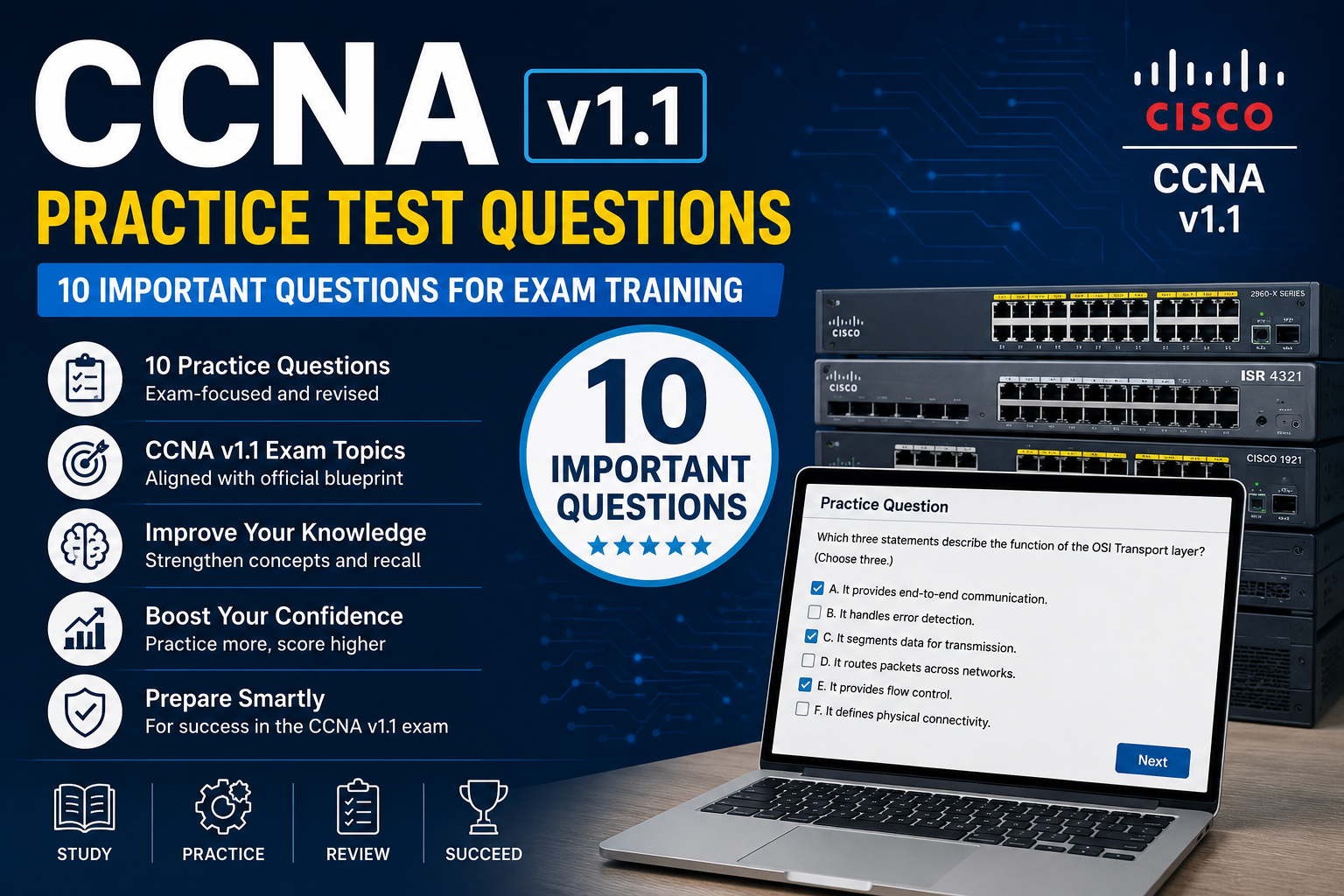
The CCNA v1.1 certification represents a foundational benchmark for individuals entering the field of networking. It is designed to assess not only theoretical understanding but also the practical ability to configure, troubleshoot, and interpret real-world network behavior. In modern IT environments, where connectivity underpins nearly every digital system, networking knowledge has become essential across multiple roles, not just specialized network engineering positions.
At its core, CCNA v1.1 focuses on validating whether a candidate can understand how data moves through networks, how devices communicate, and how infrastructure is maintained securely and efficiently. Unlike earlier learning approaches that emphasized memorization, this version of the certification places stronger emphasis on applied reasoning. Candidates are expected to interpret scenarios, identify issues, and determine appropriate technical responses based on conceptual understanding.
Networking today is deeply interconnected with cloud computing, cybersecurity, and automation systems. As a result, CCNA v1.1 is structured to reflect these changes. It no longer centers solely on traditional routing and switching but integrates security principles and automation awareness. This shift ensures that learners are prepared for evolving enterprise environments where networks are dynamic, software-driven, and increasingly complex.
Understanding this broader context is essential because it changes how preparation should be approached. Instead of treating topics as isolated modules, candidates must develop a holistic understanding of how different networking layers and technologies interact.
The Structure and Cognitive Demands of the CCNA Exam
The CCNA v1.1 exam is designed to evaluate multiple levels of cognitive ability. It not only tests recall but also comprehension, application, and analytical thinking. This layered assessment structure is intentional, as real-world networking requires professionals to diagnose issues under pressure and make decisions based on incomplete or dynamic information.
One of the defining characteristics of the exam is its blend of question types. Candidates are expected to handle conceptual questions that assess understanding of principles, as well as scenario-based challenges that simulate real network environments. These scenarios often require interpreting network behavior, identifying misconfigurations, or predicting outcomes of infrastructure changes.
Time management also plays a critical role in performance. The exam environment is structured in a way that encourages quick yet accurate decision-making. This means candidates must develop the ability to recognize question patterns and apply knowledge efficiently without excessive deliberation.
Another important aspect is the depth of understanding required across multiple domains. Instead of focusing heavily on one area, the exam distributes emphasis across networking fundamentals, IP connectivity, security principles, and automation concepts. This balanced structure ensures that certified individuals have a well-rounded skill set.
To succeed, candidates must shift from passive learning to active problem-solving. Simply reading material is not sufficient. Engaging with scenarios, mentally simulating network behavior, and practicing configuration logic are essential components of effective preparation.
Building a Strong Foundation in Network Fundamentals
Network fundamentals form the backbone of all CCNA knowledge domains. Without a strong grasp of these principles, advanced topics such as routing, security, and automation become significantly more difficult to understand.
At a fundamental level, a network is a system of interconnected devices that communicate by exchanging data. This communication relies on standardized protocols and structured layers of abstraction. Each layer performs specific functions, ensuring that complex communication processes are broken into manageable tasks.
One of the most important concepts in networking is the idea of data encapsulation. As data moves from one device to another, it is wrapped in multiple layers of information. Each layer adds its own header, which provides instructions for how the data should be handled. On the receiving side, these layers are removed in reverse order, a process known as decapsulation.
Another essential concept is bandwidth and latency. Bandwidth refers to the maximum amount of data that can be transmitted over a network in a given time period, while latency refers to the delay experienced during transmission. Understanding the difference between these two metrics is critical when analyzing network performance.
Network devices such as routers, switches, and access points each play distinct roles. Switches operate primarily within local networks, directing data based on MAC addresses. Routers, on the other hand, connect different networks and determine the best path for data transmission using IP addresses.
In addition, modern networks often include multiple layers of redundancy and optimization. These mechanisms ensure reliability in case of failures and maintain consistent performance under varying load conditions. Understanding how redundancy is implemented conceptually helps in grasping more advanced topics later in the certification path.
Exploring the OSI and TCP/IP Models in Depth
The OSI (Open Systems Interconnection) model serves as a conceptual framework that explains how data travels across a network. It divides communication into seven distinct layers, each with a specific responsibility. While it is not directly implemented in real-world systems, it provides a structured way to understand networking processes.
The lowest layer handles physical transmission of data signals, while higher layers manage more abstract functions such as session control, application interaction, and data formatting. This layered approach simplifies troubleshooting because issues can be isolated to specific functional areas.
The Transport layer is particularly important because it ensures reliable communication between devices. It manages error detection, flow control, and data sequencing. This ensures that data arrives correctly and in the proper order, even if it travels through multiple intermediate devices.
The TCP/IP model, on the other hand, is a more practical framework used in real-world networking. It consolidates OSI layers into fewer categories but maintains the same fundamental principles. Understanding both models is important because they complement each other—one provides theoretical clarity, while the other reflects operational reality.
A strong conceptual understanding of these models allows candidates to visualize how data moves through a network. This visualization is essential when diagnosing problems or interpreting exam scenarios that describe network behavior.
Switching Concepts and Local Network Communication
Switching is a core component of local area networking and plays a critical role in CCNA v1.1 preparation. Switches operate at the data link layer and are responsible for forwarding data based on MAC addresses. This allows devices within the same network to communicate efficiently without unnecessary traffic being sent across unrelated segments.
One of the key concepts in switching is the MAC address table. Switches learn which devices are connected to which ports by observing incoming traffic. Over time, they build a dynamic mapping that allows them to forward frames directly to the correct destination.
Virtual Local Area Networks (VLANs) introduce an additional layer of organization within switching environments. VLANs allow network administrators to logically separate devices into different broadcast domains, even if they are physically connected to the same switch. This improves security, reduces congestion, and enhances network management.
Trunking is another important concept that enables communication between switches while preserving VLAN segmentation. This allows multiple VLANs to traverse a single physical connection without losing logical separation.
Understanding switching behavior is essential because it forms the foundation for more complex networking topics such as inter-VLAN routing and network segmentation strategies.
Routing Fundamentals and Path Selection
Routing is the process of determining the best path for data to travel between different networks. Unlike switching, which operates within a single network, routing connects multiple networks.
Routers rely on routing tables to make forwarding decisions. These tables contain information about known networks and the best paths to reach them. Routes can be learned dynamically through routing protocols or configured manually as static routes.
Static routing provides direct control over path selection but lacks flexibility. Dynamic routing protocols, on the other hand, allow routers to exchange information and adapt to changes in the network automatically.
The concept of hop count is also important in routing. Each time data passes through a router, it is considered one hop. Routing protocols often use hop count or similar metrics to determine the most efficient path.
Understanding routing logic requires a clear mental model of how networks interconnect. Instead of viewing routers as isolated devices, they should be understood as decision-making points that guide data through complex topologies.
IPv4, IPv6, and Addressing Concepts
IP addressing is one of the most fundamental aspects of networking. Every device on a network requires a unique address to communicate effectively. IPv4 remains widely used, although IPv6 is increasingly important due to address exhaustion in IPv4 systems.
IPv4 addresses are 32-bit numbers divided into four octets. These addresses are further divided into network and host portions using subnet masks. This structure allows networks to be segmented efficiently and enables hierarchical organization.
Subnetting is a critical skill in CCNA preparation. It involves dividing a larger network into smaller sub-networks, improving efficiency and security. While subnetting can initially appear complex, it becomes intuitive with practice and conceptual understanding.
IPv6 addresses, in contrast, are 128-bit and designed to support a vastly larger number of devices. They also introduce simplified configuration mechanisms and improved routing efficiency.
Understanding both addressing systems is essential because modern networks often use a combination of IPv4 and IPv6, depending on infrastructure requirements.
Security Fundamentals in Network Environments
Network security is an integral part of CCNA v1.1. Modern networks face constant threats, making security knowledge essential for any networking professional.
Basic security principles include access control, authentication, and confidentiality. These principles ensure that only authorized users can access network resources and that data remains protected during transmission.
Firewalls play a key role in controlling traffic between networks. They enforce rules that determine which types of traffic are allowed or blocked. This helps prevent unauthorized access and mitigates potential threats.
Another important concept is network segmentation, which limits the spread of potential attacks. By dividing networks into smaller sections, organizations can contain security incidents and reduce overall risk.
Security in networking is not just about tools but also about design principles. A well-structured network inherently reduces vulnerabilities by limiting unnecessary exposure and enforcing controlled communication paths.
Introduction to Automation and Network Programmability
Modern networking increasingly relies on automation to improve efficiency and reduce human error. Automation allows repetitive tasks such as configuration updates, monitoring, and troubleshooting to be handled programmatically.
Network programmability introduces the idea that networks can be controlled using software interfaces rather than manual configuration. This shift is part of a broader trend toward software-defined infrastructure.
Automation tools typically use structured data formats and standardized communication methods to interact with network devices. This enables consistent configuration across large-scale environments.
Understanding automation at a conceptual level is important because it represents the future direction of networking. Even entry-level professionals are expected to be familiar with basic automation principles and their impact on network operations.
Developing Effective Study and Practice Habits
Success in CCNA preparation depends heavily on consistent study habits and practical exposure. Understanding concepts is important, but applying them in simulated environments reinforces learning.
A structured approach to learning helps in managing complex topics. Breaking down subjects into smaller sections allows for gradual mastery. Revisiting difficult areas multiple times ensures long-term retention.
Practical experience is equally important. Observing how networks behave under different configurations helps bridge the gap between theory and real-world application.
Mental visualization also plays a key role. Being able to imagine how data flows through a network improves problem-solving ability and reduces confusion during complex scenarios.
Common Learning Challenges in Networking Concepts
Many learners face challenges when first encountering networking topics. One common difficulty is understanding abstract concepts such as encapsulation and routing logic. These ideas require mental modeling rather than memorization.
Another challenge is subnetting, which involves numerical reasoning and binary logic. With consistent practice, however, it becomes more intuitive.
Time pressure during preparation can also lead to superficial understanding. It is important to balance speed with depth of comprehension to build a solid foundation.
Misconceptions often arise when learners attempt to memorize procedures without understanding underlying principles. True mastery comes from understanding why systems behave the way they do, not just how to configure them.
Strengthening Conceptual Clarity for Exam Readiness
Developing conceptual clarity is the most important step in preparing for CCNA v1.1. Instead of focusing solely on isolated facts, learners should aim to understand relationships between networking components.
When concepts are understood at a deeper level, problem-solving becomes more intuitive. This reduces dependency on memorization and increases adaptability in unfamiliar scenarios.
A strong conceptual foundation also improves confidence. When candidates understand how systems interact, they are better equipped to analyze questions and eliminate incorrect options logically.
This stage of preparation represents the transition from basic learning to applied understanding, which is essential for success in a certification that emphasizes real-world networking skills.
Deep Dive into Dynamic Routing and Network Intelligence
Dynamic routing is one of the most important advancements in modern networking because it allows routers to automatically adjust to changes in network topology. Unlike static routing, which requires manual configuration, dynamic routing protocols enable devices to exchange information and calculate the most efficient paths in real time.
At a conceptual level, dynamic routing works like a distributed decision-making system. Each router shares knowledge about directly connected networks with neighboring routers. Over time, this information spreads across the network, allowing every router to build a complete or partial map of the network topology depending on the protocol used.
One of the key advantages of dynamic routing is adaptability. In real-world networks, failures and changes are inevitable. Links may go down, new devices may be added, or traffic conditions may shift. Dynamic routing ensures that data continues to flow even when these changes occur by recalculating paths automatically.
The decision-making process in routing is based on metrics such as hop count, bandwidth, delay, and reliability. Different routing protocols prioritize these metrics differently, which affects how paths are selected. Understanding this behavior is essential for interpreting network performance and troubleshooting routing issues.
In enterprise environments, dynamic routing also reduces administrative overhead. Instead of manually configuring every route, administrators rely on protocols that scale automatically with the network size. This scalability is critical in large infrastructures where manual management would be inefficient and error-prone.
Understanding OSPF Behavior and Network Convergence
Open Shortest Path First (OSPF) is one of the most widely used dynamic routing protocols in enterprise networks. It operates using a link-state approach, meaning each router builds a complete map of the network before making routing decisions.
OSPF introduces the concept of areas, which divide large networks into smaller, manageable sections. This hierarchical structure improves efficiency by limiting the scope of routing updates and reducing processing overhead.
When a change occurs in the network, OSPF routers exchange updates and recalculate routes. This process is known as convergence. Fast convergence is critical because it ensures minimal disruption during network changes. The speed at which convergence occurs depends on how quickly routers detect changes and update their topology databases.
OSPF also uses the concept of cost as its primary metric. Cost is typically based on bandwidth, meaning higher-speed links are preferred over slower ones. This allows OSPF to choose optimal paths based on performance rather than simple hop count.
Understanding OSPF requires thinking in terms of relationships between routers rather than individual configurations. Each router contributes to a shared understanding of the network, making it a cooperative system rather than a centralized one.
Advanced Subnetting and Network Segmentation Strategies
Subnetting is one of the most critical skills in networking because it directly impacts how networks are designed, organized, and secured. At an advanced level, subnetting is not just about dividing IP addresses but about designing efficient and scalable network architectures.
Subnetting allows network administrators to break large address spaces into smaller, more manageable segments. Each subnet functions as an independent network, which improves performance by reducing broadcast traffic and enhances security by isolating network segments.
In practical environments, subnetting decisions are influenced by factors such as device density, departmental structure, and future growth requirements. Proper planning ensures that IP address space is used efficiently without unnecessary waste.
Variable Length Subnet Masking (VLSM) is an advanced technique that allows different subnets within the same network to use different subnet sizes. This flexibility enables more precise allocation of IP addresses based on actual needs rather than fixed patterns.
Understanding subnetting deeply also improves troubleshooting capabilities. Many network issues are related to incorrect addressing or misconfigured subnet masks. A strong conceptual understanding allows engineers to quickly identify and resolve such problems.
VLAN Architecture and Logical Network Design
Virtual Local Area Networks (VLANs) are a fundamental tool for creating logical network segmentation within physical infrastructure. They allow devices to be grouped regardless of their physical location, creating isolated broadcast domains.
This logical separation improves both performance and security. By limiting broadcast traffic to specific VLANs, networks become more efficient and less congested. At the same time, sensitive systems can be isolated from general user traffic.
VLAN configuration introduces the concept of tagging, where frames are labeled with VLAN identifiers as they traverse network devices. This ensures that traffic remains properly segmented even when passing through shared physical links.
Trunk links play a crucial role in VLAN architecture by carrying traffic from multiple VLANs between switches. These links maintain logical separation while enabling inter-device communication across the network backbone.
From a design perspective, VLANs allow organizations to align network structure with business needs. Departments, functions, or security levels can each be assigned separate VLANs, creating a more organized and manageable environment.
Inter-VLAN Routing and Communication Between Segments
While VLANs provide isolation, there are many scenarios where communication between VLANs is necessary. Inter-VLAN routing enables controlled communication between these logical segments.
This process typically involves a router or Layer 3 switch that routes traffic between VLANs based on IP addressing. Each VLAN is treated as a separate subnet, and routing rules determine how traffic flows between them.
Inter-VLAN routing introduces additional control over network traffic. Instead of allowing unrestricted communication, administrators can define specific paths and restrictions between segments. This improves security and reduces unnecessary data flow.
Understanding inter-VLAN routing requires a clear grasp of both switching and routing principles. It represents the intersection of these two domains and is a key concept in CCNA-level networking.
In modern environments, Layer 3 switching has become common, allowing routing functions to be performed directly on switching hardware. This improves performance and reduces latency compared to traditional router-based designs.
Spanning Tree Protocol and Loop Prevention Mechanisms
Network loops are one of the most critical issues in switched networks. They occur when multiple active paths exist between switches, potentially causing broadcast storms and network instability.
The Spanning Tree Protocol (STP) was developed to prevent such loops by selectively blocking redundant paths while maintaining backup links for redundancy. This ensures that only one active path exists between any two network devices at a time.
STP operates by electing a root bridge, which serves as the central reference point for path calculations. All other switches determine the best path to this root bridge and disable redundant connections accordingly.
Although STP may seem to limit network utilization, its primary purpose is stability. Without loop prevention mechanisms, even small configuration errors can cause large-scale network failures.
Modern enhancements to STP improve convergence time and efficiency, allowing networks to recover more quickly from topology changes.
NAT, Address Translation, and Internet Connectivity
Network Address Translation (NAT) is a key mechanism that allows private networks to communicate with the public Internet. Since IPv4 address space is limited, NAT enables multiple devices to share a single public IP address.
At a functional level, NAT modifies IP address information in packet headers as data passes through a router. This translation ensures that internal devices can access external resources without requiring globally unique addresses.
There are different types of NAT, including static NAT, dynamic NAT, and Port Address Translation (PAT). Each serves different use cases depending on network requirements.
PAT is the most commonly used form because it allows multiple internal devices to share a single external IP address by distinguishing traffic using port numbers.
Understanding NAT is essential because it explains how private networks operate within the global internet structure while maintaining internal address independence.
DHCP and Automated Network Configuration Systems
The Dynamic Host Configuration Protocol (DHCP) simplifies network management by automatically assigning IP addresses to devices. Instead of manually configuring each device, DHCP servers dynamically allocate addresses from a predefined pool.
This process significantly reduces administrative overhead and minimizes configuration errors. DHCP also provides additional configuration information such as default gateways, DNS servers, and subnet masks.
The DHCP process follows a structured exchange between client and server, ensuring that each device receives a valid and unique configuration.
In large networks, DHCP plays a crucial role in scalability. Without it, managing IP assignments would become increasingly complex as the number of devices grows.
Understanding DHCP behavior is important for troubleshooting connectivity issues, especially when devices fail to obtain valid network configurations.
DNS Functionality and Name Resolution Processes
The Domain Name System (DNS) is responsible for translating human-readable domain names into IP addresses. Without DNS, users would need to remember numerical addresses to access websites and services.
DNS operates through a hierarchical structure of servers that distribute name resolution tasks. When a device requests a domain name, the query is passed through multiple servers until the correct IP address is found.
Caching plays an important role in DNS performance. Frequently accessed domain names are stored locally to reduce lookup time and improve efficiency.
DNS issues can lead to significant connectivity problems, even when the underlying network infrastructure is functioning correctly. Understanding DNS behavior is therefore essential for diagnosing application-level connectivity issues.
Wireless Networking Principles and Signal Behavior
Wireless networking introduces additional complexity compared to wired communication because it relies on radio frequency signals. These signals are affected by interference, distance, and physical obstacles.
Different wireless standards define how data is transmitted over radio waves, with newer standards offering higher speeds and improved efficiency. Frequency bands such as 2.4 GHz and 5 GHz each have distinct characteristics that affect performance.
Wireless networks must balance coverage and speed. Lower frequencies provide better range but lower performance, while higher frequencies offer faster speeds but reduced coverage.
Understanding wireless behavior is essential for designing reliable networks, especially in environments with high device density or physical barriers.
Network Troubleshooting Methodologies and Analytical Thinking
Effective troubleshooting is a critical skill in networking. It involves systematically identifying, isolating, and resolving issues based on observed behavior and diagnostic information.
A structured approach is essential for efficient problem-solving. Instead of guessing, network engineers follow logical steps to narrow down potential causes.
Common troubleshooting involves analyzing connectivity, configuration accuracy, and network performance. Each layer of the network stack can introduce different types of issues, requiring layered analysis.
Developing strong troubleshooting skills requires both theoretical knowledge and practical exposure. The ability to interpret symptoms and connect them to underlying causes is what distinguishes skilled network professionals.
Strengthening Practical Understanding Through Network Behavior Analysis
Beyond theoretical knowledge, understanding how networks behave under different conditions is essential for mastery. Observing traffic flow, device interactions, and configuration outcomes helps reinforce conceptual learning.
Real-world network behavior often reveals complexities that are not immediately obvious from theoretical study alone. Factors such as latency variations, congestion, and misconfigurations can significantly impact performance.
By analyzing these behaviors, learners develop intuition about how networks operate in dynamic environments. This intuition is crucial for both exam success and professional competence in real-world networking roles.
Evolution of Enterprise Network Security and Access Control Models
In modern networking environments, security is no longer treated as an optional layer added at the end of network design. Instead, it is embedded into every stage of architecture, configuration, and operation. Enterprise networks are built with the assumption that threats may originate from both external and internal sources, making layered defense strategies essential.
One of the foundational elements of network security is access control, which determines who or what can interact with network resources. This goes beyond simple password protection and extends into identity verification, device authentication, and role-based access decisions. The goal is to ensure that only authorized entities can access specific resources, and only under defined conditions.
Traditional filtering mechanisms, such as basic packet filtering, still play a role, but modern networks rely on more granular control methods. These include stateful inspection and context-aware decision-making, where traffic is evaluated based on session state, source identity, and communication behavior rather than just static rules.
Another critical concept is device-level security enforcement. Network switches and routers can enforce restrictions at the port level, limiting unauthorized device connections. This prevents unauthorized access attempts from physically connected devices and helps maintain the integrity of the local network environment.
Authentication, authorization, and accounting principles are also fundamental to enterprise security design. Authentication verifies identity, authorization determines access rights, and accounting tracks usage behavior. Together, these mechanisms ensure accountability and traceability within the network.
As networks become more complex, security enforcement is increasingly distributed rather than centralized. This means security policies are applied at multiple points in the network, reducing reliance on a single enforcement device and improving resilience against attacks.
Identity-Based Networking and Device Authentication Concepts
Identity-based networking represents a shift from traditional IP-based trust models to identity-driven access control. In this model, devices and users are authenticated before being granted network access, regardless of their physical location or IP configuration.
This approach improves security by ensuring that network access is tied to verified identity rather than simply network presence. Devices must prove their legitimacy before being allowed to communicate with other systems.
Port-based authentication mechanisms play an important role in this model. When a device connects to a network switch, it may be required to authenticate before gaining access to network resources. If authentication fails, access is restricted or placed into a limited-access environment.
This model is particularly important in environments with high device mobility, such as corporate offices, universities, and distributed enterprises. It ensures that only trusted devices can interact with sensitive systems.
Identity-based networking also supports dynamic policy assignment. Once a device is authenticated, it may be assigned specific network permissions based on user role, device type, or security posture. This allows for flexible and scalable access control.
Software-Defined Networking and Centralized Control Logic
Software-defined networking represents a fundamental shift in how networks are designed and managed. Instead of relying on distributed control logic embedded within individual devices, SDN introduces centralized control through software-based controllers.
In traditional networking, each device independently makes forwarding decisions based on locally stored information. In contrast, SDN separates the control plane from the data plane, allowing centralized systems to define network behavior.
This separation enables greater flexibility and programmability. Network administrators can define policies at a high level, and the controller translates those policies into device-level instructions.
One of the key advantages of this approach is simplified management. Instead of configuring each device individually, administrators can manage the entire network from a centralized interface. This reduces configuration errors and improves consistency across large environments.
SDN also enables faster adaptation to changing network conditions. Because control logic is centralized, updates can be applied globally without needing to modify individual devices manually.
From a conceptual standpoint, SDN transforms networks into programmable systems, where behavior is defined by software rather than hardware limitations.
Application Programming Interfaces in Network Automation
Application Programming Interfaces, commonly known as APIs, are a critical component of modern network automation. They provide standardized methods for software systems to interact with network devices and services.
Instead of manually configuring devices through command-line interfaces, APIs allow automated systems to send structured requests that modify network behavior programmatically. This enables scalable and repeatable configuration processes.
APIs also support integration between different systems. For example, monitoring platforms, orchestration tools, and configuration management systems can all interact with network infrastructure through API calls.
This integration is essential in large-scale environments where manual management is impractical. Automation ensures consistency, reduces human error, and accelerates deployment cycles.
Another important aspect of API-driven networking is real-time responsiveness. Automated systems can react to network events instantly, adjusting configurations or rerouting traffic based on predefined rules.
Understanding the API conceptually is important because they represent the communication layer between human-defined intent and machine-executed actions within modern networks.
Quality of Service and Traffic Prioritization Mechanisms
Quality of Service, commonly referred to as QoS, is a mechanism used to manage network traffic based on priority levels. In environments where multiple applications share the same infrastructure, not all traffic has equal importance.
For example, real-time communication such as voice and video requires low latency and consistent delivery. In contrast, background data transfers can tolerate delays without significantly affecting user experience.
QoS allows networks to classify, prioritize, and manage traffic based on its importance. This ensures that critical applications receive the necessary bandwidth and minimal delay even during periods of congestion.
Traffic classification is the first step in QoS implementation. Data packets are analyzed and grouped based on predefined criteria such as application type, source, or destination.
Once classified, traffic is marked with priority levels that determine how it should be handled within the network. Higher-priority traffic is processed before lower-priority traffic during congestion conditions.
Queuing mechanisms further refine traffic handling by organizing packets into different processing queues. This ensures that important data is transmitted efficiently even when network resources are limited.
QoS is especially important in modern enterprise environments where multiple latency-sensitive applications operate simultaneously.
IPv6 Advanced Networking Behavior and Address Autoconfiguration
IPv6 introduces significant improvements over IPv4, particularly in terms of address space and configuration flexibility. One of its key features is stateless address autoconfiguration, which allows devices to generate their own IP addresses without relying on centralized configuration servers.
This mechanism simplifies network deployment by reducing administrative overhead. Devices can automatically configure themselves when connected to a network, making IPv6 highly scalable.
IPv6 also eliminates the need for traditional network address translation in many cases, allowing end-to-end connectivity between devices. This improves transparency and reduces complexity in communication paths.
Another important concept is neighbor discovery, which replaces older broadcast-based mechanisms with more efficient multicast communication. This improves network efficiency and reduces unnecessary traffic.
IPv6 also supports hierarchical addressing structures, which improve routing efficiency at a global scale. These structures allow routers to aggregate routes more effectively, reducing the size of routing tables.
Understanding IPv6 behavior is essential because it represents the future direction of global networking infrastructure.
Wireless Enterprise Architecture and Signal Optimization
Wireless networking in enterprise environments is significantly more complex than basic home or small office setups. It requires careful planning to ensure coverage, performance, and reliability across large physical areas.
One of the key challenges in wireless design is signal interference. Physical obstacles, overlapping frequencies, and environmental factors can all impact signal quality. Proper planning is required to minimize these effects.
Channel planning is an essential part of wireless optimization. By carefully selecting frequency channels, administrators can reduce interference between access points and improve overall performance.
Roaming is another important concept in enterprise wireless networks. It allows devices to move between access points without losing connectivity. This is critical in environments where mobility is required, such as offices, campuses, and industrial facilities.
Load-balancing mechanisms ensure that no single access point becomes overloaded with traffic. This helps maintain consistent performance across the entire wireless network.
Wireless security is also a key consideration. Authentication mechanisms and encryption protocols are used to protect data transmitted over wireless channels.
Cloud-Integrated Networking and Hybrid Infrastructure Models
Modern networks are increasingly integrated with cloud environments, creating hybrid infrastructures that combine on-premises systems with cloud-based resources.
This integration allows organizations to scale resources dynamically based on demand. Instead of relying solely on local infrastructure, workloads can be distributed across multiple environments.
Cloud networking introduces new architectural considerations, including virtual networks, distributed routing, and software-defined connectivity between regions.
One of the key benefits of cloud integration is flexibility. Resources can be provisioned or decommissioned rapidly, allowing networks to adapt to changing business needs.
Hybrid networking also requires careful coordination between on-premises and cloud environments to ensure consistent performance and security.
Understanding these models is essential because modern enterprise networks rarely operate in isolation. They are part of larger, interconnected ecosystems.
Network Monitoring, Telemetry, and Performance Visibility
Monitoring is a critical aspect of network operations. Without visibility into network behavior, it becomes difficult to identify issues, optimize performance, or maintain reliability.
Telemetry systems collect real-time data from network devices, providing insights into traffic patterns, resource usage, and system health.
This data is used to detect anomalies, identify bottlenecks, and predict potential failures before they impact users.
Monitoring systems often operate continuously, allowing administrators to maintain awareness of network conditions at all times.
Performance visibility is essential for maintaining service quality in large-scale environments where multiple systems interact simultaneously.
High Availability and Redundancy in Network Design
High availability is a design principle that ensures continuous network operation even in the event of hardware or software failures. It is achieved through redundancy, failover mechanisms, and distributed system design.
Redundant paths allow traffic to be rerouted automatically if a primary link fails. This ensures that communication continues without interruption.
Failover mechanisms detect failures and switch operations to backup systems. This process is typically automated to minimize downtime.
High availability is essential in enterprise environments where downtime can result in significant operational and financial impact.
Designing for redundancy requires careful planning to balance cost, complexity, and reliability.
Hierarchical Network Design and Structural Optimization
Hierarchical design is a structured approach to building scalable and efficient networks. It divides the network into distinct layers, each with specific responsibilities.
This structure simplifies management and improves performance by localizing traffic and reducing unnecessary complexity.
A well-designed hierarchical network is easier to troubleshoot, expand, and maintain. It also provides a clear separation between different functional areas of the network.
This approach is widely used in enterprise environments because it supports both scalability and operational efficiency.
Integrated Network Behavior and System-Level Understanding
At an advanced level, networking is not about isolated technologies but about how different systems interact. Routing, switching, security, automation, and wireless communication all work together to form a unified infrastructure.
Understanding these interactions is essential for diagnosing complex issues and designing efficient networks. Instead of viewing components independently, they must be understood as part of a larger ecosystem.
This system-level perspective is what distinguishes advanced networking knowledge from basic configuration skills.
Conclusion
Preparing for the CCNA v1.1 exam is not simply about memorizing commands or recalling isolated facts. It is about developing a structured understanding of how modern networks function as interconnected systems. Across the foundational, intermediate, and advanced concepts explored in this series, one consistent theme stands out: networking knowledge becomes powerful only when it is applied in context.
From basic networking principles such as IP addressing, switching, and routing to more complex topics like dynamic routing behavior, VLAN segmentation, and security enforcement, each concept builds upon the previous one. This layered structure reflects how real-world networks operate, where multiple technologies interact simultaneously to deliver seamless communication.
A key insight from CCNA-level preparation is the importance of conceptual clarity. Candidates who focus only on memorization often struggle when faced with scenario-based questions, while those who understand how systems behave under different conditions can analyze problems more effectively. This ability to think logically through network behavior is what ultimately determines success in both the exam and real-world environments.
Another important takeaway is the increasing relevance of automation, cloud integration, and programmability in modern networking. Networks are no longer static infrastructures managed manually at every level. Instead, they are dynamic, software-driven environments that require adaptability and system-level thinking. Understanding these trends ensures that learners are not only prepared for the exam but also for the evolving demands of the IT industry.
Equally important is the role of hands-on practice and consistent reinforcement. Networking concepts become clearer when they are observed in action, whether through simulated environments or real device interactions. Practical exposure strengthens theoretical understanding and builds confidence in troubleshooting and decision-making.
Ultimately, CCNA v1.1 preparation is a process of transformation. It shifts learners from passive consumers of information to active problem-solvers who can interpret, analyze, and respond to complex networking scenarios. With disciplined study, structured learning, and a focus on understanding rather than memorization, candidates can build a strong foundation that supports long-term growth in networking and beyond.