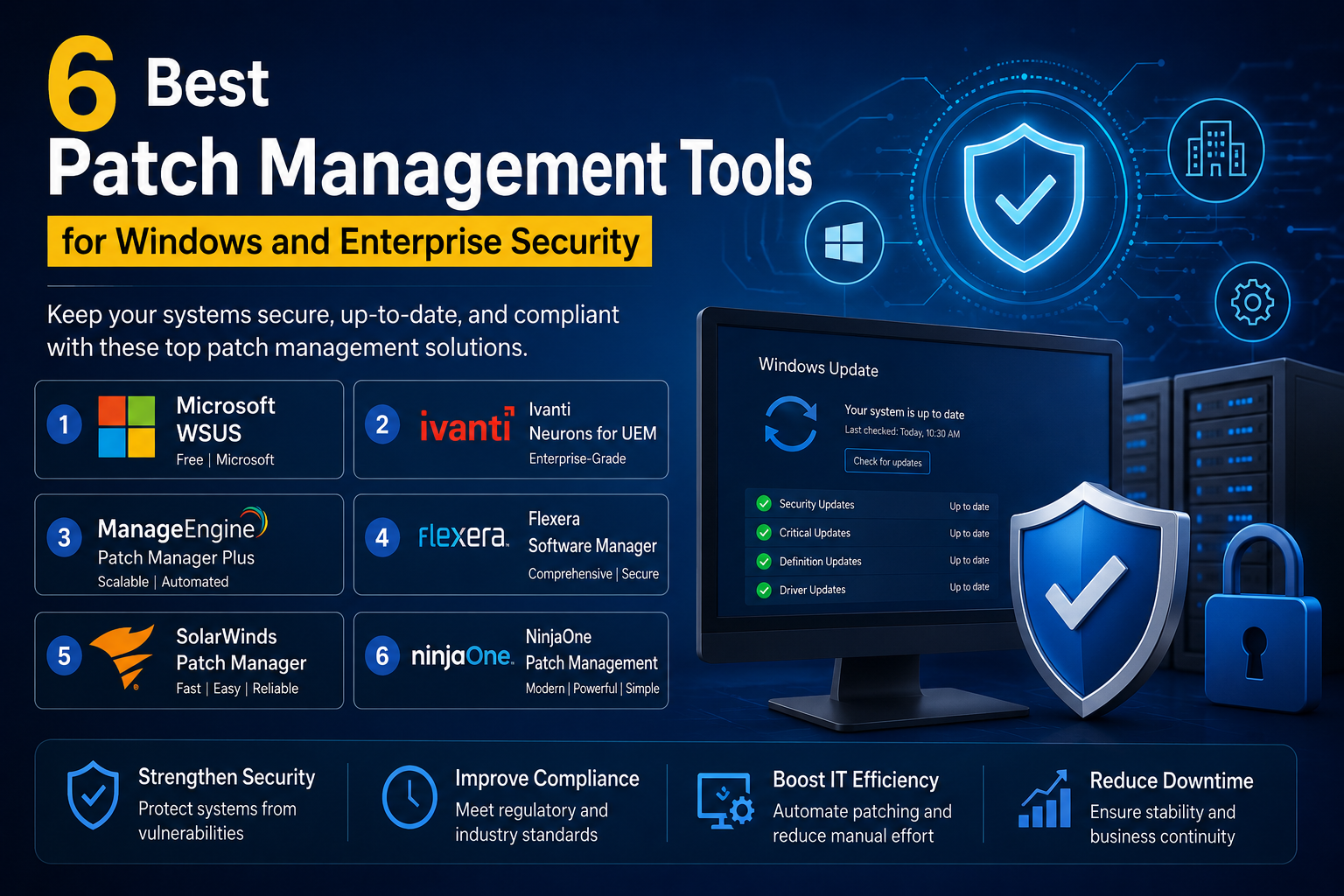
Patch management is a structured process used to keep operating systems, applications, and sometimes even firmware up to date with the latest security fixes and performance improvements. At its core, it ensures that known vulnerabilities and software bugs are addressed before they can be exploited or cause operational issues. In today’s interconnected digital environment, where organizations depend heavily on technology for daily operations, patch management has become a foundational part of IT security and system reliability.
In simple terms, patches are small pieces of software designed to fix issues in larger systems. These issues may include security vulnerabilities, performance inefficiencies, or unexpected system behavior. While applying a single patch might seem straightforward, managing hundreds or thousands of systems across a network quickly becomes complex. This is where structured patch management processes and tools become essential.
Without a defined approach, organizations often rely on manual updates. Although this may work in very small environments, it becomes increasingly risky and inefficient as the number of devices grows. The likelihood of missing systems, skipping updates, or applying inconsistent configurations increases significantly, which can lead to serious security and operational gaps.
The Role of Vulnerabilities in Software Systems
Software vulnerabilities are one of the primary reasons patch management exists. These vulnerabilities are typically unintended flaws in code that can be exploited by attackers or cause system instability. They are not deliberately introduced but often arise from complex development processes, third-party dependencies, or unforeseen interactions between system components.
Cybersecurity threats continue to evolve, and attackers actively search for known vulnerabilities in widely used software. Once a vulnerability is publicly disclosed, it becomes a race between system administrators and malicious actors. If a patch is not applied in time, systems remain exposed to potential exploitation.
Even outside of security concerns, vulnerabilities can affect system performance and reliability. Applications may crash unexpectedly, services may slow down, or compatibility issues may arise with other software components. Patching helps ensure that systems operate as intended and remain stable under varying workloads.
Because of these risks, organizations treat patching not just as a maintenance task, but as a critical security control.
The Limitations of Manual Patch Management
In small environments with only a few devices, manually installing updates might seem manageable. An administrator can log into each machine, check for updates, and apply them individually. However, this approach quickly becomes inefficient as infrastructure grows.
One of the biggest challenges with manual patching is human error. It is easy to overlook a system, forget to apply a specific update, or misconfigure a patch installation. Even a single missed machine can create a security gap in the network.
Another issue is a lack of visibility. Without centralized tracking, it becomes difficult to know which systems are fully updated and which are still pending patches. This creates uncertainty and makes it harder to ensure compliance with internal or external security requirements.
Manual processes also consume significant time. IT teams must repeatedly perform the same tasks across multiple systems, leaving less time for strategic work such as system optimization or security planning. Over time, this approach becomes unsustainable, especially in enterprise environments with distributed infrastructure.
Why Automation Became Essential in Patch Management
As IT environments grew more complex, the need for automation in patch management became clear. Automation reduces the dependency on manual intervention and ensures that updates are applied consistently across all systems.
Automated patch management systems can scan networks, identify missing updates, and deploy patches according to predefined rules. This eliminates many of the inconsistencies associated with manual processes. It also ensures that systems remain up to date without requiring constant human oversight.
Another advantage of automation is scheduling flexibility. Organizations can define specific maintenance windows during which patches are applied, reducing disruption to business operations. This is particularly important for systems that must remain available around the clock.
Automation also improves reporting. Instead of manually checking each system, administrators can generate detailed reports showing patch status across the entire environment. This visibility is crucial for both operational management and compliance requirements.
The Growing Importance of Compliance and Regulation
Modern organizations often operate under strict regulatory frameworks that require them to maintain secure and updated systems. Industries such as finance, healthcare, and government are particularly affected by these requirements.
Regulations often mandate that organizations demonstrate they are actively managing vulnerabilities and applying security updates promptly. This means that patch management is not just a technical requirement but also a compliance obligation.
Failure to comply with these standards can result in penalties, legal consequences, or loss of customer trust. As a result, organizations must maintain detailed records of patching activities, including what was updated, when it was updated, and which systems were affected.
Patch management tools play a key role in supporting compliance by providing audit-ready reports and ensuring consistent application of security updates across all systems.
Core Components of a Patch Management System
A complete patch management system typically consists of several key components working together to ensure efficient operation.
The first component is the detection engine. This is responsible for identifying missing patches across systems. It scans devices, compares installed software versions against known patch databases, and determines what updates are required.
The second component is the deployment engine. Once missing patches are identified, this system handles the distribution and installation of updates. It ensures that patches are delivered to the correct systems and applied successfully.
The third component is the reporting system. This provides visibility into the patching process, showing which systems are compliant and which still require updates. It is essential for tracking progress and maintaining accountability.
Finally, there is the policy engine, which allows administrators to define rules for how and when patches should be applied. This includes scheduling, approval workflows, and grouping of systems based on priority or function.
Understanding Patch Management in Different Environments
Patch management is not a one-size-fits-all process. Different environments require different approaches depending on their structure, scale, and operational requirements.
In small business environments, patch management may be relatively simple, involving a limited number of systems and applications. Updates can often be applied quickly, and downtime can be scheduled with minimal disruption.
In contrast, enterprise environments involve complex infrastructure spread across multiple locations. These environments may include servers, workstations, virtual machines, and cloud-based systems. Managing patches across such a diverse ecosystem requires careful planning and coordination.
Cloud environments introduce additional considerations. While cloud providers often handle infrastructure-level patching, organizations are still responsible for updating their applications and operating systems within cloud instances. This shared responsibility model requires a clear understanding of roles and responsibilities.
Hybrid environments, which combine on-premises and cloud infrastructure, present even more complexity. Consistent patching across both environments is essential to avoid security gaps.
Risks Associated with Poor Patch Management
When patch management is not handled properly, organizations face a range of risks that can impact both security and operations.
One of the most significant risks is exposure to cyberattacks. Unpatched vulnerabilities are often the entry point for malware, ransomware, and unauthorized access attempts. Attackers frequently target known vulnerabilities because they are easier to exploit.
Operational instability is another risk. Software bugs that remain unpatched can cause system crashes, data corruption, or degraded performance. This can lead to downtime and productivity loss.
There is also the risk of non-compliance with regulatory standards. Organizations that fail to maintain proper patching practices may face audits, fines, or legal consequences.
Finally, poor patch management can damage organizational reputation. Customers and stakeholders expect systems to be secure and reliable. Frequent security incidents or outages can reduce trust and confidence.
Evolution of Patch Management Tools
Over time, patch management tools have evolved from simple update mechanisms into sophisticated platforms capable of managing large-scale environments.
Early systems relied heavily on manual intervention and basic scripting. Administrators had limited visibility and control over patch deployment processes. As IT environments became more complex, these tools evolved to include centralized dashboards, automation capabilities, and integration with other IT management systems.
Modern patch management solutions now support multi-platform environments, including Windows, Linux, and macOS. They also extend beyond operating systems to include third-party applications, which are often targeted by attackers due to slower update cycles.
Integration with security tools and monitoring systems has also become common. This allows organizations to correlate patch status with security events and respond more effectively to threats.
Key Considerations Before Implementing Patch Management
Before implementing a patch management system, organizations need to evaluate several important factors.
One of the first considerations is the environment size and complexity. Larger environments require more robust and scalable solutions.
Another factor is system compatibility. The chosen approach must support all operating systems and applications in use.
Network bandwidth is also important, especially in distributed environments. Patch deployment can consume significant bandwidth, so optimization strategies may be necessary.
Testing procedures should also be defined. Applying patches directly to production systems without testing can lead to unexpected issues. A staged rollout approach is often preferred.
Finally, organizations must consider internal processes and governance. Clear policies should define how patches are approved, tested, and deployed.
Challenges in Large-Scale Patch Management
Managing patches at scale introduces several challenges that organizations must address.
One major challenge is system diversity. Enterprises often use a mix of legacy and modern systems, each with different patching requirements.
Another challenge is downtime management. Many systems cannot be taken offline during business hours, requiring careful scheduling of updates.
Coordination between teams can also be complex. Different departments may have different priorities, making it difficult to align patching schedules.
Additionally, unexpected compatibility issues can arise after patch deployment. Even well-tested updates can sometimes conflict with existing applications or configurations.
Maintaining visibility across all systems is another ongoing challenge, especially in hybrid or multi-cloud environments.
Architecture of Modern Patch Management Systems
Modern patch management tools are built on structured architectures designed to handle large-scale environments with minimal manual intervention. These systems are typically composed of centralized management servers, client agents, patch repositories, and communication channels that coordinate the entire update process.
At the center of most systems is the management console. This console acts as the control hub where administrators define policies, approve patches, and monitor deployment status. It provides visibility into all connected devices and allows IT teams to manage updates from a single interface rather than interacting with each machine individually.
Connected to the console are endpoint agents or service components installed on target devices. These agents are responsible for communicating with the central system, reporting system status, and executing patch installations. In some agentless designs, the system uses network protocols to communicate directly with devices, though agent-based approaches are generally more reliable and scalable.
Another important component is the patch repository. This is a storage system that holds downloaded updates before they are distributed to endpoints. Some tools maintain local repositories within an organization’s network to reduce external bandwidth usage, while others rely on cloud-based repositories for distribution.
Communication between components is typically encrypted to ensure security during patch transmission. This is especially important when updates are being delivered across public networks or hybrid environments.
Centralized vs Distributed Patch Management Models
Patch management systems can generally be categorized into centralized and distributed models, each with distinct advantages and limitations.
In a centralized model, all patching activities are managed from a single control point. This approach simplifies administration because all policies, updates, and reports are handled in one location. It is commonly used in environments where infrastructure is relatively contained or connected through reliable internal networks.
However, centralized systems may face scalability challenges in large or geographically distributed environments. Network latency and bandwidth limitations can slow down patch deployment when endpoints are spread across multiple regions.
Distributed patch management models address these limitations by decentralizing some of the workload. In this approach, multiple servers or relay nodes are used to distribute patches closer to endpoints. This reduces network congestion and improves deployment speed.
Large enterprises often use a hybrid approach, combining centralized control with distributed delivery systems. This allows them to maintain consistent policies while optimizing performance across different locations.
Role of Agents in Patch Deployment
Agents play a critical role in modern patch management ecosystems. These lightweight software components are installed on endpoints such as desktops, laptops, and servers. Their primary function is to maintain communication with the central management system and execute patch-related tasks.
Once installed, agents periodically check in with the management server to retrieve instructions. These instructions may include scanning for missing patches, downloading updates, or initiating installation processes.
One of the key advantages of using agents is real-time responsiveness. Because agents operate directly on the endpoint, they can immediately execute tasks without requiring continuous manual oversight.
Agents also improve reliability in environments with intermittent connectivity. If a device temporarily loses connection to the central system, the agent can continue operating locally and synchronize once connectivity is restored.
However, agent-based systems require careful management. Agents must be updated regularly, and compatibility must be maintained across different operating systems and device types. In large environments, managing thousands of agents can itself become a complex task.
Patch Discovery and Vulnerability Assessment Process
Before patches can be applied, systems must first identify what is missing. This process is known as patch discovery and is often combined with vulnerability assessment.
During discovery, patch management tools scan endpoints to collect information about installed software versions, system configurations, and existing updates. This data is then compared against a centralized patch database maintained by the tool vendor or organization.
If discrepancies are found, the system identifies missing patches and classifies them based on severity. Critical security patches are typically prioritized over optional or performance-related updates.
Vulnerability assessment adds another layer of analysis by evaluating whether missing patches correspond to known security vulnerabilities. This helps organizations prioritize updates that address the most significant risks.
Some advanced systems integrate threat intelligence feeds to enhance this process. These feeds provide real-time information about newly discovered vulnerabilities, allowing organizations to respond more quickly to emerging threats.
Patch Testing and Validation Workflows
Applying patches directly to production systems without testing can introduce significant risks. To mitigate this, most organizations implement structured testing and validation workflows.
In a typical workflow, patches are first deployed to a controlled test environment that mirrors production systems. This environment allows administrators to observe how updates behave without affecting real users.
During testing, systems are monitored for performance issues, compatibility problems, and unexpected behavior. Applications that rely on specific system components are particularly scrutinized, as updates can sometimes alter underlying dependencies.
Once testing is complete and no major issues are identified, patches are gradually rolled out to production systems. This staged approach reduces the risk of widespread disruption.
Validation does not end after deployment. Continuous monitoring is essential to ensure that systems remain stable and secure after updates are applied. If issues arise, rollback procedures may be initiated.
Cloud-Based Patch Management Systems
Cloud-based patch management has become increasingly popular due to its flexibility and scalability. In this model, patch management infrastructure is hosted in the cloud rather than on local servers.
One of the main advantages of cloud-based systems is reduced infrastructure overhead. Organizations do not need to maintain physical servers for patch distribution, which simplifies deployment and maintenance.
Cloud systems also offer greater accessibility. Administrators can manage patching activities from any location with internet access, making them suitable for remote and hybrid work environments.
Scalability is another key benefit. Cloud platforms can easily handle increasing numbers of endpoints without requiring significant infrastructure changes.
However, cloud-based systems depend heavily on network connectivity. Organizations must ensure that sufficient bandwidth is available for downloading and distributing patches, especially during large update cycles.
Security is also a consideration. While cloud providers implement strong security measures, organizations must still ensure proper configuration and access control to prevent unauthorized access.
On-Premises Patch Management Solutions
Despite the growth of cloud solutions, on-premises patch management systems remain widely used, particularly in industries with strict security or regulatory requirements.
In an on-premises model, all patch management components are hosted within the organization’s internal network. This provides greater control over data and update processes, which is important for sensitive environments.
One advantage of on-premises systems is reduced dependency on external connectivity. Organizations can manage patches even if internet access is limited or restricted.
On-premises solutions also allow for more customized configurations. Organizations can tailor patching policies to match their specific operational requirements.
However, maintaining on-premises systems requires significant infrastructure investment and ongoing maintenance. Hardware, storage, and networking resources must be managed internally, which can increase operational complexity.
Third-Party Application Patching Challenges
While operating system updates are important, many vulnerabilities originate from third-party applications. These include browsers, productivity tools, media players, and enterprise software.
Managing patches for third-party applications introduces additional complexity because updates are released by different vendors on varying schedules. Unlike operating system updates, which often follow predictable cycles, third-party patches may be irregular.
Patch management tools must maintain extensive catalogs of supported applications and continuously update them to include new versions and patches. This requires constant synchronization with vendor repositories.
Compatibility is another challenge. Third-party updates may interact with system components in unexpected ways, leading to conflicts or performance issues.
Despite these challenges, third-party patching is essential because attackers frequently target widely used applications that may not be updated as frequently as operating systems.
Integration with Vulnerability Scanning Tools
Modern patch management systems often integrate with vulnerability scanning tools to enhance security posture. This integration allows organizations to identify not just missing patches but also broader system weaknesses.
Vulnerability scanners analyze systems for misconfigurations, outdated software, and known security flaws. When combined with patch management, this information helps prioritize remediation efforts.
For example, if a vulnerability scanner identifies a critical flaw in a widely used application, the patch management system can prioritize deploying the corresponding update across all affected systems.
This integration also improves reporting accuracy. Instead of simply listing missing patches, organizations gain a comprehensive view of their security posture.
Bandwidth Optimization in Patch Distribution
Patch deployment can consume significant network bandwidth, especially in large environments. To address this, many patch management systems include optimization techniques.
One common approach is peer-to-peer distribution, where endpoints share downloaded patches with other nearby systems. This reduces the need for each device to download updates directly from the central server.
Another method is scheduling updates during off-peak hours. By deploying patches during periods of low network activity, organizations can minimize the impact on business operations.
Compression and differential updates are also used to reduce file sizes. Instead of downloading full packages, systems may only download changed components.
These optimization strategies are particularly important in environments with limited or expensive bandwidth.
Role of Reporting and Analytics in Patch Management
Reporting is a critical component of any patch management system. Without proper visibility, it is difficult to determine whether systems are fully updated or exposed to vulnerabilities.
Patch management tools generate reports that show compliance levels across the entire infrastructure. These reports typically include information such as missing patches, installation status, and system health.
Analytics features go beyond basic reporting by identifying trends and patterns. For example, they may highlight systems that consistently fail updates or identify recurring issues with specific applications.
This information helps IT teams improve patching strategies and address underlying problems more effectively.
In regulated industries, reporting is also essential for audits. Organizations must demonstrate that they are actively managing vulnerabilities and maintaining secure systems.
Lifecycle of a Patch in Enterprise Environments
The lifecycle of a patch in enterprise environments follows a structured process from release to deployment.
It begins with the release of a patch by the software vendor. This patch is then evaluated by the organization to determine its relevance and importance.
Next, the patch is tested in controlled environments to identify potential issues. Once validated, it is scheduled for deployment.
Deployment typically occurs in phases, starting with a small group of systems before expanding to the entire environment. This phased approach helps minimize risk.
After deployment, systems are monitored to ensure stability and compliance. If issues are detected, rollback procedures may be initiated.
Finally, the patch is documented for audit and reporting purposes, completing the lifecycle.
Advanced Patch Management Strategies in Enterprise Environments
As organizations scale, patch management evolves from a routine IT task into a strategic operational discipline. Large environments require more than just applying updates—they demand carefully designed strategies that balance security, uptime, performance, and compliance. At this level, patch management becomes deeply integrated with IT governance and infrastructure planning.
One of the most important strategies is segmentation of systems. Instead of treating all devices equally, organizations group systems based on function, risk level, and criticality. For example, production servers running mission-critical applications are patched differently compared to internal development machines. This segmentation ensures that high-risk systems receive the most careful testing and controlled deployment processes.
Another key strategy is risk-based prioritization. Not all patches carry the same level of urgency. Security-critical updates that address actively exploited vulnerabilities are prioritized over optional feature updates or minor bug fixes. This prioritization is often guided by vulnerability severity scores, internal risk assessments, and threat intelligence feeds.
Organizations also implement patch windows—defined periods when updates are allowed to be installed. These windows are carefully selected to minimize disruption to business operations. In global enterprises, this becomes even more complex, as systems must be patched across multiple time zones without affecting continuous service availability.
Patch Governance and Policy Enforcement Models
Governance plays a crucial role in ensuring that patch management is consistent, predictable, and aligned with organizational goals. Without governance, patching can become inconsistent, leading to security gaps and operational inefficiencies.
A patch governance framework typically defines who is responsible for approving patches, how they are tested, and when they are deployed. This includes clearly defined roles such as system administrators, security teams, and change management boards.
Policy enforcement ensures that these rules are actually followed. Modern patch management tools can enforce compliance by preventing unauthorized patching actions or requiring approval before deployment. This reduces the risk of accidental or untested updates being applied to critical systems.
Governance frameworks also define escalation procedures. If a patch fails or causes system instability, there must be a clear process for identifying the issue, rolling back changes, and communicating with stakeholders.
In regulated industries, governance extends further into auditability. Every patch action must be logged, tracked, and available for inspection during compliance audits. This includes details such as who approved the patch, when it was applied, and whether it was successfully installed.
Change Management Integration with Patch Deployment
Patch management does not operate in isolation. In enterprise environments, it is closely tied to change management processes. Change management ensures that any modification to IT systems is controlled, documented, and reviewed before implementation.
When a patch is scheduled for deployment, it is typically treated as a change request. This request goes through an approval workflow where it is evaluated for risk, impact, and timing. High-impact systems often require additional approvals from senior IT or security personnel.
Change management integration ensures that patching does not disrupt critical business operations. For example, if a system is supporting financial transactions or healthcare services, patch deployment must be carefully scheduled to avoid downtime during peak usage periods.
This integration also improves communication across teams. Stakeholders are informed about upcoming changes, expected downtime, and potential risks. This reduces confusion and ensures smoother execution of patching activities.
Automation and Intelligent Patch Scheduling
Automation has become a cornerstone of modern patch management, but advanced systems go beyond simple scheduling. Intelligent patch scheduling uses contextual awareness to determine the best time to deploy updates.
These systems analyze system usage patterns, network load, and business activity to identify optimal patching windows. For example, if a server experiences heavy usage during business hours but remains idle overnight, patches are automatically scheduled during low-activity periods.
Machine learning techniques are increasingly being used to improve scheduling accuracy. By analyzing historical patching data, systems can predict the likelihood of patch failure or performance impact and adjust deployment strategies accordingly.
Automation also extends to self-healing capabilities. In some advanced environments, if a patch fails to install correctly, the system can automatically retry installation, roll back changes, or trigger alerts for administrator intervention.
This level of automation reduces the operational burden on IT teams and ensures faster response times to security vulnerabilities.
Role of Artificial Intelligence in Patch Management
Artificial intelligence is gradually transforming how patch management systems operate. AI-driven systems can analyze large volumes of data to identify patterns, predict risks, and optimize patching strategies.
One of the key applications of AI is predictive vulnerability management. By analyzing historical vulnerability data, AI systems can predict which types of systems are most likely to be affected by future vulnerabilities.
AI also enhances prioritization. Instead of relying solely on severity scores, AI systems consider additional factors such as system criticality, exposure level, and exploitability. This leads to more accurate decision-making when determining patch urgency.
Another important application is anomaly detection. AI systems can identify unusual behavior during or after patch deployment, such as unexpected system crashes or performance degradation. This allows IT teams to respond more quickly to potential issues.
Over time, AI-driven patch management systems become more efficient as they learn from previous deployments and continuously refine their decision-making processes.
Patch Management in Virtualized and Containerized Environments
Virtualization and containerization have introduced new complexities to patch management. In traditional environments, patching involves updating physical or virtual machines directly. However, in containerized systems, applications are packaged into isolated units that may require different patching approaches.
In virtualized environments, hypervisors, virtual machines, and guest operating systems all require separate patching considerations. A vulnerability in the hypervisor layer can affect all hosted virtual machines, making hypervisor patching particularly critical.
Containerized environments, such as those using container orchestration platforms, introduce additional challenges. Containers are often short-lived and frequently recreated, which changes how patches are applied. Instead of patching running containers, organizations typically update container images and redeploy them.
This shift requires a different mindset. Patch management becomes part of the continuous integration and continuous deployment process, where updated images are built, tested, and distributed automatically.
Security remains a key concern in both environments, especially because misconfigured or outdated components can expose entire clusters or virtual infrastructures to risk.
Handling Patch Failures and Rollback Mechanisms
Despite careful planning and testing, patch failures are sometimes unavoidable. A patch may conflict with existing software, introduce performance issues, or cause system instability. As a result, robust rollback mechanisms are essential.
Rollback refers to the process of reverting a system to its previous state before a patch was applied. This can be achieved through system snapshots, backups, or version control mechanisms.
In virtualized environments, snapshots are commonly used to quickly restore system states. In physical systems, full backups or system restore points are often required.
Automated patch management systems may include built-in rollback capabilities that detect failures and initiate recovery procedures without manual intervention.
However, rollback is not always instantaneous or risk-free. Restoring systems to previous states may result in temporary data loss or service disruption, which is why prevention through testing remains the preferred strategy.
Effective rollback planning includes defining clear criteria for when a rollback should be triggered, ensuring backups are up to date, and regularly testing recovery procedures.
Patch Management for Legacy Systems
Legacy systems present one of the most difficult challenges in patch management. These systems often run outdated operating systems or applications that are no longer supported by vendors.
Because no official patches may be available, organizations must rely on alternative mitigation strategies. These may include network isolation, strict access controls, or compensating security controls.
In some cases, organizations continue using legacy systems because they support critical business functions that cannot easily be replaced. This creates long-term security risks that must be carefully managed.
Patch management tools may still monitor legacy systems for vulnerabilities, but remediation options are often limited. This makes risk assessment and prioritization even more important.
Eventually, most organizations aim to phase out legacy systems through modernization initiatives. However, this process can take years depending on system complexity and business requirements.
Endpoint Diversity and Cross-Platform Patch Management
Modern IT environments include a wide variety of devices and operating systems. This diversity adds complexity to patch management, as each platform has its own update mechanisms and requirements.
Windows systems, for example, often rely on centralized update services, while Linux systems use package managers that vary by distribution. macOS systems follow yet another update model.
Cross-platform patch management tools aim to unify these processes under a single interface. They provide consistent visibility and control across different operating systems, reducing administrative overhead.
However, differences in system architecture still require specialized handling. Not all patches behave the same way across platforms, and compatibility issues can arise when managing mixed environments.
Mobile devices and IoT systems further increase complexity. These devices may have limited patching capabilities or rely on vendor-controlled update cycles.
Security Hardening Through Patch Management
Patch management is not only about fixing vulnerabilities but also about strengthening overall system security. Regular patching reduces the attack surface and makes systems less susceptible to exploitation.
Security hardening involves applying patches in combination with configuration improvements. For example, disabling unnecessary services, enforcing strong authentication, and restricting network access.
When combined with patching, these measures create a layered defense strategy that significantly improves system resilience.
Organizations often integrate patch management into broader cybersecurity frameworks. This ensures that updates are aligned with firewall rules, intrusion detection systems, and endpoint protection solutions.
By continuously reducing vulnerabilities, patch management plays a key role in maintaining a strong security posture.
Monitoring and Continuous Compliance Validation
Continuous monitoring is essential for ensuring that patching remains effective over time. Systems must be regularly checked to confirm that updates remain installed and functioning correctly.
Compliance validation tools compare current system states against expected baselines. If discrepancies are detected, alerts are generated for further investigation.
This continuous validation process helps organizations maintain compliance with internal policies and external regulations. It also ensures that systems do not drift into insecure states over time.
Monitoring also provides valuable insights into patch performance. For example, it can identify recurring installation failures or systems that consistently fall out of compliance.
Scaling Patch Management Across Global Enterprises
Global organizations face unique challenges when scaling patch management across multiple regions and infrastructures. Differences in time zones, network conditions, and regulatory requirements all impact how patching is implemented.
To address these challenges, enterprises often use regional patch distribution servers. These servers reduce latency and improve deployment efficiency by serving updates closer to endpoints.
Coordination across global teams is also essential. Clear communication channels ensure that patching activities are synchronized and do not conflict with local operations.
Regulatory differences between countries may also influence patching strategies. Some regions may require stricter data handling or reporting standards, which must be incorporated into patch management workflows.
Scalability ultimately depends on the ability to maintain consistency while adapting to local requirements.
Emerging Trends Shaping the Future of Patch Management
As IT environments continue to evolve, patch management is also undergoing a steady transformation. What was once a purely administrative function is now becoming deeply embedded in broader cybersecurity strategies, software development practices, and infrastructure automation. Several emerging trends are reshaping how organizations think about, implement, and optimize patching at scale.
Integration with DevSecOps Pipelines
One of the most significant shifts is the integration of patch management into DevSecOps workflows. Instead of treating patching as a post-deployment activity, organizations are increasingly embedding security updates directly into the software development lifecycle.
In this model, security testing and vulnerability remediation occur continuously as code moves through development, testing, and production stages. This reduces the time between vulnerability discovery and resolution, significantly lowering exposure risk.
Automated pipelines can now detect outdated dependencies during build processes and trigger updates before applications are even deployed. This proactive approach ensures that many vulnerabilities are addressed long before they reach production environments.
Zero Trust Architecture and Continuous Patching
Zero Trust security models assume that no system, user, or device should be inherently trusted. Within this framework, patch management plays a critical role in maintaining trust boundaries.
Systems are continuously validated against security baselines, and outdated or unpatched devices are treated as potential risks regardless of their location within the network. This creates a direct link between patch compliance and access control decisions.
In practice, this means that devices failing to meet patch requirements may be automatically restricted from accessing sensitive resources until they are updated. This dynamic enforcement encourages faster patch adoption and reduces exposure windows.
Increased Focus on Supply Chain Security
Modern software environments rely heavily on third-party libraries, frameworks, and external dependencies. This has made supply chain security a major concern in patch management strategies.
Attackers increasingly target upstream components to compromise multiple downstream systems. As a result, organizations are placing greater emphasis on tracking not only direct software updates but also indirect dependencies.
Patch management systems are evolving to include dependency mapping capabilities, allowing administrators to understand how vulnerabilities in one component may affect multiple applications across the environment.
This visibility is essential for prioritizing updates in complex ecosystems where a single vulnerable library can impact numerous systems.
Continuous Endpoint Intelligence and Real-Time Visibility
Another emerging trend is the use of continuous endpoint intelligence. Instead of relying on periodic scans, modern systems now provide real-time visibility into device health, patch status, and vulnerability exposure.
This shift allows organizations to respond more quickly to emerging threats. When a new vulnerability is disclosed, affected systems can be identified almost immediately, and remediation actions can be triggered without delay.
Real-time visibility also improves operational awareness. IT teams can see exactly which systems are compliant at any given moment, reducing uncertainty and improving decision-making.
Metrics-Driven Patch Management
As patch management becomes more strategic, organizations are increasingly relying on metrics to evaluate effectiveness. Key performance indicators help measure how efficiently patches are deployed and how well systems remain protected over time.
Common metrics include average patch deployment time, compliance rates across endpoints, and frequency of patch failures. These indicators provide insight into operational efficiency and highlight areas for improvement.
Some organizations also track vulnerability exposure time, which measures how long systems remain unpatched after a vulnerability is disclosed. Reducing this timeframe is a key objective in modern security strategies.
By analyzing these metrics over time, organizations can refine their patching processes, improve automation rules, and allocate resources more effectively.
Adaptive Patch Scheduling Based on System Behavior
Traditional patch scheduling relies on fixed time windows, but newer approaches use adaptive scheduling based on system behavior and workload analysis.
These systems monitor resource usage patterns and automatically adjust patch deployment timing to minimize disruption. For example, if a system experiences an unexpected high load during a scheduled patch window, the update may be deferred automatically.
This adaptive approach improves system stability and reduces the risk of performance degradation during critical business operations. It also ensures that patching does not interfere with user experience or service availability.
Conclusion
Patch management has become a critical pillar of modern IT operations, ensuring that systems remain secure, stable, and compliant in an environment where vulnerabilities are constantly discovered and exploited. What once began as a simple task of applying updates has now evolved into a highly structured and strategic process involving automation, policy enforcement, risk assessment, and continuous monitoring.
Organizations today face increasingly complex infrastructures that span on-premises servers, cloud platforms, virtual environments, and a wide range of endpoint devices. Managing patches across such diverse systems requires careful planning, the right tools, and well-defined workflows. Without a strong patch management approach, even minor vulnerabilities can lead to serious security breaches, operational downtime, or regulatory violations.
The adoption of automated systems, intelligent scheduling, and integrated reporting has significantly improved the efficiency and reliability of patching processes. At the same time, emerging trends such as AI-driven analysis, DevSecOps integration, and zero trust security models are reshaping how organizations approach vulnerability management.
Ultimately, effective patch management is not just about applying updates—it is about maintaining continuous resilience. By combining structured processes with modern tools and proactive strategies, organizations can reduce risk, strengthen security posture, and ensure long-term system reliability in an ever-changing digital landscape.