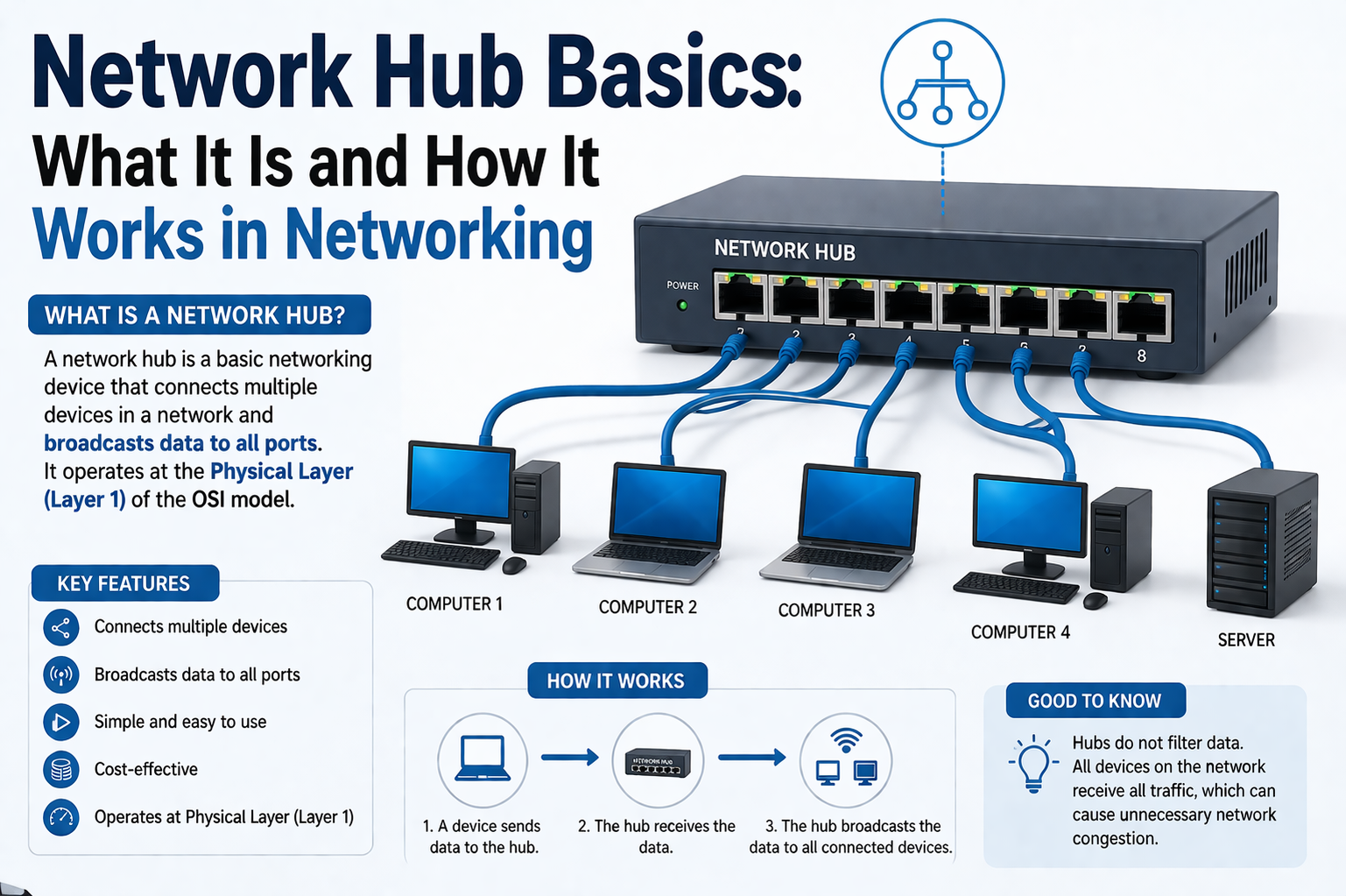
A computer network hub is one of the most basic devices used in networking, often described as a foundational component in early Ethernet environments. It operates at Layer 1 of the OSI Model, which means it deals purely with the physical transmission of data rather than interpreting or managing that data in any intelligent way. In simple terms, a hub receives electrical signals from one connected device and forwards those signals to every other device connected to it. This behavior makes it fundamentally different from more advanced devices like switches or routers. The hub does not analyze the data, does not check where it should go, and does not filter traffic; it simply repeats everything it receives. Because of this simplicity, hubs were widely used in early networking setups where cost and ease of deployment mattered more than performance or efficiency. Although they are rarely used in modern environments, understanding how they function remains important for grasping essential networking concepts that still apply today.
Role of Hubs in Early Networking Environments
In the early days of Ethernet networking, hubs played a central role in connecting multiple computers within a local area network. At a time when network speeds were relatively low and traffic demands were minimal, the simplicity of hubs made them a practical solution. Most hubs were associated with 10 Mbps Ethernet standards, particularly 10BASE-T, where devices were connected using twisted-pair cables and standard connectors. These hubs acted as a central connection point, allowing multiple devices to communicate over a shared medium. However, this shared communication method also introduced limitations. Since all devices connected to a hub shared the same bandwidth, only one device could effectively transmit data at a time. If multiple devices attempted to send data simultaneously, a collision would occur, forcing the devices to resend their data. While this might seem inefficient by today’s standards, it was an acceptable compromise in early networking environments where data loads were significantly lighter than they are now.
How Hubs Differ from Modern Networking Devices
One of the most important aspects of understanding hubs is recognizing what they do not do. Unlike switches, which operate at a higher layer of the OSI Model and can make decisions based on MAC addresses, hubs lack any form of intelligence. They do not maintain address tables, they do not direct traffic to specific destinations, and they do not isolate network segments. This means that every piece of data sent into a hub is broadcast to all connected devices, regardless of whether those devices are the intended recipients. This behavior creates a single shared communication environment known as a collision domain. In contrast, switches divide networks into multiple collision domains, allowing devices to communicate simultaneously without interference. This fundamental difference is one of the main reasons hubs have largely been replaced by switches in modern network design, as switches provide significantly better performance, efficiency, and scalability.
Understanding Collision Domains and Their Impact
A collision domain is a critical concept when discussing hubs because it directly affects network performance. In a hub-based network, all connected devices exist within the same collision domain, meaning that they compete for access to the shared communication medium. When two devices transmit data at the same time, their signals collide, resulting in corrupted data that must be retransmitted. This process not only wastes time but also reduces the overall efficiency of the network. As more devices are added to the hub, the likelihood of collisions increases, leading to congestion, delays, and reduced throughput. This limitation becomes particularly noticeable in environments with high data traffic, where frequent collisions can significantly degrade performance. Understanding collision domains helps explain why hubs are not suitable for modern high-speed networks, where efficiency and reliability are critical.
Half-Duplex Communication in Hubs
Another defining characteristic of network hubs is their reliance on half-duplex communication. In a half-duplex system, a device can either send or receive data at any given time, but it cannot do both simultaneously. This limitation is directly related to the shared communication medium used by hubs. Since all devices share the same bandwidth and collision domain, allowing simultaneous transmission and reception would increase the risk of collisions. As a result, hubs enforce a communication model where devices take turns transmitting data. While this approach simplifies the design of the network, it also reduces its overall efficiency compared to full-duplex systems, where devices can send and receive data at the same time. Modern switches support full-duplex communication, which is one of the reasons they offer significantly better performance than hubs.
Physical Connectivity and Signal Transmission
Hubs operate at the physical layer, which means they are primarily concerned with the transmission of electrical signals over network cables. In traditional Ethernet setups, devices were connected to hubs using twisted-pair cables with connectors such as RJ45. Each cable contained multiple wires or pins, each serving a specific purpose in transmitting or receiving data. For example, certain pins were designated for sending data, while others were used for receiving it. Hubs played a crucial role in managing these connections by effectively reversing the transmit and receive signals to ensure proper communication between devices. This process, while simple, was essential for maintaining connectivity in early networks. Over time, advancements in network interface technology introduced features that automatically handle these signal adjustments, reducing the need for manual configuration and specialized cables.
Transmission Behavior and Data Flow
The way a hub handles data transmission is straightforward but inefficient by modern standards. When a device sends data to the hub, the hub does not attempt to determine the destination of that data. Instead, it immediately forwards the data to all other connected ports. This means that every device on the network receives the data, even if it is not intended for them. Each device must then examine the data to determine whether it is the intended recipient. If not, the data is simply ignored. While this approach ensures that data reaches its destination, it also generates unnecessary traffic on the network, as every transmission is effectively broadcast to all devices. This inefficiency is one of the main reasons hubs have been replaced by switches, which can direct data only to the intended recipient, reducing network congestion and improving performance.
Signal Amplification and Active Hubs
Some hubs, known as active hubs, include the ability to amplify or regenerate signals as they pass through the device. This feature allows them to extend the distance over which data can be transmitted without significant signal degradation. In Ethernet networks, there is typically a maximum cable length beyond which the signal becomes too weak to be reliably detected. Active hubs help overcome this limitation by boosting the signal, effectively acting as repeaters. This capability was particularly useful in larger networks where devices needed to be connected over longer distances. However, even with signal amplification, the fundamental limitations of hubs—such as shared bandwidth and collision domains—remain unchanged. As a result, while active hubs can improve signal strength, they do not address the performance issues associated with hub-based networks.
Types of Network Hubs and Their Characteristics
Network hubs are generally categorized into different types based on their functionality. Passive hubs are the simplest form, as they do not amplify signals and simply forward incoming data to all ports. Active hubs, as mentioned earlier, include signal amplification capabilities, making them more suitable for larger or more complex networks. There are also devices sometimes referred to as intelligent hubs, which incorporate additional features such as basic monitoring or management capabilities. However, these devices often blur the line between hubs and more advanced networking equipment, as true hubs are defined by their lack of intelligence and inability to make decisions about data transmission. Understanding these distinctions helps clarify the role of hubs in networking and highlights the evolution of network devices over time.
Why Hubs Are Rare in Modern Networks
The decline of network hubs can be attributed to the rapid advancement of networking technology and the increasing demands placed on modern networks. As data traffic has grown and applications have become more bandwidth-intensive, the limitations of hubs have become more apparent. Issues such as frequent collisions, limited bandwidth, and half-duplex communication make hubs unsuitable for most contemporary use cases. In contrast, switches offer significant improvements in performance by creating separate collision domains for each port, supporting full-duplex communication, and intelligently directing traffic. Additionally, the cost of switches has decreased to the point where they are now an affordable and practical alternative to hubs. As a result, hubs have largely been phased out of modern network design, though they may still be encountered in legacy systems or educational contexts.
Educational Value of Learning About Hubs
Despite their limited use in modern networks, hubs remain an important topic for anyone studying networking. They provide a clear and simple example of how data is transmitted at the physical layer and help illustrate fundamental concepts such as collision domains, duplex communication, and signal transmission. By understanding how hubs operate, learners can gain a deeper appreciation for the advancements that have been made in networking technology and the reasons behind the design of modern devices. Additionally, knowledge of hubs is often required for certification exams and can be useful when working with older network equipment. While you may not encounter hubs frequently in real-world scenarios, the principles they demonstrate continue to be relevant in understanding how networks function as a whole.
Foundation for Understanding Advanced Networking Concepts
Studying hubs also lays the groundwork for understanding more advanced networking concepts. For example, the limitations of hubs highlight the importance of traffic management, segmentation, and efficient data handling in modern networks. These concepts are central to the design of switches, routers, and other networking devices that address the shortcomings of hubs. By comparing hubs to more advanced devices, learners can better understand the evolution of networking technology and the reasons behind current best practices. This foundational knowledge is essential for anyone pursuing a career in networking or IT, as it provides the context needed to understand how different components of a network interact and why certain technologies are preferred over others.
Continuing Exploration in Networking Fundamentals
As you continue exploring networking concepts, the role of hubs serves as a reminder of how far technology has progressed. While they may seem outdated, hubs represent an important step in the development of modern networks. Their simplicity makes them an excellent teaching tool, allowing learners to focus on the basics before moving on to more complex topics. By building a strong foundation in these fundamental concepts, you can develop a deeper understanding of networking as a whole and be better prepared to work with modern technologies.
Computer Network Hubs vs Modern Switching Technology
When comparing a computer network hub to modern networking devices, the most significant difference lies in how data is handled and delivered across the network. A hub functions as a simple signal repeater, while a switch operates with intelligence and awareness of connected devices. A switch works at Layer 2 of the OSI Model, which allows it to read hardware addresses and forward data only to the intended destination. In contrast, a hub continues to broadcast every incoming signal to all ports, regardless of necessity. This difference might seem subtle at first, but it has a profound impact on network performance, scalability, and reliability. In a network with multiple devices constantly sending and receiving data, the inefficiency of a hub becomes quickly apparent, especially when compared to the optimized communication provided by switches.
Impact of Broadcast Transmission on Network Efficiency
Broadcast transmission is a defining feature of hubs, and it directly affects how efficiently a network operates. Every time a device sends data through a hub, that data is copied and sent to all connected devices. Each device must then inspect the incoming data to determine whether it is the intended recipient. This process consumes processing resources and increases unnecessary traffic on the network. Over time, as more devices are added and more data is transmitted, the amount of redundant traffic grows significantly. This not only wastes bandwidth but also increases the likelihood of collisions and delays. In modern networking, reducing unnecessary traffic is a priority, which is why switches and routers are designed to deliver data only where it is needed. The broadcast nature of hubs, while simple, is ultimately inefficient and unsuitable for high-performance environments.
Detailed Examination of Collision Behavior
Collisions occur when two or more devices attempt to transmit data simultaneously over a shared communication medium. In a hub-based network, this shared medium is accessible to all connected devices, making collisions inevitable as network activity increases. When a collision occurs, the transmitted signals interfere with each other, resulting in corrupted data. The devices involved must then wait for a random period before attempting to retransmit their data. This process, while necessary, introduces delays and reduces overall network throughput. The mechanism used to handle collisions in Ethernet networks is known as Carrier Sense Multiple Access with Collision Detection. This protocol allows devices to detect when a collision has occurred and coordinate retransmissions. While effective in small networks, CSMA/CD becomes less efficient as the number of devices increases, further highlighting the limitations of hubs in larger environments.
Bandwidth Sharing and Its Limitations
In a hub-based network, all connected devices share the same bandwidth, which means that the total available data capacity is divided among all users. For example, in a 10 Mbps network, that bandwidth is not dedicated to each device but is instead shared collectively. If multiple devices are active at the same time, each device effectively receives a smaller portion of the available bandwidth. This can lead to slower data transfer speeds and reduced performance, particularly in networks with high traffic volumes. Unlike hubs, switches provide dedicated bandwidth to each port, allowing multiple devices to communicate simultaneously without interfering with each other. This fundamental difference makes switches far more efficient and capable of handling modern networking demands, where high-speed data transfer and low latency are essential.
Full-Duplex vs Half-Duplex Communication Revisited
The concept of duplex communication is central to understanding why hubs are less efficient than modern devices. As previously discussed, hubs operate in half-duplex mode, meaning that devices can either send or receive data at a given time, but not both simultaneously. This limitation is directly tied to the shared communication medium and the risk of collisions. In contrast, switches support full-duplex communication, allowing devices to send and receive data at the same time. This capability effectively doubles the potential data throughput and eliminates collisions within each port’s communication channel. Full-duplex communication is now standard in modern networks, enabling faster and more reliable data transmission. The inability of hubs to support this mode is another reason they have been largely replaced in contemporary network design.
Network Segmentation and Traffic Isolation
One of the key advantages of modern networking devices is their ability to segment networks and isolate traffic. Network segmentation involves dividing a network into smaller, more manageable sections, each with its own communication boundaries. This approach reduces congestion, improves performance, and enhances security. Hubs, however, do not support segmentation because they treat all connected devices as part of a single network segment. This lack of isolation means that all devices are exposed to the same traffic, increasing the risk of congestion and potential security concerns. Switches, on the other hand, create separate collision domains for each port, effectively isolating traffic and allowing multiple communications to occur simultaneously. This capability is essential in modern networks, where efficiency and security are critical considerations.
Evolution from Hubs to Switches in Network Design
The transition from hubs to switches represents a significant milestone in the evolution of networking technology. Early networks relied on hubs due to their simplicity and low cost, but as network demands grew, the need for more efficient solutions became apparent. Switches addressed many of the limitations of hubs by introducing intelligent data forwarding, dedicated bandwidth, and support for full-duplex communication. Over time, the cost of switches decreased, making them accessible for both small and large networks. This shift has led to the near-complete replacement of hubs in modern network infrastructures. Today, hubs are primarily encountered in educational settings or legacy systems, where they serve as a reminder of how networking technology has evolved.
Practical Scenarios Where Hubs May Still Appear
Although hubs are largely obsolete, there are still a few scenarios where they may be encountered. In some legacy networks, hubs may still be in use due to compatibility requirements or the cost of upgrading equipment. Additionally, hubs can be useful in certain troubleshooting situations where broadcasting all network traffic to multiple devices is beneficial. For example, a network administrator might use a hub to capture and analyze traffic using monitoring tools. However, even in these cases, more advanced solutions such as network taps or port mirroring on switches are generally preferred. These alternatives provide similar functionality with greater efficiency and without the drawbacks associated with hubs. As a result, the use of hubs in practical applications continues to decline.
Hardware Design and Simplicity of Hubs
The internal design of a network hub is relatively simple compared to other networking devices. Because hubs operate at the physical layer, they do not require complex processing capabilities or memory to store address tables. Instead, they consist primarily of circuitry that receives incoming signals and replicates them across all output ports. This simplicity contributes to their low cost and ease of use but also limits their functionality. Without the ability to process or analyze data, hubs cannot optimize network traffic or improve performance. This trade-off between simplicity and efficiency is a key factor in understanding why hubs were once popular but are no longer suitable for modern networking needs.
Security Implications of Using Hubs
From a security perspective, hubs present several challenges due to their broadcast nature. Since all data transmitted through a hub is sent to every connected device, it is possible for any device on the network to capture and analyze that data. This lack of traffic isolation makes hubs inherently less secure than switches, which limit data transmission to specific destinations. In environments where sensitive information is transmitted, this vulnerability can pose a significant risk. Modern networks prioritize security and data privacy, which is another reason why hubs have been replaced by more advanced devices. While hubs may still be useful for certain controlled scenarios, their security limitations make them unsuitable for most production environments.
Performance Degradation in High-Traffic Networks
As network traffic increases, the performance limitations of hubs become more pronounced. The combination of shared bandwidth, frequent collisions, and half-duplex communication leads to significant inefficiencies. In high-traffic environments, these issues can result in noticeable delays, reduced throughput, and an overall decline in network performance. Devices may experience slower response times, and applications that rely on real-time data transmission may be adversely affected. In contrast, modern networking devices are designed to handle high volumes of traffic efficiently, using advanced techniques to manage data flow and minimize congestion. The inability of hubs to scale effectively in such environments further underscores their obsolescence in contemporary network design.
Understanding Legacy Technology in Modern Context
Even though hubs are no longer widely used, they remain an important part of networking history and education. Studying hubs provides valuable insights into the challenges faced by early network designers and the solutions that were developed to overcome those challenges. By understanding the limitations of hubs, learners can better appreciate the features and capabilities of modern networking devices. This knowledge is particularly useful when troubleshooting legacy systems or preparing for certification exams, where an understanding of foundational concepts is essential. Hubs may no longer be a common sight in modern networks, but their influence can still be seen in the principles that underpin today’s networking technologies.
Core Functions of a Computer Network Hub
A computer network hub performs a very limited yet fundamental set of operations that revolve around signal handling and data repetition. Unlike advanced networking devices that analyze, filter, or route traffic, a hub focuses entirely on receiving incoming data signals and retransmitting them across all its available ports. This simplicity defines its role in a network and explains both its usefulness in early networking environments and its limitations in modern ones. The hub does not interpret frames, check addresses, or make forwarding decisions; instead, it acts as a central electrical connection point that ensures all connected devices receive the same signal. Because of this behavior, hubs are often described as multiport repeaters, emphasizing their function of duplicating and forwarding signals without modification or intelligence.
Receiving Data from Connected Devices
The first primary function of a hub is to receive data from any device connected to it. When a computer or other network-enabled device sends data, that data is transmitted as electrical signals through a network cable to the hub. The hub detects these incoming signals on one of its ports and prepares to distribute them to the rest of the network. At this stage, the hub does not evaluate the content or destination of the data. It does not check for errors, verify addresses, or determine whether the data should be forwarded. Its role is purely reactive, responding to the presence of a signal rather than analyzing it. This characteristic highlights the hub’s operation at the physical layer of the OSI Model, where the focus is on signal transmission rather than data processing.
Transmitting Data to All Ports
Once a hub receives a signal, its next function is to transmit that signal to all other connected ports. This means that every device connected to the hub receives the same data simultaneously. The hub does not attempt to identify the intended recipient or restrict the flow of information. Instead, it broadcasts the signal indiscriminately, ensuring that all devices have access to the transmitted data. Each device then determines whether the data is relevant by examining its addressing information. If the data is not intended for a particular device, it is simply ignored. While this approach guarantees delivery, it also leads to inefficiencies, as multiple devices process data that is not meant for them. This broadcast mechanism is a defining feature of hubs and a key reason why they are considered outdated in modern networking.
Understanding Transmit and Receive Concepts
In networking, the terms transmit (Tx) and receive (Rx) are commonly used to describe the flow of data between devices. These concepts are especially important when discussing hubs, as they help explain how signals move through the network. When a device transmits data, it sends signals through specific wires within a network cable. Conversely, when it receives data, it listens for signals on different wires. Hubs play a crucial role in managing these connections by effectively reversing the transmit and receive paths to ensure proper communication between devices. This process allows devices to exchange data even though they use separate channels for sending and receiving signals. Understanding Tx and Rx is essential for grasping how early Ethernet networks functioned and how hubs facilitated communication between connected devices.
Pin Configuration and Signal Direction
In traditional Ethernet networks, cables and connectors were designed with specific pin configurations to handle data transmission and reception. For example, in 10BASE-T networks, certain pins were designated for transmitting data, while others were used for receiving it. Hubs were designed to accommodate these configurations by internally swapping the transmit and receive signals. This ensured that data sent from one device could be correctly received by another. The need for proper pin alignment sometimes required the use of crossover cables, which manually swapped the transmit and receive wires. This added complexity to network setup and troubleshooting, as technicians needed to understand cable types and configurations. Over time, advancements in network interface technology introduced automatic detection and adjustment of these connections, reducing the reliance on manual cable selection.
Half-Duplex Operation and Its Implications
Hubs operate exclusively in half-duplex mode, which means that data transmission and reception cannot occur simultaneously on the same connection. This limitation is a direct result of the shared communication medium and the risk of signal collisions. In a half-duplex environment, devices must take turns transmitting data, waiting for the medium to be clear before sending their signals. While this approach prevents simultaneous transmissions from interfering with each other, it also reduces the overall efficiency of the network. Devices spend time waiting for access to the medium, leading to delays and reduced throughput. This limitation becomes more pronounced as the number of connected devices increases, making hubs less suitable for environments with high data traffic. Modern networking devices overcome this limitation by supporting full-duplex communication, allowing simultaneous transmission and reception.
Signal Amplification and Regeneration
Some hubs, known as active hubs, include the capability to amplify or regenerate signals as they pass through the device. This function is particularly useful in extending the reach of a network, as signals can weaken over long distances due to attenuation. By boosting the strength of incoming signals, active hubs help maintain data integrity and ensure reliable communication between devices. This capability is similar to that of a repeater, which is another type of physical layer device used to extend network distances. While signal amplification can improve connectivity, it does not address the fundamental limitations of hubs, such as shared bandwidth and collision domains. As a result, even active hubs are limited in their ability to support modern networking requirements.
Role of Passive Hubs in Signal Distribution
Passive hubs represent the simplest form of hub technology, as they do not include any signal amplification or regeneration capabilities. Instead, they rely entirely on the strength of the incoming signal to distribute data across the network. Passive hubs merely connect multiple devices and allow signals to pass through without modification. While this simplicity reduces cost and power requirements, it also limits the effective range and reliability of the network. Signals may degrade over distance, leading to potential communication issues. Passive hubs are rarely used in modern networks, as active devices provide better performance and reliability. However, they serve as an important example of early networking design, যেখানে simplicity was prioritized over advanced functionality.
Intelligent Hubs and Their Misconceptions
The term intelligent hub is sometimes used to describe devices that offer additional features beyond basic signal repetition. These features may include monitoring capabilities, basic management functions, or limited switching behavior. However, many devices labeled as intelligent hubs are למעשה closer to switches or hybrid devices rather than true hubs. A true hub, by definition, lacks the ability to make decisions about data transmission. The introduction of additional features blurs this distinction and can lead to confusion about the role of hubs in networking. Understanding this distinction is important for accurately identifying and categorizing network devices. While intelligent hubs may offer some advantages over basic hubs, they still fall short of the capabilities provided by modern switches and routers.
Use of Hubs in Network Testing and Analysis
Despite their limitations, hubs can still be useful in certain specialized scenarios, particularly in network testing and analysis. Because hubs broadcast all traffic to every connected device, they allow network administrators to capture and analyze data from multiple sources simultaneously. This can be useful for troubleshooting issues, monitoring network activity, or studying traffic patterns. Tools designed for packet analysis can take advantage of this behavior to provide insights into network performance and security. However, this same characteristic also introduces security concerns, as sensitive data can be intercepted by any connected device. In modern environments, alternative solutions such as network taps or port mirroring are often preferred, as they provide similar functionality with greater control and security.
Limitations in Supporting Modern Network Speeds
Hubs were designed for early Ethernet standards and are not capable of supporting the high-speed connections commonly used today. Most hubs operate at relatively low data rates, such as 10 Mbps, which is insufficient for modern applications that require high bandwidth and low latency. Additionally, the shared bandwidth model and collision-prone environment further limit their performance. As network technology has advanced, the demand for faster and more reliable connections has led to the widespread adoption of switches and other advanced devices. These devices are capable of supporting gigabit and even multi-gigabit speeds, making them far more suitable for contemporary networking needs. The inability of hubs to keep pace with these advancements has contributed to their decline in usage.
Practical Considerations When Using a Hub
When working with a network hub, there are several practical considerations to keep in mind. Proper cabling is essential to ensure reliable connectivity, as incorrect cable types or configurations can lead to communication issues. Power requirements must also be considered, particularly for active hubs that require an external power source. Additionally, the limitations of half-duplex communication and shared bandwidth should be taken into account when designing or troubleshooting a network. While hubs can still be used in certain scenarios, their constraints make them unsuitable for most modern applications. Understanding these practical aspects helps ensure that hubs are used effectively and appropriately כאשר they are encountered in real-world situations.
Setting Up a Computer Network Hub in Practical Environments
Setting up a computer network hub is generally straightforward because the device does not require configuration or software-based management. Unlike switches or routers, which often include administrative interfaces and customizable settings, a hub operates immediately once it is powered on and connected. The first step in the setup process involves supplying power to the hub, especially in the case of active hubs that rely on electrical amplification to strengthen signals. Once powered, network devices such as computers, printers, or servers are connected to the hub using Ethernet cables. Most commonly, these cables use RJ45 connectors, which are standard in wired networking. After connecting devices, the hub begins functioning instantly, allowing all connected systems to communicate through the shared medium. This plug-and-play nature made hubs highly attractive in early networking environments where simplicity and speed of deployment were priorities.
Understanding the Role of Uplink Ports in Hubs
Some network hubs include a specialized port known as an uplink port, which is designed to connect one hub to another or to integrate the hub into a larger network. The uplink port often features internal wiring that compensates for the transmit and receive signal differences between devices, eliminating the need for a crossover cable. This was particularly useful in older networking setups where connecting similar devices required careful attention to cable types. By using the uplink port, technicians could extend the network by linking multiple hubs together, effectively increasing the number of available connections. However, this approach also expanded the collision domain, further increasing the likelihood of network congestion and performance issues. While uplink ports were a practical solution at the time, modern networking devices have largely eliminated the need for such features through automatic configuration and more advanced communication methods.
Checking Connectivity and Diagnostic Indicators
After connecting devices to a hub, verifying connectivity is an essential step to ensure that the network is functioning properly. Many hubs include basic diagnostic indicators, typically in the form of LED lights, which provide visual feedback about the status of the device. These indicators may show whether the hub is receiving power, whether individual ports are active, and whether data is being transmitted or received. Some hubs also include indicators for collisions, which can help identify network congestion issues. By observing these lights, technicians can quickly determine whether there are problems with connections, cables, or devices. Although these diagnostic features are limited compared to modern networking equipment, they provide a simple and effective way to monitor the basic operation of a hub.
Troubleshooting Power-Related Issues
One of the most common issues encountered with network hubs is a lack of power. If a hub does not turn on, the problem is often related to the power supply rather than the device itself. Troubleshooting this issue involves checking the power source, ensuring that the hub is properly connected to an outlet, and verifying that the power cable is functioning correctly. In some cases, replacing the power cable or using a different outlet can resolve the issue. Active hubs, which rely on electrical amplification, are particularly dependent on a stable power supply. Without power, the hub cannot perform its basic function of signal repetition, effectively rendering the network inoperable. Addressing power-related issues is typically the first step in diagnosing problems with a hub.
Resolving Connectivity Problems in Hub-Based Networks
When a hub is powered on but connected devices are unable to communicate, the issue may lie in the network configuration or physical connections. Troubleshooting begins with checking all cables to ensure they are securely connected and undamaged. Incorrect cable types, such as using a straight-through cable where a crossover cable is required, can also cause connectivity problems. Additionally, devices must be configured with compatible network settings, including appropriate IP addresses and subnet configurations. Another factor to consider is compatibility with the hub’s supported speed and duplex mode. Since hubs typically operate at lower speeds and in half-duplex mode, devices configured for higher speeds or full-duplex communication may experience issues. By systematically checking these factors, most connectivity problems can be identified and resolved.
Identifying and Addressing Performance Issues
Performance problems are common in networks that rely on hubs, particularly as the number of connected devices increases. Symptoms such as slow data transfer, high latency, and intermittent connectivity often indicate issues related to collisions and shared bandwidth. Because all devices on a hub share the same communication medium, heavy network activity can lead to frequent collisions, which in turn require data retransmission. This cycle reduces overall efficiency and can significantly impact user experience. One of the most effective ways to address these issues is to replace the hub with a switch, which can eliminate collisions by creating separate communication channels for each device. While temporary measures such as reducing network load may provide some relief, upgrading to modern equipment is typically the best long-term solution.
Design Limitations and the 5-4-3 Rule
In early Ethernet network design, guidelines such as the 5-4-3 rule were used to manage the limitations of hub-based networks. This rule specified that a network could include up to five segments connected by four repeaters, with only three segments containing active devices. The purpose of this guideline was to minimize signal degradation and reduce the likelihood of collisions across the network. While such design considerations were important in the past, they are largely irrelevant in modern networking environments, where advanced devices handle signal integrity and traffic management more effectively. Understanding these historical design principles provides valuable context for the challenges faced by early network engineers and highlights the progress made in network technology.
Modern Alternatives to Network Hubs
As networking technology has evolved, several alternatives to hubs have emerged, offering improved performance, efficiency, and security. Switches are the most common replacement, providing intelligent data forwarding and dedicated bandwidth for each connected device. Other alternatives include network taps and port mirroring, which allow for traffic monitoring without the drawbacks of broadcast transmission. These solutions are particularly useful in environments where network analysis and security are important. By directing traffic only where it is needed, modern devices reduce congestion and improve overall network performance. The widespread availability and affordability of these alternatives have contributed to the decline of hubs in both residential and enterprise networks.
Security Considerations in Hub-Based Networks
The broadcast nature of hubs introduces significant security concerns, as all data transmitted through the hub is accessible to every connected device. This means that sensitive information can potentially be intercepted by unauthorized users, making hubs unsuitable for environments where data privacy is critical. In contrast, modern networking devices limit data transmission to specific destinations, reducing the risk of unauthorized access. Additional security features such as encryption, access control, and network segmentation further enhance the protection of sensitive data. While hubs may still be used in controlled or isolated environments, their lack of security makes them a poor choice for most real-world applications.
Legacy Use Cases and Niche Applications
Despite their limitations, hubs have not disappeared entirely and can still be found in certain niche applications. In some cases, older systems may rely on hubs due to compatibility requirements or the absence of modern infrastructure. Hubs may also be used in specific testing scenarios where broadcasting traffic to multiple devices is desirable. For example, network administrators may use a hub to capture and analyze traffic using tools like Wireshark. However, even in these situations, more advanced solutions are often preferred due to their efficiency and security advantages. The continued presence of hubs in these limited contexts highlights their historical significance while reinforcing their obsolescence in modern networking.
Comprehensive Troubleshooting Approach for Hub Networks
A structured approach to troubleshooting is essential when dealing with hub-based networks. This involves systematically examining each component of the network, from power and cabling to device configuration and network design. Observing diagnostic indicators, testing individual connections, and verifying compatibility between devices can help identify the root cause of issues. In many cases, replacing the hub with a more advanced device may be the most effective solution, particularly when dealing with performance or security concerns. By understanding the limitations of hubs and applying methodical troubleshooting techniques, network professionals can effectively manage and resolve issues in legacy environments.
Conclusion
Computer network hubs represent an important stage in the evolution of networking technology, providing a simple and accessible means of connecting devices in early Ethernet environments. Their operation at Layer 1 of the OSI Model highlights their focus on physical signal transmission rather than data processing or management. While their simplicity made them practical in the past, limitations such as shared bandwidth, collision domains, and half-duplex communication have rendered them largely obsolete in modern networks. Today, switches and other advanced devices offer superior performance, efficiency, and security, addressing the shortcomings of hubs and enabling the high-speed, reliable communication required by contemporary applications. Despite their decline, hubs remain a valuable educational tool, helping to illustrate fundamental networking concepts and providing insight into the development of modern network infrastructure.