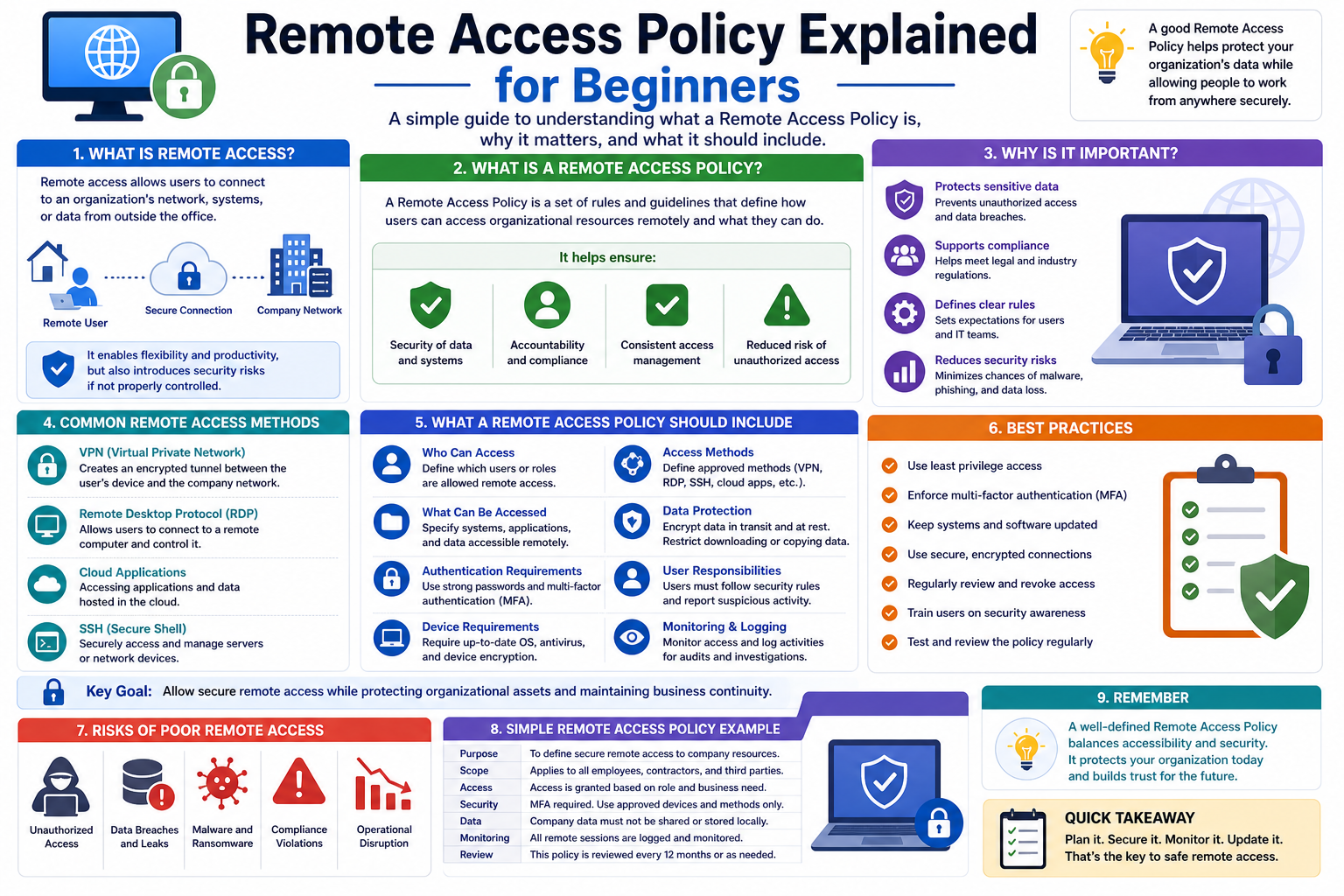
A Remote Access Policy is a formal set of rules and guidelines that defines how users can securely connect to an organization’s internal systems from outside the physical workplace. It explains who is allowed to access the network remotely, what methods they must use, what security requirements must be followed, and which resources they can access once connected. The purpose of this policy is to ensure that remote connections do not create security weaknesses that attackers can exploit. It acts as a control mechanism that balances convenience for remote users with strict protection of sensitive systems and data. In modern organizations where employees, contractors, and external partners often work from different locations, this policy becomes a core part of cybersecurity governance.
Understanding the Purpose of Remote Connectivity
Remote connectivity allows users to access organizational systems from outside locations such as homes, airports, branch offices, or while traveling. This capability is essential for productivity and flexibility, especially in environments where distributed workforces are common. However, remote access also introduces risk because it extends the network boundary beyond physical office security controls. A Remote Access Policy exists to manage this expansion safely. It ensures that only verified users can connect and that their access is restricted based on their role. Without such structured control, organizations could face unauthorized entry, data leaks, and system disruptions caused by weak or unmanaged remote connections.
Importance of Securing Remote Access Environments
Securing remote access is critical because external connections are frequent targets for cyber threats. Attackers often attempt to exploit weak passwords, unsecured devices, or exposed network services. A Remote Access Policy helps reduce these risks by enforcing strict authentication rules and secure communication methods. It also ensures that users follow consistent security practices when connecting to internal systems. As organizations increasingly rely on cloud services and distributed work models, the importance of maintaining strong remote access controls continues to grow. Proper security prevents unauthorized users from gaining access to confidential data, financial records, internal communications, and operational systems.
Common Remote Access Methods in Use
Organizations typically use several methods to allow remote connections, each designed for specific use cases and security requirements. These methods define how users interact with internal systems from external networks. The most widely used approaches include secure encrypted tunnels, remote system control interfaces, and command-based secure connections. Each method provides a different balance between usability and security. A Remote Access Policy determines which method is suitable for different user roles, ensuring that employees, administrators, and external users only use approved tools when connecting remotely. This structured selection helps maintain consistency and reduces security gaps across the network.
Secure Virtual Private Network Connections
One of the most common methods for remote access is a secure encrypted tunnel that allows users to connect to the internal network through the internet. This method ensures that all transmitted data is protected using encryption, preventing unauthorized interception. Users authenticate themselves before gaining access, and once connected, they can securely access internal applications and resources as if they were on-site. A Remote Access Policy often requires this method for general employees because it provides a controlled and secure gateway into the organization’s environment. It also helps ensure that all remote traffic is monitored and protected through standardized security protocols.
Remote Desktop Access for System Control
Remote desktop technology allows users to access and control a computer or server located within the organization from a remote location. This method provides a graphical interface, making it feel as though the user is directly operating the system in the office. It is commonly used by system administrators and technical support teams to troubleshoot issues, configure servers, or manage infrastructure. However, because this method grants deep access to systems, it requires strict security controls. A Remote Access Policy typically limits its use to authorized personnel and enforces strong authentication and encrypted connections to reduce the risk of unauthorized system control.
Secure Command-Based Remote Connections
Another widely used method is command-based secure access, which allows administrators to connect to systems through a text-based interface. This approach is commonly used for managing servers, configuring network devices, and performing technical maintenance tasks. It is highly efficient and widely used in system administration environments. Security is enforced through encryption and key-based authentication methods rather than simple passwords. A Remote Access Policy ensures that only trained and authorized individuals can use this method, as it provides powerful control over system operations. Proper configuration and strict access rules are essential to prevent misuse or unauthorized activity.
Risks Associated with Remote Access Systems
Remote access systems introduce several security risks if not properly managed. One of the most common issues is weak authentication practices, such as simple passwords or shared credentials. These can be easily exploited by attackers using automated tools or guessing techniques. Another risk is exposed remote access services that are directly accessible from the internet without proper protection. Attackers often target these entry points to gain unauthorized access to internal networks. Additionally, insecure devices used by remote workers can become a vulnerability if they are not properly updated or protected. A Remote Access Policy helps mitigate these risks by enforcing strict security standards and access controls.
Role of Authentication and User Verification
Authentication is a critical component of remote access security because it verifies the identity of users before granting access to systems. A strong Remote Access Policy defines how users must prove their identity, often requiring more than just a password. Multi-layer verification methods add extra security by combining something the user knows with something they possess or something unique about them. This reduces the likelihood of unauthorized access even if credentials are compromised. Proper authentication ensures that only legitimate users can enter the network, forming the first line of defense against cyber threats targeting remote access systems.
Access Control and Permission Management
Access control ensures that users can only access the resources necessary for their specific job roles. This principle is often referred to as least privilege access, meaning users are not given unnecessary permissions. A Remote Access Policy defines how permissions are assigned, reviewed, and updated over time. It also ensures that access is revoked when it is no longer needed, such as when employees change roles or leave the organization. Proper access control reduces the potential damage that could occur if an account is compromised. It also helps maintain order within the system by clearly defining who can access what resources.
Monitoring and Security Logging Practices
Monitoring and logging are essential parts of maintaining a secure remote access environment. Every login attempt, successful connection, and system interaction can be recorded for analysis. This allows administrators to detect unusual activity, such as repeated failed login attempts or access from unknown locations. A Remote Access Policy defines what information must be logged and how long it should be stored for security review. These records are valuable for investigating security incidents and identifying potential vulnerabilities. Continuous monitoring also helps ensure that users comply with established access rules and that no unauthorized activity goes unnoticed within the network environment.
Strengthening Remote Access Through Security Controls
A strong Remote Access Policy includes multiple layers of security controls designed to protect systems from external threats. These controls include encrypted communication channels, strict authentication requirements, controlled access permissions, and secure configuration of all remote tools. Devices used for remote access must also meet security standards, including updated software and protection against malware. The policy ensures that all remote connections are properly configured and continuously reviewed for potential weaknesses. By combining these security measures, organizations can significantly reduce the risk of unauthorized access while still enabling flexible and efficient remote working environments.
Conclusion
A Remote Access Policy plays a vital role in maintaining the security, stability, and controlled usability of modern organizational networks. As remote work and distributed operations continue to expand, the need to manage external connections securely becomes even more important. This policy ensures that only authorized users can access internal systems, and that they do so through secure, monitored, and well-defined methods. It also reduces the risk of cyberattacks by enforcing strong authentication, limiting user permissions, and requiring encrypted communication channels.
Beyond access control, the policy supports overall cybersecurity by establishing clear rules for system configuration, user behavior, and ongoing monitoring. It helps organizations detect suspicious activity early, respond to potential threats effectively, and maintain accountability across all remote sessions. When properly implemented, it strengthens the entire IT environment by reducing vulnerabilities that attackers often exploit.
In essence, a well-structured Remote Access Policy is not just a technical guideline but a fundamental security framework. It ensures that flexibility in remote working does not compromise the integrity of systems or the confidentiality of sensitive data.