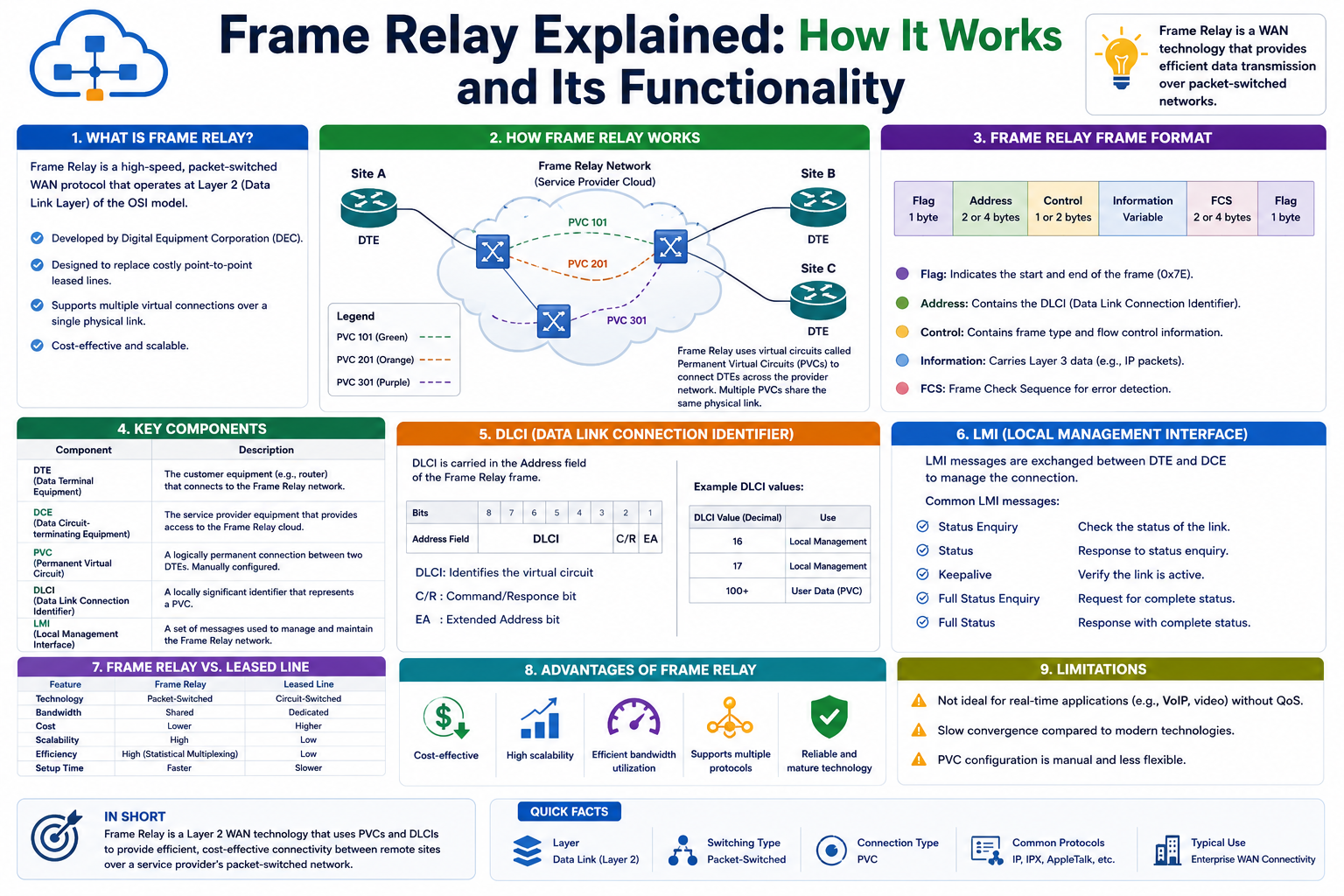
Frame relay is a packet-switching communication technology designed to transmit data efficiently across wide area networks by dividing information into manageable units and sending them through shared network paths. It was widely adopted for connecting geographically separated local networks because it offered a more economical and flexible alternative to traditional leased line connections. Although newer networking technologies have largely replaced it, frame relay remains an important concept for understanding the evolution of WAN communication and for working with older or legacy network environments.
What Frame Relay Means in Data Communication
At its core, frame relay is built around the idea of sending data in structured units called frames. These frames carry both the actual user data and the necessary control information required for delivery across a network. Unlike older dedicated circuit systems that reserve a full communication path for each connection, frame relay uses shared infrastructure, allowing multiple data streams to coexist efficiently over the same physical network. This approach significantly reduces cost while improving scalability.
Understanding the Frame Structure in Networking
In networking, a frame represents the data unit used at the data link layer of the OSI model. This layer is responsible for ensuring that data is properly packaged, addressed, and transmitted between directly connected devices. A frame includes a header containing addressing and control information, the payload which carries the actual data, and a trailer that helps verify data integrity. This structure ensures that information is delivered accurately and can be properly interpreted by the receiving device.
Relationship Between OSI Layers and Frames
To understand frame relay clearly, it is important to place it within the OSI model. Different layers of the model handle different data formats. The transport layer manages segments, the network layer handles packets, the data link layer processes frames, and the physical layer transmits bits. Frame relay operates at the data link layer, meaning it focuses on reliable transfer between network devices rather than end-to-end routing decisions. This makes it efficient for handling communication within WAN environments.
What Frame Relay Actually Does in a Network
Frame relay is designed to carry data between different networks, often across long distances. It takes data from a source device, breaks it into frames, and sends those frames through a network of switches. These switches forward the frames based on addressing information until they reach their destination. Instead of dedicating a single path for communication, frame relay dynamically shares available bandwidth among multiple users, making better use of network resources.
Virtual Circuits and Their Role in Frame Relay
One of the key concepts in frame relay is the use of virtual circuits. A virtual circuit is a logical connection between two endpoints that behaves like a dedicated link, even though the underlying physical infrastructure is shared. This means devices communicate as if they are directly connected, even when they are separated by large distances and multiple network devices. Virtual circuits allow frame relay to maintain simplicity in communication while still using shared resources efficiently.
Permanent and Switched Virtual Circuits Explained
Frame relay supports two main types of virtual circuits. Permanent virtual circuits remain continuously active and are typically used for regular, stable communication between two endpoints. These connections are preconfigured and always available, making them reliable for ongoing data transfer. Switched virtual circuits, on the other hand, are temporary connections established only when needed. They are created dynamically for a session and then terminated once communication ends. This flexibility allows networks to manage resources more efficiently depending on demand.
Role of Data Link Connection Identifiers
In frame relay networks, each virtual circuit is identified using a unique label known as a Data Link Connection Identifier. This identifier helps network devices determine where each frame should be sent. Instead of relying on full physical addresses at every step, devices use these identifiers to quickly forward data through the correct path. This simplifies routing within the frame relay network and reduces processing overhead, allowing faster communication between endpoints.
How Frame Relay Transmits Data Across Networks
When data is sent using frame relay, the source device first encapsulates the information into frames. These frames are then assigned identifiers that indicate their virtual circuit path. As they move through the network, frame relay switches examine these identifiers and forward the frames accordingly. Each switch does not need to know the full route; it only needs to know where to send the frame next. This hop-by-hop forwarding continues until the frame reaches its destination.
Efficiency Advantages of Frame Relay Technology
One of the major strengths of frame relay is its efficiency. By allowing multiple virtual circuits to share the same physical infrastructure, it eliminates the need for dedicated lines between every location. This reduces operational costs and increases scalability. Additionally, because frame relay avoids complex error correction at every hop, it can transmit data faster than many older technologies. It is designed to assume relatively reliable network conditions, shifting complexity to endpoint devices.
Why Frame Relay Became Popular in WAN Networks
Frame relay gained popularity because it provided a balance between cost, performance, and simplicity. Organizations with multiple branch locations needed a way to connect all their sites without maintaining expensive point-to-point leased lines. Frame relay allowed them to build a flexible network where communication paths could be shared and adjusted as needed. This made it particularly attractive for businesses expanding across different regions.
Limitations of Frame Relay in Modern Networking
Despite its advantages, frame relay has limitations that led to its decline. It does not include advanced error correction or congestion control mechanisms, which can affect performance in unreliable networks. It also lacks the flexibility and speed of modern technologies such as Ethernet-based WAN solutions and multiprotocol label switching. As internet-based networking evolved, more efficient and scalable alternatives gradually replaced frame relay in most environments.
Legacy Importance of Frame Relay Systems
Even though frame relay is no longer widely used in modern infrastructure, it still holds importance in legacy systems. Many older enterprise networks and industrial environments continue to rely on it for specific operations. Understanding how it works is essential for network professionals who may need to maintain or transition these systems. It also provides foundational knowledge that helps in learning more advanced networking concepts.
How Frame Relay Simplifies Network Communication
Frame relay simplifies communication by reducing the need for complex routing decisions at every intermediate point. Each switch only needs to understand local mapping between identifiers rather than maintaining a full map of the entire network. This reduces processing overhead and allows faster data forwarding. The simplicity of its design is one of the reasons it was widely adopted in earlier networking architectures.
Concept of Shared Network Bandwidth in Frame Relay
Instead of dedicating fixed bandwidth to each connection, frame relay allows multiple virtual circuits to share available bandwidth dynamically. This means network resources are used more efficiently, especially in environments where traffic fluctuates. When one connection is idle, its unused capacity can be utilized by other active connections, improving overall network utilization.
Understanding the Logical Path of Data Flow
In a frame relay network, data does not travel through a fixed physical path. Instead, it follows a logical route defined by virtual circuits. This means two devices may appear directly connected from a communication standpoint, even though their data passes through multiple intermediate devices. This abstraction simplifies network design and improves flexibility in managing connections.
Practical Importance of Frame Relay Concepts Today
Although modern networks rarely use frame relay directly, its concepts are still relevant. Ideas such as packet switching, virtual circuits, and shared bandwidth are foundational to many current technologies. Learning frame relay helps build a strong understanding of how data moves across networks, making it easier to grasp more advanced systems like MPLS and SD-WAN.
Frame Relay Operation
Frame relay works by dividing data into frames, assigning them identifiers, and transmitting them through shared network infrastructure using virtual circuits. It reduces the need for dedicated communication paths while maintaining logical connections between endpoints. By relying on efficient switching and simplified routing, it enabled cost-effective wide area networking and played a significant role in the development of modern communication systems.
Conclusion
Frame relay represents an important stage in the evolution of wide area networking, where the focus shifted from rigid, dedicated connections to more flexible and efficient shared communication systems. By using packet-based transmission and virtual circuits, it allowed organizations to connect multiple remote locations without the high cost and complexity of traditional leased lines. Its use of Data Link Connection Identifiers and logical pathways made data transfer more streamlined while still maintaining structured communication between endpoints.
Although it has largely been replaced by faster and more advanced technologies, the core principles behind frame relay continue to influence modern networking designs. Concepts such as virtual circuits, shared bandwidth utilization, and packet switching remain fundamental to current WAN solutions. Understanding how frame relay works not only provides insight into older network infrastructures but also strengthens foundational knowledge that applies to today’s networking environments.