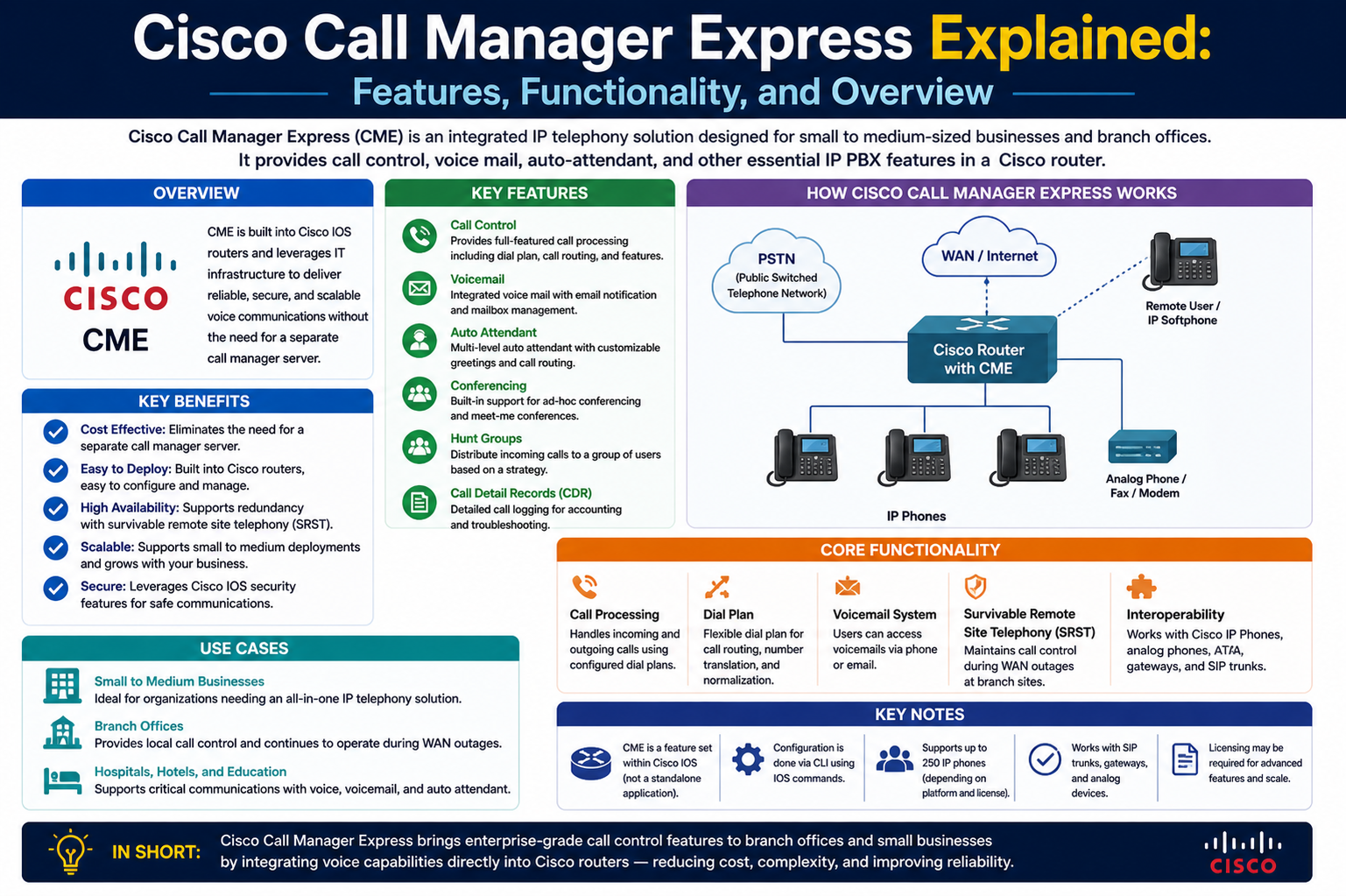
Cisco Call Manager Express is a compact call processing solution designed for organizations that require reliable voice communication at individual branch locations without deploying a full-scale centralized telephony system. It is intended to simplify voice infrastructure by embedding call control capabilities directly into Cisco networking devices, allowing businesses to manage telephony services locally within a branch environment. This approach removes the dependency on large centralized communication platforms and provides a more self-contained model for handling voice traffic.
The solution is widely used in distributed network environments where each location operates with a degree of independence. Instead of relying on a central data center to handle every call-related function, each branch can manage its own voice services. This structure makes it suitable for businesses that prioritize resilience, simplicity, and operational autonomy at remote sites.
Core Concept of Call Manager Express
Call Manager Express operates on the principle of localized call control. Rather than functioning as a standalone server application, it is integrated into Cisco routers that already manage network traffic. These routers are enhanced with voice processing capabilities, allowing them to perform call routing, device registration, and telephony feature management within the same hardware platform.
This integration means that voice services and data routing coexist on the same device. The router becomes the central point for both network connectivity and telephony operations within a branch office. This reduces infrastructure complexity and allows organizations to deploy voice services without introducing additional dedicated servers or external management systems.
Embedded Architecture within Network Devices
The architecture of Call Manager Express is built around Cisco Integrated Services Routers that support voice functionality. These routers are responsible for handling both IP traffic and voice communication, effectively merging two traditionally separate roles into a single device. Within this architecture, the call processing engine runs as embedded software inside the router itself.
This design eliminates the need for external call processing servers at each location. IP phones within the local network connect directly to the router, which acts as the registration point for all endpoints. Once registered, these devices can communicate internally or reach external networks through configured gateways.
Local Call Processing Model
One of the defining characteristics of Call Manager Express is its ability to process calls locally. When a user initiates a call, the router evaluates the dial plan, determines the routing path, and establishes the connection without involving external systems unless required. This local processing significantly reduces latency and improves call reliability within branch environments.
Because call decisions are made at the edge of the network, branches can continue operating independently even if connectivity to a central site is interrupted. This ensures that internal communication remains functional under various network conditions, which is particularly important for remote or mission-critical locations.
Role of Dial Plan Management
Dial plan management is a key function within Call Manager Express. It defines how numbers are interpreted, translated, and routed within the system. Administrators configure rules that determine how internal extensions are mapped and how external calls are handled through available voice gateways.
This structure allows organizations to create consistent numbering schemes across different branches while still maintaining local control. Each branch can have its own dial plan tailored to its operational needs, ensuring flexibility while preserving a standardized communication framework within the organization.
Device Registration and Endpoint Control
Call Manager Express manages IP phones by allowing them to register directly with the router. Once connected to the local network, these devices communicate with the embedded call processing system to obtain configuration details and extension assignments. This registration process is essential for enabling communication between endpoints.
After registration, the system maintains control over call behavior for each device. Features such as call hold, transfer, forwarding, and conferencing are managed locally. This ensures that users within a branch have access to essential communication tools without relying on external infrastructure.
Integration with External Telephony Networks
Although Call Manager Express operates primarily within local environments, it is capable of connecting to external telephony systems. This is achieved through integration with voice gateways that connect to traditional telephone networks or modern IP-based voice services. These gateways allow calls to be routed between internal users and external parties.
This integration ensures that while communication is locally managed, external connectivity is still fully supported. Businesses can maintain contact with clients, partners, and other branches without requiring a centralized call processing system to handle every interaction.
Operational Independence of Branch Locations
A major advantage of Call Manager Express is the independence it provides to individual branch locations. Each site operates its own call processing environment, meaning that telephony services do not depend on continuous communication with a central headquarters. This independence reduces the risk of widespread communication failure due to network issues.
In environments where network stability may vary, this design ensures that local communication remains unaffected. Employees within a branch can continue making and receiving calls even if external connectivity is disrupted, which enhances overall business continuity.
Comparison with Centralized Communication Systems
Centralized communication systems are typically designed to manage voice services for entire organizations from a single location. While this approach provides centralized control and advanced feature sets, it also introduces dependency on wide area network connectivity. If the central system becomes unreachable, remote branches may lose communication capabilities.
Call Manager Express takes a different approach by distributing call control to individual branches. Instead of relying on a single central system, each location operates independently. This reduces dependency on WAN links and improves resilience at the cost of reduced centralized feature complexity.
Administrative Approach and Configuration Style
The administration of Call Manager Express is typically performed through command-line configuration on the router. This approach is more technical compared to graphical interfaces used in larger enterprise systems. Network administrators define settings such as extension assignments, dial plans, and routing rules directly through structured configuration commands.
This method provides granular control over system behavior but requires a higher level of technical expertise. It is well suited for network engineers who are already familiar with router configuration and voice networking principles.
Scalability in Branch-Based Environments
Call Manager Express is designed to scale across multiple branch offices rather than within a single centralized system. Each branch operates its own instance of the call processing system, allowing organizations to replicate communication services across different locations without interdependence.
This model is effective for businesses that operate distributed sites with similar communication needs. However, scalability is limited within each individual instance, as the system is not intended to support very large numbers of endpoints at a single location.
Advantages in Distributed Network Design
In distributed network environments, Call Manager Express provides a practical balance between functionality and simplicity. It allows organizations to deploy voice services quickly without investing in complex infrastructure. Each branch can be configured independently, reducing deployment time and simplifying ongoing management.
This design also supports organizational structures where branches operate semi-independently. Each location can maintain its own communication policies while still adhering to overall corporate standards where necessary.
Limitations in Feature Depth
While Call Manager Express provides essential telephony capabilities, it does not offer the full range of advanced features found in large-scale communication systems. Functions such as extensive collaboration tools, complex call analytics, and enterprise-wide unified messaging are typically not included.
The system focuses on delivering core voice functionality rather than advanced communication services. This makes it suitable for environments where simplicity and reliability are more important than feature richness.
Use in Practical Network Environments
In practical deployment scenarios, Call Manager Express is often used in small to medium branch offices where maintaining a full centralized communication infrastructure would be unnecessary or inefficient. It is also useful in environments where network connectivity between sites cannot always be guaranteed.
Organizations with multiple independent locations benefit from its ability to provide consistent communication services without requiring constant central coordination. Each site can function as a self-contained communication unit while still supporting external connectivity when needed.
Foundational Role in Voice Networking
Call Manager Express plays an important role in understanding distributed voice networking concepts. It demonstrates how call control can be embedded directly into network infrastructure, reducing reliance on external systems. This approach highlights the relationship between routing devices and telephony services in modern network design.
It also serves as a foundational technology for engineers learning about voice integration within IP networks, offering insight into how call processing can be decentralized while still maintaining structured communication flows.
Operational Flexibility in Branch Deployments
The flexibility of Call Manager Express lies in its ability to adapt to different branch requirements. Each deployment can be customized based on the size of the office, the number of users, and the specific communication needs of that location. This adaptability makes it suitable for a wide range of business environments.
Whether used in small offices or moderately sized branch networks, it provides a consistent framework for managing voice communication while allowing for localized configuration adjustments.
Advanced Features of Call Manager Express
Call Manager Express includes a set of advanced telephony features that extend beyond basic call routing and device registration. These features are designed to provide branch offices with a functional communication environment that supports everyday business operations. While it is not as feature-rich as large centralized systems, it still delivers a practical range of capabilities that cover essential voice communication needs.
Among these features are call forwarding, call transfer, call parking, and conferencing. These functions allow users to manage ongoing calls efficiently within a local office environment. Call forwarding ensures that incoming calls are redirected when a user is unavailable, while call transfer enables seamless movement of calls between internal extensions. Call parking allows a call to be placed in a temporary holding state so another user can retrieve it, and conferencing supports multi-party communication within the same call session.
Call Handling and User Interaction
Call handling in Call Manager Express is designed to be intuitive for end users while remaining configurable for administrators. When a call is initiated, the system determines the appropriate routing based on predefined rules and extension mappings. Users interact with the system through IP phones that are registered with the router, allowing them to access features directly from their devices.
The system supports internal calling between extensions within the same branch without requiring external routing. This internal communication is handled entirely by the router, ensuring fast and efficient call setup. External calls, on the other hand, are processed through configured voice gateways that connect to external networks.
Dial Plan Structure and Flexibility
The dial plan in Call Manager Express is a critical component that defines how numbers are interpreted and routed. It allows administrators to create structured numbering systems that align with organizational requirements. These dial plans determine how internal extensions are assigned and how external numbers are processed.
Flexibility in dial plan configuration allows each branch to implement its own numbering scheme while still maintaining consistency across the organization. This is particularly useful in distributed environments where different locations may have varying communication needs but still require a unified structure.
Dial plans also support translation rules that modify dialed numbers before they are routed. These rules help ensure compatibility with external systems and allow organizations to adapt numbering formats to match different telephony standards.
Voice Gateway Integration
Voice gateway integration is an essential part of Call Manager Express functionality. It enables communication between IP-based telephony systems and traditional telephone networks. The router acts as the interface between internal IP phones and external voice services.
This integration allows users within a branch to make and receive external calls while still operating within a locally managed system. The gateway handles the conversion between IP voice traffic and traditional telephony signaling, ensuring compatibility with external networks.
Voice gateways can be configured to support different types of connections, including analog lines, digital circuits, or SIP-based services. This flexibility allows organizations to choose the most suitable external connectivity option for their environment.
Local Survivability Concept
Local survivability is one of the most important design principles behind Call Manager Express. It ensures that branch offices continue to function even if connectivity to a central network is lost. Since the system operates locally on the router, it does not depend on external call processing systems for basic functionality.
In the event of a network failure, IP phones remain registered with the local router, allowing users to continue making internal calls and external calls through local gateways. This ensures uninterrupted communication within the branch, even during WAN outages.
This capability is especially valuable in environments where network reliability is unpredictable or where continuous communication is critical for operations.
Interaction with Centralized Systems
Although Call Manager Express is designed for local operation, it can still interact with centralized communication systems in hybrid deployments. In such configurations, a central system may handle primary call processing, while Call Manager Express provides backup or localized functionality.
This interaction allows branches to benefit from centralized control while still maintaining local independence. If the connection to the central system fails, the branch can automatically switch to local call processing, ensuring continuity of service.
This hybrid approach combines the advantages of both centralized and distributed communication models, providing flexibility and resilience across the network.
Failover Capabilities in Branch Networks
Failover functionality is an important aspect of Call Manager Express when used in conjunction with centralized systems. In normal operation, calls may be managed by a central system, but if connectivity is disrupted, control can shift to the local Call Manager Express instance.
This ensures that communication services remain available even during network disruptions. Users may not notice the transition, as the system is designed to maintain continuity of basic telephony functions.
Failover configurations are typically implemented to ensure that critical communication paths remain operational under all circumstances, reducing the risk of service downtime.
Device Management and Endpoint Behavior
Device management in Call Manager Express involves configuring and maintaining IP phones within the local network. Each device is assigned an extension and registers with the router upon connection. Once registered, the device becomes part of the local communication system.
Endpoints rely on the router for call control instructions, including how calls are initiated, received, and terminated. Administrators can manage device behavior through configuration settings that define features such as speed dials, call restrictions, and feature access.
This centralized control within a local environment ensures consistent behavior across all devices within the branch.
Network Requirements and Dependencies
Call Manager Express operates within standard IP network environments, but it requires specific configuration to support voice traffic effectively. Quality of service mechanisms are often implemented to prioritize voice packets over general data traffic, ensuring clear and reliable communication.
Although the system is independent of centralized call processing, it still depends on network stability within the local branch. Proper configuration of switches, routers, and voice gateways is necessary to maintain optimal performance.
External connectivity is also required for calls that extend beyond the local environment, making network design an important factor in deployment success.
Security Considerations in Deployment
Security plays an important role in Call Manager Express environments. Since the system operates within network infrastructure, proper access control and configuration management are necessary to prevent unauthorized access. IP phones and routing devices must be secured to ensure that only authorized endpoints can register and communicate.
Voice traffic may also require encryption depending on organizational requirements. Secure communication protocols can be implemented to protect call data as it travels across the network.
Administrative access to the router should also be restricted to authorized personnel to prevent unauthorized configuration changes.
Operational Maintenance and Management
Maintaining Call Manager Express involves managing router configurations, monitoring device registrations, and ensuring that dial plans and routing rules remain accurate. Since the system is embedded within network hardware, maintenance tasks are typically performed alongside general network administration.
Routine monitoring ensures that voice services remain operational and that any issues with connectivity or device registration are addressed promptly. Because each branch operates independently, maintenance is localized and does not require centralized intervention.
This simplifies ongoing management but requires consistent configuration practices across multiple locations.
Performance Characteristics in Branch Environments
Call Manager Express is optimized for performance within branch environments where the number of users is relatively limited compared to large enterprise systems. Its embedded nature allows it to process calls efficiently without requiring significant computational resources.
Call setup times are generally fast due to local processing, and internal communication does not rely on external routing paths. This contributes to a responsive user experience within the branch.
However, performance is influenced by the underlying router hardware, making device selection an important factor in deployment planning.
Role in Modern Network Architectures
In modern network architectures, Call Manager Express represents a distributed approach to voice communication. Instead of centralizing all communication services, it distributes functionality across multiple network locations.
This approach aligns with network designs that prioritize edge processing and localized services. It reduces dependency on centralized infrastructure and supports flexible deployment models that can adapt to different organizational structures.
It also demonstrates how voice services can be integrated into broader network infrastructure rather than existing as separate systems.
Scalability Across Multiple Branches
While each instance of Call Manager Express operates independently, organizations can deploy it across many branch locations. Each site functions as its own communication environment, allowing scalability through replication rather than central expansion.
This model is effective for organizations with distributed operations, as it allows consistent deployment patterns without requiring centralized scaling. Each branch can be configured based on local requirements while maintaining a standardized approach to communication infrastructure.
Importance in Distributed Communication Strategies
Call Manager Express plays a significant role in distributed communication strategies where autonomy and resilience are priorities. It allows organizations to decentralize voice services while still maintaining structured communication capabilities at each site.
This decentralized approach reduces dependency on central systems and improves overall network resilience. It also allows branches to operate independently, which is beneficial in environments where locations are geographically dispersed or operationally distinct.
Flexibility in Mixed Network Environments
In mixed network environments where both centralized and decentralized systems are used, Call Manager Express provides flexibility by supporting integration and standalone operation. It can function independently or alongside larger systems depending on organizational requirements.
This adaptability makes it suitable for evolving network infrastructures where communication needs may change over time.
Integration with Enterprise Communication Systems
Call Manager Express can operate both as a standalone telephony solution and as part of a larger enterprise communication environment. In hybrid deployments, it is often integrated with centralized call processing systems to provide a balance between centralized control and local autonomy. This allows organizations to maintain a unified communication strategy while still supporting independent branch operations.
When integrated into a broader system, Call Manager Express can act as a local processing node that handles day-to-day call functions while still synchronizing with a central system for configuration consistency and broader communication policies. This structure enables businesses to maintain standardized communication rules across all locations while allowing each branch to function independently if connectivity is interrupted.
The integration process typically involves defining communication paths between the centralized system and local branch routers. These paths ensure that calls can be routed efficiently between locations while still allowing local survivability in case of network disruption.
Hybrid Communication Architecture
A hybrid communication architecture combines centralized call control with distributed branch-level processing. In such environments, Call Manager Express plays the role of a local fallback system while also supporting primary call handling when needed.
This architecture is designed to improve resilience and flexibility. Under normal conditions, the central system may manage call routing and advanced communication features. However, if the connection to the central system becomes unavailable, Call Manager Express continues to provide local call services without interruption.
This dual-layer approach ensures that organizations do not rely entirely on a single point of failure. It also allows businesses to optimize performance by keeping local traffic within the branch while using centralized resources for broader communication tasks.
Branch Independence in Operational Design
One of the strongest advantages of Call Manager Express is its ability to support fully independent branch operations. Each branch can operate as a self-contained communication unit with its own call processing system, dial plan, and device management.
This independence means that branches do not rely on constant communication with a headquarters system to function. Even if external connectivity is lost, internal communication within the branch remains unaffected. This is particularly important for organizations with remote sites or locations where network stability cannot always be guaranteed.
Operational independence also simplifies management for organizations that do not require centralized control over every communication detail. Each branch can be configured according to its specific needs while still following general organizational guidelines.
Decentralized Management Approach
Call Manager Express uses a decentralized management model where each router-based system is configured individually. Unlike centralized systems that rely on a single management interface, each branch manages its own configuration settings.
This includes dial plans, device registration, call routing rules, and feature configurations. While this approach increases flexibility, it also requires consistent administrative practices to ensure uniform behavior across multiple branches.
Network administrators typically use command-based configuration methods to manage these settings. This approach provides precise control over system behavior and allows for detailed customization based on branch requirements.
Call Routing Mechanisms
Call routing in Call Manager Express is handled locally by the router based on predefined rules. When a user initiates a call, the system evaluates the dialed number and determines whether the call should remain internal or be sent to an external network.
Internal calls are routed directly between devices registered on the same system, while external calls are forwarded through configured voice gateways. These routing decisions are made in real time, ensuring efficient call handling within the branch.
Routing rules can be customized to match organizational requirements, allowing administrators to define how different types of calls are processed. This includes internal extension mapping, external number translation, and priority-based routing.
Local Processing Efficiency
One of the key strengths of Call Manager Express is its ability to process calls locally without external dependency. This reduces latency and improves call setup times, as there is no need to communicate with a remote central server for every call request.
Local processing also reduces network traffic between branches and central systems. Since most communication is handled within the branch, only external calls require wider network resources. This improves overall network efficiency and reduces congestion on WAN links.
The result is a communication system that is both responsive and resource-efficient, particularly in environments with limited bandwidth or variable connectivity.
Device Behavior and User Experience
From a user perspective, Call Manager Express provides a seamless communication experience within the branch. IP phones behave as fully functional endpoints connected to a local call system, allowing users to access standard telephony features without interruption.
Users can make internal calls instantly, and external calls are processed through configured gateways. Features such as call hold, transfer, and conferencing are available directly on the device, providing a consistent user experience.
Because the system operates locally, users are not affected by delays that may occur in centralized systems due to network latency or remote processing.
Voice Traffic Optimization
Call Manager Express environments often implement voice traffic optimization techniques to ensure high-quality communication. These techniques include prioritizing voice packets over data traffic and ensuring that sufficient bandwidth is allocated for real-time communication.
Quality of service configurations are commonly used to manage traffic flow within the network. This ensures that voice calls remain clear and stable even when the network is handling large amounts of data traffic.
Optimizing voice traffic is essential in branch environments where multiple services share the same network infrastructure.
External Communication Handling
External communication in Call Manager Express is managed through voice gateways that connect the internal IP network to external telephony systems. These gateways handle the conversion between digital IP voice traffic and traditional telephony signals.
When a user places an external call, the system routes the call through the appropriate gateway based on the dial plan configuration. The gateway then establishes the connection with the external network.
This process is transparent to the user, allowing seamless communication between internal and external parties.
Redundancy and System Reliability
Call Manager Express provides a level of redundancy through its distributed design. Since each branch operates independently, the failure of one system does not affect others. This localized reliability ensures that communication remains available even if certain parts of the network experience issues.
In hybrid environments, redundancy is further enhanced by allowing failover between centralized systems and local Call Manager Express instances. If the central system becomes unavailable, the branch can continue operating using its local configuration.
This layered redundancy model improves overall system reliability and reduces the risk of complete communication failure.
Configuration Consistency Challenges
While decentralization offers flexibility, it also introduces challenges in maintaining configuration consistency across multiple branches. Each system must be configured individually, which increases the potential for inconsistencies if not properly managed.
Organizations often address this by standardizing configuration templates and administrative procedures. This ensures that each branch follows similar setup patterns while still allowing for local customization where necessary.
Maintaining consistency is important for ensuring predictable behavior across the entire communication network.
Network Design Considerations
Deploying Call Manager Express requires careful network design to ensure optimal performance. Local networks must be configured to support voice traffic efficiently, with appropriate bandwidth allocation and traffic prioritization.
Network devices such as switches and routers must be properly configured to handle voice data alongside regular traffic. This includes implementing VLAN segmentation for voice traffic and ensuring low latency communication paths within the branch.
Proper network design ensures that Call Manager Express operates effectively and delivers reliable communication services.
Scalability Through Distribution
Instead of scaling vertically within a single system, Call Manager Express scales horizontally by deploying multiple independent instances across different locations. Each branch operates its own system, allowing the overall network to grow without increasing complexity at a central point.
This distributed scalability model is particularly effective for organizations with geographically dispersed operations. It allows each location to expand independently based on local requirements.
This approach reduces pressure on centralized infrastructure and supports flexible organizational growth.
Operational Simplicity in Branch Deployments
One of the key advantages of Call Manager Express is operational simplicity. Since it runs directly on existing router hardware, deployment is straightforward and does not require complex installation procedures.
Once configured, the system operates with minimal intervention, handling call processing automatically within the branch. This reduces administrative overhead and simplifies ongoing management tasks.
Operational simplicity makes it particularly suitable for environments where dedicated IT resources may be limited.
Adaptability in Different Business Models
Call Manager Express is adaptable to a wide range of business models, including independent branch networks, distributed service organizations, and multi-location enterprises with semi-autonomous operations.
Its flexibility allows it to support different communication strategies depending on organizational structure. Whether used in small offices or larger distributed environments, it provides a consistent framework for managing voice communication.
This adaptability ensures that it remains relevant across various deployment scenarios.
Support for Mixed Technology Environments
In many modern networks, different communication technologies coexist. Call Manager Express is capable of operating within these mixed environments by supporting integration with both legacy telephony systems and modern IP-based communication platforms.
This allows organizations to gradually transition between technologies without disrupting existing communication systems. It also ensures compatibility with a wide range of external networks and devices.
The ability to function in mixed environments increases its usefulness in real-world deployments.
Role in Edge-Based Communication Systems
Call Manager Express represents an edge-based approach to communication, where processing is performed closer to the end user rather than in a centralized location. This aligns with modern network design trends that emphasize distributed processing and reduced dependency on central infrastructure.
By handling call processing at the network edge, it reduces latency, improves resilience, and enhances overall communication efficiency within branch environments.
Failover Behavior in Distributed Communication Environments
Call Manager Express plays a significant role in ensuring communication continuity when used alongside centralized telephony systems. In many enterprise or semi-distributed environments, it functions as a local backup call processing system that activates when connectivity to a primary system is lost. This failover capability is especially important in branch networks where WAN interruptions can directly affect communication availability.
When the primary call processing system becomes unreachable, the local Call Manager Express instance continues handling calls without requiring external coordination. IP phones remain registered locally, and internal communication between users continues uninterrupted. External calling is also maintained through local voice gateways, ensuring that essential communication channels remain active even during network disruptions.
This behavior ensures that branches do not become isolated from communication services during outages, preserving operational continuity in critical business functions.
Local Survivability in Branch Operations
Local survivability is a fundamental design principle in Call Manager Express deployments. It ensures that each branch office maintains independent communication functionality even when external systems are unavailable. This is achieved by embedding call processing directly into the router, allowing it to function autonomously.
In practical terms, this means that users in a branch can continue making internal calls and accessing basic telephony features regardless of the status of the central network. The system does not rely on continuous external validation to operate, which significantly increases reliability in distributed environments.
This survivability model is particularly valuable in organizations where communication downtime can directly impact productivity or service delivery.
Voice Service Continuity Mechanisms
Call Manager Express ensures continuity of voice services through local processing and intelligent routing rules. When a call is initiated, the system determines the most efficient path based on current network conditions and configuration settings.
If external connectivity is available, calls are routed through configured gateways. If not, internal communication remains fully functional. This dynamic behavior allows the system to adapt automatically to changing network conditions without requiring manual intervention.
By maintaining core communication capabilities locally, the system reduces dependency on centralized infrastructure and improves resilience across branch locations.
Decentralized Fault Isolation
One of the key advantages of Call Manager Express is its ability to isolate faults at the branch level. Since each instance operates independently, issues in one location do not propagate to others. This fault isolation ensures that communication problems remain localized and do not affect the entire organization.
If a specific branch experiences a hardware failure or network disruption, only that branch is affected. Other branches continue to operate normally, maintaining overall system stability. This decentralized fault tolerance is an important characteristic of distributed communication systems.
It also simplifies troubleshooting, as issues can be identified and resolved at the local level without impacting other locations.
Scalable Deployment Across Multiple Sites
Call Manager Express supports scalable deployment across multiple branch offices by allowing each location to operate its own independent system. This horizontal scaling model enables organizations to expand communication infrastructure without increasing central complexity.
Each branch can be configured based on its specific requirements, including number of users, dial plan structure, and external connectivity options. This flexibility ensures that communication systems can grow organically alongside the organization.
Scalability in this model is achieved through replication rather than central expansion, making it suitable for geographically distributed enterprises.
Administrative Control at the Edge
Administrative control in Call Manager Express is performed at the network edge, meaning each branch is managed independently. This approach provides granular control over local configurations, allowing administrators to tailor communication settings to specific site requirements.
Configuration tasks typically include managing extensions, defining call routing rules, and setting up voice gateway connections. These tasks are performed directly on the router, giving administrators full control over local telephony behavior.
While this decentralized approach increases flexibility, it also requires consistent management practices to ensure uniform behavior across multiple locations.
Network Traffic Optimization for Voice Communication
Call Manager Express environments rely heavily on optimized network configurations to ensure high-quality voice communication. Since voice traffic is sensitive to delays and packet loss, proper network design is essential.
Quality of service mechanisms are commonly used to prioritize voice packets over general data traffic. This ensures that calls remain clear and uninterrupted even during periods of heavy network usage.
Segmentation techniques, such as separating voice and data traffic into different logical networks, are also often implemented to further enhance performance and stability.
Integration with External Communication Systems
External communication in Call Manager Express is handled through integration with voice gateways that connect internal IP networks to external telephony systems. These gateways serve as translation points between different communication technologies.
When a user places an external call, the system routes the call through the appropriate gateway based on dial plan rules. The gateway then establishes the connection with the external network, allowing communication beyond the local branch.
This integration ensures that while communication is locally managed, external connectivity remains fully functional and seamless.
Operational Independence in Multi-Branch Environments
In organizations with multiple branch locations, Call Manager Express enables each site to operate independently. This operational independence ensures that communication services at one branch are not affected by issues at another.
Each branch maintains its own call processing system, dial plan, and configuration settings. This allows locations to function as self-contained units, which is particularly useful in distributed business models.
This independence reduces reliance on centralized infrastructure and enhances overall system resilience.
Consistency Challenges in Distributed Configurations
While distributed deployment provides flexibility, it also introduces challenges in maintaining consistency across multiple branches. Since each instance is configured separately, differences in configuration can arise if proper standards are not followed.
To address this, organizations often implement standardized configuration templates and administrative guidelines. These ensure that all branches follow similar setup procedures while still allowing for necessary local customization.
Maintaining consistency is important for ensuring predictable system behavior across the entire network.
Security in Local Telephony Environments
Security is an important consideration in Call Manager Express deployments. Since the system operates within network infrastructure, access to configuration and administrative functions must be carefully controlled.
Only authorized personnel should have access to router configurations to prevent unauthorized changes. IP phone registration and communication should also be secured to prevent unauthorized device access.
In some cases, encrypted communication protocols may be used to protect voice traffic as it travels across the network, ensuring confidentiality and integrity.
Maintenance and Operational Management
Maintaining Call Manager Express involves monitoring system performance, managing device registrations, and ensuring that configuration settings remain accurate. Since each branch operates independently, maintenance tasks are performed locally.
Routine checks help ensure that voice services remain stable and that any issues are quickly identified and resolved. This includes monitoring network connectivity, verifying dial plan accuracy, and ensuring proper gateway operation.
Because management is decentralized, organizations must maintain disciplined operational practices across all locations.
Performance Efficiency in Embedded Systems
Call Manager Express benefits from being embedded within network routers, which allows it to operate efficiently without requiring additional hardware resources. This integration reduces system overhead and improves responsiveness.
Call processing is handled directly by the router, resulting in fast call setup times and efficient internal communication. Since no external server is required for basic operations, performance is largely dependent on local hardware capabilities.
This makes it well-suited for small to medium branch environments where resource efficiency is important.
Role in Modern Distributed Networks
In modern distributed network architectures, Call Manager Express represents a shift toward edge-based service delivery. Instead of centralizing all communication functions, it distributes them across multiple locations.
This approach aligns with broader trends in networking that emphasize decentralization, resilience, and localized processing. By moving call control closer to the end user, it reduces dependency on central systems and improves overall communication reliability.
It also supports flexible deployment models that can adapt to changing organizational needs.
Flexibility in Hybrid Communication Models
Call Manager Express can operate effectively within hybrid communication models where both centralized and decentralized systems coexist. It can serve as a backup system, a primary local system, or a complementary component within a larger communication framework.
This flexibility allows organizations to design communication architectures that balance control, resilience, and efficiency. It also supports gradual migration strategies where systems evolve over time rather than requiring complete replacement.
Final Conclusion
Within branch telephony systems, Call Manager Express serves as a foundational component that enables local communication autonomy. It provides essential call control functionality while integrating with broader network infrastructure when required.
Its embedded, decentralized, and resilient design makes it a practical solution for organizations that prioritize local control and operational continuity across distributed environments.