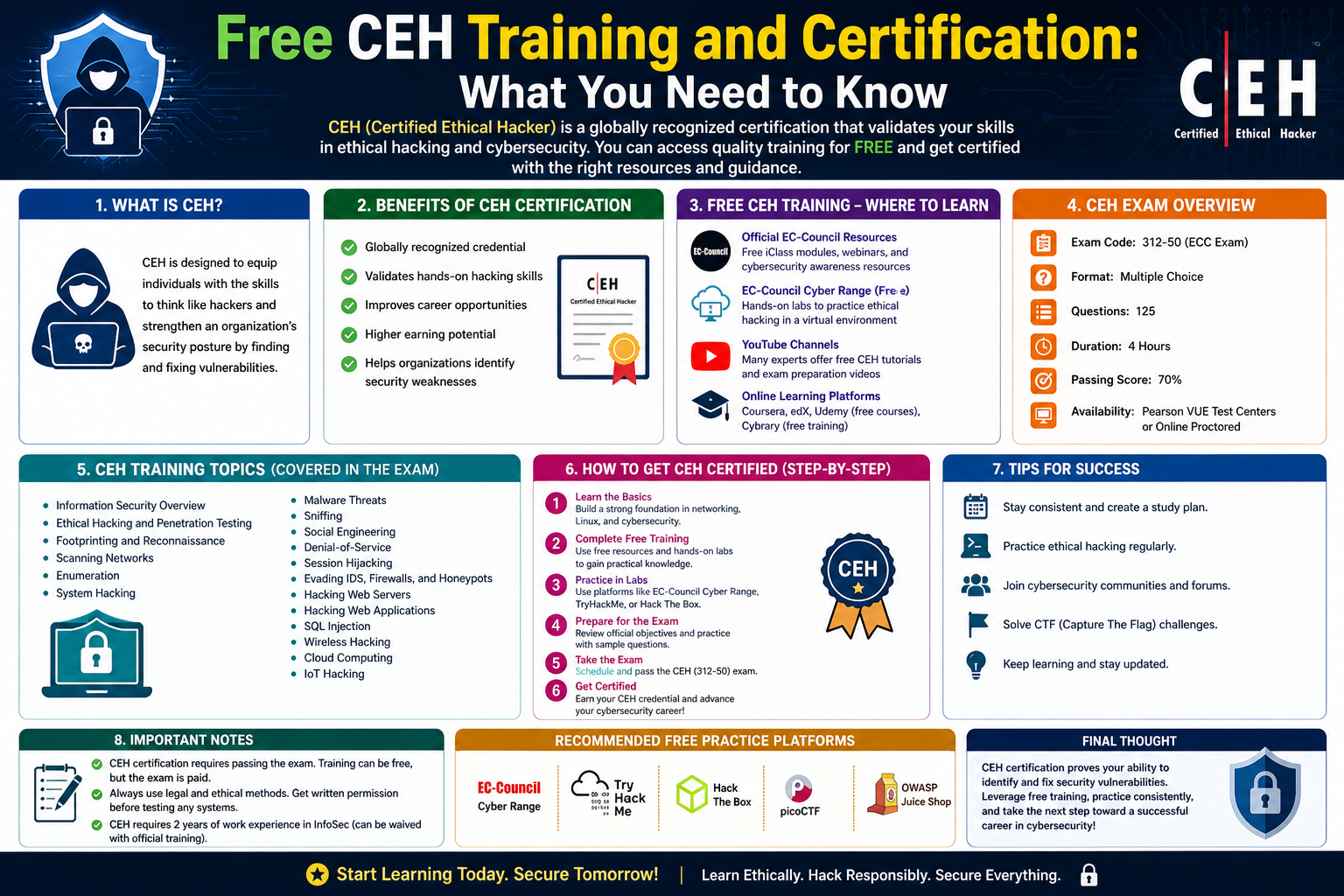
The idea of getting a professional cybersecurity certification without spending money is appealing, especially for beginners or those transitioning into the field. When it comes to the Certified Ethical Hacker credential issued by EC-Council, the reality is straightforward: the certification exam itself is not free. However, the journey toward achieving it can include many cost-saving opportunities, free resources, and strategic approaches that significantly reduce financial burden.
This distinction is important. While you cannot completely bypass the official costs tied to certification, you can absolutely minimize how much you spend on preparation. Many candidates successfully prepare using free or low-cost materials while only paying for the exam itself. This makes the CEH more accessible than it initially appears.
The certification holds strong value in the cybersecurity industry because it validates knowledge in ethical hacking techniques, tools, and methodologies. That value is why it comes at a price. Organizations rely on certified professionals to secure systems, identify vulnerabilities, and simulate real-world attacks in controlled environments. Because of this responsibility, certification bodies maintain strict standards, including paid exams and verified eligibility requirements.
Even though the certification is not free, the ecosystem around it offers flexibility. Free study materials, community-driven resources, and self-paced learning paths can help candidates avoid expensive training packages. For motivated learners, this means the CEH becomes more of a strategic investment rather than an overwhelming expense.
Understanding this balance between cost and opportunity is the first step. Instead of asking whether the CEH is free, a better question is how to achieve it in the most cost-efficient way possible while still gaining the full benefit of the certification.
Breaking Down the Real Cost Behind CEH Certification
To understand how to reduce expenses, you first need a clear picture of what contributes to the overall cost of earning the CEH credential. Unlike some certifications with fixed pricing, CEH costs vary depending on several factors, including location, testing method, and whether training is bundled with the exam.
One of the primary expenses is the exam voucher. Candidates typically choose between testing at a physical center or taking the exam remotely. Each option has its own pricing structure, and additional fees may apply depending on the method selected. There is also an application fee required for candidates who qualify through experience rather than official training, and this fee is non-refundable.
Training is where costs can increase significantly. Official courses provided by the certification body or authorized partners often include structured learning, labs, and exam vouchers. While these packages offer convenience and guided instruction, they can be expensive. Many candidates choose them for the added confidence and structured approach, but they are not mandatory for everyone.
Another factor to consider is the possibility of retaking the exam. Not every candidate passes on the first attempt, and retake vouchers add to the overall cost. This is why preparation strategy plays such a crucial role. Investing time in quality study resources can reduce the risk of needing a second attempt.
There is also an indirect cost that many people overlook: time. Preparing for the CEH exam requires dedication and consistent study. The time spent learning could have been used for other opportunities, such as gaining work experience or pursuing alternative certifications. This concept, often referred to as opportunity cost, should be part of your decision-making process.
Despite these expenses, it is entirely possible to keep total costs relatively low by avoiding unnecessary spending. Candidates who rely on free resources and only pay for essential components often spend much less than those who opt for full training packages.
Evaluating the Value and Career Benefits of CEH Certification
Before investing time and money into any certification, it is important to understand what you gain in return. The CEH certification is widely recognized in the cybersecurity industry and is often associated with roles such as security analyst, network security engineer, and penetration tester.
One of the strongest advantages of this certification is its branding. The term “Certified Ethical Hacker” immediately communicates a specialized skill set, making it attractive to employers. It signals that the candidate understands how attackers think and can use that knowledge to strengthen security systems.
Beyond the name, the certification is aligned with international standards and is recognized in various professional frameworks. This recognition adds credibility and increases its value in both public and private sector roles. For individuals seeking career growth, this can translate into better job opportunities and higher earning potential.
Financially, professionals with ethical hacking skills often command competitive salaries. Organizations are willing to invest in talent that can proactively identify and mitigate security risks. This demand continues to grow as cyber threats become more sophisticated and widespread.
However, the value of the certification is not limited to salary alone. It also provides structured knowledge across multiple domains of cybersecurity. Candidates learn about reconnaissance techniques, system vulnerabilities, network security, web application attacks, and more. This broad understanding helps build a strong foundation for advanced roles in the field.
For some individuals, the CEH may not be the only or best option. Depending on career goals, other certifications might offer a more direct path to specific roles. That is why it is important to align your certification choice with your long-term objectives rather than following trends alone.
Exploring Practical Ways to Reduce CEH Certification Costs
Reducing the cost of earning a CEH certification requires a combination of awareness, planning, and smart decision-making. One of the most effective strategies is to take advantage of promotional offers. Training providers and certification bodies occasionally offer discounts, especially during special events or awareness campaigns. Keeping an eye on these opportunities can result in significant savings.
Another practical approach is to seek financial support from employers or educational institutions. Many organizations invest in employee development and may cover certification costs as part of professional growth programs. If you are currently employed in an IT or cybersecurity role, this is worth exploring.
Students and early-career professionals can benefit from scholarships and grant programs. Some initiatives are specifically designed to support individuals entering the cybersecurity field. These programs can cover part or even all of the certification expenses, making it more accessible to those with limited financial resources.
Self-study is another powerful way to reduce costs. Instead of enrolling in expensive training programs, candidates can use free online materials, community forums, and open-source tools to build their knowledge. This approach requires discipline and consistency but can be highly effective when done correctly.
Additionally, choosing the right exam option can make a difference. Comparing different testing methods and understanding associated fees allows candidates to select the most cost-effective route. Small decisions like this can add up and significantly impact the total investment.
Ultimately, reducing costs does not mean compromising on quality. It is about making informed choices and using available resources wisely. With the right approach, earning the CEH certification becomes a manageable and worthwhile investment rather than a financial burden.
Understanding CEH Certification Eligibility and Entry Requirements
Before moving forward with preparation, it is essential to understand what it takes to qualify for the Certified Ethical Hacker certification. The certification body, EC-Council, provides two primary pathways for candidates to meet eligibility requirements. Each path is designed to accommodate individuals at different stages of their careers, making the certification accessible to both experienced professionals and those who prefer structured learning.
The first pathway involves completing an official training program. This route is straightforward because it automatically qualifies you to sit for the exam. However, it often comes with a higher cost since training programs are typically bundled with course materials, lab access, and exam vouchers. Many candidates choose this option for its structured nature, especially if they are new to ethical hacking concepts.
The second pathway is more flexible but requires proof of experience. Candidates must demonstrate at least two years of verified work in information security. This experience should cover relevant domains such as network security, system vulnerabilities, and risk assessment. To validate this, applicants must submit an eligibility application, which is reviewed before approval is granted.
This requirement can be challenging for beginners who are just entering the cybersecurity field. Without prior experience or employer support, meeting eligibility criteria may seem like a barrier. However, this is where free learning resources and hands-on practice become valuable. Building skills through labs, simulations, and independent study can help bridge the gap and prepare candidates for real-world scenarios.
The eligibility process itself also introduces an additional step that requires careful planning. Once approved, candidates typically have a limited window to purchase their exam voucher. Missing this window can result in delays or additional costs, so timing your preparation is important.
Understanding these requirements early allows you to plan your approach effectively. Whether you choose formal training or self-study combined with experience, aligning your preparation with eligibility criteria ensures a smoother path toward certification.
Exploring the Core Knowledge Domains Covered in the CEH Exam
The CEH certification is not just about passing a test; it is about mastering a wide range of cybersecurity concepts. The exam is structured around multiple domains that collectively define the skill set of an ethical hacker. These domains are carefully designed to reflect real-world responsibilities and challenges faced by security professionals.
One of the foundational areas is the overview of information security and ethical hacking. This domain introduces key concepts, terminology, and the role of ethical hackers in protecting systems. It sets the stage for more advanced topics by providing a clear understanding of how cybersecurity fits into modern organizations.
Reconnaissance is another critical domain. It involves gathering information about target systems before launching an attack. Ethical hackers use these techniques to identify potential entry points and assess vulnerabilities. Understanding reconnaissance helps professionals think like attackers while maintaining a defensive perspective.
System hacking focuses on exploiting vulnerabilities within operating systems. This includes techniques such as password cracking, privilege escalation, and maintaining access. Learning these methods allows candidates to understand how attackers gain control over systems and how to prevent such breaches.
Network and perimeter security form another major area of study. This domain covers the tools and techniques used to secure network infrastructure. It includes topics like firewalls, intrusion detection systems, and network scanning. Mastery of this area is essential for protecting data as it moves across networks.
Web application security is increasingly important in today’s digital environment. This domain addresses vulnerabilities in web-based systems, including injection attacks and authentication flaws. Ethical hackers must understand how these vulnerabilities work to effectively secure applications.
Additional domains include wireless security, mobile platform protection, cloud computing, and cryptography. Each of these areas contributes to a comprehensive understanding of modern cybersecurity challenges. By covering such a broad range of topics, the CEH certification ensures that candidates are well-prepared for diverse roles in the field.
Effective Preparation Strategies for the CEH Exam Without Overspending
Preparing for the CEH exam does not have to involve expensive training programs. With the right strategy, candidates can build the necessary knowledge and skills using cost-effective methods. The key is to focus on structured learning while leveraging free and affordable resources.
One of the most important steps is understanding the exam blueprint. This document outlines the topics covered in the exam and the distribution of questions across different domains. By studying the blueprint, candidates can prioritize their efforts and avoid wasting time on less relevant areas.
Hands-on practice is another essential component of preparation. Ethical hacking is a practical skill, and theoretical knowledge alone is not enough. Setting up a lab environment or using online platforms that offer simulated scenarios can help reinforce learning. Practicing with tools commonly used in the field allows candidates to gain confidence and develop problem-solving skills.
Community learning can also play a significant role. Online forums, discussion groups, and collaborative platforms provide opportunities to learn from others who are preparing for the same certification. These communities often share tips, study plans, and real-world experiences that can enhance your understanding.
Consistency is crucial when preparing independently. Without the structure of a formal course, it is easy to lose focus. Creating a study schedule and setting clear goals can help maintain momentum. Breaking down topics into manageable sections makes the process less overwhelming and more productive.
Another effective strategy is to combine different types of resources. Reading materials, video tutorials, and practice questions each offer unique benefits. Using a mix of these formats can improve retention and provide a more comprehensive learning experience.
By focusing on disciplined study habits and practical experience, candidates can prepare effectively without incurring high costs. This approach not only saves money but also builds self-reliance, which is a valuable skill in the cybersecurity field.
Understanding the Structure and Format of the CEH Certification Exam
Knowing what to expect on exam day can significantly improve your chances of success. The CEH exam is designed to test both theoretical knowledge and practical understanding through a structured format. Familiarity with this format helps reduce anxiety and allows candidates to manage their time more effectively.
The exam typically consists of multiple-choice questions that are scenario-based. These questions require candidates to apply their knowledge rather than simply recall facts. This approach ensures that certified professionals can handle real-world situations rather than just theoretical concepts.
The total number of questions and the time allocated for the exam create a need for efficient time management. Candidates must balance speed and accuracy, ensuring that they do not spend too much time on a single question. Developing this skill during preparation can make a significant difference in performance.
Scoring is another aspect that candidates should understand. The passing score is not fixed and may vary depending on the difficulty of the exam version. This means that consistent preparation across all domains is essential. Focusing only on strong areas while neglecting weaker ones can lead to an unbalanced performance.
The exam environment also plays a role in the overall experience. Whether taken at a testing center or remotely, candidates must follow specific guidelines and procedures. Being familiar with these requirements in advance helps avoid last-minute issues.
Practice exams can be particularly useful in this stage of preparation. They simulate the actual testing experience and help identify areas that need improvement. Regular practice builds confidence and reduces the likelihood of surprises on exam day.
Understanding the structure of the CEH exam is not just about logistics; it is about aligning your preparation with the way knowledge is tested. This alignment increases efficiency and ensures that your efforts translate into measurable results.
Leveraging Free Study Resources to Prepare for the CEH Exam
One of the most practical ways to reduce the cost of earning the Certified Ethical Hacker credential is by taking full advantage of free study resources. While the certification itself requires payment, the preparation phase offers a wide range of no-cost options that can be highly effective when used correctly. Candidates who are disciplined and resourceful can build a strong foundation without relying on expensive training packages.
A good starting point is the official readiness assessment provided by EC-Council. This type of assessment helps you evaluate your current knowledge level and identify areas that need improvement. Instead of studying blindly, you can focus your efforts on specific domains where you are weakest. This targeted approach saves both time and energy.
Video-based learning platforms are another valuable resource. Many experienced cybersecurity professionals share tutorials, walkthroughs, and concept explanations that align closely with CEH exam topics. These videos often break down complex ideas into simpler terms, making them easier to understand. However, it is important to verify the accuracy of the content, as not all freely available material meets professional standards.
Documentation and open educational content also play a major role. Many cybersecurity tools used in ethical hacking have official documentation that explains how they work. Learning directly from these sources not only prepares you for the exam but also gives you practical knowledge that can be applied in real-world scenarios.
Practice questions and community-shared quizzes can further strengthen your preparation. These resources simulate exam conditions and help you become familiar with the type of questions you may encounter. Over time, this improves your ability to analyze scenarios and choose the correct answers under pressure.
The key to success with free resources is consistency. Instead of jumping from one source to another, it is better to select a few reliable materials and follow them systematically. Creating a structured study plan ensures that you cover all necessary topics while avoiding confusion and information overload.
Building Hands-On Skills Through Practical Ethical Hacking Practice
Ethical hacking is a skill that cannot be fully developed through theory alone. Hands-on practice is essential for understanding how attacks work and how to defend against them. Fortunately, there are many ways to gain practical experience without spending a significant amount of money.
Setting up a personal lab environment is one of the most effective approaches. By using virtualization tools, you can create a safe space to experiment with different operating systems, networks, and security configurations. This allows you to practice techniques such as scanning, exploitation, and system hardening without risking real-world systems.
Another approach is to use intentionally vulnerable environments designed for learning purposes. These platforms provide pre-configured systems with known weaknesses, allowing you to practice identifying and exploiting vulnerabilities. This type of practice closely mirrors the scenarios you may encounter in the CEH exam.
Working with common ethical hacking tools is also important. Tools for network scanning, password testing, and vulnerability assessment are frequently referenced in exam questions. Familiarity with these tools not only improves your exam performance but also prepares you for real job responsibilities.
It is equally important to understand the ethical and legal boundaries of hacking. Practicing only in authorized environments ensures that your learning remains responsible and compliant with laws and regulations. Ethical hacking is about protecting systems, not causing harm, and maintaining this mindset is critical throughout your preparation.
Combining theory with practice creates a deeper level of understanding. When you apply what you learn in a hands-on environment, concepts become clearer and easier to remember. This integrated approach is one of the most effective ways to prepare for the CEH certification while keeping costs low.
Learning From Community Knowledge and Peer Experiences
One of the most overlooked yet powerful resources for CEH preparation is the global cybersecurity community. Thousands of professionals and learners share their experiences, study strategies, and insights online. Engaging with this community can provide valuable guidance and help you avoid common mistakes.
Discussion forums and collaborative platforms often contain detailed conversations about exam topics, preparation techniques, and recommended resources. These discussions can offer practical advice that goes beyond theoretical knowledge. For example, you may learn which topics are more challenging or how to approach specific types of questions.
Peer learning also creates opportunities for collaboration. Studying with others, even in an online environment, allows you to exchange ideas and clarify doubts. Explaining concepts to someone else is one of the best ways to reinforce your own understanding.
Community-driven repositories often include notes, summaries, and practice materials created by individuals who have already taken the exam. While these resources should be used carefully and verified for accuracy, they can provide useful insights into the structure and focus of the certification.
Another benefit of community engagement is motivation. Preparing for a certification can be a long and challenging process, especially when studying independently. Being part of a group with similar goals helps maintain focus and encourages consistent progress.
However, it is important to approach community content critically. Not all shared information is accurate or up to date. Cross-referencing with reliable sources ensures that your preparation remains aligned with the actual exam requirements.
Balancing Self-Study and Paid Resources for Maximum Efficiency
While free resources are valuable, there are situations where investing in paid materials can enhance your preparation. The key is to find the right balance between cost and effectiveness. Instead of spending heavily on comprehensive packages, candidates can selectively invest in resources that address their specific needs.
For example, if you struggle with a particular domain, purchasing a focused course or set of practice exams may be more efficient than trying to learn everything independently. This targeted investment can save time and improve your chances of passing the exam on the first attempt.
Another consideration is the quality of structured learning. Paid courses often provide a clear progression of topics, guided instruction, and curated materials. For some learners, this structure is essential for staying organized and avoiding gaps in knowledge.
However, relying entirely on paid resources is not necessary. Many successful candidates combine free materials with a few carefully chosen paid tools. This hybrid approach allows them to benefit from both affordability and structured learning.
Time management also plays a role in this balance. If you have limited time to prepare, investing in high-quality resources may be more practical than searching for and organizing free materials. On the other hand, if you have more flexibility, self-study can be just as effective.
Ultimately, the goal is to achieve a level of preparation that matches the demands of the CEH exam. Whether you choose free resources, paid materials, or a combination of both, the focus should remain on understanding concepts, practicing skills, and building confidence.
Common Challenges Faced During CEH Preparation and How to Overcome Them
Preparing for the Certified Ethical Hacker certification is not just about studying content; it also involves overcoming several practical and mental challenges along the way. Many candidates begin with enthusiasm but struggle to maintain consistency due to the depth and breadth of topics involved. Recognizing these challenges early can help you develop strategies to stay on track.
One of the most common difficulties is information overload. The CEH syllabus covers a wide range of domains, from reconnaissance to cryptography, and it is easy to feel overwhelmed. Instead of trying to master everything at once, breaking the material into smaller, manageable sections can make the process more effective. Focusing on one domain at a time allows for deeper understanding and better retention.
Another challenge is the lack of structured guidance when relying on self-study. Without a formal course, candidates may find it difficult to determine what to study and in what order. This is where the official exam blueprint provided by EC-Council becomes essential. It serves as a roadmap, helping you organize your preparation and ensure that all key areas are covered.
Motivation can also fluctuate during long study periods. Cybersecurity topics can be complex, and progress may feel slow at times. Setting realistic goals and tracking your achievements can help maintain momentum. Even small milestones, such as completing a domain or mastering a tool, contribute to overall progress.
Technical challenges are another factor. Setting up lab environments, understanding tools, and troubleshooting errors can be frustrating, especially for beginners. However, these challenges are also valuable learning opportunities. Overcoming them builds problem-solving skills that are directly relevant to real-world cybersecurity roles.
Time management is equally important. Balancing study with work, personal commitments, and other responsibilities requires careful planning. Creating a consistent schedule and sticking to it can make a significant difference. Even dedicating a small amount of time each day can lead to substantial progress over time.
By addressing these challenges proactively, candidates can turn potential obstacles into stepping stones. Preparation becomes more manageable, and the overall experience becomes more rewarding.
Comparing CEH With Alternative Cybersecurity Certifications
While the CEH certification is widely recognized, it is not the only option available in the cybersecurity field. Depending on your career goals, other certifications may offer a more suitable path. Understanding these alternatives helps you make an informed decision about where to invest your time and resources.
Some certifications focus more on defensive security, such as threat detection and incident response. These are ideal for roles that involve monitoring systems and responding to cyber threats. Others emphasize networking fundamentals, which can be beneficial for building a strong technical foundation before specializing in security.
The CEH, on the other hand, is centered around offensive security concepts. It teaches you how attackers think and operate, which is valuable for identifying vulnerabilities and strengthening defenses. This makes it particularly appealing for roles that involve penetration testing or vulnerability assessment.
Choosing between certifications depends on your interests and career direction. If you are drawn to the idea of ethical hacking and understanding attack methodologies, the CEH is a strong choice. However, if your focus is on network management or defensive strategies, another certification might align better with your goals.
It is also worth considering the level of difficulty and prerequisites. Some certifications are designed for beginners, while others require more advanced knowledge and experience. Evaluating your current skill level helps you select a certification that is both challenging and achievable.
In many cases, professionals pursue multiple certifications over time to build a well-rounded skill set. The CEH can be one part of a broader learning journey, complementing other credentials and experiences. This layered approach enhances your expertise and increases your value in the job market.
Maximizing Career Opportunities After Earning CEH Certification
Earning the CEH certification is a significant achievement, but it is only the beginning of your professional journey. To fully benefit from the certification, it is important to leverage it effectively in your career. This involves more than simply adding it to your resume.
One of the first steps is to highlight your skills and knowledge in practical terms. Employers are interested in what you can do, not just the certifications you hold. Demonstrating hands-on experience with tools, techniques, and real-world scenarios can set you apart from other candidates.
Networking is another key factor in career growth. Connecting with other cybersecurity professionals, attending events, and పాల్గating in online communities can open doors to new opportunities. Building relationships within the industry helps you stay informed about trends and job openings.
Continuous learning is essential in cybersecurity. The field evolves rapidly, with new threats and technologies emerging regularly. Staying updated through additional certifications, training, and practical experience ensures that your skills remain relevant.
Job roles associated with the CEH certification vary widely. They may include positions focused on security analysis, vulnerability assessment, and system protection. Each role requires a combination of technical knowledge and problem-solving abilities. By aligning your skills with job requirements, you can position yourself for success.
It is also important to develop soft skills such as communication and teamwork. Ethical hackers often need to explain complex technical issues to non-technical stakeholders. Being able to convey information clearly enhances your effectiveness and increases your professional value.
By actively applying your knowledge and continuing to grow, you can turn the CEH certification into a powerful tool for career advancement.
Advanced Study Techniques to Strengthen CEH Exam Performance
As you move closer to attempting the Certified Ethical Hacker exam, refining your study approach becomes just as important as covering the syllabus. At this stage, the goal is not only to understand concepts but to apply them quickly and accurately under exam conditions. Advanced study techniques can help bridge the gap between basic preparation and high-level performance.
One highly effective method is active recall. Instead of passively reading notes or watching videos, you test yourself regularly on key topics. This forces your brain to retrieve information, strengthening memory and improving retention. For CEH preparation, this can include recalling attack methods, tool usage, and security concepts without looking at your notes. Over time, this practice builds confidence and reduces hesitation during the exam.
Another powerful technique is spaced repetition. Rather than revisiting all topics at once, you review them at increasing intervals. This method helps move information from short-term memory to long-term memory. Given the wide scope of CEH domains, spaced repetition ensures that you do not forget earlier topics while focusing on new ones. It creates a balanced learning cycle that reinforces knowledge consistently.
Scenario-based thinking is also essential. The CEH exam is known for presenting questions in real-world contexts rather than simple definitions. Practicing how to analyze scenarios, identify the problem, and choose the best solution can significantly improve your performance. This involves understanding not just what a tool or technique does, but when and why it should be used.
Time-bound practice is another critical element. Simulating exam conditions by setting a timer while solving practice questions helps you develop speed and accuracy. Many candidates struggle not because they lack knowledge, but because they cannot manage time effectively. Regular timed sessions train you to make decisions quickly without compromising accuracy.
Error analysis is often overlooked but extremely valuable. Every mistake you make during practice is an opportunity to improve. Instead of simply noting the correct answer, take time to understand why your choice was incorrect. This deeper analysis prevents repeated errors and strengthens your conceptual clarity.
It is also beneficial to rotate between different types of learning activities. For example, you might spend one session reviewing theory, another practicing hands-on labs, and another taking mock exams. This variation keeps your study routine engaging and ensures that you develop both theoretical and practical skills.
Finally, maintaining a focused and distraction-free study environment can greatly enhance productivity. Consistency in your study habits, combined with these advanced techniques, creates a strong foundation for success. By the time you reach the exam, you are not just prepared to pass but equipped to handle complex cybersecurity challenges with confidence.
Final Thoughts
The question of whether you can obtain CEH training or certification for free does not have a simple yes or no answer. While the certification exam itself requires payment, there are numerous ways to reduce costs and make the process more accessible. Free study resources, community support, and self-directed learning all play a significant role in minimizing expenses.
The key is to approach the certification as an investment rather than a cost. By carefully planning your preparation, using available resources wisely, and focusing on practical skills, you can achieve your goal without unnecessary spending. This approach not only saves money but also builds independence and discipline, which are valuable traits in the cybersecurity field.
Ultimately, the value of the CEH certification lies in the knowledge and opportunities it provides. It opens doors to a wide range of roles and helps establish credibility in a competitive industry. For those willing to put in the effort, it is possible to navigate the path efficiently and make the most of both free and paid resources.