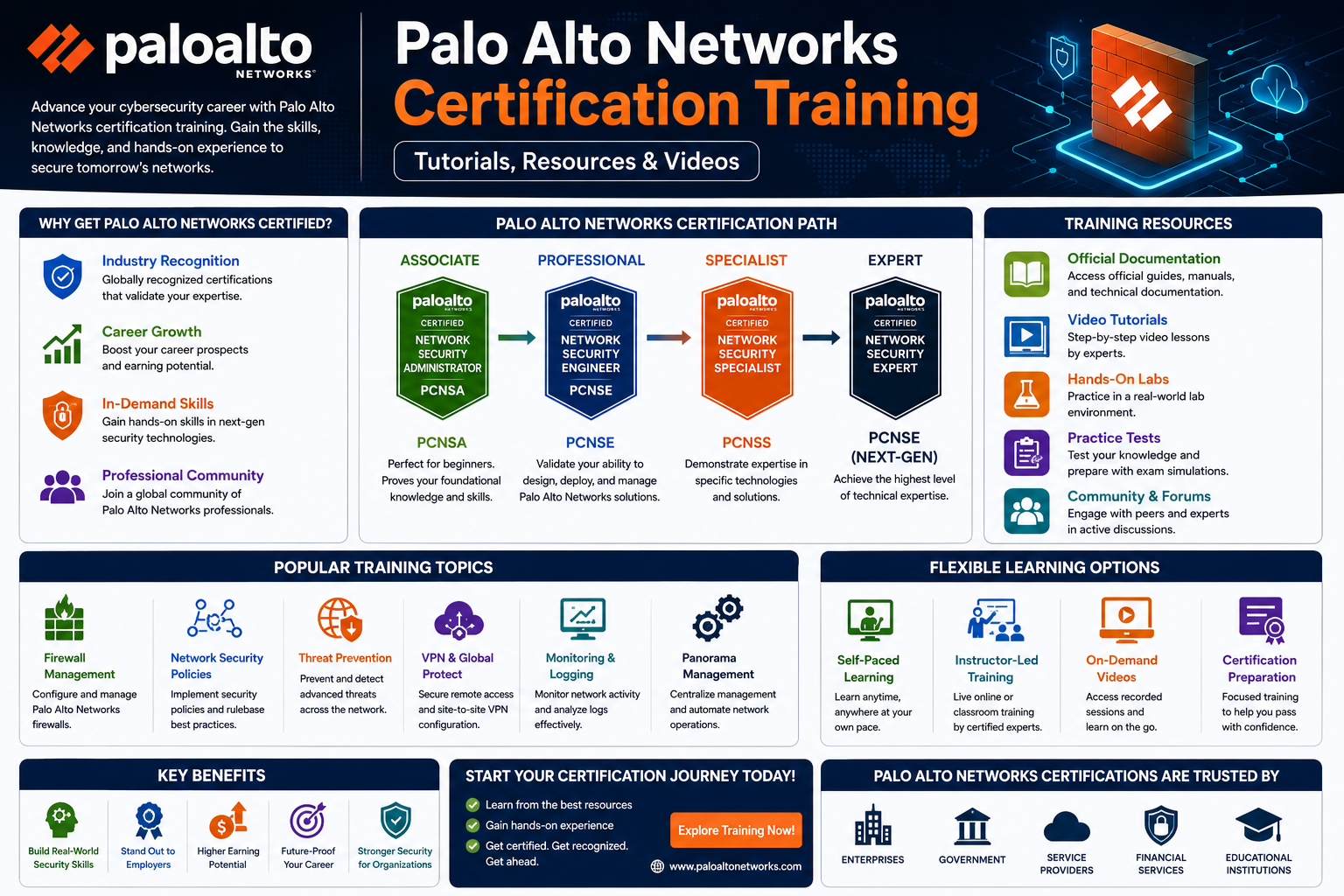
Palo Alto Networks has become a widely recognized name in the field of cybersecurity because of its strong focus on advanced threat prevention and intelligent network protection. In today’s digital environment, organizations face increasingly complex cyber threats that evolve rapidly, making traditional security tools less effective. This shift has created a strong demand for intelligent security platforms that do more than simply filter traffic—they must analyze behavior, detect anomalies, and respond to threats in real time.
At the core of Palo Alto’s approach is the idea of building security into the network itself rather than treating it as a separate layer. This means security is no longer just about blocking or allowing traffic based on static rules; it is about understanding what that traffic represents, how it behaves, and whether it poses a risk. This modern approach has made Palo Alto technologies a major focus area for professionals working in cybersecurity, network engineering, and infrastructure management.
Learning how these systems operate is not just about technical knowledge—it is about understanding how modern digital environments are protected at scale. Large enterprises rely on advanced firewalls and security platforms to protect sensitive data, ensure business continuity, and defend against both external and internal threats. As a result, gaining expertise in these systems can significantly strengthen a professional’s ability to work in complex IT environments.
Why Palo Alto Skills Matter in Modern Security
The importance of learning Palo Alto technologies comes from the increasing complexity of cyber threats. Traditional firewalls were designed to filter traffic based on ports, IP addresses, and protocols. However, modern applications do not fit neatly into these categories. Many services now use dynamic ports, encrypted traffic, and cloud-based infrastructure, making older security models less effective.
Palo Alto Systems addresses this challenge by focusing on application-level understanding. Instead of simply analyzing where traffic comes from, they analyze what the traffic actually is. This shift allows organizations to make more informed decisions about what should be allowed or blocked within a network.
From a professional perspective, this creates a strong demand for individuals who understand how these systems work. Organizations require specialists who can configure security rules, monitor network activity, and respond to threats using advanced tools. These skills are especially valuable in industries such as banking, healthcare, telecommunications, and government services, where data security is critical.
Another reason these skills are important is the increasing adoption of cloud environments. As businesses move workloads to hybrid and multi-cloud systems, security becomes more distributed and complex. Palo Alto technologies are often used to extend security policies across both on-premises and cloud environments, ensuring consistent protection regardless of where data resides.
Understanding these systems also helps professionals develop a broader cybersecurity mindset. Instead of focusing only on reactive defense, they learn how to build proactive security strategies that anticipate threats before they cause damage.
Core Concepts of Next-Generation Firewalls
Next-generation firewalls represent a major evolution in network security technology. Unlike traditional firewalls, which rely primarily on static filtering rules, next-generation systems analyze traffic at a deeper level. They combine multiple security functions into a single platform, including application awareness, intrusion prevention, and advanced threat detection.
One of the most important features of these systems is their ability to identify applications regardless of port or protocol. This means that even if an application is designed to hide its traffic or use non-standard methods, the firewall can still recognize it based on behavior and signatures.
Another key concept is context-based security. Instead of making decisions based only on isolated data points, next-generation systems consider multiple factors such as user identity, device type, location, and time of access. This contextual awareness allows for more precise and flexible security policies.
Threat prevention is also deeply integrated into these systems. They are designed to detect and block malicious activity in real time by analyzing patterns, signatures, and behavioral anomalies. This includes protection against malware, ransomware, and zero-day exploits.
In addition to prevention, these firewalls also provide detailed visibility into network activity. Administrators can see which applications are being used, how much bandwidth they consume, and whether they pose any potential risk. This level of insight is essential for maintaining both security and performance in modern networks.
Understanding Security Policies and Rule Architecture
Security policies are the foundation of any firewall system. They define how traffic is handled as it moves through the network. In a modern security environment, these policies are not simple allow-or-deny rules; they are complex configurations that take multiple variables into account.
Each policy typically includes conditions such as source and destination zones, user identity, application type, service requirements, and security profiles. When traffic matches a policy, the firewall applies the corresponding action, which may include allowing, blocking, or inspecting the traffic more deeply.
The order of these policies is also important. Firewalls evaluate rules in sequence, meaning that the first matching rule is applied. This requires careful planning to ensure that critical security rules are not bypassed by more general ones.
Another important aspect of rule architecture is segmentation. Networks are often divided into zones, and policies are used to control communication between them. This helps reduce the risk of lateral movement, where an attacker who gains access to one part of the network attempts to move to other areas.
Well-designed security policies also support scalability. As networks grow, policies must be structured in a way that remains manageable and consistent. Poorly designed rule sets can lead to conflicts, security gaps, or performance issues.
Traffic Inspection and Threat Prevention Mechanisms
One of the most powerful capabilities of modern firewall systems is deep traffic inspection. This process goes beyond basic packet filtering and examines the content of network traffic in detail. It allows the system to identify hidden threats that might otherwise go unnoticed.
Traffic inspection involves analyzing both encrypted and unencrypted data. In many cases, attackers use encryption to conceal malicious activity. Advanced systems can decrypt traffic in controlled environments, inspect it for threats, and then re-encrypt it before forwarding it to its destination.
Threat prevention mechanisms are built to identify a wide range of malicious behavior. This includes known attack signatures as well as unknown or emerging threats. Behavioral analysis plays a key role here, as it allows the system to detect unusual patterns that may indicate an attack.
Another important feature is the ability to prevent exploits targeting vulnerabilities in applications and operating systems. By monitoring how applications behave, the system can block attempts to take advantage of weaknesses before they are exploited.
These mechanisms work continuously in the background, providing real-time protection without requiring manual intervention. This makes them essential for organizations that need to maintain high levels of security while minimizing operational complexity.
User Identity and Application Awareness
Modern security systems are no longer limited to understanding IP addresses and network segments. They also incorporate user identity into security decisions. This means that access controls can be based on who the user is, not just where they are connecting from.
User identity integration allows organizations to apply more precise security policies. For example, different users may have different levels of access to the same application depending on their role within the organization. This reduces unnecessary exposure and strengthens overall security.
Application awareness is another critical component. Instead of treating all network traffic equally, the system identifies specific applications and applies tailored policies to them. This is especially important in environments where multiple applications may share the same network infrastructure.
By combining user identity and application awareness, security systems can create highly granular control mechanisms. This ensures that only authorized users can access specific applications and only under defined conditions.
This level of control is essential in preventing unauthorized access, reducing insider threats, and maintaining compliance with security standards.
Network Segmentation and Zero Trust Principles
Network segmentation is a strategy that divides a network into smaller, isolated sections. Each segment has its own security policies and controls, limiting how traffic can move between different parts of the network.
This approach significantly reduces the risk of widespread damage in the event of a security breach. If one segment is compromised, the attacker cannot easily move to other segments without triggering security controls.
The concept of zero trust builds on this idea by assuming that no user or device should be trusted by default, even if they are inside the network. Every access request must be verified before it is granted.
Zero trust models rely heavily on continuous authentication and strict access controls. This includes verifying user identity, checking device health, and analyzing behavior before allowing access to resources.
Together, segmentation and zero trust create a strong security framework that limits exposure and reduces the attack surface. These principles are widely adopted in modern cybersecurity strategies due to their effectiveness in preventing lateral movement and minimizing risk.
Logging, Monitoring, and Visibility
Visibility is one of the most important aspects of network security. Without it, administrators cannot understand what is happening within their systems or identify potential threats.
Modern firewall systems provide detailed logging capabilities that record every significant event within the network. This includes traffic flow, security violations, application usage, and system alerts.
Monitoring tools allow security teams to analyze this data in real time. They can identify unusual patterns, track suspicious activity, and respond to incidents quickly.
Visibility also plays a key role in compliance. Many industries require organizations to maintain detailed records of network activity for auditing purposes. Comprehensive logging ensures that these requirements can be met effectively.
By combining logs with analytics, organizations can gain deeper insights into their network behavior. This helps them make informed decisions about security policies, resource allocation, and risk management.
Centralized Management Concepts
In large-scale environments, managing security across multiple devices can become complex. Centralized management systems help simplify this process by providing a single interface for configuring and monitoring security policies.
These systems allow administrators to define policies once and apply them across multiple firewalls and network segments. This ensures consistency and reduces the likelihood of configuration errors.
Centralized management also improves efficiency. Instead of managing each device individually, administrators can deploy updates, monitor performance, and respond to incidents from a unified platform.
This approach is especially useful in organizations with distributed infrastructure, where security needs to be maintained across multiple locations and environments.
Common Deployment Scenarios in Enterprises
In real-world environments, firewall systems are deployed in a variety of ways depending on organizational needs. One common scenario is perimeter security, where the firewall protects the boundary between internal networks and external traffic sources.
Another scenario involves internal segmentation, where firewalls are used to control traffic between different departments or business units. This helps enforce security policies and limit access to sensitive resources.
Cloud integration is also becoming increasingly common. Many organizations deploy firewall systems in cloud environments to extend security controls beyond physical infrastructure.
Hybrid deployments, which combine on-premises and cloud-based systems, are also widely used. These setups require consistent security policies across all environments to ensure seamless protection.
Hands-On Learning Approaches
Developing practical skills in firewall management requires more than theoretical knowledge. Hands-on experience is essential for understanding how systems behave in real environments.
One effective approach is working with simulated network environments where different configurations can be tested safely. These environments allow learners to experiment with security policies, analyze traffic, and observe system behavior without risk.
Another important aspect is scenario-based practice. This involves solving real-world problems such as blocking malicious traffic, optimizing performance, or investigating security incidents.
Over time, repeated exposure to these scenarios helps build confidence and improve problem-solving skills. It also helps professionals develop a deeper understanding of how security systems interact with network infrastructure.
Troubleshooting Common Firewall Issues
Troubleshooting is a critical skill in network security. Firewalls can sometimes block legitimate traffic or fail to detect threats due to misconfiguration or system limitations.
Common issues include incorrect security policies, overlapping rules, and misaligned zone configurations. Identifying these problems requires careful analysis of logs and traffic patterns.
Performance issues can also occur if the system is overloaded or not properly optimized. In such cases, administrators must review resource usage and adjust configurations accordingly.
Effective troubleshooting involves a systematic approach, starting with identifying the problem, analyzing available data, testing possible solutions, and verifying results.
Developing this skill is essential for maintaining stable and secure network environments.
Advanced Palo Alto Security Architecture in Real-World Environments
As organizations grow and their digital ecosystems become more complex, the role of advanced security architecture becomes increasingly important. Palo Alto Networks technologies are often deployed not just as standalone firewalls but as part of a broader, layered security ecosystem designed to protect distributed environments. This includes on-premises data centers, cloud infrastructure, remote users, and hybrid systems that span multiple locations.
At an advanced level, security architecture is no longer just about blocking threats at the perimeter. Instead, it focuses on building a deeply integrated system where every layer of the network contributes to security enforcement. This includes segmentation, identity-based controls, behavioral monitoring, and automated threat response mechanisms.
A modern enterprise environment typically includes hundreds or even thousands of applications running across different infrastructures. Each of these applications generates traffic that must be inspected, classified, and controlled. Palo Alto systems help manage this complexity by providing a unified framework for visibility and control across all network layers.
One of the most important aspects of advanced architecture is scalability. Security systems must be able to grow alongside business needs without sacrificing performance or visibility. This requires careful planning of firewall placement, policy design, and resource allocation to ensure that the system remains efficient even under heavy load.
Another critical factor is resilience. Security infrastructure must be designed to continue functioning even during partial failures or attacks. This includes redundancy mechanisms, failover configurations, and distributed deployment models that ensure continuous protection.
Deep Dive into Application Identification and Control
One of the most powerful capabilities in modern firewall systems is application identification. Unlike traditional methods that rely on port numbers or IP addresses, application identification analyzes traffic patterns to determine exactly which application is generating the data.
This approach is essential in today’s environment, where applications often use dynamic ports, encryption, and cloud-based infrastructure. For example, a single port may be used by multiple applications, making port-based filtering unreliable.
Application identification works by inspecting packet behavior, protocol structure, and contextual metadata. Once an application is identified, the firewall can apply specific security policies tailored to that application.
This level of control allows organizations to enforce granular rules, such as allowing business-critical applications while restricting non-essential or risky ones. It also enables better visibility into how applications are being used across the network.
Another important aspect is application categorization. Applications are grouped into categories such as collaboration tools, file sharing platforms, social media, or enterprise systems. These categories help simplify policy creation and management at scale.
Application control is especially important in environments where employees use a wide range of tools and services. Without proper control, unauthorized applications can introduce security risks, consume bandwidth, or lead to data leakage.
By implementing application-aware policies, organizations can strike a balance between productivity and security, ensuring that users have access to the tools they need without compromising the integrity of the network.
Advanced Threat Detection and Behavioral Analysis
Cyber threats have evolved significantly over time, becoming more sophisticated and harder to detect using traditional methods. As a result, modern security systems rely heavily on behavioral analysis and advanced detection techniques.
Behavioral analysis focuses on understanding how traffic and applications normally behave within a network. Once a baseline is established, any deviation from that pattern can be flagged as suspicious.
This approach is particularly effective against unknown or zero-day threats that do not yet have known signatures. Instead of relying on predefined rules, the system identifies anomalies based on behavior.
For example, if an application suddenly begins sending large amounts of data to an unknown external server, this could indicate a potential data exfiltration attempt. Similarly, repeated failed login attempts from an unusual location may signal a brute-force attack.
Advanced threat detection systems also use machine learning models to improve accuracy over time. These models analyze vast amounts of network data to identify patterns associated with malicious activity.
In addition to detection, these systems can automatically take action to mitigate threats. This may include blocking traffic, isolating affected systems, or alerting security teams for further investigation.
The combination of behavioral analysis and automated response significantly reduces the time it takes to detect and contain security incidents.
Security Zones and Traffic Segmentation Strategies
Security zones are a foundational concept in network security architecture. They represent logical or physical segments of a network that share similar security requirements.
By dividing a network into zones, organizations can apply different security policies to different parts of the infrastructure. This helps reduce risk by limiting how traffic flows between sensitive and non-sensitive areas.
For example, a typical enterprise network might include zones for internal users, guest access, servers, and external communication. Each of these zones has different levels of trust and requires different security controls.
Traffic between zones is tightly controlled using firewall policies. This ensures that only authorized communication is allowed between different parts of the network.
Segmentation also helps prevent lateral movement during security breaches. If an attacker gains access to one zone, proper segmentation can prevent them from moving freely across the network.
In advanced environments, micro-segmentation is also used. This involves creating highly granular security boundaries at the workload or application level. Micro-segmentation provides even greater control and reduces the attack surface significantly.
Effective segmentation requires careful planning and ongoing management. As networks evolve, zones must be updated to reflect new applications, services, and business requirements.
Identity-Based Access Control in Enterprise Security
Identity-based access control is a critical component of modern cybersecurity frameworks. Instead of relying solely on network location or device information, access decisions are based on the identity of the user or system requesting access.
This approach allows for much more precise control over who can access what resources. For example, two users in the same location may have completely different access permissions based on their roles within the organization.
Identity-based controls often integrate with directory services that manage user accounts and authentication. This allows security systems to apply policies based on group membership, job function, or other attributes.
One of the key advantages of this approach is flexibility. As employees change roles or move between departments, their access rights can be updated automatically without requiring manual reconfiguration of firewall rules.
This reduces administrative overhead and helps prevent security gaps caused by outdated access permissions.
Identity-based security is also an important component of zero-trust architecture. In a zero-trust model, every access request is verified regardless of where it originates. Identity plays a central role in this verification process.
By combining identity with application awareness and behavioral analysis, organizations can create highly secure and adaptive access control systems.
Cloud Security Integration and Hybrid Environments
As organizations continue to adopt cloud computing, security systems must evolve to protect resources across both on-premises and cloud environments. This has led to the development of hybrid security architectures that extend firewall capabilities into cloud platforms.
In a hybrid environment, security policies must remain consistent regardless of where applications are hosted. This requires centralized management and policy synchronization across all environments.
Cloud security introduces additional challenges such as dynamic scaling, multi-tenancy, and shared infrastructure. Security systems must be able to adapt to rapidly changing environments without losing visibility or control.
One of the key benefits of cloud integration is scalability. Security systems can automatically adjust to increased workloads without requiring manual intervention.
Another important aspect is visibility. Cloud environments often lack the same level of transparency as traditional data centers. Integrated security systems help bridge this gap by providing consistent monitoring and reporting across all environments.
Hybrid architectures also support workload mobility. Applications can move between on-premises and cloud environments while maintaining consistent security policies.
This flexibility is essential for modern organizations that rely on distributed infrastructure to support global operations.
Centralized Policy Management at Scale
Managing security policies across large and complex environments can be challenging. Centralized policy management systems address this issue by providing a unified interface for configuring and enforcing security rules.
Instead of managing each firewall individually, administrators can define policies at a global level and apply them across multiple devices. This ensures consistency and reduces the risk of configuration errors.
Centralized management also simplifies compliance. Organizations can ensure that security policies meet regulatory requirements across all environments without needing to manually verify each system.
Another advantage is efficiency. Changes can be deployed quickly across the entire network, reducing the time required to respond to new threats or business requirements.
Advanced policy management systems also support version control and auditing. This allows administrators to track changes over time and understand how policies have evolved.
In large enterprises, this level of control is essential for maintaining security, compliance, and operational efficiency.
Advanced Logging, Correlation, and Incident Investigation
Logging is one of the most important aspects of any security system. It provides a detailed record of network activity that can be used for analysis, troubleshooting, and incident response.
Advanced logging systems capture a wide range of information, including traffic flows, security events, user activity, and system performance metrics.
However, raw logs alone are not always useful. This is where correlation becomes important. Correlation involves analyzing multiple log sources together to identify patterns or relationships that may indicate a security incident.
For example, a single failed login attempt may not be significant. However, multiple failed attempts followed by a successful login from an unusual location could indicate a compromised account.
Incident investigation relies heavily on these correlated insights. Security teams use them to reconstruct events, identify root causes, and determine the impact of an attack.
Advanced systems often include visualization tools that make it easier to interpret large volumes of log data. These tools help analysts quickly identify anomalies and focus on critical issues.
Automation in Modern Security Operations
Automation has become a key component of modern cybersecurity operations. As threats become more frequent and complex, manual response methods are no longer sufficient.
Automated security systems can detect threats, analyze their severity, and take predefined actions without human intervention. This significantly reduces response time and limits the impact of attacks.
Automation can also be used for routine tasks such as policy updates, log analysis, and system monitoring. This frees up security teams to focus on more strategic activities.
In advanced environments, automation is often combined with orchestration systems that coordinate actions across multiple security tools. This creates a more cohesive and efficient security infrastructure.
Machine learning also plays a role in automation by helping systems improve decision-making over time. As more data is analyzed, the system becomes better at identifying threats and predicting potential risks.
The integration of automation into security operations represents a major shift toward more proactive and intelligent defense strategies.
Performance Optimization and Scalability Challenges
As security systems grow in complexity, maintaining performance becomes a critical concern. Firewalls must be able to process large volumes of traffic without introducing latency or bottlenecks.
Performance optimization involves tuning system resources, refining policies, and distributing workloads effectively across infrastructure.
One common challenge is balancing security depth with speed. Deep inspection provides better protection but requires more processing power. Organizations must carefully balance these factors based on their requirements.
Scalability is another major concern. As networks expand, security systems must be able to handle increased traffic and additional devices without degradation in performance.
This often requires distributed architectures where multiple security devices work together to share processing load.
Proper planning and ongoing optimization are essential to ensure that security systems remain efficient as organizational demands grow.
Security Operations Center (SOC) Integration with Palo Alto Environments
In mature cybersecurity environments, firewall systems do not operate in isolation. They are deeply integrated into Security Operations Centers (SOC), where security analysts continuously monitor, detect, and respond to threats. Palo Alto Networks technologies play a central role in this ecosystem by providing high-quality telemetry, detailed logs, and real-time alerts that feed into SOC workflows.
A SOC is essentially the command center of cybersecurity operations. It brings together people, processes, and technology to ensure that security incidents are identified and handled efficiently. In this environment, firewall data becomes one of the most valuable sources of intelligence because it reflects real-time activity across the entire network.
When integrated into SOC workflows, Palo Alto systems help analysts correlate network activity with other security signals. This includes endpoint behavior, cloud logs, identity authentication events, and threat intelligence feeds. By combining these data sources, SOC teams can build a complete picture of potential security incidents.
One of the key advantages of Palo Alto integration is the clarity of its logs. Instead of raw, unstructured data, the system provides categorized and contextualized information about applications, users, and threats. This makes it easier for analysts to quickly understand what is happening and prioritize responses.
In high-volume environments, SOC teams rely heavily on automated alerting. Palo Alto systems can generate alerts based on predefined thresholds or anomalous behavior. These alerts are then triaged by analysts based on severity and potential impact.
Incident Response Lifecycle in Palo Alto-Based Environments
Incident response is a structured process used to manage and mitigate security breaches. In environments using Palo Alto technologies, this process is supported by detailed visibility and real-time control mechanisms.
The lifecycle typically begins with detection. This may involve identifying suspicious traffic, unusual application behavior, or failed authentication attempts. Once an anomaly is detected, it is logged and escalated for analysis.
The next phase is analysis. Security teams examine logs, traffic flows, and contextual information to determine whether the event represents a genuine threat. Palo Alto’s application-aware logs are particularly useful here, as they provide insight into exactly what type of activity occurred.
Once a threat is confirmed, containment measures are implemented. This may involve blocking specific traffic, isolating affected systems, or modifying security policies to prevent further spread. The ability to enforce changes at the firewall level in real time is a critical advantage.
After containment, eradication steps are taken to remove the threat from the environment. This could involve patching vulnerabilities, removing malicious files, or disabling compromised accounts.
Finally, recovery ensures that normal operations are restored safely. Systems are monitored closely during this phase to ensure that no residual threats remain.
Post-incident review is also an important part of the lifecycle. Security teams analyze what happened, why it happened, and how similar incidents can be prevented in the future.
Advanced Troubleshooting Methodologies for Security Engineers
Troubleshooting in complex firewall environments requires a structured and methodical approach. Security engineers must be able to identify issues quickly while minimizing disruption to network operations.
One of the first steps in troubleshooting is defining the scope of the problem. This involves identifying whether the issue affects a single user, a group of users, or the entire network. Understanding the scope helps narrow down potential causes.
The next step is analyzing logs. Firewall logs provide detailed information about traffic behavior, policy matches, and security actions. By reviewing these logs, engineers can identify where traffic is being blocked or misrouted.
Policy verification is another critical step. Misconfigured or incorrectly ordered policies are one of the most common causes of connectivity issues. Engineers must ensure that rules are correctly defined and applied in the intended sequence.
Another important aspect is zone configuration. Traffic between security zones must be explicitly allowed. If zones are misconfigured, legitimate traffic may be blocked unintentionally.
Engineers also examine routing configurations to ensure that traffic is being directed correctly. Incorrect routing can cause packets to bypass security controls or fail to reach their destination.
Performance-related issues are also considered. High CPU usage, memory constraints, or overloaded interfaces can impact firewall behavior and lead to unexpected results.
By following a structured troubleshooting approach, engineers can efficiently diagnose and resolve issues while maintaining network stability.
Building Effective Security Lab Environments for Skill Development
Hands-on practice is essential for developing expertise in Palo Alto technologies. Lab environments provide a safe and controlled space where learners can experiment with configurations, test scenarios, and build practical skills.
A well-designed lab typically includes virtual firewalls, simulated network segments, and multiple virtual machines representing different user roles and applications. This allows learners to replicate real-world environments and understand how security policies behave in practice.
One of the key benefits of lab environments is the ability to test configurations without risk. Users can experiment with complex policies, enable or disable features, and observe the impact on network traffic.
Lab exercises often focus on tasks such as creating security policies, configuring application control, enabling threat prevention, and analyzing logs. These exercises help reinforce theoretical knowledge through practical application.
Another important aspect of lab learning is troubleshooting practice. Simulated issues can be introduced intentionally, allowing learners to diagnose and resolve problems in a controlled setting.
Over time, repeated exposure to these scenarios helps build confidence and technical intuition. This is particularly valuable for professionals preparing to work in enterprise environments where quick decision-making is required.
Certification Mindset and Skill Progression Strategy
Developing expertise in Palo Alto technologies often involves a structured learning path that progresses from foundational knowledge to advanced specialization. This progression helps ensure that professionals build a strong understanding of core concepts before moving into complex topics.
At the foundational level, learners focus on basic networking concepts, security principles, and firewall operations. This includes understanding how traffic flows through networks and how basic security policies are applied.
As learners progress, they begin working with more advanced features such as application identification, threat prevention, and user-based access control. This stage involves deeper technical understanding and practical configuration skills.
At an advanced level, professionals focus on designing scalable security architectures, integrating systems across cloud environments, and optimizing performance in large-scale deployments.
Skill progression also involves developing troubleshooting expertise and incident response capabilities. These skills are critical for real-world operations where quick and accurate problem-solving is required.
A strong certification mindset involves consistent practice, hands-on experimentation, and continuous learning. It is not just about memorizing concepts but understanding how they apply in real environments.
Security Policy Design Patterns in Enterprise Networks
Designing effective security policies requires more than just technical knowledge; it requires strategic thinking. Policy design patterns help ensure that security rules are structured, scalable, and easy to manage.
One common design pattern is the least privilege approach. This principle ensures that users and applications are granted only the access they need to perform their tasks. By limiting unnecessary access, organizations reduce the risk of unauthorized activity.
Another important pattern is role-based segmentation. In this approach, policies are designed based on user roles rather than individual identities. This simplifies management and ensures consistency across large organizations.
Application-based policies are also widely used. Instead of focusing on network locations, these policies control access based on specific applications. This allows for more granular control and better alignment with business needs.
Zone-based design patterns help control traffic between different parts of the network. By grouping systems into logical zones, organizations can enforce consistent security controls and reduce complexity.
Effective policy design also considers scalability. As networks grow, policies must remain manageable and avoid unnecessary complexity. Poorly structured policies can lead to security gaps and operational inefficiencies.
VPN, Remote Access, and Secure Connectivity Models
Remote access has become a critical component of modern enterprise networks. Employees, contractors, and partners often require secure access to internal resources from outside the corporate network.
Virtual Private Networks (VPNs) are commonly used to provide secure, encrypted connections between remote users and internal systems. These connections ensure that data remains protected even when transmitted over public networks.
Modern firewall systems support multiple types of VPN configurations, including site-to-site and remote access models. Site-to-site VPNs connect entire networks, while remote access VPNs connect individual users.
Authentication plays a key role in secure connectivity. Users must verify their identity before gaining access to network resources. This may involve multi-factor authentication mechanisms to enhance security.
Another important aspect is traffic segmentation for remote users. Once connected, users should only have access to specific resources based on their roles and permissions.
Secure connectivity models must also consider performance. Encryption and tunneling can introduce latency, so systems must be optimized to maintain user experience while ensuring security.
SSL Decryption and Encrypted Traffic Inspection Governance
With the increasing use of encryption across the internet, a significant portion of network traffic is no longer visible to traditional security tools. This creates challenges for threat detection and monitoring.
SSL decryption addresses this issue by allowing security systems to inspect encrypted traffic. Once decrypted, the traffic is analyzed for threats and then re-encrypted before being forwarded.
However, SSL decryption introduces governance challenges. Organizations must carefully decide which types of traffic should be decrypted, as some data may be sensitive or subject to privacy regulations.
Policy-based decryption allows administrators to define rules that control when and how traffic is decrypted. This ensures that security requirements are balanced with privacy and compliance considerations.
Performance impact is another important factor. Decrypting traffic requires additional processing power, so systems must be properly sized and optimized.
Despite these challenges, SSL decryption is essential for maintaining visibility in modern encrypted environments and ensuring that threats do not hide within secure channels.
High Availability, Redundancy, and Failover Strategies
High availability is a critical requirement for enterprise security systems. Organizations cannot afford downtime in their security infrastructure, as this can expose them to significant risk.
High availability configurations ensure that if one system fails, another system takes over seamlessly. This minimizes disruption and maintains continuous protection.
Redundancy is a key component of high availability. Multiple devices are deployed in parallel to ensure that no single point of failure exists within the system.
Failover mechanisms detect system failures and automatically switch traffic to backup devices. This process is designed to be fast and transparent to users.
Load balancing is also used in some environments to distribute traffic evenly across multiple devices. This improves performance and ensures efficient resource utilization.
Proper configuration of high availability systems requires careful planning, testing, and monitoring to ensure reliability under all conditions.
Software Updates, Lifecycle Management, and System Maintenance
Security systems require regular updates to remain effective against evolving threats. Software updates include new features, bug fixes, and security patches that enhance system performance and protection.
Lifecycle management involves planning and executing updates in a controlled manner to minimize disruption. This includes testing updates in lab environments before deploying them to production systems.
Version control is important in maintaining consistency across devices. Organizations must ensure that all systems are running compatible versions to avoid conflicts.
Maintenance tasks also include monitoring system health, optimizing configurations, and reviewing security policies regularly.
Proper lifecycle management ensures that security systems remain up to date, stable, and effective in protecting network infrastructure.
Conclusion
Palo Alto Networks has established itself as a cornerstone of modern cybersecurity by reshaping how organizations approach network protection. Instead of relying on traditional perimeter-based defenses, its technologies emphasize deep visibility, application awareness, and intelligent threat prevention. This shift reflects the realities of today’s digital environments, where cloud adoption, remote work, and complex application ecosystems have made conventional security methods insufficient.
Across enterprise networks, Palo Alto solutions enable a more adaptive and proactive security model. Features such as next-generation firewalls, identity-based access control, and behavioral threat detection work together to create layered protection that is both flexible and resilient. These capabilities allow organizations to respond to evolving cyber threats with greater speed and accuracy while maintaining operational efficiency.
From a professional development perspective, gaining expertise in Palo Alto technologies equips individuals with highly relevant and practical skills. Understanding firewall configuration, security policy design, traffic inspection, and incident response provides a strong foundation for careers in cybersecurity and network engineering. These skills are increasingly valuable as organizations continue to prioritize secure and scalable infrastructure.
As cyber threats grow more sophisticated, the need for intelligent and integrated security systems will only increase. Palo Alto Networks represents a forward-looking approach that aligns with this demand, combining automation, analytics, and real-time protection into a unified framework. Developing knowledge in this area not only enhances technical capability but also prepares professionals to contribute effectively in high-demand security environments.