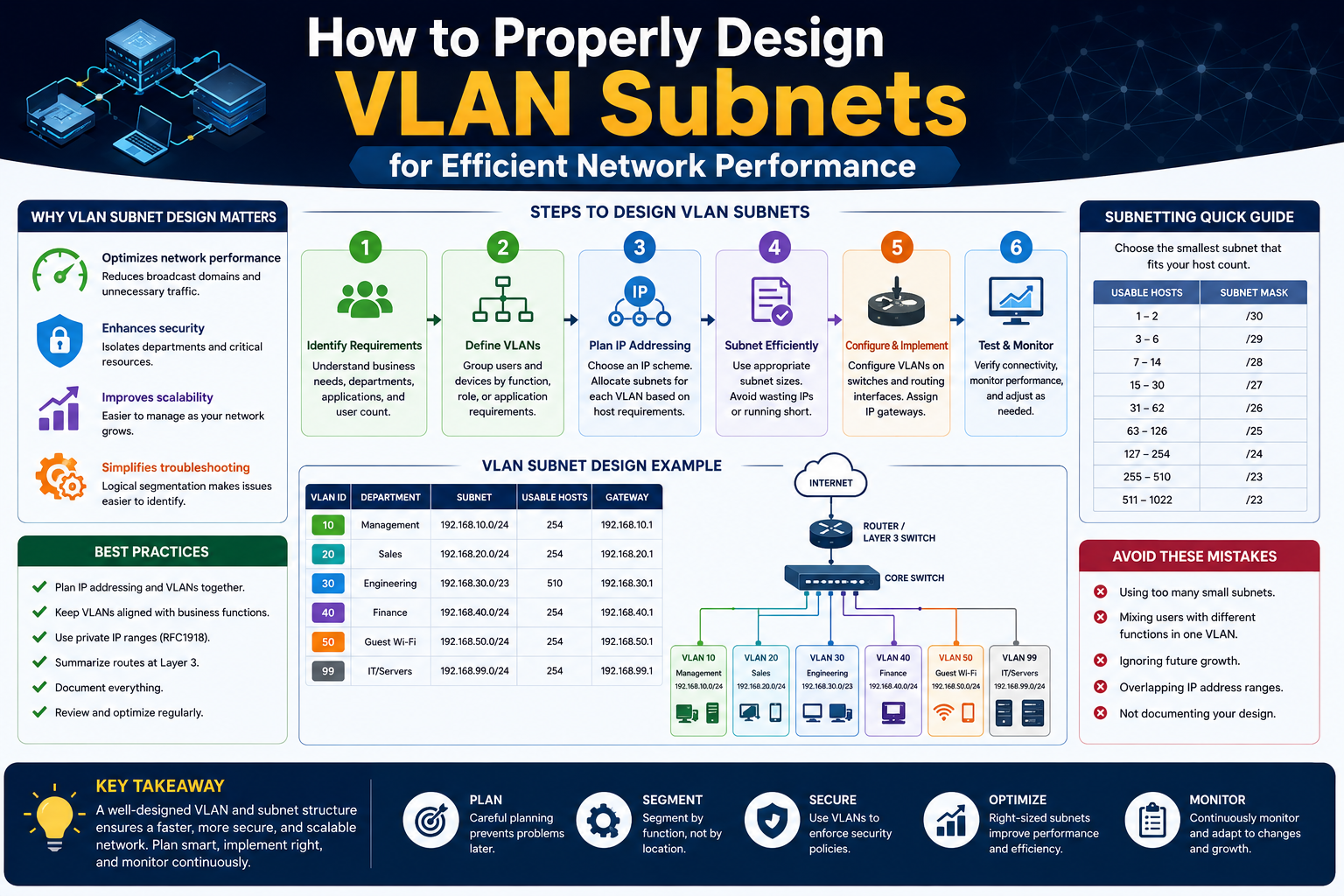
In modern networking environments, VLANs and subnets are foundational building blocks that shape how data moves, how devices communicate, and how efficiently an organization’s infrastructure performs. Although they operate at different layers of the networking model, they are deeply interconnected in real-world network design. VLANs define logical separation at the data link layer, while subnets define logical separation at the network layer. When designed correctly, they complement each other to create structured, scalable, and secure networks.
One of the most critical aspects of designing such environments is selecting the appropriate subnet size for each VLAN. This is not just a mathematical exercise but a strategic decision that impacts performance, scalability, and manageability. Understanding how to align subnet sizes with VLAN requirements allows network engineers to avoid wasteful IP allocation, reduce broadcast overhead, and ensure smooth growth as organizational needs evolve.
Understanding the Relationship Between VLANs and Subnets
To properly design subnet sizes for VLANs, it is essential to first understand how these two concepts interact. A VLAN is essentially a logical grouping of devices that behave as if they are on the same physical network, even if they are located in different physical locations or connected to different switches. This logical grouping allows administrators to segment networks based on function, department, or security requirements rather than physical layout.
A subnet, on the other hand, defines how IP addresses are structured and divided within a network. It determines which portion of an IP address identifies the network itself and which portion identifies individual devices within that network. By adjusting the subnet mask, network designers control the number of available IP addresses in a given segment.
When VLANs and subnets are aligned, each VLAN typically corresponds to a unique subnet. This alignment ensures that traffic within a VLAN stays within its designated IP range, while inter-VLAN communication can be controlled through routing devices. Without this alignment, network management becomes chaotic, leading to routing inefficiencies, security issues, and troubleshooting difficulties.
In practical terms, VLANs define “who can talk together,” while subnets define “how they are addressed.” When both are properly mapped, they create a predictable and organized network structure.
Why Subnet Planning Matters in VLAN Design
Subnet planning is not just a technical detail; it is a critical part of network architecture. Poor subnet design can lead to IP address exhaustion, inefficient routing, unnecessary complexity, and even network downtime. On the other hand, well-planned subnet allocation ensures that VLANs operate efficiently and can scale without requiring frequent redesigns.
One of the main reasons subnet planning is so important is that IP addresses are finite within any given private network. If a subnet is too small, it may quickly run out of available addresses, especially in environments where devices such as phones, laptops, printers, IoT devices, and virtual machines are constantly added. If a subnet is too large, it may waste address space and increase broadcast traffic, which can degrade performance.
Subnet planning also plays a role in security. By properly segmenting VLANs into appropriately sized subnets, administrators can enforce strict access control policies. For example, guest networks can be isolated in their own subnet, preventing them from accessing internal systems. Similarly, sensitive systems like servers or management interfaces can be placed in tightly controlled subnets with limited access.
Additionally, subnet planning supports troubleshooting and maintenance. When each VLAN has a clearly defined and appropriately sized subnet, identifying network issues becomes significantly easier. Engineers can quickly determine whether a problem is localized to a specific segment or affects multiple VLANs.
Ultimately, subnet planning ensures that the network remains structured, scalable, and manageable over time.
Breaking Down Network Requirements Before Choosing Subnet Sizes
Before deciding on subnet sizes for VLANs, it is necessary to carefully analyze the requirements of the network. This step is often overlooked, but it is the foundation of effective design. Without understanding how many devices will exist in each VLAN and how those devices will grow over time, subnet allocation becomes guesswork.
The first step in requirement analysis is identifying the types of VLANs needed. Most organizational networks include several common VLAN categories such as user VLANs, voice VLANs, server VLANs, guest VLANs, and management VLANs. Each of these serves a different purpose and has different scaling needs.
User VLANs typically contain employee devices such as laptops and desktops. These VLANs tend to grow gradually as organizations hire more staff or add more devices per user. Voice VLANs, on the other hand, are used for IP phones and may scale in a more predictable one-device-per-user pattern.
Server VLANs usually contain a smaller number of high-value systems, but these systems often require more careful planning due to their critical role. Guest VLANs can be highly unpredictable because guest device counts fluctuate frequently, especially in environments like offices, campuses, or public facilities.
Once VLAN types are identified, the next step is estimating current and future device counts. This is where many network designs fail, as they only consider present requirements. A properly designed subnet should account not only for current devices but also for expected growth over several years. This avoids the need for frequent readdressing or network redesign.
Another important consideration is the nature of the devices themselves. Some environments include a high number of transient devices, such as mobile phones or temporary connections. Others include more stable devices that rarely change. Understanding this behavior helps determine whether a subnet should be flexible or tightly controlled.
Finally, network designers must also consider potential architectural changes. For example, a small office network might eventually expand into multiple branches or integrate cloud services. Subnet planning should always anticipate these possibilities.
How Host Requirements Influence Subnet Selection
One of the most direct factors in selecting subnet sizes is the number of hosts that each VLAN must support. Every subnet provides a fixed number of usable IP addresses, and this number must align with the expected number of devices.
A key principle in subnet design is to avoid both under-allocation and over-allocation. Under-allocation occurs when a subnet does not provide enough IP addresses for all devices, leading to connectivity issues and administrative overhead. Over-allocation occurs when a subnet provides far more addresses than needed, which can waste address space and complicate network management.
For example, a small office VLAN might only require support for a few dozen devices. In such cases, a smaller subnet is appropriate because it minimizes wasted addresses and reduces unnecessary network broadcast scope. In contrast, a large enterprise user VLAN might require hundreds or even thousands of addresses, making a larger subnet more suitable.
However, host requirements are not static. They evolve as organizations grow, adopt new technologies, and introduce additional device types. This means subnet selection should always include a buffer to accommodate future expansion.
Another important factor is device density within VLANs. Some VLANs may have a high concentration of devices per user, such as environments where employees use multiple endpoints like laptops, smartphones, and virtual machines. In these cases, subnet sizing must reflect the total device footprint rather than just the number of users.
Network designers must also consider special cases such as IoT deployments. IoT devices often increase rapidly in number and can quickly consume IP address space if not properly planned for. These devices may also be distributed across multiple VLANs depending on security requirements, further influencing subnet design decisions.
Ultimately, host requirements serve as the primary quantitative driver for subnet selection, but they must always be interpreted within the broader context of network growth and design strategy.
Common Subnet Sizes and Their Practical VLAN Use Cases
In real-world networking, certain subnet sizes are used more frequently than others due to their balance between efficiency and scalability. While subnetting allows for a wide range of configurations, practical deployments tend to favor a few standard sizes.
Smaller subnets are often used in tightly controlled environments where device counts are low and predictable. These are commonly found in point-to-point links or specialized network segments where only a few devices need connectivity. Such subnets minimize wasted IP space and reduce unnecessary broadcast traffic.
Medium-sized subnets are widely used in departmental VLANs where the number of devices is moderate and relatively stable. These subnets are often ideal for small to medium business environments, where each department, such as HR, finance, or operations, may require its own network segment.
Larger subnets are typically used in high-density environments such as corporate user VLANs, guest networks, or wireless access networks. These environments often experience unpredictable growth and require a large pool of IP addresses to accommodate fluctuating device counts.
The selection between small, medium, and large subnet sizes is not arbitrary. It is based on careful evaluation of device density, expected growth, and network behavior. For example, guest networks often require larger subnets because they must accommodate a high number of temporary devices, even if most users only connect briefly.
Similarly, internal user VLANs in larger organizations often require more IP addresses than initially expected due to the presence of multiple devices per user, including laptops, smartphones, tablets, and virtual machines.
Choosing the correct subnet size is therefore not just about current usage but about anticipating real-world behavior and ensuring that the network remains functional under varying conditions.
Designing VLAN Segments Based on Traffic Types
Another important factor in subnet selection is the type of traffic each VLAN is expected to carry. Different types of network traffic place different demands on IP addressing, scalability, and performance.
For example, voice traffic VLANs are typically designed for real-time communication. These VLANs require stable and predictable addressing but usually do not require extremely large subnets, as the number of voice devices is often closely tied to the number of users.
Data VLANs, which carry general user traffic, are much more dynamic. They may include a wide range of devices and applications, from simple browsing sessions to large-scale data transfers. These VLANs often require larger subnets to accommodate variability in device usage.
Server VLANs are typically more stable but require careful planning. While they may not require large numbers of IP addresses, they often demand high availability and strict segmentation. Subnet size in these VLANs is usually determined by planned infrastructure rather than user-driven growth.
Guest VLANs are among the most unpredictable. They must be large enough to accommodate spikes in usage, especially in environments where visitors or external devices frequently connect to the network. Because of this unpredictability, guest VLANs often use larger subnets even if average usage is relatively low.
Management VLANs, which handle administrative access to network devices, are usually small and tightly controlled. These VLANs prioritize security over scalability, meaning subnet sizes are kept minimal to reduce exposure and simplify access control.
By analyzing traffic types, network designers can make more informed decisions about subnet allocation, ensuring that each VLAN is optimized for its specific role.
Scalability Considerations and Future Growth Planning
One of the most important aspects of subnet selection for VLANs is scalability. Networks are not static systems; they evolve as organizations grow, adopt new technologies, and change operational requirements.
A well-designed subnet strategy always includes room for growth. This means avoiding overly tight subnet allocations that might work in the present but fail under future expansion. It also means avoiding excessive over-allocation that wastes valuable IP space.
Scalability planning often involves anticipating not just the number of devices but also the types of devices that may be added in the future. For example, the rise of IoT, cloud-based services, and remote work has significantly increased the number of network-connected devices in modern environments.
Another important scalability consideration is network segmentation. As organizations grow, they often introduce additional VLANs to separate departments, applications, or security zones. Subnet design must accommodate this segmentation without requiring a complete redesign.
Good scalability planning also considers routing efficiency. Larger networks with multiple VLANs require careful planning to ensure that routing tables remain manageable and that network performance is not degraded by overly complex addressing schemes.
Ultimately, scalability is about balance. The goal is to design a subnet structure that is flexible enough to accommodate growth while remaining efficient and easy to manage.
Common Mistakes in VLAN Subnet Design
Despite the importance of subnet planning, several common mistakes frequently occur in real-world network design. One of the most common mistakes is underestimating future growth. Network designers may allocate subnets based solely on current requirements, only to find that they quickly run out of IP addresses as the network expands.
Another common issue is over-segmentation. While dividing networks into many VLANs can improve security and organization, excessive segmentation can lead to unnecessary complexity. Each VLAN requires its own subnet, and too many small subnets can make routing and management more difficult.
A further mistake is ignoring traffic behavior. Some networks allocate subnets based purely on device counts without considering how those devices interact. This can lead to inefficient designs where high-traffic VLANs are under-resourced while low-traffic VLANs consume excessive address space.
Inconsistent subnet sizing is another issue. When VLANs are assigned arbitrary subnet sizes without a clear strategy, the result is often a fragmented and difficult-to-manage IP structure.
Finally, failing to align VLANs and subnets properly can create significant operational challenges. When these two components are not synchronized, troubleshooting becomes more difficult, and network policies become harder to enforce.
By avoiding these mistakes and focusing on structured planning, network designers can create VLAN and subnet architectures that are both efficient and resilient.
Designing a Structured Subnetting Strategy for VLAN Environments
Once the foundational relationship between VLANs and subnets is understood, the next step is building a structured strategy for assigning IP ranges in a way that supports both operational efficiency and long-term scalability. This is where subnet design moves from basic planning into real architectural thinking.
A VLAN environment is rarely static. Even in small organizations, departments expand, devices multiply, and new services are introduced regularly. Without a structured subnetting strategy, VLANs quickly become chaotic, with overlapping ranges, wasted address space, and routing inefficiencies.
A strong subnetting strategy begins by treating the entire network as a hierarchical system rather than a flat collection of VLANs. Each VLAN is assigned a role, and each role determines the appropriate subnet size. Instead of assigning IP ranges randomly or reactively, network designers must plan proactively using structured blocks of address space.
One of the most effective approaches is to reserve larger contiguous address spaces for entire groups of VLANs. Within those blocks, smaller subnets can be carved out as needed. This creates a predictable structure that simplifies routing, troubleshooting, and future expansion.
For example, a network might allocate a large private address block for all internal operations and then subdivide it into VLAN-specific ranges. This ensures that even as VLANs grow or change, the overall structure remains consistent and easy to manage.
This structured approach also reduces fragmentation. Fragmentation occurs when IP ranges are scattered across unrelated sections of the address space, making summarization and routing more complex. By maintaining contiguous blocks, administrators can reduce routing overhead and improve network efficiency.
Applying Hierarchical Network Design to VLAN Subnet Planning
Hierarchical design is one of the most important principles in modern networking, especially when dealing with VLANs and subnets at scale. It organizes the network into layers, each with a specific purpose and level of control.
At the highest level, networks are divided into major functional blocks. These may represent different sites, departments, or geographic regions. Within each of these blocks, VLANs are created to further segment traffic based on function or security requirements.
Subnetting plays a critical role in maintaining this hierarchy. Each level of the hierarchy is assigned a range of IP addresses that can be further subdivided without breaking the overall structure.
For example, a large enterprise might allocate a specific address range for an entire office location. Within that range, separate subnets are assigned to departments such as engineering, finance, and HR. Each department VLAN then receives its own subnet based on device density and growth expectations.
This layered approach simplifies routing because routers can summarize entire blocks of addresses rather than handling individual subnets separately. It also improves scalability because new VLANs can be added within existing hierarchical boundaries without redesigning the entire network.
Hierarchical design also improves fault isolation. If a problem occurs within a specific VLAN or subnet, it is easier to identify the affected layer and isolate the issue without impacting the rest of the network.
In addition, hierarchical subnet planning supports better security segmentation. Sensitive VLANs can be placed in controlled layers with restricted access, while less critical VLANs can be more open or flexible.
The Role of Variable Length Subnet Masking in VLAN Design
Variable Length Subnet Masking (VLSM) is a key technique that allows network designers to allocate IP addresses more efficiently. Instead of using a single fixed subnet size across all VLANs, VLSM allows different VLANs to use different subnet sizes based on actual requirements.
This flexibility is essential in modern networks, where VLANs often vary significantly in size. For example, a server VLAN might only need a small number of IP addresses, while a guest VLAN might require hundreds or thousands.
Without VLSM, networks would be forced to use uniform subnet sizes, leading to significant IP waste. With VLSM, each VLAN can be sized appropriately, ensuring optimal use of address space.
The process of implementing VLSM begins with identifying the largest VLAN requirement and allocating a subnet large enough to accommodate it. Once that is done, the remaining address space is divided into progressively smaller subnets for other VLANs.
This hierarchical allocation ensures that large VLANs are supported without constraining smaller ones. It also prevents fragmentation by keeping related subnets grouped within the same address block.
However, VLSM requires careful planning. Poorly designed VLSM structures can lead to overlapping subnets or inefficient routing. It is essential to maintain a clear map of all allocated ranges and ensure that each VLAN is properly documented.
When used correctly, VLSM significantly improves IP efficiency and allows networks to scale smoothly without frequent redesigns.
Aligning Broadcast Domains with VLAN Subnet Boundaries
One of the primary reasons VLANs and subnets are used together is to control broadcast domains. A broadcast domain is a segment of a network where broadcast traffic is forwarded to all devices within that segment.
Large broadcast domains can become inefficient because every broadcast packet must be processed by all devices within the domain. This can lead to unnecessary network overhead and reduced performance.
By aligning VLANs with subnets, network designers ensure that each broadcast domain is properly contained. Devices within a VLAN share the same subnet, and broadcast traffic remains within that boundary unless explicitly routed.
This alignment is critical for performance optimization. When VLANs are properly segmented, broadcast traffic is reduced, and devices only receive relevant network communication.
However, subnet size also plays a role in broadcast efficiency. Very large subnets can still create large broadcast domains, even if they are logically segmented by VLANs. This is why subnet sizing must balance address availability with broadcast control.
In environments with high device density, careful consideration must be given to how large each broadcast domain should be. Smaller subnets reduce broadcast scope but may limit scalability. Larger subnets increase scalability but may introduce more broadcast traffic.
The optimal design depends on the specific needs of the network, including device behavior, application requirements, and performance expectations.
IP Address Planning Across Multiple VLAN Layers
Effective VLAN subnet design requires careful IP address planning across multiple layers of the network. This involves not only assigning subnets to VLANs but also ensuring that the overall IP structure remains organized and scalable.
A common approach is to divide the private IP address space into logical blocks based on function. Each block is reserved for a specific category of VLANs, such as user networks, server networks, or guest networks.
Within each block, individual subnets are assigned based on VLAN requirements. This creates a predictable structure that simplifies management and reduces the risk of overlap.
IP planning also involves considering future expansion. Even if a VLAN currently requires only a small subnet, it may need more addresses in the future. Allocating slightly larger blocks than currently needed can prevent future restructuring.
Another important consideration is consistency. Using consistent subnet sizes for similar VLAN types simplifies troubleshooting and documentation. For example, all user VLANs might use one standard subnet size, while all guest VLANs use another.
Consistency also helps with automation and network management tools, which often rely on predictable structures to function efficiently.
Finally, IP planning must account for routing efficiency. Aggregating subnets into larger blocks allows routers to use summarized routes, reducing routing table size and improving performance.
Optimizing Subnet Allocation for Multi-Department VLAN Environments
In multi-department environments, VLAN subnet allocation becomes more complex because each department has unique requirements. Some departments may have many users and devices, while others may have only a few.
A common mistake is to assign equal subnet sizes to all departments regardless of their actual needs. This leads to inefficient use of IP addresses and unnecessary complexity.
A better approach is to analyze each department individually and assign subnet sizes based on real usage patterns. For example, engineering departments may require larger subnets due to the presence of development systems, virtual machines, and testing environments. Administrative departments may require smaller subnets with fewer devices.
It is also important to consider the growth rate of each department. Departments that are expanding rapidly should be allocated larger subnets to accommodate future growth, while stable departments can use smaller allocations.
Another factor is inter-departmental communication. Departments that frequently communicate may benefit from being placed in adjacent IP ranges, which can simplify routing and filtering rules.
In addition, security requirements must be considered. Sensitive departments such as finance or human resources may require stricter segmentation, even if their device count is small. This may influence both VLAN design and subnet sizing.
By tailoring subnet allocation to departmental needs, network designers can create a more efficient and secure environment that reflects real-world organizational structure.
DHCP Planning and Its Impact on VLAN Subnet Sizing
Dynamic Host Configuration Protocol (DHCP) plays a significant role in how subnets are used within VLANs. DHCP automatically assigns IP addresses to devices, reducing the need for manual configuration.
When designing VLAN subnets, it is important to consider how DHCP pools will be structured within each subnet. The size of the subnet directly determines how many addresses are available for DHCP allocation.
If a subnet is too small, DHCP pools may become exhausted, leading to connectivity issues for new devices. If a subnet is too large, DHCP may allocate unnecessary address space, reducing efficiency.
DHCP planning also involves reservation strategies. Some devices, such as printers or servers, may require static or reserved IP addresses within a subnet. These reservations must be accounted for when calculating available DHCP space.
Another important consideration is lease duration. In high-turnover environments like guest VLANs, shorter lease times may be used to recycle IP addresses more efficiently. In stable environments, longer lease times may be more appropriate.
DHCP scope design must also align with VLAN boundaries. Each VLAN typically has its own DHCP scope to ensure proper segmentation and avoid address conflicts.
By integrating DHCP planning with subnet design, network administrators can ensure smooth IP allocation and efficient resource utilization across all VLANs.
Managing Growth and Readdressing Challenges in VLAN Networks
As networks grow, one of the biggest challenges is managing IP address exhaustion and avoiding the need for large-scale readdressing. Poor subnet planning often leads to situations where VLANs must be reconfigured entirely due to insufficient address space.
Readdressing is a complex and disruptive process. It involves changing IP addresses across multiple devices, updating routing configurations, and potentially modifying security policies. In large networks, this can lead to downtime and operational disruption.
To avoid these issues, subnet design must always include growth margins. Even if a VLAN does not currently require a large number of addresses, allocating additional space can prevent future problems.
Another strategy is to use flexible addressing schemes that allow for expansion without reconfiguration. This can include reserving adjacent subnets or using larger address blocks that can be subdivided later.
It is also important to monitor IP usage over time. Regular analysis of subnet utilization can help identify VLANs that are approaching capacity, allowing proactive adjustments before issues arise.
In some cases, network designers may also implement migration strategies that allow a gradual transition to new subnet structures without full downtime. This requires careful planning and coordination but can significantly reduce disruption.
Ultimately, managing growth is about anticipating change and designing VLAN subnet structures that can evolve without breaking the network.
Improving Routing Efficiency Through Subnet Aggregation
Subnet aggregation, also known as route summarization, is a technique used to reduce the complexity of routing tables in large VLAN environments. Instead of advertising individual subnets separately, multiple subnets are combined into a single summarized route.
This improves routing efficiency by reducing the number of entries that routers must process. It also simplifies network topology and reduces memory and CPU usage on routing devices.
For subnet aggregation to work effectively, VLAN subnets must be designed in a contiguous and hierarchical manner. Disorganized or fragmented subnets make summarization difficult or impossible.
Proper VLAN subnet planning ensures that related subnets fall within predictable address ranges. This allows routers to advertise a single summary route that represents multiple VLANs.
Aggregation also improves network stability. Fewer routing updates are required, and changes in one VLAN are less likely to impact the entire network.
However, aggregation must be balanced with visibility. Over-aggregation can obscure network structure and make troubleshooting more difficult. The goal is to find a balance between efficiency and transparency.
When implemented correctly, subnet aggregation significantly improves scalability and performance in large VLAN-based networks.
Refining VLAN Subnet Allocation for Real-World Network Behavior
After establishing structured subnetting strategies and hierarchical planning, the next layer of design focuses on real-world behavior. Networks rarely operate exactly as planned on paper. Device counts fluctuate, users behave unpredictably, and application demands evolve. This is where VLAN subnet design must move from theoretical planning into adaptive engineering.
One of the most important refinements in subnet allocation is recognizing that not all VLANs experience growth in the same way. Some VLANs remain stable for long periods, while others expand rapidly due to user behavior or technology adoption. For example, a user VLAN in an office environment might slowly increase as the organization hires new employees. In contrast, a guest VLAN can spike unpredictably during meetings, events, or peak operational hours.
This difference in behavior requires subnet designs that are flexible rather than rigid. A VLAN that appears small today may become one of the largest consumers of IP addresses tomorrow. Designing with this variability in mind ensures that networks remain functional even during unexpected surges in demand.
Another important aspect of real-world subnet behavior is device diversity. Modern networks are no longer limited to traditional desktops and servers. They now include smartphones, tablets, IoT sensors, wireless controllers, virtual machines, and cloud-connected endpoints. Each of these contributes to IP consumption in different ways.
For example, IoT devices often remain permanently connected and do not release IP addresses frequently. Mobile devices, however, may connect and disconnect multiple times a day. Virtual environments can dynamically create and destroy interfaces, further complicating IP usage patterns. These differences must be reflected in VLAN subnet design to avoid congestion or exhaustion.
Understanding these patterns allows network engineers to move beyond static assumptions and design subnets that match real operational conditions.
Balancing Efficiency and Flexibility in VLAN Subnet Design
One of the most difficult challenges in subnet design is balancing efficiency with flexibility. Efficiency focuses on minimizing wasted IP addresses, while flexibility ensures that the network can grow and adapt without disruption. These two goals often conflict with each other.
A highly efficient subnet design uses IP space very precisely. Each VLAN is assigned just enough addresses to meet current requirements, with minimal unused capacity. While this approach appears ideal on paper, it often leads to problems in real environments. Even small increases in device count can cause address exhaustion, forcing immediate redesign.
On the other hand, a highly flexible design allocates large subnet blocks to each VLAN, ensuring that growth is always possible. However, this can lead to inefficient use of IP space, especially in smaller environments where many addresses remain unused.
The optimal approach lies between these two extremes. Subnets should be sized based on realistic growth expectations rather than only current usage. This requires careful analysis of historical trends, organizational growth patterns, and device behavior.
For example, a VLAN supporting internal users might be allocated additional capacity beyond current needs because user counts tend to grow steadily. A server VLAN, however, may remain relatively stable and require less aggressive scaling.
Flexibility also involves designing subnet boundaries that can expand without major restructuring. This means avoiding tightly packed address allocations that leave no room for adjacent growth. Instead, subnet blocks should be spaced in a way that allows future expansion into nearby ranges.
By combining efficiency with flexibility, network designers can create VLAN subnet structures that remain functional and scalable over time.
The Impact of Network Segmentation on Subnet Planning
Network segmentation is one of the core reasons VLANs and subnets are used together. By dividing a network into smaller, isolated segments, administrators gain better control over traffic flow, security, and performance. However, segmentation also directly influences subnet planning.
Each VLAN represents a segmented portion of the network, and each segment requires its own subnet. The number of VLANs in a network, therefore, determines how many subnets must be planned and managed.
In highly segmented environments, subnet planning becomes more complex because each VLAN may serve a unique purpose. For example, a single organization might have separate VLANs for engineering, finance, HR, guest access, wireless devices, IoT systems, and management infrastructure. Each of these requires careful subnet sizing based on its role and expected traffic load.
Segmentation also introduces security considerations. Sensitive VLANs must be isolated not only logically but also in terms of IP structure. This ensures that access controls and firewall rules can be applied consistently across the network.
Another important factor is traffic containment. Proper segmentation ensures that broadcast traffic remains within each VLAN, reducing unnecessary load on the network. However, overly fragmented segmentation can lead to excessive routing complexity, which can negatively impact performance.
Subnet planning must therefore align with segmentation goals. Each VLAN should represent a meaningful functional or security boundary, and each subnet should support that boundary without introducing unnecessary complexity.
Address Conservation Techniques in VLAN Subnet Design
Even though modern networks have access to large private IP ranges, efficient address conservation remains an important design principle. Poor subnet planning can still lead to waste, fragmentation, and unnecessary complexity.
One of the most effective conservation techniques is right-sizing VLAN subnets. This involves selecting subnet sizes that closely match actual device requirements while still allowing room for moderate growth. It prevents excessive allocation of unused addresses while avoiding frequent reconfiguration.
Another technique is grouping similar VLANs into shared address blocks. Instead of scattering VLAN subnets across different parts of the IP space, related VLANs can be placed within contiguous ranges. This improves organization and allows for easier summarization.
Network designers can also reuse certain subnet structures in isolated environments. For example, guest VLANs in different locations can use identical subnet ranges because they are not routed between sites. This reduces planning complexity and ensures consistency across deployments.
Address conservation also involves avoiding unnecessary VLAN creation. While segmentation is important, creating too many VLANs can lead to inefficient IP usage and increased administrative overhead. Each VLAN requires its own subnet, routing configuration, and management policies.
By carefully evaluating whether a new VLAN is truly necessary, network designers can prevent unnecessary subnet expansion.
Adapting VLAN Subnet Design for Wireless and Mobile Environments
Wireless networks introduce unique challenges for VLAN subnet design due to their dynamic and unpredictable nature. Unlike wired networks, where devices remain relatively stable, wireless environments experience constant device movement, connection changes, and fluctuating usage patterns.
In wireless VLANs, device density can change rapidly. A single access point may serve dozens or even hundreds of devices at peak times. This requires subnets that are large enough to accommodate sudden spikes in connectivity.
Mobile users also contribute to variability. Devices frequently disconnect and reconnect as users move between access points or leave and re-enter coverage areas. This behavior increases IP churn and requires DHCP systems to efficiently recycle addresses.
Another consideration is roaming behavior. In enterprise wireless networks, users often move between different physical locations while maintaining connectivity. VLAN and subnet design must support seamless roaming without requiring IP reassignment that could disrupt sessions.
Wireless VLANs also tend to carry mixed traffic types, including voice, video, and data. This diversity increases demand on subnet resources and requires careful planning to ensure consistent performance.
Because of these factors, wireless VLANs often use larger subnets compared to wired segments, even if the average number of active devices appears similar. This ensures that peak demand can be supported without service degradation.
VLAN Subnet Design for Security Segmentation
Security is one of the most important drivers of VLAN and subnet design. Proper segmentation helps protect sensitive systems, restrict unauthorized access, and enforce organizational policies.
In secure network environments, VLANs are often used to isolate critical systems such as servers, administrative interfaces, and financial systems. Each of these VLANs is assigned a dedicated subnet that is tightly controlled through routing policies and firewall rules.
Subnet size in security-focused VLANs is often smaller because the number of devices is limited. However, the importance of strict control outweighs the need for large address pools. The goal is not scalability but containment and protection.
Security segmentation also extends to guest networks. These VLANs are isolated from internal systems to prevent unauthorized access. Even though guest VLANs may use larger subnets, they are heavily restricted in terms of routing and access permissions.
Another important security consideration is minimizing the attack surface. Smaller, well-defined subnets reduce the number of potential entry points and make monitoring easier. This improves detection of unusual activity and simplifies incident response.
Subnet design must therefore align closely with security architecture. Each VLAN should represent a clearly defined security boundary, and each subnet should reinforce that boundary through isolation and controlled access.
Conclusion
Selecting subnet sizes for VLANs is not a standalone technical task—it is a foundational part of designing a stable, scalable, and efficient network. Every decision made during subnet planning directly influences how well a network performs, how easily it can be managed, and how effectively it can grow over time. When VLANs and subnets are aligned properly, they create a structured environment where traffic flows logically, resources are used efficiently, and administrative control becomes significantly easier.
A well-planned subnet strategy begins with understanding real-world requirements rather than relying solely on theoretical values. Device counts, user behavior, application demands, and organizational growth all play a critical role in determining appropriate subnet sizes. Underestimating these factors can quickly lead to IP exhaustion and network disruptions, while overestimating them can waste valuable address space and introduce unnecessary complexity.
The relationship between VLANs and subnets also highlights the importance of segmentation. Each VLAN represents a logical boundary, and each subnet reinforces that boundary through structured IP allocation. This alignment improves security, reduces broadcast traffic, and simplifies troubleshooting by ensuring that network segments remain clearly defined and isolated.
At the same time, subnet design must remain flexible. Modern networks are dynamic, with constantly changing device types, mobility patterns, and traffic loads. Wireless devices, IoT systems, and cloud-integrated services all contribute to unpredictable growth patterns. A rigid subnet structure cannot adapt to these changes effectively, which is why scalability and forward planning are essential.
Ultimately, successful VLAN subnet design is about balance—balancing efficiency with flexibility, structure with adaptability, and current needs with future growth. Networks that follow this principle remain easier to manage, more secure, and better prepared for long-term expansion.
By carefully aligning subnet sizes with VLAN requirements and considering real-world behavior, network designers can build infrastructures that are not only functional today but also resilient for the future.