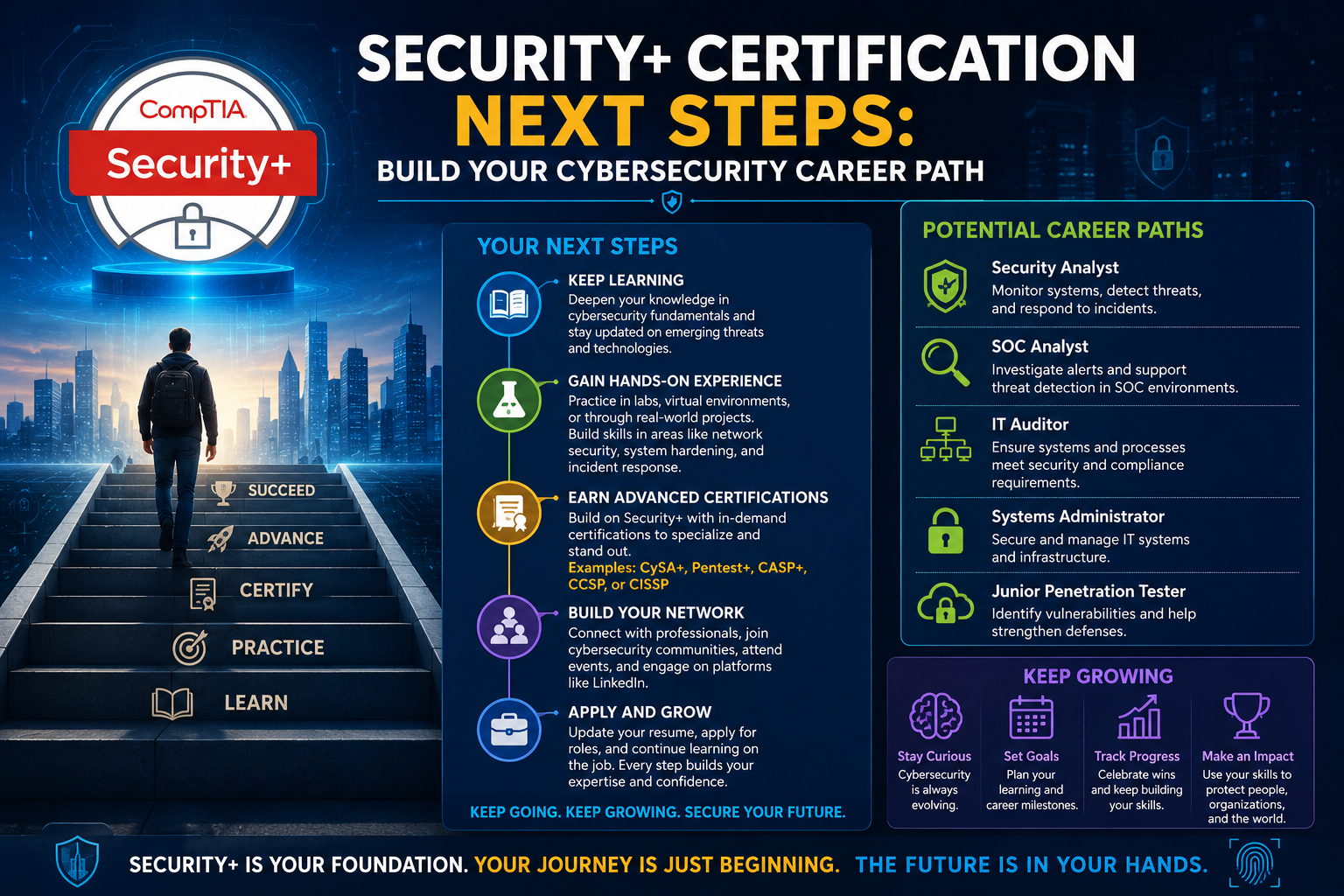
Earning a cybersecurity certification such as Security+ is often the moment when many IT professionals begin to see their career in a different light. It marks a shift from general technical awareness to a more structured understanding of how systems are protected, how risks are identified, and how organizations respond to threats. In today’s digital environment, where nearly every business depends on secure infrastructure, this type of certification acts as a strong signal that a candidate is ready to take on security responsibilities.
Security+ is widely recognized because it validates foundational cybersecurity knowledge. It does not focus on a single vendor or technology, which makes it flexible and applicable across many environments. This is especially important in workplaces where different tools, operating systems, and network configurations are used together. Employers often view this certification as proof that an individual understands core principles such as access control, risk management, cryptography basics, and incident response concepts.
However, what truly makes this certification valuable is not only what it teaches, but what it enables. It creates a starting point for a career that can move in multiple directions—technical, managerial, or specialized. Many professionals assume that certification alone guarantees advancement, but in reality, it functions more like a foundation. What comes after is where long-term career growth is actually shaped.
After achieving Security+, professionals often find themselves at a crossroads. Some choose to continue building hands-on technical expertise, while others move toward governance, auditing, or security analysis roles. Understanding this flexibility is essential because it allows individuals to make intentional decisions rather than random job moves.
Building Foundational Skills After Certification
Once Security+ is completed, the next important phase is strengthening practical skills. While the certification provides theoretical knowledge, real-world environments demand the ability to apply that knowledge under pressure. This is where learning becomes more experiential and less structured.
At this stage, professionals benefit greatly from improving their understanding of operating systems, particularly Windows and Linux environments. Security operations are deeply tied to how systems behave, how logs are generated, and how unauthorized access attempts can be identified. Without familiarity with these environments, it becomes difficult to interpret security events effectively.
Networking knowledge also becomes increasingly important. Even though Security+ introduces basic networking concepts, real-world scenarios require deeper insight. Understanding how data flows through routers, switches, firewalls, and cloud systems allows security professionals to identify anomalies more accurately. Many security incidents are, at their core, network-related issues such as unauthorized access, misconfigured ports, or unusual traffic patterns.
Another key area of development is analytical thinking. Cybersecurity is not just about tools; it is about interpreting patterns. For example, identifying whether a login attempt is legitimate or malicious requires context, history, and behavioral understanding. This skill develops gradually through exposure to real incidents, troubleshooting exercises, and guided experience in IT environments.
Communication skills also begin to matter more at this stage. Security professionals often need to explain risks to non-technical stakeholders. Being able to describe a technical issue in simple terms is a powerful ability that influences decision-making within organizations.
Entry-Level Opportunities in Cybersecurity
After obtaining Security+, many professionals explore entry-level roles that serve as stepping stones into the broader cybersecurity field. These positions are critical because they provide exposure to real systems, real threats, and real organizational structures.
One of the most common starting points is a help desk or technical support role. While this may not appear directly related to cybersecurity at first glance, it plays an important role in building foundational troubleshooting experience. Help desk professionals interact with users, resolve system issues, and learn how different applications behave in real environments. This exposure becomes valuable when transitioning into security-focused responsibilities.
Another common pathway is internships or volunteer technical work. These opportunities allow individuals to gain experience without requiring extensive prior job history. Working with smaller organizations, nonprofits, or community systems helps build confidence while also developing a practical understanding of IT operations.
In some cases, Security+ holders may qualify for entry-level systems administration roles. These positions involve managing user accounts, maintaining servers, applying updates, and ensuring system availability. Systems administration is closely connected to security because administrators are often responsible for implementing security policies, controlling access, and monitoring system health.
There are also junior security-focused roles available in some organizations. These positions may involve monitoring security alerts, assisting with incident response, or maintaining security tools. Although responsibilities are often limited at this level, the exposure to security operations is extremely valuable for long-term growth.
The key point at this stage is not the job title itself, but the experience gained. Every interaction with systems, users, and security tools contributes to building a professional foundation that supports future advancement.
Transitioning Into Systems and Network Security Roles
As experience grows, professionals often transition into more specialized roles that focus on systems and network security. This stage represents a shift from general IT support to more targeted security responsibilities.
One common role at this level is a network security engineer. This position involves designing and maintaining secure network infrastructure. Responsibilities may include configuring firewalls, managing intrusion detection systems, and ensuring secure communication between internal and external systems. Understanding how networks operate becomes essential because most cyber threats exploit weaknesses in connectivity.
Another role is that of a systems security administrator. In this position, professionals focus on securing operating systems, managing patches, controlling access permissions, and monitoring system behavior for suspicious activity. This role requires strong attention to detail and a solid understanding of system architecture.
Information security analysts also play a critical role in this stage of career development. These professionals monitor security alerts, investigate potential threats, and respond to incidents. They often work in security operations centers where real-time monitoring is a key responsibility. The ability to analyze logs, identify patterns, and respond quickly is essential.
IT auditing roles are also part of this progression. Security auditors evaluate whether systems comply with organizational policies and industry standards. They assess risks, identify vulnerabilities, and recommend improvements. This role requires both technical understanding and a structured approach to evaluation.
As professionals move through these roles, they begin to develop a clearer understanding of how different security domains connect. Network security, system security, application security, and compliance all work together to form a complete security posture.
Growing Toward Security Specialization
With more experience, professionals often begin to specialize in specific areas of cybersecurity. This is where career paths start to diverge significantly based on interest, strengths, and organizational needs.
One specialization path is ethical hacking and penetration testing. Professionals in this area focus on identifying vulnerabilities before malicious attackers can exploit them. They simulate attacks, test system defenses, and provide recommendations for improvement. This role requires creativity, curiosity, and a strong understanding of how systems can be manipulated.
Another specialization is security architecture. Security architects design secure systems from the ground up. They determine how networks, applications, and infrastructure components should be structured to minimize risk. This role requires a strategic mindset and a deep understanding of both technical and business requirements.
Incident response is another important specialization. Professionals in this field handle active security breaches and coordinate recovery efforts. They analyze how attacks occurred, contain damage, and implement measures to prevent future incidents. This role is often high-pressure and requires strong decision-making skills.
Compliance and governance are also growing areas of specialization. Professionals in this field ensure that organizations follow legal, regulatory, and internal security standards. They often work closely with auditors and management teams to maintain proper documentation and security practices.
Each specialization requires different skill sets, but all are built on the foundational knowledge gained through early certifications and experience. Choosing a direction often depends on personal interest and exposure during early career stages.
Importance of Workplace Experience in Career Development
While certifications provide theoretical knowledge, workplace experience is what transforms that knowledge into practical skill. Every organization has unique systems, workflows, and security challenges. Exposure to these environments helps professionals understand how theory applies in real situations.
One of the most important aspects of workplace experience is learning how systems behave under normal conditions. Without this baseline, it becomes difficult to recognize abnormal activity. Over time, professionals develop intuition about what “normal” looks like, which is essential for identifying threats.
Collaboration is another key element of workplace growth. Cybersecurity is rarely an isolated function. It involves coordination between IT teams, management, developers, and external vendors. Learning how to work within these structures is essential for long-term success.
Documentation also plays a significant role. Security professionals are often required to record incidents, write reports, and maintain logs. This documentation becomes valuable for audits, investigations, and process improvements.
Workplace experience also exposes professionals to tools and technologies that may not be covered in certification material. Security information and event management systems, endpoint protection tools, and cloud security platforms are commonly used in real environments. Familiarity with these tools becomes increasingly important as careers progress.
Developing a Security-Oriented Mindset
Beyond technical skills, cybersecurity requires a specific way of thinking. This mindset focuses on risk awareness, attention to detail, and proactive problem-solving.
A security-oriented mindset involves constantly questioning how systems could be exploited. This does not mean assuming everything is unsafe, but rather understanding where weaknesses might exist. Professionals learn to think like both defenders and attackers, which helps them anticipate potential threats.
Attention to detail is another critical trait. Small misconfigurations, overlooked settings, or minor anomalies can often lead to significant security issues. Developing the ability to notice these details improves overall effectiveness in security roles.
Proactive thinking is also essential. Instead of reacting to incidents after they occur, security professionals aim to prevent them in the first place. This involves regular system reviews, updates, and continuous monitoring.
Over time, this mindset becomes second nature and significantly influences career success.
Early Career Strategy and Direction Planning
After Security+, career planning becomes an ongoing process rather than a one-time decision. Professionals must evaluate their interests, strengths, and available opportunities regularly.
Some may choose to focus on technical growth, building deeper expertise in networking, systems, or penetration testing. Others may lean toward managerial or compliance roles that involve coordination and policy enforcement. There is no single correct path, but making intentional decisions helps avoid stagnation.
Continuous learning remains important throughout this stage. Technology evolves rapidly, and security threats become more sophisticated over time. Staying updated ensures long-term relevance in the field.
Career progression is not always linear. It often involves shifts between roles, industries, and specializations. Each experience contributes to a broader understanding of cybersecurity as a whole, helping professionals build versatile and resilient careers.
Expanding Career Directions After Security+
After gaining Security+ and taking initial steps into IT security roles, the next phase of growth becomes less about entry and more about direction. At this stage, professionals begin to realize that cybersecurity is not a single career path but a collection of interconnected domains. Each domain represents a different way of contributing to organizational security, and each requires a slightly different combination of skills, mindset, and technical depth.
What makes this stage important is the shift from general exposure to intentional specialization. Instead of simply working within IT environments, professionals begin to identify patterns in what they enjoy and where they perform best. Some gravitate toward monitoring and defense, others toward system hardening, while some prefer investigative or analytical work. This natural differentiation is what shapes long-term success in cybersecurity.
Another key change at this stage is responsibility. Early roles often involve assisting or supporting existing systems. As professionals progress, they begin to take ownership of specific security functions. This may include managing security alerts, maintaining infrastructure integrity, or contributing to organizational risk assessments. With this responsibility comes the expectation of deeper technical understanding and more consistent decision-making.
Career growth beyond Security+ is also influenced by how quickly professionals adapt to evolving threats. Cybersecurity is a constantly shifting field where attack methods change regularly. Staying static is not an option. Those who progress successfully are usually those who continuously refine their understanding of both defensive and offensive techniques.
Strengthening Core Cybersecurity Domains in Operational Roles
One of the most important stages after Security+ involves developing expertise within core operational security domains. These domains form the backbone of most cybersecurity teams and include monitoring, detection, response, and system protection.
In many organizations, professionals enter a security operations environment where they monitor systems and analyze alerts. This environment is often structured around a centralized monitoring system that collects logs and event data from multiple sources. Working in such environments requires the ability to interpret large volumes of data and identify meaningful signals.
A key part of this process is understanding normal system behavior. Without this baseline, it becomes difficult to detect anomalies. Over time, professionals learn to distinguish between routine system activity and suspicious behavior. This skill develops through repetition and exposure to real-world scenarios.
Another critical aspect of operational cybersecurity is alert triage. Not every alert indicates a genuine threat. Many are false positives triggered by normal system operations. Learning to prioritize and categorize alerts effectively is essential for maintaining efficiency and avoiding alert fatigue.
Operational roles also introduce professionals to structured workflows. Security incidents often follow defined processes that include detection, analysis, escalation, and resolution. Understanding these workflows helps ensure that incidents are handled consistently and effectively.
This stage also strengthens technical familiarity with logs, endpoints, and network traffic. Professionals begin to interpret system logs, analyze authentication attempts, and review network connections. These skills form the foundation for more advanced security roles later in the career.
Advancing Into Threat Detection and Incident Response
As experience grows, many professionals move into more focused roles centered on threat detection and incident response. These roles require a deeper level of analysis and faster decision-making under pressure.
Threat detection involves identifying malicious activity before it causes significant damage. This requires understanding how attackers operate, what patterns they follow, and how they attempt to remain undetected. Professionals in this area often work closely with security monitoring tools that aggregate and analyze data in real time.
Incident response, on the other hand, focuses on what happens after a threat has been identified. This includes containment, eradication, recovery, and post-incident analysis. Each stage requires coordination and precision, as mistakes can lead to further exposure or data loss.
A major part of incident response involves investigation. Professionals must trace the origin of an attack, determine how it entered the system, and assess what systems or data were affected. This investigative process requires patience, analytical thinking, and attention to detail.
Another important aspect is communication. During a security incident, technical teams must often communicate with management, legal departments, and sometimes external stakeholders. The ability to explain complex technical issues clearly becomes extremely valuable in these situations.
Over time, professionals in these roles develop strong situational awareness. They learn to respond quickly, think critically under pressure, and coordinate effectively with multiple teams. These abilities significantly increase career value in the cybersecurity field.
Building Practical Experience Through Labs and Simulated Environments
One of the most effective ways to grow after Security+ is through hands-on practice in controlled environments. While real-world experience is ideal, simulated environments provide a safe and structured way to develop technical skills without risk to live systems.
Lab environments allow professionals to experiment with system configurations, network setups, and security tools. This experimentation is crucial because cybersecurity is not a purely theoretical field. Understanding how systems behave under different conditions requires direct interaction.
Simulated attack environments are particularly useful for learning how vulnerabilities are exploited. By observing how attacks unfold in a controlled setting, professionals gain insight into attacker behavior. This knowledge is essential for improving defensive strategies.
Another benefit of practical environments is repetition. Skills such as log analysis, intrusion detection, and system hardening improve significantly when practiced repeatedly. Over time, these tasks become more intuitive and less time-consuming.
Practical environments also help bridge the gap between certification knowledge and workplace expectations. Many professionals discover that real systems behave differently from theoretical examples. Exposure to varied scenarios helps prepare for this complexity.
Consistency is key in this stage. Regular practice ensures that knowledge remains fresh and skills continue to develop. Without practical reinforcement, theoretical understanding can fade over time.
Developing a Professional Cybersecurity Portfolio
As careers progress, demonstrating skills becomes just as important as acquiring them. A professional portfolio serves as evidence of capability and growth. It allows employers to see not just what certifications a person holds, but how they apply their knowledge.
A strong portfolio typically includes documentation of practical projects, such as system configurations, security analyses, or simulated incident responses. These examples help demonstrate problem-solving ability and technical depth.
Writing about experiences is also valuable. Even simple explanations of how a system was secured or how an issue was resolved can provide insight into analytical thinking. Clear communication in documentation reflects the ability to work effectively in professional environments.
Another important aspect of portfolio development is consistency. A well-maintained record of progress over time shows dedication and continuous learning. This can be more impactful than isolated achievements.
Portfolios also help professionals reflect on their own growth. By reviewing past work, it becomes easier to identify strengths, weaknesses, and areas that need improvement. This self-awareness is essential for long-term career development.
In cybersecurity, where practical ability is highly valued, a portfolio often carries significant weight in hiring decisions. It provides tangible proof of skill beyond certifications and resumes.
Transitioning Into Cloud Security and Modern Infrastructure
As organizations increasingly adopt cloud technologies, cybersecurity roles are also evolving. Cloud environments introduce new challenges, including distributed systems, shared responsibility models, and dynamic infrastructure.
Working in cloud security requires understanding how traditional security principles apply in virtualized environments. Concepts such as access control, encryption, and network segmentation still apply, but their implementation differs significantly.
One of the key challenges in cloud environments is visibility. Unlike traditional on-premises systems, cloud infrastructure is often distributed across multiple regions and services. Monitoring and securing these environments requires specialized tools and approaches.
Identity and access management become particularly important in cloud security. Ensuring that only authorized users have access to specific resources is critical for maintaining security. Misconfigured permissions are one of the most common causes of security issues in cloud systems.
Another important aspect is automation. Cloud environments often rely heavily on automated processes for deployment and scaling. Understanding how to secure automated workflows is essential for maintaining system integrity.
Professionals transitioning into cloud security often need to learn new tools and frameworks. However, the foundational knowledge gained through Security+ remains relevant, especially in areas such as risk management and security principles.
Understanding Governance, Risk, and Compliance Pathways
Not all cybersecurity careers are purely technical. Some focus more on policy, regulation, and organizational risk management. These roles fall under governance, risk, and compliance.
Governance involves defining security policies and ensuring that they align with organizational goals. This requires a strong understanding of both technical and business environments.
Risk management focuses on identifying potential threats and evaluating their impact. Professionals in this area assess vulnerabilities and determine how likely they are to be exploited. They also recommend strategies to reduce risk to acceptable levels.
Compliance involves ensuring that organizations follow legal and regulatory requirements. This may include industry standards, government regulations, or internal policies. Compliance professionals often conduct audits and reviews to verify adherence.
These roles require strong analytical and communication skills. While they may not always involve hands-on technical work, they are critical for ensuring organizational security at a strategic level.
Building a Strategic Skill Stack for Career Growth
Career advancement in cybersecurity depends heavily on skill stacking. This means combining multiple areas of expertise to increase overall value in the job market.
For example, combining networking knowledge with security analysis skills creates a strong foundation for defensive roles. Adding cloud expertise further enhances versatility. Similarly, combining incident response skills with threat intelligence knowledge creates strong analytical capabilities.
Skill stacking also involves balancing technical and soft skills. Technical knowledge alone is not sufficient for advanced roles. Communication, leadership, and problem-solving abilities are equally important.
Continuous learning plays a central role in skill development. As technologies evolve, professionals must adapt by expanding their knowledge base. Those who remain flexible tend to progress faster in their careers.
Preparing for Interviews and Real-World Hiring Expectations
As professionals advance beyond entry-level roles, hiring expectations become more detailed and specific. Employers often look for evidence of practical experience, problem-solving ability, and situational awareness.
Interview processes in cybersecurity often involve scenario-based questions. Candidates may be asked how they would respond to a security incident or how they would secure a specific system. These questions assess both technical knowledge and reasoning ability.
Understanding common security tools and workflows is also important. Employers expect familiarity with monitoring systems, incident response procedures, and basic forensic concepts.
Communication during interviews is equally important. Being able to explain technical concepts clearly demonstrates readiness for real-world collaboration.
Avoiding Common Career Mistakes After Security+
One of the most common mistakes after earning Security+ is becoming overly focused on additional certifications without gaining practical experience. While certifications are valuable, they must be supported by hands-on application.
Another mistake is narrowing focus too early without understanding different cybersecurity domains. Exploring multiple areas before specializing leads to better long-term decisions.
Some professionals also underestimate the importance of soft skills. Communication, teamwork, and documentation are often just as important as technical ability in real environments.
A final common mistake is stagnation. Cybersecurity requires continuous adaptation. Failing to stay updated with evolving threats and technologies can significantly slow career growth.
Evolving into Advanced Cybersecurity Specializations
As a cybersecurity professional moves beyond foundational roles and early operational experience, the career trajectory begins to shift toward deeper specialization. At this stage, Security+ is no longer the defining credential but rather the entry point that opened the door. The focus now becomes mastery of a specific domain within cybersecurity, where expertise is built through repeated exposure, advanced training, and real-world problem solving.
Advanced specialization is important because cybersecurity has grown too large for any single professional to cover every area in depth. Organizations now divide security responsibilities into distinct categories such as offensive security, defensive security, cloud protection, application security, identity management, and governance. Each of these areas requires a unique skill set and mindset.
Professionals often begin noticing that their day-to-day tasks naturally align with one or more of these domains. For example, someone who enjoys analyzing logs and detecting anomalies may gravitate toward security operations, while someone who enjoys exploring system weaknesses may find offensive security more appealing. This natural alignment is often the starting point for specialization.
At this stage, learning becomes more targeted and less generalized. Instead of focusing on broad concepts, professionals dive deeper into specific tools, frameworks, and attack methodologies. The goal shifts from understanding cybersecurity as a whole to becoming highly skilled in one area of it.
Moving from Practitioner to Architect Mindset
One of the most significant transitions in an advanced cybersecurity career is the shift from practitioner thinking to architect thinking. A practitioner focuses on executing tasks, responding to incidents, and maintaining systems. An architect focuses on designing systems that prevent issues from occurring in the first place.
This shift requires a broader perspective. Instead of looking at individual systems or events, professionals begin to consider how entire environments interact. They evaluate how security controls work together, how data flows across systems, and where vulnerabilities might emerge from system design rather than individual misconfigurations.
An architect’s mindset also involves long-term thinking. Decisions are no longer made based solely on immediate needs but on future scalability, risk exposure, and adaptability. This requires balancing security with usability, performance, and business objectives.
Professionals developing this mindset often become involved in high-level planning discussions. They contribute to designing secure infrastructure, defining security standards, and ensuring that systems align with organizational risk tolerance.
This stage of career development also emphasizes documentation and structured thinking. Security architecture requires clear models, diagrams, and justification for design decisions. Communication becomes increasingly important as architects must explain complex systems to both technical and non-technical stakeholders.
Deep Dive into Offensive Security Pathways
Offensive security represents one of the most dynamic and intellectually challenging areas in cybersecurity. Professionals in this field focus on understanding how systems can be exploited, with the goal of identifying weaknesses before malicious actors do.
This path requires a deep understanding of system behavior, network communication, and application logic. Offensive security professionals simulate attacks in controlled environments to evaluate system resilience. These simulations help organizations identify vulnerabilities and improve their defenses.
A key aspect of offensive security is creativity. Attackers rarely follow predictable patterns, and defenders must anticipate unconventional approaches. This requires thinking beyond standard configurations and exploring how systems behave under unusual conditions.
Professionals in this field often work with simulated environments that replicate real-world infrastructure. These environments allow them to test different attack techniques without impacting production systems. Over time, they develop an intuitive understanding of how vulnerabilities are introduced and exploited.
Another important component is reporting. Offensive security is not only about identifying weaknesses but also about clearly explaining them. Reports must describe vulnerabilities, potential impact, and recommended remediation steps in a way that is understandable to system owners and decision-makers.
Offensive security professionals also contribute to improving defensive strategies. By understanding attack methods they help organizations strengthen their systems and reduce exposure to real threats.
Defensive Security and SOC Evolution
Defensive security is one of the most established and essential areas in cybersecurity. It focuses on protecting systems, detecting threats, and responding to incidents. Many professionals begin their careers in this domain and continue to grow within it as they gain experience.
Security Operations Centers, often referred to as SOCs, form the backbone of defensive cybersecurity. These centers operate continuously, monitoring systems for suspicious activity and responding to alerts in real time. Working in such environments requires strong analytical skills and the ability to remain focused under pressure.
As professionals advance in defensive roles, they move from basic monitoring tasks to more complex analysis. Instead of simply responding to alerts, they begin to investigate patterns, correlate events, and identify root causes of security incidents.
A critical part of defensive evolution is threat hunting. This involves proactively searching for hidden threats within systems rather than waiting for alerts. Threat hunting requires intuition, experience, and a deep understanding of attacker behavior.
Defensive professionals also play a key role in improving detection systems. They help refine alert rules, reduce false positives, and enhance monitoring accuracy. This continuous improvement process is essential for maintaining effective security operations.
As experience increases, some professionals move into SOC leadership roles where they manage teams, define processes, and oversee incident response strategies. This transition requires both technical expertise and strong organizational skills.
DevSecOps and Integration with Software Development
As software development becomes faster and more automated, cybersecurity has evolved to integrate directly into development processes. This approach is commonly known as DevSecOps, where security is embedded into every stage of software creation.
Professionals working in this area focus on ensuring that applications are secure from the moment they are designed. Instead of treating security as a final step, it becomes a continuous process integrated into development workflows.
This requires collaboration between developers, operations teams, and security professionals. Security checks are automated within development pipelines, allowing vulnerabilities to be detected early in the development cycle.
DevSecOps professionals must understand both software development and security principles. They work with code repositories, automation tools, and deployment systems to ensure that security standards are maintained.
One of the key benefits of this approach is speed. By identifying security issues early, organizations reduce the cost and complexity of fixing vulnerabilities later in the development process.
Professionals in DevSecOps roles often act as bridges between development and security teams. They help ensure that security requirements do not slow down innovation while still maintaining strong protection standards.
Cloud-Native Security Engineering
Cloud computing has transformed how organizations build and manage infrastructure. As a result, cloud-native security has become a critical specialization within cybersecurity.
Cloud environments are highly dynamic, with resources being created, modified, and removed continuously. This requires a different approach to security compared to traditional systems. Instead of static configurations, security must adapt to changing environments.
Cloud security engineers focus on securing virtual infrastructure, managing identity and access, and ensuring data protection across distributed systems. They must understand how cloud services interact and how security controls are applied in virtual environments.
One of the major challenges in cloud security is visibility. With resources spread across multiple services and regions, maintaining a clear understanding of system activity is complex. Security professionals must rely on monitoring tools that aggregate and analyze data from various sources.
Identity management plays a central role in cloud security. Since users and services often access resources remotely, controlling permissions is essential. Misconfigured access policies are a common source of security vulnerabilities in cloud environments.
Automation is another key component. Cloud systems often rely on automated scaling and deployment processes. Security must be integrated into these workflows to ensure that new resources are properly configured from the start.
Cyber Threat Intelligence and Analytics
Cyber threat intelligence is a specialized field focused on understanding attacker behavior and predicting potential threats. Instead of reacting to incidents, professionals in this area analyze data to anticipate future attacks.
This involves collecting information from multiple sources, including system logs, external threat reports, and observed attack patterns. The goal is to identify trends and provide actionable insights.
Threat intelligence professionals often categorize threats based on severity, origin, and method of attack. This helps organizations prioritize their defenses and allocate resources effectively.
Analytics plays a major role in this field. Large volumes of data must be processed to identify meaningful patterns. Professionals use analytical techniques to correlate events and detect anomalies.
Another important aspect is communication. Threat intelligence must be translated into clear recommendations for security teams and decision-makers. Without clear communication, even valuable insights can lose their impact.
Over time, professionals in this field develop a deep understanding of attacker motivations and strategies. This knowledge becomes essential for improving defensive capabilities across organizations.
Leadership Transition in Security Careers
As cybersecurity professionals gain experience, many eventually transition into leadership roles. This stage involves managing teams, defining strategies, and aligning security objectives with business goals.
Leadership in cybersecurity is different from purely technical roles. While technical knowledge remains important, the focus shifts toward decision-making, resource allocation, and long-term planning.
Security leaders must understand both technical risks and business priorities. They are responsible for ensuring that security measures support organizational objectives without hindering productivity.
Team management becomes a key responsibility. Leaders guide security teams, assign tasks, and ensure that incident response processes are followed effectively.
Communication also becomes increasingly important. Security leaders often interact with executives, stakeholders, and external partners. They must be able to explain risks and justify security investments in clear terms.
Another important aspect of leadership is incident management oversight. While technical teams handle the details of security incidents, leaders coordinate response efforts and ensure proper escalation.
Building Long-Term Professional Resilience
Cybersecurity is a field that requires continuous adaptation. Threats evolve, technologies change, and organizational needs shift over time. Professionals must build resilience to remain effective throughout their careers.
Long-term resilience comes from continuous learning. Staying updated with emerging technologies, attack methods, and defensive strategies is essential. Without ongoing development, skills can quickly become outdated.
Adaptability is another key factor. Professionals must be willing to shift roles, learn new tools, and explore different domains as the industry evolves.
Practical experience also contributes to resilience. Exposure to diverse environments helps professionals handle unfamiliar situations more effectively.
Finally, maintaining curiosity plays a significant role. Cybersecurity rewards those who continuously explore how systems work, how they fail, and how they can be improved.
Strengthening Career Momentum Through Continuous Security Exposure
As cybersecurity professionals progress beyond intermediate and specialized roles, sustaining momentum becomes just as important as acquiring new skills. At this stage, growth is less about dramatic transitions and more about steady refinement of expertise through consistent exposure to evolving security challenges.
One of the most effective ways to maintain career momentum is by staying actively engaged with real-world security environments. This does not always require a formal job change or new certification. Instead, it involves continuously interacting with systems, observing new threat patterns, and adapting to changes in technology infrastructure. Cybersecurity is shaped heavily by real-time developments, and professionals who remain close to operational environments tend to respond more effectively to industry shifts.
Another important factor is expanding awareness of cross-domain security interactions. Modern IT environments are no longer isolated systems; they are interconnected ecosystems involving cloud platforms, mobile devices, third-party integrations, and automated services. Understanding how a vulnerability in one area can cascade into another helps professionals think more strategically about risk.
At this stage, professionals also begin to recognize the importance of security maturity models within organizations. Different companies operate at different levels of security maturity, ranging from reactive environments to highly proactive and automated security ecosystems. Understanding where an organization stands allows professionals to tailor their approach more effectively and identify realistic improvement opportunities.
Communication continues to play a critical role in career advancement. However, it evolves from basic reporting into strategic influence. Experienced cybersecurity professionals often participate in decision-making discussions where they must justify security investments, evaluate risk trade-offs, and align technical recommendations with business priorities. The ability to translate complex security concepts into actionable business language becomes a defining skill at this level.
Mentorship also becomes an important aspect of long-term growth. As professionals gain experience, they often begin guiding junior colleagues, helping them understand technical concepts, and shaping their early career decisions. This not only strengthens the overall security team but also reinforces the mentor’s own understanding of core principles through teaching and explanation.
Another often overlooked element of sustained growth is adaptability to organizational change. Cybersecurity roles are heavily influenced by shifts in business structure, technology adoption, and regulatory requirements. Professionals who remain flexible and open to evolving responsibilities tend to thrive even in rapidly changing environments.
Ultimately, maintaining long-term momentum in cybersecurity is about balancing depth and adaptability. While specialization provides expertise, continuous exposure to new technologies and evolving threats ensures that skills remain relevant. This combination of focused knowledge and flexible thinking is what allows cybersecurity professionals to remain effective throughout extended careers in the field.
Conclusion
A career in cybersecurity after Security+ is not defined by a single path or destination but by continuous movement through expanding layers of responsibility, specialization, and understanding. What begins as foundational knowledge of security principles gradually transforms into hands-on operational experience, and later into deeper strategic or specialized roles that shape how organizations defend their digital environments.
Security+ acts as the entry point into this broader ecosystem. It provides the essential vocabulary and conceptual framework needed to understand how threats emerge, how systems are protected, and how security fits into the wider IT landscape. However, its true value is revealed only when it is followed by consistent practice, exploration, and real-world application. The certification opens the door, but long-term success depends on what is built beyond it.
As professionals move forward, they encounter a wide range of opportunities—from technical roles in system and network security to more advanced positions in cloud protection, threat intelligence, and incident response. Each direction offers its own challenges and rewards, requiring both technical depth and the ability to adapt to rapidly changing technologies.
Over time, cybersecurity careers also evolve beyond purely technical work. Governance, risk management, architecture, and leadership roles become increasingly important as professionals gain experience. At this stage, the focus shifts from simply responding to threats to designing resilient systems, guiding teams, and influencing organizational security strategy.
What remains constant throughout this journey is the need for continuous learning. Cybersecurity is not a static field; new vulnerabilities, tools, and attack methods emerge regularly. Professionals who stay curious, adaptable, and committed to skill development are the ones who maintain long-term relevance and career stability.
Ultimately, a Security+ certification is not an endpoint but a starting foundation. It marks the beginning of a dynamic and evolving career path where growth is shaped by experience, specialization, and the willingness to keep learning in an ever-changing digital world.