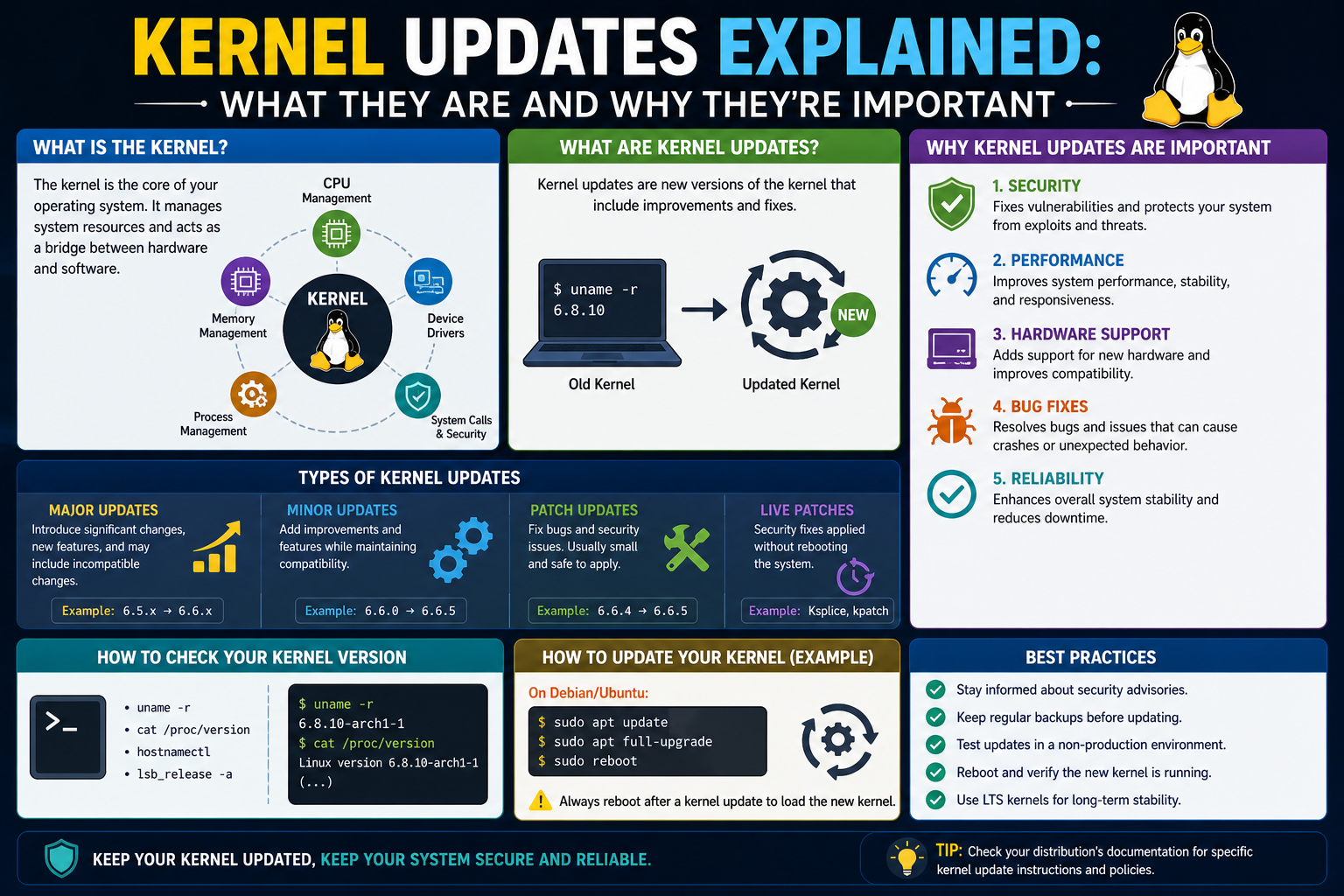
A kernel update refers to an improvement or modification made to the core component of a Linux-based operating system known as the kernel. This is not a simple application update or a cosmetic change in the interface. Instead, it is a deep-level enhancement that directly affects how the entire system operates at its foundation. The kernel acts as the central layer between the hardware and the software, and updating it means refining how this communication takes place. When a kernel update is applied, it can change how efficiently the system runs, how securely it operates, and how well it supports modern hardware and applications. These updates are essential because they ensure that the system remains reliable, protected, and compatible with ongoing technological advancements. Without these improvements, a system could gradually become outdated, unstable, or exposed to security risks.
Kernel updates are developed by a global community of developers who constantly analyze performance issues, security weaknesses, and hardware requirements. Their work ensures that Linux systems remain flexible and suitable for both personal and enterprise environments. Every update is a step toward making the operating system more intelligent in handling system resources and more resilient against potential threats.
Understanding the Role of the Linux Kernel at the Core of the Operating System
The Linux kernel is the central part of the operating system that manages all essential operations. It is responsible for controlling how software interacts with physical hardware components such as the processor, memory, storage devices, and input or output systems. Without the kernel, applications would not be able to communicate with the machine itself. It acts as a bridge that translates software requests into actions that hardware can execute.
The kernel is often described as the heart of the system because it continuously runs in the background and oversees everything that happens on the device. Every time a program is opened, a file is saved, or a command is executed, the kernel is involved in coordinating these actions. It ensures that system resources are allocated properly and that multiple processes can run at the same time without interfering with each other.
This central role makes the kernel one of the most important components of the operating system. Any improvement or update to it has a direct impact on overall system behavior, influencing performance, responsiveness, and reliability. Because of this, kernel updates are treated with high importance in Linux environments.
How the Kernel Manages Hardware, Memory, and System Processes
One of the most critical responsibilities of the Linux kernel is managing hardware interaction. Every device connected to a system, whether internal or external, relies on the kernel to function properly. This includes processors, memory modules, storage drives, network interfaces, and peripheral devices. The kernel uses specialized components known as modules or drivers to communicate with these devices efficiently.
Memory management is another key function handled by the kernel. It determines how memory is allocated to different applications and processes, ensuring that no single program consumes more resources than allowed. This helps maintain system stability and prevents crashes caused by memory overload. The kernel also handles virtual memory, allowing systems to use storage space as an extension of physical memory when needed.
In addition to hardware and memory, the kernel manages system processes. It schedules tasks, prioritizes operations, and ensures that multiple programs can run simultaneously. This ability to multitask effectively is what allows modern operating systems to feel smooth and responsive. Without proper process management, systems would become slow, unresponsive, or prone to freezing under heavy workloads.
Why the Kernel Is Considered the Foundation of System Stability
System stability depends heavily on how effectively the kernel performs its duties. Since it controls all core operations, even a small issue within the kernel can lead to significant problems across the entire system. If the kernel encounters a critical failure, the system may stop functioning entirely, leading to crashes or forced restarts.
Stability is achieved through careful coordination of resources and strict control over system behavior. The kernel ensures that processes do not interfere with each other and that hardware resources are used in an organized manner. It also monitors system activity continuously to detect and handle errors before they escalate into major failures.
Because the kernel operates at such a fundamental level, its stability directly affects user experience. A well-optimized kernel results in smoother performance, fewer crashes, and more predictable system behavior. On the other hand, an outdated or poorly maintained kernel can lead to instability, slowdowns, and unexpected system issues. This is why kernel updates play a vital role in maintaining a reliable computing environment.
Security Strengthening Through Kernel Improvements
Security is one of the most important reasons for kernel updates. Since the kernel has direct access to all system resources, it is also a primary target for malicious attacks. Any vulnerability within the kernel can potentially be exploited to gain unauthorized access to a system or disrupt its normal functioning.
Kernel updates often include security enhancements designed to close loopholes and strengthen system defenses. These improvements help protect against unauthorized access attempts, malicious code execution, and other forms of cyber threats. As attackers continuously discover new methods to exploit systems, kernel developers respond by reinforcing weak points and improving protective mechanisms.
The kernel also plays a key role in controlling access permissions. It ensures that applications can only access the resources they are authorized to use. This controlled environment reduces the risk of system-wide compromise. Regular updates help maintain this security structure by refining access controls and improving detection of suspicious activities.
How Kernel Updates Address Vulnerabilities and Threats
Over time, vulnerabilities may be discovered in the kernel that could potentially be exploited. These weaknesses are often identified through testing, research, or real-world usage. Once detected, developers work to fix them through updates that strengthen system security.
Kernel vulnerabilities can appear in different forms. Some may allow excessive system resource usage, leading to performance degradation or system crashes. Others may enable unauthorized code execution, which can compromise system integrity. There are also issues related to memory handling that can cause unpredictable behavior or data corruption.
Kernel updates address these vulnerabilities by modifying internal code, improving validation processes, and reinforcing system boundaries. These corrections ensure that known security gaps are closed, reducing the risk of exploitation. Applying updates regularly is essential to maintain a secure computing environment and prevent attackers from taking advantage of outdated system components.
Performance and Stability Enhancements Delivered by Kernel Updates
Kernel updates are not limited to security improvements; they also enhance overall system performance. Developers continuously optimize how the kernel handles processes, memory usage, and hardware communication. These optimizations allow systems to run faster and more efficiently.
Performance improvements may include better scheduling of tasks, more efficient use of CPU resources, and improved input/output operations. These changes help reduce delays, improve responsiveness, and ensure smoother multitasking. As a result, applications can run more efficiently, and system resources are utilized more effectively.
Stability enhancements are also a key part of kernel updates. These improvements help reduce system crashes, prevent unexpected errors, and improve overall reliability. By refining how the kernel handles different system conditions, updates ensure that the operating system remains consistent even under heavy workloads.
Compatibility With Modern Hardware Through Kernel Evolution
As technology evolves, new hardware components are introduced regularly. These include advanced processors, graphics units, storage devices, and networking equipment. The kernel must adapt to support these innovations, ensuring that users can fully utilize modern hardware capabilities.
Kernel updates introduce support for new devices and improve compatibility with existing ones. Without these updates, newer hardware may not function properly or may not be recognized by the system at all. This makes kernel updates essential for maintaining a modern and functional computing environment.
By continuously expanding hardware support, the kernel ensures that Linux systems remain relevant and adaptable. This flexibility is one of the reasons Linux is widely used across different industries and devices, from personal computers to servers and embedded systems.
Bug Fixes and Continuous Improvement in Kernel Development
Kernel development is an ongoing process that involves constant identification and resolution of bugs. These bugs may affect performance, stability, or functionality. Developers work continuously to detect these issues and release updates that resolve them.
Bug fixes are essential because even minor issues in the kernel can lead to noticeable problems in system behavior. Fixing these issues improves reliability and ensures that the operating system functions as intended. Each update represents an accumulation of improvements that refine the system over time.
Continuous improvement is a core principle of kernel development. Instead of remaining static, the kernel evolves through regular updates that enhance its capabilities. This ongoing development ensures that the system remains efficient, secure, and compatible with modern requirements.
Deep Structure of the Linux Kernel and How It Is Organized
The Linux kernel is built in a way that allows it to manage extremely complex system operations while still maintaining efficiency and flexibility. At its core, it follows a monolithic design, meaning most essential services such as process management, memory handling, device control, and system communication are handled within a single unified system. However, this does not mean it is rigid or limited. Instead, it is designed with modular capabilities that allow parts of the kernel to be dynamically loaded or removed when needed.
These modular components are especially important for hardware support. Instead of building everything permanently into the kernel, Linux uses loadable modules that can be inserted or removed based on system requirements. This design allows the operating system to remain lightweight while still supporting a wide range of devices and functionalities. It also makes updates more efficient, since only specific components may need modification instead of the entire system.
This structure is one of the key reasons Linux is highly scalable. It can run on small embedded devices as well as large enterprise servers without requiring major architectural changes.
System Calls and the Communication Between Software and Kernel
One of the most important mechanisms in the Linux kernel is the system call interface. This is how user-level applications request services from the kernel. Since applications do not have direct access to hardware for security and stability reasons, they rely on system calls to perform operations such as reading files, creating processes, or allocating memory.
When a program makes a system call, it transitions from user space into kernel space. In kernel space, the system has elevated privileges and can directly interact with hardware and system resources. Once the operation is completed, control is returned to user space. This controlled interaction ensures that applications cannot interfere with each other or with the core system.
System calls form the foundation of all software execution in Linux. Without them, applications would not be able to perform even basic tasks. Kernel updates often improve how system calls are processed, making them faster, more secure, and more efficient in handling system requests.
Process Scheduling and How the Kernel Manages Multiple Tasks
The Linux kernel is responsible for managing all running processes on a system through a mechanism known as scheduling. Since multiple applications often run at the same time, the kernel must decide how to allocate CPU time to each process fairly and efficiently.
Process scheduling ensures that no single application monopolizes system resources. The kernel continuously switches between processes in a way that creates the illusion of parallel execution. This switching happens so quickly that users experience smooth multitasking even when many programs are running simultaneously.
Different scheduling strategies are used depending on system needs. Some prioritize responsiveness for user-facing applications, while others focus on maximizing throughput for background tasks. The kernel dynamically balances these requirements to maintain optimal performance.
Kernel updates often refine scheduling algorithms to improve responsiveness, reduce latency, and enhance overall system efficiency. These improvements can significantly impact system performance, especially under heavy workloads.
Memory Management and Efficient Use of System Resources
Memory management is one of the most critical responsibilities of the Linux kernel. It ensures that every running process receives the memory it needs while preventing conflicts or overuse of system resources. The kernel divides memory into different segments and assigns them based on process requirements.
One of the key features of Linux memory management is virtual memory. This allows the system to use disk space as an extension of physical memory when RAM becomes limited. This mechanism helps prevent crashes and ensures that applications continue running even under heavy load.
The kernel also manages memory protection, ensuring that one process cannot access or modify the memory of another process. This isolation is essential for system stability and security.
Kernel updates often include improvements to memory allocation strategies, reducing fragmentation and improving speed. These enhancements allow systems to run more efficiently and handle larger workloads without performance degradation.
Device Drivers and Hardware Interaction Through the Kernel
Device drivers are specialized components within the kernel that enable communication between the operating system and hardware devices. These drivers act as translators, converting system commands into instructions that hardware can understand.
Without proper drivers, hardware components such as graphics cards, printers, network adapters, and storage devices would not function correctly. The kernel manages these drivers and ensures they operate smoothly within the system.
Linux supports a wide range of hardware through its modular driver system. This allows drivers to be added or updated without requiring changes to the entire kernel. Kernel updates frequently include new drivers or improvements to existing ones, ensuring compatibility with modern hardware.
This continuous development is essential because hardware technology evolves rapidly. Keeping the kernel updated ensures that users can take full advantage of new devices and improvements in performance.
Kernel Space vs User Space and Why Separation Matters
The Linux operating system is divided into two main areas: kernel space and user space. Kernel space is where the core of the operating system operates, including memory management, process scheduling, and hardware interaction. User space is where applications and user-level programs run.
This separation is critical for system stability and security. If an application running in user space crashes, it does not directly affect the kernel or other applications. However, if an issue occurs in kernel space, it can impact the entire system.
The separation also prevents unauthorized access to critical system resources. Applications must request permission through system calls to interact with the kernel, ensuring controlled and secure communication.
Kernel updates often strengthen this boundary by improving access control mechanisms and reducing potential vulnerabilities between user space and kernel space interactions.
Interrupt Handling and Real-Time System Responsiveness
Interrupt handling is another essential function of the Linux kernel. Interrupts are signals sent by hardware or software indicating that immediate attention is required. For example, pressing a key on the keyboard or receiving network data generates an interrupt.
When an interrupt occurs, the kernel temporarily pauses current operations to handle the event. This ensures that time-sensitive tasks are processed without delay. After handling the interrupt, normal system operations resume.
Efficient interrupt handling is crucial for maintaining system responsiveness. Poor handling can lead to delays, lag, or system instability. The kernel prioritizes interrupts based on urgency and system conditions.
Kernel updates often improve interrupt handling mechanisms, making systems more responsive and better suited for real-time applications such as audio processing, gaming, and network communication.
Virtualization Support and Modern Computing Environments
Modern computing increasingly relies on virtualization, where multiple operating systems run on a single physical machine. The Linux kernel plays a central role in enabling this capability by providing infrastructure for virtual machines and containers.
Through virtualization support, the kernel allows resources to be divided and allocated to multiple isolated environments. Each virtual environment behaves like an independent system, even though they share the same physical hardware.
This capability is widely used in cloud computing, software testing, and enterprise environments. It allows efficient use of hardware resources and improves scalability.
Kernel updates often enhance virtualization performance, improve isolation between virtual machines, and introduce better resource management techniques. These improvements make Linux a preferred choice for modern infrastructure systems.
Containers, Namespaces, and Lightweight Isolation Techniques
In addition to full virtualization, the Linux kernel supports lightweight isolation techniques such as containers. Containers allow applications to run in isolated environments without requiring a full virtual machine.
This is achieved using kernel features such as namespaces and control groups. Namespaces isolate system resources like process IDs, network interfaces, and file systems, while control groups manage resource allocation such as CPU and memory usage.
These features enable efficient deployment of applications in isolated environments while minimizing overhead. Containers are widely used in modern software development and deployment pipelines.
Kernel updates continuously improve container performance, security, and resource efficiency, making them a key part of modern Linux-based systems.
Kernel Compilation, Customization, and Distribution Management
The Linux kernel is highly customizable, allowing users and organizations to compile their own versions based on specific requirements. This involves selecting features, enabling or disabling modules, and optimizing the kernel for particular hardware or workloads.
Different Linux distributions may ship with customized kernel versions tailored for their target audience. Some prioritize stability, while others focus on performance or cutting-edge features.
Kernel updates in distributions are often managed through package systems, ensuring that users receive tested and stable versions. However, advanced users may choose to manually compile or upgrade kernels for specific needs.
This flexibility is one of the strengths of Linux, allowing it to adapt to a wide range of use cases from embedded systems to high-performance servers.
Continuous Kernel Development and Community Contribution
The Linux kernel is developed through a global collaborative effort involving thousands of contributors. Developers continuously review code, submit improvements, and fix issues to ensure the kernel remains secure and efficient.
This open development model allows rapid identification and resolution of problems. It also ensures that the kernel evolves to meet modern computing demands.
Kernel updates are the result of extensive testing and review processes, ensuring reliability before deployment. This collaborative approach has made Linux one of the most stable and widely used operating system kernels in the world.
Security Model Inside the Linux Kernel and Why It Matters
Security inside the Linux kernel is built on strict control over how processes interact with system resources. The kernel acts as the ultimate authority, deciding what is allowed and what is blocked at the most fundamental level of the operating system. Every file access, memory request, or hardware interaction must pass through kernel validation before it is executed. This creates a controlled environment where unauthorized actions are significantly restricted.
The kernel security model is designed around isolation and permission enforcement. Each process operates within its own boundaries, and direct interference between processes is prevented. This separation reduces the chances of one compromised application affecting the entire system. The kernel also enforces privilege levels, ensuring that only trusted system-level operations are allowed to perform sensitive tasks.
This layered protection makes Linux systems inherently more secure, but it does not eliminate risk entirely. Vulnerabilities can still exist in kernel code, which is why continuous updates are necessary. Kernel security is not a static feature but an evolving system that adapts to new threats through constant refinement and improvement.
Understanding Kernel Vulnerabilities and Exposure Risks
Kernel vulnerabilities are weaknesses in the core system that can be exploited by attackers to gain unauthorized control or disrupt system behavior. These vulnerabilities are particularly dangerous because they exist at the lowest level of the operating system. Once exploited, they can give attackers access to nearly all system resources.
These issues often arise from complex interactions between hardware, software, and system processes. Even small coding errors can lead to serious security flaws if they occur in critical kernel components. Attackers actively search for such weaknesses, making kernel security a constant focus for developers.
Common types of kernel vulnerabilities include memory handling errors, privilege escalation flaws, and logic errors in system calls. Each of these can lead to different types of exploitation, ranging from system crashes to full system compromise. Kernel updates play a crucial role in eliminating these risks by patching known issues and strengthening weak points in system design.
How Kernel Updates Strengthen System Security Over Time
Kernel updates are one of the most effective ways to improve system security. Each update typically includes patches that fix known vulnerabilities, improve access controls, and enhance overall system resilience. These updates are developed after careful analysis of reported issues and potential attack vectors.
When a vulnerability is discovered, developers analyze its root cause and create a fix that prevents similar issues from occurring in the future. This process not only resolves immediate threats but also improves the long-term security architecture of the kernel.
Regular updates ensure that systems remain protected against newly discovered threats. Without these updates, systems gradually become more vulnerable over time, as attackers continue to develop new exploitation techniques. Keeping the kernel updated is therefore a critical part of maintaining a secure computing environment.
The Role of Kernel Patching in System Protection
Kernel patching refers to the process of applying targeted fixes to specific parts of the kernel without requiring a complete system overhaul. These patches are essential for addressing security issues quickly and efficiently.
Patching allows developers to respond rapidly to newly discovered vulnerabilities. Instead of waiting for a full kernel release, critical fixes can be applied to existing systems to reduce exposure to risk. This is particularly important for servers and production environments where downtime must be minimized.
Kernel patches also improve system stability by correcting bugs that may not be security-related but still affect performance or reliability. Over time, continuous patching ensures that the kernel remains robust, secure, and efficient in handling system operations.
Performance Optimization Through Kernel Improvements
Performance is a key focus area in kernel development. The kernel is responsible for managing system resources, so even small improvements in its efficiency can have a significant impact on overall system performance.
Kernel updates often include optimizations that improve CPU scheduling, memory allocation, and input/output processing. These enhancements allow the system to execute tasks more efficiently and reduce unnecessary delays. As a result, applications run smoother, and system responsiveness improves noticeably.
Performance tuning also involves refining how the kernel handles multitasking. By improving process scheduling algorithms, the kernel can ensure that resources are distributed more effectively among running applications. This leads to better balance between system load and responsiveness.
Network Stack Improvements and Communication Efficiency
The Linux kernel plays a central role in managing network communication. It handles data transmission, routing, and packet processing for all network activities. Because of this, improvements to the network stack can significantly enhance system performance and reliability.
Kernel updates often optimize how data packets are processed and transmitted. These improvements reduce latency, increase throughput, and improve stability in network-heavy environments. This is especially important for servers, cloud systems, and applications that rely on real-time communication.
Security enhancements are also integrated into the network stack. These updates help protect against network-based attacks such as packet injection, denial of service attempts, and unauthorized data interception. By strengthening both performance and security, kernel updates ensure reliable and secure communication channels.
Handling Common System Crashes and Kernel Panic Scenarios
A kernel panic occurs when the system encounters a critical error that it cannot safely recover from. This is one of the most severe types of system failure, as it halts all operations to prevent data corruption or further damage.
Kernel panics can be caused by hardware failures, software bugs, or corrupted memory states. When such an event occurs, the system typically shuts down or restarts automatically. Although this may seem disruptive, it is a protective mechanism designed to preserve system integrity.
Kernel updates help reduce the likelihood of such failures by fixing underlying bugs and improving error handling mechanisms. Enhanced diagnostics also allow developers to better identify the root causes of crashes, leading to more stable system behavior over time.
Long-Term Support Kernels and Stability-Focused Updates
Some kernel versions are designed specifically for long-term stability rather than frequent feature updates. These versions receive extended maintenance and security patches over a longer period, making them ideal for enterprise environments where stability is more important than rapid change.
Long-term support kernels focus on reliability, compatibility, and predictable performance. They are widely used in servers, industrial systems, and infrastructure environments where downtime must be minimized.
Updates for these kernels are carefully tested to ensure they do not introduce new issues. This conservative approach prioritizes system reliability and security over experimental features. As a result, long-term support kernels provide a stable foundation for critical systems.
Distribution-Level Kernel Management and Customization
Different Linux distributions manage kernel updates in different ways based on their goals and target users. Some distributions prioritize stability and provide carefully tested kernel versions, while others focus on delivering the latest features as quickly as possible.
Distribution maintainers often customize the kernel to better suit their users’ needs. This may include enabling specific features, applying patches, or optimizing performance for certain hardware configurations.
This customization allows Linux to remain highly flexible and adaptable. Users can choose a distribution that aligns with their requirements, whether they need cutting-edge performance or maximum stability.
Security Hardening Techniques Applied in Kernel Updates
Kernel hardening refers to strengthening the internal security mechanisms of the kernel to make it more resistant to attacks. This includes reducing attack surfaces, improving memory protection, and enforcing stricter access controls.
Hardening techniques often involve limiting unnecessary functionality, improving input validation, and strengthening isolation between system components. These measures reduce the number of potential vulnerabilities that attackers can exploit.
Kernel updates frequently introduce new hardening features that make systems more resilient. Over time, these improvements significantly increase the difficulty of successfully attacking a Linux system at the kernel level.
Debugging, Monitoring, and Kernel Diagnostics Tools
The Linux kernel includes various tools and mechanisms for debugging and monitoring system behavior. These tools help developers and system administrators identify issues, analyze performance, and detect anomalies.
Kernel logs provide detailed information about system events, including errors, warnings, and hardware interactions. This data is essential for diagnosing problems and understanding system behavior under different conditions.
Monitoring tools allow real-time observation of kernel activity, helping identify performance bottlenecks or unusual behavior. These insights are critical for optimizing system performance and ensuring stability.
Kernel updates often enhance these diagnostic tools, making it easier to detect and resolve issues before they impact system performance.
Virtual Memory Management and Swap Optimization
Virtual memory is a key feature of the Linux kernel that allows systems to extend physical memory using disk space. This mechanism ensures that applications continue to run even when RAM is fully utilized.
The kernel manages virtual memory by swapping inactive data between RAM and storage. Efficient swap management is essential for maintaining system performance, especially under heavy workloads.
Kernel updates often improve swap algorithms and memory compression techniques. These enhancements reduce performance overhead and improve responsiveness when system memory is under pressure.
Technical Reflection on Kernel Evolution and System Behavior
The Linux kernel continues to evolve as computing demands grow and technology advances. Each update contributes to a more secure, efficient, and capable operating system. Through continuous development, optimization, and community collaboration, the kernel remains adaptable to modern challenges.
Kernel updates are not just maintenance tasks; they are essential improvements that shape how systems perform, interact, and protect themselves. From security enhancements to performance tuning and hardware compatibility, every update plays a role in strengthening the foundation of Linux-based systems.
Kernel Update Understanding
Kernel updates are a fundamental part of maintaining a secure, stable, and high-performing Linux system. They ensure that the operating system continues to evolve with changing technology, protect against emerging threats, and deliver consistent performance across different environments.
How Kernel Updates Are Delivered and Managed in Real Systems
Kernel updates do not reach systems in a random or uncontrolled manner. They are delivered through structured update mechanisms provided by Linux distributions. These mechanisms ensure that updates are tested, packaged, and deployed in a way that maintains system stability. Instead of users manually modifying the kernel in most cases, updates are applied through system package managers that handle dependencies and compatibility automatically.
This managed approach reduces the risk of system failure and ensures that updates integrate smoothly with existing system components. Distribution maintainers play a key role here by selecting kernel versions, applying patches, and testing performance across different environments before release. This controlled pipeline ensures that kernel updates are both reliable and safe for general use.
Different systems may receive updates at different speeds depending on their update model. Some prioritize stability and slow, carefully tested updates, while others focus on delivering the latest improvements more quickly. Regardless of the model, the goal remains the same: maintaining a secure and functional kernel environment.
Rolling Updates Versus Stable Kernel Releases
Kernel update strategies generally fall into two categories: rolling updates and stable releases. Each approach serves different user needs and system requirements.
Rolling updates provide continuous improvements, where the kernel is frequently updated with the latest features, bug fixes, and security patches. This model ensures that the system always stays close to the most recent development state. It is often preferred by users who want cutting-edge performance and hardware support.
Stable releases, on the other hand, focus on reliability and long-term consistency. In this model, kernel updates are carefully selected and tested before being released to users. The emphasis is on minimizing risk rather than introducing rapid changes. These versions are widely used in enterprise environments where system stability is more important than frequent feature updates.
Both approaches rely on kernel updates but differ in their philosophy of change management. One prioritizes innovation and speed, while the other prioritizes reliability and predictability.
Kernel Compilation and Custom Build Systems
Advanced users and system administrators sometimes choose to compile their own Linux kernel instead of using pre-built versions. Kernel compilation involves configuring, building, and installing a custom version of the kernel tailored to specific hardware or performance needs.
This process allows fine-grained control over which features are included. Unnecessary components can be removed to reduce system size and improve efficiency, while essential features can be optimized for better performance. Custom kernels are often used in specialized environments such as embedded systems, high-performance servers, or research setups.
However, kernel compilation requires technical knowledge and careful configuration. Incorrect settings can lead to system instability or hardware incompatibility. Despite the risks, it provides maximum flexibility and control over system behavior.
Live Kernel Patching and Minimizing System Downtime
One of the most advanced developments in kernel management is live patching. This technique allows critical security updates to be applied to a running kernel without requiring a system reboot. It is especially important in environments where downtime must be avoided, such as servers, financial systems, and large-scale infrastructure.
Live patching works by dynamically replacing vulnerable sections of the kernel while the system continues running. This ensures that security issues can be resolved quickly without interrupting services. It also reduces maintenance windows and improves system availability.
While not all kernel updates can be applied using live patching, it is highly effective for security fixes and minor bug corrections. This technology represents a major advancement in system reliability and operational continuity.
Kernel Modules and Dynamic Feature Expansion
Kernel modules are a powerful feature that allows functionality to be added or removed from the kernel at runtime. Instead of permanently embedding all features into the core kernel, Linux uses a modular system where components can be loaded as needed.
These modules are commonly used for device drivers, file systems, and network protocols. When hardware is connected or a new feature is required, the appropriate module can be loaded into the kernel without restarting the system. This flexibility allows Linux to remain lightweight while still supporting a wide range of hardware and use cases.
Kernel updates often include improved module management, better compatibility, and enhanced performance. This ensures that systems can adapt dynamically to changing hardware environments.
Boot Process and Kernel Initialization Behavior
When a Linux system starts, the kernel plays a central role in initializing hardware and preparing the system for use. During the boot process, the kernel is loaded into memory and begins detecting hardware components, initializing drivers, and setting up system resources.
This process is critical because it determines how efficiently the system starts and how quickly it becomes operational. Kernel updates can improve boot speed by optimizing initialization routines and reducing unnecessary startup tasks.
The bootloader is responsible for loading the kernel, and once control is passed to the kernel, it takes over full system management. A well-optimized kernel ensures a smooth transition from startup to full system readiness.
System Recovery and Kernel Rollback Mechanisms
Despite careful testing, some kernel updates may occasionally introduce unexpected issues. To address this, Linux systems often include rollback mechanisms that allow users to revert to a previous kernel version.
This feature is essential for maintaining system stability. If a newly installed kernel causes performance problems or compatibility issues, users can easily switch back to a stable version. This ensures that system functionality is not permanently disrupted by problematic updates.
Kernel rollback is particularly important in production environments where downtime must be minimized. It provides a safety net that allows administrators to test new kernels without risking system failure.
Security Lifecycle and Ongoing Kernel Maintenance
The kernel has a continuous security lifecycle that involves regular monitoring, vulnerability assessment, patch development, and update deployment. This lifecycle ensures that security threats are addressed promptly and effectively.
As new vulnerabilities are discovered, they are analyzed and prioritized based on severity. Critical issues receive immediate attention, while less severe bugs may be scheduled for future updates. This structured approach helps maintain a balance between stability and security.
Ongoing maintenance also includes improving existing security mechanisms and strengthening system defenses. This ensures that the kernel remains resilient against evolving threats over time.
Real-World Use Cases of Kernel Updates in Different Environments
Kernel updates play a vital role in a wide range of computing environments. In personal computers, they improve hardware compatibility, enhance performance, and ensure system security. Users benefit from smoother operation and better support for modern devices.
In server environments, kernel updates are critical for maintaining uptime, security, and scalability. Servers often handle large workloads and require highly stable kernels to ensure uninterrupted service delivery. Updates in these environments are carefully tested before deployment.
In cloud computing and virtualization platforms, kernel updates improve resource management, container performance, and isolation between virtual machines. These improvements are essential for running large-scale distributed systems efficiently.
Embedded systems also rely on kernel updates for improved hardware support and optimized performance in resource-constrained environments.
Debugging Kernel Behavior and System Diagnostics in Practice
Kernel debugging is an important process used to identify and resolve system issues. Developers and administrators use diagnostic tools to analyze kernel logs, monitor system performance, and detect abnormal behavior.
These tools provide insight into how the kernel interacts with hardware and software components. They help identify bottlenecks, memory leaks, and hardware failures that may affect system performance.
Kernel updates often improve debugging capabilities by enhancing logging systems and providing more detailed diagnostic information. This makes it easier to troubleshoot issues and maintain system health over time.
Resource Management Improvements Through Kernel Evolution
Efficient resource management is one of the core goals of kernel development. The kernel continuously evolves to improve how CPU time, memory, storage, and network resources are allocated.
Better resource management leads to improved system responsiveness and reduced overhead. It ensures that applications receive the resources they need without wasting system capacity.
Kernel updates often refine these mechanisms, resulting in better multitasking performance and more efficient use of hardware resources.
Long-Term Impact of Kernel Updates on System Longevity
Over time, kernel updates significantly extend the usable life of a system. By continuously improving performance, fixing bugs, and adding hardware support, updates ensure that systems remain functional even as technology advances.
Without regular updates, systems gradually become outdated, less secure, and less compatible with modern hardware and software. Kernel updates prevent this decline by continuously refreshing system capabilities.
This long-term improvement cycle is one of the key strengths of Linux, allowing systems to remain relevant and reliable for extended periods.
Final Conclusion
Kernel updates are one of the most critical aspects of maintaining a healthy Linux system. They ensure that the core of the operating system remains secure, stable, and capable of supporting modern hardware and software demands. Through continuous development, updates improve performance, fix vulnerabilities, and introduce new features that enhance the overall computing experience.
From security protection and memory management to hardware compatibility and system optimization, every aspect of the kernel benefits from regular updates. These improvements are not optional enhancements but essential maintenance that keeps systems functional and resilient.
Understanding kernel updates provides deeper insight into how Linux operates at its core. It reveals the constant evolution happening beneath the surface, where developers work tirelessly to improve stability, security, and performance. In essence, kernel updates are the foundation that keeps Linux systems powerful, adaptable, and reliable in an ever-changing technological landscape.