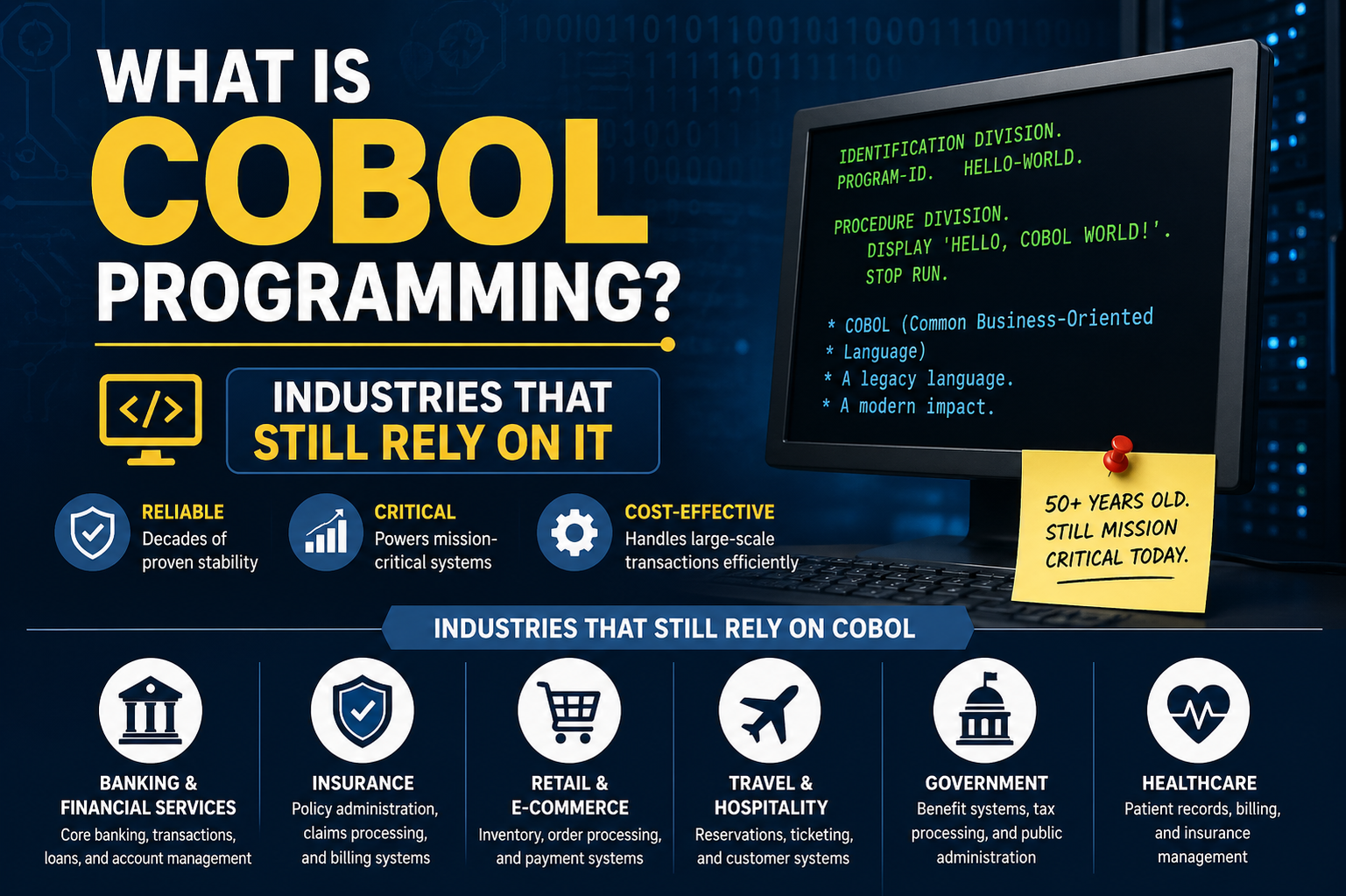
COBOL, short for Common Business-Oriented Language, is one of the oldest high-level programming languages still in active use today. Created in 1959 during an era when computers were massive, expensive machines primarily used by governments and large corporations, COBOL was designed with a very specific goal: to make programming accessible and readable, especially for business professionals who were not deeply technical. Unlike many modern languages that prioritize efficiency and compactness, COBOL emphasizes clarity, using English-like syntax so that its instructions resemble natural language. This design philosophy allowed managers, analysts, and non-engineers to understand what the code was doing, even if they were not the ones writing it. Over time, COBOL became the backbone of enterprise computing, powering systems that handled payroll, banking transactions, insurance records, and government data processing. Even decades later, these systems remain deeply embedded in global infrastructure, making COBOL far more relevant than many assume.
The Design Philosophy Behind COBOL and Procedural Programming
At its core, COBOL follows the procedural programming paradigm, which means it operates by executing a sequence of step-by-step instructions. In procedural programming, the developer explicitly defines how tasks are performed, guiding the computer through each operation in a linear and logical flow. This is quite different from object-oriented programming, which organizes code into reusable components called objects that represent real-world entities. COBOL’s structure reflects its business-oriented roots, focusing on clear data definitions and straightforward processing logic. One of its most distinctive features is its verbosity—programs often require many lines of code to accomplish relatively simple tasks. While this may seem inefficient compared to modern languages, the trade-off is readability. COBOL programs are often self-documenting, meaning someone can read the code and understand its purpose without extensive external documentation. This characteristic made COBOL highly effective in large organizations where multiple teams needed to collaborate and maintain systems over long periods.
How COBOL Handles Data and Why It Matters
A defining aspect of COBOL is how it manages data. Before performing any operations, COBOL requires developers to explicitly define the structure, type, and size of each data element. This is typically done using the PICTURE clause, which specifies how data should be formatted and stored. For example, a number might be defined with a certain number of digits, ensuring consistency and preventing unexpected errors during processing. This strict approach to data definition is particularly valuable in industries where precision is critical, such as banking and finance. By enforcing clear data structures, COBOL reduces ambiguity and helps maintain data integrity across complex systems. Although modern programming languages also provide ways to define data types, they often allow more flexibility, which can lead to inconsistencies if not carefully managed. COBOL’s rigidity, while sometimes seen as a limitation, has contributed to its reliability in mission-critical applications where even a small mistake can have significant consequences.
Comparing COBOL to Modern Programming Languages
When compared to modern languages like Python, the differences become immediately apparent. Python is known for its simplicity and brevity, allowing developers to write powerful programs with relatively few lines of code. In contrast, COBOL requires a more detailed and structured approach, often resulting in longer programs. While Python prioritizes developer productivity and rapid development, COBOL prioritizes clarity and stability. This difference reflects the contexts in which each language is used. Python is widely adopted in fields like data science, artificial intelligence, and web development, where flexibility and speed are essential. COBOL, on the other hand, is deeply rooted in legacy systems that demand consistency, reliability, and long-term maintainability. Despite its age, COBOL continues to perform critical tasks that modern languages have not fully replaced, largely because rewriting these systems would be both risky and expensive.
The Workforce Challenge Surrounding COBOL
One of the most pressing issues facing COBOL today is the shrinking pool of skilled developers. Many of the programmers who originally built COBOL systems are now approaching retirement or have already left the workforce. At the same time, younger developers are less inclined to learn COBOL, as it is rarely taught in modern computer science programs and is often perceived as outdated. This creates a significant skills gap, leaving organizations with limited expertise to maintain and update their systems. As a result, when problems arise, companies may struggle to find qualified professionals who understand the intricacies of their existing code. This shortage is particularly concerning given the critical nature of COBOL-based systems, which handle vast amounts of financial and operational data every day. The lack of new talent entering the field has turned COBOL into both a valuable and scarce skill, creating unique challenges for organizations that depend on it.
The Scale and Impact of COBOL in Global Systems
Despite its age, COBOL remains deeply embedded in the global economy. It is estimated that hundreds of billions of lines of COBOL code are still in active use, supporting essential operations across various industries. In the banking sector, for instance, a significant portion of transaction processing relies on COBOL systems. These systems handle everything from ATM withdrawals to account management and payment processing. Similarly, insurance companies use COBOL to manage policies, claims, and customer data. Government agencies also depend on COBOL for tasks such as tax processing, social services, and public records management. The sheer scale of these systems makes them incredibly difficult to replace. Even a small change can have far-reaching consequences, which is why many organizations choose to maintain their existing COBOL infrastructure rather than attempt a complete overhaul.
Why Organizations Continue to Rely on COBOL
The continued use of COBOL is not simply a matter of inertia; it is a strategic decision driven by practicality. Rewriting legacy systems in a modern language is a complex and costly process that carries significant risks. These systems often contain decades of business logic that has been refined and tested over time. Recreating this logic in a new environment requires a deep understanding of both the old and new systems, as well as extensive testing to ensure accuracy. In industries where errors can lead to financial losses or regulatory issues, the stakes are extremely high. As a result, many organizations opt to maintain their existing COBOL systems while gradually integrating modern technologies where possible. This approach allows them to preserve the reliability of their core systems while adapting to changing technological demands.
The Complexity of Legacy Code and Documentation Issues
Another major challenge associated with COBOL systems is the lack of documentation. Many legacy applications were developed decades ago, often without comprehensive records of how they were designed or why certain decisions were made. Over time, as developers left organizations or retired, this knowledge was lost. Today, companies are left with massive codebases that are difficult to understand and maintain. This lack of documentation makes it challenging to modify or upgrade systems, as even small changes can have unintended consequences. In some cases, organizations must rely on reverse engineering to understand how their systems work, which can be both time-consuming and error-prone. The absence of clear documentation further complicates efforts to modernize COBOL systems, reinforcing the need for careful planning and expertise.
The Risks and Realities of Rewriting COBOL Systems
Rewriting COBOL systems in modern languages is often seen as a solution to many of these challenges, but it is far from straightforward. The process involves translating not just the code itself, but also the underlying business logic that drives critical operations. This task is particularly difficult when documentation is limited or outdated. Developers must carefully analyze the existing system, identify its functions, and ensure that the new implementation produces the same results. Any errors in this process can lead to significant disruptions, especially in industries like banking and finance. Additionally, rewriting large systems can take years to complete, during which time the organization must continue to operate its existing infrastructure. This dual burden of maintaining old systems while developing new ones adds to the complexity and cost of modernization efforts.
The Strategic Importance of COBOL in Critical Industries
COBOL’s continued relevance is closely tied to its role in critical industries. Financial institutions, government agencies, and large corporations depend on its stability and reliability to manage essential operations. These systems are often designed to handle high volumes of transactions with minimal downtime, making them highly efficient for their intended purposes. While newer technologies offer greater flexibility and scalability, they may not always match the proven reliability of existing COBOL systems. As a result, organizations must carefully weigh the benefits of modernization against the risks of disrupting established processes. In many cases, the decision is to retain COBOL as a core component of their infrastructure while exploring ways to enhance it with modern tools and technologies.
Industries That Continue to Depend on COBOL Systems
COBOL remains deeply embedded across multiple industries, not because organizations are resistant to change, but because their entire operational backbone depends on it. The banking sector is perhaps the most prominent example. Large financial institutions process millions of transactions daily, including deposits, withdrawals, transfers, and interest calculations, all of which rely on systems built decades ago. These systems were designed for reliability and precision, and over time they have been refined to handle enormous workloads with minimal failure. Insurance companies are another major user of COBOL, managing policy data, premium calculations, and claims processing through long-established programs. Government agencies also rely heavily on COBOL to manage social services, taxation systems, and public records. In each of these sectors, the cost and risk of replacing COBOL systems outweigh the perceived benefits of switching to newer technologies, ensuring its continued use in mission-critical environments.
The Role of COBOL in Banking and Financial Infrastructure
In the financial world, COBOL is not just a legacy language—it is the engine that powers daily operations. A significant percentage of global financial transactions pass through COBOL-based systems, making it one of the most important technologies in the modern economy. From ATM withdrawals to online banking, COBOL programs handle the logic that ensures transactions are processed accurately and securely. These systems are designed to operate continuously, often running on mainframe computers that are optimized for high-volume processing. One of the reasons COBOL has endured in this sector is its ability to handle structured data with exceptional reliability. Financial data must be precise, consistent, and secure, and COBOL’s strict data handling rules help achieve these requirements. Even as banks adopt digital platforms and mobile applications, the underlying transaction processing often still relies on COBOL, demonstrating its continued relevance in a rapidly evolving industry.
Government Systems and National Infrastructure Built on COBOL
Government agencies around the world continue to depend on COBOL for essential services. These systems often manage large-scale operations such as tax collection, pension distribution, healthcare records, and unemployment benefits. During times of crisis, such as economic downturns or global emergencies, the importance of these systems becomes even more apparent. They must handle sudden increases in demand while maintaining accuracy and reliability. COBOL-based systems have proven capable of meeting these challenges, which is why they remain in use despite their age. However, this reliance also highlights a critical vulnerability: many of these systems are difficult to update or scale quickly. When demand spikes, as seen in recent global events, governments may struggle to adapt their COBOL infrastructure to new requirements. This has led to renewed interest in modernizing these systems, though the process remains complex and resource-intensive.
Insurance and Healthcare Systems Powered by Legacy Code
The insurance and healthcare industries also rely heavily on COBOL for managing vast amounts of sensitive data. Insurance companies use COBOL to calculate premiums, process claims, and maintain customer records. These processes involve complex business rules that have been developed and refined over many years. Rewriting this logic in a new language would require not only technical expertise but also a deep understanding of industry-specific regulations and practices. Similarly, healthcare systems use COBOL to manage patient records, billing, and administrative processes. Accuracy and reliability are critical in these المجالات, as errors can have serious consequences. COBOL’s structured approach to data handling makes it well-suited for these applications, even if it lacks the flexibility of modern programming languages.
Why Small Companies Rarely Use COBOL Today
While large organizations continue to rely on COBOL, smaller companies rarely adopt it for new projects. Modern startups and small businesses typically choose programming languages that are easier to learn, faster to develop with, and better suited for cloud-based environments. Languages like Python, JavaScript, and Java offer extensive libraries, frameworks, and community support, making them more attractive for new development. Additionally, these languages are designed to integrate seamlessly with modern technologies such as web applications, mobile platforms, and cloud services. For small companies, the cost of building and maintaining a COBOL-based system would be impractical, especially given the limited availability of skilled developers. As a result, COBOL is primarily associated with legacy systems in large enterprises rather than new applications.
The Hidden Complexity of COBOL Codebases
One of the reasons COBOL systems are so difficult to replace is their sheer complexity. Many organizations have millions of lines of COBOL code that have been developed over decades. These codebases often contain intricate business logic that is not documented anywhere else. Over time, different developers may have added new features or modified existing ones, creating a system that is both powerful and difficult to understand. This complexity makes it challenging to identify how different parts of the system interact, increasing the risk of errors during any modification or migration effort. In some cases, even experienced developers may struggle to fully comprehend the system, especially if they are unfamiliar with COBOL’s syntax and conventions. This hidden complexity is a major factor in the continued reliance on COBOL, as organizations are reluctant to tamper with systems they do not fully understand.
The Cost and Risk of Modernization Efforts
Modernizing COBOL systems is not simply a technical challenge—it is also a financial and operational one. Rewriting a large codebase can take years and require significant investment in both time and resources. During this period, the organization must continue to maintain its existing systems, which can strain resources and increase the risk of errors. Additionally, any mistakes in the new system could lead to disruptions in critical operations, potentially resulting in financial losses or regulatory penalties. This risk is particularly high in industries such as banking and healthcare, where accuracy and reliability are paramount. As a result, many organizations choose to adopt a gradual approach to modernization, updating specific components of their systems rather than attempting a complete overhaul. This strategy allows them to reduce risk while still benefiting from newer technologies.
The Challenge of Knowledge Transfer and Training
As the number of experienced COBOL developers declines, organizations face the challenge of transferring knowledge to a new generation of programmers. Training new developers in COBOL can be difficult, as it requires not only learning the language itself but also understanding the legacy systems in which it is used. Many young programmers are more interested in modern languages and technologies, which can make it challenging to attract talent to COBOL-related roles. To address this issue, some organizations have begun offering specialized training programs and incentives to encourage developers to learn COBOL. Others are partnering with educational institutions to reintroduce COBOL into computer science curricula. Despite these efforts, the skills gap remains a significant concern, highlighting the need for innovative solutions to ensure the continued maintenance of COBOL systems.
The Role of Mainframes in Supporting COBOL Applications
COBOL is often associated with mainframe computers, which are powerful systems designed to handle large-scale processing tasks. Mainframes are known for their reliability, security, and ability to process high volumes of transactions, making them ideal for the types of applications that COBOL supports. Many organizations continue to use mainframes as the foundation of their IT infrastructure, running COBOL programs that manage critical operations. While modern computing platforms offer greater flexibility, they may not always match the performance and stability of mainframes in certain scenarios. As a result, COBOL and mainframes often go hand in hand, forming a robust and dependable system that has stood the test of time. However, maintaining and upgrading mainframe systems can be expensive, prompting organizations to explore hybrid approaches that combine legacy and modern technologies.
The Future Outlook for COBOL in a Changing Technology Landscape
Despite the challenges associated with COBOL, it is unlikely to disappear anytime soon. Its deep integration into critical systems ensures that it will remain relevant for years to come. However, the way organizations use COBOL is likely to evolve. Instead of relying on it exclusively, many companies are adopting hybrid approaches that integrate COBOL with modern technologies. This may involve using APIs to connect legacy systems with new applications or gradually migrating certain functions to more flexible platforms. These strategies allow organizations to preserve the reliability of their existing systems while adapting to new technological demands. As the technology landscape continues to change, COBOL will likely remain a key part of enterprise computing, serving as a reminder of the enduring value of well-designed systems.
The COBOL Dilemma in Modern Technology Environments
COBOL exists today in a paradoxical position: it is both indispensable and increasingly difficult to sustain. Organizations that rely on COBOL systems often find themselves trapped between maintaining legacy infrastructure and embracing modern technology. This situation is commonly referred to as the “COBOL dilemma.” On one hand, these systems are stable, reliable, and deeply integrated into business operations. On the other hand, they are aging, difficult to modify, and supported by a shrinking pool of experts. The dilemma arises because replacing COBOL is not simply a technical upgrade—it is a transformation that affects business logic, compliance, and operational continuity. As a result, companies must carefully balance innovation with stability, often choosing incremental improvements rather than radical changes.
Understanding the Challenge of Rewriting Legacy Systems
Rewriting a COBOL system is far more complex than translating code from one language to another. These systems often contain decades of accumulated business rules that define how an organization operates. Every transaction, calculation, and validation step is embedded within the code, making it a living record of institutional knowledge. When developers attempt to rewrite such systems using modern languages like Python or Java, they must first understand what the original code is doing. This process can be extremely time-consuming, especially when documentation is incomplete or nonexistent. Even a small misunderstanding can lead to incorrect behavior in the new system, which can have serious consequences in industries like banking or insurance. Therefore, rewriting is not just a coding task—it is an exercise in reverse engineering and risk management.
The Risk of Errors in Mission-Critical Applications
One of the biggest concerns when dealing with COBOL systems is the potential for errors during modification or migration. These systems often handle sensitive operations such as financial transactions, tax calculations, and benefits distribution. A single mistake in the code could result in incorrect payments, data inconsistencies, or regulatory violations. Because of this, organizations must implement rigorous testing and validation प्रक्रियाएं when making any changes. However, testing legacy systems can be challenging, especially when the original developers are no longer available to provide insights. In some cases, companies may not even have a complete understanding of how certain parts of the system function. This uncertainty increases the risk associated with any modernization effort, making organizations more cautious about altering their COBOL infrastructure.
The Incremental Approach to Modernization
Given the risks involved, many organizations adopt an incremental approach to modernizing their COBOL systems. Instead of attempting a complete rewrite, they focus on gradually updating specific components while keeping the core system intact. This might involve exposing COBOL functionality through modern interfaces such as APIs, allowing new applications to interact with legacy systems without directly modifying them. Another common strategy is to migrate certain workloads to cloud-based environments while maintaining the original COBOL programs on mainframes. This hybrid approach allows organizations to benefit from modern technology without sacrificing the reliability of their existing systems. Although this process can take years, it reduces risk and provides a more manageable path toward modernization.
The Role of Automation and Tools in COBOL Maintenance
To address the challenges of maintaining COBOL systems, organizations are increasingly turning to automation and specialized tools. These tools can analyze existing code, identify dependencies, and even assist in translating COBOL programs into modern languages. While automation cannot بالكامل replace human expertise, it can significantly reduce the time and effort required to understand and modify legacy systems. Some tools also provide visualization features that help developers see how different parts of the system interact, making it easier to identify potential issues. Additionally, automated testing frameworks can help ensure that changes do not introduce errors, providing an extra layer of सुरक्षा. By leveraging these tools, organizations can extend the lifespan of their COBOL systems while gradually transitioning to newer technologies.
The Human Factor: Skills Shortage and Knowledge Gaps
A critical aspect of the COBOL dilemma is the shortage of skilled developers. Many experienced COBOL programmers are retiring, and fewer युवा developers are choosing to learn the language. This creates a knowledge gap that makes it difficult for organizations to maintain their systems. In some cases, companies may rely on a small number of विशेषज्ञ who are responsible for critical أجزاء of the system. If these individuals leave or retire, the organization may struggle to find replacements with the necessary expertise. To mitigate this risk, some companies are investing in training programs to teach COBOL to new developers. Others are exploring ways to document their systems more thoroughly, ensuring that knowledge is preserved for future generations. Despite these efforts, the skills shortage remains a significant challenge that will continue to impact the future of COBOL.
Why COBOL Systems Are Difficult to Replace Completely
The difficulty of replacing COBOL systems lies not only in their size but also in their গভ complexity. Over the years, these systems have been optimized to handle specific tasks with remarkable efficiency. They are often tightly integrated with other أجزاء of an organization’s infrastructure, creating dependencies that are hard to untangle. For example, a banking system may rely on multiple interconnected COBOL programs to process transactions, manage accounts, and generate reports. Replacing one component without affecting others can be extremely challenging. Additionally, regulatory requirements may mandate that certain processes remain unchanged, further complicating modernization efforts. These factors make a complete replacement both risky and impractical, reinforcing the need for gradual and carefully planned बदलाव.
The Economic Impact of COBOL Dependencies
COBOL’s continued use has significant economic implications. Organizations spend billions of dollars each year maintaining and updating their legacy systems. While this may seem inefficient, the cost of replacing these systems could be even higher. For many कंपनियां, COBOL represents a stable and reliable investment that continues to deliver value. However, this dependence also creates vulnerabilities, particularly when it comes to scalability and adaptability. As businesses grow and التكنولوجيا evolves, COBOL systems may struggle to keep up with new demands. This can limit an organization’s ability to innovate and प्रतिस्पर्धा in a rapidly changing बाजार. Balancing the cost of maintenance with the need for modernization is a key चुनौती for organizations that rely on COBOL.
Security Considerations in Legacy COBOL Systems
Security is another important factor in the discussion of COBOL systems. While these systems are often considered secure due to their isolation and stability, they are not immune to modern threats. As organizations integrate COBOL systems with newer technologies, they may expose vulnerabilities that were not previously a concern. For example, connecting a legacy system to the internet can introduce risks related to unauthorized access and data breaches. To address these challenges, organizations must implement robust security measures, including encryption, access controls, and नियमित audits. Ensuring the security of COBOL systems is particularly important in industries that handle sensitive data, such as finance and healthcare. By prioritizing security, organizations can protect their legacy systems while adapting to new technological requirements.
The Strategic Decision: Maintain, Modernize, or Replace
Ultimately, organizations must decide how to approach their COBOL systems. There are three primary strategies: maintain, modernize, or replace. Maintaining involves continuing to use existing systems with minimal changes, focusing on stability and reliability. Modernizing involves updating specific components or integrating new technologies to improve functionality and scalability. Replacing involves building entirely new systems using modern programming languages and architectures. Each approach has its advantages and disadvantages, and the best choice depends on the organization’s goals, resources, and risk tolerance. In many cases, a combination of these strategies is used, allowing organizations to धीरे-धीरे transition away from COBOL while preserving the ارزش of their existing systems.
Scalability Challenges in COBOL-Based Systems
COBOL was originally designed for an era when computing workloads were predictable and centralized, which makes scalability one of its most significant limitations today. Traditional COBOL systems often run on mainframes that handle large volumes of transactions efficiently, but scaling these systems to meet modern, dynamic demands is not always straightforward. Unlike cloud-native applications that can automatically scale up or down based on usage, COBOL systems typically require manual intervention or specialized configurations to handle increased loads. This becomes particularly challenging during sudden spikes in demand, such as peak financial transactions or emergency government service requests. While it is possible to integrate COBOL with cloud platforms, doing so requires additional layers of complexity, including middleware and APIs, which can introduce new نقاط of failure. As a result, organizations must carefully plan how to extend the scalability of their legacy systems without compromising performance or reliability.
Maintainability Issues and Long-Term Sustainability
Maintaining COBOL systems over the long term presents another major challenge. Many of these systems have been in operation for decades, and their codebases have grown to enormous sizes. Over time, multiple developers may have contributed to the same system, each adding new features or modifying existing ones without comprehensive documentation. This can result in code that is difficult to read and even harder to modify. Although COBOL was originally designed to be readable, the lack of consistent standards and documentation can undermine this advantage. Furthermore, as experienced developers retire, organizations lose valuable institutional knowledge that is difficult to replace. Training new developers to understand and maintain COBOL systems requires significant time and effort, especially when compared to modern languages like Python, which are widely taught and supported. These factors make maintainability a critical concern for organizations that rely on COBOL, forcing them to invest in training, documentation, and أدوات to ensure استمرار operations.
Upgradability and the Burden of Legacy Code
Upgrading COBOL systems is a complex and resource-intensive process. Unlike modern applications that are built with modular architectures, many COBOL systems are monolithic, meaning that different components are tightly interconnected. This makes it difficult to update one part of the system without affecting others. Additionally, the lack of documentation and the complexity of legacy code can make it challenging to understand how changes will impact overall functionality. In some cases, organizations may need to analyze millions of lines of code before implementing even minor updates. This process can take months or even years, depending on the size and complexity of the system. Despite these challenges, upgrades are often necessary to meet new regulatory requirements, improve performance, or integrate with modern technologies. Organizations must therefore adopt careful planning and rigorous testing practices to ensure that upgrades are सफल and do not disrupt critical operations.
The Role of Cloud Integration in Extending COBOL’s Life
One of the most promising approaches to addressing the limitations of COBOL is integrating it with cloud technologies. By connecting legacy systems to cloud platforms, organizations can enhance scalability, flexibility, and accessibility without completely replacing their existing infrastructure. This often involves creating APIs that allow modern applications to interact with COBOL programs, enabling seamless data exchange between old and new systems. Cloud integration can also دعم advanced analytics, allowing organizations to extract valuable insights from their legacy data. However, this approach is not without challenges. It requires careful planning, skilled developers, and robust security measures to ensure that sensitive data is protected أثناء transmission. Despite these hurdles, cloud integration represents a practical and increasingly popular strategy for extending the life of COBOL systems while embracing modern التكنولوجيا.
Training the Next Generation of COBOL Developers
As the demand for COBOL expertise continues, organizations are recognizing the importance of تدريب a new generation of developers. While COBOL may not be as popular as modern programming languages, it offers unique career opportunities due to the scarcity of skilled professionals. Some universities and التدريب programs have begun reintroducing COBOL into their curricula, emphasizing its أهمية in real-world applications. Companies are also investing in internal training initiatives to equip their employees with the skills needed to maintain and modernize legacy systems. These programs often focus on bridging the gap between traditional COBOL knowledge and modern development practices, enabling developers to work effectively in hybrid environments. By nurturing new talent, organizations can ensure that they have the expertise اللازمة to support their systems in the years to come.
Balancing Innovation with Stability in Enterprise Systems
Organizations that rely on COBOL must constantly balance the need for innovation with the ضرورة of maintaining stable operations. On one hand, adopting new technologies can improve efficiency, enhance user experiences, and open up new business opportunities. On the other hand, making changes to critical systems carries inherent risks that can disrupt operations. This balance requires a strategic approach that considers both short-term needs and long-term goals. Many organizations achieve this by implementing hybrid solutions that combine COBOL with modern technologies, allowing them to تدريجيًا introduce new features without compromising reliability. This approach enables الشركات to remain competitive while preserving the القيمة of their existing systems.
The Future Outlook of COBOL in a Modern World
Looking ahead, COBOL is unlikely to disappear, but its role will continue to evolve. Instead of being the primary language for new development, it will increasingly serve as the foundation for legacy systems that are integrated with modern platforms. Advances in tools and technologies may make it easier to maintain and modernize COBOL systems, reducing some of the challenges associated with its use. At the same time, the demand for skilled COBOL developers is likely to remain strong, particularly in industries that تعتمد heavily on legacy infrastructure. Organizations will need to continue investing in training, documentation, and modernization efforts to ensure that their systems remain reliable and secure.
Conclusion
COBOL’s enduring presence is a testament to its reliability, clarity, and قدرة to handle complex business العمليات. While it may not offer the flexibility and scalability of modern programming languages, it continues to play a critical role in industries that يعتمد عليها millions of people every day. From banking and insurance to government services, COBOL systems form the backbone of essential operations that must function without interruption. The challenges associated with COBOL—such as scalability, maintainability, and the shortage of skilled developers—are significant, but they are not insurmountable. Through careful planning, incremental modernization, and investment in new talent, organizations can continue to leverage the strengths of COBOL while adapting to a rapidly changing technological landscape. Ultimately, COBOL remains not just a relic of the past, but a vital component of the present and future of enterprise computing.