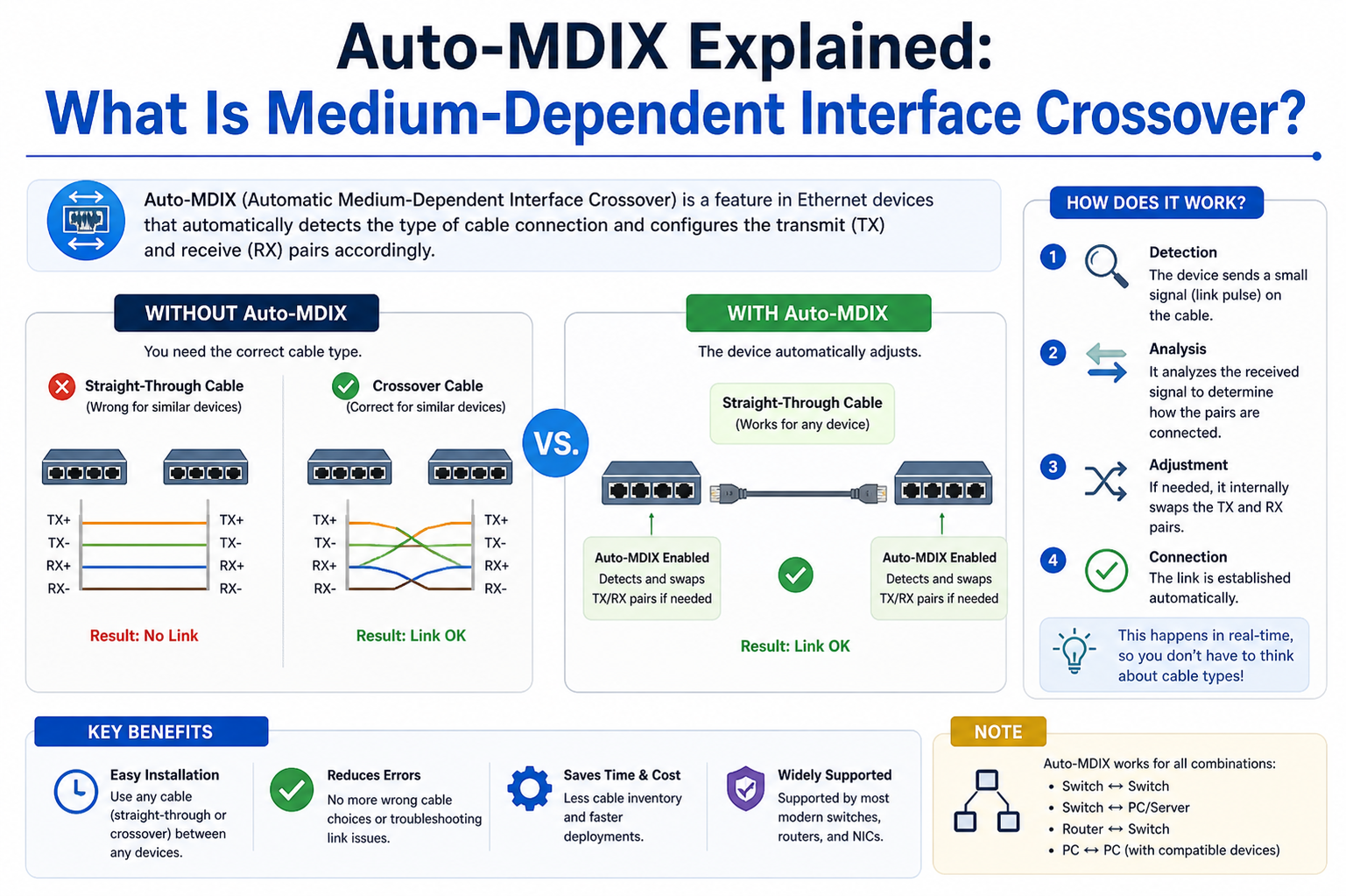
Auto-Medium-Dependent Interface Crossover (MDI-X) is a network interface capability designed to simplify how Ethernet devices connect through physical cables. It automatically recognizes the type of Ethernet cable being used—whether straight-through or crossover—and adjusts the internal transmission and reception pathways accordingly. This automation removes the traditional requirement for manually selecting specific cable types when connecting similar networking devices. The primary purpose of MDI-X is to make network setup more flexible, efficient, and less prone to configuration errors, especially in environments where multiple devices must communicate reliably without complex cabling planning.
MDI-X plays an important role in modern Ethernet networking by handling signal direction internally within the device’s port. Instead of requiring a technician to decide how transmit and receive pairs should be aligned, the system performs this detection and adjustment automatically. This capability has become a foundational feature in most contemporary network switches, routers, and network interface cards, making physical connectivity far more intuitive than in earlier networking systems.
Why Ethernet Cabling Still Matters in Modern Networks
Even though wireless communication has become widely popular in homes, offices, and mobile environments, Ethernet cabling continues to serve as the backbone of many critical network infrastructures. High-performance environments such as data centers, enterprise systems, and industrial networks still depend heavily on wired connections due to their stability, speed, and resistance to interference. Unlike wireless signals that may suffer from congestion or environmental disruption, Ethernet provides consistent and predictable performance.
In these wired systems, proper communication between devices depends not only on the cable itself but also on how the transmitting and receiving signals are arranged. This is where concepts like MDI and MDI-X become essential. Without proper handling of signal direction, two devices may fail to communicate even if the physical cable is intact. As networks grew larger and more complex, reducing dependency on manual cable selection became a priority for engineers, leading to smarter interface technologies like MDI-X.
Understanding Basic Ethernet Communication
Ethernet communication relies on pairs of wires inside a cable that carry electrical signals between devices. These wires are organized into transmit and receive pairs. For communication to work correctly, the transmitting pins on one device must align with the receiving pins on another. If this alignment is incorrect, data cannot be interpreted properly, and the connection fails.
In early networking setups, devices were designed with fixed roles for transmitting and receiving data. This meant that connecting two identical devices, such as two computers or two switches, required special handling to ensure proper signal alignment. Without automatic adjustment, network administrators had to carefully select or configure cables to match the required communication pattern. This dependency made physical setup more complicated and increased the likelihood of human error during installation.
Early Network Connection Limitations
In the early stages of Ethernet networking, physical connections were rigid and required careful planning. Devices followed a strict design where each port had a defined role as either a medium-dependent interface or a cross-connected interface. Because of this structure, direct connections between similar devices were not naturally supported using standard cables.
If two devices with the same interface type were connected using a regular cable, the transmit signals from both devices would collide instead of reaching the correct receiving pins. This made direct device-to-device communication unreliable unless additional hardware or specially designed cables were used. As networks expanded beyond small environments, this limitation became a significant challenge for scalability and efficiency.
Need for Better Device-to-Device Connectivity
As networking environments evolved, the need for simpler and more flexible device connectivity became increasingly important. Organizations began deploying larger numbers of switches, computers, and networking equipment that required frequent interconnection. Relying on strict cabling rules slowed down installation processes and increased operational complexity.
To address these issues, engineers sought a solution that would allow devices to automatically determine how to communicate without requiring manual cable selection. The goal was to eliminate dependency on specialized crossover cables and reduce the need for intermediary devices. This shift in design philosophy encouraged the development of smarter Ethernet interfaces capable of adapting to connection types dynamically.
Introduction of Crossover Concept
The concept of crossover connections emerged as a practical workaround for the limitations of early Ethernet systems. A crossover cable is designed to swap transmit and receive pairs internally, allowing two similar devices to communicate directly. This meant that instead of relying on external devices to correct signal direction, the cable itself performed the adjustment.
While this approach solved immediate connectivity issues, it introduced new challenges. Network administrators needed to maintain multiple cable types and carefully determine when each type should be used. Mistakes in cable selection could still lead to connection failures, making troubleshooting more time-consuming. Although crossover cables improved flexibility, they did not fully eliminate configuration complexity.
How MDI and MDI-X Initially Worked
Medium-Dependent Interface (MDI) and Medium-Dependent Interface Crossover (MDI-X) were introduced to define how Ethernet ports handle transmit and receive signals. MDI ports are typically used on end devices such as computers, where transmission and reception paths follow a standard layout. In contrast, MDI-X ports are commonly found on networking equipment like switches, where internal wiring reverses the signal pairs to ensure proper communication with MDI devices.
In traditional setups, connecting an MDI device to an MDI-X device required a standard straight-through cable because the internal wiring already compensated for signal alignment. However, connecting two devices of the same type required a crossover cable to correct mismatched signal paths. This distinction created a dependency on correct cable selection, which often led to configuration errors in larger networks.
Challenges with Manual Cabling Selection
One of the biggest challenges in early Ethernet networking was the need for manual identification of cable types. Network technicians had to determine whether a straight-through or crossover cable was required based on the devices being connected. This process was not only time-consuming but also prone to mistakes, especially in environments with large-scale deployments.
Incorrect cabling could result in a complete loss of connectivity, leading to troubleshooting delays and increased maintenance effort. As networks became more dynamic, with frequent additions and reconfigurations, relying on manual cable selection became increasingly inefficient. The growing complexity of network environments highlighted the need for an automated solution that could eliminate guesswork from physical connections.
Shift Toward Smarter Network Interfaces
To overcome the limitations of manual cabling, networking technology began evolving toward intelligent interfaces capable of automatic detection and adjustment. This shift led to the development of systems that could analyze incoming electrical signals and determine how to align transmit and receive pairs dynamically.
This advancement laid the foundation for Auto-MDI-X, which removes the distinction between cable types from the user’s perspective. Instead of requiring specific cabling knowledge, the network interface itself handles the necessary adjustments internally. This evolution significantly reduced configuration overhead and made Ethernet networking more accessible, scalable, and reliable in diverse environments.
Evolution Toward Auto-MDI-X Technology
As Ethernet networks continued to expand in size and complexity, the limitations of manual cabling and fixed port behavior became increasingly clear. Network engineers needed a solution that would eliminate dependency on human decision-making when selecting between straight-through and crossover cables. This demand led to the evolution of Auto-Medium-Dependent Interface Crossover (Auto-MDI-X), a technology that introduced intelligence into Ethernet port design.
Auto-MDI-X was created to automatically detect the electrical signal patterns on a connected cable and adjust the transmit (Tx) and receive (Rx) pairs accordingly. Instead of relying on predefined port roles or cable types, the system dynamically analyzes the connection and configures itself in real time. This innovation removed one of the most common sources of network setup errors and significantly simplified Ethernet deployment in both small and large environments.
How Auto-MDI-X Works Internally
At its core, Auto-MDI-X functions by continuously monitoring the electrical signals transmitted through the Ethernet cable. When a connection is established between two devices, the interface begins detecting whether the incoming signals match the expected transmit or receive orientation. If a mismatch is detected, the system automatically swaps the signal pairs internally to establish proper communication.
This process happens almost instantly and without user intervention. The device essentially “negotiates” the correct wiring configuration during the initial connection phase. Once the correct alignment is determined, the connection stabilizes, and data transmission begins normally. This intelligent adjustment eliminates the need for physical crossover cables, as the device itself performs the crossover function electronically.
Role of Signal Detection in Network Communication
Signal detection is a critical component of Auto-MDI-X functionality. Ethernet communication relies on differential signaling across twisted wire pairs, and correct alignment is necessary for accurate data interpretation. When two devices attempt to communicate, their network interfaces must ensure that transmitted signals from one device are received correctly by the other.
Auto-MDI-X simplifies this requirement by removing the dependency on fixed wiring roles. Instead of forcing one device to always transmit and the other to always receive, both devices can dynamically adjust based on detected signal patterns. This flexibility allows any two Ethernet-enabled devices to communicate directly, regardless of their original port configuration.
Comparison Between Traditional MDI/MDI-X and Auto-MDI-X
Traditional MDI and MDI-X configurations required strict adherence to port roles. MDI ports were typically used on end devices, while MDI-X ports were used on network infrastructure devices like switches. Communication between different device types worked seamlessly using straight-through cables, but identical devices required crossover cables to correct signal alignment.
Auto-MDI-X removes this distinction entirely by making every port capable of performing both roles. Instead of relying on physical cable design, the system determines the correct configuration electronically. This means that any Ethernet port can connect to any other Ethernet port without concern for device type or cable orientation. The result is a more flexible and error-resistant networking environment.
Impact on Network Design and Installation
The introduction of Auto-MDI-X had a significant impact on how networks are designed and installed. In earlier systems, careful planning was required to ensure that the correct cable types were used for each connection. This added complexity to network documentation, installation procedures, and troubleshooting processes.
With Auto-MDI-X, much of this complexity is eliminated. Network administrators no longer need to maintain separate inventories of crossover and straight-through cables for different scenarios. Instead, a single type of Ethernet cable can be used across most connections. This simplification reduces installation time, minimizes human error, and improves overall network efficiency.
Advantages in Large-Scale Network Environments
In large-scale environments such as corporate networks, data centers, and service provider infrastructures, Auto-MDI-X provides substantial operational advantages. These environments often involve hundreds or thousands of interconnected devices, where manual cable selection would be impractical and error-prone.
Auto-MDI-X ensures consistent connectivity across all devices, regardless of how they are connected. This consistency reduces the likelihood of downtime caused by cabling mistakes and allows network teams to focus more on performance optimization rather than physical troubleshooting. Additionally, it supports faster expansion and reconfiguration of network topologies without requiring extensive rewiring.
Reduction of Dependency on Crossover Cables
One of the most noticeable changes introduced by Auto-MDI-X is the reduced need for crossover cables. In traditional Ethernet setups, crossover cables were essential for connecting similar devices directly. However, maintaining and correctly using these cables added unnecessary complexity to network management.
With Auto-MDI-X enabled devices, crossover cables become largely obsolete. Since the interface itself can detect and adjust signal orientation, standard Ethernet cables can be used universally. This change simplifies inventory management and reduces the chances of using incorrect cable types during installation or maintenance.
Improvement in Plug-and-Play Networking
Auto-MDI-X significantly enhances the plug-and-play nature of modern networking equipment. Devices equipped with this feature can be connected without requiring manual configuration or specialized knowledge of Ethernet wiring standards. Once a cable is plugged in, the devices automatically negotiate the correct communication setup.
This ease of use is particularly beneficial in environments where non-specialist users may be responsible for basic network setup tasks. It reduces reliance on trained network engineers for simple physical connections and allows devices to be deployed more quickly and efficiently.
Interaction with Auto-Negotiation Processes
Auto-MDI-X often works alongside another important Ethernet feature known as auto-negotiation. While Auto-MDI-X determines the correct transmit and receive pair alignment, auto-negotiation determines link speed and duplex settings. Together, these systems ensure that two connected devices can establish an optimal communication link without manual configuration.
When a connection is initiated, both processes occur almost simultaneously. Auto-MDI-X handles the physical wiring alignment, while auto-negotiation establishes performance parameters. This combined functionality allows modern Ethernet connections to operate seamlessly across a wide range of devices and network conditions.
Reduction of Configuration Errors in Networking
One of the major benefits of Auto-MDI-X is its ability to reduce configuration errors. In traditional setups, incorrect cable selection or misconfigured ports could easily lead to connection failures. These issues often required time-consuming troubleshooting to identify and resolve.
By automating the detection and adjustment of signal paths, Auto-MDI-X eliminates a large portion of these potential errors. Even if a cable is connected incorrectly from a traditional perspective, the system compensates automatically. This reliability improves network stability and reduces downtime caused by simple physical misconfigurations.
Role in Modern Ethernet Standards
Auto-MDI-X has become a standard feature in modern Ethernet technologies. Most contemporary switches, routers, and network interface cards include built-in support for automatic crossover detection. In many cases, this feature is enabled by default, requiring no manual activation from the user.
Its widespread adoption reflects the industry’s shift toward automation and simplicity in network design. As Ethernet standards continue to evolve, features like Auto-MDI-X play a crucial role in ensuring backward compatibility while improving usability. This makes it easier for older and newer devices to coexist within the same network infrastructure.
Role of Auto-MDI-X in Modern Network Infrastructure
Auto-MDI-X has become an essential component in modern network infrastructure because it directly addresses one of the most persistent challenges in Ethernet connectivity: physical cabling complexity. In traditional networks, administrators had to carefully match cable types and port roles to ensure successful communication between devices. This often required detailed planning and technical knowledge of how each device’s interface was designed. Auto-MDI-X removes much of this burden by allowing network ports to automatically adjust their signal configuration, making device interconnection far more flexible and intuitive.
In practical terms, this means that network engineers can focus more on designing logical network architectures rather than worrying about whether a specific cable is correct for a particular connection. This shift improves efficiency during deployment and reduces the time required to bring new devices online. As a result, Auto-MDI-X has become a foundational feature in enterprise-grade networking equipment and is now expected in most modern Ethernet-enabled devices.
Simplifying Network Expansion and Scalability
One of the most significant advantages of Auto-MDI-X is its contribution to network scalability. As organizations grow, they frequently need to add new devices, reconfigure existing connections, or expand their infrastructure. In traditional Ethernet setups, each new connection could require verification of cable type and port compatibility, which slowed down expansion and introduced potential for human error.
With Auto-MDI-X, these concerns are largely eliminated. Any Ethernet port can connect to another without needing to determine whether a crossover or straight-through cable is required. This allows networks to scale more rapidly and with fewer operational constraints. It also simplifies the process of integrating new hardware into existing systems, since compatibility is handled automatically at the interface level.
Reduction of Physical Layer Complexity
The physical layer of networking is responsible for the actual transmission of electrical signals across cables. In earlier Ethernet designs, this layer required strict alignment between transmitting and receiving pins. Any mismatch in this alignment would result in communication failure, making the physical layer one of the most sensitive parts of network setup.
Auto-MDI-X reduces this complexity by introducing dynamic correction at the physical layer. Instead of requiring external adjustments through cabling, the network interface itself modifies the signal path internally. This means that the physical layer becomes more tolerant of incorrect wiring assumptions, while still maintaining reliable data transmission. The result is a more robust and error-resistant networking environment that is easier to manage and maintain.
Impact on Network Hardware Design
The introduction of Auto-MDI-X has also influenced the design of networking hardware. Manufacturers no longer need to include strict separation between MDI and MDI-X ports in most devices. Instead, many modern switches and routers are designed with universal ports that can handle any type of Ethernet connection.
This design approach simplifies manufacturing and reduces hardware complexity. It also improves device compatibility, since a single port can now support multiple connection scenarios without requiring physical modification. In many cases, this has led to more compact and cost-efficient networking equipment, as fewer specialized components are needed to handle different types of connections.
Elimination of Port Role Restrictions
In traditional Ethernet systems, ports were often assigned fixed roles depending on the type of device they were built into. For example, end devices like computers typically used MDI ports, while switches used MDI-X ports. This rigid structure meant that certain connections required specific cable types to function correctly.
Auto-MDI-X removes these restrictions by allowing each port to function dynamically. Instead of being limited to a single role, a port can automatically determine whether it needs to transmit or receive signals based on the connected device. This flexibility eliminates the need for predefined port assignments and allows for more dynamic network topologies.
Improved Flexibility in Device Interconnection
Networking environments today often involve a wide variety of devices, including computers, switches, routers, servers, and embedded systems. Each of these devices may have different interface configurations, which can complicate direct connectivity in traditional setups.
Auto-MDI-X greatly improves flexibility by ensuring that any two devices can be connected without concern for their interface type. Whether connecting two switches, two computers, or a computer and a router, the system automatically handles signal alignment. This universal compatibility simplifies network design and reduces dependency on detailed hardware knowledge during installation.
Reduction in Maintenance and Troubleshooting Effort
Maintenance and troubleshooting are important aspects of network management, and cabling issues have historically been a common source of network problems. Incorrect cable types, miswired connections, or incompatible port configurations could all lead to connectivity failures that required manual diagnosis.
Auto-MDI-X reduces the frequency of such issues by automatically correcting many common physical layer problems. When connectivity issues do occur, technicians can often rule out cabling mismatches as a cause, allowing them to focus on more advanced diagnostic areas such as configuration errors or hardware faults. This improves troubleshooting efficiency and reduces downtime in critical network environments.
Role in Enterprise and Data Center Environments
In enterprise and data center environments, where large numbers of devices must be interconnected reliably, Auto-MDI-X plays a crucial role in maintaining operational stability. These environments demand high availability and minimal disruption, making any reduction in configuration complexity highly valuable.
Auto-MDI-X supports these requirements by ensuring that physical connections are less likely to fail due to human error. It also allows for rapid reconfiguration of network topologies, which is especially important in dynamic environments where workloads and device assignments frequently change. This adaptability contributes to more resilient and efficient infrastructure management.
Interaction with Modern Ethernet Standards and Technologies
Modern Ethernet standards have increasingly incorporated features that support automation and intelligent configuration. Auto-MDI-X fits into this broader trend by complementing other technologies such as auto-negotiation and energy-efficient Ethernet.
When combined with these features, Auto-MDI-X helps create a fully automated connection process in which devices independently determine how to communicate, at what speed, and using which physical configuration. This reduces the need for manual intervention and ensures consistent performance across a wide range of network conditions and device types.
Consistency Across Mixed Device Environments
Many real-world networks consist of a mix of old and new devices, often operating with different levels of Ethernet capability. In such environments, maintaining consistent connectivity can be challenging. Auto-MDI-X helps bridge this gap by providing backward-compatible functionality that works across a wide range of hardware generations.
Even when connecting newer devices with older ones, Auto-MDI-X can often still negotiate a working connection by adjusting signal paths appropriately. This compatibility ensures that organizations do not need to immediately replace older equipment when upgrading their infrastructure, allowing for gradual modernization of network systems.
Auto-MDI-X in Plug-and-Play Networking Environments
Auto-MDI-X plays a major role in making Ethernet networks truly plug-and-play. In earlier networking setups, physically connecting two devices required prior knowledge of port types and cable categories. This made installation a technical task that often required trained personnel. With Auto-MDI-X, the process becomes significantly more straightforward because the device itself handles the configuration of transmit and receive signal paths automatically.
When a cable is connected, the interface immediately begins analyzing the electrical signals to determine how the connection should be established. If it detects a mismatch in signal orientation, it internally adjusts the configuration until proper communication is achieved. This allows users to simply plug in a cable without worrying about whether it is the correct type, greatly simplifying everyday network usage.
Automatic Correction of Cable Orientation Issues
One of the most important functions of Auto-MDI-X is its ability to correct cable orientation issues automatically. In traditional Ethernet setups, using the wrong type of cable could prevent communication entirely. For example, connecting two similar devices without a crossover cable would result in both devices attempting to transmit on the same wire pairs, causing signal collisions and connection failure.
Auto-MDI-X eliminates this problem by dynamically reassigning transmit and receive roles within the network interface. If the system detects that both devices are transmitting on the same pair, it automatically switches internal wiring logic to correct the mismatch. This ensures that data flows correctly regardless of how the cable is physically arranged.
Efficiency Improvements in Network Deployment
Network deployment becomes significantly more efficient with Auto-MDI-X enabled devices. In large installations, technicians often need to connect dozens or hundreds of devices within tight timeframes. Without automation, each connection would require careful verification of cable type and port compatibility.
With Auto-MDI-X, this step is no longer necessary. Any standard Ethernet cable can be used for virtually all connections, which speeds up installation and reduces the chance of errors. This efficiency is particularly valuable in enterprise environments, data centers, and campus networks where rapid deployment and reconfiguration are frequent requirements.
Minimizing Human Error in Physical Connections
Human error has historically been one of the most common causes of network connectivity issues. Misidentifying cable types, plugging cables into incorrect ports, or misunderstanding device roles could all lead to network downtime. Auto-MDI-X significantly reduces these risks by removing cable type dependency from the connection process.
Because the system automatically adjusts signal paths, even incorrectly chosen cables will usually still function correctly. This built-in intelligence reduces the cognitive load on technicians and ensures that small mistakes in physical setup do not escalate into larger network failures.
Improved Compatibility Across Network Devices
Modern networks often include a wide range of devices from different manufacturers and generations. Each device may have slightly different hardware implementations or interface designs. Auto-MDI-X helps unify these differences by providing a standardized method of handling physical connections.
Regardless of device type, the Ethernet interface can automatically determine how to align communication signals. This improves compatibility across heterogeneous environments and ensures that devices can communicate effectively even if they were not originally designed with identical networking assumptions.
Integration with Modern Switching Equipment
Network switches are one of the most common devices that benefit from Auto-MDI-X functionality. In traditional setups, connecting switches together required careful selection of crossover cables to ensure proper communication. With Auto-MDI-X enabled switches, this requirement is eliminated entirely.
Each port on a modern switch can independently detect and adjust its signal configuration, allowing switches to connect to other switches, routers, or end devices without manual intervention. This flexibility simplifies network topology design and reduces the complexity of inter-switch communication.
Support for Dynamic Network Topologies
Many modern networks are no longer static; they change frequently based on workload demands, user requirements, or infrastructure upgrades. Auto-MDI-X supports these dynamic environments by allowing devices to be reconnected or relocated without reconfiguring cabling.
If a device is moved from one port to another or connected to a different type of device, the interface automatically adapts to the new connection. This adaptability makes it easier to maintain flexible network architectures such as mesh networks, hierarchical designs, or hybrid topologies.
Reduced Need for Specialized Cabling Knowledge
In traditional networking environments, understanding cable types was an essential skill. Technicians needed to know when to use straight-through cables versus crossover cables and how each affected signal transmission. This knowledge requirement added complexity to training and network management.
With Auto-MDI-X, much of this specialized knowledge is no longer necessary for basic operations. Standard Ethernet cables can be used in most situations without concern for internal wiring differences. This simplification lowers the barrier to entry for network setup and allows less experienced users to perform basic installation tasks.
Consistency in Network Performance
Auto-MDI-X contributes to consistent network performance by ensuring that physical connection issues are minimized. When cables are correctly aligned automatically, data transmission becomes more stable and predictable. This consistency is important for applications that rely on continuous data flow, such as streaming services, enterprise applications, and cloud-based systems.
Although initial connection negotiation may take a brief moment, once the link is established, performance remains stable. The automatic nature of the system ensures that even in complex or changing environments, the underlying physical connections remain reliable.
Long-Term Impact on Ethernet Networking Design
Over time, Auto-MDI-X has influenced the overall direction of Ethernet networking design. The industry has increasingly moved toward automation, abstraction, and simplification of lower-layer network functions. Auto-MDI-X is a key example of this trend, as it removes manual intervention from a previously complex physical layer process.
This shift has contributed to the development of more intelligent networking devices that prioritize ease of use and adaptability. As Ethernet technology continues to evolve, features like Auto-MDI-X are expected to remain fundamental components of modern network communication systems.
Advanced Troubleshooting in Auto-MDI-X Networks
Even though Auto-MDI-X significantly reduces physical connectivity issues, troubleshooting may still be required in some network scenarios. When problems occur, they are usually not related to cable type but instead to deeper issues such as faulty hardware, incorrect configuration, or damaged cabling.
In a modern Auto-MDI-X enabled environment, the first step in troubleshooting is to confirm that both devices are powered on and functioning correctly. Since cable mismatch is no longer a common failure point, technicians can focus more on verifying link status indicators, interface configurations, and system logs. This streamlines the diagnostic process and reduces the time needed to identify the root cause of connectivity problems.
If connectivity issues persist, tools such as network analyzers or packet capture utilities may be used to examine traffic flow. These tools help determine whether data is being transmitted and where it may be getting interrupted. However, in many cases, Auto-MDI-X eliminates the need to inspect physical layer wiring as a primary cause of failure.
Performance Considerations of Auto-MDI-X
Although Auto-MDI-X is designed to operate seamlessly, there is a very brief negotiation phase that occurs when a connection is first established. During this phase, the device determines the correct transmit and receive alignment. This process typically happens within milliseconds and is usually unnoticeable in real-world usage.
Once the connection is established, there is no ongoing performance penalty. Data transmission proceeds at full speed based on the capabilities of the network interface and cable quality. In modern high-speed networks, this initial delay is negligible compared to overall transmission performance.
Auto-MDI-X is therefore considered highly efficient, as it improves usability without compromising long-term network speed or stability. It is especially effective in environments where devices frequently connect and disconnect, such as virtualized infrastructures or dynamically changing enterprise networks.
Compatibility with Legacy Ethernet Systems
One of the strengths of Auto-MDI-X is its compatibility with older Ethernet standards. Many organizations still operate hybrid networks that include both legacy and modern devices. Auto-MDI-X helps bridge the gap between these systems by automatically adapting to different interface behaviors.
Even when connected to older hardware that does not support automatic crossover detection, modern Auto-MDI-X capable devices can often still establish communication by adjusting their own internal configuration. This backward compatibility ensures that network upgrades can be performed gradually without requiring immediate replacement of all existing infrastructure.
Role in Reducing Infrastructure Costs
By eliminating the need for specialized crossover cables and reducing configuration complexity, Auto-MDI-X also contributes to lower infrastructure costs. Organizations no longer need to maintain separate inventories of different cable types for different scenarios. Instead, a single standard Ethernet cable type can be used across most installations.
This simplification reduces procurement complexity and minimizes the risk of incorrect cable usage during deployment. It also lowers training requirements for technical staff, as fewer specialized cabling rules must be learned and applied in daily operations. Over time, these small efficiencies contribute to significant cost savings in large-scale network environments.
Influence on Modern Networking Practices
Auto-MDI-X has influenced modern networking practices by shifting the focus away from physical layer configuration and toward logical network design. As physical connectivity becomes more automated, network engineers can dedicate more attention to optimizing performance, security, and scalability.
This shift aligns with broader trends in networking, where automation and abstraction are increasingly used to simplify infrastructure management. Technologies such as software-defined networking (SDN) build on this principle by further separating physical hardware from logical network control. Auto-MDI-X can be seen as an early step in this direction of intelligent network automation.
Real-World Applications of Auto-MDI-X
In real-world environments, Auto-MDI-X is widely used across many types of networks. In office environments, it allows employees to connect devices without needing technical assistance. In data centers, it simplifies the process of interconnecting servers, switches, and storage systems. In industrial environments, it improves reliability by reducing the risk of misconfigured physical connections.
Its versatility makes it suitable for nearly any Ethernet-based system. Whether in small home networks or large enterprise infrastructures, Auto-MDI-X ensures that basic connectivity remains simple, reliable, and consistent. This universality is one of the reasons it has become a standard feature in modern networking equipment.
Final Conclusion
Auto-Medium-Dependent Interface Crossover (Auto-MDI-X) is a fundamental advancement in Ethernet networking that simplifies physical connectivity by automatically detecting and adjusting transmit and receive signal paths. By removing the traditional requirement for manual selection between straight-through and crossover cables, it eliminates one of the most common sources of configuration errors in network setup.
This technology enhances plug-and-play functionality, improves compatibility across different devices, and reduces the need for specialized cabling knowledge. It also streamlines network deployment, lowers maintenance complexity, and supports scalable infrastructure growth in both small and large environments.
Through its ability to intelligently manage physical layer connections, Auto-MDI-X has transformed Ethernet networking into a more efficient, user-friendly, and reliable system. It stands as a key example of how automation in network design can reduce complexity while improving overall performance and usability.