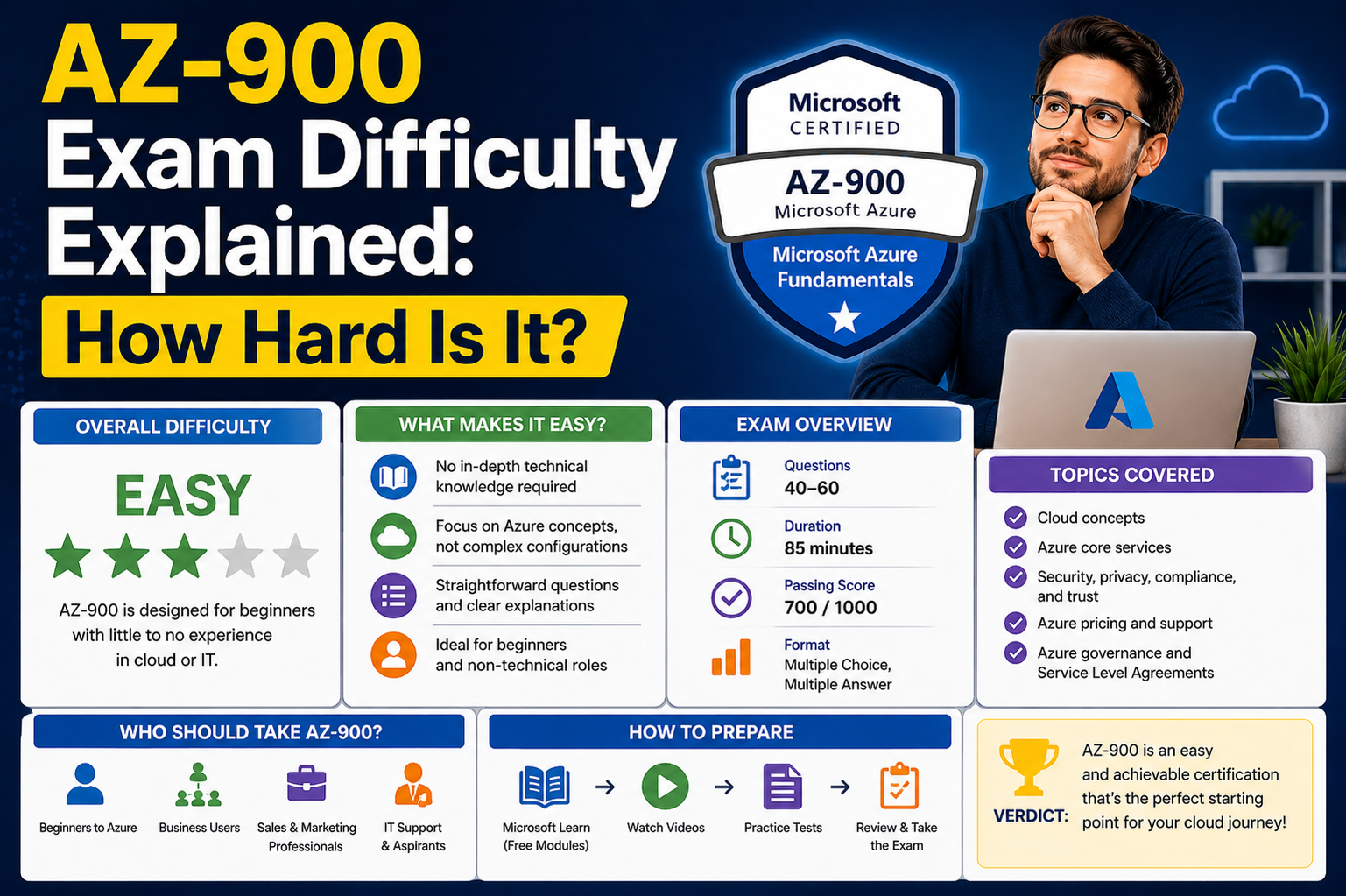
The AZ-900 exam format is designed to be straightforward in presentation but requires careful attention to detail in understanding each question. Candidates are usually given a set of multiple-choice questions, scenario-based questions, and occasionally questions that require selecting multiple correct answers. The structure is intentionally designed to test conceptual understanding rather than memorized facts.
The time limit is generally sufficient for most candidates, but only if they are comfortable with the topics. Since the questions are not overly complex in wording, the challenge comes from interpreting what is being asked correctly. Many candidates find that rushing leads to mistakes, even when they know the correct concepts. A steady pace and careful reading are essential for performing well.
The exam also includes questions that present real-world business scenarios. These scenarios are used to evaluate whether the candidate can identify the correct Azure service or cloud concept that best fits a given situation. This approach makes the exam feel more practical, even though it remains foundational in nature.
Understanding the Scoring System
The AZ-900 exam uses a scaled scoring system rather than a simple percentage-based result. This means that your final score is calculated based on the difficulty level of the questions you answer correctly, rather than just counting correct answers. The passing score is set in a way that ensures candidates have a reliable understanding of cloud fundamentals.
Because of this scoring method, two candidates may answer a similar number of questions correctly but still receive slightly different final scores depending on question difficulty. This system is designed to ensure fairness across different exam versions. It also helps maintain consistency in certification standards globally.
For candidates, the key takeaway is that focusing on understanding concepts thoroughly is more important than trying to predict exact scoring patterns. A strong conceptual foundation naturally leads to a passing score.
Common Misunderstandings About AZ-900 Difficulty
One of the most common misconceptions is that AZ-900 is so easy that no preparation is needed. While it is true that it is the most beginner-friendly Azure certification, this does not mean it is effortless. Many candidates underestimate the breadth of topics covered and assume general IT knowledge is enough.
Another misunderstanding is that the exam is purely theoretical and does not require any real understanding of cloud systems. In reality, the exam tests your ability to apply knowledge in practical situations, even if you are not configuring systems directly. Understanding how services are used in real environments is essential.
Some candidates also believe that memorizing definitions is sufficient to pass. While memorization can help with basic recall, it is not enough to handle scenario-based questions. The exam requires interpretation, reasoning, and understanding of how services relate to each other.
Role of Cloud Computing Knowledge in AZ-900
Cloud computing is the backbone of the AZ-900 certification. The exam introduces foundational concepts that are essential for anyone working in modern IT environments. These include ideas such as shared responsibility models, cloud deployment types, and service models.
Understanding cloud computing is important because most modern organizations rely on cloud infrastructure for scalability, security, and cost efficiency. The AZ-900 exam helps candidates understand why companies are moving away from traditional on-premises systems and adopting cloud solutions.
Even if a candidate does not plan to become a technical specialist, having this knowledge improves their ability to participate in technology-driven decision-making processes. It also enhances communication between technical and non-technical teams.
Understanding Azure Services at a Basic Level
One of the key parts of the exam is understanding different Azure services at a high level. These services include compute, storage, networking, and database solutions. Each category contains multiple tools designed for specific use cases.
For example, compute services focus on running applications and workloads, while storage services are used to store data in different formats. Networking services help connect resources securely, and database services manage structured and unstructured data.
The exam does not require deep configuration knowledge of these services, but it does require understanding their purpose and when they should be used. This conceptual mapping is a critical skill for answering questions correctly.
Importance of Azure Management Tools
Azure provides several management and monitoring tools that are also part of the AZ-900 syllabus. These tools help organizations control their cloud environment, monitor performance, and manage costs effectively.
Understanding these tools is important because they demonstrate how cloud environments are maintained in real-world scenarios. Concepts such as resource groups, subscriptions, and governance policies are included in this area.
Candidates are expected to understand how these tools contribute to organization, security, and efficiency within Azure environments. This helps build a complete picture of how cloud systems are managed at scale.
Security and Compliance Awareness
Security is another important aspect of the AZ-900 exam. Candidates are expected to understand basic security principles and how Azure supports secure cloud environments. This includes identity management, access control, and threat protection concepts.
Compliance is also introduced at a foundational level. Organizations must meet certain regulatory and legal standards when using cloud services, and Azure provides tools to help with this. Understanding why compliance matters is part of the exam’s broader educational goal.
While the exam does not go deep into cybersecurity techniques, it ensures that candidates understand the importance of protecting data and managing access responsibly in cloud systems.
Why AZ-900 Feels Easy for Some Candidates
For individuals already working in IT or those familiar with cloud platforms, AZ-900 often feels relatively easy. This is because many of the concepts overlap with existing knowledge. Familiarity with basic networking, storage, or virtualization makes the content easier to understand.
Additionally, candidates with prior exposure to Microsoft products or enterprise environments tend to recognize many of the ideas presented in the exam. This reduces the learning curve significantly.
However, even for experienced professionals, the challenge lies in aligning their knowledge with Microsoft’s specific terminology and service structure. Understanding how Azure categorizes and names its services is crucial.
Why Beginners May Find It Challenging
For complete beginners, AZ-900 can feel overwhelming due to the number of new terms introduced. Even though the concepts are basic, they are often completely new to learners who have never worked with cloud systems before.
The challenge is not the complexity of individual topics but the volume of information that needs to be absorbed. Learners must understand multiple service categories, definitions, and use cases within a short period of time.
Without a structured study plan, beginners may struggle to connect concepts together. This is why consistent learning and repetition are important for success.
Building Confidence Before the Exam
Confidence plays an important role in performing well in AZ-900. Many candidates know more than they realize but struggle due to uncertainty. Practicing sample questions and reviewing concepts regularly helps build familiarity with exam patterns.
As candidates become more comfortable with terminology and scenarios, their ability to answer questions improves significantly. Confidence also helps reduce mistakes caused by overthinking or misinterpretation.
The more exposure a learner has to Azure concepts, the more natural the exam becomes. This gradual familiarity is one of the key factors in passing successfully.
Importance of Concept Connections
One of the most important skills for AZ-900 is connecting different concepts together. Cloud computing is not just a collection of separate ideas but a system where services interact with each other.
For example, understanding how storage connects with compute services or how networking supports application deployment is essential. These relationships often appear in exam questions in indirect ways.
Candidates who focus on understanding these connections rather than isolated definitions tend to perform better. This deeper understanding also helps in real-world application of cloud knowledge.
Understanding of Exam Nature So Far
The AZ-900 exam is best understood as a structured introduction to cloud computing rather than a technical certification. It is designed to build awareness, not expertise, and serves as a foundation for future learning in Microsoft Azure.
Its difficulty is relative, depending on the learner’s background and preparation style. While it is accessible, it still requires attention, consistency, and conceptual understanding to pass successfully.
The exam’s true value lies in the knowledge it provides rather than just the certification itself, as it prepares learners for more advanced cloud roles and responsibilities.
How Cloud Concepts Shape the AZ-900 Exam
Cloud concepts form the backbone of the AZ-900 exam and are often the starting point for every candidate. These concepts introduce the fundamental idea of cloud computing, including why organizations move from traditional infrastructure to cloud-based systems. Understanding this section is critical because it sets the foundation for everything else in the exam.
At this level, you are expected to understand basic ideas such as scalability, elasticity, reliability, and high availability. These terms describe how cloud systems behave under different conditions, such as increased demand or system failures. The exam does not ask you to design systems, but it does require you to understand what these concepts mean in practical terms.
Another important part of cloud concepts is understanding different cloud deployment models. These include public cloud, private cloud, and hybrid cloud environments. Each model has its own advantages depending on organizational needs, security requirements, and cost considerations. Candidates must be able to distinguish between these models and understand where each is commonly used.
Understanding Shared Responsibility in Cloud Computing
One of the most important ideas introduced in AZ-900 is the shared responsibility model. This concept explains how security and management responsibilities are divided between the cloud provider and the customer.
In simple terms, the cloud provider is responsible for the infrastructure, while the customer is responsible for their data, applications, and access control. However, the exact responsibilities vary depending on the type of service being used, such as IaaS, PaaS, or SaaS.
This concept is frequently tested in scenario-based questions where candidates must identify who is responsible for a specific task. Understanding this clearly helps in answering questions correctly and avoiding confusion between different service models.
Differences Between IaaS, PaaS, and SaaS
A key part of AZ-900 preparation is understanding the differences between Infrastructure as a Service, Platform as a Service, and Software as a Service. These three models represent different levels of control and responsibility in cloud computing.
Infrastructure as a Service provides the most control, allowing users to manage operating systems, applications, and data while the provider manages the physical infrastructure. Platform as a Service removes the need to manage underlying infrastructure, allowing developers to focus on applications. Software as a Service delivers fully managed applications that users access directly.
Understanding these differences is important because many exam questions focus on selecting the correct service model for a given scenario. Candidates must be able to identify which model best fits a specific use case based on control, flexibility, and responsibility.
Azure Architecture at a Foundational Level
Azure architecture is another major area of the AZ-900 exam. This section introduces how Microsoft organizes its cloud environment globally and how resources are structured within it. It provides a high-level understanding rather than technical implementation details.
Azure is built using regions, which are geographical areas containing data centers. These regions are grouped to ensure redundancy, performance, and availability. Understanding how regions work helps explain how Azure delivers services globally.
Availability zones are also part of this architecture. They are physically separate locations within a region that help protect applications from data center failures. Candidates are expected to understand why these structures are important for reliability and disaster recovery.
Resource Organization in Azure
Azure uses a structured system to organize resources, which is an important part of the AZ-900 syllabus. Resources are grouped into resource groups, which act as containers for related services. This helps in managing, monitoring, and controlling access efficiently.
Subscriptions are another key concept. They represent a billing and management boundary within Azure. Organizations often use multiple subscriptions to separate environments such as development, testing, and production.
Understanding how resource groups and subscriptions work together helps candidates grasp how cloud environments are structured in real-world scenarios. This is often tested through practical scenario questions in the exam.
Introduction to Azure Core Services
Azure offers a wide range of core services, and the AZ-900 exam introduces these at a basic level. These services are categorized into compute, storage, networking, and databases, each serving a specific purpose in cloud environments.
Compute services are used to run applications and workloads in the cloud. Storage services allow users to store and retrieve data efficiently. Networking services manage communication between different resources, while database services handle structured and unstructured data storage.
Candidates are not required to configure these services but must understand their purpose and when to use them. This helps in answering conceptual questions effectively.
Overview of Azure Compute Services
Compute services in Azure are designed to provide processing power for applications and workloads. One of the most commonly referenced services is virtual machines, which allow users to run operating systems in the cloud.
Other compute options include containers and serverless computing, which offer more flexible and scalable solutions. These services are designed to reduce infrastructure management while improving efficiency.
Understanding when to use each compute option is important for the exam. Questions often focus on identifying the most appropriate compute solution for a given business scenario.
Azure Storage Fundamentals
Storage services in Azure are used to store different types of data, including files, blobs, and structured databases. These services are designed to be scalable, secure, and highly available.
Candidates must understand the different types of storage options and their use cases. For example, blob storage is used for unstructured data such as images or videos, while file storage is used for shared access across applications.
The exam may include questions that require identifying the correct storage solution based on a specific requirement. Understanding these distinctions is essential for success.
Networking Basics in Azure
Networking is a key part of cloud infrastructure and is included in the AZ-900 exam at a foundational level. Azure networking services allow communication between resources within the cloud and external systems.
Virtual networks are used to create isolated environments where resources can securely communicate. Load balancers distribute traffic across multiple resources to ensure performance and availability.
Understanding basic networking concepts helps candidates recognize how cloud systems remain connected and secure. This section focuses more on awareness than technical configuration.
Introduction to Identity and Access Management
Identity and access management is an important part of cloud security in Azure. It ensures that only authorized users can access specific resources within an environment.
Azure Active Directory plays a central role in managing identities and permissions. It allows organizations to control access to applications and services based on user roles.
The exam expects candidates to understand why identity management is important and how it supports secure cloud operations. This concept is often included in scenario-based questions.
Basic Understanding of Azure Pricing
Pricing is another important topic in the AZ-900 exam. Candidates are expected to understand how cloud pricing works and what factors influence cost in Azure environments.
Cloud pricing is typically based on usage, meaning users pay only for the resources they consume. This includes compute time, storage usage, and data transfer.
Understanding pricing models helps candidates identify cost-effective solutions in different scenarios. The exam may include questions about selecting services based on cost efficiency.
Azure Governance and Compliance Overview
Governance in Azure refers to the policies and controls used to manage cloud resources effectively. This includes monitoring usage, enforcing rules, and ensuring compliance with organizational standards.
Compliance ensures that cloud services meet legal and regulatory requirements. Azure provides tools that help organizations maintain compliance with industry standards.
Candidates are expected to understand why governance and compliance are important in cloud environments, even at a basic level. This ensures awareness of responsible cloud usage.
Role of Azure Monitoring Tools
Monitoring tools in Azure help organizations track performance, detect issues, and analyze system behavior. These tools provide visibility into how resources are being used.
Azure Monitor is one of the key services used for this purpose. It collects and analyzes data from different resources to provide insights into system health.
Understanding monitoring tools helps candidates recognize how cloud environments are maintained and optimized over time.
Understanding Azure Security Fundamentals in AZ-900
Security is one of the most important pillars of the AZ-900 exam, and it focuses on introducing candidates to how cloud environments are protected rather than teaching advanced cybersecurity techniques. At this level, the exam emphasizes awareness of basic security principles and how Microsoft Azure implements them across its services.
A key idea is that security in the cloud is a shared responsibility. While Microsoft secures the physical infrastructure, customers are responsible for securing their data, identities, and applications. This division of responsibility is essential for understanding how cloud systems remain protected at multiple layers.
Candidates are expected to understand basic security concepts such as encryption, authentication, and authorization. These concepts appear frequently in scenario-based questions where you must identify how a system should be secured or which Azure service helps achieve a specific security goal.
Identity Protection and Azure Active Directory Basics
Identity management plays a central role in Azure security, and Azure Active Directory is the primary service used to manage user identities and access control. It allows organizations to ensure that only authorized users can access specific resources based on assigned roles.
At the AZ-900 level, you are not expected to configure identity systems, but you must understand how identity services work conceptually. This includes knowing how users are authenticated and how permissions are assigned within an organization.
Multi-factor authentication is also introduced as an additional layer of security. It requires users to verify their identity using more than one method, making unauthorized access more difficult. Understanding why this is important is often tested in exam questions.
Role-Based Access Control Concept
Role-based access control, commonly referred to as RBAC, is another important security concept in AZ-900. It is used to manage permissions within Azure environments by assigning roles to users instead of giving direct access to resources.
This system helps organizations maintain security by limiting access based on job responsibilities. For example, an administrator may have full access, while a developer may only have access to specific resources needed for their work.
Candidates are expected to understand how RBAC improves security and simplifies management of permissions. Questions often focus on identifying appropriate access levels for different user roles in a given scenario.
Understanding Azure Compliance Standards
Compliance is an essential part of cloud computing, especially for organizations that operate in regulated industries. In AZ-900, candidates are introduced to the idea that cloud providers must follow specific legal and industry standards.
Microsoft Azure provides compliance support through certifications and frameworks that help organizations meet regulatory requirements. These standards ensure that data is handled securely and responsibly across different regions.
The exam does not require detailed knowledge of specific regulations but expects candidates to understand why compliance matters. This includes awareness of how cloud providers help organizations meet legal obligations.
Overview of Azure Cost Management Concepts
Cost management is an important topic in AZ-900 because cloud computing is based on a pay-as-you-go model. This means organizations only pay for the resources they use, which makes cost control a critical part of cloud usage.
Candidates are expected to understand the basic factors that influence cost, such as compute time, storage usage, and network traffic. These elements determine how much an organization spends on Azure services.
Azure provides tools that help monitor and manage costs effectively. These tools allow organizations to track spending and optimize resource usage to avoid unnecessary expenses. Understanding these concepts is important for scenario-based questions.
Understanding Azure Pricing Models
Azure pricing models are designed to offer flexibility based on usage and service type. In AZ-900, candidates are introduced to the idea that different services may have different pricing structures depending on how they are consumed.
For example, virtual machines are typically billed based on uptime, while storage services are billed based on the amount of data stored. This usage-based model allows organizations to scale resources according to demand.
Understanding these pricing differences helps candidates identify cost-effective solutions in real-world scenarios. The exam may include questions that ask which option provides the best value for a given situation.
Azure Service Level Agreements Overview
Service Level Agreements, commonly known as SLAs, define the level of service reliability that Microsoft guarantees for its Azure services. These agreements are an important part of understanding cloud performance expectations.
At the AZ-900 level, candidates are expected to understand what SLAs represent and why they are important. They describe uptime guarantees and help organizations measure service reliability.
While detailed calculations are not required, understanding the concept of service availability is essential. Questions may test your ability to identify which services offer higher reliability based on their architecture.
High Availability and Disaster Recovery Concepts
High availability is a key concept in cloud computing that ensures applications remain accessible even during failures. Azure achieves this through redundant systems and geographically distributed resources.
Disaster recovery focuses on restoring services after a major failure or outage. It ensures that data and applications can be recovered quickly to minimize downtime.
Candidates must understand the difference between these two concepts and how they contribute to system reliability. These ideas are often tested in scenario-based questions where system resilience is important.
Introduction to Azure Monitoring and Analytics Tools
Monitoring tools in Azure help organizations track the performance and health of their resources. These tools provide insights into how systems are operating and help identify potential issues before they become critical.
Azure Monitor is one of the primary tools used for this purpose. It collects data from different services and provides visualizations that help in analyzing system behavior.
At the AZ-900 level, candidates are expected to understand the purpose of monitoring rather than how to configure it. The focus is on awareness of how monitoring supports operational efficiency.
Understanding Automation in Azure
Automation in Azure helps reduce manual effort by allowing repetitive tasks to be performed automatically. This improves efficiency and reduces the risk of human error.
At a foundational level, candidates are introduced to the idea that automation can be used for tasks such as resource deployment, updates, and system management.
Understanding why automation is beneficial is more important than knowing how to implement it. The exam may include questions about identifying scenarios where automation is useful.
Introduction to Cloud Governance Principles
Governance in cloud computing refers to the policies and rules that control how resources are managed and used. In AZ-900, candidates learn how governance helps maintain order and compliance within cloud environments.
Governance tools in Azure allow organizations to enforce rules, manage resources, and ensure that systems follow organizational standards. This helps prevent misuse and ensures consistency across environments.
Candidates must understand how governance supports security, compliance, and cost management in cloud systems. This concept often appears in scenario-based questions.
Understanding Azure Resource Management
Resource management is an important concept in Azure that focuses on organizing and controlling cloud resources effectively. This includes grouping resources, assigning permissions, and managing lifecycle operations.
Azure Resource Manager is used to deploy and manage resources in a structured way. It ensures that resources are created, updated, and deleted in a consistent manner.
Candidates are expected to understand the purpose of resource management and how it contributes to organized cloud environments. This helps in understanding how large-scale systems are maintained.
Basic Overview of Cloud Migration Concepts
Cloud migration refers to the process of moving applications, data, and workloads from on-premises systems to the cloud. In AZ-900, this concept is introduced at a basic level to help candidates understand why organizations adopt cloud solutions.
Migration can involve different strategies depending on business needs, such as rehosting, refactoring, or replacing systems entirely. However, the exam focuses only on general awareness rather than technical execution.
Understanding why organizations migrate to the cloud helps candidates connect theoretical knowledge with real-world business decisions.
Understanding Azure Support and Service Options
Azure provides different levels of support to help organizations manage their cloud environments effectively. In AZ-900, candidates are introduced to the idea that support plans vary based on organizational needs and the level of assistance required.
Support options typically range from basic documentation access to more advanced technical assistance. The key concept is understanding that higher support levels provide faster response times and more specialized help.
Candidates are expected to recognize why organizations choose different support plans depending on their size, critical workloads, and operational requirements. This understanding helps in answering scenario-based questions related to service reliability and business continuity.
Introduction to Azure Documentation and Learning Resources
Microsoft Azure offers extensive documentation and learning resources designed to help users understand its services. These resources play an important role in helping beginners prepare for AZ-900 and build foundational knowledge.
At this level, candidates are encouraged to become familiar with where to find information rather than memorizing every detail. The ability to navigate documentation effectively is considered an important skill in cloud environments.
Understanding that cloud technologies evolve frequently, learning how to access updated information becomes more valuable than relying on static knowledge. This mindset is part of the exam’s broader learning objective.
Understanding Azure Resource Lifecycle
The resource lifecycle in Azure refers to how cloud resources are created, managed, updated, and eventually removed. This concept helps candidates understand how cloud environments are maintained over time.
Resources are typically created when needed, modified as requirements change, and deleted when they are no longer required. This dynamic approach helps organizations manage costs and maintain efficiency.
In AZ-900, candidates are expected to understand this lifecycle at a conceptual level. The exam may include questions that test awareness of when resources should be scaled or removed to optimize usage.
Introduction to Cloud Scalability Concepts
Scalability is a fundamental cloud concept that refers to the ability of a system to handle increased or decreased demand. In AZ-900, this idea is introduced to help candidates understand how cloud systems adapt to changing workloads.
There are two main types of scalability: vertical and horizontal. Vertical scalability involves increasing the power of existing resources, while horizontal scalability involves adding more resources to distribute the load.
Candidates must understand why scalability is important for modern applications, especially in environments where demand can fluctuate rapidly. This concept often appears in real-world scenario questions.
Understanding Elasticity in Cloud Environments
Elasticity is closely related to scalability but focuses more on automatic adjustment of resources based on demand. In Azure, systems can automatically increase or decrease resources depending on workload requirements.
This ensures that organizations only use what they need at any given time, helping optimize performance and cost efficiency. Elasticity is one of the key advantages of cloud computing compared to traditional infrastructure.
At the AZ-900 level, candidates are expected to understand the difference between scalability and elasticity and how both contribute to efficient cloud operations.
Overview of Azure Marketplace
The Azure Marketplace is a platform where users can find and deploy applications and services built for Azure. It provides a wide range of solutions from Microsoft and third-party providers.
This concept is introduced in AZ-900 to help candidates understand how cloud ecosystems extend beyond core services. Organizations can quickly deploy pre-built solutions instead of developing everything from scratch.
Understanding the purpose of the marketplace helps candidates recognize how businesses accelerate development and deployment using cloud-based tools and services.
Introduction to Hybrid Cloud Concepts
Hybrid cloud is an important concept in AZ-900 that describes environments combining on-premises infrastructure with cloud services. This model allows organizations to maintain some systems locally while using cloud resources for others.
This approach is often used by organizations that want to gradually transition to the cloud or maintain certain systems for compliance or security reasons. It offers flexibility and control over infrastructure.
Candidates must understand why hybrid cloud solutions are used and how they differ from fully public or private cloud environments. This is a common topic in exam scenarios.
Understanding Azure Global Infrastructure
Azure operates on a global infrastructure that includes data centers distributed across different regions worldwide. This setup ensures high availability, redundancy, and low-latency access to services.
At the AZ-900 level, candidates are expected to understand the purpose of regions and how they contribute to service delivery. Each region is designed to operate independently while being part of a larger global network.
This global structure allows organizations to deploy applications closer to their users, improving performance and reliability. It is also important for disaster recovery and compliance requirements.
Introduction to Data Residency and Sovereignty
Data residency refers to the physical or geographical location where data is stored. In cloud computing, this is an important consideration for organizations that must comply with local regulations.
Data sovereignty goes a step further by ensuring that data is subject to the laws of the country where it is stored. These concepts are important for understanding how cloud providers handle global data management.
In AZ-900, candidates are expected to understand why data location matters and how Azure supports compliance with regional laws and regulations.
Overview of Azure Pricing Calculator Concept
The Azure pricing calculator is a tool that helps organizations estimate the cost of using Azure services. It allows users to plan and forecast expenses based on selected resources and usage levels.
At the AZ-900 level, candidates are not required to perform detailed calculations but should understand the purpose of cost estimation tools. This helps organizations make informed decisions before deploying resources.
Understanding cost planning is important because cloud spending can vary depending on usage, and proper estimation helps avoid unexpected expenses.
Understanding Tags and Resource Organization
Tags in Azure are used to organize and categorize resources based on different criteria such as department, project, or environment. This helps organizations manage large numbers of resources efficiently.
By applying tags, administrators can filter, track, and manage resources more effectively. This is especially useful in large-scale environments where multiple teams are working on different projects.
In AZ-900, candidates are expected to understand the purpose of tagging and how it contributes to better resource management and cost tracking.
Introduction to Azure Policies
Azure policies are rules that help enforce organizational standards and control resource behavior. They ensure that resources comply with specific requirements set by an organization.
These policies can be used to restrict certain actions, enforce configurations, or ensure compliance with security standards. They play an important role in maintaining consistency across cloud environments.
At a foundational level, candidates should understand why policies are used and how they support governance and compliance in Azure.
Understanding Blueprints in Azure
Azure Blueprints are used to define repeatable sets of resources and policies that can be deployed consistently across environments. They help organizations maintain standard configurations.
This concept is useful for large organizations that need to deploy similar environments multiple times while ensuring compliance and consistency.
Candidates are expected to understand the purpose of blueprints at a conceptual level and how they support structured cloud deployments.
Final Thoughts
The AZ-900 exam covers a broad range of foundational topics designed to introduce candidates to cloud computing and Microsoft Azure. It focuses on awareness, understanding, and conceptual clarity rather than technical depth.
Each section of the exam builds a general understanding of how cloud systems work, how they are managed, and how organizations benefit from them. The goal is to create a strong base for future learning in more advanced Azure certifications.
By covering cloud concepts, architecture, security, pricing, governance, and support, the exam ensures that candidates develop a well-rounded understanding of cloud fundamentals.