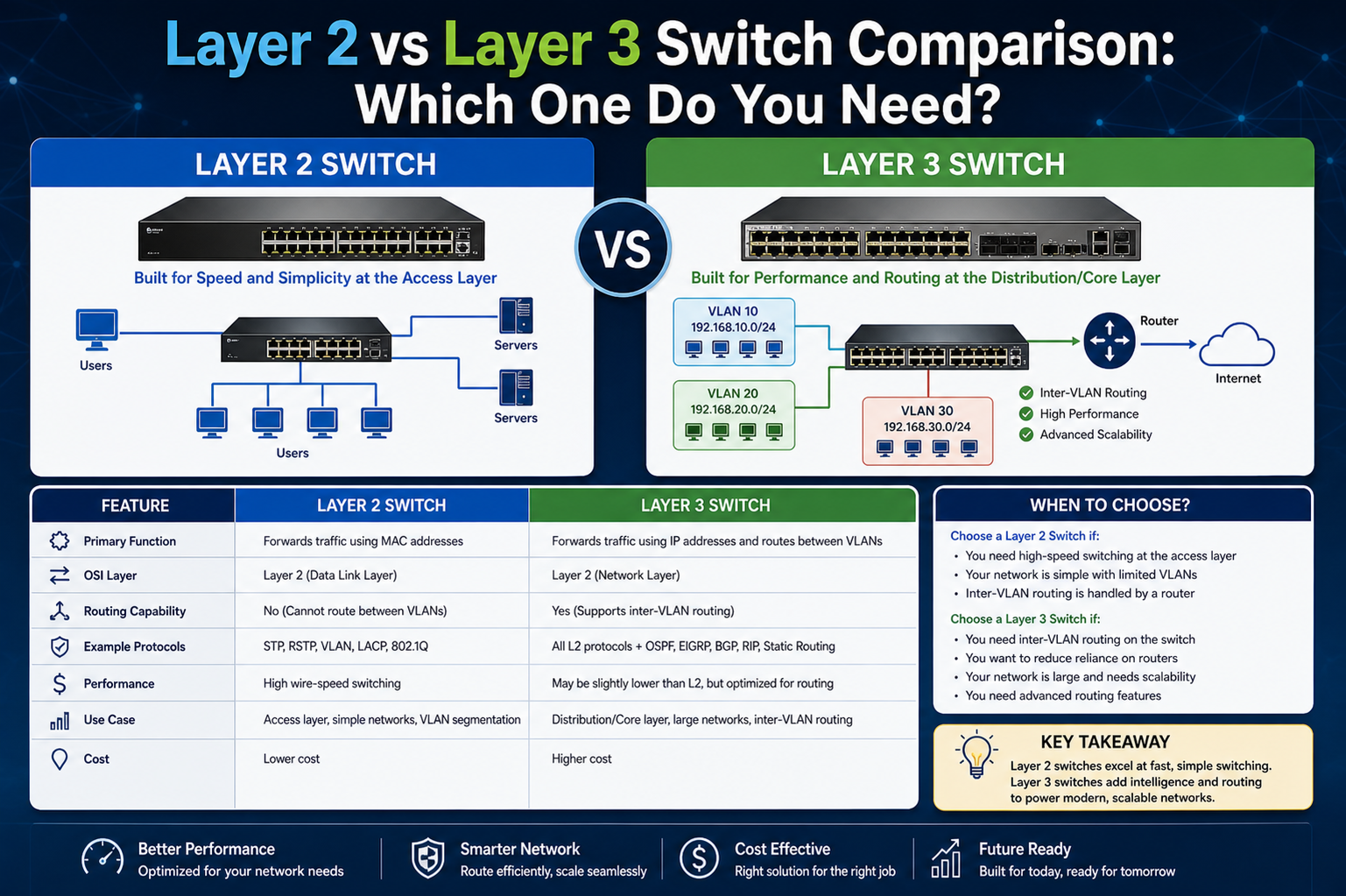
In any modern digital environment, networks serve as the foundation that allows devices to communicate, share resources, and operate efficiently. At the center of these networks are switches, which act as the connecting point between computers, servers, wireless access points, and other hardware. Without switches, building a functional local network would be nearly impossible. However, not all switches are designed the same way, and understanding their differences is essential for building an efficient and scalable network. Two primary categories dominate this space: Layer 2 switches and Layer 3 switches. Each plays a distinct role and offers unique capabilities that cater to different networking needs.
The Concept Behind Network Layers and Switching
To fully understand how switches operate, it is important to grasp the concept of network layers. Networking systems are often explained using a layered model, where each layer performs a specific function in the communication process. Switches are named based on the layer they primarily operate on. A Layer 2 switch functions at a level where devices are identified by their physical hardware addresses, while a Layer 3 switch operates at a higher level, incorporating logical addressing and routing capabilities. This distinction defines how data moves through a network and determines the complexity and functionality of the switch.
What Defines a Layer 2 Switch
A Layer 2 switch is designed to operate at the data link layer, where communication happens using hardware addresses. Every device connected to a network has a unique identifier known as a MAC address. This address allows the switch to determine where data should be sent within the local network. When a Layer 2 switch receives data, it examines the destination MAC address and forwards the information to the appropriate port. If the switch does not yet know where that address is located, it temporarily sends the data to all connected ports until the correct device responds. Over time, the switch builds a table of known addresses, making future communication faster and more efficient.
How Layer 2 Switching Handles Data Transmission
The process of handling data in a Layer 2 switch revolves around frames, which are units of data that include both payload and addressing information. When a device sends a frame, the switch reads the source address and records it in its internal memory. It then checks whether the destination address exists in its table. If it does, the switch forwards the frame directly to the correct port. If not, it broadcasts the frame across the network segment. This learning process ensures that the switch becomes more efficient over time, reducing unnecessary traffic and improving overall network performance.
The Simplicity of Layer 2 Switching
One of the most notable characteristics of Layer 2 switches is their simplicity. They are designed to provide straightforward connectivity without requiring complex configuration. In many cases, they can be deployed with minimal setup, making them ideal for environments where ease of use is a priority. This simplicity also means that troubleshooting and maintenance are relatively easy, as there are fewer features and settings to manage. For organizations that do not require advanced networking capabilities, this simplicity can be a significant advantage.
Cost Efficiency and Accessibility of Layer 2 Switches
Another major advantage of Layer 2 switches is their affordability. Because they focus on basic functionality, they are generally much less expensive than more advanced alternatives. This makes them an attractive option for small businesses, educational institutions, and home networks where budget constraints are a concern. Despite their lower cost, they still provide reliable performance for standard networking tasks, making them a practical choice for many scenarios.
Reliability in Basic Networking Environments
Layer 2 switches are highly reliable when used within their intended scope. They are particularly effective in small to medium-sized networks where all devices are part of the same subnet. In such environments, they can handle data transmission efficiently without the need for additional features like routing or traffic prioritization. Their stability and predictability make them a dependable choice for straightforward network setups, such as office workspaces, classrooms, and testing labs.
Limitations of Layer 2 Switching
While Layer 2 switches are effective for basic networking, they do have limitations. Their primary constraint is the inability to route traffic between different subnets. This means that all connected devices must be part of the same network segment, which can lead to congestion as the network grows. Additionally, they lack advanced features such as traffic prioritization and network segmentation, which are often necessary in more complex environments. These limitations highlight the need for more advanced solutions in larger or more demanding networks.
Introduction to Layer 3 Switching Capabilities
Layer 3 switches build upon the foundation of Layer 2 switching by adding routing capabilities. In addition to handling data based on MAC addresses, they can also process information using logical addresses, such as IP addresses. This allows them to direct traffic between different network segments, effectively combining the functions of a switch and a router. By integrating these capabilities into a single device, Layer 3 switches provide greater flexibility and efficiency in managing network traffic.
How Layer 3 Switches Enhance Network Functionality
The key advantage of a Layer 3 switch lies in its ability to make intelligent decisions about data routing. Instead of simply forwarding data within a single network, it can determine the best path for data to travel between multiple networks. This capability is essential for larger organizations that require communication between different departments or locations. By handling routing internally, Layer 3 switches reduce the need for separate routing devices, simplifying network architecture and improving performance.
The Role of IP Addressing in Layer 3 Switching
Unlike Layer 2 switches, which rely solely on hardware addresses, Layer 3 switches use IP addresses to identify devices and determine routing paths. This allows them to manage traffic more effectively, especially in networks with multiple subnets. By analyzing both MAC and IP information, these switches can ensure that data reaches its destination quickly and efficiently, even in complex network environments. This dual-layer functionality is what sets them apart from simpler switching solutions.
Advanced Features Introduced by Layer 3 Switches
Layer 3 switches offer a range of advanced features that go beyond basic connectivity. One of the most important is the ability to create virtual network segments, allowing administrators to divide a single physical network into multiple logical networks. This improves security and organization by isolating different types of traffic. Additionally, these switches can prioritize certain types of data, ensuring that critical applications receive the bandwidth they need to function properly. These features make Layer 3 switches a powerful tool for managing modern networks.
Performance Advantages in High-Demand Environments
In environments where large amounts of data are transmitted, performance becomes a critical factor. Layer 3 switches are designed to handle high levels of traffic with minimal delay. By processing routing decisions internally, they reduce the time it takes for data to move between different parts of the network. This results in higher throughput and lower latency, which are essential for applications such as video conferencing, online collaboration, and real-time data processing. Their ability to maintain performance under heavy loads makes them suitable for enterprise-level networks.
Scalability and Future Growth Considerations
As organizations grow, their networking needs become more complex. Layer 3 switches are built with scalability in mind, allowing networks to expand without significant redesign. They can support additional devices, new subnets, and increased traffic without compromising performance. This makes them a long-term investment for businesses that anticipate growth. By providing a flexible and adaptable solution, they help ensure that the network can evolve alongside the organization.
Balancing Complexity with Capability
While Layer 3 switches offer many advantages, they also introduce a higher level of complexity. Configuring and managing these devices requires a deeper understanding of networking concepts, including routing protocols and traffic management. This can increase the time and expertise needed for deployment and maintenance. However, for organizations that require advanced functionality, the benefits often outweigh the challenges. The key is to balance the need for features with the available resources and expertise.
The Foundation for Comparing Layer 2 and Layer 3 Switching
Understanding the core characteristics of both Layer 2 and Layer 3 switches provides a solid foundation for comparison. Each type serves a specific purpose and is suited to different environments. Layer 2 switches excel in simplicity and cost-effectiveness, making them ideal for basic networks. Layer 3 switches, on the other hand, offer advanced capabilities that support complex and high-performance environments. Recognizing these differences is essential for making informed decisions about network design and implementation.
Comparing Data Handling Approaches in Layer 2 and Layer 3 Switching
When examining how Layer 2 and Layer 3 switches differ, one of the most important aspects to consider is how they handle data as it travels across a network. Layer 2 switches focus purely on forwarding frames within a single network segment using MAC addresses. Their decision-making process is straightforward and limited to identifying which physical port a device is connected to. In contrast, Layer 3 switches take a more intelligent approach by analyzing both MAC and IP addresses. This allows them to determine not only where a device is located within a network but also how to route data between entirely different network segments. This fundamental difference in data handling significantly impacts how networks are designed and managed.
Understanding Traffic Flow Within a Single Subnet
Layer 2 switches are highly efficient when all devices exist within the same subnet. In such environments, communication is direct and uncomplicated, as all devices share the same network boundaries. The switch simply ensures that data reaches the correct destination without needing to interpret complex routing information. This makes Layer 2 switching ideal for localized communication, where speed and simplicity are more important than advanced control. However, this efficiency begins to diminish as the network grows and requires communication across multiple subnets.
Managing Communication Across Multiple Subnets
Layer 3 switches introduce the ability to handle communication between different subnets, which is a crucial requirement in larger networks. Instead of relying on an external router, a Layer 3 switch can internally direct traffic from one subnet to another. This reduces the need for additional hardware and streamlines the overall network design. By enabling inter-subnet communication, Layer 3 switches allow organizations to segment their networks while still maintaining seamless connectivity between different departments or functions.
The Role of Network Segmentation in Modern Design
As networks expand, segmentation becomes an essential strategy for maintaining organization and security. Layer 3 switches support this by enabling logical separation of network traffic. This means that devices can be grouped based on function, department, or security level, even if they share the same physical infrastructure. By controlling how traffic flows between these segments, administrators can reduce congestion, improve performance, and enhance overall network management. This capability is particularly valuable in environments where different types of data must be kept separate.
Traffic Isolation and Its Impact on Security
One of the key benefits of segmentation is improved security. By isolating traffic into different segments, Layer 3 switches help prevent unauthorized access and limit the spread of potential threats. For example, sensitive data can be kept within a restricted segment, while general network traffic remains separate. This approach reduces the risk of breaches and makes it easier to enforce security policies. Layer 2 switches, on the other hand, lack this level of control, as they treat all connected devices as part of the same network space.
Broadcast Domains and Network Efficiency
In Layer 2 networks, broadcast traffic can become a significant issue as the number of devices increases. Broadcast messages are sent to all devices within the same network segment, which can lead to unnecessary traffic and reduced performance. Layer 3 switches address this problem by dividing the network into smaller broadcast domains. Each segment operates independently, reducing the amount of broadcast traffic that each device must process. This leads to a more efficient and scalable network, especially in larger environments.
Quality of Service and Traffic Prioritization
Modern networks often support a wide range of applications, each with different performance requirements. Layer 3 switches include features that allow administrators to prioritize certain types of traffic. For instance, time-sensitive applications such as voice and video communication can be given higher priority to ensure smooth performance. This capability, often referred to as Quality of Service, is essential in environments where consistent performance is critical. Layer 2 switches typically lack this level of control, making them less suitable for networks with diverse and demanding workloads.
Handling Network Congestion and Bottlenecks
As networks grow in size and complexity, congestion can become a major challenge. Layer 3 switches are better equipped to handle this issue due to their ability to route traffic efficiently and prioritize important data. By directing traffic along optimal paths and reducing unnecessary transmissions, they help minimize bottlenecks and maintain consistent performance. Layer 2 switches, while effective in smaller environments, may struggle to manage congestion in larger networks due to their limited functionality.
Integration of Routing and Switching Functions
One of the defining characteristics of Layer 3 switches is their ability to combine routing and switching into a single device. This integration simplifies network architecture by reducing the need for separate routers. It also improves performance, as data does not need to travel between multiple devices for processing. By handling both functions internally, Layer 3 switches provide a more streamlined and efficient solution for managing complex networks.
Deployment in Enterprise and Campus Networks
Layer 3 switches are commonly used in large-scale environments such as enterprise offices, campuses, and data centers. In these settings, the ability to manage multiple subnets, prioritize traffic, and maintain high performance is essential. These switches serve as the backbone of the network, connecting different segments and ensuring smooth communication across the entire infrastructure. Their advanced capabilities make them well-suited for handling the demands of modern organizations.
Use of Layer 2 Switches in Edge Networks
While Layer 3 switches dominate in core network environments, Layer 2 switches still play an important role at the edge of the network. They are often used to connect end-user devices such as computers, printers, and access points. In these scenarios, their simplicity and cost-effectiveness make them an ideal choice. By handling local traffic efficiently, they complement the advanced capabilities of Layer 3 switches without adding unnecessary complexity.
Hybrid Network Architectures and Their Benefits
Many organizations choose to combine Layer 2 and Layer 3 switches in a hybrid architecture. In this approach, Layer 3 switches are used at the core to handle routing and advanced features, while Layer 2 switches are deployed at the edge for basic connectivity. This combination provides a balance between performance and cost, allowing organizations to take advantage of the strengths of both types of switches. It also offers flexibility, as different parts of the network can be optimized for specific needs.
Evaluating Performance Metrics Across Switch Types
Performance is a critical factor when choosing between Layer 2 and Layer 3 switches. While both types can handle data transmission effectively, Layer 3 switches are designed to support higher traffic volumes and more complex operations. They typically offer greater throughput and lower latency, making them suitable for demanding applications. Layer 2 switches, while fast in simple environments, may not provide the same level of performance under heavy loads. Understanding these differences helps in selecting the right solution for specific requirements.
The Impact of Network Design on User Experience
The choice between Layer 2 and Layer 3 switching has a direct impact on the user experience. In smaller networks, Layer 2 switches can provide fast and reliable connectivity without unnecessary complexity. However, as the network grows and supports more applications, the limitations of Layer 2 switching can become apparent. Layer 3 switches address these challenges by offering greater control and performance, ensuring that users experience consistent and efficient network access.
Balancing Cost and Functionality in Decision Making
Cost is often a deciding factor when selecting network equipment. Layer 2 switches are generally more affordable, making them attractive for organizations with limited budgets. However, the additional features and capabilities of Layer 3 switches can justify their higher cost in many cases. By reducing the need for separate routing devices and improving overall network performance, they can provide long-term value. The key is to evaluate the specific needs of the network and determine which solution offers the best balance between cost and functionality.
Key Functional Differences Between Layer 2 and Layer 3 Switching
A deeper comparison between Layer 2 and Layer 3 switches reveals that their differences extend far beyond basic operation. At the core, Layer 2 switches are focused on delivering data within a single network segment, ensuring devices can communicate efficiently using physical addressing. Layer 3 switches, however, expand this capability by introducing logical decision-making, allowing traffic to move across different segments with greater intelligence. This added functionality transforms the role of the switch from a simple connector into a more strategic component of network infrastructure.
Addressing Methods and Their Impact on Communication
One of the most defining differences lies in how each type of switch identifies devices. Layer 2 switches rely entirely on MAC addresses, which are fixed identifiers assigned to network interfaces. This makes communication straightforward but limited to a local environment. Layer 3 switches, on the other hand, incorporate IP addressing into their operations. This allows them to understand not just where a device is physically connected, but also where it exists within a broader network structure. By combining both addressing methods, Layer 3 switches enable more flexible and scalable communication.
Differences in Network Scope and Reach
Layer 2 switches are inherently limited to a single subnet, meaning all connected devices must share the same network boundaries. This works well in smaller environments but becomes restrictive as networks expand. Layer 3 switches remove this limitation by supporting multiple subnets and enabling communication between them. This expanded reach allows organizations to design more complex network topologies without sacrificing connectivity. It also supports the creation of hierarchical network structures, which are essential for managing large-scale systems.
Complexity in Configuration and Management
Another important distinction is the level of complexity involved in configuring and managing these switches. Layer 2 switches are known for their ease of use, often requiring little to no configuration to become operational. This simplicity makes them accessible even to users with limited technical expertise. In contrast, Layer 3 switches require a more in-depth understanding of networking concepts. Setting up routing, segmentation, and traffic policies involves careful planning and precise configuration. While this complexity can be challenging, it also provides greater control over how the network operates.
Cost Considerations and Investment Value
The difference in functionality between Layer 2 and Layer 3 switches is reflected in their cost. Layer 2 switches are generally more affordable, making them suitable for environments where budget is a primary concern. Layer 3 switches, with their advanced features, come at a higher price point. However, this cost can often be justified by the value they provide. By integrating routing capabilities and reducing the need for additional devices, they can streamline network infrastructure and lower long-term expenses. Evaluating the total cost of ownership is essential when making a decision.
Performance Under Varying Network Conditions
Performance is another area where the differences between these switches become evident. Layer 2 switches perform exceptionally well in simple environments with minimal traffic complexity. Their straightforward design allows for fast data transmission within a single subnet. However, as network demands increase, their limitations can lead to congestion and reduced efficiency. Layer 3 switches are built to handle more demanding conditions, offering higher throughput and better traffic management. This makes them more suitable for environments where performance is critical.
Use Cases for Layer 2 Switching
Layer 2 switches are best suited for scenarios where simplicity and cost-effectiveness are the primary concerns. They are commonly used in small offices, educational settings, and home networks, where the need for advanced features is minimal. In these environments, they provide reliable connectivity without unnecessary complexity. Their ease of deployment also makes them a practical choice for temporary setups or testing environments, where quick and straightforward installation is required.
Use Cases for Layer 3 Switching
Layer 3 switches are designed for more complex environments that require advanced functionality. They are often deployed in enterprise networks, data centers, and large campus infrastructures. In these settings, the ability to manage multiple subnets, prioritize traffic, and maintain high performance is essential. Layer 3 switches enable organizations to build robust and scalable networks that can support a wide range of applications and services. Their versatility makes them a key component in modern network design.
The Importance of Routing Capabilities
Routing is one of the most significant features that distinguishes Layer 3 switches from their Layer 2 counterparts. This capability allows data to move between different network segments, enabling communication across a broader infrastructure. Without routing, networks would be limited to isolated segments, reducing their overall effectiveness. By incorporating routing into the switch, Layer 3 devices eliminate the need for separate routers in many cases, simplifying network architecture and improving efficiency.
Traffic Control and Policy Implementation
Layer 3 switches provide advanced tools for controlling how traffic flows through the network. Administrators can define policies that determine which types of traffic are prioritized, restricted, or redirected. This level of control is essential for maintaining performance and security in complex environments. For example, critical business applications can be given priority over less important traffic, ensuring that they operate smoothly even during periods of high demand. Layer 2 switches, with their limited functionality, do not offer this level of control.
Scalability as a Critical Decision Factor
Scalability is a key consideration when designing a network, especially for organizations that expect growth. Layer 2 switches are effective in smaller environments but may struggle to accommodate expansion. As more devices are added and traffic increases, their limitations become more apparent. Layer 3 switches are designed with scalability in mind, allowing networks to grow without significant changes to the underlying infrastructure. This makes them a more future-proof solution for organizations with evolving needs.
Security Enhancements in Layer 3 Switching
Security is an increasingly important aspect of network design, and Layer 3 switches offer several advantages in this area. By enabling segmentation and traffic control, they allow administrators to isolate sensitive data and enforce security policies more effectively. This reduces the risk of unauthorized access and helps protect critical resources. While Layer 2 switches can provide basic security features, they do not offer the same level of protection as Layer 3 devices.
Balancing Simplicity and Advanced Features
Choosing between Layer 2 and Layer 3 switches often comes down to finding the right balance between simplicity and functionality. Layer 2 switches excel in environments where ease of use and cost are the primary concerns. Layer 3 switches, while more complex, provide the advanced features needed to support modern applications and large-scale networks. Understanding the specific requirements of the network is essential for making the right choice.
Designing Networks with Both Switch Types
In many cases, the best solution is not to choose one type of switch over the other, but to use both in a complementary manner. Layer 3 switches can be deployed at the core of the network to handle routing and advanced features, while Layer 2 switches are used at the edge to connect end-user devices. This approach allows organizations to optimize performance while keeping costs under control. It also provides flexibility, as different parts of the network can be tailored to specific needs.
Choosing the Right Switch Based on Network Requirements
Selecting between Layer 2 and Layer 3 switches ultimately depends on a clear understanding of your network’s specific needs. Every organization operates differently, and what works perfectly for one environment may not be suitable for another. The decision begins with evaluating the size of the network, the number of connected devices, and the type of applications being used. Smaller networks with limited communication demands often function efficiently with Layer 2 switches, while larger infrastructures that require advanced traffic management benefit significantly from Layer 3 capabilities. Taking the time to assess these factors ensures that the chosen solution aligns with both current requirements and future goals.
Evaluating Network Size and Expansion Plans
One of the most critical considerations when choosing a switch is the scale of the network and its potential for growth. A small office with a handful of devices may not need advanced routing or segmentation, making Layer 2 switches a practical and cost-effective option. However, as the network grows and additional devices are introduced, the limitations of a single subnet become more apparent. Layer 3 switches provide the flexibility to expand by supporting multiple subnets and enabling seamless communication between them. Planning for growth from the beginning can prevent costly upgrades and disruptions later on.
Understanding Routing Needs in Network Design
Routing is a fundamental requirement in many modern networks, particularly those that span multiple departments or locations. If a network requires communication between different segments, a Layer 3 switch becomes essential. It allows data to move efficiently across boundaries without relying on separate routing devices. In contrast, networks that operate within a single segment can rely on Layer 2 switches without sacrificing performance. Identifying whether routing is necessary is a key step in determining which type of switch to deploy.
Assessing Application Performance Requirements
Different applications place varying demands on a network, and these demands play a significant role in switch selection. Applications such as video conferencing, voice communication, and real-time data processing require consistent performance and low latency. Layer 3 switches are better equipped to handle these requirements due to their ability to prioritize traffic and manage bandwidth effectively. On the other hand, basic tasks such as file sharing and internet browsing can be handled efficiently by Layer 2 switches. Understanding the performance needs of your applications helps ensure a smooth and reliable user experience.
Budget Constraints and Cost Management
Budget is often a deciding factor when investing in network infrastructure. Layer 2 switches are generally more affordable, making them an attractive choice for organizations with limited financial resources. They provide reliable connectivity without the added expense of advanced features. Layer 3 switches, while more expensive, offer capabilities that can reduce the need for additional equipment and improve overall efficiency. When evaluating costs, it is important to consider not only the initial investment but also the long-term value and potential savings associated with each option.
Exploring Hybrid Network Approaches
In many cases, the most effective solution is a combination of both Layer 2 and Layer 3 switches. A hybrid approach allows organizations to leverage the strengths of each type while minimizing their weaknesses. For example, a Layer 3 switch can be used at the core of the network to handle routing and advanced features, while Layer 2 switches are deployed at the edge to provide simple and cost-effective connectivity. This design creates a balanced network that delivers high performance without unnecessary complexity or expense.
Optimizing Network Performance Through Strategic Placement
The placement of switches within a network has a direct impact on performance and efficiency. Layer 3 switches are typically positioned at the core or distribution layer, where they can manage traffic between different segments and ensure optimal data flow. Layer 2 switches are often used at the access layer, connecting end-user devices and handling local traffic. This hierarchical structure allows each type of switch to operate within its strengths, resulting in a more efficient and manageable network. Proper placement also simplifies troubleshooting and enhances overall reliability.
Addressing Security Requirements in Modern Networks
Security is a major concern for any organization, and the choice of switch can influence how effectively a network is protected. Layer 3 switches offer advanced security features that allow administrators to control traffic between different segments and enforce policies that restrict unauthorized access. By dividing the network into smaller, isolated sections, they reduce the risk of widespread breaches. While Layer 2 switches can provide basic security measures, they do not offer the same level of control and protection. For environments with sensitive data, investing in Layer 3 capabilities can significantly enhance security.
Managing Network Complexity and Administrative Overhead
As networks become more advanced, managing them can become increasingly complex. Layer 3 switches introduce additional configuration requirements, which may require skilled personnel to implement and maintain. This can increase administrative overhead but also provides greater control over network behavior. Layer 2 switches, with their simpler design, are easier to manage and require less technical expertise. Organizations must consider their available resources and expertise when deciding which type of switch to deploy, ensuring that they can effectively manage the chosen solution.
Ensuring Scalability for Future Technologies
Technology continues to evolve, and networks must be able to adapt to new demands. Layer 3 switches are better suited for environments that anticipate the adoption of advanced technologies, as they provide the flexibility and scalability needed to support growth. Whether it is integrating new applications, expanding to additional locations, or increasing the number of connected devices, Layer 3 switches offer the foundation for future development. Layer 2 switches, while effective in smaller environments, may require replacement or significant upgrades as demands increase.
Practical Scenarios for Decision Making
In practical terms, choosing the right switch often comes down to specific use cases. A small business with basic connectivity needs and a limited budget will likely benefit from Layer 2 switches. An organization that requires segmentation, routing, and performance optimization will find Layer 3 switches to be a better fit. In many situations, a combination of both provides the ideal solution, allowing different parts of the network to operate efficiently without unnecessary expense. Evaluating real-world scenarios helps clarify which option is most appropriate.
Long-Term Value and Return on Investment
When investing in network infrastructure, it is important to consider the long-term value rather than focusing solely on initial costs. Layer 3 switches may require a higher upfront investment, but their advanced features can lead to improved performance, reduced bottlenecks, and lower operational costs over time. By supporting scalability and reducing the need for additional devices, they can provide a strong return on investment. Layer 2 switches, while less expensive, may need to be replaced or supplemented as the network grows, which can increase costs in the long run.
The Strategic Role of Switches in Network Architecture
Switches are not just simple connectors; they play a strategic role in shaping the overall architecture of a network. The choice between Layer 2 and Layer 3 switches influences how data flows, how security is enforced, and how the network adapts to changing demands. By carefully selecting and deploying the right type of switch, organizations can create a robust and efficient infrastructure that supports their operations and growth. This strategic approach ensures that the network remains reliable and capable of meeting future challenges.
Final Thoughts
The decision between Layer 2 and Layer 3 switches is ultimately about balancing simplicity, cost, and capability. Layer 2 switches provide dependable performance for basic networking needs, making them ideal for smaller environments and budget-conscious setups. Layer 3 switches, with their advanced routing, segmentation, and traffic management features, are better suited for complex and high-demand networks. Many organizations achieve the best results by combining both types, using Layer 3 switches at the core and Layer 2 switches at the edge. By understanding the strengths and limitations of each, and aligning them with your network’s requirements, you can build an infrastructure that is both efficient and future-ready.